
3D Ultrasound Twins Visibility: Yes, With Limits | 2026
Yes, twins can be seen clearly on a 3D/4D ultrasound, but each baby needs a favorable viewing angle, and clear pictures of both faces together are not guaranteed. One twin can be easier to see than the other; image clarity does not establish whether either baby is healthy, and an elective session does not replace your prenatal ultrasound care.
TL;DR
3D ultrasound twins visibility depends on fetal position, fluid around each face, and an unobstructed viewing angle.
Separate pictures of each twin are a practical goal; a shared portrait is not guaranteed.
4D ultrasound shows movement but cannot reveal a face hidden behind another baby or the placenta.
The Ultrasound Concierge provides private pregnancy ultrasound services in Keller and Willow Park; medical monitoring remains separate.
Why this matters
With twins, you are hoping to recognize two babies—not simply see a pregnancy on the screen. That creates two different questions: can the scan identify each baby, and can it produce recognizable surface pictures of each face? Those are not the same task.
For your 2026 appointment, make the goal specific: ask about separate views of each twin rather than assuming both faces will appear together. The guide to how many weeks pregnant you should be for a 3D/4D ultrasound provides related planning context, but your prenatal clinician should guide decisions about imaging in your twin pregnancy.
A recognizable picture is a keepsake, not a medical clearance. You can enjoy seeing facial features while keeping questions about growth, anatomy, fluid, and placental function with your obstetric care team.
Can twins be seen clearly on a 3D/4D ultrasound?
Yes. Ultrasound can capture separate surface views of twins when the sound beam reaches each baby's face without obstructing tissue in the way. A favorable view of one twin does not guarantee the same view of the other.
The main distinction is between identifying babies during a medical examination and producing face-like surface images. Conventional ultrasound remains central to prenatal assessment; surface rendering adds a different way to display selected anatomy.
2D ultrasound
What you see: Flat cross-sectional images
Best for: Medical assessment
Main limitation: Facial features do not have the sculpted appearance of a surface image
3D ultrasound
What you see: A reconstructed volume displayed as a still image
Best for: Still surface views
Main limitation: Obstruction and movement can affect the reconstruction
4D ultrasound
What you see: Updating 3D images that show movement
Best for: Moving surface views
Main limitation: Movement does not remove an obstruction in front of a face
In dimensional terms, 2D displays two dimensions, while 3D represents three dimensions. The fourth dimension in 4D ultrasound is time: you see the reconstructed view update as the baby moves.
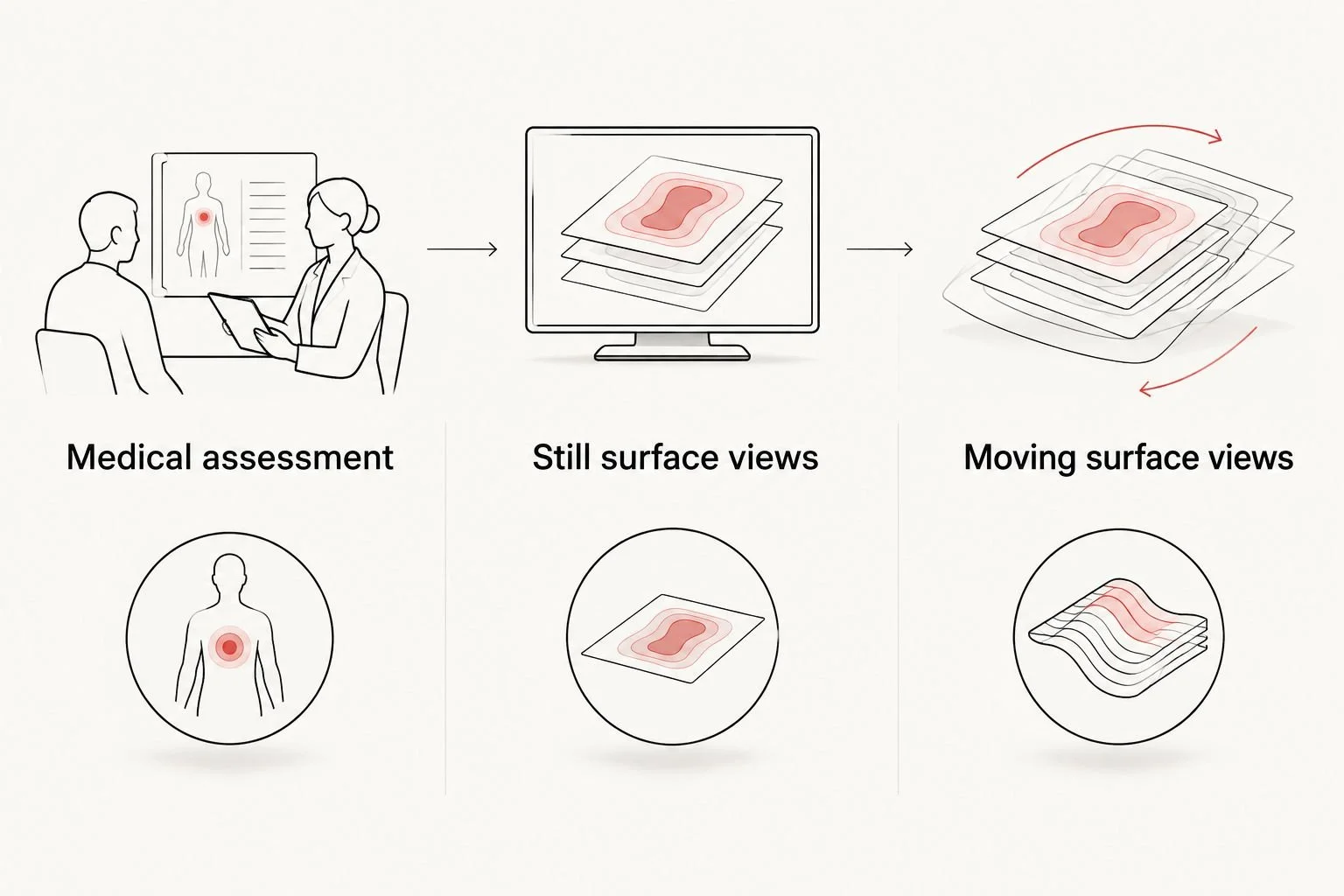
Different displays answer different questions; a moving image does not guarantee a clearer face.
Your 2026 booking question should therefore be about achievable views, not just the display format. Ask whether the appointment's purpose is medical assessment, elective imaging, or both, and what information you will receive afterward.
Seeing each twin separately
Separate images of each twin are a sensible goal. The sonographer can examine different angles rather than requiring both faces to fit into one favorable view.
Each baby has a different relationship to the placenta, uterine wall, and the other twin. One face can have fluid in front of it while the other rests against nearby tissue. That difference explains why pictures from the same appointment can look markedly different.
Ask the person performing the scan to explain which baby is being shown. If your clinical records use Twin A and Twin B, ask how the displayed views relate to those labels rather than identifying babies yourself by facial appearance.
There is also a practical limit: a saved surface image does not independently establish a baby's identity across different visits. Keep the provider's labeling with the image, and take clinical identification questions to your prenatal team.
Seeing both twins in the same picture
Both twins can appear in a shared ultrasound view, but a clear portrait of both faces requires favorable positioning for both babies at once. Two babies being visible on the screen is not the same as two unobstructed faces being visible.
A shared picture can show part of one face and a profile, limb, or body region of the other. That is still a view of the twins, even if it does not resemble the side-by-side portrait you imagined.
Do not make a shared portrait the measure of a successful appointment. Separate recognizable images can be more informative as keepsakes than a crowded frame with unclear features.
Before booking in 2026, ask what happens if only one baby's face is visible. Discuss the provider's approach and any repeat-visit policy directly; do not assume another session is included or medically appropriate.
Why 3D ultrasound twins visibility varies
The main visibility factors are physical. A different rendering style cannot reliably overcome a blocked sound path.
Fetal position: A face directed toward a usable scanning angle is easier to capture than a face turned away or tucked against nearby tissue.
Fluid around the face: A fluid space helps distinguish facial surfaces from surrounding structures. Contact with tissue makes that boundary harder to display.
The other twin: A sibling's body or limbs can obstruct the view. Each baby needs an individually useful imaging angle.
Placental position: Placental tissue between the scanning angle and the face can limit the surface view. Placement alone does not predict every image.
Movement during acquisition: Movement can interrupt a volume capture and create an incomplete or distorted rendering.
Sound transmission: Tissue between the probe and the babies affects image quality, and the sonographer must work within those imaging limitations.
These factors also explain why a baby can look different in successive images. The reconstruction depends on the information captured at that moment, not just the baby's actual facial shape.
Do not interpret a missing cheek, flattened-looking feature, or incomplete outline in a keepsake rendering as a diagnosis. Ask the sonographer to explain the image; concerns about anatomy require a diagnostic assessment by your clinical team.
When should you schedule a twin ultrasound?
There is no single appointment week that guarantees clear faces for every twin pregnancy. Gestational age matters, but the babies' positions and available viewing space matter too.
Early images and later images serve different purposes. As pregnancy progresses, facial features develop, but changing positions and closer contact with surrounding structures can complicate surface views. Choosing a date is therefore a planning decision, not a promise about the pictures.
For medical context, the American College of Obstetricians and Gynecologists describes the standard second-trimester ultrasound as generally occurring at 18–22 weeks. That range refers to a prenatal medical examination, not a guaranteed window for attractive twin keepsake images; twin pregnancies can require additional monitoring on an individualized schedule.
For a 2026 elective appointment, ask your obstetric clinician whether the visit fits your care plan. Then tell the imaging provider your gestational age, that you are carrying twins, and whether you have any specific imaging restrictions from your clinician.
Keep every recommended medical scan even if an elective image looks reassuring. A surface portrait does not supply the measurements and clinical interpretation needed for twin surveillance.
How can you prepare for clearer views?
Preparation starts with accurate information and realistic expectations. Follow the imaging provider's instructions, but do not treat a home preparation routine as a way to control fetal position.
Confirm the purpose. Establish whether you are arranging a diagnostic examination or an elective viewing session. Ask who interprets medical findings when a diagnostic examination is planned.
Share pregnancy details. Tell the provider you are carrying twins, your current gestational age, and any instructions from your prenatal clinician. Ask whether relevant records are needed.
Define the image goal. Request separate views of each baby and ask how images will be labeled. Treat a shared portrait as an additional possibility, not a requirement.
Clarify limitations. Ask how the provider handles an obstructed view and whether any change in position is appropriate during the appointment.
Follow clinical advice. Use the preparation instructions you receive. Do not change medication, fluid intake, or your care schedule to chase a clearer keepsake image.
During the visit, ask for an explanation when the view changes. Understanding whether you are seeing a profile, a partial face, or an imaging artifact is more useful than trying to interpret every shape yourself.
Avoid using sugary drinks or unusually large amounts of water as an improvised visibility strategy. Neither establishes a guaranteed view, and your own pregnancy instructions take priority over advice from social media.
Is 4D better than 3D for seeing twins?
4D is better suited to watching movement; it is not a guarantee of better facial visibility. Both formats depend on obtaining usable ultrasound information from each baby.
A moving display can make a hand movement or change in facial position easier to recognize. A still 3D image can be easier to save and examine as a single portrait. These are different uses, not proof that one format always produces a clearer result.
If one twin's face is obscured, a 4D sequence can continue to show an obscured face. Ask about the viewing conditions before choosing a session solely because its description emphasizes moving images.
Does a blurry twin picture mean something is wrong?
A blurry or incomplete 3D picture does not, by itself, establish a medical problem. Position, obstruction, movement, and reconstruction artifacts can all affect the displayed surface.
The reverse is equally important: a clear face does not establish that a twin pregnancy is progressing normally. Medical assessment requires the appropriate examination, measurements, and interpretation—not a judgment based on how pleasing the picture looks.
If you have bleeding, fluid leakage, significant pain, or a concerning change in fetal movement, contact your maternity care team promptly. Do not book an elective imaging session instead of seeking assessment for symptoms.
Is an elective twin scan a substitute for prenatal monitoring?
No. An elective 3D/4D session does not replace ultrasound examinations ordered to assess fetal anatomy, growth, fluid, or other clinical concerns in a twin pregnancy.
Ultrasound uses sound waves rather than ionizing radiation, but that does not justify unlimited exposure. The FDA discourages ultrasound performed solely to create fetal keepsake images, and professional guidance supports prudent use by appropriately trained personnel.
Discuss any additional imaging with your prenatal clinician. For 2026 planning, choose a provider who explains the examination's purpose and limitations rather than promising that more scanning will produce a particular picture.
The distinction protects you from two mistakes: mistaking an enjoyable viewing experience for medical reassurance, and extending imaging solely because a baby has not turned toward the probe. The care plan comes before the portrait.
Choosing a private setting for your appointment
The Ultrasound Concierge is best suited to patients in Keller and Willow Park seeking private, personalized pregnancy ultrasound services. The practice provides diagnostic and elective imaging, including 3D/4D services, in a concierge-style setting.
That setting addresses the experience of the visit, not the biological limits of twin visibility. The Ultrasound Concierge's pregnancy ultrasound services cannot make an obstructed face visible simply because the appointment is private.
You can review The Ultrasound Concierge and ask directly about the purpose of a twin appointment, image labeling, clinical interpretation, and what happens when views are limited. Those answers matter more than a promise of a perfect portrait.
FAQ
Can you see both twins clearly on a 3D ultrasound?
Yes, both twins can be seen clearly when each baby has a usable viewing angle and an unobstructed face. Clear separate images are possible, but equally clear images of both babies are not guaranteed.
Can twins appear together in one 4D ultrasound video?
Yes, twins can appear together in a 4D view, but both faces will not necessarily be visible. Separate views can show each baby more clearly than a shared frame.
Why is one twin clearer than the other on ultrasound?
One twin can be clearer because each baby has a different position and a different amount of unobstructed viewing space. The placenta, limbs, and the other baby can affect each view differently.
What is the best week for a 3D ultrasound with twins?
No single week guarantees clear 3D images of twins. Ask your prenatal clinician about appropriate timing, then discuss your gestational age and viewing goals with the imaging provider.
Is 4D ultrasound better than 3D for twin faces?
4D ultrasound shows movement, but it does not guarantee clearer twin faces than 3D ultrasound. Both require usable imaging angles and an unobstructed view.
Does a blurry 3D picture mean my twin has a problem?
A blurry 3D picture does not, by itself, establish a medical problem. Ask the sonographer to explain image limitations and take questions about fetal health to your prenatal care team.
Can The Ultrasound Concierge guarantee clear pictures of both twins?
Clear pictures of both twins cannot be guaranteed because fetal position and obstruction affect visibility. Discuss achievable image goals and the appointment's limitations before booking.
Do I still need my medical ultrasound after a clear 3D scan?
Yes, you still need the medical ultrasound examinations recommended by your prenatal clinician. A clear surface image does not replace assessment of anatomy, growth, fluid, or other clinical concerns.
One last thing
Ask for the baby's identity to stay attached to every saved image. A beautiful picture becomes less useful if you later cannot tell which twin it shows.
Request separate, clearly labeled views before asking for a shared portrait. That gives you a practical goal while respecting the limits of the examination.