
Can you get a 3D/4D ultrasound if you have a high BMI?
Yes—you can have a 3D/4D ultrasound with a high BMI, but increased tissue depth can reduce image clarity, and a recognizable view of your baby's face is not guaranteed. For a 2026 appointment, discuss your pregnancy stage, scan purpose, and imaging expectations with the provider rather than treating BMI as a pass-or-fail test.
TL;DR
For 3D ultrasound high BMI image quality, tissue depth matters, but BMI alone cannot predict a clear facial view.
3D and 4D ultrasound depend on usable underlying images; neither guarantees clearer pictures than standard ultrasound.
The Ultrasound Concierge offers private pregnancy ultrasound for patients in Keller and Willow Park, Texas.
Keep diagnostic prenatal scans separate from elective images, and ask your obstetric clinician about incomplete medical views.
Can you get a 3D/4D ultrasound if you have a high BMI?
A high BMI does not automatically prevent 3D or 4D imaging. Ultrasound quality depends on the path sound travels through your abdomen, the baby's position, and whether the area being pictured has a clear viewing window. BMI describes body size relative to height; it does not measure the exact tissue depth between the probe and your baby.
The Ultrasound Concierge provides private diagnostic and elective pregnancy ultrasound in the Keller and Willow Park area. Before arranging a visit, ask the provider to explain the scan's purpose and realistic image expectations for your pregnancy.
The distinction between ultrasound modes helps explain why changing the display does not remove an imaging limitation:
2D ultrasound
Best for: Standard diagnostic assessment by qualified clinicians
What it shows: A cross-sectional view in 2 dimensions
Main limitation: Tissue depth, fetal position, and other barriers can obscure structures
3D ultrasound
Best for: Viewing surface shape when an adequate volume is captured
What it shows: A reconstructed image in 3 dimensions
Main limitation: A poor underlying image can produce an incomplete or distorted surface view
4D ultrasound
Best for: Viewing movement in a volume-based image
What it shows: Moving 3D images, with time as the additional dimension
Main limitation: Movement does not overcome an obstructed view or weak signal
A pleasing surface image and a medically useful diagnostic image are different goals. A baby's face can be difficult to render even when other views are obtainable; a clear-looking facial picture also does not establish that every part of the pregnancy is healthy.
Why this matters
Searching for 3D ultrasound high BMI image quality often brings up pictures without explaining the conditions behind them. Another patient's image is not a forecast for your appointment. Your scan depends on the anatomy and positioning present during your own examination.
For your 2026 booking decision, separate the desire to see your baby's face from the need for clinical information. The U.S. Food and Drug Administration discourages ultrasound performed solely to create nonmedical keepsake images and recommends prudent use by trained professionals. Discuss an elective visit with your obstetric clinician rather than using it to replace prenatal care.
3D ultrasound: a still surface view
A 3D ultrasound reconstructs a volume of ultrasound information into a view with depth. Facial features are a familiar example, but the reconstruction needs adequate information to show the surface clearly. It cannot accurately fill in anatomy that the scan did not capture.
With greater tissue depth, more of the ultrasound signal is attenuated before returning to the probe. That can reduce the detail available for reconstruction. The relevant issue is the sound path—not whether your body meets a particular appearance or clothing size.
Best for: viewing surface shape when the underlying scan supports it. The benefit is an understandable view of contours; the limitation is that shadows, interruptions, and missing information can make those contours look irregular. Do not interpret an unusual-looking rendered face as a diagnosis.
If you see a gap, flattened feature, or blurred edge, ask the sonographer what the image can and cannot show. Reconstruction artifacts are a reason to seek an explanation, not to compare the picture against social-media photographs.
4D ultrasound: movement, not a clarity guarantee
A 4D ultrasound displays changing 3D images over time. You might see movement when the view permits it, but the moving display uses the same basic ultrasound information. It does not bypass intervening tissue or objects in front of the face.
Best for: observing movement in an obtainable volume-based view. Its benefit is the moving perspective; its limitation is that movement and reconstruction can make a difficult view harder to interpret. A moving image is not automatically a more informative medical examination.
For a 2026 visit, ask what the provider means by image quality: recognizable facial features, visible movement, or completion of diagnostic views. Those are different outcomes. Agreeing on the goal before the scan prevents a technically limited facial image from being mistaken for a failed medical assessment.
Why 3D ultrasound image quality varies with a high BMI
Several established imaging factors affect clarity. None gives you a guaranteed result before scanning, and none makes an unclear picture your fault.
Tissue depth: A longer sound path through tissue increases attenuation. The amount and distribution of abdominal tissue matter more directly than the BMI label alone.
Baby's position: A face turned away from the probe is harder to picture. Hands, feet, or the umbilical cord in front of the face can obstruct a surface view.
Fluid window: Fluid between the face and nearby structures helps separate the surface being imaged. A face pressed against surrounding tissue is more difficult to render clearly.
Pregnancy stage: Fetal development, size, and available space change throughout pregnancy. Timing affects what the sonographer can reasonably try to show.
Imaging technique: Probe position, frequency selection, and machine settings affect the balance between penetration and detail. Adjustments work within physical limits; they do not guarantee a clear face.
These factors interact. Favorable positioning does not eliminate attenuation, and a strong signal does not reveal a face hidden behind a hand. The useful question is which limitation is affecting the view during your examination.
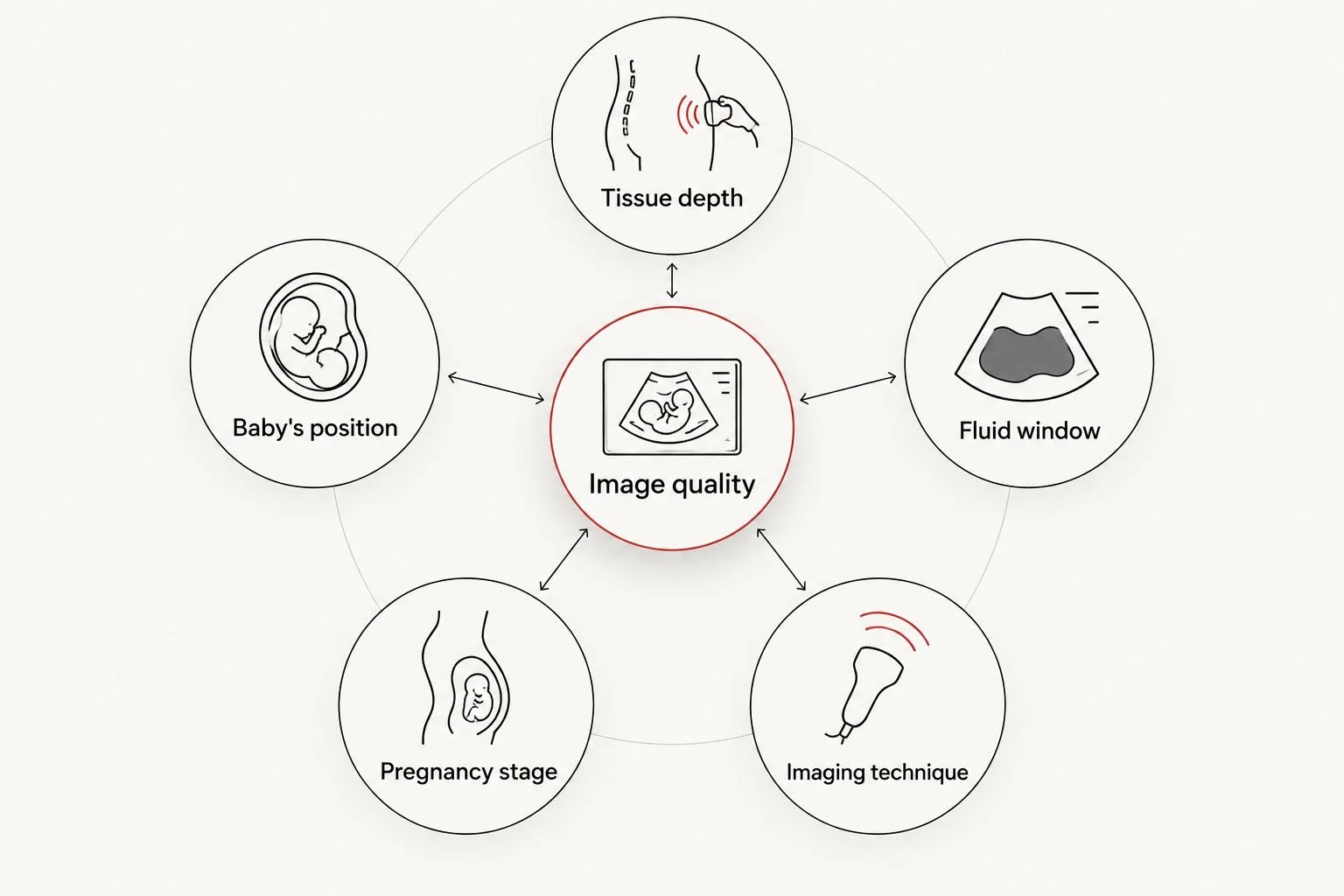
BMI alone does not describe every factor that affects your ultrasound view.
If the sonographer explains that the face is obscured by position, that is different from difficulty obtaining a strong signal through tissue. Ask for that distinction. It gives you a clearer understanding of the result without promising that a different appointment will solve it.
Is there a BMI cutoff for getting a clear 3D ultrasound?
There is no universal BMI number that guarantees or rules out a clear 3D facial image. Provider policies and individual imaging circumstances are separate questions, so ask about both before booking.
For adults, a BMI of 30 kg/m² or higher falls within the standard obesity classification. That classification is not an ultrasound image-quality threshold, and a pregnancy-related BMI discussion needs clinical context. Do not use your current pregnancy weight to set your own scan eligibility.
A provider should explain any service-specific restrictions directly. Ask whether a restriction concerns examination logistics, clinical suitability, or expectations for elective images; those explanations mean different things for your next step.
Does a blurry 3D ultrasound mean something is wrong with the baby?
A blurry 3D facial image does not, by itself, establish that something is wrong with your baby. Ultrasound artifacts and limited viewing conditions can affect a surface reconstruction without indicating an abnormality.
However, an incomplete diagnostic examination needs a clinical follow-up plan. If your obstetric clinician says a required structure was not adequately seen, ask which view is missing and what examination is recommended next. An elective picture cannot resolve that question on its own.
Will drinking more water improve a high-BMI ultrasound?
Drinking extra water does not remove abdominal tissue or guarantee a sharper 3D image. Follow the provider's preparation instructions instead of relying on a general hydration tip from social media.
Normal hydration and scan-specific bladder instructions are not the same thing. Ask whether you need a full bladder for your particular examination, and follow any fluid restrictions given by your treating clinician. Do not force excessive fluids to try to produce a better photograph.
How to prepare for a 2026 ultrasound appointment
Preparation starts with clear information, not a plan to change your body before the visit. Use these steps to make the conversation practical and keep the medical purpose visible.
Confirm the purpose. Ask whether the appointment is diagnostic, elective, or includes separately explained components. Know who will interpret any diagnostic findings.
Share pregnancy details. Tell the provider your gestational age and any relevant guidance from your obstetric clinician. Describe previous imaging difficulties without assuming the same problem will recur.
Ask about expectations. Explain whether you hope to see facial contours or movement. Ask what happens if those views cannot be obtained.
Follow preparation instructions. Confirm bladder and hydration requirements for the examination you are actually having. Do not substitute instructions from another type of scan.
Keep your prenatal plan. Attend scheduled medical imaging and follow-up visits. Ask your obstetric clinician before adding scans to address a medical concern.
You deserve a respectful conversation about body size and positioning. Ask the sonographer to explain any position change or pressure adjustment, and speak up if you are uncomfortable. Cooperation during a scan should not require tolerating unexplained discomfort.
If you are bringing relatives, discuss privacy and attendance before the appointment. The guide to bringing family to a 3D/4D ultrasound session addresses a separate planning question; guests do not change the imaging limitations.
What to ask before choosing a private ultrasound provider
The Ultrasound Concierge is best for Keller and Willow Park patients seeking private pregnancy ultrasound. Its stated service model offers a calm, personalized alternative to clinical imaging centers. That setting is relevant to your experience, but it is not evidence that a particular facial view will be obtainable.
For any provider, ask direct questions rather than looking for a promise of perfect pictures:
Does the provider distinguish diagnostic imaging from elective viewing?
Who performs the scan, and who interprets any medical findings?
How does the provider explain limited or incomplete images?
What preparation applies to your specific examination?
What should you do if the scan raises a medical question?
For a 2026 appointment, a useful answer explains both the intended benefit and the limits. Avoid treating a display label, polished example image, or comfortable room as proof of diagnostic completeness. The examination's purpose and clinical follow-up matter more than the appearance of a sample photograph.
FAQ
Can I get a 3D ultrasound if my BMI is over 30?
A BMI over 30 kg/m² does not automatically prevent 3D ultrasound, but it does not predict whether a clear facial view will be obtainable. Ask the provider about individual imaging expectations and any service-specific eligibility policy.
Is 4D ultrasound clearer than 3D ultrasound if I have a high BMI?
4D ultrasound is not automatically clearer than 3D ultrasound with a high BMI. It adds movement to a volume-based view, but both depend on adequate underlying ultrasound information.
Does high BMI always mean blurry ultrasound pictures?
High BMI does not always mean blurry ultrasound pictures. Tissue depth, fetal position, the fluid window, pregnancy stage, and imaging technique all affect the result.
Can I improve ultrasound pictures by drinking lots of water?
Drinking lots of water does not guarantee clearer ultrasound pictures or remove tissue-related attenuation. Follow the preparation instructions for your examination and any fluid guidance from your treating clinician.
Should I repeat a scan if the baby's face is hidden?
A hidden face alone is not a reason to arrange repeated scans without professional guidance. Ask whether the limitation affects an elective picture or a required diagnostic view, then follow the appropriate clinical advice.
Can a clear 3D picture replace my anatomy scan?
A clear 3D picture cannot replace a diagnostic anatomy scan. A recognizable face does not establish that all required fetal structures have been evaluated.
What should I ask The Ultrasound Concierge before booking in 2026?
Ask The Ultrasound Concierge whether the visit is diagnostic or elective, what preparation applies, and how limited views are handled. Discuss medical concerns and the need for additional imaging with your obstetric clinician.
One last thing
Ask what the image limitation means, not just whether the picture looks good. A beautiful facial rendering can coexist with an unanswered medical question, while a disappointing keepsake image can result from an ordinary positioning obstacle.
Before leaving, clarify whether any diagnostic views remain incomplete and who will arrange follow-up. If the limitation concerns only an elective facial picture, keep that distinction clear. Your body does not need to produce a photograph that matches someone else's.