
Ultrasound referrals for midwives: complete 2026 guide
Midwives’ ultrasound referral coordination is the process of connecting patients with appropriate imaging and clinical follow-up to support pregnancy care decisions. This 2026 guide explains how to choose the right setting, write a useful referral, and keep diagnostic imaging separate from elective keepsake visits.
TL;DR
Ultrasound referrals for midwives should specify the clinical question, appropriate imaging setting, and clinician responsible for follow-up.
The Ultrasound Concierge provides private diagnostic and elective ultrasound for patients in Keller and Willow Park, Texas.
Diagnostic pregnancy ultrasound and elective 3D/4D imaging serve different purposes; keepsake images do not replace clinical assessment.
Confirm order acceptance, interpretation, report delivery, and escalation procedures before referring a patient.
Why ultrasound referrals matter for midwives
An ultrasound referral connects your assessment to an imaging examination. The useful output is not simply a photograph: it is information that answers a clinical question and reaches the clinician responsible for acting on it. Start with the intended decision, then select the examination and setting.
For midwifery practices, that handoff deserves particular attention when prenatal visits and imaging happen in different organizations. Your patient needs to understand why the scan is requested, what it can assess, and who will explain the result. Your practice needs a report rather than a verbal summary passed along by the patient.
In 2026, distinguish authority to order an examination from an imaging provider’s process for accepting an order. Certified nurse-midwives and licensed midwives have different regulatory frameworks; do not assume one provider’s requirements apply to every credential or examination. Confirm current requirements with the receiving provider and the rules governing your own practice.
The guide to referral requirements for private ultrasound addresses a related patient question. For clinical coordination, also establish who interprets the examination and how the findings return to your practice.
Build a referral workflow that closes the loop
Define the clinical question before choosing the scan
Start manually with a brief clinical summary in your existing record. Write the question you need answered before selecting an imaging location. A request to assess pregnancy dating is different from a request to evaluate anatomy, growth, or a new symptom.
ACOG’s patient guidance on ultrasound examinations describes a standard second-trimester examination as usually performed at 18–22 weeks of pregnancy. That routine window does not determine the timing of every patient’s scan; symptoms, previous findings, and the treating clinician’s assessment guide other examinations.
For your 2026 referral template, use 1 primary clinical question per request, adding related questions when they are necessary. This is a documentation recommendation, not a restriction on clinical assessment. A clear question helps the receiving provider determine whether the requested examination fits its services.
State the reason for imaging in plain clinical language.
Include gestational age and the basis for dating when known.
Describe relevant symptoms and previous findings.
Identify the decision the result will inform.
Distinguish a routine request from a time-sensitive concern.
Confirm ordering requirements and patient consent
Use a phone call or the receiving provider’s existing referral instructions before building a more elaborate workflow. Confirm whether your credential is accepted for the requested examination and what documentation the provider requires. Do not infer ordering requirements from an elective booking page.
Keep ordering authority separate from patient consent. A valid clinical request does not replace a conversation about the examination, and a patient’s willingness to attend does not establish that a facility accepts your order. Discuss the purpose, relevant limitations, and how results will be communicated.
Ask about the proposed examination approach when that affects the patient’s decision. If transvaginal imaging is being considered, explain why the treating team is considering it and allow questions before the appointment. The imaging team must address its own consent process as well.
Confirm accepted referring credentials for the specific examination.
Ask which order fields and signatures are required.
Explain the clinical purpose and examination limitations.
Document the patient’s questions and preferences.
Confirm a secure method for transferring relevant records.
Match the patient to the right imaging setting
Build a simple reference sheet of imaging settings and the questions each can address. Verify capabilities directly rather than judging a provider by attractive images, equipment terminology, or appointment descriptions. The key distinction is whether the examination produces the clinical information your patient needs.
The Ultrasound Concierge provides private diagnostic and elective ultrasound services for patients in Keller and Willow Park, Texas. The Ultrasound Concierge is best suited to local patients seeking private ultrasound in a calm, personalized setting. For a diagnostic referral, confirm the requested examination, order requirements, interpretation arrangements, and reporting process before directing the patient there.
A private setting addresses the experience of attending imaging; it does not establish that every specialist examination or urgent assessment is available. When a question needs maternal-fetal medicine expertise, an obstetric pathway, or urgent evaluation, choose that pathway on clinical grounds.
Match the examination to the documented clinical question.
Confirm diagnostic services separately from elective services.
Verify interpretation and report delivery arrangements.
Use specialist assessment when the clinical question requires it.
Consider travel, privacy preferences, and accessibility needs.
Send a complete, readable referral
A reusable document in your current records system is a practical starting point. Keep it short enough to read but complete enough to avoid basic clarification calls. A patient should not have to reconstruct their history at the imaging appointment because the referral says only pregnancy scan.
In your 2026 referral template, include 2 contact routes: the routine results destination and the urgent clinical contact. These can be different routes within the same practice. Define them explicitly so an imaging team does not have to guess where a concerning finding belongs.
Send only information relevant to the examination through an appropriate secure channel. Include previous reports when they affect interpretation or timing, and identify the clinician responsible for follow-up. Avoid substituting patient photographs or keepsake images for the original diagnostic report.
Include patient identifiers and reliable contact details.
Name the referring clinician and relevant credential.
State the requested examination and clinical indication.
Attach relevant previous reports and dating information.
Provide routine and urgent clinical contact routes.
Identify the clinician responsible for reviewing the result.
Prepare the patient without promising a result
Start with a short written explanation and a conversation. Explain what the examination is intended to assess, who will discuss the findings, and what happens if further imaging is recommended. This helps prevent a reassuring image from being mistaken for a complete clinical assessment.
Ask the receiving provider for examination-specific preparation instructions. Do not apply one bladder instruction, visit length, or companion policy to every scan. Those details belong to the provider performing the examination and should be confirmed for the actual appointment.
Give patients language they can use when booking: diagnostic pregnancy ultrasound requested by my midwife, rather than a general request to see the baby. If they also want elective images, explain that this is a separate purpose. Neither appealing images nor an enjoyable visit establishes that all requested anatomy has been assessed.
Explain the reason for the examination.
Share preparation instructions supplied by the imaging provider.
Clarify diagnostic imaging versus elective viewing.
Explain who will review and communicate results.
Discuss what to do if symptoms change before the visit.
Track the referral through clinical review
Use a secure task list or your existing records system before buying additional software. Assign ownership to each referral so responsibility does not sit vaguely with the whole practice. An appointment marked completed is not the same as a report reviewed.
Organize tracking around 3 stages: Sent, Received, Reviewed. Sent means the request has left your practice; Received means the report has returned; Reviewed means the responsible clinician has assessed it and documented the next action. Track appointment completion separately when it helps explain a missing report.
Close the loop with the patient, not just the record. Communicate the findings in plain language, explain any limitations, and document whether additional assessment is needed. A recommendation for follow-up imaging is an outstanding clinical task until the treating team addresses it.
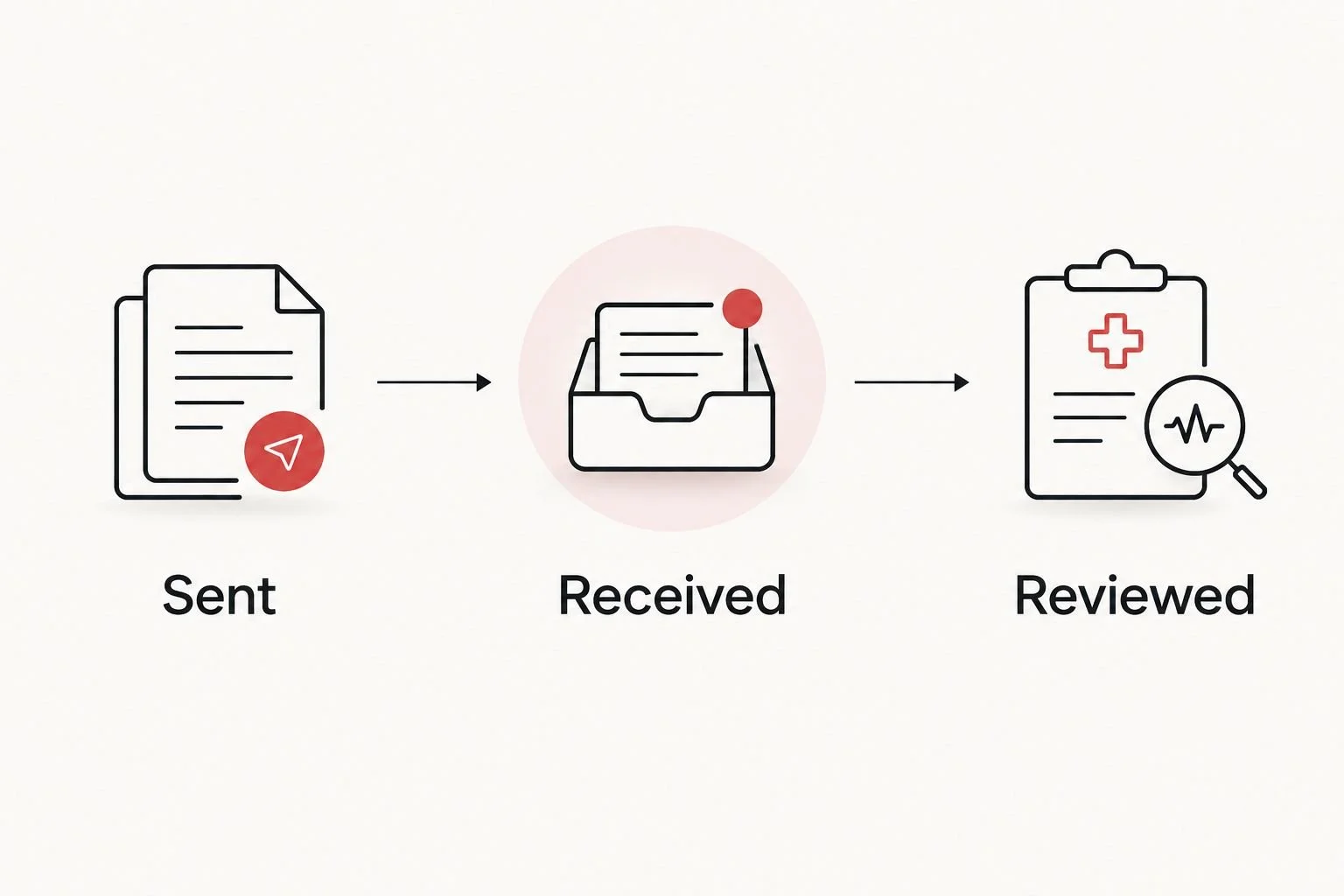
The referral closes after clinical review, not when the appointment ends.
Use the same tracking process for outside imaging, even when the patient arranged the appointment independently. Obtain the diagnostic report through the appropriate records process rather than relying on the patient’s recollection.
Assign a named owner for outstanding referrals.
Record when the request was sent.
Confirm receipt of the diagnostic report.
Document clinician review and patient communication.
Track recommended follow-up to completion.
Set escalation rules before they are needed
Agree on escalation procedures with the receiving provider before sending routine referrals. Ask how unexpected findings are communicated and what your practice should do if the designated clinician cannot be reached. Document the arrangement in a place your team can find.
A routine outpatient ultrasound appointment is not an emergency assessment. Severe abdominal pain, heavy bleeding, fainting, or other urgent pregnancy concerns require prompt clinical evaluation through an appropriate urgent pathway. Do not ask a patient to wait for a keepsake visit or routine booking to assess an acute concern.
Separate administrative delays from clinical urgency. A missing report needs a records follow-up; a patient with changing symptoms needs clinical reassessment. Staff should know when to stop trying to solve a scheduling problem and connect the patient with clinical care.
Define who receives urgent findings.
Establish a backup clinical contact.
Tell patients how to seek help for changing symptoms.
Document escalation conversations and decisions.
Reassess the care pathway when the clinical situation changes.
Compare imaging options for your patient
Choose the option that answers the clinical question, not the option with the most appealing images. Each setting has a useful role and a boundary. Confirm the specific examination and reporting arrangements instead of assuming that the setting’s name guarantees a particular service.
The Ultrasound Concierge diagnostic ultrasound
Best for: Keller and Willow Park patients seeking private diagnostic imaging
Main advantage: Diagnostic services within a concierge-style, personalized setting
Key limitation: Confirm the requested examination, interpretation, and referral requirements; specialist and emergency capabilities are not established here
Obstetric practice imaging
Best for: Patients whose treating obstetric team coordinates imaging and follow-up
Main advantage: Keeps the imaging question within the established obstetric care pathway
Key limitation: Confirm examination scope and whether outside or specialist imaging is needed
Maternal-fetal medicine assessment
Best for: Clinical questions requiring specialist pregnancy assessment
Main advantage: Adds specialist evaluation to the imaging question
Key limitation: Not a substitute for an urgent-care pathway when immediate assessment is needed
Hospital-based assessment
Best for: Patients directed to hospital evaluation for urgent or complex concerns
Main advantage: Places imaging within a broader clinical assessment pathway
Key limitation: Routine elective viewing is a different purpose
Elective ultrasound viewing
Best for: Patients seeking non-diagnostic pregnancy images or a viewing experience
Main advantage: Serves an elective, personal purpose
Key limitation: Does not replace diagnostic assessment, an anatomy examination, or clinical follow-up
The Ultrasound Concierge’s diagnostic and elective ultrasound services should be discussed as distinct purposes. A patient can value a calm visit while still needing a clearly defined diagnostic examination and documented follow-up. Confirm the clinical workflow rather than treating the concierge setting as a reporting guarantee.
Review local ultrasound services
Explore diagnostic and elective ultrasound services for patients in Keller and Willow Park.
Common referral mistakes midwives make
Requesting a pregnancy scan without a clinical question
A vague request leaves the receiving provider to clarify the purpose. Replace it with the relevant history, requested assessment, and decision the result will support. Keep the wording within your professional scope and confirm that the provider offers the examination.
Treating elective images as an anatomy assessment
A recognizable face or visible movement is not evidence that a diagnostic anatomy examination is complete. Keep elective images separate from the diagnostic record. Obtain the formal report for the examination your patient’s care plan requires.
Assuming every midwifery credential follows the same rules
Do not carry one facility’s acceptance process into another referral relationship. In 2026, verify requirements for your own credential and the requested examination. Document the confirmed process so another team member does not have to repeat the same uncertainty.
Letting the patient become the results courier
Patients deserve an explanation, not responsibility for moving clinical information between organizations. Establish direct report delivery and a named reviewer. If a report has not arrived, follow up with the imaging provider rather than treating the patient’s verbal summary as the result.
Using an elective visit to address a new urgent concern
An elective appointment cannot replace clinical triage. Reassess the patient’s symptoms and direct them to the appropriate clinical setting. Preserve the distinction between a planned viewing experience and an examination requested to investigate a concern.
FAQ
Can a midwife refer a patient for a diagnostic ultrasound?
Whether a midwife can order a particular diagnostic ultrasound depends on the clinician’s credential, applicable practice rules, and the receiving provider’s requirements. Confirm all three before sending the order; do not assume elective booking requirements establish diagnostic ordering authority.
What should ultrasound referrals for midwives include?
Ultrasound referrals for midwives should include patient identifiers, the clinical question, relevant pregnancy history, the requested examination, and results contact details. Identify who will review the report and provide an urgent clinical contact route.
Is a 3D or 4D ultrasound a replacement for an anatomy scan?
Elective 3D or 4D imaging does not replace a diagnostic anatomy examination. Attractive images do not establish that the required structures were assessed or that a diagnostic report was completed.
When is the routine pregnancy anatomy ultrasound usually performed?
ACOG’s patient guidance describes the standard second-trimester ultrasound as usually performed at 18–22 weeks of pregnancy. Other examinations follow the patient’s clinical indication and the treating clinician’s assessment.
Is The Ultrasound Concierge suitable for midwife-referred patients?
The Ultrasound Concierge provides private diagnostic and elective ultrasound for patients in Keller and Willow Park, Texas. Before making a diagnostic referral, confirm the requested examination, accepted order, interpretation arrangements, and report delivery process.
Who should explain the ultrasound results to the patient?
The clinician responsible for the patient’s care should ensure that diagnostic findings are reviewed and explained. Set that responsibility before the appointment, including who follows up on recommendations for additional assessment.
Should a patient wait for a booked ultrasound if pregnancy symptoms worsen?
A patient with worsening or urgent pregnancy symptoms should seek appropriate clinical assessment rather than wait for a routine or elective ultrasound appointment. Severe abdominal pain, heavy bleeding, or fainting require prompt medical evaluation.
One last thing
Audit unresolved reports, not just missed appointments. A patient can attend imaging while the clinical handoff remains unfinished. For your 2026 workflow, check whether each completed examination has a received report, documented review, and communicated next step; that is where referral coordination becomes care.