
Best early gender blood tests compared in 2026
Best for private local support: SneakPeek through The Ultrasound Concierge. Best for home collection: an at-home SneakPeek test. Best for prenatal chromosome screening: clinician-ordered NIPT. This 2026 early gender blood test comparison explains which route matches your goal—and why an elective fetal-sex result is not a medical screening result.
TL;DR
The Ultrasound Concierge offers SneakPeek Gender Tests for patients seeking private local support in Keller and Willow Park.
Choose an early gender blood test for fetal-sex information, not reassurance about your baby's health.
At-home SneakPeek suits self-collection; follow the manufacturer's current timing and sample instructions.
Choose clinician-ordered NIPT when your goal includes prenatal chromosome screening.
Why this matters
An early gender blood test and noninvasive prenatal testing, or NIPT, can both report fetal-sex information. They answer different questions. Choosing between them starts with whether you want an elective result or a conversation about prenatal screening.
These blood tests analyze DNA in a pregnant person's blood. Pregnancy-associated cell-free DNA comes largely from the placenta; laboratories use particular DNA signals to produce their reports. A fetal-sex test does not show your baby, confirm a heartbeat, or assess development.
The term gender test is common in consumer searches, but these tests estimate fetal sex rather than future gender identity. That distinction keeps the result in perspective without taking away the excitement of learning something about your pregnancy.
For 2026, choose the test by its purpose—not by the most confident advertising claim. If you have a medical concern, your prenatal clinician is the right starting point.
What makes the best early gender blood test?
Use these criteria before comparing providers or ordering a kit:
Purpose: Does the test report fetal sex only, or screen for chromosome conditions as well?
Timing: Does your pregnancy meet the specific test's gestational-age requirement?
Collection: Will you collect the sample yourself or arrange collection through a provider?
Interpretation: Who explains an inconclusive, unexpected, or conflicting result?
Pregnancy context: Do twins, a vanishing twin, or other clinical circumstances affect interpretation?
Privacy: Can you control who receives the result and whether fetal sex appears in a medical report?
Accuracy matters, but a percentage without context is not enough. Look for what was studied, when samples were collected, which pregnancies were included, and how inconclusive samples were handled. Collection instructions are part of the test, not an optional extra.
For an elective test, ask what happens if the sample cannot be analyzed. For NIPT, ask what the screening covers and how your clinician handles a positive or no-result report. Those questions tell you more than a promise of an exciting reveal.
Early gender blood tests at a glance
This comparison ranks testing routes by use case, not by an unsupported claim that one laboratory outperforms another. SneakPeek appears in both provider-supported and home-collection routes because the collection setting is a meaningful choice.
SneakPeek through The Ultrasound Concierge
Best for: Private local support
Standout feature: An elective testing option from a concierge imaging provider serving Keller and Willow Park
Key limitation: Does not replace prenatal screening; confirm collection arrangements before booking
Best for: Home collection
Standout feature: Self-collection outside a provider visit
Key limitation: You are responsible for following collection and handling instructions
Clinician-ordered NIPT
Best for: Prenatal screening
Standout feature: Screens for specified chromosome conditions and can include fetal-sex information
Key limitation: A screening result is not a diagnosis; reporting varies by laboratory
The right route depends on what you need from the result. A private visit addresses the setting, home collection addresses convenience, and NIPT addresses a medical screening decision. None answers every pregnancy question.
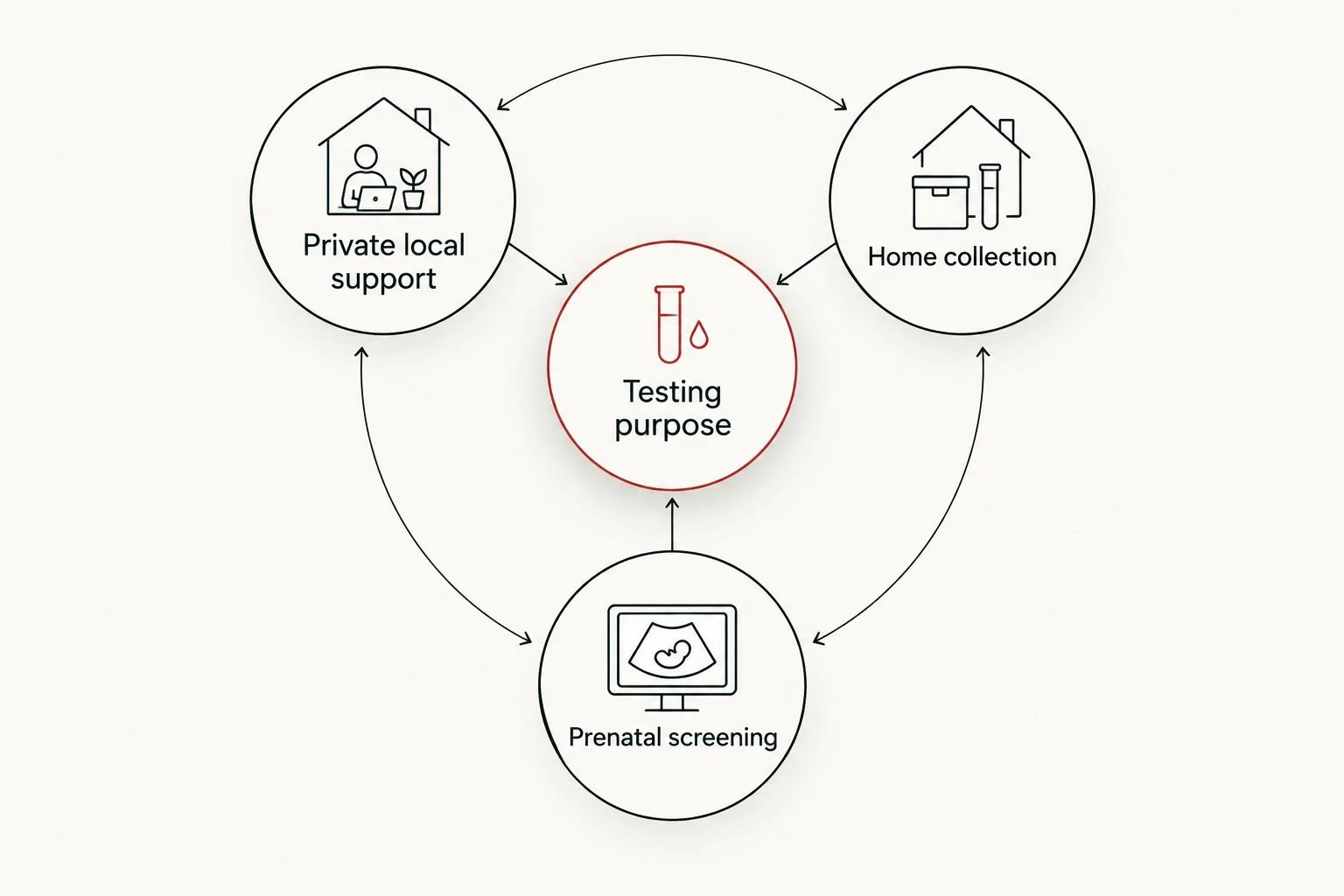
Choose the testing purpose before choosing the collection setting.
1. Provider-supported SneakPeek: best for private local support
The Ultrasound Concierge offers SneakPeek Gender Tests alongside diagnostic and elective ultrasound services for patients in Keller and Willow Park, Texas. Its stated setting is calm, private, and personalized. This route fits readers who want to discuss an elective testing visit with a local provider rather than manage the entire process independently.
The Ultrasound Concierge is best for patients in Keller and Willow Park seeking an early gender blood test in a private, personalized setting. Confirm how sample collection works, what preparation applies, and how results reach you before arranging your visit.
Provider-supported SneakPeek pros
Offers a local point of contact for questions about the testing visit.
Matches a preference for a private, personalized setting.
Gives you a provider to ask about preparation and result delivery.
Provider-supported SneakPeek cons
An elective fetal-sex result does not screen for chromosome conditions.
A provider visit requires coordination that home collection avoids.
The provider's setting does not remove the test's timing or interpretation limits.
Best for: Patients who prioritize a local, private setting for elective testing.
Before booking in 2026, separate the blood-test appointment from any ultrasound you are considering. Ask what each service answers and whether either requires preparation. Do not assume a blood-test result confirms pregnancy location, viability, or development.
Verdict: Buy this route for private local support—not as a substitute for prenatal care.
2. At-home SneakPeek: best for self-directed collection
At-home SneakPeek lets you collect a sample outside a provider visit and submit it for laboratory analysis. It suits someone comfortable reading instructions, preparing the collection area, and completing the required handling steps. The appeal is control over the collection setting, not a different medical purpose.
SneakPeek's manufacturer describes testing from 6 weeks of pregnancy. That is a product eligibility claim, not a guarantee that every pregnancy dated at 6 weeks will produce a usable result. Follow the current instructions for the exact test you choose, and clarify uncertain pregnancy dating before collection.
At-home SneakPeek pros
Lets you manage collection in your own setting.
Avoids coordinating a provider visit for the collection itself.
Keeps the testing goal focused on elective fetal-sex information.
At-home SneakPeek cons
You must follow the sample-collection and handling instructions yourself.
Contamination can affect tests that look for Y-chromosome DNA.
It does not provide chromosome screening or an ultrasound assessment.
Best for: Readers who prefer home collection and feel comfortable completing the process independently.
In 2026, read the instructions before opening or using collection materials. Pay attention to cleaning, permitted handling, and packaging. Do not replace the manufacturer's procedure with advice from a social-media video.
Verdict: Buy this route for home collection; skip it if managing the sample feels stressful.
3. Clinician-ordered NIPT: best for prenatal screening
NIPT, also called cell-free DNA screening, evaluates the chance of specified chromosome conditions. Some panels also report fetal sex. Your clinician helps you choose the screening and interpret what the report does—and does not—establish.
The American College of Obstetricians and Gynecologists describes cell-free DNA screening as an option beginning at 10 weeks of pregnancy. For this 2026 comparison, that guidance applies to medical prenatal screening, not to the eligibility rules of an elective fetal-sex kit. Confirm the laboratory's requirements with your clinician.
Clinician-ordered NIPT pros
Addresses prenatal chromosome-screening questions beyond fetal sex.
Includes a clinician in test selection and result interpretation.
Can provide fetal-sex information when the selected panel reports it.
Clinician-ordered NIPT cons
It is screening, not a definitive diagnosis of a chromosome condition.
Positive or inconclusive results require clinical follow-up.
Panels differ, so fetal-sex reporting is not something to assume.
Best for: Pregnant patients who want to discuss chromosome screening with their prenatal clinician.
If you already plan to have NIPT, ask whether the chosen panel reports fetal sex before adding an elective test. You might prefer to receive the information through that existing clinical pathway. You also have the option to decline fetal-sex information.
Verdict: Hold until your prenatal clinician helps you choose the appropriate screening.
Timing: early does not mean interchangeable
The timing milestones answer different questions. SneakPeek's manufacturer describes elective testing from 6 weeks, ACOG describes cell-free DNA screening from 10 weeks, and the routine fetal anatomy ultrasound generally takes place at 18–22 weeks. These are not competing versions of the same appointment.
A blood test does not replace the anatomy examination. The ultrasound assesses fetal structures; a fetal-sex blood test looks for DNA signals. Even if you learn fetal sex earlier, keep the prenatal examinations your clinician recommends.
Gestational age is ordinarily counted from the first day of the last menstrual period, not from conception. Irregular cycles and uncertain dates complicate that estimate. Ask your prenatal clinician how the pregnancy has been dated before relying on an early-testing threshold.
Do not collect at the earliest advertised point simply to beat a calendar date. In 2026, use the current eligibility instructions and your pregnancy dating together. If they do not line up clearly, resolve the timing question first.
Accuracy: ask what the result actually establishes
A test looking for Y-chromosome DNA uses the presence or absence of a signal to estimate fetal sex. That process depends on the assay, sample quality, and pregnancy circumstances. A result is not a full assessment of fetal chromosomes, anatomy, or health.
Manufacturer accuracy claims and clinical screening performance describe specific populations and methods. They do not establish that every collection setting, gestational age, or pregnancy situation performs identically. Avoid treating an elective test's marketing percentage as proof that prenatal care is unnecessary.
Twins need particular care. With a Y-detection method, a detected Y signal can indicate at least one male fetus, but it does not by itself assign fetal sex to each twin. A vanishing twin can also complicate cell-free DNA interpretation; tell your clinician and testing provider about that history.
If a later ultrasound and an early blood-test result disagree, contact your prenatal clinician before ordering another test or planning around either result. Bring the original report and collection date. A clinical discussion is more useful than comparing conflicting anecdotes online.
Before you arrange an early gender blood test
Use this short sequence to make the decision easier:
Define your goal: Decide whether you want elective fetal-sex information or medical screening.
Confirm your dates: Check the pregnancy dating against the selected test's requirements.
Explain your history: Mention twins, a vanishing twin, and relevant clinical circumstances.
Check the process: Ask about collection, preparation, sample problems, and result delivery.
Protect the reveal: Decide who should receive the report and whether you want to see it yourself.
Ask The Ultrasound Concierge about the arrangements for its SneakPeek Gender Tests rather than assuming they match an at-home kit. The service name alone does not establish the collection method, preparation instructions, or result-delivery process.
For NIPT, direct those questions to your prenatal clinician and laboratory. Do not change fasting instructions, medications, or prenatal appointments based on a general buying guide. Follow the instructions for your actual appointment.
Discuss your testing visit
Ask about SneakPeek Gender Tests and preparation in Keller and Willow Park.
How these options are ranked
The ranking uses purpose, collection setting, timing, interpretation, pregnancy context, and privacy. It does not claim a laboratory accuracy winner or a clinical advantage for one collection setting without supporting evidence.
Provider-supported SneakPeek leads for private local support, at-home SneakPeek leads for self-directed collection, and NIPT leads for the prenatal-screening use case. That order is a decision guide, not a recommendation that every pregnant patient needs an elective test.
Which early gender blood test should you choose?
Choose provider-supported SneakPeek if your priority is a private local testing experience. Choose home collection if you prefer managing the sample yourself. Discuss NIPT with your clinician if your goal includes chromosome screening.
If you are undecided, start with the purpose rather than the brand. Ask whether your existing prenatal plan already includes a test that reports fetal sex. Then decide whether a separate elective result adds something you actually want.
For a 2026 decision, keep the blood test, the reveal, and prenatal care in separate lanes. An exciting result can be meaningful without being a medical all-clear.
FAQ
What's the best early gender blood test?
The best early gender blood test depends on your goal: provider-supported SneakPeek for private local support, at-home SneakPeek for self-collection, or clinician-ordered NIPT for prenatal chromosome screening. Elective fetal-sex testing and medical screening are not interchangeable.
How early can I take a SneakPeek test?
SneakPeek's manufacturer describes testing from 6 weeks of pregnancy. Follow the current instructions for the specific test and clarify uncertain pregnancy dating before collecting a sample.
Is NIPT better than an elective gender blood test?
NIPT is the appropriate route when you want prenatal chromosome screening, while an elective fetal-sex test addresses a narrower question. NIPT is still screening rather than diagnosis, and fetal-sex reporting depends on the selected panel.
Can an early gender blood test tell me my baby is healthy?
No, an elective early gender blood test cannot establish that your baby is healthy. It does not assess fetal anatomy, confirm a heartbeat, or replace prenatal screening and examinations.
Does an early gender blood test work for twins?
Interpretation depends on the test and the twin pregnancy. A test that detects Y-chromosome DNA can indicate at least one male fetus without identifying the sex of each twin; discuss the specific assay with your clinician or testing provider.
What should I do if my blood test and ultrasound disagree?
Contact your prenatal clinician and share both reports. The clinician can review pregnancy dating, collection details, ultrasound findings, and other circumstances before recommending the next step.
Where can I ask about private early gender testing near Keller?
The Ultrasound Concierge offers SneakPeek Gender Tests for patients in the Keller and Willow Park area. Ask about collection arrangements, preparation, and result delivery before arranging a visit.
One last thing
A surprise can disappear before the party if fetal sex appears in a portal notification or report you open automatically. Before testing, ask exactly where the result will appear and who receives it. Request your preferred handling in advance, and confirm whether the provider or laboratory can accommodate it.
That small conversation protects the experience you want. It also keeps the reveal separate from medical information that your prenatal clinician needs to discuss with you.