
SneakPeek Gender Test Twins Accuracy: Limits in 2026
SneakPeek can provide an early fetal-sex result in a twin pregnancy, but it cannot identify each twin’s sex separately. A boy result means at least one twin is male; a girl result means both twins are predicted to be female, assuming a valid sample and the usual test conditions. For twins, an accurate result is not necessarily a complete answer about both babies.
TL;DR
SneakPeek gender test twins accuracy depends on interpreting a shared blood sample, not identifying each baby separately.
A SneakPeek boy result means at least one male twin, not necessarily two boys.
A SneakPeek girl result predicts two female twins when the sample and testing conditions are valid.
Prenatal ultrasound can assess each twin individually; SneakPeek does not replace your prenatal care.
Is SneakPeek accurate for twin pregnancies?
Yes, but the result has a narrower meaning than it does in a singleton pregnancy. SneakPeek’s published twin-pregnancy explanation distinguishes between detecting male DNA and determining the sex of each baby. For individual views, read about whether twins can be seen clearly on ultrasound.
Boy
What it means for twins: At least one twin is predicted to be male
What it does not establish: Whether the other twin is male or female
Girl
What it means for twins: Both twins are predicted to be female
What it does not establish: Each baby’s anatomy or overall health
Inconclusive or invalid
What it means for twins: The test has not supplied an interpretable result
What it does not establish: Either twin’s sex
The test looks for Y-chromosome DNA in the pregnant patient’s blood. It does not collect a separate sample from Twin A and Twin B, so a detected Y-chromosome signal cannot tell you which baby contributed it.
The practical rule for 2026: interpret a boy result as “at least one boy,” not “two boys.” That distinction matters more than a headline accuracy percentage when you are planning a twin announcement.
Why this matters
You might be asking two different questions: whether the blood test correctly detects male DNA, and whether it tells you the sex of both twins. Those are not the same measurement. A correct boy result still leaves the second baby’s sex unresolved.
That does not make the result useless. It gives you early information, but it does not support every possible announcement. If you want to announce a boy-and-girl pair or two boys, wait until your prenatal team can assess each fetus individually.
For your 2026 pregnancy, decide what you need to know before choosing a test. An early clue and an individual answer serve different purposes.
Boy result: at least one male twin
A boy result means the sample contains the Y-chromosome signal the test uses to predict male fetal sex. In an ongoing twin pregnancy under ordinary testing conditions, that is consistent with either two male fetuses or one male and one female fetus.
You cannot choose between those combinations from a SneakPeek boy result alone. A stronger-looking result or a repeat boy result does not turn a shared sample into two individual samples.
The benefit is straightforward: you have information that at least one baby is predicted to be male. The limitation is just as important: you do not know whether that describes one baby or both.
If you already know you are carrying twins, tell the person organizing your reveal how to interpret the report. Otherwise, a standard boy-themed announcement can unintentionally imply that both babies are boys.
Girl result: both twins predicted female
A girl result means the test did not detect the Y-chromosome signal used to predict male fetal sex. For twins, the manufacturer’s interpretation is that both babies are female, provided the sample is valid and collected under the appropriate testing conditions.
This result answers the combination question more directly than a boy result. It predicts two female fetuses rather than leaving two different combinations open.
Still, a girl result is a prediction, not an assessment of each baby’s anatomy. It does not confirm that the pregnancy is developing normally, establish whether the twins are identical, or replace scheduled prenatal imaging.
If you receive a girl result and a later scan suggests a male fetus, contact your prenatal clinician and the testing provider. Keep the original report so they can review the result, collection circumstances, and pregnancy history together.
Identical and fraternal twins: what changes?
Identical twins arise from the same fertilized egg and ordinarily have the same chromosomal sex. Fraternal twins arise from separate fertilized eggs and can have the same or different sexes. That biological difference changes how you think about possible combinations, but it does not change what a shared blood sample measures.
Do not use SneakPeek to decide whether your twins are identical. Two boys or two girls can be identical or fraternal, so a same-sex result does not settle that question.
Your prenatal team also assesses whether the twins share a placenta or an amniotic sac. Those findings affect pregnancy monitoring and are not supplied by an elective fetal-sex blood test.
If you have been told your twins are identical, ask your clinician what established that conclusion. Do not infer it from a boy or girl report, the babies’ appearance on a keepsake image, or the number of placentas alone.
Why SneakPeek results and interpretation vary
Several factors affect whether a fetal-sex result is dependable and what you can reasonably conclude from it:
Pregnancy timing: Collection before the test’s permitted gestational age can leave too little pregnancy-derived DNA for reliable interpretation. Follow the current instructions rather than estimating from a positive pregnancy test.
Sample contamination: Outside male DNA can interfere with a test designed to detect Y-chromosome DNA. Follow the collection procedure closely.
Sample quality: Collection, handling, and laboratory acceptance determine whether the sample is usable. An invalid result is not a girl result.
Twin combination: A boy result cannot distinguish two male twins from a male-and-female pair. This is an interpretation limit, not necessarily a laboratory error.
A vanished twin: DNA associated with a demised co-twin can complicate blood-based fetal-sex interpretation. Tell your prenatal clinician about any earlier scan showing an additional fetus.
Other relevant medical history: A transplant or another unusual source of circulating DNA requires individual review. Ask your clinician and the laboratory before relying on an elective result.
These factors deserve different responses. Collection concerns belong with the testing provider; pregnancy-history concerns belong with your prenatal clinician as well. Neither is resolved by comparing your report with another parent’s experience online.
For testing in 2026, use the instructions supplied with your actual test. Do not substitute a social-media collection checklist for the manufacturer’s procedure.
Which option answers your actual question?
Choose the method by the question you need answered. SneakPeek addresses an early fetal-sex prediction, ultrasound examines each fetus, and prenatal screening addresses specific health-related screening questions.
SneakPeek
Best for: An early indication of whether male fetal DNA is detected
Main benefit: Provides a fetal-sex prediction from a blood sample
Main limitation: Cannot assign sex separately to each twin
Prenatal ultrasound
Best for: Assessing each baby individually
Main benefit: Shows anatomy and allows separate fetal assessment
Main limitation: Position and gestational age can limit the view
Clinical cell-free DNA screening
Best for: Prenatal screening discussed with your clinician
Main benefit: Screens for specified chromosomal conditions
Main limitation: Twin eligibility and fetal-sex reporting depend on the laboratory
Clinical cell-free DNA screening is not interchangeable with SneakPeek. A prenatal screening report also should not be assumed to assign sex to each twin: ask the ordering clinician what that particular laboratory reports.
Ultrasound offers an individual view, but a scan is not automatically conclusive. If one baby’s position blocks the relevant anatomy, the sonographer needs to record that limitation rather than guess.
Elective imaging also does not replace a diagnostic examination. Your prenatal clinician determines which medical scans and screening tests your twin pregnancy needs.
How do you confirm each twin’s sex?
Ask your prenatal team to assess each fetus separately during an appropriate ultrasound examination. The American College of Obstetricians and Gynecologists describes the standard second-trimester ultrasound window as 18–22 weeks of pregnancy; twin pregnancies can require additional imaging according to the clinical plan.
That window is not a guarantee that fetal sex will be visible. At 18 weeks of pregnancy, one twin’s position can obstruct the view; at 22 weeks of pregnancy, visibility still depends on the examination. The purpose of the anatomy scan is medical assessment, not guaranteeing a reveal.
Use this sequence when discussing confirmation:
Share history. Tell the clinician you have twins and disclose any earlier finding of a vanished twin.
Bring results. Provide the actual SneakPeek report, not just a recollection of the result.
Ask separately. Ask whether the assessment applies to Twin A, Twin B, or both.
Clarify uncertainty. Ask whether both views were adequate or one baby’s sex remains unconfirmed.
Plan follow-up. Follow the prenatal team’s recommendation instead of arranging extra scans solely to resolve uncertainty.
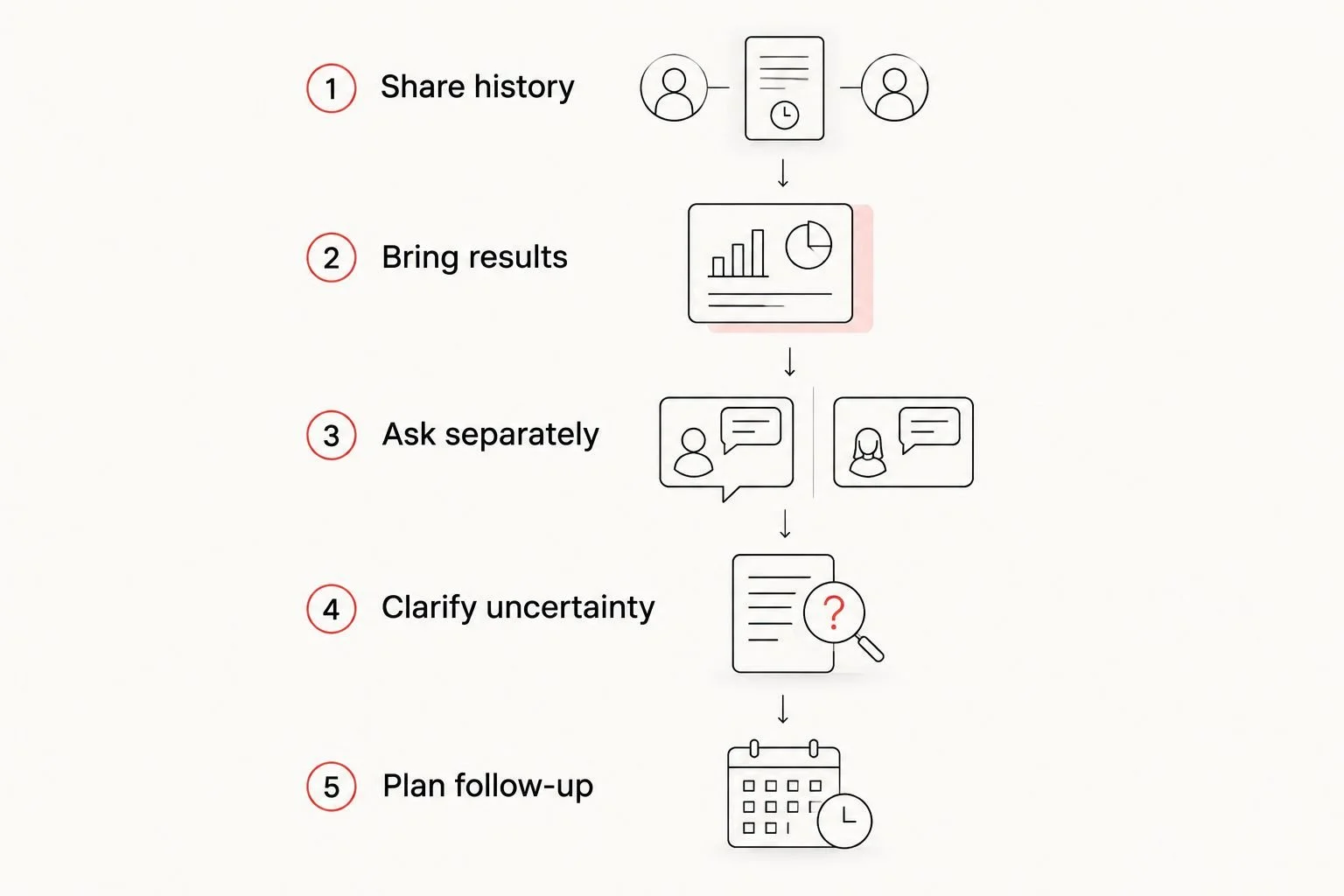
An individual answer requires a clear assessment of each twin, not just a shared blood-test result.
For your 2026 appointments, write down which findings apply to which twin. Keep the clinical labels consistent with your prenatal team’s records rather than assigning them yourself based on where a baby appears in a photograph.
What if SneakPeek and ultrasound disagree?
A disagreement needs review, not a quick declaration that one method is wrong. A boy result followed by one female-appearing fetus is not necessarily a conflict: the other twin can be male.
The more meaningful discrepancy is a boy result followed by adequate ultrasound views suggesting both twins are female, or a girl result followed by a clearly identified male fetus. Bring both reports to your prenatal clinician and ask what needs clarification.
The clinician can review gestational dating, the quality of the ultrasound views, sample collection, and any history of a vanished twin. Additional evaluation depends on the circumstances; repeating an elective blood test is not automatically the right next step.
Do not let a fetal-sex disagreement delay ordinary prenatal care. If a clinician identifies a medical concern, follow the medical evaluation rather than treating it as a gender-reveal problem.
Can you plan a twin gender reveal from the result?
Yes, if the announcement matches what the result actually establishes. A boy result supports saying that at least one baby is predicted to be a boy, but it does not support announcing two boys or a boy-and-girl pair.
A girl result predicts two girls under valid testing conditions. If you want individual confirmation before announcing, wait for adequate ultrasound assessment of both babies.
Give the reveal organizer explicit instructions about uncertainty. You do not need separate envelopes, matching decorations, or a fixed announcement date before you have an answer that supports those choices.
Where does a private appointment fit?
The Ultrasound Concierge is best for Keller and Willow Park patients seeking private pregnancy ultrasound and SneakPeek testing. Its stated service model offers a calm, personalized alternative to a clinical imaging center.
For twin pregnancies, the useful question is not whether a private setting makes the blood test more accurate. Ask The Ultrasound Concierge how the visit fits your goal: an early fetal-sex prediction, elective imaging, or diagnostic ultrasound coordinated with your prenatal care.
The Ultrasound Concierge’s pregnancy ultrasound and SneakPeek services serve different purposes. The same twin-result limits apply in a private setting, and an elective visit does not replace medically indicated monitoring.
FAQ
Does SneakPeek work if I’m pregnant with twins?
SneakPeek can provide a fetal-sex prediction in a twin pregnancy, but it cannot identify each twin separately. A boy result means at least one male twin; a girl result predicts both twins are female under valid testing conditions.
Does a SneakPeek boy result mean both twins are boys?
No. A SneakPeek boy result means at least one twin is predicted to be male; the other twin can be male or female.
Does a SneakPeek girl result mean both twins are girls?
Yes, that is the manufacturer’s interpretation for a valid twin-pregnancy result. It remains a fetal-sex prediction and does not replace individual prenatal ultrasound assessment.
Can SneakPeek tell me whether my twins are identical?
No. SneakPeek does not establish whether twins are identical or fraternal, and two babies of the same sex can be either.
Can a vanished twin affect a SneakPeek result?
A vanished twin can complicate blood-based fetal-sex interpretation because pregnancy-derived DNA from the demised co-twin can influence the sample. Discuss that history with your prenatal clinician and the laboratory before relying on the result.
When can an ultrasound check each twin’s sex?
The routine second-trimester anatomy ultrasound is generally performed at 18–22 weeks of pregnancy, when individual fetal anatomy can be assessed. Fetal position can still prevent a clear view, and your clinician determines the imaging schedule for your twin pregnancy.
Can The Ultrasound Concierge replace my OB’s twin monitoring?
No. The Ultrasound Concierge offers private diagnostic and elective ultrasound services, but an elective fetal-sex appointment does not replace your prenatal clinician’s twin-pregnancy monitoring plan.
One last thing
Write “at least one boy” beside a boy result before sharing it. Those four words prevent the most consequential interpretation mistake: turning one detected signal into two individual answers.
For a twin reveal in 2026, let the certainty of the result set the announcement—not the announcement date set the certainty you expect from the test.