
Fertility Ultrasound Appointment Length: Plan Your Visit 2026
The fertility ultrasound appointment length depends on the examination ordered and what your provider includes in the visit, so confirm the total arrival-to-departure time before arranging work, travel, or childcare. The imaging portion alone does not include registration, preparation, or any separately scheduled bloodwork or medical review. For a 2026 appointment, ask for the full reserved visit time—not just the time spent scanning.
TL;DR
Confirm fertility ultrasound appointment length for the complete visit, not just the scan.
The Ultrasound Concierge provides private fertility ultrasound imaging for patients in Keller and Willow Park, Texas.
Ask whether fertility monitoring includes bloodwork, report delivery, or a separate clinician review.
Follow your provider’s bladder instructions; preparation depends on the ultrasound approach.
Why this matters
Fertility care can involve appointments tied to your treatment plan, making an unclear schedule particularly frustrating. Knowing when you need to arrive, what happens during the visit, and who reviews the results helps you plan without rushing.
The Ultrasound Concierge is best suited to Keller and Willow Park patients seeking a private, personalized setting for fertility ultrasound imaging. You can explore The Ultrasound Concierge when considering that setting; confirm the requested examination and coordination requirements before booking.
A comfortable setting and a medically useful examination serve different needs. Your fertility clinician still needs the appropriate images, measurements, and report to guide care. Choose an appointment that supports both your comfort and the clinical question being asked.
How long does a fertility ultrasound appointment take?
A fertility ultrasound appointment takes more than the time needed to capture images. The useful scheduling estimate is the complete visit: arrival, preparation, examination, and any included discussion before you leave.
Ask the booking team to explain these stages rather than accepting an estimate labeled only as scan time. If you have another commitment afterward, explain that constraint before confirming the appointment.
Check-in
What happens: Identity, paperwork, and examination details are checked
What to confirm before booking: Whether forms can be completed beforehand
Preparation
What happens: Staff explain the examination and any changing or bladder instructions
What to confirm before booking: Whether the reserved appointment includes preparation
Imaging
What happens: The sonographer obtains the requested views and measurements
What to confirm before booking: Which examination your clinician ordered
Next steps
What happens: You receive instructions about reporting or follow-up
What to confirm before booking: Whether medical review occurs separately
Do not treat a scan-time estimate as a guaranteed departure time. Registration delays, examination requirements, and separate appointments affect the schedule differently.
For your 2026 booking, request an estimated departure time based on the actual appointment arrangement. Also ask what happens if your referring clinician needs additional views or measurements.
What should I say when I call?
Explain whether the appointment is for an initial fertility assessment, treatment monitoring, or early pregnancy after fertility treatment. These are different clinical purposes, even when they all involve pelvic ultrasound.
Then ask: Does the appointment estimate include check-in and preparation? Are bloodwork and the results discussion separate? Who sends the report to my fertility clinician?
That conversation gives you a more useful planning answer than a generic ultrasound duration. Keep the booking instructions with your treatment paperwork so you can check them before leaving home.
What happens during a fertility ultrasound appointment?
The exact examination follows the clinical request, but you can prepare around a straightforward sequence. Confirm the purpose first; preparation and reporting should follow that purpose.
Confirm the order. Make sure the imaging provider knows which examination your fertility clinician requested and whether particular measurements are needed.
Follow preparation. Use the provider’s instructions for bladder filling, clothing, and paperwork. Do not substitute instructions from a previous appointment.
Complete imaging. The sonographer explains the approach and obtains the required views. Tell staff about discomfort or concerns before and during the examination.
Clarify follow-up. Before leaving, establish who receives the report and who will explain what it means for your care.
A scheduled ultrasound does not automatically include a fertility consultation. Confirm that distinction before the visit, particularly if you expect to discuss medication, treatment timing, or the next stage of care.
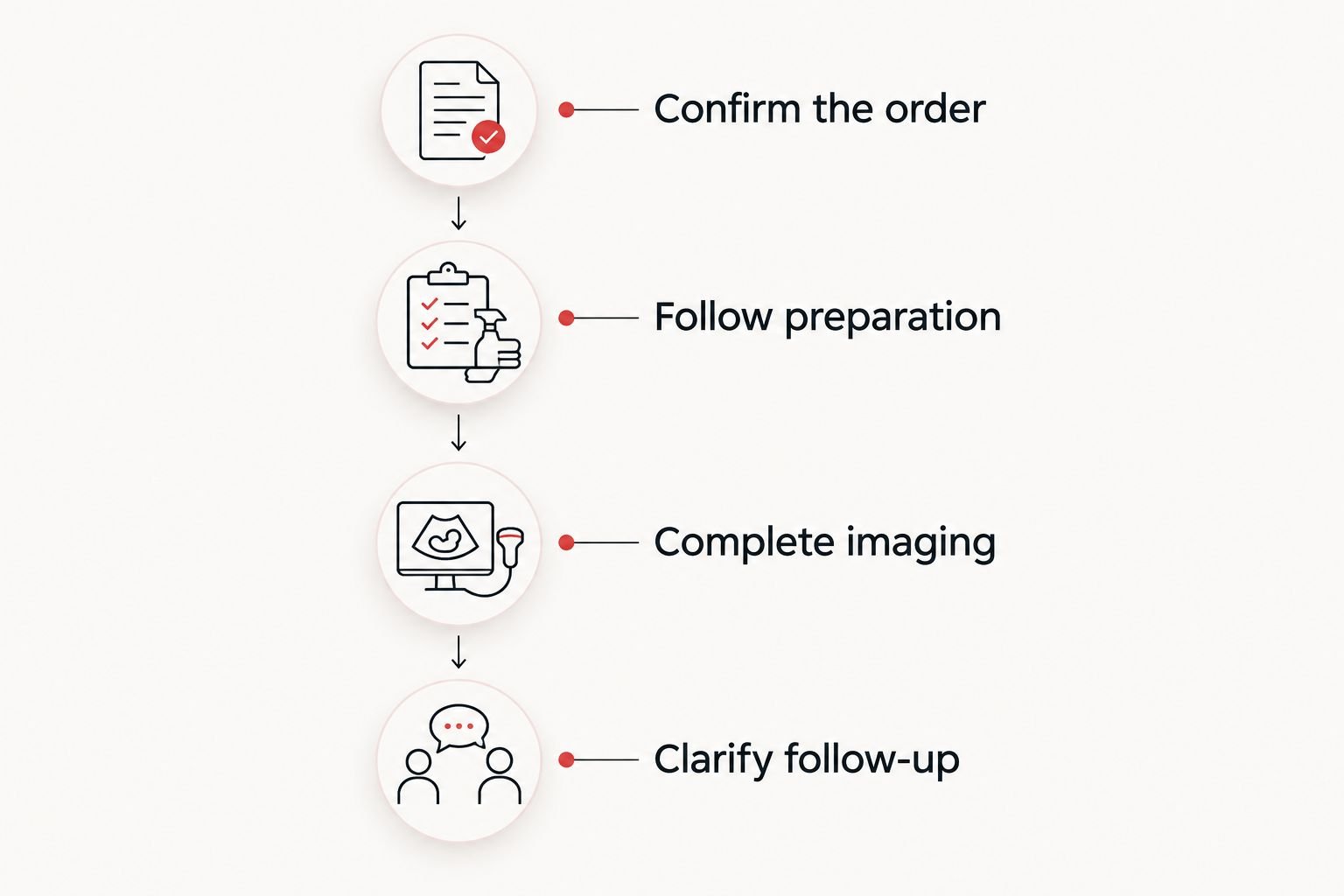
The appointment is easier to plan when preparation and follow-up are confirmed before arrival.
Does the ultrasound approach change the visit?
Pelvic ultrasound can use a transabdominal approach, a transvaginal approach, or both, depending on the examination. The preparation and experience differ, so ask which approach is planned rather than assuming every fertility visit works the same way.
Transabdominal ultrasound
Best for: A broader pelvic view when requested
Benefit: Imaging takes place through the lower abdomen
Limitation or consideration: A full bladder is commonly required; some structures need closer assessment
Transvaginal ultrasound
Best for: Detailed assessment of the uterus and ovaries when appropriate
Benefit: The probe sits closer to the pelvic structures
Limitation or consideration: It is an internal examination requiring consent and attention to comfort
Combined examination
Best for: Assessment requiring both broader and closer views
Benefit: The approaches provide complementary information
Limitation or consideration: Preparation can involve changing bladder instructions during the visit
Transabdominal fertility ultrasound
For a transabdominal examination, the sonographer moves a probe over your lower abdomen. A full bladder commonly helps create a viewing window for pelvic structures.
Follow the imaging provider’s specific instructions instead of choosing your own drinking schedule. If bladder filling is painful or difficult, tell staff rather than trying to endure it silently.
Transvaginal fertility ultrasound
For a transvaginal examination, a covered ultrasound probe is inserted into the vagina to obtain closer views of pelvic structures. This approach commonly forms part of fertility assessment and monitoring.
Ask staff to explain the procedure before it begins. You can raise concerns, ask about a chaperone, and request that the examination pause or stop; discuss alternatives with the clinical team if you do not consent.
A combined examination
When both approaches are requested, staff guide you through the preparation needed for each part. That can include using the bathroom between portions of the examination.
A combined examination is not interchangeable with a single-view appointment. Confirm what was ordered so the reserved visit matches the clinical request.
Why fertility ultrasound appointment length varies
Fertility ultrasound timing depends on the work required during the visit, not simply the name of the service. These are the factors to clarify when arranging your appointment:
Examination purpose: An initial assessment and a treatment-monitoring examination answer different clinical questions.
Imaging approach: Transabdominal, transvaginal, and combined examinations involve different preparation.
Requested measurements: Your clinician’s order determines the structures and measurements that need assessment.
Image access: Anatomy, bowel gas, and bladder preparation can affect how readily the required views are obtained.
Included services: Bloodwork, medical consultation, and imaging are not automatically part of the same appointment.
Comfort and consent: Questions, position changes, and pauses belong in the examination when you need them.
A longer visit does not, by itself, establish that something is wrong. Equally, a brief scan does not tell you whether the findings are normal. Only the clinical assessment and report address those questions.
When arranging care in 2026, explain any scheduling constraints without asking staff to shorten the ordered examination. A suitable appointment is one that allows the required assessment and respects your comfort.
How can I keep the appointment from running behind?
You can reduce avoidable disruption by confirming the order, preparation, and reporting details before arrival. You cannot control every part of the schedule, but clear instructions prevent unnecessary confusion.
Use this preparation checklist:
Confirm the location and requested arrival time.
Ask whether registration happens before the reserved imaging slot.
Check whether the imaging provider has the examination request.
Follow the bladder instructions supplied for this appointment.
Bring the documents the provider specifically requests.
Identify the fertility clinician who should receive the report.
Explain mobility, positioning, privacy, or examination concerns beforehand.
If your clinician changes the requested examination, tell the imaging provider before the visit. Do not assume a booking made for one purpose automatically covers a different assessment.
For questions about examination requests, the guide to whether a private ultrasound needs a doctor’s referral provides related context. Confirm the requirements for your fertility examination directly with your treating clinician and imaging provider.
Will I get my fertility ultrasound results before I leave?
Receiving images and receiving a medical interpretation are different steps. Ask who prepares the report, how it reaches your fertility clinician, and who will explain its implications for your treatment.
The person obtaining the images does not necessarily make treatment decisions. Do not interpret a sonographer’s silence, facial expression, or time spent on a particular view as a result.
Before a 2026 monitoring visit, confirm the reporting arrangement with your fertility team. If the findings will inform a treatment decision, ask what to do if the report has not reached the clinician when expected.
Do not change fertility medication based on your own reading of ultrasound images. Follow the treating clinician’s instructions and contact that team when you need clarification.
Can I return to work after a fertility ultrasound?
A routine transabdominal or transvaginal ultrasound generally does not require a recovery period or sedation. Your ability to return to work also depends on any separate procedure, medication, or appointment scheduled alongside it.
Ask about the complete visit before planning your return. Travel, check-in, and a separate consultation still occupy time even when the ultrasound itself does not require recovery.
If you experience significant discomfort or feel unwell, tell the clinical team. Do not use a general scheduling guide to dismiss symptoms or override instructions specific to your care.
FAQ
What does fertility ultrasound appointment length include?
Fertility ultrasound appointment length should cover check-in, preparation, imaging, and any included discussion before departure. Ask whether bloodwork and clinician review are separate appointments.
Does The Ultrasound Concierge offer fertility ultrasound imaging?
The Ultrasound Concierge provides private fertility ultrasound imaging for patients in the Keller and Willow Park, Texas area. Confirm the requested examination, preparation, and report coordination before booking.
Do I need a full bladder for a fertility ultrasound?
Bladder preparation depends on the ultrasound approach. Transabdominal pelvic imaging commonly requires a full bladder, while transvaginal imaging is commonly performed with an empty bladder; follow your provider’s specific instructions.
Is a longer fertility ultrasound a sign that something is wrong?
A longer fertility ultrasound does not, by itself, mean something is wrong. Image access, requested measurements, preparation, and comfort can all affect the examination.
Will a fertility ultrasound appointment include bloodwork?
Do not assume a fertility ultrasound appointment includes bloodwork. Ask your fertility team whether blood tests are needed and whether they take place at the same location or in a separate visit.
Can I ask the sonographer to stop a transvaginal ultrasound?
Yes, you can ask the sonographer to pause or stop a transvaginal ultrasound. Discuss your concerns and any alternative examination with the clinical team so you understand what information is still needed.
How should I plan a fertility ultrasound appointment in 2026?
For a fertility ultrasound appointment in 2026, confirm the full arrival-to-departure estimate and the reporting plan before booking. Keep travel, preparation, and any separate consultation distinct from the scan-time estimate.
One last thing
The most useful scheduling question is not just how long the scan takes—it is when your fertility clinician will receive the information needed for your care. A convenient appointment and a clear reporting plan solve different problems.
Before confirming your 2026 visit, check both. Knowing your expected departure time helps you organize the day; knowing the next clinical step helps you leave without guessing what happens afterward.