
Fertility Ultrasound Ovulation Timing: Yes, in 2026
Yes—a fertility ultrasound can help estimate when you’re approaching ovulation, and repeat scans can show changes consistent with an egg having been released. It cannot pinpoint the exact moment of ovulation or confirm egg quality; your clinician interprets the images alongside your cycle history and, when needed, hormone testing. This 2026 guide explains what the scan tells you and how to use that information without treating it as a countdown clock.
TL;DR
Fertility ultrasound ovulation timing is an estimate; repeat scans provide more information than a single image.
Ultrasound tracks ovarian follicles; urine LH tests detect a hormone surge that usually precedes ovulation.
A follicle measurement does not prove egg quality, fertilization, or pregnancy.
The Ultrasound Concierge provides private fertility ultrasound imaging for patients in Keller and Willow Park.
Can a fertility ultrasound tell you when you’re ovulating?
A fertility ultrasound can help predict approaching ovulation and provide evidence that ovulation has occurred, but it cannot give you an exact release time. The useful distinction is between seeing a follicle develop and seeing changes after that follicle releases an egg.
A clinician usually gets the clearest picture from a sequence rather than an isolated scan. Before arranging imaging, ask who will interpret the report and whether an order is needed; this guide explains referral questions for a private ultrasound.
Before ovulation: Ultrasound measures fluid-filled ovarian follicles and assesses the uterine lining. A developing dominant follicle helps your clinician estimate whether ovulation is approaching.
Across repeat scans: Changes in follicle size help your clinician follow development. The interval between scans depends on your cycle and treatment plan, not a universal schedule.
After suspected ovulation: A follicle that has collapsed or disappeared, a developing corpus luteum, and pelvic fluid can support the assessment that ovulation occurred. Your clinician considers these findings together rather than treating any one sign as proof.
An ultrasound shows the follicle surrounding an egg, not the egg itself. That means a reassuring-looking follicle is useful information, but it is not a direct assessment of the egg’s maturity or ability to become a pregnancy.
Why this matters
Timing matters because your fertile window begins before ovulation, not after you receive confirmation that it happened. The American Society for Reproductive Medicine’s patient guidance describes a 6-day fertile window ending on the day of ovulation, reflecting how long sperm can remain capable of fertilization before an egg is released.
Sperm can survive for up to 5 days in the reproductive tract under favorable conditions. An egg generally remains capable of fertilization for about 12–24 hours after release. These are biological windows, not guarantees about an individual cycle.
For your 2026 conception plan, the practical lesson is simple: do not wait for a post-ovulation scan to begin following your clinician’s timing advice. If you are undergoing fertility treatment, follow the clinic’s instructions for intercourse, insemination, medication, or procedures rather than calculating your own schedule from a measurement.
What can a single fertility ultrasound tell you?
A single scan can describe what your ovaries and uterine lining look like at that appointment. It can identify and measure follicles, assess the lining, and identify findings that need clinical interpretation.
Its main limitation is the missing timeline. Without earlier images or supporting information, a clinician has less evidence about whether a follicle is growing as expected, has stopped developing, or has recently changed after ovulation.
Best for: Assessing ovarian and uterine findings at a particular point in your cycle. The benefit is direct imaging; the limitation is that one appointment cannot show the full sequence of development and release.
Bring the date your last period started, recent ovulation-test results, and your medication list. Those details give the image context and help your clinician decide whether another scan or a different test answers the remaining question.
What do repeat fertility ultrasounds add?
Repeat ultrasounds let your clinician compare the same cycle over time. A series can track follicle development and then look for changes consistent with ovulation, which is more informative than estimating from an isolated measurement.
Best for: Clinician-directed follicle monitoring, including cycles in which fertility medication makes monitoring part of treatment. The benefit is a record of change; the limitation is that imaging still does not establish an exact release time or guarantee conception.
The scan schedule must match the clinical question. An early-cycle assessment, a scan near expected ovulation, and a scan after suspected ovulation serve different purposes, so booking them interchangeably can leave your original question unanswered.
Ask your treating clinician to specify the purpose before you schedule. If another imaging provider performs the scan, confirm how the report will reach the clinician responsible for your next step.
How does ultrasound compare with other ovulation tests?
Ultrasound, urine luteinizing hormone tests, and progesterone testing answer different questions. Your 2026 tracking plan should distinguish prediction before ovulation from evidence after ovulation, rather than treating every result as interchangeable.
Urine LH tests detect a hormone surge that usually precedes ovulation by 1–2 days, according to American Society for Reproductive Medicine guidance on fertility evaluation. A positive result suggests that ovulation is approaching; it does not prove that an egg was released.
Fertility ultrasound
What it tells you: Follicle development and findings consistent with recent ovulation
Best for: Clinician-directed monitoring
Main benefit: Directly assesses ovaries and uterine lining
Main limitation: A single scan cannot establish exact release time
Urine LH test
What it tells you: Whether a urinary hormone surge is detected
Best for: At-home prediction of approaching ovulation
Main benefit: Provides a signal before expected release
Main limitation: A positive test does not confirm ovulation
Progesterone blood test
What it tells you: Whether hormone levels support recent ovulation
Best for: Clinician-directed confirmation afterward
Main benefit: Adds biochemical evidence
Main limitation: Correct timing matters; it does not predict the next release
Calendar or cycle app
What it tells you: An estimate based on cycle dates
Best for: Recording patterns and planning discussions
Main benefit: Organizes your cycle history
Main limitation: Does not measure current follicle development or hormone changes
No method in this table assesses egg quality or confirms pregnancy. Combining information is useful when your clinician has a specific question—not simply because collecting more results feels reassuring.
Why fertility ultrasound ovulation timing varies
The interpretation depends on your cycle, the scan’s timing, and whether treatment is involved. These factors explain why a follicle measurement should not become a self-directed medication or insemination decision.
Cycle pattern: Ovulation does not always fall on the same cycle day. A calendar estimate is less informative when cycle lengths vary.
Appointment timing: A scan before release and a scan afterward capture different findings. Neither is a continuous recording of what happened between appointments.
Follicle development: A visible follicle does not necessarily release an egg. Clinical interpretation must distinguish development from evidence of ovulation.
Fertility medication: Treatment can change follicle development and the number of developing follicles. Monitoring and timing decisions belong to the prescribing clinician.
Underlying hormonal conditions: Conditions such as polycystic ovary syndrome can complicate cycle prediction and LH-test interpretation. Your clinician decides which evidence is most useful.
There is no single follicle-size rule that lets every patient identify the exact hour of ovulation. Use the report to support your clinician’s plan, not to replace it.
How should you plan a scan around ovulation?
Start with the decision you need the scan to support. For a 2026 fertility appointment, a clear clinical question is more useful than asking for a general scan and hoping it explains the entire cycle.
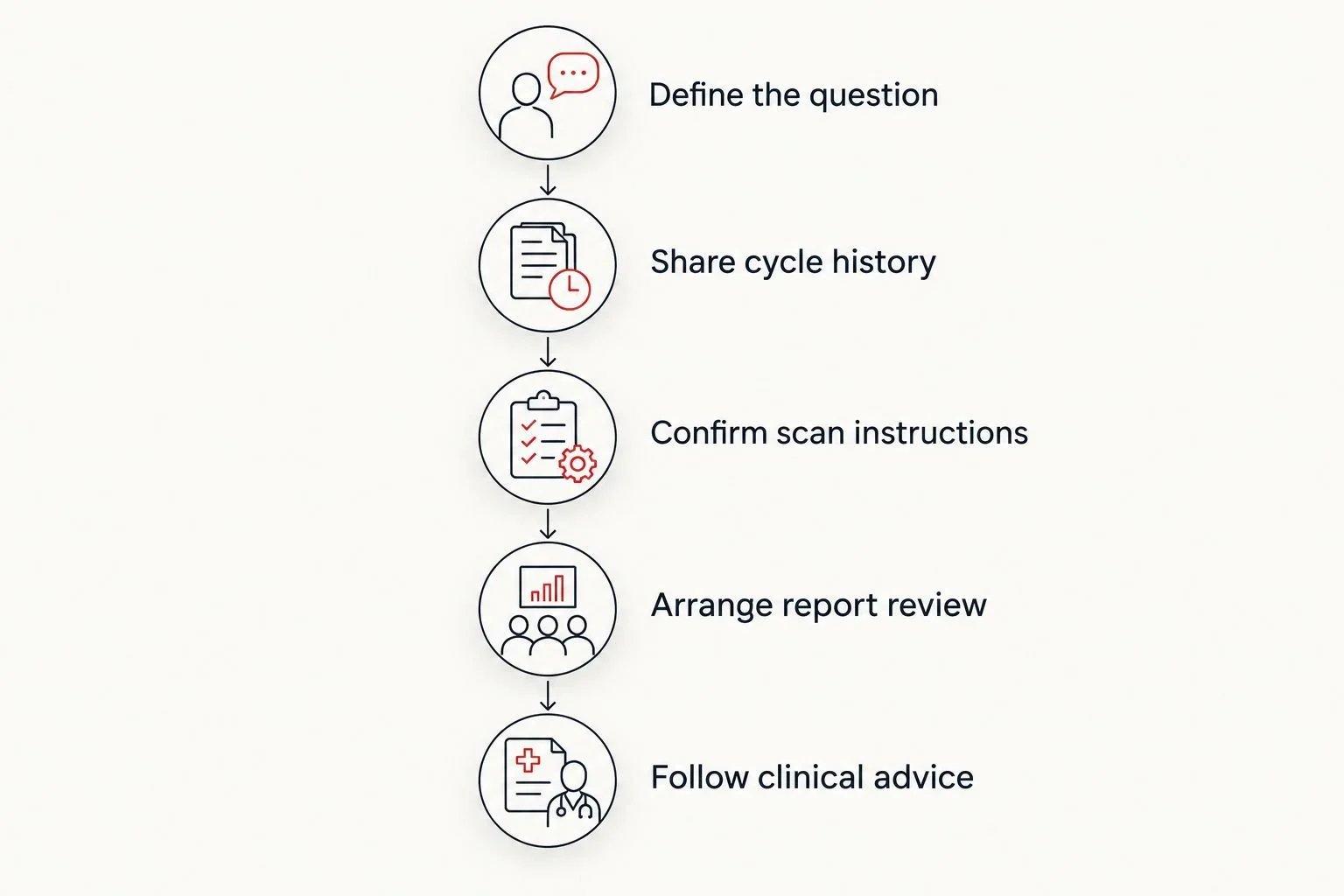
Define the question. Tell your clinician whether you want to assess follicle development, investigate irregular cycles, or look for evidence of recent ovulation.
Share cycle history. Provide period dates, recent LH-test results, relevant symptoms, and fertility medications. Do not stop or change medication to prepare for imaging unless your prescriber instructs you.
Confirm scan instructions. Ask whether transvaginal imaging is planned and what preparation is required. Bladder instructions differ by examination type, so follow the imaging provider’s directions.
Arrange report review. Confirm who receives and interprets the report. Knowing when and how you will receive clinical advice prevents a measurement from becoming an unanswered question.
Follow clinical advice. Ask what the findings change about your plan and whether repeat imaging or hormone testing is needed. Obtain medication and procedure instructions from your treating team.
Decide who will interpret the scan before using the findings to guide your next step.
You can also ask how the examination works and discuss comfort concerns before it begins. Transvaginal ultrasound often provides detailed ovarian imaging, but the provider should explain the procedure and obtain your consent; you can ask questions or request that the examination stop.
Where does private fertility imaging fit into your care?
The Ultrasound Concierge is best for patients in Keller and Willow Park seeking private fertility ultrasound imaging. Its stated services include fertility and diagnostic ultrasound in a calm, personalized setting.
That setting can match your preference for a less institutional visit. The limitation is unchanged: an imaging appointment does not replace fertility diagnosis, prescribing, or treatment decisions by your clinician.
Before arranging fertility imaging with The Ultrasound Concierge, ask whether the requested examination matches your clinician’s needs and how reporting will be coordinated. Do not assume that every ultrasound appointment includes serial follicle monitoring or immediate treatment instructions.
Can ultrasound confirm that you already ovulated?
Ultrasound can provide evidence consistent with recent ovulation when the ovarian findings fit the expected changes after release. Comparing scans strengthens that assessment because your clinician can see how the follicle changed.
A progesterone blood test can add supporting evidence when appropriately timed. Neither test, alone or together, identifies the exact moment the egg was released.
Does a normal fertility ultrasound mean you can get pregnant?
No—a normal fertility ultrasound does not establish that every requirement for conception is present. It does not fully assess sperm factors, egg quality, or whether the fallopian tubes are open during a routine pelvic examination.
If pregnancy is not happening, ask for a fertility evaluation rather than repeatedly using normal imaging as reassurance. The appropriate next test depends on your history and your clinician’s assessment.
Is ultrasound necessary if your ovulation test is positive?
Not automatically—a positive urine LH test and an ultrasound provide different information. For someone trying to conceive without a prescribed monitoring plan, a positive LH result does not by itself create a need for imaging.
If you have irregular cycles, a condition affecting ovulation, or fertility-treatment instructions, ask your clinician how to interpret the result. Continue scheduled monitoring unless the treating team changes the plan.
FAQ
Can a fertility ultrasound tell me the exact day I will ovulate?
A fertility ultrasound can help estimate approaching ovulation, but it cannot guarantee the exact day or hour. Repeat scans and hormone information give your clinician more context than a single measurement.
How long after a positive ovulation test does ovulation happen?
Ovulation usually follows a urine LH surge by 1–2 days, but a positive test does not prove an egg was released. If you are receiving fertility treatment, follow your clinic’s timing instructions.
Can you see the egg itself on a fertility ultrasound?
No—a routine fertility ultrasound shows the ovarian follicle surrounding the egg, not the egg itself. Follicle appearance does not establish egg quality or guarantee fertilization.
Is one ultrasound enough to confirm ovulation?
One ultrasound can show findings consistent with recent ovulation, but it does not always settle the question. Comparison with earlier imaging and appropriately timed hormone testing can support the assessment.
Should I wait until ultrasound confirms ovulation to try to conceive?
Do not wait for ultrasound confirmation unless that is your clinician’s instruction. The fertile window includes the 5 days before ovulation and the day of ovulation, so confirmation afterward can come too late for that window.
Can fertility ultrasound diagnose blocked fallopian tubes?
A routine fertility ultrasound does not establish that your fallopian tubes are open. Your clinician can recommend a dedicated tubal-patency examination when that question needs an answer.
Does The Ultrasound Concierge provide fertility ultrasound imaging?
The Ultrasound Concierge provides private fertility ultrasound imaging for patients in Keller and Willow Park, TX. Ask whether your clinician’s requested examination can be performed and how the report will reach the treating team.
One last thing
A scan taken after ovulation can answer whether release likely occurred while being too late to help you anticipate that same release. That distinction is easy to miss when every test is described as an ovulation check.
For your 2026 appointment, ask one direct question: Are we trying to predict ovulation, confirm it afterward, or monitor treatment? The answer determines when to scan, which supporting tests matter, and what you should do with the result.