
Best placenta encapsulation services near Fort Worth, TX (2026)
Best overall: clinician-guided postpartum care. Best for practical recovery support: a postpartum doula. No placenta encapsulation service earns a medical recommendation here: benefits are unproven, and preparation does not reliably eliminate infection risks. This 2026 guide explains how to assess placenta encapsulation services near Fort Worth without confusing a personal preference with a proven treatment.
TL;DR
For placenta encapsulation services Fort Worth searches, prioritize medical evidence over testimonials or wellness promises.
The CDC advises avoiding placenta capsules because processing does not reliably eliminate infectious pathogens.
Choose clinician-guided postpartum care for mood symptoms, suspected anemia, or other recovery concerns.
The Ultrasound Concierge provides pregnancy imaging, not a substitute for postpartum medical care.
Why this matters
Placenta encapsulation means preparing the placenta after birth, typically by dehydrating it and putting the material into capsules for ingestion. Providers sometimes market the practice around energy, milk production, mood, or recovery. Those promises are not established clinical benefits.
The CDC's published investigation of recurrent group B Streptococcus infection in an infant linked the infection to maternal consumption of contaminated placenta capsules. Its recommendation is to avoid placenta capsule ingestion because encapsulation does not, by itself, eradicate infectious pathogens.
That distinction matters when choosing a Fort Worth service in 2026. A reassuring consultation, careful packaging, or training certificate does not establish that swallowing the finished capsules is safe or effective.
For a separate pregnancy-imaging need, The Ultrasound Concierge provides diagnostic and elective ultrasound services for patients in Keller and Willow Park. Imaging and placenta processing are different services; one does not validate the other.
What makes the best postpartum support option?
A useful comparison starts with what you need help with—not which business has the most appealing testimonials. Apply these criteria before choosing any postpartum service in 2026:
Evidence: Does the proposed service address your goal with an established clinical approach, or rely on personal stories?
Safety: Does the provider explain risks clearly, including reasons not to proceed?
Scope: Can the provider distinguish practical support from diagnosis and treatment?
Coordination: Will the provider direct medical concerns to your obstetric clinician, midwife, or another appropriate professional?
Accountability: Are responsibilities, handling procedures, and escalation instructions written down?
Fit: Does the service address your actual concern—feeding, sleep logistics, mood, pain, or another recovery need?
A service is not the best choice simply because it offers more steps, supplements, or keepsakes. Start with the problem you want solved, then choose someone qualified to help with that problem.
Postpartum options at a glance
These are support pathways, not a ranking of Fort Worth businesses. They serve different purposes, and several belong in the same recovery plan.
Clinician-guided postpartum care
Best for: Symptoms and medical recovery questions
What it provides: Assessment and treatment planning
Key limitation: Does not replace day-to-day household help
Postpartum doula support
Best for: Practical help after birth
What it provides: Nonmedical recovery and family support
Key limitation: Does not diagnose or treat medical conditions
Lactation care
Best for: Breastfeeding and milk-transfer concerns
What it provides: Feeding assessment and individualized guidance
Key limitation: Does not address every cause of postpartum symptoms
Placenta encapsulation
Best for: Evaluating a personal preference, not treating a condition
What it provides: Processing placenta into capsules
Key limitation: Benefits are unproven; infection risks remain
1. Clinician-guided care: best for postpartum health concerns
Your obstetric clinician or midwife is the starting point for symptoms such as persistent exhaustion, worsening pain, mood changes, or concerns about bleeding. Assessment helps distinguish expected recovery from a condition that needs treatment. A capsule cannot make that distinction.
Best for: You want help understanding a symptom, evaluating recovery, or deciding whether testing or treatment is appropriate.
Clinician-guided care pros:
Connects symptoms with a medical history and examination.
Supports testing or treatment when clinically indicated.
Creates a route for referrals and follow-up.
Clinician-guided care limitations:
An appointment does not provide ongoing household assistance.
Feeding or mental-health concerns sometimes require additional specialists.
If you are considering encapsulation for energy, explain the fatigue itself rather than asking only whether capsules are acceptable. Describe how you feel, when it started, and what makes daily activities difficult. That gives your clinician a clearer problem to assess.
Seek urgent medical help for chest pain, trouble breathing, severe headache, heavy bleeding, or thoughts of harming yourself or your baby. Do not wait for a scheduled wellness service.
Verdict: Choose clinician-guided care for symptoms; skip placenta capsules as a substitute for assessment.
2. Postpartum doula support: best for practical recovery help
A postpartum doula provides nonmedical support after birth. Depending on the agreed scope, that support can include newborn-care education, help organizing daily routines, and assistance as your household adjusts.
Best for: You need practical support and a clearer division of responsibilities at home.
Postpartum doula support pros:
Addresses daily tasks that medical appointments do not cover.
Helps you plan support around your household's needs.
Offers a defined nonmedical role alongside clinical care.
Postpartum doula support limitations:
Does not diagnose infection, anemia, or postpartum depression.
Duties and training differ, so you must review the agreement.
Ask what the doula does when a parent reports worsening symptoms. A clear answer should direct medical concerns to an appropriate clinician rather than recommend supplements or encapsulation as treatment.
If the same person offers doula support and placenta processing, evaluate each service separately. Being helpful with newborn routines does not establish expertise in infection prevention or prove that placenta ingestion improves recovery.
Verdict: Choose postpartum doula support for practical help; skip any arrangement that blurs nonmedical support with treatment.
3. Lactation care: best for feeding concerns
A qualified lactation professional assesses breastfeeding concerns such as latch, discomfort, and milk transfer. An International Board Certified Lactation Consultant holds a specific lactation credential; ask providers to identify their qualifications accurately.
Best for: You are considering placenta capsules because you are worried about milk production or feeding.
Lactation care pros:
Focuses directly on feeding rather than a general wellness promise.
Supports an individualized plan based on the feeding situation.
Helps identify concerns that need pediatric or maternal medical review.
Lactation care limitations:
Does not replace a pediatric assessment of an unwell baby.
Some feeding problems need coordination with additional clinicians.
Ask how the professional assesses milk transfer and when they refer a baby for medical evaluation. A provider should not treat a supplement recommendation as a substitute for understanding how feeding is actually going.
Verdict: Choose lactation care for feeding concerns; skip placenta capsules as a proven milk-supply treatment.
4. Placenta encapsulation: not recommended for health benefits
Placenta encapsulation turns placental tissue into capsules for ingestion. Preparation methods vary, and processing is not proof that the finished capsules are free of infectious organisms. There is no established clinical benefit that justifies presenting encapsulation as treatment for postpartum depression, low milk supply, or fatigue.
Best for: Understanding a personal preference before making a decision—not treating a postpartum condition.
Placenta encapsulation's limited practical features:
A written agreement can clarify who handles the placenta.
A documented handoff can identify who is responsible for transport.
Clear exclusion policies can explain when a processor will decline a case.
These are administrative safeguards, not evidence that ingestion is safe or beneficial. They should not be described as health advantages.
Placenta encapsulation cons:
Claimed recovery benefits are not established by reliable clinical evidence.
Contamination and infection risks remain despite processing.
Using capsules instead of assessment can delay appropriate care.
No local business should receive a medical endorsement based only on reviews, a certificate, or a description of its preparation method. Location does not change the underlying evidence.
Verdict: Skip placenta encapsulation as a health intervention. Discuss any intention to ingest placenta with your maternity clinician and your baby's pediatrician.
Before contacting a Fort Worth placenta processor
If you still intend to explore encapsulation, make 2 calls before arranging a handoff: one to your maternity clinician and one to your birth facility. Ask about medical concerns, placenta release procedures, and whether examination by pathology takes priority.
Then request 1 written plan from the processor. It should cover identity tracking, transport responsibilities, storage instructions, preparation, and circumstances in which processing will not proceed. Written details make responsibilities clearer; they do not remove the underlying medical concerns.
Organize your conversation around these 3 questions:
Clinical review: What should my maternity clinician and baby's pediatrician know before I decide?
Facility release: Who authorizes release, and what happens if the placenta needs examination?
Processor documentation: Who handles the tissue at every stage, and what makes the processor decline it?
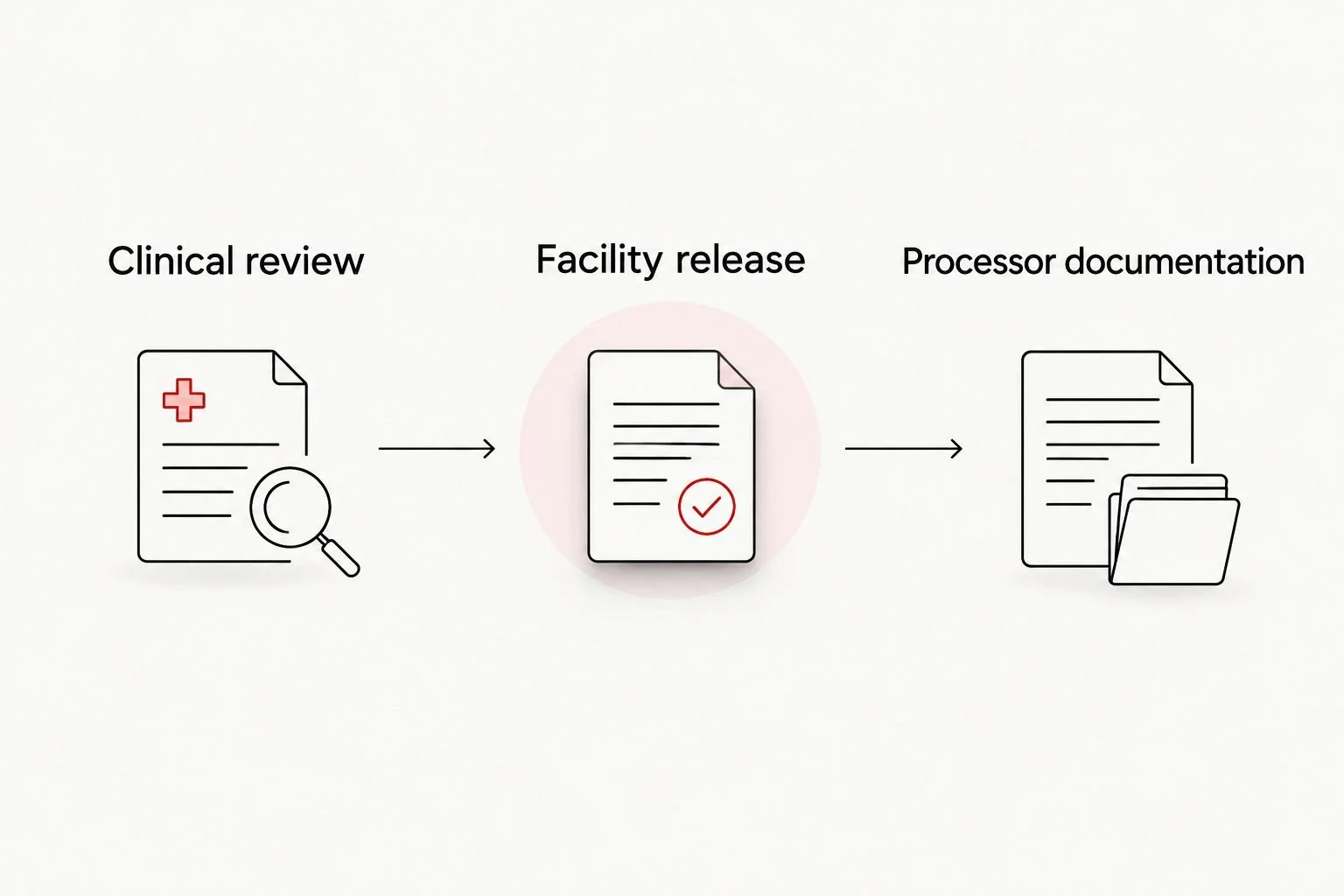
Clarify medical concerns and release requirements before arranging placenta handling.
Do not accept a claim that a preparation temperature makes every placenta safe. The CDC notes that standards for processing placenta for consumption do not exist. A provider's internal procedure is not the same as a validated guarantee against infection.
For further planning questions, the placenta encapsulation guide is a related resource. Keep the medical decision separate from package comparisons or administrative convenience.
How these options are ranked
This 2026 comparison prioritizes evidence, scope of practice, and the problem each option addresses. It does not score named businesses or imply that a local processor has passed an independent safety assessment.
Clinician-guided care ranks first for health concerns because it provides a route to assessment and treatment. Doula and lactation support have distinct roles. Placenta encapsulation ranks last because its proposed health benefits are unproven and ingestion carries infection concerns.
The CDC's investigation concerns an infant infection associated with contaminated placenta capsules. It is not a comparison of Fort Worth providers, and it cannot establish which local processor is safer than another.
Which postpartum option should you choose?
Choose the service that addresses your actual need, not a capsule marketed to cover everything. For symptoms, contact your clinician. For practical household support, consider a postpartum doula. For feeding concerns, seek qualified lactation care.
The Ultrasound Concierge is best suited to patients in Keller and Willow Park seeking private diagnostic or elective ultrasound imaging. Its role is separate from postpartum treatment and placenta processing; a pregnancy scan does not establish whether placenta ingestion is appropriate.
For your 2026 birth plan, keep these decisions in separate categories: prenatal imaging, delivery arrangements, postpartum medical care, and practical home support. Separating them makes responsibilities easier to understand and questions easier to direct.
FAQ
What's the best placenta encapsulation service near Fort Worth?
No placenta encapsulation service is recommended here as a health intervention. Benefits are unproven, and the CDC advises avoiding placenta capsules because processing does not reliably eliminate infectious pathogens.
Does placenta encapsulation prevent postpartum depression?
Placenta encapsulation is not an established treatment or prevention method for postpartum depression. Contact your maternity clinician about persistent sadness, anxiety, intrusive thoughts, or difficulty functioning rather than relying on capsules.
Can placenta capsules increase breast milk supply?
Placenta capsules are not a proven way to increase milk supply. A qualified lactation professional can assess feeding and coordinate with your baby's clinician when needed.
Does steaming or dehydrating a placenta make it safe to eat?
Steaming or dehydrating does not establish that a placenta is safe to ingest. The CDC warns that encapsulation does not by itself eradicate infectious pathogens.
Can I take my placenta home from a Fort Worth hospital?
Ask your specific birth facility about its release procedures before delivery. Medical examination, documentation, and handling requirements must be clarified with the facility rather than assumed from a processor's instructions.
Is a placenta encapsulation certificate the same as a medical license?
A placenta encapsulation training certificate is not a medical license. Ask who issued the credential, what it covers, and whether the person separately holds any relevant professional license.
Does The Ultrasound Concierge provide placenta encapsulation?
The Ultrasound Concierge is described here as a provider of diagnostic and elective ultrasound imaging, not as a placenta encapsulation provider. Do not assume that pregnancy imaging includes placenta processing or postpartum treatment.
Should I tell my baby's pediatrician if I take placenta capsules?
Yes, tell your baby's pediatrician if you ingest placenta capsules. That information is relevant to assessing possible infection exposure, particularly if your baby becomes unwell.
One last thing
Put the intended benefit in writing before choosing a service. If your goal is “more energy,” “less anxiety,” or “better feeding,” take that goal to the professional qualified to assess it. You deserve support directed at the concern itself—not an unsupported promise attached to a capsule.
Keep the placenta-handling decision in your birth plan, but keep medical symptoms out of a processor's hands. A clear boundary protects your ability to get appropriate care promptly.