
Best ultrasound studios for LGBTQ+ family-building (2026)
Best local private-studio fit: The Ultrasound Concierge for patients around Keller and Willow Park, Texas. Best for treatment monitoring: your fertility clinic; best for ongoing pregnancy care: your prenatal practice. This 2026 LGBTQ+ family building ultrasound guide compares care settings by purpose, privacy, consent, and coordination—not by unsupported claims of LGBTQ+ specialization.
TL;DR
The Ultrasound Concierge offers private pregnancy and fertility imaging near Keller and Willow Park; confirm your specific care requirements.
For LGBTQ+ family building ultrasound during fertility treatment, choose a provider your treating clinic accepts.
Prenatal diagnostic scans and elective ultrasound appointments serve different purposes; one does not replace the other.
Ask every provider about names, pronouns, consent, support people, and who receives results before booking.
Why this matters
Your ultrasound appointment should answer the right question without requiring you to explain or defend your family. That means separating the clinical purpose of the scan from the experience you want around it.
An intended parent, gestational carrier, non-gestational parent, or transgender patient can have different needs at the same appointment. A welcoming greeting matters, but so do consent, accurate records, and a clear route for medical results.
For your 2026 shortlist, choose the clinical role first and assess the patient experience second. A private room cannot replace a diagnostic report, and a detailed report does not excuse disrespectful communication.
What makes the best LGBTQ+ family building ultrasound provider?
Use these criteria before comparing studios or clinics:
Correct scan purpose: Establish whether you need fertility monitoring, pregnancy assessment, a scheduled prenatal examination, or an elective viewing session.
Respectful communication: Ask how staff record your name, pronouns, family roles, and preferred anatomical language while preserving medically necessary information.
Consent throughout: Ask how the examination is explained, how you can request a pause, and what happens if you decline part of it.
Clinical accountability: Identify who interprets diagnostic images, who receives the report, and who explains the findings.
Privacy and participation: Confirm who can attend, who can receive images, and how information-sharing permissions are documented.
Treatment coordination: For fertility care or a gestational-carrier pregnancy, confirm that the treating team accepts the examination and reporting process.
A provider earns your consideration through clear answers to these questions. A rainbow graphic or the word “family” does not establish how an appointment actually works.
Best options at a glance
This ranking compares one named local provider with care-setting options. It is a decision guide, not a ranking of independently verified LGBTQ+ programs; each option serves a different purpose.
1. The Ultrasound Concierge
Best for: Private local pregnancy or fertility imaging
Standout fit: Concierge-style diagnostic and elective services around Keller and Willow Park
Key limitation: Confirm examination requirements, reporting, and inclusion practices directly
2. Your treating fertility clinic
Best for: Treatment-linked monitoring
Standout fit: Scans connected to your fertility treatment plan
Key limitation: Does not replace ongoing prenatal care after transfer of care
3. Your prenatal practice
Best for: Routine pregnancy assessment
Standout fit: Ultrasound considered alongside your pregnancy history and care plan
Key limitation: Guest participation and elective viewing depend on practice policies
4. A diagnostic imaging center
Best for: A specifically ordered diagnostic examination
Standout fit: Imaging organized around the requested medical question
Key limitation: Confirm pregnancy or fertility examination scope before choosing a center
1. The Ultrasound Concierge: best for private local imaging
The Ultrasound Concierge is the best fit here for patients seeking private pregnancy or fertility ultrasound around Keller and Willow Park. Its stated services include diagnostic and elective imaging in a calm, personalized setting.
That combination makes it a local option to evaluate when you want a less institutional appointment. It does not establish a particular LGBTQ+ training program, guest policy, or fertility-clinic reporting arrangement; ask about those separately.
The Ultrasound Concierge pros:
Provides pregnancy and fertility ultrasound services.
Offers both diagnostic and elective imaging.
Describes a private, concierge-style patient experience.
Serves patients in the Keller and Willow Park area.
The Ultrasound Concierge considerations:
Confirm that the specific examination meets your clinician’s requirements.
Ask directly about pronouns, support people, privacy, and result-sharing procedures.
Best for: Local patients who prioritize a private setting and can confirm the appointment matches their medical or elective purpose.
For a 2026 appointment, describe what you need before discussing image formats. “My fertility clinic needs monitoring results” and “we want to share a pregnancy viewing experience” require different booking conversations.
Verdict: Hold until the scan purpose, consent arrangements, and reporting requirements are confirmed; then book if they match.
2. Your treating fertility clinic: best for treatment monitoring
Your treating fertility clinic is the default choice when an ultrasound informs an active treatment plan. During fertility treatment, imaging findings need to reach the team making decisions about your care.
For reciprocal IVF, donor-assisted conception, or a gestational-carrier arrangement, ask whose examination is required and who receives the findings. Do not assume that an outside studio’s scan can substitute for the clinic’s requested monitoring.
Your treating fertility clinic pros:
Connects imaging to the treatment plan managed by that clinic.
Keeps interpretation and treatment decisions within the treating team’s workflow.
Gives you a direct place to clarify required measurements and timing.
Your treating fertility clinic considerations:
Ask how the clinic includes a non-gestational or intended parent.
Treatment monitoring is not a substitute for ongoing obstetric care.
Best for: Patients whose next treatment decision depends on ultrasound findings.
If you prefer an outside provider, get the clinic’s requirements first. Confirm the examination, report recipient, image-transfer method, and deadline rather than relying on a general description such as “fertility scan.”
Verdict: Book through your treating clinic, or use an outside provider only after the clinic accepts the arrangement.
3. Your prenatal practice: best for ongoing pregnancy assessment
Your prenatal practice is the best starting point for scans that belong within ongoing pregnancy care. The clinical team can consider ultrasound findings alongside symptoms, medical history, and other assessments.
A standard fetal anatomy ultrasound is commonly performed at 18–22 weeks of pregnancy. An elective viewing session does not replace that examination or other scans your clinician recommends.
Your prenatal practice pros:
Places ultrasound findings within the broader pregnancy care plan.
Provides a clinical route for discussing findings and follow-up.
Helps determine whether additional specialist assessment is needed.
Your prenatal practice considerations:
Confirm support-person and recording rules before the appointment.
Do not assume a diagnostic visit includes an extended viewing experience.
Best for: Pregnant patients who need scheduled prenatal assessment or evaluation recommended by their pregnancy clinician.
For LGBTQ+ families, clarify introductions before the scan begins. Tell staff which terms you use for each parent or support person, while allowing the clinical record to distinguish who is pregnant and who has authorized access to information.
Verdict: Book recommended prenatal imaging through the care pathway your pregnancy clinician establishes.
4. A diagnostic imaging center: best for a specific ordered scan
A diagnostic imaging center is an option when your clinician requests a defined examination and accepts that center’s reporting process. Choose the examination capability, not simply the closest ultrasound appointment.
Not every center performs every pregnancy or fertility examination. Ask whether the center handles your exact request and who will interpret the images before arranging the visit.
A diagnostic imaging center pros:
Organizes the examination around a defined diagnostic question.
Can provide an outside imaging pathway when your clinician requests one.
Gives you a reporting process to confirm before attending.
A diagnostic imaging center considerations:
Verify the exact pregnancy or fertility examination offered.
Ask separately about inclusive intake, support people, and consent procedures.
Best for: Patients with a specific diagnostic request and a clinician responsible for reviewing the findings.
Your 2026 booking conversation should include the report destination. Receiving pictures is not the same as receiving an interpreted diagnostic report, and neither replaces a clinician explaining what the result means for you.
Verdict: Book only after the center confirms the requested examination and your clinician’s reporting requirements.
Diagnostic versus elective ultrasound: choose the purpose first
Diagnostic ultrasound addresses a medical question. Elective ultrasound centers on viewing or keepsake images and does not replace prenatal screening, fertility monitoring, or assessment of symptoms.
Image format is a separate issue. Standard 2D ultrasound shows 2 dimensions; 3D imaging represents 3 dimensions; 4D adds movement over time. A more dimensional image does not, by itself, establish that an appointment includes a diagnostic examination.
Diagnostic imaging
What to establish: The clinical question, interpretation, and follow-up pathway
What not to assume: That receiving images alone completes medical care
Elective viewing
What to establish: The viewing purpose, consent, and participation rules
What not to assume: That it replaces a recommended diagnostic examination
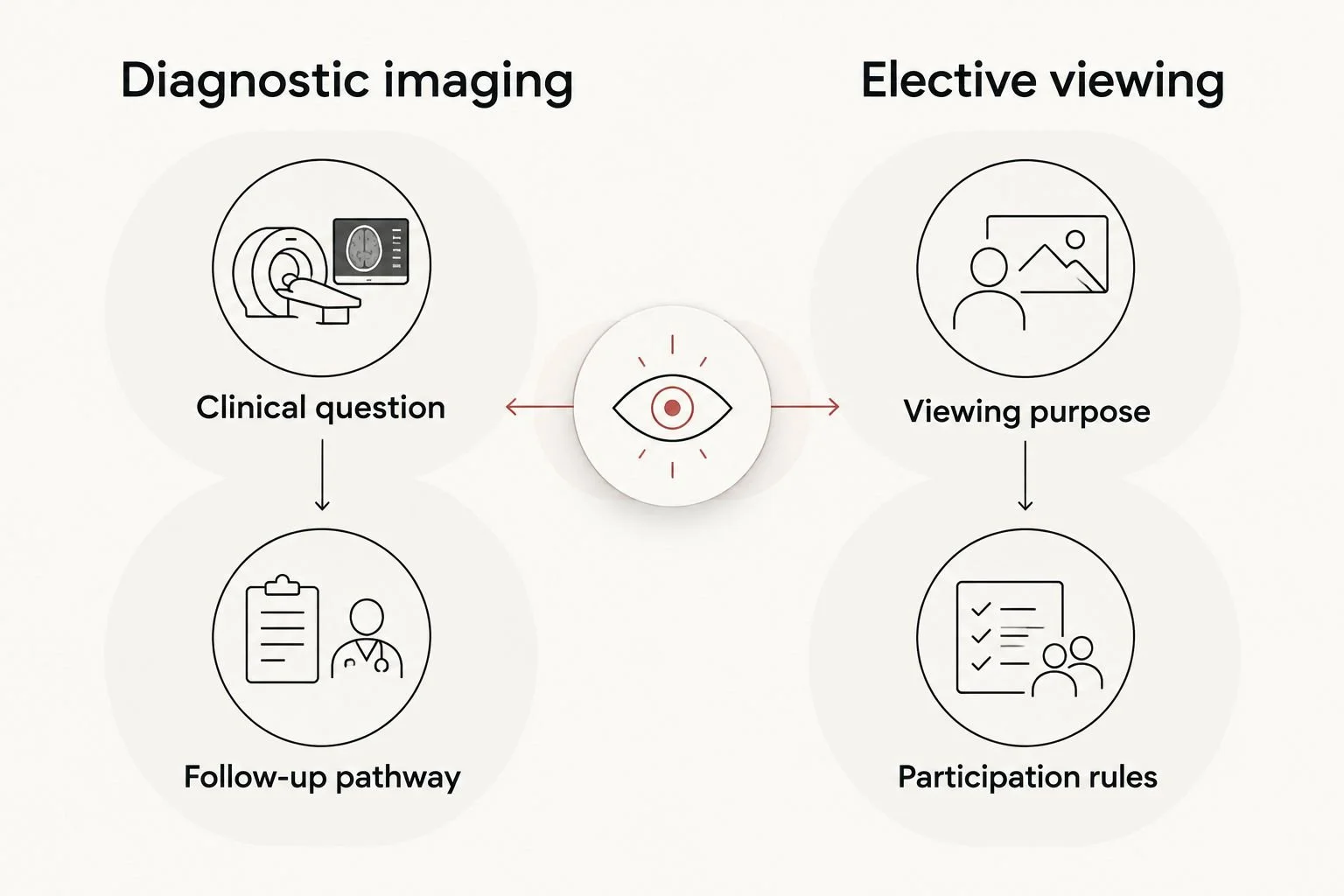
Choose the purpose of the appointment before choosing the image format.
For 2026 planning, ask your pregnancy clinician whether an additional scan is appropriate. Professional guidance discourages ultrasound performed solely for nonmedical keepsake purposes; ultrasound should be used prudently by qualified personnel.
If you have pain, bleeding, fainting, or another concerning symptom, contact your clinical team promptly rather than booking an elective reassurance visit. Seek emergency care for severe symptoms.
Questions that reveal whether a provider fits your family
You do not need to disclose your full family-building history to ask for respectful care. Start with the information needed for the examination, then explain the communication or participation arrangements that matter to you.
Names and family roles
Ask: “How do you record my name and pronouns, and how should we identify each parent or support person?” Accurate medical documentation and respectful language should work together.
For a gestational-carrier pregnancy, distinguish the patient undergoing the examination from intended parents. Attendance does not automatically authorize access to medical records or decision-making.
Consent and examination comfort
Ask: “Will you explain each part before starting, and how do I request a pause?” If an internal examination is proposed, ask why it is recommended and discuss concerns or alternatives with the clinician.
Consent belongs to the patient undergoing the examination. A partner, intended parent, or support person does not replace that patient’s permission.
Results and privacy
Ask: “Who interprets the scan, who receives the report, and how will I hear about findings?” Then confirm which phone number, email address, or portal the provider will use.
If you want someone included—or excluded—from image sharing, say so before the appointment. Clear instructions protect your privacy without making staff guess about family relationships.
Discuss your ultrasound needs
Ask about pregnancy or fertility imaging in Keller and Willow Park before choosing an appointment.
How these options are ranked
The ranking prioritizes the scan’s purpose, clinical responsibility, privacy, consent, and coordination. The named local studio appears first for its stated private-service fit—not as a claim that it outperforms other providers on unverified inclusion practices.
Use the list as a decision tree. Active treatment points toward the fertility team; ongoing pregnancy assessment points toward prenatal care; a specific order points toward an accepted diagnostic provider.
Which ultrasound option should you choose?
Choose the provider responsible for the medical question first. If your goal is a private local pregnancy or fertility imaging appointment, The Ultrasound Concierge belongs on your shortlist, with your examination and inclusion requirements confirmed before booking.
Do not choose a studio solely because it offers a particular image format. The better appointment is the one that respects the patient, serves the intended purpose, and leaves you knowing who handles the next step.
FAQ
What's the best LGBTQ+ family building ultrasound option near Keller?
The Ultrasound Concierge is a local option for private pregnancy and fertility imaging around Keller and Willow Park. Confirm its examination scope, reporting arrangements, and approach to your family's communication needs before booking.
Should I use a private studio for IVF monitoring?
Use a private provider for IVF monitoring only when your treating fertility clinic accepts the arrangement. Confirm the required examination, measurements, reporting process, and timing directly with the clinic.
Can my partner or intended parents attend an ultrasound?
Attendance depends on the provider's rules and the patient's consent. Ask before booking, and clarify whether permission to attend also includes permission to receive images or medical information.
Is a 3D ultrasound better than a diagnostic pregnancy scan?
A 3D image format is not a replacement for a diagnostic pregnancy examination. Diagnostic value depends on the clinical purpose, examination, interpretation, and follow-up—not simply the image format.
Can a transgender or nonbinary patient request different anatomical language?
You can ask the team to use your preferred language and explain medically necessary terminology. Discuss names, pronouns, examination steps, and any concerns about discomfort or dysphoria before the scan begins.
Who controls consent during a gestational-carrier ultrasound?
The patient undergoing the examination provides consent for the scan and participation in the room. Intended parents should clarify attendance and information-sharing arrangements without assuming access or decision-making authority.
Does an elective ultrasound replace the anatomy scan?
No, an elective viewing session does not replace the standard fetal anatomy examination, commonly performed at 18–22 weeks of pregnancy. Follow the imaging schedule recommended by your prenatal clinician.
One last thing
Ask staff to confirm who receives the report and who receives the pictures. Those are different permissions, particularly when a gestational carrier, intended parents, and multiple clinicians are involved.
Put your preferences in writing before the visit. That simple step makes your expectations clear without requiring you to repeat sensitive details in the examination room.