
A private ultrasound can replace the imaging portion of your OB’s dating appointment only when it is a diagnostic examination that your OB agrees meets your care needs; an elective keepsake scan cannot. In 2026, the deciding factors are the examination’s purpose, clinical interpretation, and your OB’s acceptance of the records—not whether the appointment happens in a private studio. Keep your scheduled prenatal appointment unless your OB tells you otherwise.
TL;DR
Can a private ultrasound replace OB dating scan appointments? Only when your OB accepts an appropriate diagnostic examination.
Elective pregnancy ultrasound provides keepsake images, not a replacement for diagnostic dating or prenatal care.
The Ultrasound Concierge offers diagnostic and elective imaging; confirm which examination matches your OB’s request.
Ask about clinical interpretation, records transfer, and follow-up before changing your prenatal schedule.
Can a private ultrasound replace your OB’s dating scan?
Sometimes—but only a suitable diagnostic scan, accepted by your OB, can take the place of the requested imaging. A private location does not make a scan nonmedical, and an ultrasound image does not automatically make an appointment diagnostic. Check the ultrasound services description, then confirm the examination with both offices.
OB-arranged diagnostic ultrasound
Best for: Patients following their prenatal team’s imaging plan
Main benefit: Connects the examination to the clinician managing pregnancy care
Limitation: It does not replace other parts of the prenatal visit
Can it replace the requested dating imaging?: It is the requested examination when arranged for that purpose
Private diagnostic ultrasound
Best for: Patients whose OB accepts an outside diagnostic examination
Main benefit: Provides another setting for medically directed imaging
Limitation: Acceptance depends on the examination, interpretation, and records
Can it replace the requested dating imaging?: Yes, if your OB confirms it meets the request
Elective keepsake ultrasound
Best for: Patients seeking additional pregnancy images
Main benefit: Offers a separate opportunity to view the pregnancy
Limitation: Does not substitute for a diagnostic assessment or prenatal care
Can it replace the requested dating imaging?: No
The distinction is about the work performed and how the findings enter your medical care. A beautiful image, a gestational-age label on a screen, or an informal comment during scanning does not establish that your OB’s requested examination is complete.
Why this matters
Early pregnancy appointments answer different questions. You might want to see the pregnancy, while your clinician needs measurements, documentation of pregnancy location, or assessment of a symptom. Those goals overlap, but they are not interchangeable.
For your 2026 appointment planning, separate the scan from the prenatal visit. Even when an outside diagnostic examination is accepted, your OB still manages your medical history, testing, medications, and follow-up. Replacing an imaging appointment does not replace prenatal care.
There is also a practical benefit to asking first: you can avoid arranging an examination that does not answer the clinical question. The right booking starts with what your OB needs to know, not with which image style you prefer.
What makes an ultrasound a diagnostic dating examination?
A diagnostic dating examination estimates gestational age using appropriate ultrasound measurements and clinical interpretation. Your clinician considers that information alongside your menstrual history, prior imaging, and, when relevant, fertility-treatment dates.
The American College of Obstetricians and Gynecologists’ guidance, Methods for Estimating the Due Date, identifies first-trimester ultrasound through 13 weeks 6 days as the most accurate ultrasound method for establishing or confirming gestational age. It describes first-trimester crown–rump length dating accuracy as approximately 5–7 days. That is a clinical estimate—not a guarantee of the date you will give birth.
Crown–rump length measures the embryo or fetus from the top of the head to the bottom of the torso. Whether that measurement is appropriate depends on what is visible at the examination. If the pregnancy is too early for a useful measurement, your clinician determines the next step rather than treating an incomplete scan as a final answer.
Ask whether the outside examination includes the assessment your OB requested, who interprets it, and what documentation your OB will receive. Do not assume that every appointment described as an “early scan” includes the same clinical work.
Private diagnostic ultrasound: a conditional alternative
A private diagnostic examination is an alternative setting for imaging, not an alternative to the clinician responsible for your pregnancy. Its usefulness depends on whether it answers the medical question and reaches the right clinician in a usable form.
Before booking, ask your OB whether outside diagnostic imaging is acceptable for your particular pregnancy. Then ask the imaging provider whether it performs that requested examination and how the results are interpreted and delivered. Get agreement before canceling anything.
The Ultrasound Concierge is best for patients seeking private diagnostic or elective ultrasound in Keller or Willow Park, not a substitute for ongoing prenatal care. Its stated services include both diagnostic and elective imaging, so confirm the purpose of the specific appointment rather than assuming every pregnancy booking serves both roles.
The advantage is the option of a private imaging setting. The limitation is that a private appointment does not automatically fulfill your OB’s requirements. For background on coordination between imaging providers and prenatal practices, see the guide to ultrasound partners for OB-GYN practices.
Elective ultrasound: an addition, not a replacement
An elective scan focuses on the viewing or keepsake experience rather than replacing medically indicated assessment. A session described as 3D or 4D tells you about image presentation; those labels alone do not establish whether a diagnostic dating examination is included.
The benefit is a separate opportunity to see pregnancy images. The limitation matters more for this decision: an elective appointment cannot establish that all the clinical questions from your OB’s dating request have been assessed and documented.
Seeing cardiac activity is meaningful, but it does not prove that every aspect of the pregnancy is normal. Likewise, a reassuring-looking image does not explain bleeding, pain, or other symptoms. Tell your prenatal team about concerns rather than using an elective appointment to decide whether medical care is necessary.
For 2026 bookings, treat terms such as “reassurance” and “early peek” as descriptions to clarify, not clinical guarantees. Ask directly whether the appointment is diagnostic or elective and what happens if the examination raises a concern.
Why acceptance of a private dating scan varies
Your OB’s decision depends on the clinical question and the information available. These factors explain why an outside scan can be sufficient for one patient but not another:
Examination purpose: A diagnostic dating request is different from a keepsake session or a limited viewing appointment.
Pregnancy timing: Very early imaging can be inconclusive because the structures needed for assessment are not yet visible.
Image quality: The clinician needs images and measurements adequate for the question being asked.
Clinical interpretation: Your OB needs to know who assessed the findings and what the conclusions mean for your care.
Records transfer: Images without the necessary report or context might not fulfill the request.
Individual history: Symptoms, previous findings, and fertility-treatment information affect what your clinician needs assessed.
None of these factors is resolved by choosing a more detailed-looking keepsake image. The appropriate examination is the one matched to your medical circumstances.
How do you check before changing your OB appointment?
Use this sequence for a 2026 private ultrasound booking. It keeps the clinical decision with your prenatal team while giving the imaging provider a clear request.
Ask your OB. Explain that you are considering outside imaging and ask whether an accepted diagnostic examination would replace the imaging portion of your appointment.
Confirm the examination. Ask the imaging provider whether it performs the specific diagnostic study your OB needs, including any required order or referral.
Arrange records. Confirm which report and images your OB requires, how they will be sent, and who will interpret the findings.
Keep follow-up. Ask your OB what remains scheduled and who will contact you about the results. Keep existing appointments until the office confirms a change.
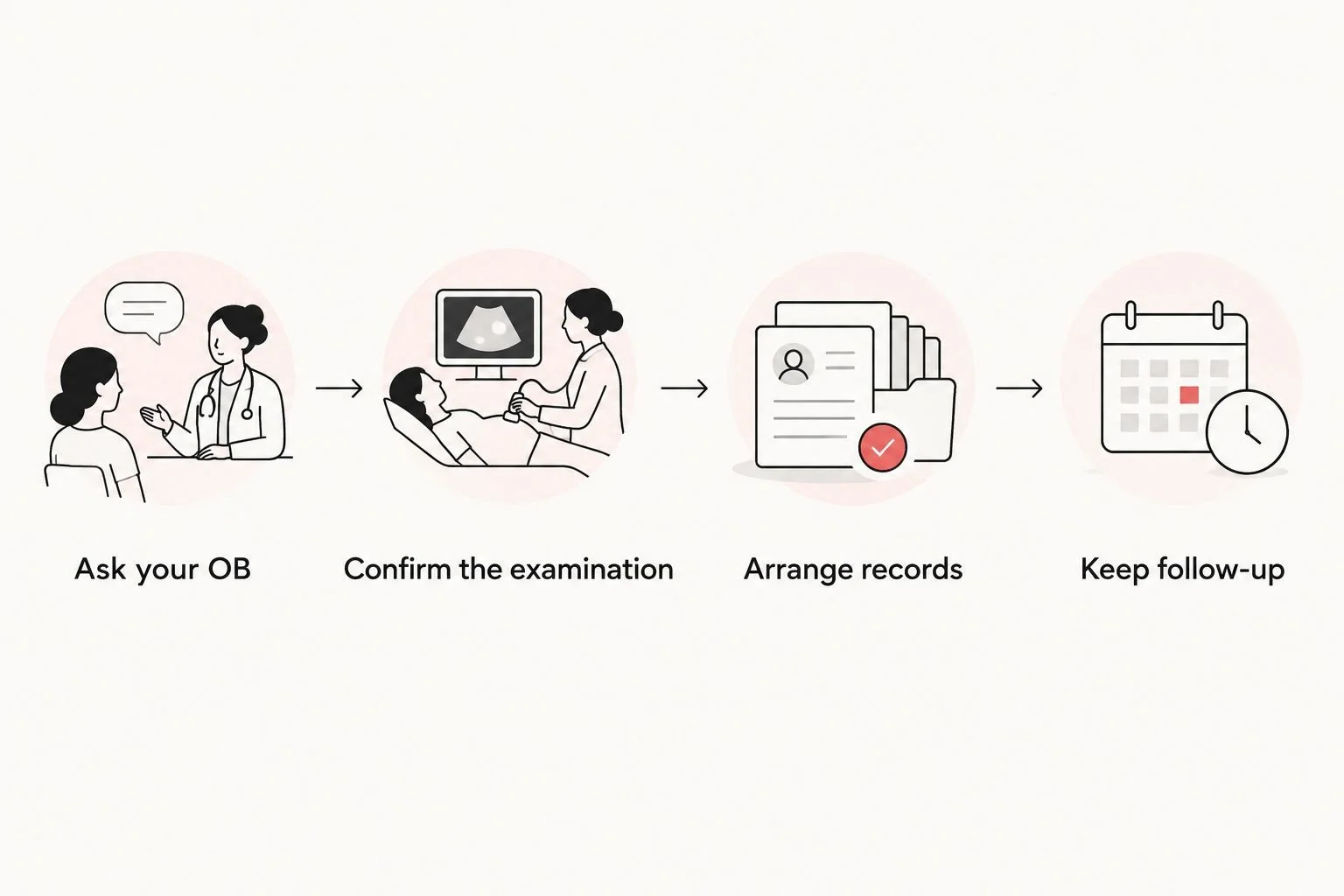
Confirm the examination and records process before changing your prenatal schedule.
When contacting The Ultrasound Concierge, explain whether you want elective images or an examination requested by your OB. That distinction gives the conversation a clear starting point without assuming a particular appointment includes diagnostic reporting or records transfer.
You can also ask your OB’s office to put its imaging requirements in writing. A clear request is more useful than trying to relay technical details from memory.
Will my OB use the due date from a private scan?
Your OB decides which estimated due date belongs in your pregnancy record. A private scan’s displayed age or date is information for review, not an automatic change to your prenatal chart.
Your clinician considers the timing and quality of the scan alongside other dating information. For pregnancies conceived through assisted reproduction, treatment dates also matter. Give the office your fertility records rather than asking a separate scan to override them.
Once your clinician establishes the estimated due date, later size differences do not automatically mean the date was wrong. Ask your OB to explain any discrepancy before changing the due date in your pregnancy app or sharing a revised date with other providers.
Does an early private scan replace the anatomy scan too?
No—dating and anatomy assessment answer different clinical questions. ACOG’s patient guidance, Ultrasound Exams, describes the standard second-trimester ultrasound as typically performed at 18–22 weeks. An early dating examination does not provide that later assessment.
A later elective viewing session also does not replace the anatomy examination simply because it produces recognizable facial images. Follow your prenatal clinician’s imaging plan, including additional examinations recommended for your circumstances.
What if the private scan is too early to show much?
An inconclusive early scan needs clinical follow-up, not a conclusion based on missing images alone. Your dates, symptoms, ultrasound findings, and sometimes blood tests help your clinician decide what to do next.
Do not interpret an empty-looking image or the absence of visible cardiac activity without clinical context. Contact your prenatal team for a follow-up plan rather than scheduling repeated elective scans to answer a medical question.
When should you seek medical care instead?
Do not wait for a private scan if you have severe or worsening abdominal or pelvic pain, heavy bleeding, fainting, or shoulder pain with pregnancy concerns. These symptoms can require urgent assessment, including evaluation for ectopic pregnancy. Seek emergency care for severe symptoms.
For less severe bleeding, pain, or other concerns, contact your prenatal clinician promptly for instructions. An elective ultrasound is not an emergency assessment, and a previously reassuring scan does not explain a new symptom.
FAQ
Can a private ultrasound replace my OB’s dating scan in 2026?
A private diagnostic ultrasound can replace the requested imaging only if your OB confirms that the examination and its documentation meet your care needs. An elective keepsake scan cannot replace diagnostic dating or prenatal care.
Does seeing a heartbeat mean I can skip my OB appointment?
No, seeing cardiac activity does not replace your OB appointment. Your prenatal team still needs to address your history, testing, symptoms, and follow-up.
How accurate is an early ultrasound for pregnancy dating?
First-trimester crown–rump length dating has an accuracy of approximately 5–7 days, according to ACOG’s guidance on estimating the due date. Your clinician interprets that estimate alongside your history and other relevant records.
Can a 3D or 4D ultrasound tell me my official due date?
A 3D or 4D label does not establish that an appointment includes diagnostic dating. Your prenatal clinician determines the estimated due date used in your medical record after reviewing appropriate clinical information.
Should I cancel my OB scan after having a private ultrasound?
Do not cancel your OB scan until your OB confirms that the outside examination is sufficient. Sending images does not by itself confirm that the requested assessment is complete.
Do I need a referral for a private diagnostic pregnancy scan?
Confirm referral or order requirements with both the imaging provider and your OB before booking. Do not assume that the rules for an elective session also apply to a diagnostic examination.
Can The Ultrasound Concierge take over my prenatal care?
The Ultrasound Concierge provides diagnostic and elective imaging, not a replacement for ongoing prenatal care. Keep your OB or other prenatal clinician involved in interpreting findings and planning follow-up.
One last thing
The most useful question is not whether you can get an ultrasound somewhere else. It is whether that examination answers the question your OB needs answered. Before changing a 2026 appointment, ask your prenatal office to confirm that it has received and accepted the outside results—not simply that the images arrived.