
No—an ultrasound estimates your due date; it cannot determine the exact day you will give birth. An early diagnostic ultrasound gives the most accurate ultrasound-based estimate of gestational age, but measurement accuracy and the timing of labor are different things. For your pregnancy planning in 2026, treat the date as a clinical reference point, not a guaranteed birthday.
TL;DR
Can an ultrasound determine exact due date? No—pregnancy dating estimates gestational age, not the day labor starts.
ACOG identifies first-trimester ultrasound as the most accurate ultrasound method for establishing or confirming gestational age.
Later measurements assess growth; they do not automatically replace an established due date.
Ask your prenatal clinician which estimated due date belongs in your medical record.
Before choosing ultrasound services, ask whether the appointment provides diagnostic pregnancy dating or elective images. Those visits serve different purposes.
Can an ultrasound determine your exact due date?
Ultrasound can help establish your estimated due date, but it cannot predict your exact delivery date. The scan measures pregnancy development, and your prenatal clinician interprets those measurements alongside your menstrual history, earlier imaging, and fertility-treatment records when applicable.
The American College of Obstetricians and Gynecologists, together with the American Institute of Ultrasound in Medicine and the Society for Maternal-Fetal Medicine, explains this distinction in Committee Opinion No. 700, Methods for Estimating the Due Date. That guidance is the clinical reference for the dating principles summarized in this 2026 guide.
Last menstrual period
Best for: An initial estimate when cycle dates are reliable
Main strength: Provides a starting point before imaging
Main limitation: Depends on menstrual recall and assumptions about ovulation
First-trimester ultrasound
Best for: Establishing or confirming early pregnancy dating
Main strength: Most accurate ultrasound-based dating method
Main limitation: Still estimates gestational age rather than delivery day
Second-trimester ultrasound
Best for: Dating when reliable early information is unavailable
Main strength: Uses several fetal measurements
Main limitation: Has greater dating uncertainty than an early scan
Third-trimester ultrasound
Best for: Assessing fetal size and growth
Main strength: Helps evaluate development later in pregnancy
Main limitation: Least reliable ultrasound period for establishing gestational age
Your clinician selects the best obstetric estimate rather than treating every method as equally precise. Once that estimate is established, changing it requires a clinical reason.
Why this matters
Your due date helps your care team schedule screening, interpret growth, and make decisions near the end of pregnancy. A date that changes casually between appointments creates confusion about what a measurement actually means.
The practical priority in 2026 is not finding a scan that promises an exact birthday. It is making sure your prenatal team has the earliest reliable dating information and documents one clear estimate.
A due date also differs from a planned delivery date. An induction or cesarean appointment reflects a care plan; it does not prove that an ultrasound predicted when spontaneous labor would begin.
First-trimester dating: about 5–7 days of uncertainty
First-trimester ultrasound dating has an accuracy of approximately plus or minus 5–7 days, according to ACOG's dating guidance. That figure describes uncertainty in estimated gestational age—not a promise that birth will occur within that interval around your due date.
Early dating commonly uses crown-rump length, which measures the embryo or fetus from the top of the head to the bottom of the torso. The measurement is useful because early development is more consistent than fetal size later in pregnancy.
An examination performed very early does not always provide a measurable embryo. If the necessary structures are not yet visible, your clinician determines whether follow-up imaging is needed rather than assigning certainty to an incomplete examination.
Best for: establishing or confirming pregnancy dates when an adequate early measurement is available. Its limitation is straightforward: even a well-performed early scan cannot reveal the day labor will start.
Second-trimester dating: about 7–14 days of uncertainty
Second-trimester ultrasound dating has approximately 7–14 days of uncertainty, depending on how far along the pregnancy is. ACOG describes greater precision earlier in this trimester and less precision as pregnancy advances.
The examination uses measurements such as head size, abdominal circumference, and femur length. These measurements help estimate gestational age when reliable early dating is unavailable, but they also reflect fetal size.
If an early diagnostic scan already established your due date, a later measurement that differs does not automatically mean the original date was wrong. Your clinician evaluates the difference in the context of growth and the earlier record.
Best for: estimating gestational age when reliable first-trimester information is missing. The trade-off is wider uncertainty than early dating, so preserving earlier reports remains useful even when you have newer images.
Third-trimester dating: about 21–30 days of uncertainty
Third-trimester ultrasound is the least reliable ultrasound method for establishing gestational age, with approximately 21–30 days of uncertainty under ACOG's guidance. By this stage, differences in fetal size make dating from measurements more difficult.
A fetus measuring smaller than expected needs clinical interpretation, not an automatic later due date. Redating without considering growth risks confusing a size difference with a younger pregnancy.
The same principle applies when a fetus measures larger than expected. The measurement does not independently establish an earlier conception date or prove that delivery will happen sooner.
Best for: evaluating fetal size and growth within your prenatal care plan. Its limitation is poor precision for establishing a new pregnancy timeline, especially when a reliable earlier estimate already exists.
Why ultrasound due-date estimates vary
The main drivers involve when measurements are taken and which information supports them. A difference between dates deserves explanation, but it does not by itself establish a problem.
Scan timing: Early measurements provide more precise dating than measurements taken later in pregnancy.
Menstrual history: An uncertain last period or irregular cycles makes a menstrual-date estimate less dependable.
Ovulation timing: A calendar calculation assumes a pattern that does not match every cycle.
Measurement conditions: Fetal position, image quality, and the ability to obtain the required measurement affect interpretation.
Growth differences: Later fetal size reflects individual growth as well as gestational age.
Fertility-treatment records: Embryo age and transfer timing provide information that changes how the due date is established.
These factors explain why an app, a menstrual calendar, and an ultrasound report can show different estimates. Your prenatal clinician reconciles the information rather than asking you to choose whichever date feels most plausible.
How does your clinician decide which date to use?
Your prenatal clinician combines the available history with the earliest reliable diagnostic findings. The date in your prenatal record should be a documented clinical decision, not simply the newest date displayed on a scan.
Review menstrual history. Share the first day of your last period and explain whether your cycles are regular or the date is uncertain.
Review early imaging. Provide the actual report, including the examination date, measurements, and estimated gestational age—not only a keepsake image.
Review treatment records. If you conceived through IVF, supply embryo-transfer details so your clinician can apply assisted-reproduction dating.
Confirm the estimate. Ask which estimated due date your care team will use and whether any revision needs to be documented.
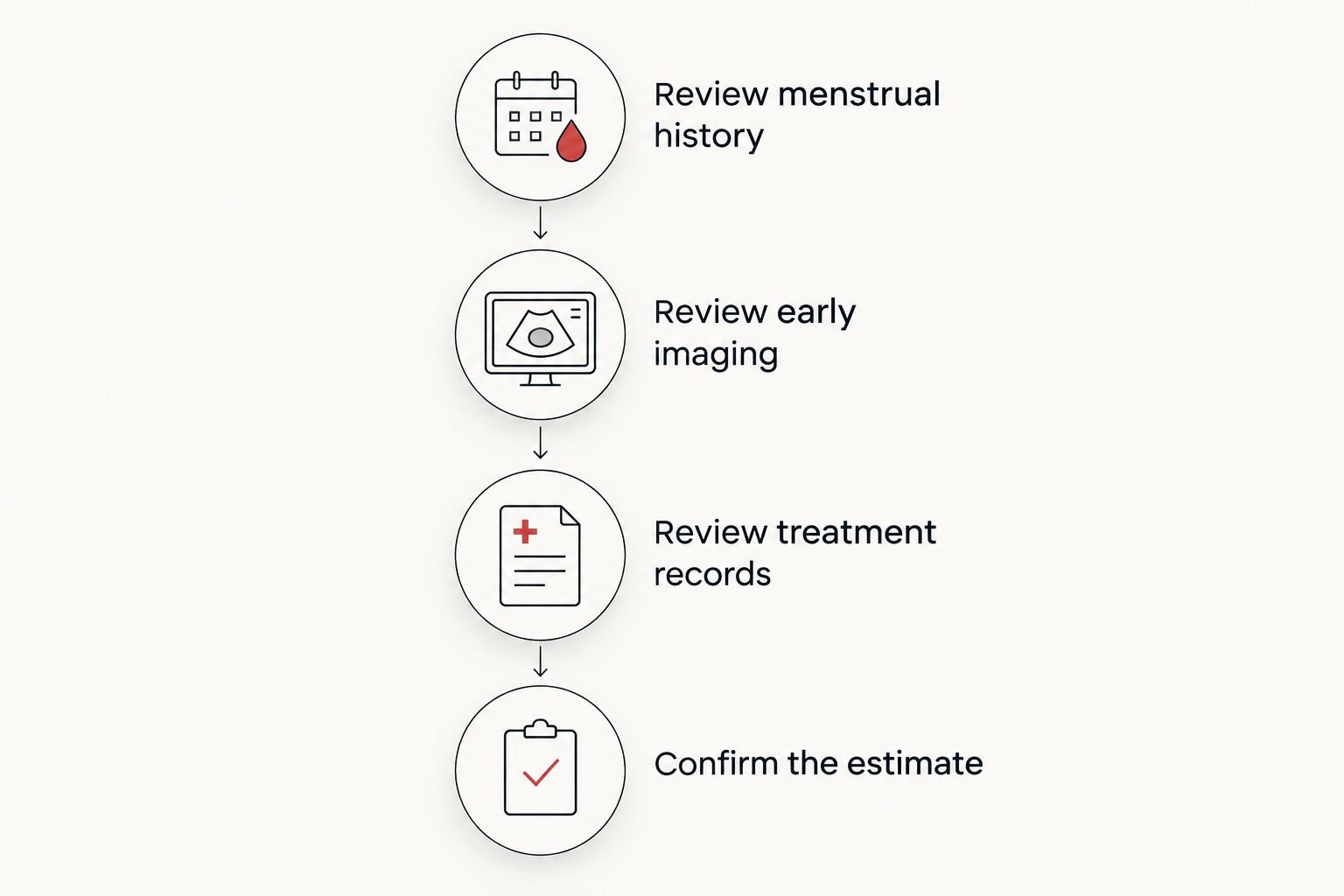
Your clinician reconciles the records before confirming the estimated due date.
For a pregnancy beginning or continuing in 2026, keep these records together when transferring care or attending appointments at different facilities. A short written explanation of the established date helps prevent conflicting calendar entries.
Does a due date mean pregnancy lasts exactly 40 weeks?
40 weeks is the conventional reference used to calculate an estimated due date from the first day of the last menstrual period. That equals 280 days, using a standard calculation that assumes a 28-day menstrual cycle and ovulation around the middle of that cycle.
Those assumptions do not describe every pregnancy. Irregular cycles, uncertain menstrual dates, or later ovulation explain why an early ultrasound sometimes supports a different estimate.
Gestational age also is not the same as time since fertilization. The pregnancy calendar starts before conception under the usual menstrual-dating convention, so being a certain number of weeks pregnant does not identify an exact conception day.
Can a later scan change my due date?
A later scan can lead your clinician to reconsider a due date, but it should not automatically replace reliable early dating. The decision depends on the timing of the examinations, the size of the discrepancy, and the quality of the earlier information.
Ask whether the new report describes ultrasound-estimated age, size relative to the established date, or a formally revised due date. Those are different findings, even when the screen displays a calendar date beside each measurement.
If your clinician changes the estimate, ask for the reason and the updated date in writing. That makes the change understandable across your prenatal appointments.
Is a 3D or 4D ultrasound better for pregnancy dating?
A 3D or 4D image does not make a due date exact. Clinical dating depends on appropriate measurements, examination timing, and interpretation—not on how detailed a facial image looks.
Elective imaging and diagnostic pregnancy dating have different purposes. An elective session does not replace the prenatal examinations your clinician recommends or settle a disagreement about gestational age.
Choose an appointment based on the question you need answered. For dating concerns, ask specifically about diagnostic evaluation and how the findings will reach your prenatal clinician.
Choosing a private ultrasound appointment
The Ultrasound Concierge is best for patients in Keller and Willow Park seeking private, personalized ultrasound care. The practice provides diagnostic and elective imaging; the relevant choice for a dating question is whether the appointment addresses that clinical purpose.
Before arranging pregnancy ultrasound care with The Ultrasound Concierge in 2026, explain whether you need an initial estimate, clarification of conflicting dates, or elective images. Ask what records to bring and how to coordinate the examination with your prenatal team.
The limitation applies to private ultrasound care everywhere: no setting can promise an exact delivery date. A calm visit supports your experience, but it does not remove the uncertainty inherent in pregnancy dating.
Ask about pregnancy ultrasound care
Explain your dating question and ask which type of appointment fits your needs.
FAQ
Can an ultrasound tell me the exact day my baby will arrive?
No—ultrasound estimates gestational age and an estimated due date, not the exact day of birth. The timing of labor remains separate from how accurately the pregnancy is dated.
What's the most accurate ultrasound for estimating my due date?
First-trimester diagnostic ultrasound is the most accurate ultrasound method for establishing or confirming gestational age. ACOG describes approximately plus or minus 5–7 days of dating accuracy, which is not a guaranteed delivery window.
Is my ultrasound due date better than my period-based due date?
An early ultrasound can provide a more dependable estimate when your menstrual date is uncertain or your cycles are irregular. Your prenatal clinician compares both sources before confirming the date used for care.
Can an ultrasound tell me my exact conception date?
No—ultrasound measurements do not identify the exact day of conception. They estimate gestational age, which follows a different calendar convention from time since fertilization.
Should I change my due date if my baby measures ahead?
No—do not change your due date yourself because a later scan shows larger measurements. Ask your prenatal clinician whether the finding concerns growth, measurement variation, or a reason to review the original dating.
Is an IVF pregnancy dated differently?
Yes—IVF pregnancy dating uses the embryo's age and the transfer date. Your prenatal clinician uses those treatment records rather than replacing them casually with a later size-based estimate.
Can I use an elective scan instead of a diagnostic dating scan?
No—an elective imaging session does not replace a diagnostic examination recommended for pregnancy dating. Ask The Ultrasound Concierge which appointment addresses your question and coordinate clinical decisions with your prenatal clinician.
One last thing
An ultrasound report can display an age calculated from today's measurements while your established due date remains unchanged. Ask, “Is this my official due date, or the age suggested by these measurements?” That distinction prevents a normal-looking date field from becoming an unnecessary source of worry.
Keep the answer with your pregnancy records in 2026. The most useful date is the one your prenatal team has explained and documented—not a promise that your baby must arrive on schedule.