
An ultrasound is often useful around 6–8 weeks of pregnancy, which is roughly 2–4 weeks after a positive test taken around your missed period; your clinician can recommend earlier imaging when symptoms or medical history call for it. A scan immediately after a positive test can be inconclusive, and pain, bleeding, faintness, or shoulder pain needs medical assessment rather than waiting for a routine appointment.
TL;DR
Wondering how soon after positive pregnancy test can you get an ultrasound? Pregnancy weeks matter more than days since testing.
Around 6–8 weeks, an early pregnancy ultrasound often provides more information than a scan immediately after testing.
The Ultrasound Concierge offers private pregnancy imaging; confirm the appropriate diagnostic appointment with your prenatal clinician.
Severe pain, fainting, shoulder pain, or heavy bleeding requires urgent medical assessment, not an elective reassurance scan.
Why this matters
A positive pregnancy test and an ultrasound answer different questions. The test detects a pregnancy hormone; ultrasound helps assess pregnancy location and development when the pregnancy is far enough along to see.
An earlier appointment does not automatically provide an earlier answer. Before booking pregnancy imaging in 2026, ask your prenatal clinician what the scan needs to establish, then review the available ultrasound services for the appropriate appointment type.
How soon after a positive pregnancy test can you get an ultrasound?
You can receive an ultrasound soon after a positive pregnancy test when medically indicated. For someone without concerning symptoms, imaging around 6–8 weeks of pregnancy often gives more useful information than imaging immediately after the first positive result.
Pregnancy dating starts from the first day of your last menstrual period, not the day you conceived or tested positive. If you test around your missed period, you are often already about 4 weeks pregnant, although irregular cycles and later ovulation change that estimate.
Use this comparison to understand the purpose and limits of different appointment windows. These are general developmental expectations, not deadlines that every pregnancy must meet.
Immediately after a positive test
Best for: A clinician-directed evaluation when symptoms or history warrant it
What ultrasound can help assess: Findings interpreted alongside symptoms and blood tests
Main limitation: The pregnancy can be too small to locate or assess
Around 5 weeks pregnant
Best for: Clinician-directed assessment of pregnancy location
What ultrasound can help assess: An early gestational sac is sometimes visible with transvaginal imaging
Main limitation: An embryo or cardiac activity is not necessarily visible
Around 6–8 weeks pregnant
Best for: Early assessment of location, dating, and development
What ultrasound can help assess: An embryo and cardiac activity are often visible
Main limitation: Incorrect dates or limited views can still require follow-up
Any stage with concerning symptoms
Best for: Prompt medical evaluation
What ultrasound can help assess: Assessment for complications, including ectopic pregnancy
Main limitation: A routine or elective appointment is not a substitute for urgent care
The American College of Obstetricians and Gynecologists explains in its guidance on early pregnancy loss that a single ultrasound or blood test is not always enough to make a diagnosis. An inconclusive early scan needs a follow-up plan, not a conclusion based on the calendar alone.
Around 5 weeks: an early look with important limits
At around 5 weeks of pregnancy, transvaginal ultrasound sometimes shows a gestational sac inside the uterus. This is an early finding, not a complete assessment of how the pregnancy will develop.
A sac-like structure alone does not answer every question about pregnancy location or viability. The interpreting clinician considers the appearance, other structures, your symptoms, and any blood-test results before deciding what the finding means.
If you are arranging your first scan in 2026, ask what an appointment at this stage is expected to establish. Going in with a specific clinical question is more useful than expecting a heartbeat simply because the pregnancy test is positive.
Best for: clinician-directed early evaluation. Limitation: you can leave without a definitive answer and need another scan.
Around 6–8 weeks: often a more informative first scan
At around 6–8 weeks of pregnancy, ultrasound often provides a clearer assessment of pregnancy location, an embryo, and cardiac activity. Once an embryo is visible, its measurements can help establish pregnancy dating.
This window is not a guarantee. Ovulation later than expected, uncertain menstrual dates, and the type of ultrasound all affect what appears on the screen.
If cardiac activity is your main question, read how soon a heartbeat can be seen on ultrasound. Your clinician must interpret the finding in relation to measurements and the overall examination, not an app's estimated week alone.
Best for: an early assessment when your clinician recommends it. Limitation: even a reassuring scan cannot guarantee the outcome of the pregnancy or replace ongoing prenatal care.
Why the right ultrasound timing varies
The right appointment depends on the pregnancy and the question being asked. When planning an early pregnancy ultrasound in 2026, discuss these factors with your clinician:
Menstrual dates: An uncertain last period makes calendar-based pregnancy estimates less reliable.
Ovulation timing: Later ovulation means the pregnancy can be earlier than your period-based estimate suggests.
Symptoms: Bleeding or pelvic pain changes the need for assessment, even before a routine scan would be informative.
Medical history: A previous ectopic pregnancy or fertility treatment can change the monitoring plan.
Scan approach: Transvaginal imaging generally provides more detail than abdominal imaging in very early pregnancy.
Clinical question: Confirming location, assessing development, and creating keepsake images are different goals.
Do not select a date solely because someone else saw cardiac activity at that same week. Their dating, examination method, and clinical circumstances are not yours.
Transvaginal or abdominal ultrasound: which is more useful early?
Transvaginal ultrasound generally provides clearer views in very early pregnancy. The probe sits closer to the uterus, which helps when the structures being assessed are still small.
An abdominal ultrasound uses a probe over your lower abdomen. It avoids an internal examination, but early pregnancy structures can be harder to see through the abdominal wall.
Transvaginal ultrasound
Best for: Detailed assessment in very early pregnancy
Main benefit: Closer views of the uterus and early pregnancy structures
Main limitation: Involves an internal examination and requires your consent
Transabdominal ultrasound
Best for: Assessment when the pregnancy is visible through the abdomen
Main benefit: Imaging without an internal probe
Main limitation: Can provide less detail early and sometimes requires a fuller bladder
You can ask why a particular approach is recommended, what it involves, and what alternatives exist. If you decline an internal examination, ask how that affects the information available and the follow-up plan.
Neither approach uses ionizing radiation. Medical ultrasound should still have a clear purpose and be performed by appropriately trained professionals; more scanning is not automatically better care.
What should you do after your first positive test?
For your 2026 appointment, start with a clinical plan rather than booking the earliest open scan. These steps help connect the timing to the information you need.
Check symptoms. Tell a healthcare professional about bleeding, pelvic pain, dizziness, or other concerning changes. Severe symptoms need urgent assessment.
Contact prenatal care. Share the positive result, the first day of your last period, and relevant pregnancy or fertility history.
Confirm scan purpose. Ask whether the goal is pregnancy location, dating, development, or evaluation of symptoms.
Confirm scan approach. Ask whether early transvaginal imaging is appropriate and what preparation the facility requires.
Arrange follow-up. Find out who interprets the examination, who receives the report, and who explains an uncertain result.
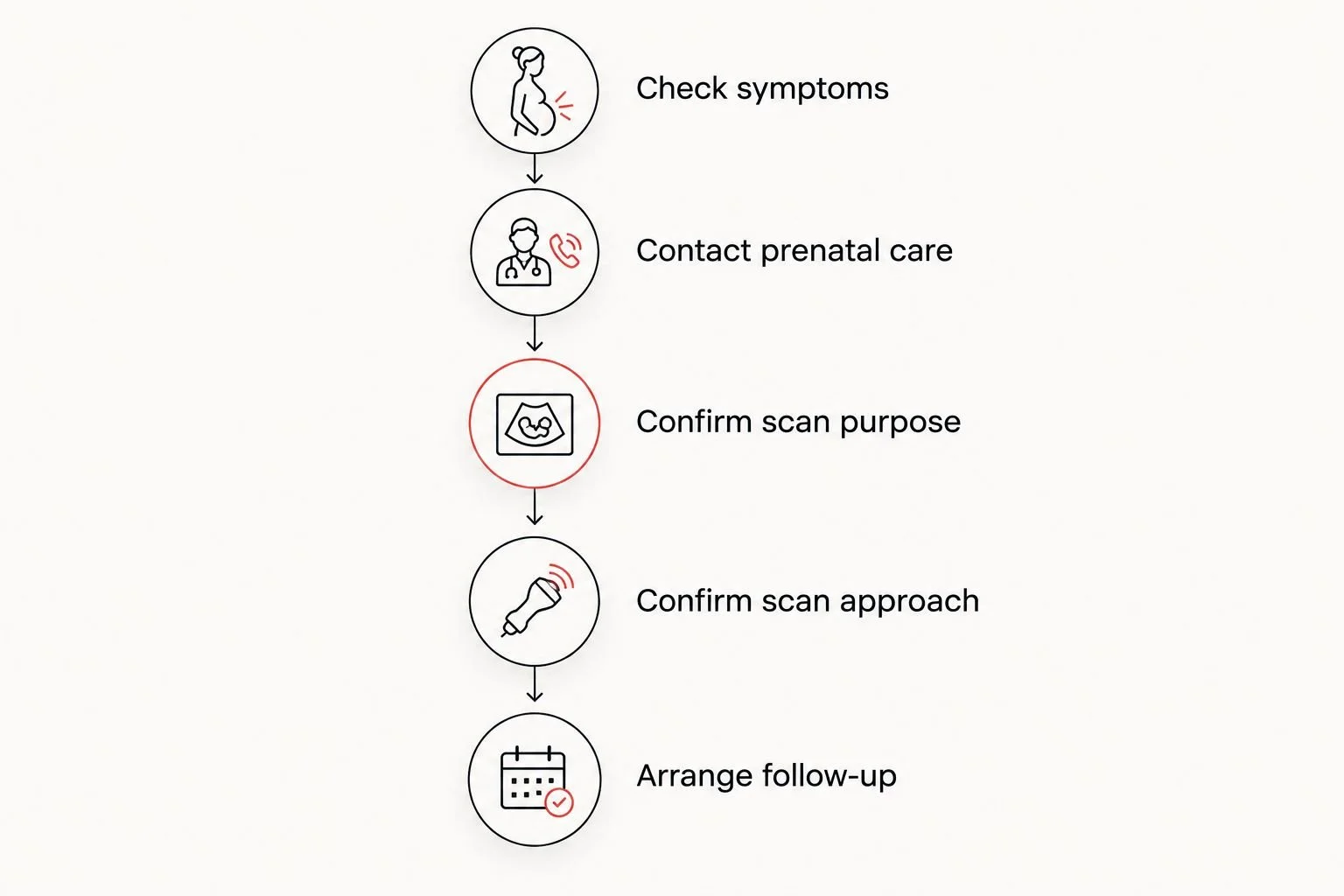
Choose the scan timing around the clinical question and a clear follow-up plan.
Keep the date of your positive test and any previous results available. If you received fertility treatment, follow the fertility clinic's dating and monitoring instructions rather than calculating an appointment from a home test alone.
What if the ultrasound does not show a pregnancy yet?
A positive test with no pregnancy identified on ultrasound needs clinical follow-up. It can reflect a pregnancy that is too early to see, a pregnancy loss, or an ectopic pregnancy; the scan alone does not settle which explanation applies.
Clinicians sometimes call this a pregnancy of unknown location. That phrase describes an unresolved finding, not a final diagnosis.
Your clinician can use repeat ultrasound and serial pregnancy-hormone blood tests to clarify the situation. A single hormone value does not, by itself, establish pregnancy location or prove that the pregnancy is developing normally.
Before leaving, ask who will review the results and what symptoms require immediate care. If symptoms worsen, seek assessment rather than waiting for the planned follow-up date.
When should you seek care instead of waiting for a scan?
Severe or worsening abdominal or pelvic pain, fainting, marked dizziness, shoulder-tip pain, or heavy bleeding requires urgent medical assessment. These symptoms can occur with an ectopic pregnancy or other complications, including before ultrasound has confirmed a pregnancy in the uterus.
Call emergency services or go to an emergency department for severe symptoms. Do not drive yourself if you feel faint or unstable.
For milder bleeding or discomfort, contact your prenatal clinician promptly for individualized advice. Symptoms alone cannot confirm whether a pregnancy is healthy, and an elective reassurance scan is not an emergency evaluation.
Can a private ultrasound replace your first prenatal visit?
A private ultrasound does not replace your first prenatal visit. Prenatal care also covers medical history, medications, laboratory testing, and planning for the rest of the pregnancy.
The Ultrasound Concierge is suited to patients in Keller and Willow Park seeking private pregnancy ultrasound imaging. The service offers a calm, personalized setting; the boundary is that private imaging does not replace a prenatal clinician's ongoing assessment or emergency care.
Before choosing a diagnostic appointment with The Ultrasound Concierge, confirm that it addresses your clinician's question, whether a referral is required, and how results reach the clinician responsible for your care. Do not assume an elective imaging visit includes a diagnostic evaluation.
Ask about pregnancy ultrasound appointments
Confirm the scan type, preparation, and reporting process before choosing an appointment.
FAQ
Can I get an ultrasound the day after a positive pregnancy test?
You can have an ultrasound the day after a positive test when a clinician recommends it, but it can be too early to see the pregnancy. Symptoms and medical history determine whether immediate evaluation is needed.
How many weeks pregnant am I when my test turns positive?
You are often around 4 weeks pregnant when a test becomes positive near your missed period. Pregnancy dating starts from the first day of your last menstrual period, so irregular cycles and later ovulation affect the estimate.
Is 5 weeks too early for an ultrasound?
At 5 weeks, ultrasound can be useful for a clinician-directed assessment, but it often cannot answer every question about development. A gestational sac is sometimes visible with transvaginal imaging, while an embryo or cardiac activity is not necessarily visible yet.
Will I definitely see a heartbeat at 6 weeks?
At 6 weeks, cardiac activity is often visible with transvaginal ultrasound, but it is not guaranteed. Your clinician interprets the scan using measurements, dating, and other findings before deciding whether follow-up is needed.
Should I wait for my appointment if I have pain or bleeding?
Do not wait for a routine appointment if you have severe pain, fainting, shoulder-tip pain, or heavy bleeding; seek urgent medical assessment. Contact your clinician promptly about milder pain or bleeding as well.
Do I need a full bladder for an early pregnancy ultrasound?
Bladder preparation depends on the ultrasound approach. Abdominal imaging sometimes requires a fuller bladder, while transvaginal imaging usually uses an empty bladder; follow the facility's instructions.
Can The Ultrasound Concierge replace my OB appointment?
The Ultrasound Concierge provides pregnancy imaging, not a replacement for ongoing prenatal care. Confirm the appropriate scan type and reporting arrangements with the team and your prenatal clinician.
One last thing
The most useful appointment is the one with a clear question and a clear next step—not simply the earliest date. For your first scan in 2026, ask: What should this examination establish, and what happens if the result is uncertain?
That conversation helps you distinguish a planned follow-up from an unexpected problem. You deserve an explanation of both what the scan shows and what it cannot yet tell you.