
How long do you need to wait between ultrasound scans?
There is no universal minimum waiting period between ultrasound scans; the right interval depends on what your clinician needs to assess and what the previous scan showed. A medically necessary repeat scan should follow your care plan, while an elective scan should never replace an examination for new symptoms or an unresolved medical concern.
TL;DR
How long between ultrasound scans depends on the clinical question, not a universal waiting period.
FDA guidance discourages ultrasound performed solely for pregnancy keepsake images; spacing alone does not establish safety.
Early pregnancy and fertility ultrasound follow-up should follow the treating clinician’s instructions.
New or worsening symptoms need medical assessment, not a later elective ultrasound appointment.
The Ultrasound Concierge is best for patients in Keller and Willow Park seeking private ultrasound imaging. Diagnostic appointments and elective pregnancy visits serve different purposes, so confirm which you need before choosing a date.
How long do you need to wait between ultrasound scans?
Wait for the interval your treating clinician recommends, rather than applying a fixed rule to every ultrasound. Ultrasound does not use ionizing radiation, but that does not make every additional examination necessary. The timing should match a question that imaging can answer.
Early pregnancy follow-up
What determines the interval: Previous findings, pregnancy dating, and symptoms
Best for: Clarifying an uncertain early finding
Benefit and limitation: A repeat examination can clarify development; repeating too soon can leave the same uncertainty.
Pregnancy growth monitoring
What determines the interval: The monitoring plan and previous measurements
Best for: Tracking growth when clinically indicated
Benefit and limitation: Comparison helps assess growth; measurements need an appropriate interval to be meaningful.
Fertility monitoring
What determines the interval: Cycle stage, treatment, and clinic instructions
Best for: Guiding fertility treatment
Benefit and limitation: Timely scans support treatment decisions; a generic waiting rule can disrupt the plan.
General diagnostic ultrasound
What determines the interval: The organ being examined and the clinical question
Best for: Investigating or following a medical concern
Benefit and limitation: A repeat scan can answer a specific question; ultrasound is not the right test for every condition.
Elective pregnancy imaging
What determines the interval: Prenatal care, medical advice, and the purpose of the visit
Best for: Discussing optional pregnancy images
Benefit and limitation: Images can be meaningful to families; an elective visit does not replace diagnostic prenatal care.
These distinctions apply in 2026 whether your appointment is at a hospital, an imaging center, or a private ultrasound practice. The setting does not determine the medically appropriate interval.
Why this matters
An ultrasound appointment and a follow-up plan are not the same thing. A calendar opening tells you when a provider can see you; it does not tell you when a repeat examination will answer your medical question.
Repeating an examination too soon can mean another inconclusive result. Delaying a recommended examination can postpone an assessment your clinician needs for treatment or monitoring. The useful question is not simply whether you can have another scan, but what that scan is expected to establish.
For your 2026 care plan, keep the previous report and the follow-up instructions together. If the instructions are unclear, contact the clinician who requested the scan before booking another one.
Early pregnancy follow-up: use the previous findings
An early pregnancy scan can leave questions unanswered because the pregnancy is earlier than expected or because the findings need further assessment. Your clinician interprets those findings alongside your symptoms, pregnancy history, and any other relevant testing.
The route of the examination matters, too. A transvaginal ultrasound and an abdominal ultrasound do not provide identical views in early pregnancy, so their follow-up instructions are not interchangeable.
Ask what the next examination is intended to confirm. Is the clinician checking pregnancy location, looking for expected development, or reassessing a finding that was uncertain? Knowing the purpose helps you understand why a particular date was recommended.
Do not shorten an early-pregnancy follow-up interval solely to obtain reassurance. An examination performed before an expected change is visible can repeat the uncertainty rather than resolve it. However, new symptoms require medical advice even if your planned repeat scan is still ahead.
Pregnancy growth monitoring: follow the monitoring plan
Growth assessment relies on comparing measurements over time. Your maternity clinician chooses the interval based on the reason for monitoring, the previous findings, and the wider pregnancy assessment.
Not every pregnancy ultrasound is a growth scan. An examination checking another concern can have a different timetable from one intended to measure growth. That distinction explains why two patients at a similar stage of pregnancy can receive different follow-up instructions.
Ask whether your next appointment is for growth, anatomy, fluid assessment, or another specific purpose. You do not need to interpret the measurements yourself; you need to know what the appointment contributes to your care.
For pregnancy monitoring in 2026, keep the schedule set by your maternity team unless that team changes it. An elective appointment between medical examinations does not reset or replace that schedule.
Fertility ultrasound: let the treatment schedule lead
Fertility ultrasound timing depends on the treatment plan and what your clinic is monitoring. Follicle development and the uterine lining can inform treatment decisions, so follow-up timing is tied to your cycle rather than a general ultrasound waiting period.
Do not postpone a fertility scan because you recently had another ultrasound. Contact your fertility clinic if an appointment conflicts with work, travel, or another medical visit; the clinic needs to decide how to adjust the schedule.
The advantage of repeated monitoring is that it gives the treating team information relevant to the current cycle. Its limitation is that an isolated image, without the treatment context, does not provide a complete plan.
Before using a separate imaging provider, ask your fertility clinic what examination and reporting details it requires. Confirm where the report should go and who will review it before any treatment decision.
General diagnostic ultrasound: match the scan to the question
Abdominal, pelvic, and other diagnostic ultrasound examinations do not share a single repeat interval. Follow-up depends on the finding being assessed, whether symptoms have changed, and whether ultrasound remains the appropriate test.
An unchanged medical concern does not automatically require another scan. Equally, a recent normal examination does not rule out every cause of new symptoms. Your clinician decides whether you need repeat imaging, a different test, or an examination first.
Ask what the repeat diagnostic ultrasound will change about your care. A clear answer might involve checking an unresolved finding or assessing a response to treatment. If you are unsure why the repeat was requested, clarify the purpose rather than cancelling it yourself.
Bring the previous report when you attend another provider. Comparing examinations requires more than knowing that your last scan was described as normal.
Elective pregnancy ultrasound: spacing is not a safety guarantee
There is no calendar interval that turns an unnecessary pregnancy ultrasound into a medically indicated examination. The FDA discourages ultrasound performed solely to create fetal keepsake images, and the American Institute of Ultrasound in Medicine supports prudent use by appropriately trained professionals.
Ultrasound energy can produce biological effects, so responsible practice considers the reason for the examination, exposure settings, and examination time. Waiting longer between visits is not a substitute for appropriate use. This remains the relevant safety distinction when planning an elective visit in 2026.
The Ultrasound Concierge offers diagnostic and elective pregnancy ultrasound services. Confirm the purpose of the appointment, how it fits with your prenatal care, and where medical questions should be directed. The limitation of an elective visit is clear: it does not replace a diagnostic examination or your maternity team’s advice.
If you are considering repeat elective visits, read about 3D/4D ultrasound safety across pregnancy trimesters. Keep the decision connected to your clinical care rather than treating each trimester as an automatic reason for another scan.
Why the interval between ultrasound scans varies
The next appointment should reflect the circumstances of the examination, not a rule borrowed from someone else’s pregnancy or treatment.
Clinical purpose: Checking early pregnancy development is different from monitoring fertility treatment or examining an abdominal concern.
Previous findings: A clearly answered question and an unresolved finding require different follow-up decisions.
Pregnancy or cycle stage: The timing affects what the examination can show and how the findings are interpreted.
Symptoms: New or worsening symptoms can change the need for assessment before a scheduled follow-up.
Examination method: The views available from abdominal and transvaginal examinations differ, particularly in early pregnancy.
Care plan: Treatment decisions and planned monitoring determine when the next report is needed.
How do I choose the right date for a repeat ultrasound?
Use the following sequence before arranging your next appointment. It keeps the scheduling decision connected to the reason for the examination.
Confirm purpose. Ask what the next scan is intended to establish and whether it is diagnostic or elective.
Review findings. Check the previous report and the clinician’s follow-up instructions, rather than relying only on what you remember from the appointment.
Confirm timing. Ask the treating clinician when the next examination should happen and whether that timing depends on other results.
Report symptoms. Tell the clinical team about new or worsening symptoms before deciding to wait for the planned scan.
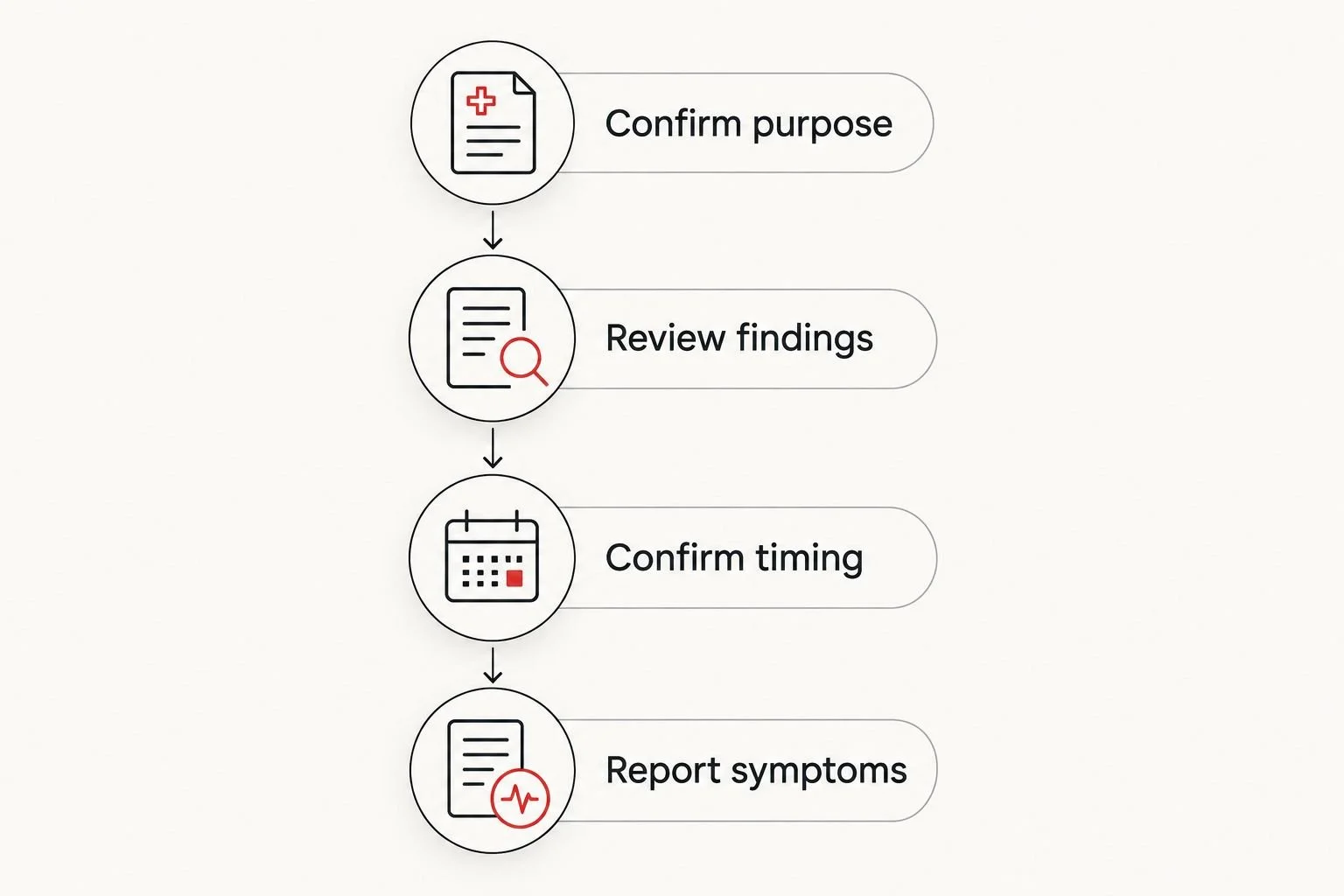
Choose the next appointment from the care plan, not from a generic waiting rule.
Also confirm who will receive the report and who will explain the result. A completed scan still needs the right clinical follow-up; collecting images alone does not finish the process.
Can I have another ultrasound soon after my last one?
Another ultrasound can be appropriate soon after a previous examination when a clinician needs additional information. A recent scan does not create a mandatory waiting period that overrides a medical need.
Do not arrange repeated elective examinations simply because there is no universal minimum interval. The reason for scanning still matters, particularly during pregnancy.
Should I wait if my symptoms change before the next scan?
Do not wait for a scheduled ultrasound when symptoms need urgent medical assessment. During pregnancy, severe abdominal pain, heavy bleeding, fainting, or feeling seriously unwell require urgent care. Reduced or changed fetal movement also requires prompt advice from your maternity team.
A private imaging appointment is not an emergency assessment. Contact the appropriate medical service rather than using an elective scan to decide whether a concerning symptom is serious.
FAQ
How long between ultrasound scans is safe during pregnancy?
There is no universal waiting interval that establishes safety between pregnancy ultrasound scans. Medically indicated examinations should follow your clinician’s plan, and spacing alone does not make elective scanning appropriate.
Can I get another ultrasound after a recent scan?
Yes, another ultrasound can be appropriate after a recent scan when your clinician needs additional information. Ask what the repeat examination will assess and when it should be performed.
Why did my clinician ask me to wait before another early pregnancy scan?
Your clinician can recommend waiting so a repeat examination has a better chance of clarifying development or an uncertain finding. Follow the instructions for your specific report, and seek medical advice if symptoms change.
Is an elective ultrasound the same as a diagnostic ultrasound?
No, an elective pregnancy ultrasound does not replace a diagnostic examination. Diagnostic imaging addresses a medical question and needs appropriate interpretation and follow-up.
Do fertility ultrasound scans need the same spacing as pregnancy scans?
No, fertility ultrasound timing follows the cycle and treatment plan. Follow your fertility clinic’s instructions rather than applying another patient’s pregnancy scan schedule.
Should I wait for my next ultrasound if I have pain or bleeding?
Do not wait for a planned scan if pain, bleeding, or other symptoms need urgent medical assessment. Contact your pregnancy care team, and seek urgent care for severe pain, heavy bleeding, fainting, or feeling seriously unwell.
Can The Ultrasound Concierge replace my scheduled prenatal scans?
An elective pregnancy visit at The Ultrasound Concierge does not replace scheduled diagnostic prenatal scans. Keep your maternity team’s appointments and confirm the purpose of any additional imaging.
One last thing
A repeat ultrasound can be more useful because it happens at the right time, not because it happens sooner. Before booking, ask your clinician what change the next examination is expected to show and who will act on the result.
For your next ultrasound appointment with The Ultrasound Concierge in 2026, keep those questions beside your previous report. That gives the visit a clear purpose while keeping medical decisions connected to your treating team.