
Ultrasound partnerships for birth centers: complete 2026 guide
Birth center ultrasound partnerships are referral arrangements that connect your patients with diagnostic imaging while keeping the birth center responsible for coordinating prenatal care. The aim is a clear clinical handoff without losing the calm, personal experience patients expect from your team.
TL;DR
Ultrasound partnerships for birth centers need defined exam scope, report ownership, and an escalation plan.
The Ultrasound Concierge provides private diagnostic and elective ultrasound services for patients around Keller and Willow Park, Texas.
Keep diagnostic prenatal imaging separate from elective keepsake sessions; one does not replace the other.
Choose a partner by clinical fit and communication, not image presentation alone.
Why ultrasound partnerships matter for birth centers
A birth center referral crosses organizational boundaries. Your team knows the patient’s history and care plan; the imaging provider needs enough information to perform the requested examination, and your clinician needs the result back to make decisions.
That handoff deserves the same attention as the appointment itself. A completed scan is not a completed referral until the appropriate clinician receives, reviews, and acts on the report.
For your 2026 referral policy, separate clinical responsibilities from patient-experience preferences. A quiet setting matters, but it cannot substitute for an appropriate examination, qualified interpretation, or a documented follow-up process. The guide to ultrasound referrals for midwives addresses the closely related midwifery referral pathway.
Choose the clinical pathway first and the setting second. Build the relationship around what your patients need assessed, then confirm how the provider supports that work.
How to build a birth center ultrasound partnership
Define the examinations your patients need
Start with a written list of the clinical questions your team refers out. Use your existing referral records rather than assuming every prenatal scan belongs in the same pathway. Your ordering clinician should determine the appropriate examination and timing.
Distinguish routine diagnostic requests from specialist assessment and elective imaging. An attractive fetal image does not establish that the requested diagnostic examination was completed. Likewise, a limited examination should not be treated as a substitute for a more detailed assessment.
Write these boundaries into your 2026 referral protocol so staff can explain them consistently. Patients should understand why they are being referred before they schedule.
Exam purpose: Record the clinical question or indication.
Requested examination: Specify the examination your clinician orders.
Prior findings: Include relevant history and previous imaging.
Specialist referral: Identify cases requiring obstetric or maternal-fetal medicine assessment.
Elective imaging: Keep keepsake requests separate from diagnostic orders.
Assign responsibility for every handoff
Create a simple referral tracker using your existing clinical system and approved communication channels. Identify who sends the request, who confirms receipt, who checks for the report, and who contacts the patient afterward. Software is not a prerequisite for defining ownership.
Do not assign clinical interpretation to administrative staff or expect the patient to carry the entire handoff. A patient can help obtain records, but your workflow still needs a named person responsible for following up on missing information.
Use a short staff walkthrough to test the process. A recommended 15-minute exercise with a fictional referral can expose unclear ownership without using real patient information.
Name the referring clinician and a backup contact.
Assign a staff member to track referral completion.
Record the destination for reports and relevant images.
Define who reviews findings and documents the care plan.
Establish how unanswered messages are escalated.
Evaluate providers against your clinical checklist
Compare providers manually before discussing a formal arrangement. Ask each candidate the same questions about examination scope, sonographer qualifications, interpreting clinicians, report delivery, and communication of unexpected findings. Obtain answers directly rather than inferring capabilities from service names.
The Ultrasound Concierge provides private diagnostic and elective ultrasound imaging for patients in the Keller and Willow Park, Texas area. The Ultrasound Concierge is best for patients seeking private, personalized ultrasound care around Keller and Willow Park. For a birth center relationship, confirm the specific obstetric examination, interpretation arrangements, and referral process before sending patients.
A direct provider discussion is the faster next step after your checklist is complete. It establishes whether the service fits your workflow without treating a private setting as proof of clinical scope.
Confirm that the provider performs your requested examination.
Ask who performs and who interprets the study.
Request an explanation of report contents and delivery.
Confirm how incomplete examinations are handled.
Discuss patient comfort, accessibility, and consent needs.
Agree on reports and escalation before referring
Draft the communication pathway together, starting with a written contact list. Separate routine report delivery from urgent clinical communication. A report sent to a general inbox does not establish that the responsible clinician has seen it.
Agree on a report-delivery target rather than assuming one. Record the provider’s actual commitment in your 2026 agreement, along with the steps your team takes when a report is overdue. Do not advertise a turnaround that has not been confirmed.
For unexpected or urgent findings, define direct clinician-to-clinician communication and a backup route. Your clinical lead should approve the escalation protocol, including what happens outside normal office hours.
Document the routine report destination and receipt check.
Name the clinician responsible for reviewing each result.
Record primary and backup clinical contacts.
Establish how urgent communication is acknowledged.
Define the process for incomplete studies and additional assessment.
Explain the referral without creating false reassurance
Write a plain-language patient handout before adding automated messages or scheduling instructions. Explain the examination’s purpose, who will discuss results, and how the patient should contact your team with questions. Keep preparation instructions specific to the requested examination and imaging provider.
Ask about privacy preferences, language needs, mobility needs, and concerns about the examination. Confirm consent requirements, including how the provider handles any proposed internal examination. A personal experience includes the ability to ask questions and understand what will happen.
Make the safety boundary explicit: a scheduled outpatient scan is not an emergency assessment. Patients with concerning symptoms should contact their maternity clinician promptly; severe symptoms require emergency care rather than waiting for imaging.
Explain why the clinician requested the examination.
Pass along the provider’s current preparation instructions.
Identify who will explain the clinical findings.
Explain the difference between images and a diagnostic report.
Give clear instructions for questions or concerning symptoms.
Run a limited pilot and close each referral
Begin with a small, defined process review rather than a broad referral commitment. A recommended 30-day pilot lets your team examine how requests, appointments, reports, and patient communication fit together. It is a workflow test, not evidence of clinical performance.
Track each referral through four stages: Referral sent, Exam completed, Report reviewed, and Patient informed. Mark a referral closed only when the responsible clinician has reviewed the result and documented the next step. A missed appointment or incomplete study needs its own follow-up action.
For your 2026 pilot, record delays and their causes without assigning blame before checking the facts. Distinguish an unanswered referral from a patient’s decision not to proceed.
Referral sent: Confirm receipt by the intended provider.
Exam completed: Record completion, cancellation, or an incomplete study.
Report reviewed: Document the responsible clinician’s review.
Patient informed: Record communication and the follow-up plan.
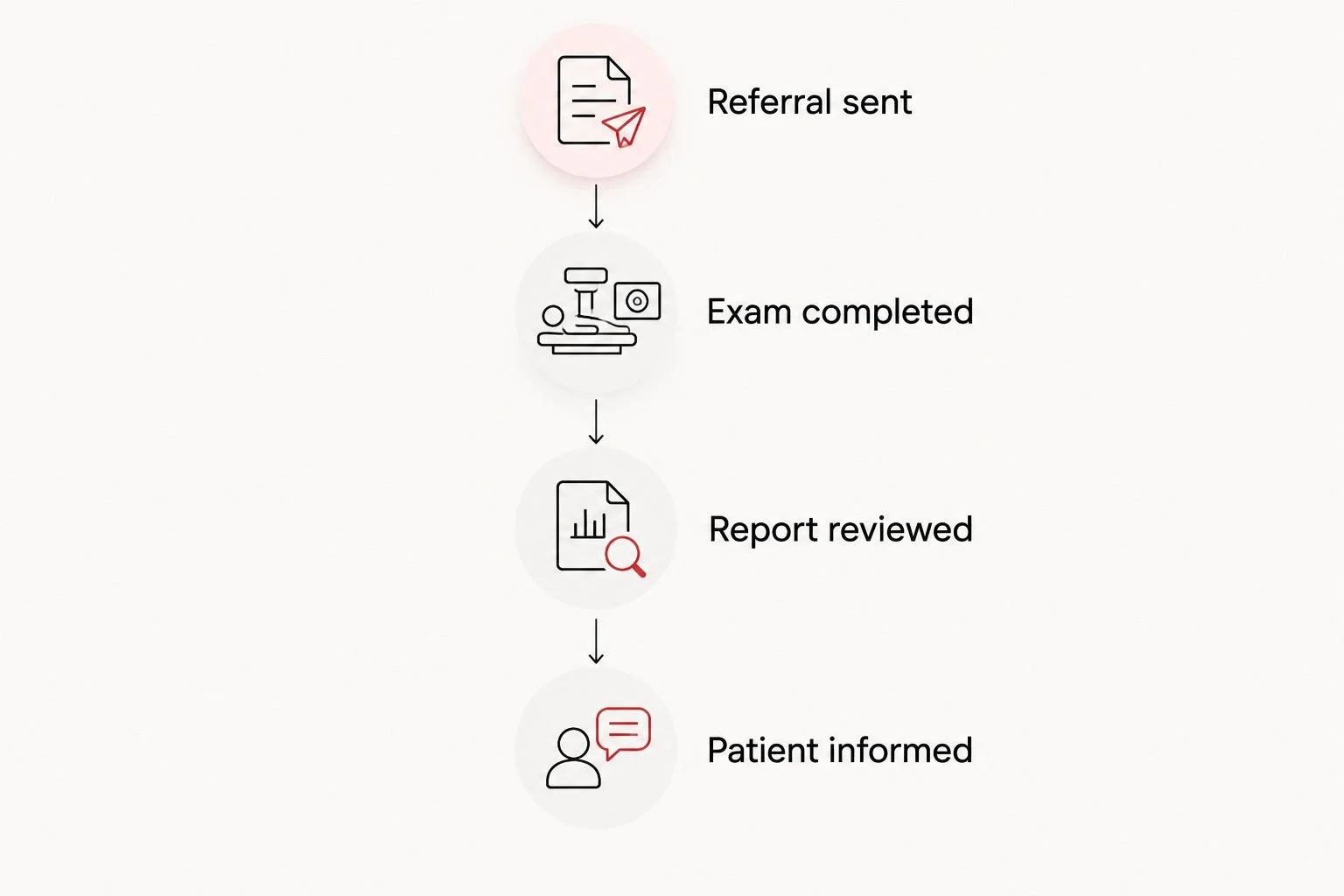
Close the referral after clinical review and documented patient follow-up, not simply after the scan.
Review the relationship against your own records
Use a manual review of completed referrals before buying reporting tools or expanding the arrangement. As a practical starting point, review 10 completed referrals and examine every unresolved referral separately. This is a suggested audit sample, not a published quality benchmark.
Check whether your team received the information it needed and whether patients understood the next step. Count missing reports, incomplete requests, and referrals without documented follow-up. Do not interpret patient satisfaction as evidence that an examination met its clinical purpose.
Keep a dated 2026 review record with an owner for each correction. Continue the relationship only where the provider’s scope and your communication process remain suitable.
Check orders for a clear examination request and clinical question.
Check reports for documented receipt and clinician review.
Review incomplete examinations and outstanding follow-up.
Ask patients whether instructions and result communication were clear.
Assign corrective actions and a date to check completion.
Compare ultrasound partnership options
The best option depends on the examination your clinician needs, not a single preferred setting. Use this comparison to shortlist a pathway, then verify the individual provider’s scope and responsibilities. These are service models, not interchangeable substitutes.
The Ultrasound Concierge
Best for: Patients around Keller and Willow Park seeking private, personalized ultrasound care
Main advantage: Offers diagnostic and elective imaging in a concierge-style setting
Key limitation: Specific birth center referral, interpretation, and reporting arrangements require confirmation
Hospital-based imaging service
Best for: Patients whose care pathway involves hospital services
Main advantage: Provides an imaging pathway within a hospital organization
Key limitation: The birth center still needs to confirm external referral and report access processes
Independent diagnostic imaging provider
Best for: Birth centers seeking an external diagnostic referral destination
Main advantage: Offers an alternative to building an internal imaging service
Key limitation: Obstetric examination scope and interpretation arrangements vary by provider
Maternal-fetal medicine practice
Best for: Patients referred for specialist obstetric assessment
Main advantage: Connects imaging with a specialist care pathway
Key limitation: It is not a substitute for emergency assessment or routine birth center follow-up
In-house ultrasound service
Best for: Birth centers prepared to manage imaging responsibilities directly
Main advantage: Keeps the examination workflow within the birth center
Key limitation: Requires qualified personnel, equipment oversight, interpretation arrangements, and quality processes
No model removes the need for clinical ownership. An external provider needs a clear referral; an in-house service needs equally clear interpretation, documentation, and escalation arrangements.
Common mistakes birth centers make
Treating elective images as diagnostic documentation
Keepsake images do not replace a diagnostic examination or its report. Tell patients which appointment serves a clinical purpose and which is elective, and keep those distinctions clear in your records.
Assuming a local provider covers every obstetric need
Location and a welcoming setting do not establish examination scope. Confirm each requested study and identify the specialist pathway before a patient needs it.
Letting the patient become the only messenger
Asking a patient to bring images is not a reliable report-tracking process. Your team needs a documented route for receiving results and checking that the appropriate clinician reviewed them.
Using reassurance language that overstates the findings
An ultrasound answers particular clinical questions; it does not guarantee that every pregnancy concern has been excluded. Explain what the examination assessed and let the responsible clinician discuss its limits and implications.
Expanding referrals before testing the handoff
A friendly introductory conversation does not prove the workflow is complete. Test receipt, report delivery, review, and patient follow-up before making the arrangement your default referral pathway.
FAQ
What are ultrasound partnerships for birth centers?
Ultrasound partnerships for birth centers are referral arrangements for obtaining imaging and returning findings to the patient's maternity care team. A useful arrangement defines examination scope, clinical responsibilities, report delivery, and follow-up.
What's the best ultrasound partner for a birth center?
The best ultrasound partner is the provider that performs the requested examination and supports a documented clinical handoff. Compare qualifications, interpretation arrangements, report communication, and patient needs before selecting a referral destination.
Does The Ultrasound Concierge provide diagnostic ultrasound?
The Ultrasound Concierge provides diagnostic and elective ultrasound services for patients in the Keller and Willow Park, Texas area. Birth centers should confirm the specific examination and referral, interpretation, and reporting arrangements directly before referring.
Can an elective ultrasound replace a diagnostic prenatal scan?
No, an elective keepsake ultrasound does not replace a clinically indicated diagnostic prenatal examination. Your maternity clinician should determine which diagnostic study is needed and review its findings.
Who should explain ultrasound results to a birth center patient?
The clinician responsible for the patient's care should ensure that diagnostic findings and the follow-up plan are explained. Agree beforehand who communicates results and document that responsibility in the referral workflow.
Should a birth center wait for an outpatient ultrasound when a patient has concerning symptoms?
No, an outpatient imaging appointment should not delay appropriate clinical assessment. Patients should contact their maternity clinician promptly about concerning symptoms and seek emergency care for severe symptoms.
How do we start an ultrasound referral partnership?
Start by listing the examinations your clinicians request and mapping who owns each referral step. Then confirm provider scope, report delivery, escalation contacts, and patient instructions before testing the process with a limited pilot.
One last thing
Test the referral pathway backward. Start with a fictional patient asking, “Who explains my result?” and work back through clinician review, report receipt, examination completion, and the original order.
If your team cannot name the responsible person at any stage, fix that gap before the next referral. The strongest partnership has no unclear handoffs.