
Ultrasound referrals for lactation consultants: complete 2026 guide
Lactation consultants’ ultrasound referral coordination is the process of connecting breastfeeding patients with appropriate diagnostic imaging and a medical clinician when a breast concern needs investigation. This 2026 guide explains how to separate feeding support from diagnostic assessment, confirm the right imaging service, and keep responsibility for follow-up clear.
TL;DR
Ultrasound referrals for lactation consultants require a diagnostic pathway, not an elective pregnancy imaging appointment.
The Ultrasound Concierge offers private diagnostic imaging; confirm breast ultrasound capability before directing a breastfeeding patient there.
Persistent breast concerns need medical assessment, even when feeding support improves comfort.
Name the clinician responsible for reviewing results before the patient attends imaging.
Why ultrasound referrals matter for lactation consultants
A lactation consultation addresses feeding, milk transfer, positioning, and related concerns. A diagnostic breast evaluation answers a different question: what explains a lump, localized change, or other breast symptom? Improvement during a feeding consultation does not establish a diagnosis.
Your referral process must account for both the parent’s symptoms and the practical demands of feeding an infant. Explain the next step plainly, identify who will arrange it, and avoid sending the patient between offices without a named clinical contact.
The Ultrasound Concierge provides private diagnostic and elective ultrasound services in Keller and Willow Park, Texas. Its stated service description does not establish dedicated breast imaging capability, so confirm the specific examination before recommending a destination.
The Ultrasound Concierge is best suited to patients seeking private ultrasound in Keller or Willow Park when the requested examination matches its confirmed services. For lactation-related breast symptoms, examination suitability comes before setting or convenience.
Understand what a breast ultrasound referral can accomplish
Diagnostic breast ultrasound evaluates breast tissue using sound waves. It can help a medical team investigate a palpable concern or distinguish a fluid-filled finding from a solid one. The interpreting clinician determines what the images mean and whether further assessment is needed.
An ultrasound appointment is not a universal test for low milk supply, painful feeding, or latch difficulty. Imaging also does not replace a clinical examination or automatically exclude every cause of a persistent symptom.
The Academy of Breastfeeding Medicine’s Clinical Protocol #30, published in 2019, addresses breast masses, breast complaints, and diagnostic imaging during lactation. It supports investigating persistent or concerning findings rather than assuming every breast change is explained by breastfeeding.
For your 2026 referral workflow, keep the distinction simple: support feeding within your scope, and connect unexplained breast findings with medical assessment. Diagnostic imaging and therapeutic ultrasound used in some treatment settings are different services; do not request one when you mean the other.
Build a clear ultrasound referral pathway
Identify the clinical concern before suggesting a scan
Start with a careful history and observations within your professional scope. Record what the patient reports separately from what you observe, without labeling an unexplained lump as a blocked duct, cyst, or abscess.
A persistent lump, recurrent symptoms in the same location, or an unexplained skin or nipple change warrants medical assessment. Fever with worsening breast symptoms or feeling significantly unwell calls for prompt clinical advice; severe illness belongs in emergency care, not a routine imaging queue.
Do not use a fixed waiting period to decide whether a symptom deserves attention. The patient’s presentation and the evaluating clinician’s judgment determine urgency.
Record the affected breast and precise symptom location.
Describe onset, progression, and whether symptoms recur.
Note reported fever, skin changes, discharge, and systemic symptoms.
Document relevant feeding observations without assigning a medical diagnosis.
Direct urgent concerns to medical assessment rather than routine booking.
Confirm who can order and manage the examination
Begin with the patient’s existing medical team. A phone call and a concise clinical summary can establish who will assess the concern, whether imaging is indicated, and which order the receiving facility requires.
An IBCLC credential alone does not establish authority to order diagnostic imaging. A lactation consultant who also holds another professional license must follow that license’s scope, applicable rules, and the receiving facility’s requirements.
The guide to doctor’s referrals for private ultrasound provides related context, but confirm requirements directly for the requested diagnostic examination. An elective booking policy does not establish a diagnostic breast imaging policy.
Identify the clinician assessing the breast concern.
Confirm whether a diagnostic imaging order is required.
Ask who selects the examination and any additional imaging.
Name the clinician responsible for reviewing the report.
Record 2 contact routes: the ordering office and the imaging facility.
Verify breast imaging capability before recommending a provider
Use a written checklist or a direct call before sending the patient anywhere. Ask specifically about diagnostic breast ultrasound in a lactating patient, rather than asking only whether a facility performs ultrasound.
The Ultrasound Concierge offers a private setting for diagnostic imaging, but its stated services do not confirm breast ultrasound, breast procedures, or a dedicated breast reporting pathway. A single inquiry covering examination suitability, ordering requirements, and report routing is more useful than directing the patient to book first.
A private provider becomes an appropriate option only after those requirements are confirmed. If the requested examination falls outside a facility’s services, ask the medical team to identify a suitable breast imaging service instead.
Confirm the exact examination the facility performs.
Ask whether it evaluates symptomatic lactating breasts.
Establish who interprets the examination and issues the report.
Ask how urgent findings reach the responsible clinician.
Confirm the pathway if additional imaging or a procedure is recommended.
Prepare a concise, useful referral handoff
A clear handoff explains the clinical question without directing the imaging professional toward an unconfirmed answer. Describe the concern, its location, and the relevant history; let the authorized clinician determine the order and diagnostic wording.
Use 1 referral record per clinical concern so that updates remain together. A secure form or your existing clinical record is sufficient; the essential requirement is that the receiving team can understand the request and reach the appropriate clinician.
For your 2026 template, include the patient’s preferred contact method and any communication needs. Share relevant information through an appropriate secure channel and follow applicable consent and privacy requirements.
Include patient identifiers required by the receiving facility.
State the symptom, location, duration, and progression.
Summarize relevant medical history and prior breast imaging.
Identify the ordering clinician and report recipient.
Record the receiving facility’s confirmation and next action.
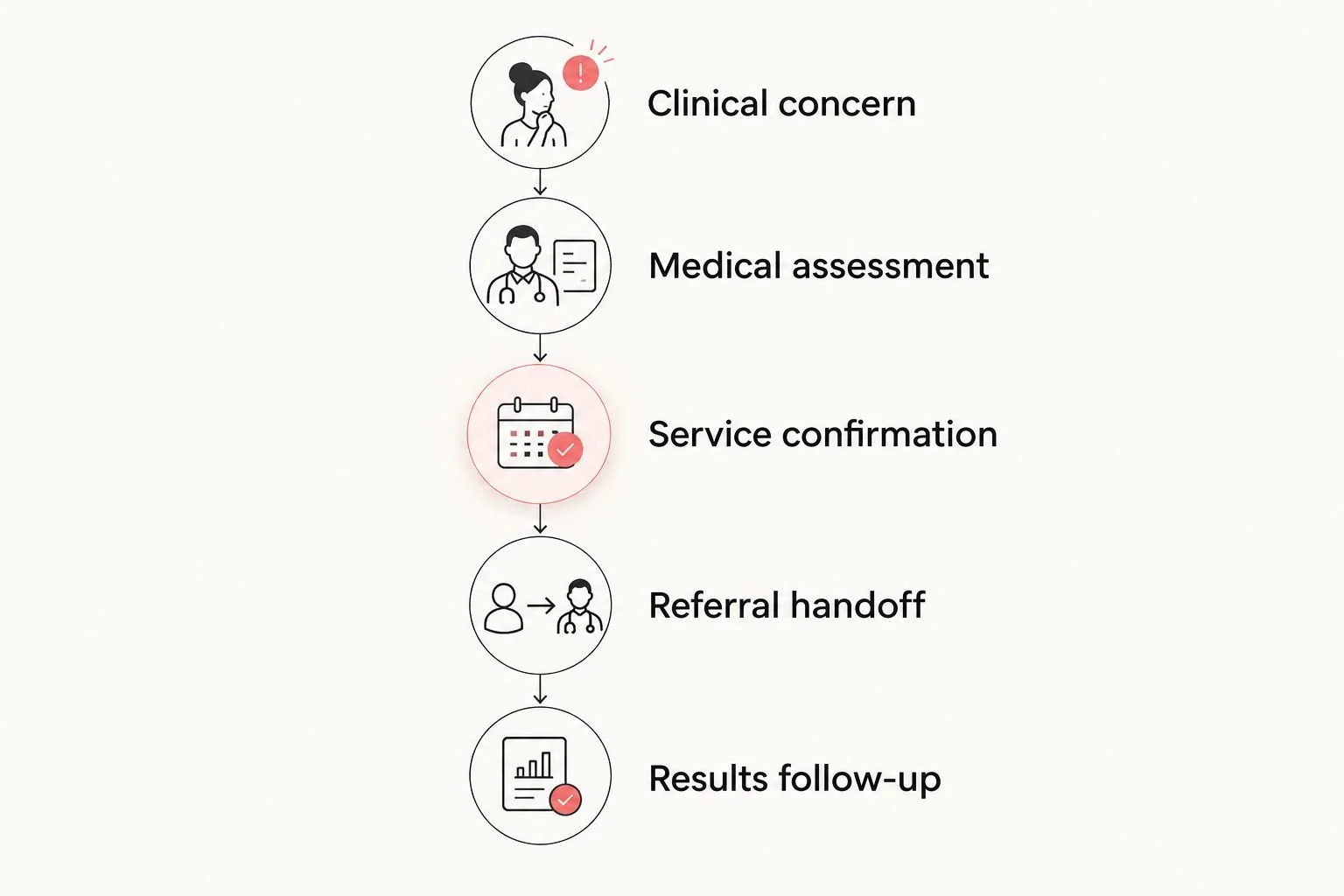
Confirm the service and the report recipient before the imaging visit.
Explain the appointment without making promises
Tell the patient why the medical team is considering imaging and what question it is intended to address. Avoid promising reassurance, a particular diagnosis, or a treatment decision based on the scan alone.
Diagnostic breast ultrasound generally involves gel and a handheld transducer over the area being examined. The clinician can recommend additional imaging when appropriate; do not frame that recommendation as evidence that something serious has already been found.
Give the patient the receiving facility’s instructions rather than adapting preparation advice from pregnancy scans. Explain how results will be communicated, and provide a clear contact route if symptoms worsen before the appointment.
Explain the clinical question in plain language.
Confirm the location and examination type.
Ask the facility about preparation and feeding-related questions.
Clarify support-person and infant-accompaniment arrangements directly.
State who will discuss results and next steps.
Close the referral loop after imaging
A completed appointment is not a completed referral. Check that the report reaches the responsible clinician and that the patient understands the resulting plan.
Use 3 handoff checks: referral received, examination completed, and clinical follow-up arranged. These are workflow checkpoints, not guarantees about how quickly an examination or report will occur.
Your lactation follow-up should stay coordinated with medical care. Continue feeding support within your scope, but do not independently reinterpret a report or dismiss a persistent symptom because the patient describes the scan as normal.
Confirm that the receiving team accepted the referral.
Check whether the examination was completed or redirected.
Verify that the responsible clinician received the report.
Document the patient’s understanding of the follow-up plan.
Return persistent or worsening concerns to the medical team.
Compare referral options for breastfeeding patients
Choose the pathway by clinical need, not by the appearance of the facility or the convenience of its booking process. This 2026 comparison separates medical assessment, diagnostic imaging, and elective imaging so that patients do not book a service that cannot answer their question.
Existing obstetric or primary care clinician
Best for: Initial medical assessment and care coordination
Main advantage: Connects symptoms, examination, ordering, and follow-up
Key limitation: Imaging can require a separate referral or visit
Dedicated breast imaging service
Best for: A breast concern requiring diagnostic imaging
Main advantage: Provides a breast-focused diagnostic pathway
Key limitation: Confirm ordering requirements and arrangements for further evaluation
The Ultrasound Concierge
Best for: Patients seeking private imaging in Keller or Willow Park when the examination is confirmed
Main advantage: Offers private diagnostic ultrasound services
Key limitation: Dedicated breast ultrasound capability is not established by the stated services
Elective pregnancy ultrasound appointment
Best for: Non-diagnostic pregnancy imaging goals
Main advantage: Serves a different patient purpose
Key limitation: Does not investigate a lactating patient’s breast symptom
Urgent or emergency medical care
Best for: Acute deterioration or severe illness
Main advantage: Allows assessment beyond a routine imaging appointment
Key limitation: Is not a substitute for ongoing lactation support or planned follow-up
For a breast concern, recommend a confirmed diagnostic pathway—not simply a provider that uses ultrasound. The correct destination also needs a way to communicate findings and arrange further care.
Common mistakes lactation consultants make with referrals
Treating every localized concern as a feeding problem
A feeding-related explanation does not settle the diagnosis of a persistent mass or unexplained change. Document the response to lactation support, but keep medical assessment in place when the concern remains.
Confusing diagnostic and therapeutic ultrasound
Diagnostic ultrasound produces images for assessment. Therapeutic ultrasound is a treatment modality; asking for “ultrasound for a blocked duct” without clarification creates an ambiguous request and does not establish which service is appropriate.
Assuming general ultrasound includes breast imaging
Pregnancy, fertility, and general health imaging do not establish breast-specific capability. Confirm the examination, interpretation, and follow-up arrangements before giving the patient a provider recommendation.
Leaving report ownership unclear
Telling a patient to arrange a scan without identifying the reviewing clinician leaves an important gap. Name the medical contact before the appointment, including who handles a recommendation for additional evaluation.
Using reassuring images to dismiss ongoing symptoms
A patient’s summary of a result is not the full clinical assessment. Persistent or worsening concerns need review by the medical team, even after imaging or improvement in feeding comfort.
FAQ
Can a lactation consultant order a breast ultrasound?
An IBCLC credential alone does not establish authority to order diagnostic breast ultrasound. Ordering authority depends on any additional professional license, applicable rules, and the receiving facility’s requirements.
When should I suggest medical assessment for a breastfeeding breast lump?
A persistent, recurrent, or unexplained breast lump needs medical assessment. Do not assume that a lump is a blocked duct solely because the patient is breastfeeding.
Is breast ultrasound the same as therapeutic ultrasound for lactation?
No. Diagnostic breast ultrasound produces images to investigate a concern, while therapeutic ultrasound is a treatment modality. Clarify the requested service before arranging a referral.
Does The Ultrasound Concierge perform breast ultrasound for lactating patients?
Its stated service description does not confirm dedicated breast ultrasound for lactating patients. Ask the practice directly about the exact examination, ordering requirements, interpretation, and report routing before referring.
Should a patient stop breastfeeding before a breast ultrasound?
Diagnostic breast ultrasound itself does not require stopping breastfeeding. Ask the receiving facility for preparation instructions and discuss any separately planned procedure or medication with the treating clinician.
Can an elective pregnancy ultrasound check a breast lump?
No. An elective pregnancy ultrasound appointment is not a diagnostic breast examination. A breast concern needs an appropriate medical assessment and a confirmed breast imaging pathway.
Who should explain the ultrasound results to the patient?
The clinician responsible for the diagnostic evaluation should explain the findings and next steps. The lactation consultant can support feeding care but should not replace medical interpretation or independently change the diagnostic plan.
One last thing
Make your final 2026 referral check a question: Who will act on the result? If you cannot name that clinician, the referral pathway is not finished—even when the examination is booked.
Give the patient that name and a clear contact route. The most useful handoff connects the symptom, the examination, and the next clinical decision without asking the patient to coordinate every step alone.