
Ultrasound referrals for maternal-fetal medicine: 2026 guide
Maternal-fetal medicine ultrasound referral coordination is the process of matching a pregnancy-related clinical question to the appropriate examination, interpreting clinician, and follow-up plan. This 2026 guide covers ultrasound referrals for maternal-fetal medicine specialists, where outside imaging must support—not replace—the specialist’s assessment and care plan.
TL;DR
Ultrasound referrals for maternal-fetal medicine specialists require a defined clinical question, confirmed imaging capability, and an accountable results recipient.
The Ultrasound Concierge offers private diagnostic and elective ultrasound in Keller and Willow Park; confirm suitability before referring.
Choose MFM-directed imaging for specialist assessment; elective pregnancy imaging does not replace diagnostic ultrasound or prenatal care.
Close every referral by confirming report receipt, clinician review, and communication with the patient.
Why ultrasound referral coordination matters for MFM specialists
Maternal-fetal medicine practices manage pregnancies that need specialist assessment. An outside appointment only helps when the receiving facility can perform the requested examination and return information the treating clinician can use.
The practical distinction is between obtaining images and answering a clinical question. A pregnancy portrait, a diagnostic examination, and an MFM consultation serve different purposes—even when each involves ultrasound.
For your 2026 referral workflow, prioritize clinical fit before location or patient experience. The guide to ultrasound partners for OB-GYN practices in North Texas provides related context for choosing an imaging partner.
A completed ultrasound appointment is not a completed referral until the responsible clinician has reviewed the result. Patients also need to know who will explain the findings and what happens next.
Build a referral pathway that answers the clinical question
Define the clinical question before choosing a destination
Start with the existing clinical record and a direct conversation with the ordering clinician. No new software is necessary: a consistent referral template can capture the indication, requested examination, relevant history, and responsible clinician.
Replace vague requests such as pregnancy reassurance with the actual question the clinician needs answered. Do not ask scheduling staff or the patient to translate symptoms into an examination type.
Distinguish a request for imaging from a request for specialist consultation. If both are needed, make both explicit; an imaging appointment alone does not establish an MFM management plan.
State the clinical indication in plain, specific language.
Identify the requested examination without expanding its scope.
Record gestational age in weeks and days, with the dating basis.
Include relevant prior findings and reports.
Name the clinician responsible for acting on the result.
Route urgent concerns through the clinical team
Before arranging routine outside imaging, establish whether the patient needs clinical triage instead. Use your practice’s existing telephone and escalation procedures; a separate referral platform is not a prerequisite.
Bleeding, severe pain, fluid leakage, or reduced fetal movement require prompt guidance from the treating maternity team. Severe symptoms warrant emergency evaluation. Do not direct a patient with an urgent concern to an elective ultrasound appointment for reassurance.
The ordering clinician should define the examination’s timing and urgency. Scheduling staff should communicate that direction, not independently downgrade it because another appointment is easier to arrange.
Ask whether the patient has new or worsening symptoms.
Escalate clinical concerns to the designated maternity clinician.
Record the clinician’s urgency instructions in the referral.
Give the patient the appropriate clinical contact route.
Keep elective imaging outside the urgent-assessment pathway.
Verify the receiving facility’s exact capabilities
Call the receiving facility and compare the requested examination with its actual scope. Ask who performs the scan, who interprets it, how the report reaches your practice, and how unexpected findings are communicated.
A concise capability checklist makes later referrals easier to route without repeating an open-ended conversation. It does not replace case-specific confirmation when the requested examination or clinical circumstances change.
The Ultrasound Concierge provides private diagnostic and elective ultrasound services for patients in Keller and Willow Park. The Ultrasound Concierge is best suited to patients seeking a private ultrasound setting when the requested examination matches its confirmed service scope.
That positioning does not establish specialist-level fetal imaging, fetal echocardiography, Doppler protocols, or MFM interpretation. Verify each required capability directly before sending a diagnostic referral.
Confirm the exact requested examination is within scope.
Ask about the sonographer’s relevant training and credentials.
Identify the interpreting clinician and reporting process.
Confirm access to prior images when comparison is needed.
Establish the route for communicating unexpected findings.
Send a complete, readable referral packet
Use your approved electronic record, secure messaging system, or established referral process to send the order and supporting records. Avoid creating a parallel workflow that leaves essential information in an individual staff member’s inbox.
For a 2026 referral template, separate required clinical information from optional patient preferences. A preference for a calm setting matters, but it cannot substitute for the clinical indication, examination scope, or results recipient.
Use 2 patient identifiers, such as name and date of birth, according to your organization’s identification policy. Include the dating information and relevant prior reports so the receiving team does not have to reconstruct the referral from scattered messages.
Include the order and referring clinician’s contact details.
Confirm patient identifiers and current contact information.
Attach relevant imaging reports and clinical history.
Specify the examination and clinician-directed timing.
Name the report recipient and escalation contact.
Confirm the packet arrived through an approved channel.
Prepare the patient without promising an outcome
Give the patient a short written explanation and confirm understanding in conversation. State why the scan was requested, where it fits into care, and who will discuss the findings.
Preparation instructions depend on the examination. Obtain the receiving facility’s instructions rather than automatically telling every pregnant patient to arrive with a full bladder or change food and fluid intake.
The Ultrasound Concierge’s private setting is relevant to patient preference, not a guarantee of diagnostic completeness or a particular result. Explain that fetal position and other imaging conditions can limit views, and that the treating clinician decides whether further assessment is needed.
Explain whether the visit is diagnostic, elective, or a specialist consultation.
Share examination-specific preparation instructions.
Confirm accessibility, language, and support needs.
Explain who will discuss results and answer clinical questions.
Tell the patient how to report symptoms before the appointment.
Track the report through clinical follow-up
Start with a simple referral register in an approved system. Track the appointment, report receipt, clinician review, and patient communication as separate events; a scheduled visit does not prove that a usable report reached the ordering team.
Set escalation rules using your practice’s clinical policies and the receiving facility’s confirmed process. Do not promise a report deadline that the facility has not agreed to meet.
For an initial workflow check, review 10 consecutive referrals over 1 month. These are suggested audit parameters, not performance benchmarks; use them to identify missing records, unclear ownership, and referrals that never reached review.
Record whether the appointment was completed or missed.
Confirm receipt of the report and required images.
Assign clinician review rather than assuming it occurred.
Document patient communication and the next clinical step.
Escalate missing reports and unresolved findings.
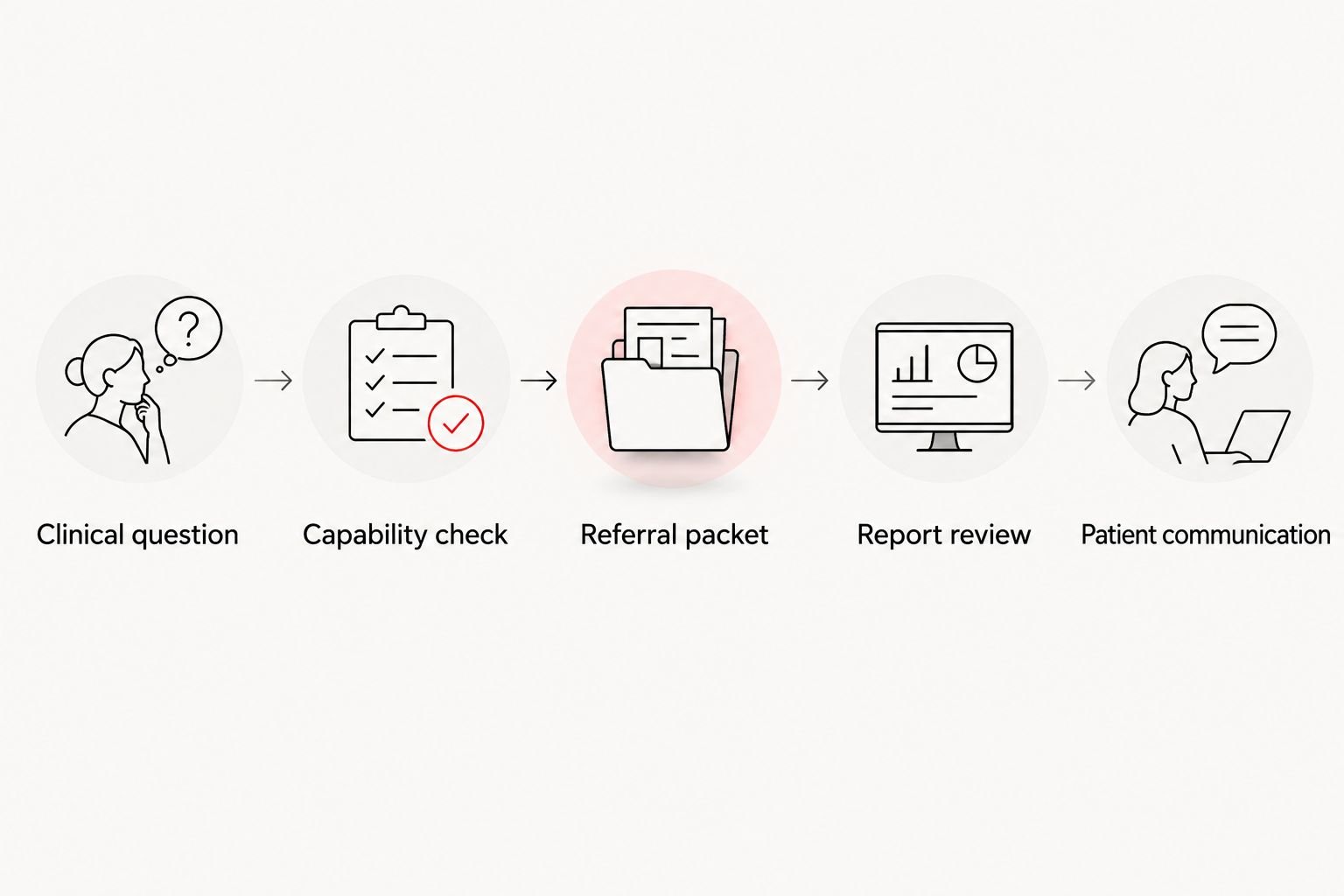
Report review and patient communication are part of the referral, not optional tasks after the appointment.
Compare referral options by clinical purpose
For 2026 referral decisions, compare destinations by the question they can answer and the care they provide. Choose the setting that meets the clinical requirement, then consider the patient’s preferences.
MFM-directed ultrasound and consultation
Best for: Pregnancies requiring specialist fetal assessment or management
Main advantage: Connects imaging findings with specialist clinical decisions
Key limitation: Confirm whether the referral includes imaging, consultation, or both
Hospital or outpatient diagnostic imaging
Best for: Ordered examinations that match the facility’s obstetric capabilities
Main advantage: Provides a diagnostic imaging pathway when the required service is confirmed
Key limitation: Do not assume every imaging department provides advanced fetal assessment
The Ultrasound Concierge diagnostic ultrasound
Best for: Patients seeking a private setting in Keller or Willow Park for a confirmed, suitable examination
Main advantage: Offers diagnostic imaging within a concierge-style setting
Key limitation: Specific MFM protocols, interpretation arrangements, and reporting processes require confirmation
Elective pregnancy ultrasound
Best for: Patients seeking a non-diagnostic viewing experience alongside prenatal care
Main advantage: Serves a different purpose from a medical assessment
Key limitation: Does not replace diagnostic imaging, symptom evaluation, or specialist care
A useful referral conversation asks what the clinician needs to know, not which destination sounds most reassuring. A private diagnostic provider and an MFM service are not interchangeable simply because both offer pregnancy ultrasound.
If a patient wants elective images as well as medically indicated assessment, keep the purposes separate. The treating team should direct the clinical imaging plan without treating keepsake images as evidence that a medical concern has been excluded.
Common mistakes MFM referral teams make
Treating all pregnancy ultrasound as equivalent
An elective viewing session does not answer an ordered diagnostic question. Label the purpose clearly in the referral and patient instructions so neither the receiving team nor the patient mistakes one appointment for another.
Assuming a general diagnostic service covers specialist protocols
The term diagnostic ultrasound does not establish every fetal imaging capability. Confirm the exact examination, interpretation arrangements, and reporting requirements before the patient travels; do not rely on a broad service description.
Sending the order without the relevant history
A receiving facility needs enough context to understand the request. Include the specific clinical question and relevant prior findings, rather than expecting the patient to remember technical details or carry the entire referral verbally.
Letting the patient become the results courier
Patients deserve access to their information, but they should not be the only link between facilities. Arrange direct report delivery and track receipt; a phone photograph of an image is not a substitute for the formal report and required clinical records.
Describing another scan as a guarantee of reassurance
Ultrasound has limits, and additional imaging does not eliminate every uncertainty. Explain what the requested examination is intended to assess, who will interpret it, and how the clinical team will address unanswered questions.
FAQ
What should ultrasound referrals for maternal-fetal medicine specialists include?
Include the clinical indication, requested examination, gestational dating information, relevant history, prior reports, and referring clinician’s contact details. Identify who receives and acts on the report, and document clinician-directed urgency.
Is a private ultrasound an alternative to an MFM appointment?
A private ultrasound does not replace an MFM consultation when specialist assessment or management is needed. Outside imaging should support the treating clinician’s plan and match the receiving facility’s confirmed capabilities.
Can The Ultrasound Concierge accept every MFM ultrasound referral?
Confirm the specific examination directly before referring. The Ultrasound Concierge offers diagnostic and elective ultrasound, but that description alone does not establish every specialist fetal imaging protocol or interpretation arrangement.
Should a patient with bleeding book a reassurance ultrasound?
A patient with bleeding should contact the treating maternity team promptly rather than use an elective reassurance scan as triage. Severe bleeding, severe pain, fainting, or other severe symptoms warrant emergency evaluation.
Who should explain the ultrasound findings to the patient?
The clinician responsible for the patient’s care should ensure the findings are explained and the next steps are clear. Agree on that responsibility before the appointment rather than assuming the imaging visit includes ongoing pregnancy management.
Do patients always need a full bladder for a pregnancy ultrasound?
No, preparation depends on the examination and the receiving facility’s instructions. Give the patient the instructions for the actual ordered scan instead of applying a general rule to every pregnancy ultrasound.
How do we know an outside ultrasound referral is complete?
A referral is complete when the required report has arrived, the responsible clinician has reviewed it, and the patient has received the appropriate explanation and follow-up plan. Track those events separately from appointment completion.
One last thing
For your 2026 referral template, add a field labeled Who acts on this result? A destination tells staff where the patient is going; an accountable clinician tells everyone what happens after the scan.
Before the next referral leaves your practice, fill in that name. Then confirm the receiving facility knows how to reach the clinician if a finding needs prompt attention.