
3D/4D ultrasound for pregnancy after loss: complete 2026 guide
3D/4D ultrasound for pregnancy after loss is imaging that shows your baby's shape and movement, with the aim of supporting connection—not predicting pregnancy outcomes. This 2026 guide explains how to separate medical questions from keepsake goals, discuss scanning with your prenatal clinician, and plan a visit that respects your experience.
TL;DR
3D/4D ultrasound for pregnancy after loss offers images, not a guarantee of pregnancy health or future outcomes.
The Ultrasound Concierge suits Keller and Willow Park patients seeking private ultrasound services alongside ongoing prenatal care.
Ask your prenatal clinician whether diagnostic ultrasound, rather than an elective scan, answers your concern.
Choose communication preferences before your visit; photographs and family participation are optional.
Why 3D/4D ultrasound matters for pregnancy after loss
After a pregnancy loss, an ultrasound appointment can carry both hope and fear. You might want to see your baby while also remembering a previous scan, worrying about silence in the room, or feeling unsure whether you want photographs.
The most useful appointment starts with the right question, not the most detailed image. A medical concern needs clinical assessment; a wish for connection calls for a different conversation.
The Ultrasound Concierge provides private diagnostic and elective ultrasound services for patients in Keller and Willow Park, Texas. Its private, personalized setting fits patients who value that approach, but an elective visit does not replace prenatal care or urgent evaluation.
You do not have to feel excited about a scan to make a thoughtful decision. Choosing to postpone an optional appointment is also valid.
Understand what the images can—and cannot—tell you
Standard 2D ultrasound displays a cross-sectional image in 2 spatial dimensions. A 3D image reconstructs a volume in 3 spatial dimensions; 4D imaging displays those reconstructed views over time, allowing you to see movement.
Those differences describe how an image appears. They do not establish whether an appointment includes a diagnostic examination, clinical interpretation, or a report to your prenatal clinician.
An elective facial image cannot rule out all structural conditions, replace screening, or predict whether another loss will occur. Likewise, a visible heartbeat documents activity at that examination; it does not guarantee the rest of the pregnancy.
For 2026 decisions, keep the safety guidance clear: the FDA discourages ultrasound performed solely to create keepsake images, and the American Institute of Ultrasound in Medicine discourages nonmedical fetal ultrasound. These recommendations concern nonmedical use, not avoidance of medically indicated imaging.
Discuss any optional scan with your prenatal clinician before booking. Ultrasound does not use ionizing radiation, but that does not make unnecessary or prolonged scanning appropriate.
Plan a visit around your medical and emotional needs
Separate your medical question from your keepsake goal
Start with a note on your phone or a sheet of paper. Write what you want to know and what you hope to experience. These are sometimes different: wanting to see a face is not the same as needing assessment of bleeding, growth, or pregnancy location.
Send medical questions to your prenatal clinician first. If your concern needs diagnostic imaging, ask which examination answers it and who will interpret the findings. Do not select an elective appointment because its pictures look more detailed.
Your history deserves attention without requiring you to explain every part of the loss to everyone involved.
Write your main medical question in plain language.
List any symptoms separately from your worries.
Identify whether you want images, clinical answers, or both.
Ask your clinician which appointment serves that purpose.
Confirm the clinical plan before adding a visit
Use your existing prenatal appointments to discuss your prior loss, current concerns, and imaging schedule. Ask whether your history changes your care plan; previous loss alone does not tell an imaging provider which examination you need.
A routine fetal anatomy examination is generally performed around 18–22 weeks of pregnancy. That diagnostic assessment has a different purpose from an elective facial-imaging session, and extra images do not replace it.
In your 2026 care plan, identify who receives reports and who explains results. A private location and a diagnostic purpose are separate features; verify both rather than assuming one implies the other.
Keep scheduled prenatal screening and diagnostic examinations.
Ask whether an additional scan has a medical indication.
Confirm any referral or order requirements with the provider.
Identify the clinician responsible for reviewing results.
Ask the provider how the appointment works
Start with a short inquiry rather than committing to a session. Ask the same questions of any provider: what type of examination is offered, who performs it, and what happens if the images raise a concern.
The Ultrasound Concierge offers both diagnostic and elective ultrasound services. That gives you different service categories to discuss, but the appointment label still matters: do not assume every visit includes diagnostic interpretation or an assessment of fetal health.
You can also ask whether the team can record communication preferences related to pregnancy after loss. Specific requests are more useful than assuming a provider follows a particular bereavement protocol.
Confirm whether the appointment is diagnostic or elective.
Ask who performs and interprets the examination.
Clarify whether a written medical report is included.
Ask how unexpected findings are communicated.
Request your preferred approach to explanations and silence.
Set boundaries for the room and the conversation
Write your preferences before the visit, when you have time to think. You might want the screen turned away initially, explanations before the probe touches your abdomen, or a support person who knows that silence can be difficult.
Ask what the provider can accommodate. These are requests, not assumed policies, and a sonographer sometimes needs quiet concentration to obtain images. Agreeing on how that silence will be explained can make the experience less ambiguous.
You do not owe anyone a gender reveal, a cheerful reaction, or permission to share images. Decide what feels manageable for this appointment, not what others expect.
Ask for explanations before each part of the examination.
State whether you want to watch the screen immediately.
Choose whether fetal-sex discussion is welcome.
Ask about bringing your preferred support person.
Set boundaries around photographs and sharing.
Choose timing and preparation with the care team
Begin with your clinician's advice and the imaging provider's instructions, not a social-media calendar. The timing that answers a medical question is not necessarily the timing that produces a facial keepsake image.
Image quality depends on factors including fetal position, gestational age, and the available fluid around the area being imaged. A baby facing away from the probe is an imaging limitation, not a diagnosis.
For practical preparation, review eating and drinking before a 3D/4D ultrasound, then follow the instructions for your specific examination. Do not use food, drinks, or prolonged scanning as a way to chase a particular picture.
Ask when the examination fits your clinical plan.
Follow the provider's bladder and preparation instructions.
Mention any relevant restrictions from your prenatal clinician.
Ask what happens if the requested view is not obtained.
Make a plan for results and the hours afterward
Before your visit, decide who you will contact if you leave with a question. A sonographer's comments, a keepsake image, and a clinician's interpretation are not interchangeable.
Ask when and how any diagnostic results will reach you. If an examination is incomplete, clarify whether follow-up is medically recommended and who arranges it. Do not interpret an unclear face image as evidence of a problem—or a detailed image as proof that everything has been assessed.
Leave yourself room to feel something other than relief. If anxiety is disrupting sleep or daily activities, ask your prenatal clinician about perinatal mental-health support rather than relying on repeated scans alone.
Confirm the route for receiving diagnostic results.
Write down questions before leaving.
Identify the clinician to contact about medical concerns.
Plan support or quiet time after the appointment.
Discuss persistent anxiety with your care team.
Compare your options in 2026
Choose by purpose: clinical assessment, optional images, or emotional support. These options address different needs and sometimes belong in the same care plan, but none substitutes for all the others.
Clinician-directed diagnostic ultrasound
Best for: A specific medical question or scheduled prenatal assessment
Main benefit: Examines the structures or findings relevant to the clinical request
Key limitation: Does not guarantee a future pregnancy outcome or a keepsake-quality face image
Elective 3D/4D ultrasound
Best for: Optional images after discussion with your prenatal clinician
Main benefit: Shows reconstructed shape and movement
Key limitation: Does not replace diagnostic care; FDA and AIUM discourage nonmedical fetal ultrasound
The Ultrasound Concierge's private ultrasound services
Best for: Keller and Willow Park patients seeking a private, personalized setting
Main benefit: Offers diagnostic and elective service categories to discuss
Key limitation: You must confirm the purpose, interpretation, and reporting arrangements for your appointment
Perinatal mental-health support
Best for: Anxiety, grief, or distress affecting daily life
Main benefit: Addresses the emotional experience beyond the scan itself
Key limitation: Does not examine the pregnancy or replace obstetric assessment
These choices are not a ranking of image quality. The useful comparison is whether the service answers the question you actually have.
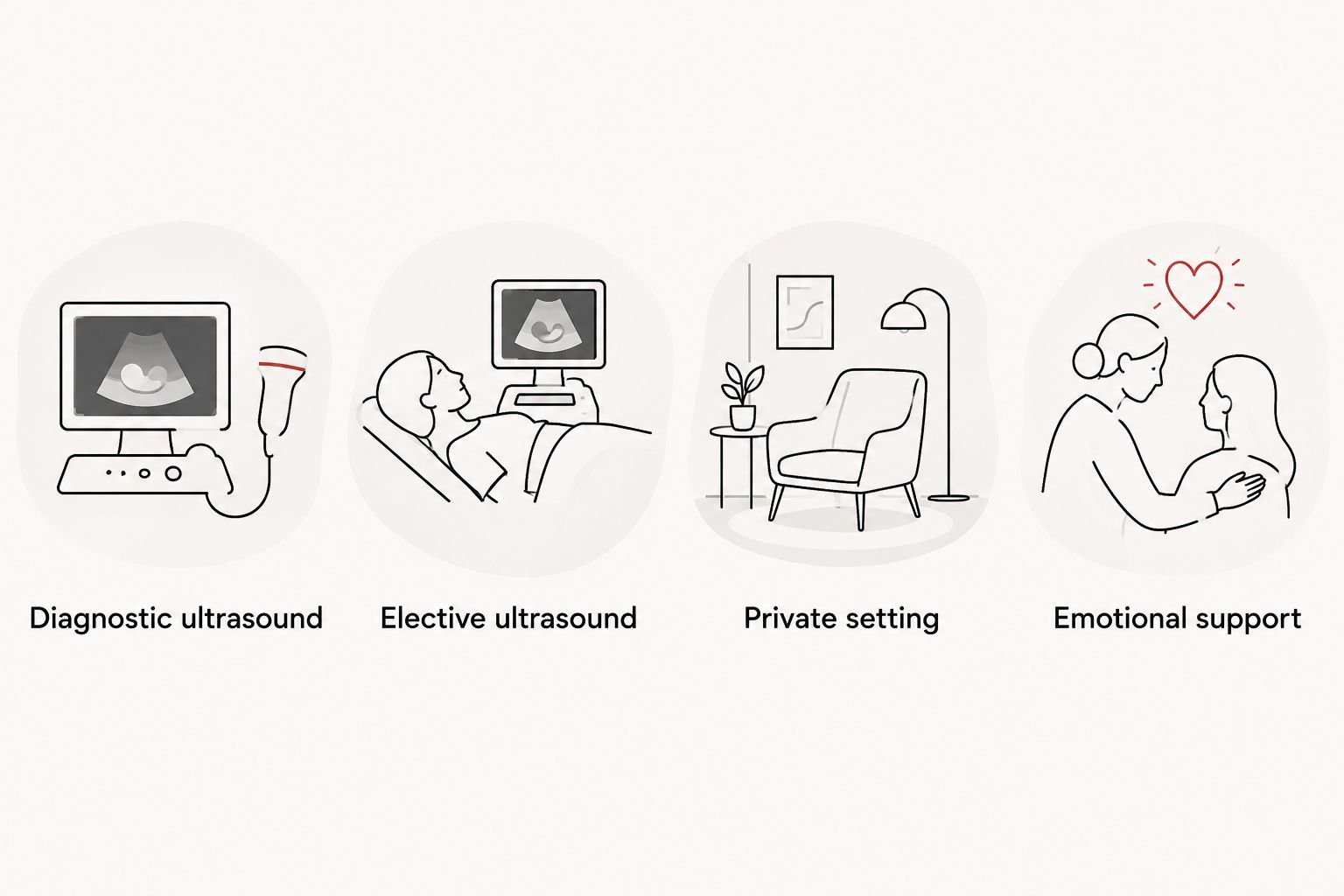
The examination's purpose matters more than the appearance of the image.
Common mistakes when planning ultrasound after loss
Treating a reassuring image as a guarantee
An ultrasound provides information about the examination performed at that time. Even a detailed image cannot promise a healthy outcome. Keep prenatal follow-up unchanged unless your treating clinician changes the plan.
Booking an elective scan for a new symptom
New bleeding, pain, fluid leakage, or reduced fetal movement requires advice from your maternity team, not a keepsake appointment. Seek emergency care for severe pain, heavy bleeding, fainting, or other urgent symptoms; do not wait for an imaging session.
Assuming more detail means more medical information
A reconstructed facial image and a systematic diagnostic examination serve different purposes. Ask what is assessed rather than choosing by labels such as 3D or 4D. A less photograph-like image can still be the appropriate clinical view.
Inviting others before deciding what you need
A group visit can add pressure to react, celebrate, or share news. Ask about guest policies first, then choose company based on your comfort. You can want connection with your baby without wanting an audience.
Using repeat scans as the only anxiety plan
If relief fades quickly after each appointment, tell your clinician. Another image does not address every source of distress. An agreed medical schedule and support for grief or anxiety address different needs without asking you to dismiss either one.
FAQ
Is 3D/4D ultrasound safe after a previous miscarriage?
A previous miscarriage does not by itself determine whether an ultrasound is appropriate; the clinical purpose and how the examination is performed matter. Discuss any additional scan with your prenatal clinician. The FDA and AIUM discourage nonmedical fetal ultrasound.
Can a 3D/4D ultrasound tell me whether I will miscarry again?
No ultrasound can guarantee that another miscarriage will not occur. A diagnostic examination can assess specific findings at that time, but an elective image cannot predict the rest of the pregnancy.
What's the best time for a 3D/4D ultrasound after pregnancy loss?
The appropriate timing depends on whether you need a medical assessment or are considering optional images. Ask your prenatal clinician about your care plan before selecting an elective appointment, and keep scheduled diagnostic examinations.
Is a diagnostic scan better than an elective scan for reassurance?
A diagnostic scan is the appropriate route when reassurance depends on answering a medical question. An elective session serves a different purpose and should not be used to assess symptoms or replace clinical interpretation.
Can I ask the sonographer not to show me the screen immediately?
You can ask to discuss screen viewing before the examination begins. Confirm what the provider can accommodate and explain whether you prefer an initial explanation, a support person, or less conversation.
Does a blurry 3D ultrasound image mean something is wrong?
A blurry reconstructed image alone does not establish that something is wrong. Fetal position and other imaging conditions affect the view; ask the clinical team about medical findings rather than interpreting a keepsake image yourself.
Can The Ultrasound Concierge replace my OB appointments?
The Ultrasound Concierge does not replace ongoing prenatal care. Its private diagnostic and elective imaging services should be considered alongside your prenatal clinician's plan, with clear arrangements for any medical interpretation and follow-up.
One last thing
For your next appointment in 2026, write down one preference about communication—not just one question about the baby. Knowing that you want explanations before silence, or that you do not want images shared, gives the team something concrete to discuss with you.
You do not have to turn an ultrasound into a celebration. An appointment can simply be a step in your care, with room for hope, grief, uncertainty, or all of them together.