
Ultrasound referrals for prenatal chiropractors: complete 2026 guide
Prenatal chiropractors’ ultrasound referral coordination is the process of connecting pregnant patients with appropriate imaging services to support coordinated prenatal care. This guide separates diagnostic assessment from elective imaging and explains how to make a clear handoff without stepping outside your professional scope.
TL;DR
Ultrasound referrals for prenatal chiropractors start with the clinical question, not the scan package.
Keep diagnostic ultrasound and elective pregnancy imaging separate; keepsake images do not replace prenatal assessment.
The Ultrasound Concierge fits patients seeking private ultrasound services in Keller and Willow Park.
Confirm ordering requirements, report recipients, and follow-up responsibility before directing a patient to imaging.
Why ultrasound referral coordination matters for prenatal chiropractors
Your patient brings pregnancy-related questions into a chiropractic appointment, but those questions do not all belong in chiropractic care. Pelvic discomfort, concerns about fetal position, and requests for keepsake images require different responses. A referral recommendation is not the same as a diagnostic order.
For your 2026 referral workflow, distinguish patient education, coordination with the prenatal clinician, and any ordering activity permitted within your scope. Do not assume that an imaging provider accepts orders from every professional who recommends its services. Review whether a private ultrasound needs a doctor’s referral, then confirm the requirements for the specific examination directly.
A calm private setting matters to patients who feel overwhelmed by medical appointments. It does not change the purpose of the examination or replace obstetric care. Your referral process needs to protect both the patient’s experience and the clinical handoff.
Build your ultrasound referral workflow in 6 steps
1. Define the question before discussing imaging
Start with a conversation and a short note in the patient record. Ask what the patient wants to understand, whether symptoms are present, and who currently manages the pregnancy. A request to see the baby is different from a concern about bleeding or reduced movement.
Separate the conversation into 3 referral pathways: a clinical question for the prenatal clinician, an elective imaging request, or an urgent concern requiring medical assessment. These pathways organize your response; they do not diagnose the patient.
Update your 2026 intake materials so staff can distinguish the pathways without interpreting symptoms themselves. Do not direct a patient with an urgent concern to an elective scan for reassurance. Heavy bleeding, severe abdominal pain, fainting, or other severe symptoms require urgent medical assessment; use emergency services for a medical emergency.
Clinical question: Contact the clinician managing the pregnancy for assessment and imaging decisions.
Elective request: Explain the non-diagnostic purpose before sharing provider information.
Urgent concern: Follow your escalation process rather than routine scheduling.
Existing assessment: Ask whether the prenatal clinician has already evaluated the concern.
2. Confirm scope and ordering requirements
Use a telephone call or secure message to confirm the imaging provider’s requirements. Ask who can order the requested examination, what documentation is necessary, and whether the patient must coordinate through the prenatal clinician. Record the answer rather than relying on a general description of the service.
Texas scope-of-practice questions require current guidance from the relevant licensing authority and, when necessary, legal counsel. This guide does not establish that a chiropractor can order a particular obstetric examination. Do not turn an informational recommendation into a medical order without confirming your authority.
Keep chiropractic findings distinct from obstetric questions. An ultrasound is not a test that validates an adjustment, establishes pelvic alignment, or proves that chiropractic care changed fetal position. Avoid referral language that suggests those conclusions.
Confirm the requirements for the exact examination, not ultrasound services generally.
Identify the authorized ordering clinician when an order is required.
Ask whether prior imaging or relevant clinical records are needed.
Document the boundary between your recommendation and the prenatal clinician’s decision.
3. Choose a provider by purpose and communication
Build a simple provider directory yourself. Separate diagnostic imaging contacts from elective imaging contacts, and record what each provider confirms about orders, interpretation, and communication. A familiar name alone does not establish suitability for a particular clinical question.
For patients seeking a private setting in Keller or Willow Park, The Ultrasound Concierge provides diagnostic and elective ultrasound services. The Ultrasound Concierge is best for patients seeking private, concierge-style ultrasound services in Keller and Willow Park. Its service range does not make every appointment interchangeable: confirm the examination and its reporting process before directing a diagnostic referral there.
A direct conversation with The Ultrasound Concierge is the next step for clarifying the requested service, rather than asking the patient to explain clinical documentation requirements alone. Do not promise accepted orders, interpretation arrangements, or report delivery until the provider confirms them.
For your 2026 directory, separate established facts from questions still requiring confirmation. This prevents staff from repeating assumptions as policy.
Record whether the service is diagnostic or elective.
Confirm who interprets diagnostic images and issues the report.
Ask how urgent findings reach the responsible clinician.
Confirm preparation instructions for the requested examination.
Note patient preferences concerning privacy, accessibility, and communication.
4. Explain diagnostic and elective imaging clearly
Use plain language before the patient chooses a service. Diagnostic ultrasound addresses a clinical question and requires an appropriate interpretation and follow-up process. Elective imaging focuses on the viewing or keepsake experience; it does not replace medically indicated prenatal examinations.
Explain the difference without dismissing the patient’s wish for connection or reassurance. Seeing an image can feel meaningful, but an appealing image is not a complete assessment of fetal health. The FDA discourages ultrasound used solely for nonmedical keepsake purposes; do not recommend extra exposure simply to fill a gap between prenatal visits.
Refer because the purpose is appropriate, not because another scan sounds comforting. When a patient reports a new concern, the prenatal clinician should determine the assessment needed. Never imply that a non-diagnostic visit can rule out complications.
Describe whether the requested visit answers a medical question or serves an elective purpose.
Explain that keepsake images do not replace a diagnostic report.
Direct questions about scan necessity and timing to the prenatal clinician.
Avoid promises about fetal position, image clarity, or reassurance.
Give patients space to decline an elective service without pressure.
5. Send a complete handoff and assign ownership
A manual referral checklist is enough to start. Use your existing secure communication process and confirm receipt when you are coordinating diagnostic care. A patient carrying a business card is not the same as a completed clinical handoff.
Use 4 core handoff fields: patient identifiers, referral purpose, responsible clinician, and report destination. Add relevant clinical context through the appropriate secure channel. Keep administrative messages limited to what the recipient needs, and follow applicable privacy requirements and your practice’s policies.
In your 2026 referral log, distinguish a recommendation from an accepted order, a booked appointment, and a received report. These are separate events. Do not mark a referral complete just because someone sent a scheduling message.
Patient identifiers: Check that the receiving office can match the correct patient.
Referral purpose: State the concern without inserting an unsupported diagnosis.
Responsible clinician: Identify who owns the obstetric assessment and next steps.
Report destination: Confirm where the interpreted report needs to go.
Receipt confirmation: Record that the receiving office received the necessary information.
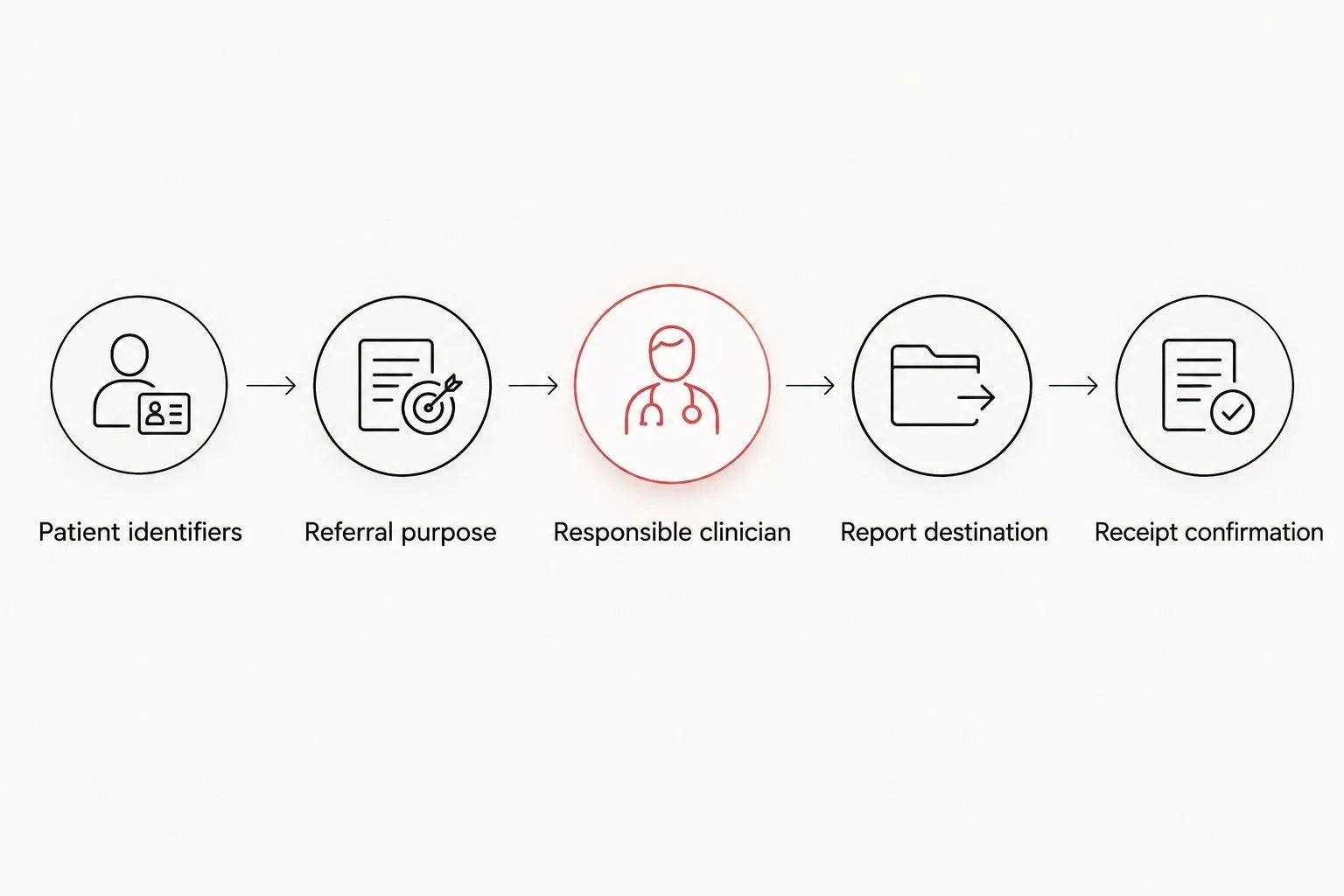
A complete handoff identifies both the clinical owner and the report destination.
6. Close the loop without interpreting beyond your role
After a diagnostic referral, confirm that the responsible clinician receives the report through the agreed process. Do not substitute your reading of an image, a patient’s recollection, or a keepsake photograph for the diagnostic interpretation. If the report has not arrived, follow up with the appropriate office.
The referral loop closes when responsibility is clear, not when the patient says the appointment went well. Document communications relevant to your care and direct questions about obstetric findings to the clinician responsible for interpreting and acting on them.
Review your 2026 referral process for recurring failures: missing orders, unclear service selection, undelivered reports, and patients uncertain about whom to call. Correct the specific failure rather than adding more scans. No referral arrangement should make patients feel obligated to choose a particular provider.
Verify report receipt when relevant to the coordinated care plan.
Record which clinician will discuss diagnostic findings with the patient.
Escalate unresolved communication gaps through the agreed channel.
Keep chiropractic documentation separate from obstetric interpretation.
Preserve patient choice when offering provider information.
Compare referral options by the patient’s actual need
Best for labels describe the purpose of each pathway, not a ranking of medical quality. Start with the question being asked. A private setting, a specialist assessment, and an elective viewing appointment serve different needs.
The Ultrasound Concierge offers both diagnostic and elective services, so the examination must be specified rather than inferred from the brand name. Confirm the required clinical pathway before booking. No setting replaces emergency assessment when a patient has an emergency.
Existing prenatal care team
Best for: New pregnancy concerns and decisions about medically indicated imaging
Main strength: Keeps assessment and follow-up with the clinician managing the pregnancy
Key limitation: An outside examination still needs coordination with that team
Maternal-fetal medicine pathway
Best for: Specialist assessment when the prenatal clinician identifies a need
Main strength: Connects the imaging question with specialist pregnancy care
Key limitation: Not a substitute for routine referral coordination or emergency care
The Ultrasound Concierge
Best for: Patients seeking private diagnostic or elective ultrasound services in Keller and Willow Park
Main strength: Offers both service categories in a concierge-style setting
Key limitation: The exact examination, ordering requirements, and reporting arrangements need confirmation
Elective imaging appointment
Best for: Non-diagnostic viewing requests discussed separately from clinical concerns
Main strength: Provides a distinct setting for the elective experience
Key limitation: Does not replace diagnostic imaging or assess new pregnancy symptoms
Common referral mistakes prenatal chiropractors make
Treating suspected fetal position as a chiropractic diagnosis
A patient’s sensations or your musculoskeletal assessment do not establish fetal presentation. Direct questions about presentation and its significance to the prenatal clinician. Do not advertise ultrasound as evidence that an adjustment turned the baby.
Using an elective visit to settle a clinical concern
An elective scan is not the appropriate destination for a new symptom simply because the setting feels less clinical. Contact the prenatal team for assessment instructions. Keep convenience separate from clinical suitability.
Promising a result or provider policy you have not confirmed
Avoid promising that a scan will answer every question, that a particular order will be accepted, or that images will show a specific view. Explain what needs confirmation before the patient acts. Clear expectations are more reassuring than certainty you cannot support.
Assuming someone else will handle the report
A referral can stall between the imaging office, prenatal clinician, chiropractic practice, and patient. Name the responsible clinician and report destination before the examination. A warm introduction helps, but it does not assign clinical responsibility.
Turning optional imaging into an expectation of care
Do not bundle elective imaging into a routine chiropractic care recommendation or suggest that patients need it to continue treatment. Explain the distinction, respect the patient’s decision, and keep necessary prenatal assessment with the appropriate clinician.
FAQ
Can a prenatal chiropractor order a pregnancy ultrasound in Texas?
Do not assume a prenatal chiropractor can order a particular pregnancy ultrasound in Texas. Confirm current scope requirements with the relevant licensing authority and confirm the receiving provider’s requirements for the exact examination.
What is the best ultrasound referral pathway for a pregnant chiropractic patient?
The best pathway depends on whether the patient has a clinical concern or an elective imaging request. Clinical concerns belong with the prenatal clinician, while elective requests require a clear explanation that the visit does not replace prenatal assessment.
Does an elective ultrasound replace the anatomy scan?
No. An elective ultrasound does not replace a medically indicated anatomy examination or its diagnostic interpretation. Keep the patient’s scheduled prenatal imaging plan with the clinician managing the pregnancy.
Can ultrasound prove that a chiropractic adjustment changed the baby’s position?
Ultrasound does not establish that a chiropractic adjustment caused a change in fetal position. Questions about fetal presentation and its significance belong with the prenatal clinician.
Where can patients find private ultrasound services in Keller or Willow Park?
The Ultrasound Concierge provides private diagnostic and elective ultrasound services for patients in Keller and Willow Park. Confirm the specific examination, ordering requirements, and reporting process before directing a diagnostic referral.
What should I send with an ultrasound referral?
Send the required patient identifiers, referral purpose, responsible clinician, and report destination through an appropriate secure channel. Confirm the receiving office’s documentation requirements and whether an authorized clinical order is necessary.
Should a patient with reduced fetal movement book a reassurance scan?
A patient reporting reduced fetal movement should contact the prenatal care team promptly rather than book an elective reassurance scan. Follow that team’s assessment instructions; use emergency services for a medical emergency.
One last thing
The most useful referral detail is often not the scan type—it is the name of the clinician who will act on the result. Before your next handoff, ask the patient who will explain the findings and arrange any necessary follow-up. If that answer is unclear, finish the coordination before treating the referral as complete.