
3D/4D ultrasound as a prenatal workplace benefit: 2026 guide
Employer-sponsored prenatal ultrasound is a workplace benefit that supports pregnancy imaging with the aim of helping employees access appropriate care; 3D/4D ultrasound as a prenatal workplace benefit needs a clear boundary between diagnostic care and elective keepsake imaging. For your 2026 policy, put clinical guidance, voluntary participation, and employee privacy ahead of scan packages or promotional claims.
TL;DR
3d/4d ultrasound as a prenatal workplace benefit should not replace clinician-directed prenatal imaging.
FDA guidance discourages ultrasound performed solely for nonmedical keepsake images or videos.
The Ultrasound Concierge provides private pregnancy ultrasound in Keller and Willow Park; employer arrangements require separate confirmation.
Keep employee images, findings, and pregnancy details out of employer reimbursement records.
Why prenatal ultrasound benefits matter for employers
A prenatal benefit sits at the intersection of healthcare, workplace administration, and deeply personal information. Your employees need clear answers about what the benefit supports, who decides whether imaging is appropriate, and what their employer will learn.
The distinction between medical and elective imaging matters more than the image format. Three-dimensional ultrasound creates still images with depth; four-dimensional ultrasound shows those images in motion. Neither label, by itself, establishes medical necessity or insurance coverage. Start with the distinction explained in Can You Use Insurance for an Elective 3D/4D Ultrasound?, then have your benefits administrator confirm your actual plan terms.
For employers considering a local provider, The Ultrasound Concierge serves pregnancy patients in Keller and Willow Park, Texas. That location information supports a local access discussion—not an assumption that the practice has an employer program, direct-billing arrangement, or negotiated benefit.
The right starting point is a prenatal-support policy, not a promise of additional scans. Build your 2026 approach around employee choice and appropriate care, without claiming improvements in retention, pregnancy outcomes, or healthcare spending that you have not measured.
How to design a responsible prenatal ultrasound benefit
1. Define the purpose before choosing a scan
Write the intended benefit in plain language before contacting providers. Supporting access to clinician-directed imaging is different from funding an optional family experience, and your policy should not blur those purposes.
Begin with a simple internal document. Ask HR, the benefits administrator, and your clinical adviser to identify which activities belong within the proposal. Do not let a package name determine the medical scope.
Separate 3 decisions: the employee's clinical needs, the employer's administrative rules, and the provider's services. The employee and treating clinician handle medical decisions; HR handles the benefit rules.
State whether the proposal concerns diagnostic care, elective imaging, or broader prenatal support.
Explain that participation is voluntary and declining it has no workplace consequence.
Keep routine prenatal appointments separate from optional imaging experiences.
Name the person responsible for answering administrative questions.
Exclude promises that a scan will confirm that everything is healthy.
2. Set clinical boundaries before approving reimbursement
Start by asking your clinical adviser to review the proposed language. Ultrasound uses sound waves rather than ionizing radiation, but that does not make unnecessary exposure a workplace benefit to encourage.
For your 2026 policy, follow the FDA's published guidance discouraging fetal ultrasound performed solely to create nonmedical keepsake images or videos. The American Institute of Ultrasound in Medicine also discourages nonmedical fetal ultrasound. Those positions concern the purpose and appropriate use of imaging, not whether parents value seeing their baby.
Do not build a benefit around extra scans for entertainment or guaranteed reassurance. If your organization supports pregnancy imaging, preserve clinical judgment and avoid incentives tied to scan frequency.
Ask whether the proposed imaging has a medical purpose.
Require qualified personnel and appropriate clinical oversight.
Leave scan timing and repeat imaging to the treating clinician and imaging team.
Prohibit messaging that an elective session replaces an anatomy scan or prenatal visit.
Direct employees with symptoms or urgent concerns to their treating clinician, not a benefits booking process.
3. Assess the provider without assuming a partnership exists
Create a provider questionnaire yourself before discussing any arrangement. Ask the same questions of every candidate so you compare care processes rather than image galleries.
A local practice gives you a direct place to ask service-specific questions instead of interpreting promotional descriptions. The Ultrasound Concierge provides diagnostic and elective pregnancy imaging in a calm, private setting in Keller and Willow Park. The Ultrasound Concierge is best for local families seeking private pregnancy ultrasound in those communities.
For an employer, the limitation is separate: a patient-facing service description does not establish corporate eligibility rules, employer billing, or a data-sharing agreement. Confirm each proposed arrangement directly before naming a provider in your policy.
Ask who performs the examination and who interprets diagnostic findings.
Confirm which services are diagnostic and which are elective.
Ask about referral requirements and coordination with the employee's prenatal clinician.
Establish how unexpected findings and urgent concerns are handled.
Verify what administrative documentation the provider can supply without clinical images.
4. Choose an administrative route before making promises
Start with a manual process map: employee request, eligibility review, appointment, documentation, and payment handling. Have your benefits administrator and tax adviser review it before announcing anything.
Do not assume an insurance plan, health savings account, or flexible spending account will treat an elective keepsake session as an eligible medical expense. A card transaction going through is not a determination of eligibility. Likewise, an employer's willingness to reimburse an expense does not establish its tax treatment.
For a 2026 rollout, keep medical coverage, employer reimbursement, and employee self-payment distinct in every communication. This prevents an optional service from being presented as an insured entitlement.
Confirm the benefit's legal structure with the appropriate advisers.
Define the covered purpose rather than relying on a provider's package title.
Specify what documentation is necessary and who reviews it.
Explain how employees obtain an eligibility decision before proceeding.
Keep provider selection separate from the employer's payment decision.
5. Protect privacy at every handoff
Draw the information flow on paper before collecting any forms. Identify what HR needs to administer the benefit, what the provider needs to deliver care, and what should remain between the employee and clinician.
Use 4 policy fields as a starting checklist: eligibility, documentation, access, and retention. These are administrative categories, not a request for medical history. Ask your privacy adviser to determine the minimum records needed for the arrangement.
An employer does not need a baby's image to understand that a reimbursement request concerns an appointment. Avoid turning a personal healthcare experience into workplace content, even when your intentions are supportive.
Limit collection to documentation approved for benefit administration.
Keep managers out of clinical findings and ultrasound-image sharing.
Use a designated benefits channel rather than a shared team inbox.
Explain who can access records and how long records are retained.
Keep testimonials, announcements, and workplace celebrations separate from benefit participation.
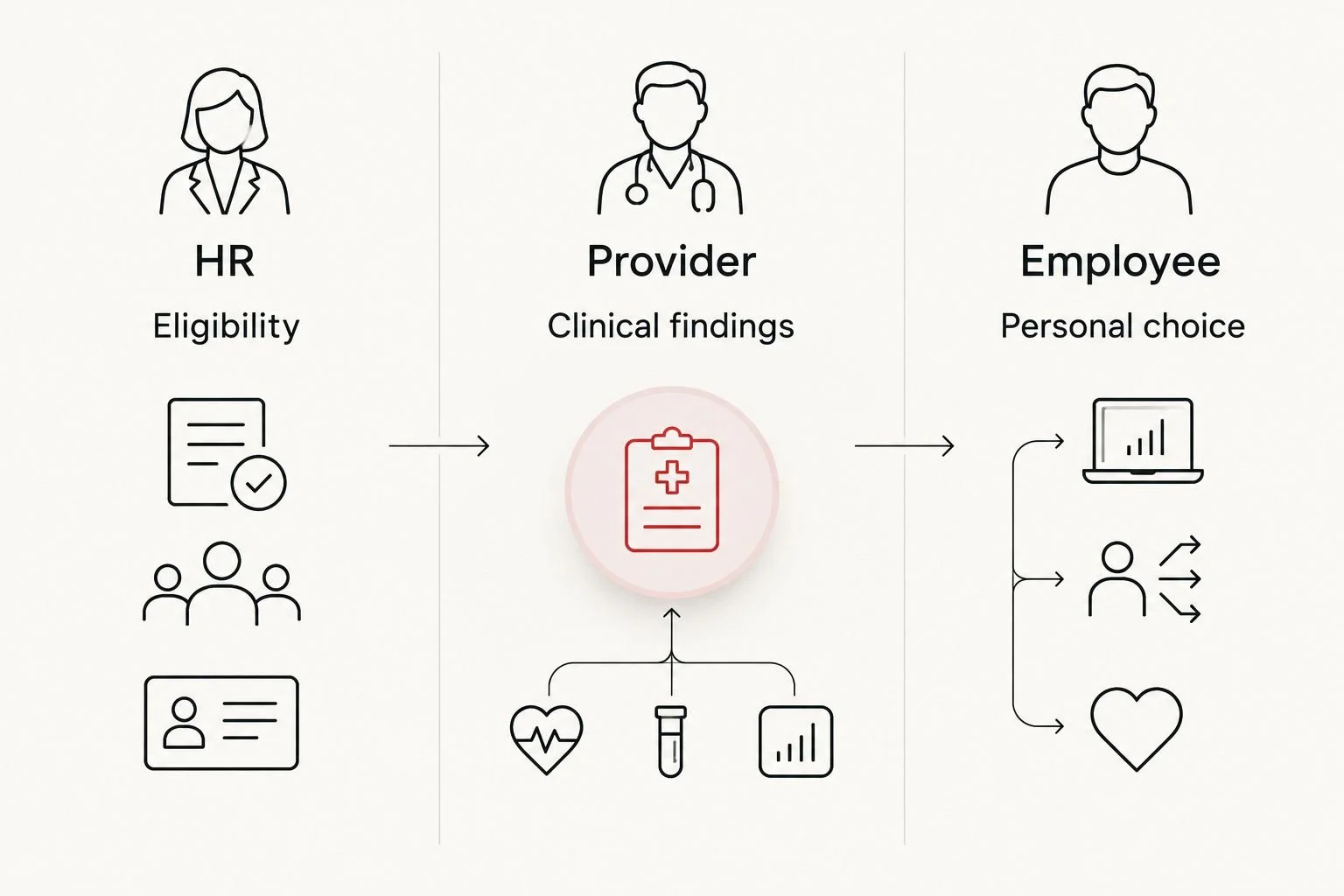
Keep benefit administration separate from clinical information and personal choices.
6. Make the benefit usable without pressuring employees
Test the written process with a hypothetical employee before launch. Can someone understand it without telling a manager about a pregnancy, sharing an image, or explaining a family-building history?
A Keller or Willow Park provider is a local option, not a complete solution for a geographically dispersed workforce. Address travel, work schedules, and provider choice in the policy rather than assuming every employee can use the same location.
Use neutral language about partners and support people. Avoid making participation depend on a public pregnancy announcement, a gender reveal, or an employee's willingness to discuss the pregnancy at work.
Provide a private way to ask eligibility questions.
Explain how appointment-related time requests follow workplace policy.
Review access for remote staff and employees outside the local area.
State how the policy treats covered dependents and different family-building circumstances.
Allow employees to decline communications about optional pregnancy experiences.
7. Measure administration without collecting pregnancy outcomes
Start with a small operational review rather than a medical-results dashboard. Your purpose is to learn whether the process is understandable and whether employees can use it privately.
For your 2026 review, separate completed requests from employee satisfaction. Neither measure establishes that the benefit improves clinical outcomes. Avoid reporting narrow groups where colleagues could infer who is pregnant or who used the benefit.
Use 3 review questions: Was the policy clear? Was the process workable? Was privacy protected? These questions assess benefit administration without asking employees to disclose scan findings.
Track administrative issues using nonclinical categories.
Collect optional feedback without asking for pregnancy details.
Review complaints about access, documentation, or unwanted disclosure.
Examine whether employee-facing language still matches the actual arrangement.
Revise confusing rules before expanding the program.
Compare the benefit options
Choose the administrative model only after defining the purpose. The options below describe possible policy designs, not services or employer programs confirmed at The Ultrasound Concierge. Have advisers review any funded arrangement before implementation.
Existing health-plan pathway
Best for: Clinician-directed diagnostic imaging
Main advantage: Keeps medical imaging within the employee's established care and benefits process
Key limitation: Coverage, referrals, and network rules depend on the plan
Employer reimbursement arrangement
Best for: Employers considering a separately defined benefit
Main advantage: Allows written eligibility and documentation rules
Key limitation: Requires legal, tax, privacy, and administrative review
Provider information without reimbursement
Best for: Employers offering local resource information
Main advantage: Leaves booking and payment decisions with the employee
Key limitation: Does not provide financial assistance or establish clinical suitability
Appointment-time support
Best for: Employees needing time to attend appropriate care
Main advantage: Addresses a scheduling barrier without choosing a scan
Key limitation: Does not determine imaging coverage or replace a healthcare benefit
Prefer support for appropriate care over incentives to obtain more imaging. A provider list is information; it is not medical approval. An employer reimbursement policy is an administrative arrangement; it is not proof that a service is clinically necessary.
Common mistakes employers make
Treating 3D/4D as a medical quality rating
Image format does not establish diagnostic completeness. Evaluate personnel, clinical purpose, interpretation, and follow-up rather than assuming more dimensional detail means better prenatal care.
Presenting optional imaging as reassurance after symptoms
A workplace benefit must not become a route around clinical assessment. Employees with pain, bleeding, or other pregnancy concerns need guidance from their healthcare team, not a promise that a keepsake appointment will answer the concern.
Calling every pregnancy-related expense tax-advantaged
Pregnancy-related does not automatically mean eligible under a particular plan or account. Obtain an administrative determination instead of telling employees that an elective service qualifies because it concerns pregnancy.
Making personal disclosure part of participation
A manager's enthusiasm can still feel like pressure. Do not ask employees to bring images to team meetings, share findings with supervisors, or explain why they declined an optional session.
Advertising an employer partnership before confirming it
A provider offering private appointments does not establish a corporate program. Confirm the scope, documentation process, and responsibilities before using partnership language in employee materials.
FAQ
Is 3D/4D ultrasound a good prenatal workplace benefit?
A benefit built around extra nonmedical scans is not the right starting point. Support clinician-directed care, privacy, and appointment access instead; FDA guidance discourages ultrasound solely for keepsake images or videos.
Can a workplace ultrasound benefit replace prenatal care?
No. A workplace ultrasound benefit cannot replace prenatal appointments or clinician-directed diagnostic examinations. Image format does not establish that a session includes a complete medical assessment.
Can employees use insurance or an HSA for an elective ultrasound?
Employees should not assume an elective ultrasound is eligible for insurance coverage or HSA reimbursement. Confirm the service's purpose and the applicable rules with the insurer or account administrator before proceeding.
Should HR receive ultrasound pictures to approve a request?
HR should not make ultrasound pictures a routine requirement for benefit administration. Have the benefits and privacy advisers define the minimum necessary documentation and keep clinical findings separate.
Does The Ultrasound Concierge offer an employer ultrasound program?
Employer-program terms require direct confirmation with the practice. Its stated services include private diagnostic and elective pregnancy ultrasound in Keller and Willow Park, but those services do not establish an employer arrangement.
When should an employee schedule a 3D/4D ultrasound?
The employee should discuss timing and clinical appropriateness with the prenatal clinician and imaging provider. An employer should not set a pregnancy-week requirement based on a promotional image or encourage repeat scans to obtain a preferred picture.
What should an employer do before launching a benefit in 2026?
Define the purpose, obtain clinical and administrative review, and establish privacy rules before announcing the benefit. Confirm provider responsibilities and employee eligibility rather than promising an arrangement that has not been agreed.
One last thing
The most useful prenatal benefit is not necessarily another scan. Before adding an imaging perk, ask whether employees can attend existing prenatal appointments without avoidable administrative friction or unwanted disclosure.
Remove the scheduling and privacy obstacles first. Then assess any ultrasound-related proposal against clinical guidance, documented benefit rules, and the employee's freedom to choose.