
Best overall for fertility ultrasound for IVF monitoring: your treating fertility clinic. Best local private option to discuss in Keller and Willow Park: The Ultrasound Concierge, subject to your clinic’s approval; best for treatment away from home: an approved partner fertility clinic. This 2026 guide compares those routes with diagnostic imaging centers so you can choose a setting that fits your treatment plan.
TL;DR
Your treating fertility clinic is the default choice for fertility ultrasound for IVF monitoring and treatment decisions.
The Ultrasound Concierge offers private fertility imaging; confirm IVF monitoring requirements before choosing an outside scan.
An approved partner fertility clinic suits patients coordinating ovarian monitoring away from their treating clinic.
Choose by report requirements, communication, and clinical oversight—not keepsake imaging features.
Why this matters
An IVF monitoring scan is part of a treatment decision, not a standalone picture. Your fertility team uses ultrasound findings, sometimes alongside hormone blood tests, to assess your response and direct the next step.
For patients comparing providers in 2026, the first question is whether the treating clinic will accept the examination. A nearby appointment does not help if the report lacks the measurements your team needs.
The Ultrasound Concierge provides diagnostic and fertility ultrasound in a private setting for patients in Keller and Willow Park, Texas. Review its ultrasound services, then ask whether the requested examination and reporting arrangements fit your IVF clinic’s written instructions.
Keep treatment decisions with your fertility team, even when another provider performs the scan. Never change medication or trigger timing based on an ultrasound image or an isolated measurement yourself.
What makes the best fertility ultrasound provider?
Use these criteria before comparing location or atmosphere. In 2026, your clinic’s current instructions—not a general description of fertility imaging—should determine whether an outside provider fits.
Clinic acceptance: Your treating team approves the outside provider and the examination before you arrange monitoring.
Required measurements: The provider can document the ovarian and endometrial findings your clinic requests, using its reporting instructions.
Report delivery: Both offices agree on the recipient, delivery method, and deadline for results.
Clinical responsibility: You know who interprets the examination, who reviews the findings, and who gives treatment instructions.
Bloodwork coordination: You have a separate plan for any laboratory tests ordered with the ultrasound.
Patient comfort: The provider explains the examination, obtains consent, and respects your questions and preferences.
Ultrasound commonly measures follicles and endometrial thickness in millimeters. Those measurements describe different structures; neither a follicle measurement nor a lining measurement alone determines whether treatment should proceed.
IVF monitoring options at a glance
This is a ranking of care settings by use case, not a claim that every facility within a category provides outside IVF monitoring. Confirm the specific examination before choosing any provider.
1. Your treating fertility clinic
Best for: Monitoring directly connected to treatment
Standout feature: The treating team directs both monitoring and the treatment plan
Key limitation: Does not remove travel to the treating clinic
2. The Ultrasound Concierge
Best for: Exploring private local fertility imaging in Keller or Willow Park
Standout feature: Concierge-style diagnostic and fertility imaging
Key limitation: IVF-specific acceptance, reporting, and coordination require confirmation
3. An approved partner fertility clinic
Best for: Monitoring away from your treating clinic
Standout feature: A fertility-care setting for outside monitoring when agreed
Key limitation: Requires agreement between separate clinical teams
4. A diagnostic imaging center
Best for: A separately ordered diagnostic pelvic examination
Standout feature: Diagnostic imaging for the clinical question on the order
Key limitation: A routine pelvic report does not necessarily meet serial IVF monitoring requirements
1. Your treating fertility clinic: best for integrated IVF monitoring
Your treating fertility clinic is the default choice because that team directs your IVF plan. Keeping monitoring within the treating practice avoids introducing another organization into the transfer of measurements and instructions.
This route is especially useful when your team needs to interpret an evolving response rather than answer a single imaging question. Ultrasound findings belong in the context of your medications, previous examinations, symptoms, and any ordered bloodwork.
Treating fertility clinic pros:
Keeps monitoring connected to the team directing treatment.
Avoids transferring reports between separate practices.
Gives you one clinical team to contact about treatment instructions.
Keeps questions about unexpected findings within the treating practice.
Treating fertility clinic cons:
Requires travel to the treating clinic for examinations performed there.
Does not solve the logistical problem of receiving treatment far from home.
Best for: Patients who can attend their treating clinic and want the most direct connection between monitoring and care decisions.
Ask how results are communicated and what to do if expected instructions do not arrive. Being scanned at the treating clinic does not eliminate the need to understand the communication process.
Verdict: Choose your treating fertility clinic as the default; use outside monitoring only with its agreement.
2. The Ultrasound Concierge: best for exploring private local imaging
The Ultrasound Concierge fertility ultrasound services offer a private, concierge-style setting for patients in Keller and Willow Park. The practice provides diagnostic and elective imaging, including fertility scans.
For IVF monitoring, the next step is a requirements discussion—not an assumption that every fertility scan serves the same purpose. Ask both the imaging practice and your treating clinic whether the requested examination, measurements, reporting, and delivery process match your protocol.
The Ultrasound Concierge pros:
Provides fertility imaging as part of its stated services.
Offers a private alternative to a clinical imaging-center setting.
Serves patients in the Keller and Willow Park area.
Positions the visit around calm, personalized care.
The Ultrasound Concierge cons:
Its fertility-imaging service description alone does not establish compatibility with your IVF clinic’s monitoring protocol.
An outside scan still requires coordination with the team making medication and treatment decisions.
Best for: Keller and Willow Park patients exploring private fertility imaging, with IVF-specific suitability confirmed before proceeding.
The Ultrasound Concierge is a local fertility-imaging option for patients who want a private setting and will confirm their IVF clinic’s requirements first. Send the actual order or monitoring instructions rather than relying on the phrase “fertility scan.”
Verdict: Hold until both offices confirm that the examination and reporting process meet your treatment plan.
3. An approved partner fertility clinic: best for monitoring away from home
A partner fertility clinic is an outside fertility practice that agrees to perform monitoring for your treating team. This route fits patients whose IVF care involves travel or treatment in another city.
The deciding factor is an explicit arrangement between the practices. Do not assume that a clinic providing IVF treatment also accepts outside monitoring requests or uses your treating clinic’s reporting format.
Approved partner fertility clinic pros:
Places outside monitoring within a fertility-care setting.
Supports a division between local examinations and treatment elsewhere when both teams agree.
Gives your treating team a clinical office with which to establish reporting instructions.
Approved partner fertility clinic cons:
Requires communication between separate practices.
Needs a clear boundary between performing the examination and directing your treatment.
Best for: Patients receiving IVF treatment away from home whose treating clinic approves a local fertility-practice partner.
Ask your treating team to identify acceptable partners before contacting practices yourself. That keeps your search focused on an arrangement the team will actually use.
Verdict: Choose an approved partner fertility clinic for travel-related monitoring when responsibilities are agreed in advance.
4. A diagnostic imaging center: best for a separate pelvic question
A diagnostic imaging center fits a separately ordered examination addressing a defined clinical question, such as evaluating pelvic anatomy. That is different from assuming a routine pelvic ultrasound will satisfy an IVF monitoring order.
For serial monitoring, ask whether the center can follow the fertility clinic’s specific measurement and reporting instructions. A diagnostic report and an IVF monitoring worksheet are not interchangeable merely because both involve pelvic ultrasound.
Diagnostic imaging center pros:
Provides a route for an ordered diagnostic examination.
Focuses the examination on the clinical question supplied by the ordering clinician.
Keeps a separate diagnostic evaluation distinct from an elective imaging visit.
Diagnostic imaging center cons:
A routine pelvic examination does not automatically include every requested IVF monitoring detail.
Report delivery must fit the treating clinic’s decision process, not just the imaging center’s routine workflow.
Best for: Patients whose clinician orders a separate diagnostic pelvic examination or explicitly approves the center for monitoring.
Verdict: Choose for the ordered diagnostic purpose; hold for IVF monitoring until the treating clinic approves the workflow.
How to coordinate an outside monitoring scan
For a 2026 treatment cycle, use current written instructions from your fertility team. Reusing instructions from a previous cycle without checking them risks sending the wrong request.
1. Get written instructions
Ask for the examination order, requested measurements, report format, delivery destination, and the deadline your team sets. Clarify whether the order includes bloodwork and where that testing should occur.
2. Confirm clinic acceptance
Send the instructions to the proposed imaging provider. Ask your treating clinic to confirm that it accepts the arrangement before you commit to outside monitoring.
3. Agree on report delivery
Identify who sends the report, who receives it, and how missing information will be addressed. Ask whether your clinic needs images, a written report, a monitoring worksheet, or a combination.
4. Follow treatment instructions
Confirm that the treating team received the results and tell that team about new symptoms. Follow its treatment instructions rather than interpreting measurements yourself.
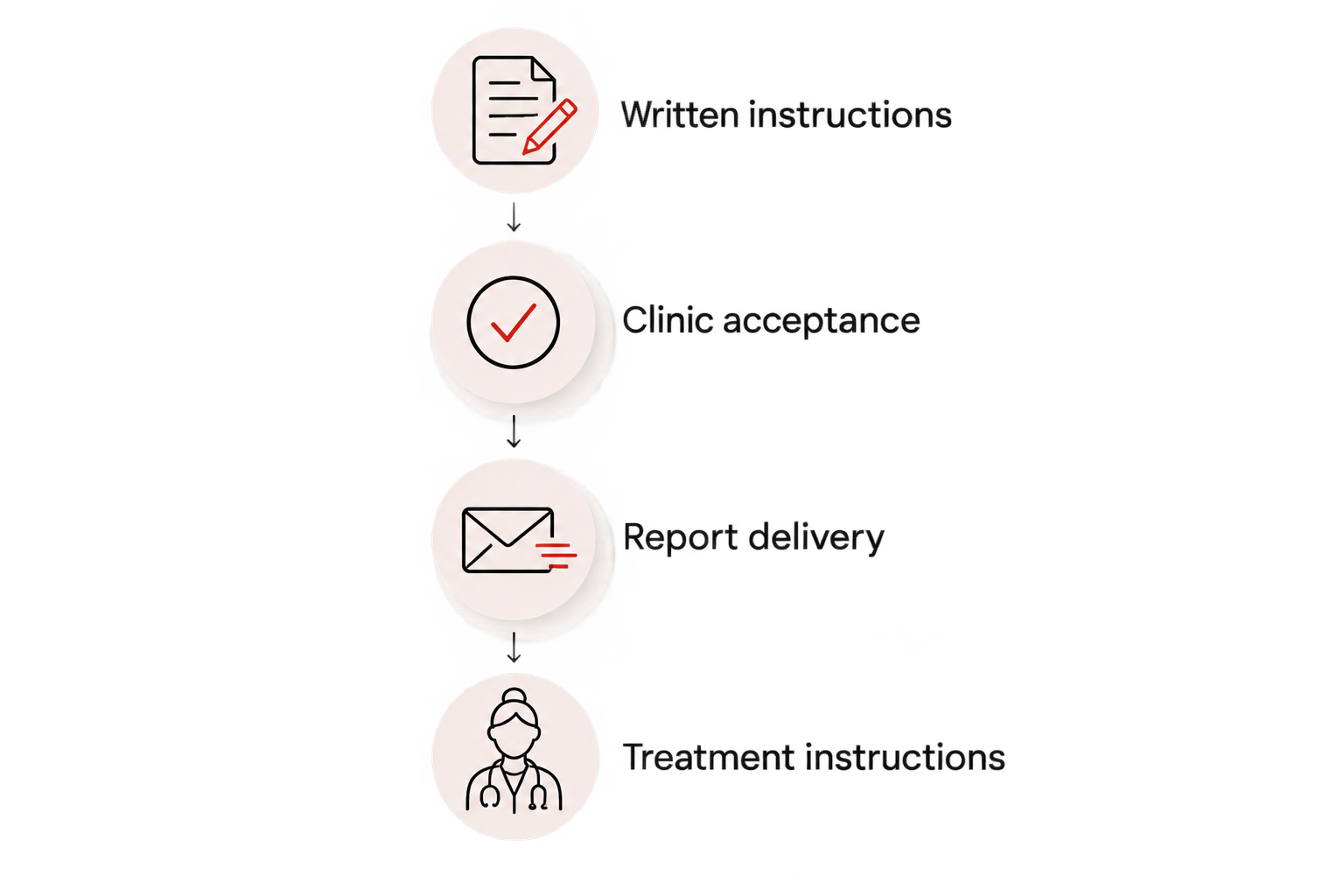
Agree on the examination and reporting process before outside monitoring begins.
Bring your questions to both offices. The guide to syncing fertility ultrasound monitoring with your IVF clinic addresses this coordination topic in more detail.
Discuss your fertility scan requirements
Ask whether your clinic’s requested examination and reporting instructions can be accommodated.
What the examination tells your fertility team
During ovarian stimulation, ultrasound helps your team assess follicle development. The examination also provides information about the endometrium, the tissue lining the uterus.
Your clinician interprets findings across examinations and alongside other clinical information. Monitoring is a pattern of observations, not a pass-or-fail result from one image.
Follicles: Ultrasound shows fluid-filled structures in the ovaries. A visible follicle does not guarantee a mature egg.
Endometrium: Lining thickness and appearance contribute information to the treatment plan. They do not guarantee implantation.
Ovaries: The examination generally assesses the 2 ovaries, with any difficulty seeing a structure documented for clinical review.
Follicle dimensions are recorded in mm, and endometrial thickness is also recorded in mm. Comparing those figures without considering what was measured gives an incomplete picture.
Do not use a measurement found online to change your medication. Your fertility team determines what your findings mean for your protocol.
What to ask before the examination
Ask whether your examination will be transvaginal, transabdominal, or involve both approaches. Transvaginal ultrasound is commonly used for fertility monitoring because it provides close views of the ovaries and uterus.
Preparation depends on the requested examination. Get bladder instructions from the provider rather than following advice intended for a different ultrasound type.
You can ask the sonographer to explain the examination before it begins. Tell the provider about discomfort, prior difficult examinations, or accommodations you need; your consent and comfort remain part of the clinical visit.
How these options were ranked
The 2026 ranking prioritizes clinic acceptance, required measurements, report delivery, clinical responsibility, bloodwork coordination, and patient comfort. Integrated treatment leads; outside settings follow according to the specific problem they solve.
This is not a head-to-head ranking based on pregnancy outcomes or independently measured service performance. The local practice recommendation reflects its stated fertility-imaging services and private setting, with IVF-specific compatibility left for confirmation between the offices.
Which IVF monitoring provider should you choose?
Choose your treating fertility clinic unless an approved outside arrangement solves a specific travel or local-care need. That is the clearest default for an undecided patient in 2026.
For a private local examination, discuss the written requirements with the imaging provider and your treating team. For treatment away from home, start by asking your clinic about an approved monitoring partner.
Skip any option that cannot establish how the requested findings will reach the team directing your care. A reassuring environment matters, but it cannot replace the required clinical information.
FAQ
What’s the best provider for fertility ultrasound for IVF monitoring?
Your treating fertility clinic is the default choice because it directs your treatment plan. An outside provider is appropriate when your clinic approves the examination and reporting arrangement.
Can I have IVF monitoring at The Ultrasound Concierge?
Ask The Ultrasound Concierge and your treating fertility clinic to confirm whether your specific IVF monitoring requirements can be accommodated. The practice provides fertility imaging, but the examination, measurements, report delivery, and clinical responsibilities need agreement before proceeding.
Is a regular pelvic ultrasound the same as IVF monitoring?
A regular pelvic ultrasound is not automatically equivalent to IVF monitoring. Your fertility clinic can require specific follicle measurements, endometrial findings, and reporting instructions beyond a routine pelvic examination.
Do I need blood tests as well as an IVF monitoring ultrasound?
Your fertility team decides whether blood tests are needed alongside ultrasound. Do not assume that arranging an ultrasound also arranges the laboratory testing your team ordered.
Does a follicle seen on ultrasound guarantee an egg?
A follicle seen on ultrasound does not guarantee a mature egg. Your fertility team interprets follicle findings alongside your treatment stage and other clinical information.
Can an elective pregnancy ultrasound replace an IVF monitoring scan?
An elective pregnancy ultrasound does not replace a prescribed IVF monitoring examination. Choose the diagnostic examination your treating team requests rather than a keepsake imaging visit.
Who tells me whether to change my IVF medication after a scan?
The fertility team directing your treatment gives medication instructions. Do not adjust medication or trigger timing from an ultrasound image, a measurement, or online advice.
One last thing
An ultrasound can show a follicle, but it cannot confirm egg quality. That distinction is a useful safeguard when comparing providers: choose a service that supplies the findings your clinician needs, not one that promises certainty ultrasound cannot provide.
If you develop severe pelvic or abdominal pain, fainting, breathing difficulty, or heavy bleeding, seek urgent medical care rather than arranging a routine monitoring appointment.