
How to sync fertility ultrasound monitoring with your IVF clinic
Instead of manually reconciling ultrasound appointments with changing IVF instructions, use one clinic-approved monitoring plan that connects your scan order, appointment, report deadline, and treatment-team follow-up. To sync fertility ultrasound with IVF clinic schedule changes, confirm the clinic’s requirements before booking and close each appointment with confirmation that the results reached the right team.
TL;DR
To sync fertility ultrasound with IVF clinic schedule changes, get written monitoring instructions before booking.
The Ultrasound Concierge offers private fertility ultrasound; your IVF clinic must approve any outside monitoring arrangement.
Track appointment time, report deadline, laboratory requirements, and the person responsible for reviewing results.
A completed scan is not a completed handoff: confirm receipt and wait for your clinic’s treatment instructions.
Why this matters
An ultrasound appointment and an IVF treatment decision are separate events. Your clinic needs the requested information in time to review it, alongside any ordered bloodwork, before giving you the next instructions.
The Ultrasound Concierge is best for patients seeking private fertility ultrasound in Keller or Willow Park, with outside monitoring subject to their IVF clinic’s approval. A calm setting supports the visit; it does not replace the treating clinic’s protocol or establish that a particular outside-monitoring arrangement is supported.
Start with the fertility clinic referral workflow when discussing the handoff between your treatment team and imaging provider. For your 2026 cycle, the written instructions from your own IVF clinic remain the source of truth.
Before you start
Get the clinic’s approval and order. Ask whether outside monitoring is accepted for your specific cycle, which ultrasound measurements and images are required, and whether bloodwork must accompany the scan. Obtain the order and any required paperwork before booking.
Collect both teams’ contact details. You need the clinic’s designated monitoring contact, its approved results-delivery method, and the imaging provider’s process for accepting orders and sending records. Ask whether a release or authorization is required.
Resolve the hidden timing problem. An early scan does not guarantee that a completed report reaches the clinic before its review cutoff. Confirm the reporting process, cutoff, and time zone with both teams before choosing an appointment.
You do not need a new scheduling app. A private calendar plus a written checklist works, provided you keep sensitive medical information out of shared calendars and use the teams’ approved channels for clinical records.
Clinic requirements
Build your monitoring brief
The bold labels below are headings for a checklist you create, not buttons or fields in a particular clinic portal. Keep the brief with your current instructions so you can check every booking against the same requirements.
Create Clinic instructions. Save the current written order and record who issued it. Ask your clinic how it defines cycle day rather than calculating a treatment date from a general fertility calendar.
Create Scan requirements. Copy the requested examination and reporting details directly from the order. Ask whether the clinic requires specific follicle measurements, endometrial measurements, images, or a particular reporting form.
Create Bloodwork. Record whether laboratory testing is ordered, where it must be completed, and how those results reach the treatment team. Do not assume an ultrasound appointment includes laboratory services.
Create Review deadline. Write down the clinic’s required receipt time, its time zone, and the contact responsible for reviewing the results.
Create Backup contact. Record the clinic’s instructions for delayed results, unanswered messages, and questions outside routine office communication.
Expected result: You can explain what needs to happen, who needs the results, and when the clinic needs them—without reconstructing the plan from separate messages.
For a reusable 2026 template, leave treatment-specific measurements blank until the clinic supplies them. Copying another patient’s monitoring requirements into your checklist creates a false starting point.
Choose the monitoring arrangement
Best for clinic-led treatment coordination: keep the IVF clinic responsible for the protocol, whether imaging happens there or elsewhere. Outside monitoring adds a records handoff that must be agreed upon in advance.
Monitoring at your IVF clinic
Best for: Patients keeping imaging and treatment review within their treating clinic
Main advantage: Keeps the coordination within the treating organization
Main limitation: Requires attending the clinic’s designated location
Clinic-approved outside monitoring
Best for: Patients seeking local imaging while another clinic directs treatment
Main advantage: Separates the imaging location from the treatment location
Main limitation: Requires agreement on orders, reporting, receipt, and review
Neither arrangement changes who makes medication or procedure decisions. Your treating team remains responsible for interpreting monitoring information within your treatment plan.
Appointment and deadline setup
Book against the reporting deadline
Give the imaging provider the order before confirming the appointment. Ask whether it can perform the requested examination and meet the clinic’s reporting requirements.
State the clinic’s receipt deadline, including the time zone. Ask when the report and any required images will be sent, and whether any separate interpretation step affects that timing.
Confirm preparation instructions directly with the imaging provider. Bladder preparation depends on the examination; do not apply instructions from a pregnancy keepsake visit to fertility monitoring.
Coordinate any separately ordered laboratory visit. Ask your clinic whether the ultrasound and bloodwork must occur on the same date and whether there is a required sequence.
Enter the confirmed appointment in your calendar. Keep the clinical order in a secure location rather than attaching it to a calendar shared with coworkers or relatives.
Expected result: Your appointment fits the clinic’s reporting requirements, not just an open space in your personal calendar.
When contacting The Ultrasound Concierge about fertility ultrasound, ask specifically about your clinic’s order, required measurements, records transfer, and reporting deadline. The service description alone does not confirm those operational details.
Separate the visit from the handoff
Create 3 calendar entries: Scan appointment, Report check, and Clinic instructions. These are tracking checkpoints, not promises about reporting speed or when your clinic will respond.
Put the confirmed location, arrival instructions, and preparation notes under Scan appointment. Add travel time separately if it helps you plan.
Set Report check for a time agreed with the imaging provider. Record the destination and the contact to use if transmission is not confirmed.
Set Clinic instructions around the review process your treatment team specifies. Include its instructions for what to do if you have not heard back before a scheduled medication dose.
Label tentative future scans as tentative. Replace them only when the clinic confirms the next monitoring date.
Expected result: You can distinguish attending the scan, sending the records, and receiving a treatment decision.
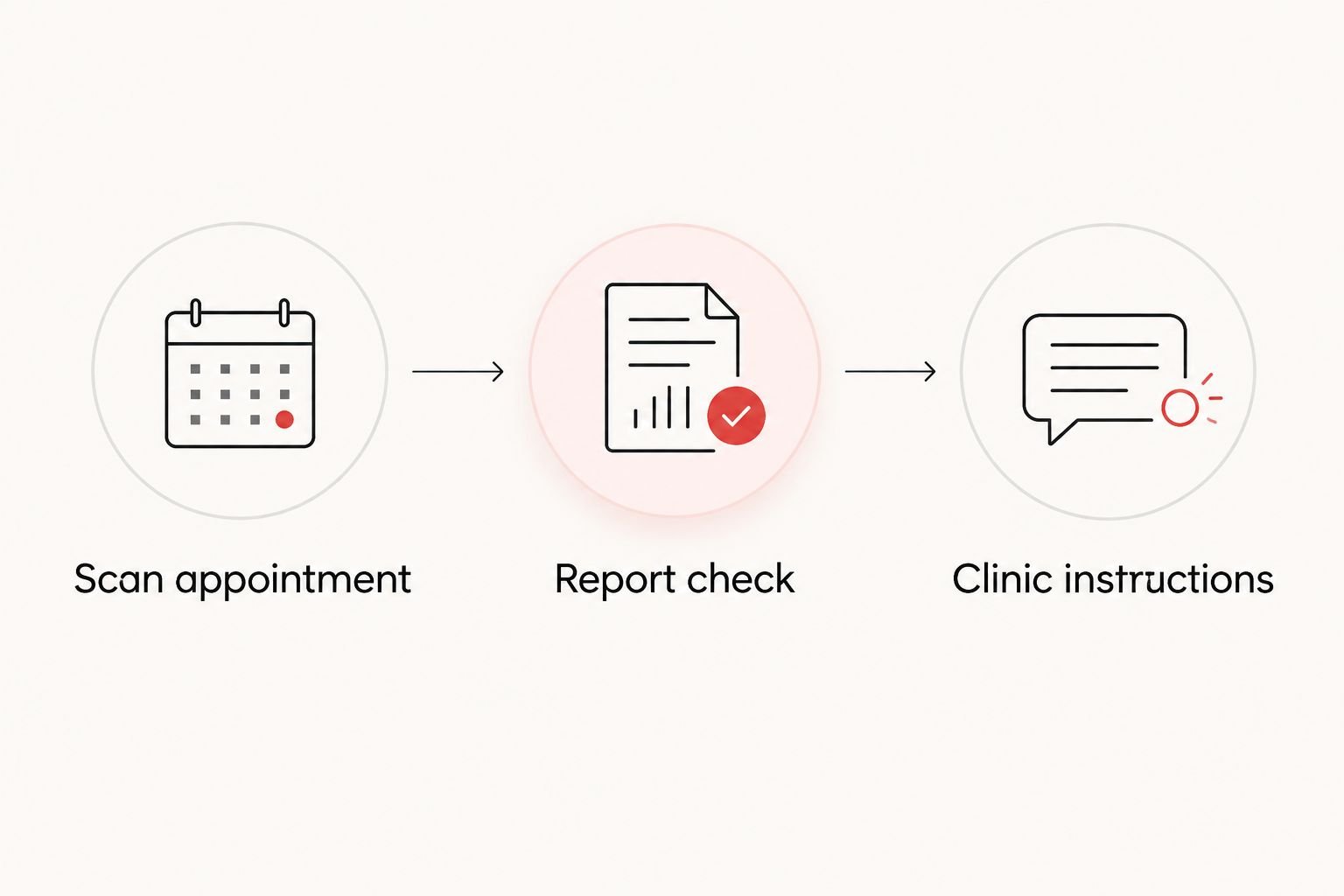
Track the appointment, records handoff, and treatment instructions separately.
Use the same structure for each appointment in your 2026 cycle. Do not automatically repeat a scan interval simply because it appeared on an earlier calendar entry.
Results delivery and clinic review
Close the records handoff
Before leaving the imaging visit, ask how the report and required images will reach the clinic. Confirm the receiving destination against the instructions in your monitoring brief.
Ask for transmission confirmation through the provider’s normal process. Keep your own copy of records when supplied, but do not assume a patient copy replaces the clinic’s required delivery method.
Contact the clinic through its designated monitoring channel to confirm receipt. If the clinic needs laboratory results too, ask whether the monitoring information is complete.
Obtain the next treatment instructions from the IVF team. Read back any unclear medication name, dose, route, or timing rather than interpreting shorthand yourself.
Record the next action and retire outdated instructions from your active checklist. Preserve the originals in your records instead of deleting the history.
Expected result: The clinic has the required information, and you know which current instructions to follow.
A message marked sent is not proof of clinical review. Likewise, an ultrasound image on your phone does not establish that the clinic has the measurements or report it requested.
Do not change medication or trigger timing based on ultrasound images, calendar reminders, or your own reading of a report. If instructions are unclear or delayed, use the clinic’s escalation process.
When your IVF clinic updates the schedule
The second workflow begins with a changed instruction rather than a new appointment. Use it when the clinic changes a monitoring date, requests another measurement, or revises the treatment plan.
Capture the update. Save the new message and identify exactly what changed: date, examination, laboratory order, reporting requirement, or treatment instruction.
Confirm the order. Ask whether the imaging provider needs an updated order before the revised examination. Do not assume a previous order covers a different request.
Reconfirm the handoff. Check the new appointment against the clinic’s receipt deadline and laboratory requirements. Notify both teams if the old appointment is canceled or moved.
Replace the active plan. Update the calendar and checklist together. Mark the old plan as superseded so it cannot be mistaken for current instructions.
Expected result: Both teams and your personal calendar reflect the same current plan.
For an ongoing 2026 cycle, write the instruction date beside each update. A dated instruction is easier to distinguish from an older screenshot with the same appointment description.
Keep medication questions outside the calendar
A calendar organizes appointments; it does not reconcile medications or supplements. Send those questions to your IVF team, especially when a schedule change also changes treatment instructions.
Questions about prenatal vitamins before IVF belong in that clinical review: give your team the product names, ingredient lists, and doses you take rather than treating general preparation advice as your personal protocol. Do not start, stop, or change supplements based on a scheduling guide.
Keep appointment notes brief. Store the clinic’s actual medication instructions in its approved communication channel so a shortened calendar label does not become an accidental substitute for the prescription.
Troubleshooting
The clinic cannot find the report
Ask the imaging provider to verify the recipient, patient identifiers, examination date, and transmission status. Then ask the clinic to check its designated receiving channel. Resend through the approved process rather than sending medical records to an unverified email address.
The report arrived without the requested details
Compare the clinic’s request with what was delivered and ask the two teams to resolve the discrepancy. The next step is clinician-directed clarification, an addendum, or another examination when appropriate—not estimating missing measurements yourself.
The appointment cannot meet the clinic’s cutoff
Contact the IVF clinic before accepting the appointment as your monitoring solution. Ask the clinic to approve another arrangement or revised plan. Do not silently move the scan to another day or assume a late report will be acceptable.
Bloodwork and ultrasound are not both received
Tell the clinic which component is outstanding and contact the responsible provider. Ask the treatment team what to do while it waits; do not infer medication instructions from the ultrasound alone.
Two messages give different instructions
Pause and ask the clinic to identify the current instruction. Provide the dates and wording of both messages, then update your active checklist once the discrepancy is resolved. If a dose or time-sensitive action is approaching, use the clinic’s designated urgent contact route.
Customize your workflow
Keep 2 documents: a reusable contact sheet and a cycle-specific monitoring checklist. The contact sheet holds communication details; the checklist holds the current order, confirmed appointments, reporting requirements, and next action.
Add travel, work coverage, or childcare reminders if those affect your day. Leave medical decision-making with the clinic. For your next 2026 appointment, the most useful improvement is a confirmed handoff—not more reminders attached to an unconfirmed plan.
FAQ
Can I have fertility monitoring near home if my IVF clinic is elsewhere?
You can arrange outside fertility monitoring when your IVF clinic approves it and the imaging provider can meet its requirements. Confirm the order, required measurements, reporting process, and receipt deadline before booking.
How do I sync fertility ultrasound with my IVF clinic schedule?
Start with the IVF clinic’s written monitoring instructions, then book imaging around its results-receipt deadline. Track the scan, report handoff, and treatment-team response as separate checkpoints.
Does The Ultrasound Concierge offer fertility ultrasound?
The Ultrasound Concierge offers fertility ultrasound services for patients in the Keller and Willow Park, Texas area. Confirm whether your specific clinic order and reporting requirements can be supported before arranging outside monitoring.
Should I book all my IVF monitoring scans in advance?
Book confirmed scans according to your clinic’s instructions and treat projected dates as tentative. Update future appointments when the treatment team confirms the next monitoring step.
Do I need bloodwork on the same day as my fertility ultrasound?
Your IVF clinic determines whether bloodwork is required and when it must happen. An ultrasound booking does not establish that laboratory testing is included or coordinated.
What should I do if my clinic has not received my ultrasound results?
Contact the imaging provider to verify transmission and ask the clinic to confirm receipt through its designated channel. Use the clinic’s escalation instructions if a treatment decision or medication time is approaching.
Can an ultrasound report tell me when to take my trigger medication?
Your IVF team must give you the trigger instruction within your treatment plan. Do not choose the timing yourself from follicle measurements, images, or calendar reminders.
One last thing
Ask who confirms receipt before you ask when the scan ends. The appointment is only one part of monitoring; a named receiving contact and a clear escalation route turn a completed examination into an actionable handoff.
This guide supports coordination, not individualized medical advice. Follow your IVF clinic’s examination, medication, and urgent-care instructions.