
Yes—ultrasound can detect signs of ovarian torsion, but a normal ultrasound or normal Doppler blood flow cannot rule it out. Clinicians use the scan alongside your symptoms and examination; surgery provides the definitive diagnosis. If you have sudden, severe pelvic or lower abdominal pain, especially with nausea or vomiting, seek emergency care now rather than waiting for an outpatient scan.
TL;DR
Can an ultrasound detect ovarian torsion? Yes, but normal imaging cannot exclude it.
ACOG advises that Doppler blood flow alone should not determine whether ovarian torsion is present.
Sudden, severe pelvic pain needs emergency evaluation, even if an earlier ultrasound looked normal.
Pelvic ultrasound supports diagnosis; urgent gynecologic assessment determines whether surgery is needed.
Why this matters
Ovarian torsion can interrupt an ovary's blood supply. Prompt treatment gives clinicians the opportunity to untwist the ovary and preserve ovarian function, so a reassuring scan must not outweigh concerning symptoms.
This 2026 guide explains what ultrasound can show, what it cannot exclude, and when you need emergency assessment. If you are researching a known cyst without acute symptoms, the guide to whether ultrasound can check for ovarian cysts addresses that separate question. A cyst assessment is not the same as ruling out torsion.
Can an ultrasound detect ovarian torsion?
Ultrasound can identify findings that support ovarian torsion, but it cannot reliably exclude torsion on its own. Pelvic ultrasound with Doppler is generally the first imaging examination when clinicians suspect a gynecologic cause of acute pelvic pain.
The examination looks at ovarian structure and blood flow. An enlarged, swollen ovary, follicles pushed toward the outer edge, or a twisted vascular pedicle can raise concern; reduced or absent flow adds evidence but is not required for torsion to be present.
Enlarged, swollen ovary
What it contributes: Supports concern for torsion in the right clinical setting
Important limitation: Enlargement also occurs with other conditions
Follicles around the ovarian edge
What it contributes: Can reflect swelling within the ovary
Important limitation: This appearance does not establish torsion alone
Twisted vascular pedicle
What it contributes: A direct sign that strongly supports torsion when identified
Important limitation: The twisted tissue is not always visible
Reduced or absent Doppler flow
What it contributes: Raises concern about impaired circulation
Important limitation: Technical factors also affect flow detection
Preserved Doppler flow
What it contributes: Shows detectable circulation during the examination
Important limitation: Does not exclude partial or intermittent torsion
Fluid in the pelvis
What it contributes: Adds context to the examination
Important limitation: Fluid is nonspecific and has other causes
The American College of Obstetricians and Gynecologists, in its guidance titled Adnexal Torsion in Adolescents, states that no clinical or imaging criteria are sufficient to confirm the diagnosis before surgery. It also advises against using Doppler flow alone to guide clinical decisions. That guidance specifically addresses adolescents; the limitation of preserved flow also matters when clinicians evaluate adults.
For patients reading in 2026, the practical distinction is straightforward: ultrasound helps identify torsion; it is not a stand-alone clearance test.
Which ultrasound examination helps assess ovarian torsion?
Clinicians commonly use 2 approaches to pelvic ultrasound: transabdominal and transvaginal imaging. These approaches provide different views and often complement each other rather than compete.
Doppler is an additional ultrasound technique that evaluates blood flow. It can accompany either approach; it is not a separate guarantee that torsion has been excluded.
Transabdominal ultrasound
Best for: A broader pelvic overview
Main benefit: Examines pelvic structures through the lower abdomen
Main limitation: Bowel gas, bladder filling, and tissue depth can limit detail
Transvaginal ultrasound
Best for: Closer ovarian detail when appropriate and consented to
Main benefit: Places the transducer closer to the pelvic organs
Main limitation: An internal examination is not appropriate or acceptable for everyone
Doppler assessment
Best for: Evaluating blood-flow patterns
Main benefit: Adds information about ovarian circulation
Main limitation: Detectable flow does not rule out torsion
Your clinician chooses the examination based on your age, symptoms, circumstances, and consent. Tell the care team if an internal examination concerns you; you can ask what information it would add and what alternatives are appropriate.
Do not delay emergency assessment to fill your bladder or follow preparation instructions intended for a scheduled appointment. The emergency team will tell you what preparation, if any, is needed.
Why ultrasound findings vary
The scan captures ovarian appearance and circulation during the examination. Torsion is not always a fixed, complete interruption of blood flow, which explains why symptoms and imaging sometimes disagree.
Intermittent twisting: An ovary can twist and untwist, so the examination can occur during a temporary improvement.
Partial twisting: Some circulation can remain despite twisting of the supporting tissues.
Dual blood supply: Ovarian circulation receives contributions from 2 arterial sources—the ovarian artery and branches of the uterine artery. Detectable arterial flow does not prove that the ovary is untwisted.
Changing tissue appearance: Swelling and other structural findings depend on what is happening in the ovary when imaging occurs.
Imaging access: Ovarian position, bowel gas, and examination technique affect how clearly the ovary and its vessels are seen.
Other pelvic conditions: Cysts and other abnormalities can produce overlapping findings that need clinical interpretation.
These limitations do not make ultrasound unhelpful. They explain why the report must be read alongside the pain history, examination, and specialist assessment—not as an isolated yes-or-no answer.
What happens when clinicians suspect ovarian torsion?
The priority is timely assessment, not obtaining a particular scan result before asking for help. In 2026, the appropriate pathway for sudden, severe pelvic pain remains emergency evaluation rather than a routine imaging appointment.
Emergency assessment. Tell the team when the pain began, where it is strongest, whether it comes and goes, and whether you have nausea, vomiting, bleeding, or faintness. Mention pregnancy possibility, fertility treatment, known ovarian cysts, and previous torsion.
Pelvic imaging. The team evaluates ovarian appearance and circulation, usually with pelvic ultrasound and Doppler. Pregnancy testing and other investigations help assess alternative causes of pain.
Gynecology review. If symptoms remain concerning, clinicians seek specialist input even when imaging is inconclusive or flow is present. A normal report does not automatically end the assessment.
Surgical assessment. When suspicion warrants surgery, laparoscopy allows the surgeon to inspect the ovary directly. If torsion is present, treatment generally aims to untwist and preserve the ovary when appropriate.
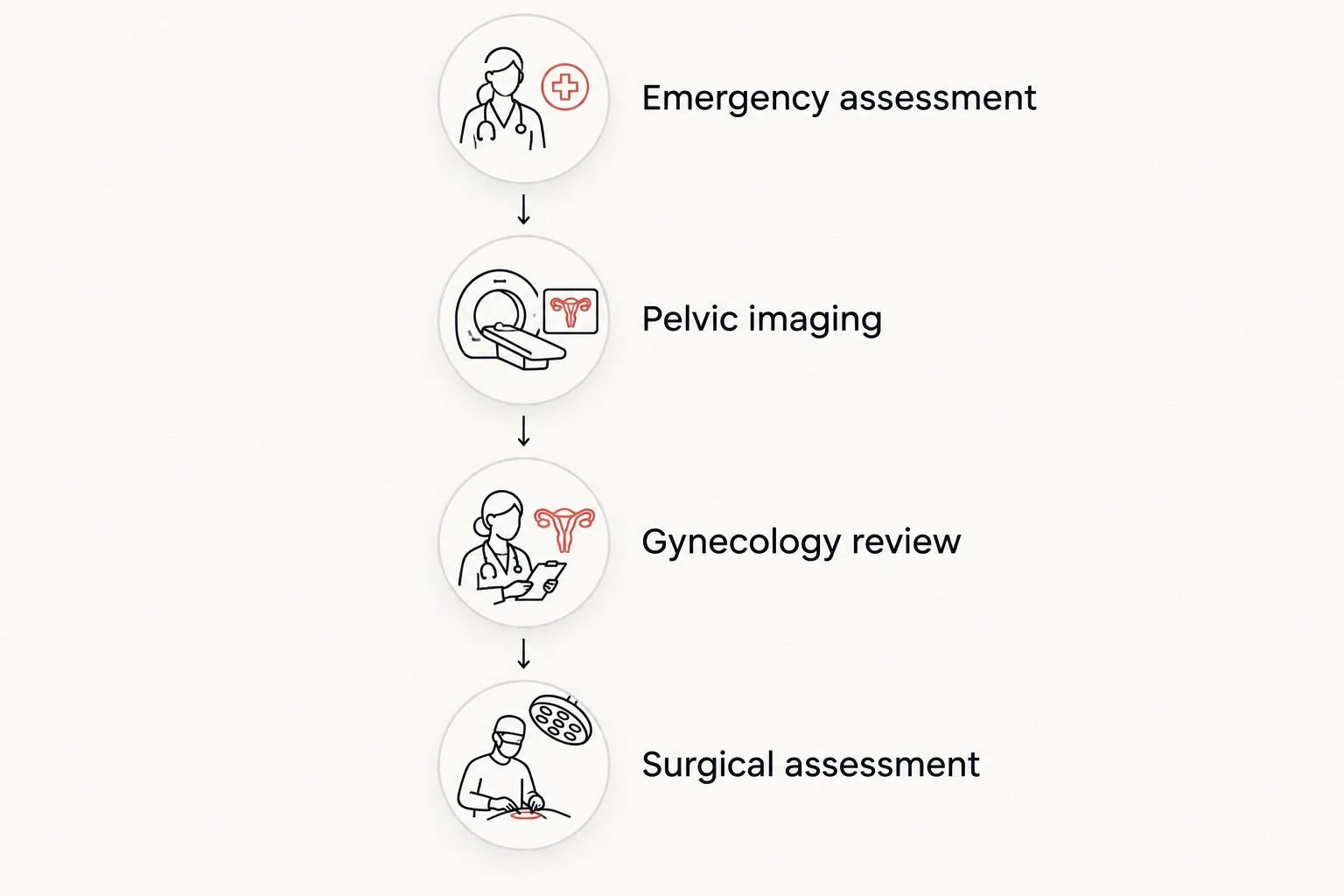
Concerning symptoms can require gynecology review even when ultrasound is inconclusive.
Surgery is not recommended solely because you have pelvic pain or an ovarian cyst. The treating team weighs the full clinical picture, explains the concern, and discusses the proposed procedure with you.
Can normal Doppler blood flow rule out ovarian torsion?
Normal Doppler blood flow cannot rule out ovarian torsion. Blood can remain detectable because the ovary has overlapping arterial supply, because twisting is incomplete, or because the ovary has temporarily untwisted.
Read report language carefully. A statement that blood flow is present describes an imaging observation; it does not necessarily establish the cause of your pain or exclude every emergency.
If severe pain persists or returns after a reassuring scan, seek reassessment. Bring the report if you have it, but do not delay care while trying to obtain records.
Can ovarian torsion pain come and go?
Ovarian torsion pain can come and go, particularly when twisting is intermittent. Temporary relief does not establish that the underlying problem has resolved.
Describe the whole episode to your clinician, including severe pain that eased before the examination. The strongest earlier symptoms still matter, even if you feel more comfortable when someone assesses you.
Pain patterns alone cannot distinguish torsion from a ruptured cyst, kidney stone, appendicitis, or other causes. You need clinical evaluation rather than a symptom checklist to make that distinction.
Does an ovarian cyst mean you have torsion?
An ovarian cyst does not mean you have torsion. A cyst or mass can increase the likelihood of twisting, but many cysts do not twist, and torsion can occur without a known cyst.
A cyst seen on ultrasound therefore needs interpretation in context. Routine monitoring instructions for a stable cyst do not replace emergency assessment if you develop sudden, severe pain.
If you are receiving fertility treatment, tell the emergency team. Ovarian enlargement associated with treatment is relevant to the assessment, but it does not establish the diagnosis by itself.
When should you go to the emergency department?
Seek emergency care for sudden, severe pelvic or lower abdominal pain, particularly when it occurs with nausea or vomiting. Pain concentrated on one side is concerning, but torsion does not require a perfectly typical symptom pattern.
If pregnancy is possible, pain with vaginal bleeding, shoulder pain, dizziness, or fainting also needs urgent assessment because ectopic pregnancy is another important possibility. Do not assume that a positive pregnancy test explains severe pain as a normal pregnancy symptom.
Call 911 if you collapse, feel faint with severe symptoms, or cannot travel safely. Do not drive yourself if pain, weakness, or dizziness makes driving unsafe.
There is no dependable home waiting period that makes suspected torsion safe. Do not wait for pain to become constant, for a fever to develop, or for a scheduled scan to become available.
Where private ultrasound fits—and where it does not
The Ultrasound Concierge is best suited to patients seeking private, nonemergency ultrasound imaging in Keller and Willow Park. Its diagnostic ultrasound and elective pregnancy imaging services serve different purposes; an elective pregnancy visit is not an emergency evaluation for suspected ovarian torsion.
For a nonurgent concern, you can review The Ultrasound Concierge's ultrasound services and discuss the appropriate examination with your treating clinician. A calm, personalized setting can support your experience, but setting alone does not determine whether a scan answers a specific medical question.
The limitation is clear: private outpatient imaging does not replace emergency assessment when torsion is suspected. Your care pathway must include clinical evaluation and access to urgent gynecologic treatment when needed.
What should you ask after a reassuring scan?
A useful discussion goes beyond whether the report says normal. Ask how the imaging findings fit your symptoms and what should happen if the pain continues.
Were both ovaries adequately visualized?
What findings explain the pain, if any?
Does the clinical assessment still raise concern for torsion?
Is gynecology review needed?
Which symptoms mean I should return immediately?
These questions support communication; they are not a checklist you must complete before seeking care. If symptoms worsen after discharge, follow the emergency return instructions rather than waiting for a routine follow-up conversation.
For your 2026 medical records, keep a copy of the ultrasound report and discharge instructions if available. Tell the next clinician about changes since the examination, especially recurrent severe pain or vomiting.
FAQ
Can an ultrasound detect ovarian torsion even if blood flow is normal?
Yes, ultrasound can show structural signs of ovarian torsion even when Doppler blood flow is present. Normal flow does not exclude torsion, so clinicians must consider your symptoms and examination.
What's the best scan for suspected ovarian torsion?
Pelvic ultrasound with Doppler is generally the first imaging examination for suspected ovarian torsion. Transabdominal and transvaginal views can complement each other when appropriate, but no ultrasound result rules out torsion by itself.
Can ovarian torsion be missed on an ultrasound?
Yes, ovarian torsion can be missed on ultrasound. Intermittent twisting, preserved circulation, and limited visualization can produce an inconclusive or reassuring-looking examination.
Do I need surgery to confirm ovarian torsion?
Direct surgical assessment provides the definitive diagnosis of ovarian torsion. Clinicians decide whether surgery is warranted using the full clinical picture, not the ultrasound report alone.
Can I wait until tomorrow if the pain has stopped?
Temporary pain relief does not make waiting safe when ovarian torsion is a concern. Seek urgent assessment after sudden, severe pelvic pain, especially if it recurs or was accompanied by nausea or vomiting.
Can ovarian torsion happen during pregnancy?
Yes, ovarian torsion can occur during pregnancy. Severe pelvic pain needs urgent evaluation because torsion and other emergencies cannot be distinguished safely at home.
Should I book a private ultrasound if I think I have ovarian torsion?
No—suspected ovarian torsion needs emergency evaluation rather than a routine private scan. The Ultrasound Concierge's private ultrasound services do not replace the emergency assessment and potential surgical care this condition requires.
One last thing
An improved symptom is not the same as an excluded diagnosis. If severe pain stops before your scan, tell the clinician how intense it was, how suddenly it started, and whether it has happened before; intermittent twisting is one reason that history matters.
The most useful takeaway from this 2026 guide is not a particular phrase to look for on a report. It is knowing that persistent or recurrent concerning symptoms deserve reassessment, even after a scan that showed blood flow.