
Yes, an ultrasound can detect thyroid nodules and show their size, location, and whether they contain fluid, solid tissue, or both. It also identifies features that help your clinician decide whether a nodule needs monitoring or a biopsy. Ultrasound alone usually cannot determine whether a thyroid nodule is cancerous, and it does not measure how well your thyroid works.
TL;DR
Can an ultrasound detect thyroid nodules? Yes; thyroid ultrasound shows their size, composition, and features that guide follow-up.
A thyroid nodule is not a cancer diagnosis; suspicious findings sometimes require a needle biopsy.
Blood tests assess thyroid function; ultrasound evaluates thyroid structure.
The Ultrasound Concierge provides private diagnostic ultrasound; confirm the specific thyroid examination before arranging your visit.
Why this matters
Finding a lump in your neck can feel unsettling. A thyroid ultrasound helps turn that concern into a more specific question: what does the finding look like, and what needs to happen next?
The Ultrasound Concierge best fits Keller and Willow Park patients seeking private diagnostic ultrasound in a calm, personalized setting. Before arranging thyroid imaging, ask The Ultrasound Concierge whether the specific examination your clinician requests is provided and how the report reaches your care team.
For your 2026 care decisions, keep detection separate from diagnosis. Seeing a nodule is the beginning of an assessment, not a conclusion about cancer or a reason to assume you need surgery.
Can an ultrasound detect thyroid nodules?
Yes. Thyroid ultrasound uses sound waves to create images of the gland at the front of your neck. It can find nodules that a clinician cannot feel during a physical examination and measure findings for comparison with later scans.
The American Thyroid Association's patient guidance describes ultrasound as an important test for evaluating thyroid nodules. Its role is to describe the finding and help select the next step—not to replace blood testing or tissue sampling when those are needed.
Size and location
What it helps your clinician assess: Where the nodule sits and how its measurements compare over time
What it cannot establish alone: Whether the nodule is cancerous
Solid or fluid content
What it helps your clinician assess: Whether the nodule is solid, cystic, or mixed
What it cannot establish alone: How much thyroid hormone it produces
Shape and margins
What it helps your clinician assess: Whether the appearance raises concern
What it cannot establish alone: A final tissue diagnosis
Bright spots within a nodule
What it helps your clinician assess: Whether particular internal features affect its risk category
What it cannot establish alone: Cancer based on a bright spot alone
Nearby lymph nodes, when assessed
What it helps your clinician assess: Whether additional neck findings need evaluation
What it cannot establish alone: The cause of every enlarged lymph node
A useful report connects these observations to a recommendation. Look for a clear statement about whether the finding needs no further imaging, repeat ultrasound, or consideration of a biopsy.
What can thyroid ultrasound tell you about cancer?
Thyroid ultrasound estimates concern; it does not usually confirm or exclude cancer by itself. Clinicians consider several features together rather than treating a single word in the report as a diagnosis.
For example, a purely fluid-filled cyst generally has a different risk profile from a solid nodule with suspicious margins. A darker appearance, a taller-than-wide shape, or certain tiny bright spots can influence the recommendation, but none should be interpreted without the rest of the examination.
Your medical history matters, too. Tell your clinician about prior radiation treatment involving the head or neck, a family history of thyroid cancer, persistent voice changes, or a growing neck lump.
In 2026, the practical question remains: What does the complete report recommend for this particular nodule? An isolated description from an image or a search result cannot answer that safely.
When does a thyroid nodule need a biopsy?
Not every thyroid nodule needs a biopsy. The decision depends on its ultrasound appearance, size, your history, and the clinical guideline your care team uses.
The American College of Radiology's Thyroid Imaging Reporting and Data System, called ACR TI-RADS, assigns categories using ultrasound features. For adult nodules, its usual size thresholds for recommending fine-needle aspiration are:
TR3
Description: Mildly suspicious
Usual biopsy threshold: 2.5 cm or larger
TR4
Description: Moderately suspicious
Usual biopsy threshold: 1.5 cm or larger
TR5
Description: Highly suspicious
Usual biopsy threshold: 1 cm or larger
These are adult ACR TI-RADS thresholds, not universal rules for every patient. Pediatric assessment, suspicious lymph nodes, symptoms, and particular medical histories require individualized decisions. Other guideline systems also use different criteria.
A nodule below a biopsy threshold can still qualify for ultrasound follow-up. Conversely, a nodule that looks benign does not automatically need a needle sample simply because it is noticeable.
For a 2026 results discussion, ask which classification system appears in your report. A category and measurement are useful only when your clinician explains how they apply to you.
What happens during a thyroid needle biopsy?
Fine-needle aspiration uses a thin needle to collect cells from a nodule, often with ultrasound guiding the needle. A laboratory examines the sample to help determine the next step.
The benefit is information that images alone cannot provide. The limitations include discomfort, bruising, and the possibility of an insufficient or indeterminate sample that requires further assessment.
Is ultrasound better than a thyroid blood test?
Neither replaces the other. Ultrasound examines thyroid structure; blood testing examines thyroid function. Your clinician selects the test that answers the question raised by your symptoms, examination, or previous results.
Thyroid ultrasound
Best for: Evaluating a known or suspected nodule
Main benefit: Shows structure without ionizing radiation
Main limitation: Usually cannot establish whether a nodule is cancerous
Thyroid blood tests
Best for: Assessing hormone function
Main benefit: Helps identify an underactive or overactive thyroid
Main limitation: Does not show a nodule's shape or margins
Fine-needle aspiration
Best for: Sampling a nodule that meets clinical criteria
Main benefit: Provides cells for laboratory assessment
Main limitation: Invasive; results are sometimes inconclusive
You can have a thyroid nodule with normal thyroid blood results. You can also have abnormal thyroid function without a discrete nodule.
If your thyroid-stimulating hormone, or TSH, is low, your clinician sometimes considers a radionuclide thyroid scan to assess whether a nodule produces excess hormone. That is a different test from ultrasound and requires its own clinical assessment, including pregnancy-related precautions.
What happens during a thyroid ultrasound appointment?
A standard thyroid ultrasound is an external neck examination. You usually lie on your back while the sonographer places gel on your neck and moves a handheld probe over the skin.
The probe does not deliver ionizing radiation. You might feel pressure, especially if your neck is tender, so tell the sonographer about discomfort or difficulty tilting your head.
A typical examination follows this sequence:
History review: Explain why the scan was requested and describe any neck symptoms or previous thyroid findings.
Neck positioning: Lie in a position that exposes the thyroid comfortably; ask for adjustments if needed.
Image collection: The sonographer records views and measurements of the gland and any identified nodules.
Report review: The interpreting clinician documents the findings, and your treating clinician explains the recommendation.
The report matters more than an informal comment during imaging. A sonographer's conversation does not replace the final interpretation or your clinician's plan.
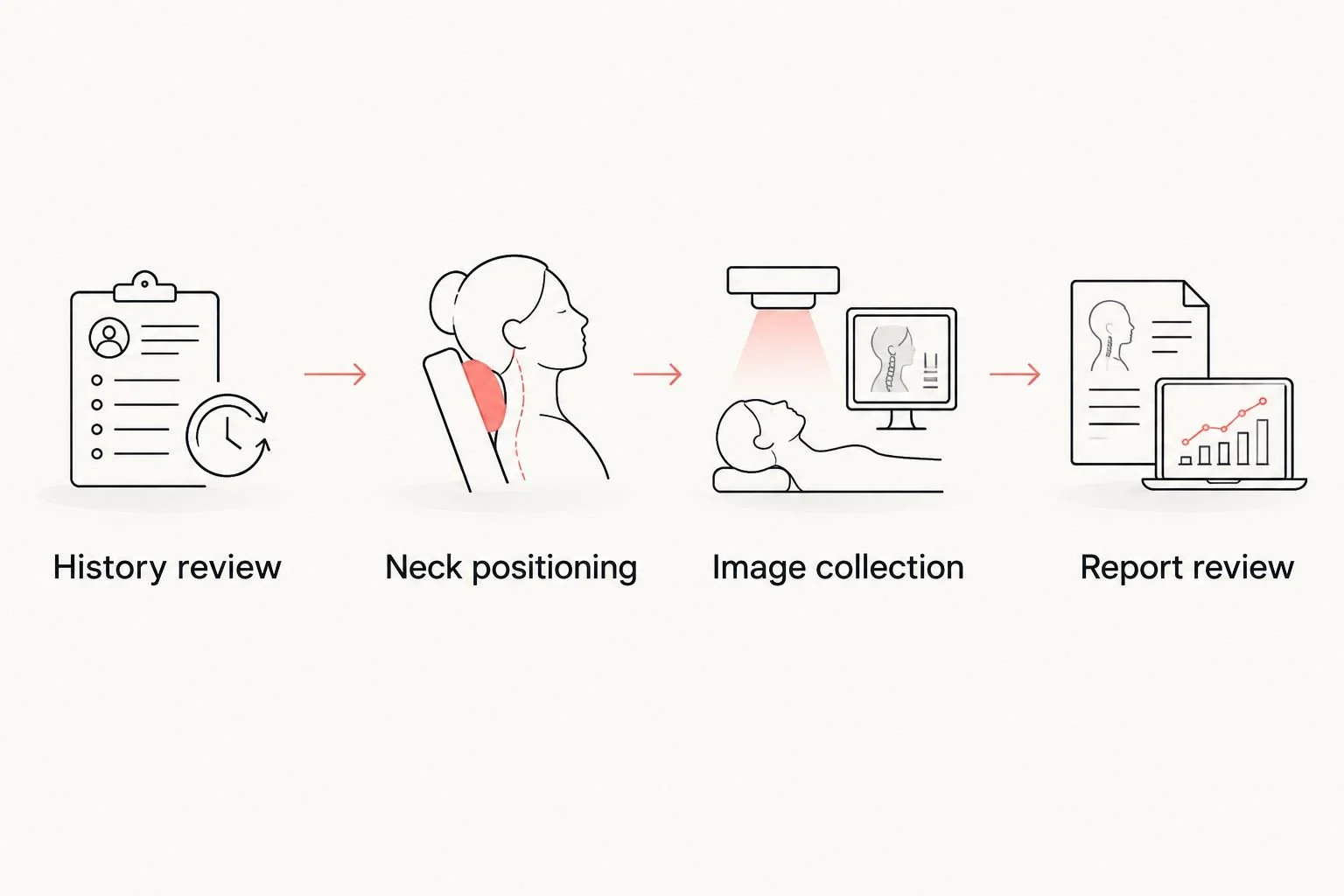
The examination is complete only when the findings connect to a follow-up plan.
How should you prepare?
A thyroid ultrasound generally does not require fasting or a full bladder. Follow the imaging provider's instructions, particularly if you are having another examination during the same visit.
Wear clothing that leaves your neck accessible and remove necklaces. Bring previous thyroid reports and, when possible, the earlier images; comparison is more useful than relying on memory about a nodule's size.
When arranging diagnostic ultrasound with The Ultrasound Concierge, confirm the examination type, required paperwork, and reporting process. The guide to whether you need a doctor's referral for a private ultrasound covers a useful question to resolve before your visit.
Why thyroid nodule recommendations vary
Different recommendations do not automatically mean that one report is wrong. Your next step depends on the entire clinical picture, not simply whether the scan found something.
These factors explain why follow-up differs:
Ultrasound appearance: Composition, shape, margins, and internal bright spots contribute to the assessment.
Nodule size: Measurement affects whether a nodule meets a guideline's biopsy or surveillance threshold.
Previous imaging: Earlier scans help establish whether the appearance or size has changed.
Symptoms and examination: Swallowing difficulty, persistent hoarseness, or pressure symptoms need clinical attention even alongside reassuring imaging.
Medical history: Childhood neck radiation and relevant family history affect the assessment.
Thyroid function: Blood results help determine whether testing beyond ultrasound is appropriate.
For follow-up imaging in 2026, bring the original report rather than only a summary. Small measurement differences can reflect scanning technique, so your clinician should assess change using the appropriate criteria rather than treating every difference as growth.
Does finding a thyroid nodule mean I have cancer?
No. Most thyroid nodules are benign, according to American Thyroid Association patient guidance. A nodule's risk category describes its appearance and helps guide assessment; it is not a cancer diagnosis.
If your report recommends a biopsy, that means more information is needed. Ask what finding triggered the recommendation and who will explain the laboratory result.
Can a normal thyroid ultrasound explain all my symptoms?
No. A normal thyroid ultrasound does not rule out a thyroid hormone disorder or explain every cause of neck discomfort, fatigue, or swallowing difficulty. Those symptoms need a clinical assessment that can include examination and blood testing.
If symptoms persist despite reassuring images, return to your clinician. Repeating imaging without a clear clinical question is not a substitute for investigating the symptoms.
Should I get a thyroid ultrasound without symptoms?
Routine thyroid cancer screening is not recommended for asymptomatic adults by the U.S. Preventive Services Task Force. That recommendation is different from evaluating a neck lump, an examination finding, or a nodule discovered on another test.
Ask for an assessment, not automatically a scan. Screening can identify small findings that lead to additional testing without a clear health benefit, while a clinically indicated examination answers a specific concern.
When should you seek medical attention?
Arrange a medical assessment for a new or enlarging neck lump, persistent hoarseness, or difficulty swallowing. These symptoms have several possible causes, and an ultrasound appointment alone does not replace an examination.
Seek emergency care for difficulty breathing or rapidly worsening neck swelling that affects breathing. Do not wait for a routine imaging visit.
FAQ
Can an ultrasound detect thyroid nodules that I cannot feel?
Yes, thyroid ultrasound can detect nodules that are not noticeable by touch. Their appearance and size help your clinician decide whether any follow-up is needed.
Can a thyroid ultrasound tell if a nodule is cancer?
Thyroid ultrasound identifies features associated with cancer risk, but it usually cannot confirm cancer on its own. A needle biopsy is sometimes needed to examine cells.
Can I have a thyroid nodule with normal blood tests?
Yes, a thyroid nodule can be present even when thyroid blood tests are normal. Blood tests assess hormone function, while ultrasound shows the gland's structure.
Does every thyroid nodule need a biopsy?
No, many thyroid nodules do not need a biopsy. Ultrasound features, size, medical history, and the guideline your clinician uses determine the recommendation.
Do I need to stop eating before a thyroid ultrasound?
A standard thyroid ultrasound generally does not require fasting. Follow your provider's instructions if another examination is scheduled at the same visit.
Is a thyroid ultrasound painful?
A thyroid ultrasound is usually well tolerated, although pressure from the probe can feel uncomfortable over a tender area. Tell the sonographer if positioning your neck causes pain.
Can The Ultrasound Concierge help me arrange diagnostic imaging?
The Ultrasound Concierge provides private diagnostic ultrasound for patients in the Keller and Willow Park area. Confirm the specific thyroid examination, any required order, and the report-sharing process before arranging your visit.
One last thing
The largest thyroid nodule is not automatically the one that needs a biopsy. When several nodules are present, ultrasound features help determine which deserve closer assessment; size alone does not settle the question.
Before leaving your 2026 results appointment, ask for the next action in plain language: no further imaging, a follow-up examination, a biopsy discussion, or another test. Know who is responsible for that step and how you will receive the result.