
Yes, an ultrasound can detect twins that were not identified on an earlier scan, especially when the first examination happened very early or the views were limited. A later diagnostic scan can show a second embryo and assess each baby's cardiac activity, but symptoms or a keepsake image cannot confirm twins. Ask your prenatal clinician to review the original report and decide whether you need a repeat diagnostic ultrasound.
TL;DR
Can an ultrasound detect twins missed on an earlier scan? Yes, particularly after an early or limited examination.
A diagnostic ultrasound confirms fetal number; pregnancy symptoms and hormone levels alone do not establish twins.
The Ultrasound Concierge offers private pregnancy ultrasound; coordinate medical questions and follow-up with your prenatal clinician.
If twins are confirmed, ask whether they share a placenta or an amniotic sac.
Why this matters
A possible second baby raises a medical question, not just an imaging question. Confirming the number of babies and whether they share a placenta helps your prenatal team plan appropriate monitoring. You deserve a clear explanation of what the earlier examination established—and what remained uncertain.
The Ultrasound Concierge provides private diagnostic and elective pregnancy imaging in Keller and Willow Park, Texas. When reviewing its ultrasound services, distinguish an appointment intended to answer a clinical question from one intended for keepsake images.
Can an ultrasound detect twins missed on an earlier scan?
Yes. A later ultrasound can identify twins after an earlier examination showed only one embryo or did not establish fetal number. That does not mean another baby developed between appointments; the later examination provides information that was not visible or documented before.
The meaning of the original scan matters. An early report describing a gestational sac is different from a completed examination documenting a single living embryo with adequate views. A photograph alone cannot tell you whether the sonographer surveyed the entire uterus or obtained all the necessary images.
For your 2026 prenatal appointments, start with the written report rather than an online comparison of ultrasound pictures. Ask whether the result was conclusive, limited, or awaiting follow-up.
A gestational sac without a clearly visible embryo
What it establishes: The examination has not yet fully characterized the pregnancy
What to ask next: When should the pregnancy be reassessed?
One embryo on a limited examination
What it establishes: One embryo was identified in the available views
What to ask next: Was fetal number confidently assessed?
A single living embryo on a complete examination
What it establishes: The report supports a singleton pregnancy at that examination
What to ask next: Is there a clinical reason to repeat imaging?
Two embryos on a later examination
What it establishes: The later examination identifies twins
What to ask next: What does the report say about each embryo and the placenta?
These findings are not interchangeable. Your clinician should interpret them alongside gestational age, symptoms, and the reason the examination was performed.
Why an earlier ultrasound can leave uncertainty
The main issue is whether the first examination had enough information to answer the question. “Only one baby was seen” does not always mean “a complete examination definitively documented one baby.” Ask which statement fits your report.
Several factors affect what the examiner can identify:
Pregnancy timing: Very early structures are small, and an examination before embryos are clearly visible has limits.
Dating uncertainty: Ovulation later than expected can make the pregnancy younger than dates based on your last period suggest.
Scanning approach: Transabdominal and transvaginal examinations provide different views, especially early in pregnancy.
Image quality: Bowel gas, tissue depth, and uterine position affect the ultrasound window.
Examination scope: A limited scan answering a narrow question is not the same as a complete diagnostic assessment.
Available views: A single image captures one view, not the entire examination or its interpretation.
These are reasons to clarify the report, not proof that twins were missed. Do not treat an unclear picture as evidence of a second baby.
Does the type of ultrasound change what you can see?
The scanning approach matters, but “more detailed-looking” does not automatically mean more useful for confirming twins. The right examination depends on gestational age and the clinical question.
Both standard transabdominal and transvaginal ultrasound use sound waves. A transvaginal examination places the probe closer to early pregnancy structures; an abdominal examination images through the abdominal wall. Your clinician selects the approach and explains what it involves.
Transvaginal diagnostic ultrasound
Best for: Detailed assessment early in pregnancy when clinically appropriate
Main benefit: Provides close views of early pregnancy structures
Main limitation: Requires an internal examination and your consent
Transabdominal diagnostic ultrasound
Best for: Pregnancy assessment when adequate abdominal views are obtainable
Main benefit: Provides views without an internal probe
Main limitation: Very early structures or limited imaging windows can be harder to assess
Elective 3D/4D imaging
Best for: Keepsake views alongside established prenatal care
Main benefit: Shows rendered surface images or movement
Main limitation: Does not replace a diagnostic evaluation of suspected twins
Standard two-dimensional diagnostic imaging is used to assess fetal number. A rendered face image is not required to establish whether a pregnancy contains twins.
If you decline an internal examination, tell the clinician. Ask what an abdominal examination can establish and whether a later reassessment would be appropriate; consent remains part of the discussion.
When can a repeat scan give a clearer answer?
A repeat examination is useful when its timing allows the clinician to answer an unresolved question. Booking another scan immediately does not necessarily add useful information, particularly if the first examination was very early.
An embryo and cardiac activity can become visible around 6 weeks of pregnancy on transvaginal ultrasound, but that is not a guaranteed deadline. Dating uncertainty and examination findings affect interpretation. Failure to identify everything at a presumed gestational age requires clinical assessment, not a conclusion based on a calendar alone.
First-trimester assessment around 11–14 weeks of pregnancy provides an opportunity to assess fetal number and, when twins are present, their placental and sac arrangement. This timing is described in International Society of Ultrasound in Obstetrics and Gynecology guidance for the first-trimester scan; it is not a reason to postpone an earlier clinically indicated examination.
The American College of Obstetricians and Gynecologists describes the standard fetal anatomy examination as occurring at 18–22 weeks of pregnancy. That examination assesses fetal anatomy; it is not the first appointment you should wait for if an earlier report needs clarification.
For a 2026 follow-up plan, ask your clinician for a date tied to the unresolved finding. No single waiting interval fits every early pregnancy examination.
What should you do if you think a twin was missed?
Arrange a review of the original findings before choosing another imaging appointment. This avoids booking an elective visit for a question that needs diagnostic interpretation.
Read the report. Look for the documented number of embryos, cardiac activity, gestational measurements, and any stated limitations. Ask your clinician to translate unfamiliar terms.
Contact your clinician. Explain why you are concerned, whether you have symptoms, and when the earlier scan occurred. Mention fertility treatment if it applies.
Confirm the scan. Ask whether the next examination needs to be diagnostic, which approach is appropriate, and what referral information the imaging provider needs.
Plan follow-up. Establish who will interpret the results, communicate them, and arrange further care if twins or another finding are identified.
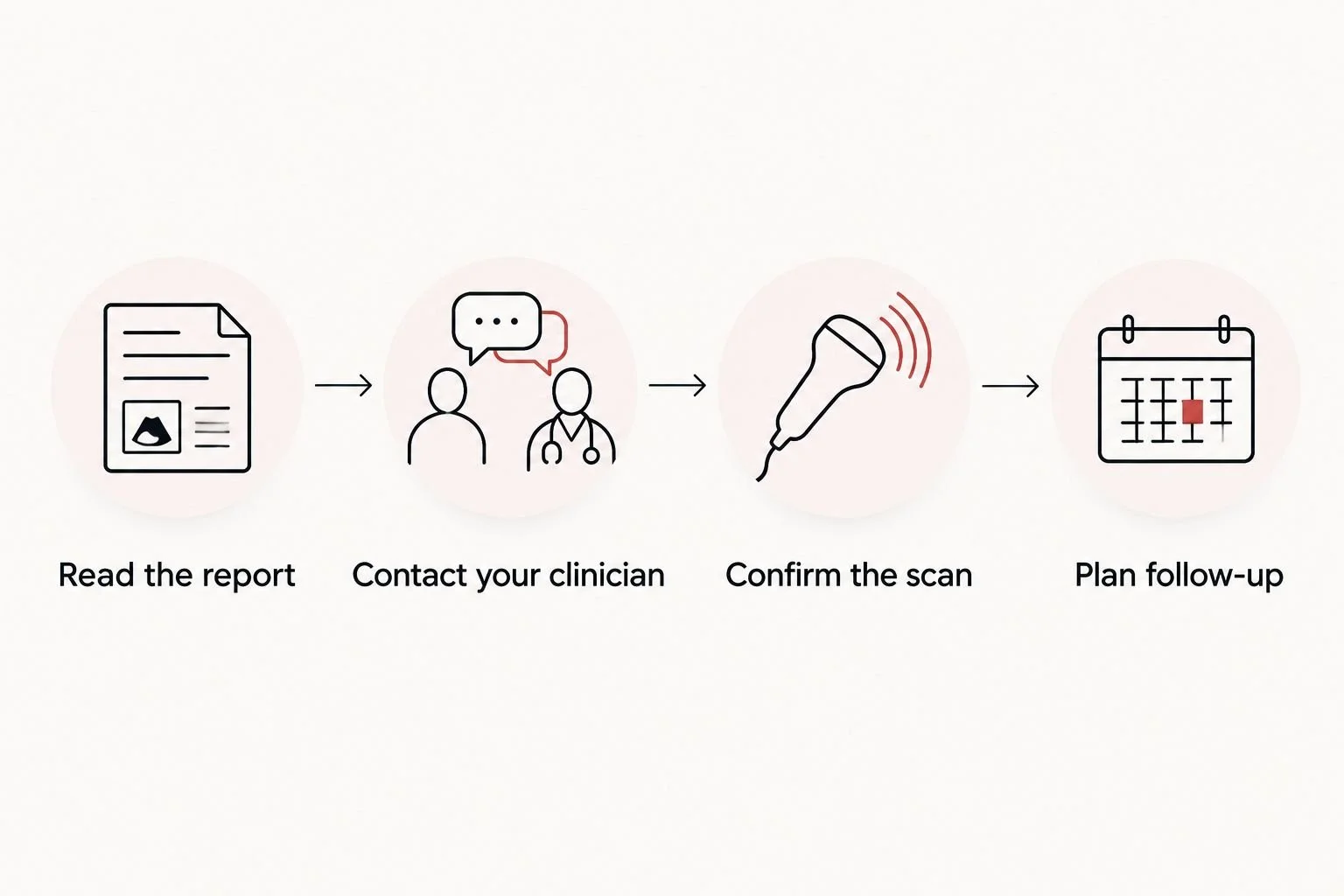
Choose the examination around the unanswered medical question, not the keepsake image you want.
Bring the earlier report and any available images to the follow-up appointment. The written interpretation gives the next clinician context that a selected photograph does not.
If the original result was uncertain, the guide to repeat ultrasound after an inconclusive scan explains why follow-up can be part of an assessment rather than evidence that something went wrong.
What changes if a later scan confirms twins?
Confirming twins is the beginning of a more specific assessment. Your clinician will want to establish gestational age, evaluate each baby, and determine whether the babies share a placenta or an amniotic sac.
“Chorionicity” describes the placental arrangement; “amnionicity” describes the amniotic sacs. You do not need to memorize the terminology. Ask the clinician to explain the arrangement in plain language and document it in your records.
NICE guidance on twin and triplet pregnancy recommends first-trimester ultrasound to estimate gestational age and determine these arrangements. They help guide monitoring because different twin pregnancies have different care needs.
For care planning in 2026, ask these practical questions:
Has each baby's cardiac activity been assessed?
Do the babies share a placenta or an amniotic sac?
Are any findings still uncertain?
Who will manage the pregnancy and arrange the next examination?
A private imaging visit does not replace your prenatal team. Keep your obstetric clinician informed of findings obtained elsewhere so the records and care plan stay connected.
Can twins stay hidden behind each other throughout pregnancy?
Twins can be difficult to distinguish in a particular ultrasound view, but “one baby hiding behind the other” is not a reliable explanation for every uncertain scan. A diagnostic examination uses multiple views rather than relying on one still image.
A complete later examination documenting a singleton pregnancy gives a different level of information from a very early limited scan. If you remain concerned, ask whether the examiner confidently established fetal number rather than requesting repeated scans based on internet stories.
Do stronger pregnancy symptoms mean an ultrasound missed twins?
No. Nausea, fatigue, breast tenderness, and changes in abdominal size do not establish how many babies you are carrying. These experiences vary between pregnancies and overlap between singleton and twin pregnancies.
Blood pregnancy hormone levels also overlap. Ultrasound—not symptom intensity or a single hormone result—is the examination used to establish fetal number.
Could this be a vanishing twin instead?
A vanishing twin describes a pregnancy in which an embryo stops developing after a multiple pregnancy has been identified. That is different from discovering a second ongoing embryo after an earlier limited examination.
Your clinician needs the sequence of reports to distinguish these situations. A discrepancy between photographs alone does not establish either a missed twin or a pregnancy loss, and you should not have to interpret it without support.
Choosing a private pregnancy ultrasound appointment
The Ultrasound Concierge is best for patients seeking private pregnancy ultrasound in Keller or Willow Park, Texas. Its diagnostic and elective services serve different purposes, so describe the medical question before choosing an appointment.
The benefit of a private setting is the setting itself; it does not remove the need for appropriate clinical interpretation or obstetric follow-up. Ask whether the proposed appointment can address fetal number and how findings will reach your prenatal clinician. Confirm those details before booking.
When should you seek urgent care instead of another scan?
Seek urgent medical assessment for severe or worsening abdominal pain, fainting, shoulder-tip pain, or heavy vaginal bleeding during pregnancy. Do not wait for a routine private imaging appointment to investigate those symptoms.
A possible twin pregnancy does not explain away concerning symptoms. Tell the treating clinician what the earlier scan showed and whether an intrauterine pregnancy was confirmed.
FAQ
Can an ultrasound find twins after an earlier scan showed one baby?
Yes, a later ultrasound can identify twins after an earlier examination showed one embryo, especially if the first examination was very early or limited. Ask your prenatal clinician to compare the reports and explain what each examination established.
Can twins be missed at 6 weeks?
Yes, an examination around 6 weeks can leave uncertainty about fetal number, particularly when dating or views are limited. That possibility does not mean twins are present; the written findings determine the follow-up plan.
Is a transvaginal ultrasound better for finding twins early?
Transvaginal ultrasound often provides clearer views of early pregnancy structures than an abdominal examination. Your clinician should explain whether it is appropriate, obtain your consent, and discuss alternatives if you decline.
Should I book a 3D ultrasound to check whether I am carrying twins?
Choose a diagnostic assessment, not an elective keepsake appointment, to investigate suspected twins. Standard two-dimensional imaging is used to assess fetal number; rendered surface images are not necessary for that question.
Does a high hCG level mean an ultrasound missed a twin?
No, a high hCG level alone does not establish twins because hormone levels overlap between singleton and multiple pregnancies. Your clinician interprets blood results alongside ultrasound findings and your clinical history.
How long should I wait before another ultrasound?
Your prenatal clinician should set the interval based on gestational age, symptoms, and the unresolved finding. Seek urgent assessment rather than waiting for routine follow-up if you develop severe pain, fainting, or heavy bleeding.
Can The Ultrasound Concierge replace my OB's follow-up scan?
The Ultrasound Concierge offers diagnostic and elective pregnancy ultrasound, but you should not substitute an appointment without confirming the required examination with your OB. Ask what assessment is needed and how the findings will be communicated to your prenatal team.
One last thing
The most useful question is not “Could another baby be hiding?” It is “Did the examination confidently establish fetal number, and what evidence is documented?” That question directs the conversation toward an answer rather than another photograph.
For your next appointment in 2026, take the report and write down the unresolved question. Request a plain-language explanation of the result and a clear next step before you leave.