
Yes—needing a repeat ultrasound after an inconclusive scan is a normal part of care when the first examination cannot answer the clinical question. An inconclusive result does not, by itself, mean something is wrong, but it also does not confirm that everything is normal; your clinician needs to explain what remains uncertain and how to follow it up.
TL;DR
A repeat ultrasound after inconclusive scan results helps resolve uncertainty; it does not automatically signal a problem.
Early pregnancy timing, fetal position, and limited views can leave an ultrasound unfinished.
The Ultrasound Concierge offers private diagnostic ultrasound for patients in Keller and Willow Park.
Follow your clinician’s timing; severe pain, fainting, or heavy bleeding needs urgent assessment.
Why this matters
Leaving an appointment without a clear answer is unsettling. The most useful next step is to separate an incomplete view from an unresolved medical finding, because those situations do not always need the same follow-up.
An inconclusive scan is a description of uncertainty, not a diagnosis. Your report should explain the limitation and recommend what happens next. For background on scheduling, read about how long to wait between ultrasound scans, then confirm the interval with the clinician managing your care.
For your 2026 appointment, leave with a specific plan rather than a general instruction to try again. You need to know what the next examination is intended to establish and who will review it.
Is it normal to need a repeat ultrasound after an inconclusive scan?
Yes. Ultrasound depends on obtaining useful views of the structure being examined, and an examination sometimes ends before every required view or measurement is available. Early pregnancy adds another challenge: a scan can happen before the expected structures are clearly visible.
The reason for repeating the scan matters more than the word repeat. These situations illustrate the differences:
Early pregnancy
What remains uncertain: Pregnancy location or development is not established
What follow-up can add: Later images and, when indicated, blood tests help clarify the picture
Important limitation: A single unclear scan cannot establish the outcome
Incomplete anatomy views
What remains uncertain: A required body part was not adequately seen
What follow-up can add: Targeted imaging attempts to complete the examination
Important limitation: Missing views are not the same as normal findings
Limited pelvic or abdominal views
What remains uncertain: An organ or area was partly obscured
What follow-up can add: Different preparation, positioning, or imaging approach can improve assessment
Important limitation: Repeating the same approach does not guarantee an answer
An uncertain finding
What remains uncertain: A visible area cannot yet be confidently characterized
What follow-up can add: Comparison, specialist assessment, or another imaging method can clarify it
Important limitation: Another ultrasound is not always the appropriate next test
Ask your clinician which situation applies. That answer determines whether you need a scheduled repeat, specialist review, blood testing, or a different examination.
Early pregnancy: when time changes what a scan can show
An early scan sometimes cannot establish pregnancy location or whether development is progressing. Dates calculated from your last period do not identify ovulation precisely, so the pregnancy can be earlier than expected.
However, uncertain dates are not an explanation to assume without assessment. If a pregnancy test is positive but no pregnancy location has been established, your clinician must consider the possibility of an ectopic pregnancy and arrange appropriate follow-up.
For early-pregnancy decisions in 2026, NICE guideline NG126 provides specific safeguards against diagnosing pregnancy loss too soon. In defined situations involving an embryo without visible cardiac activity or a gestational sac without a visible embryo on transvaginal ultrasound, it recommends a repeat scan after at least 7 days; measurements determine whether a second opinion is also needed.
When the corresponding uncertainty follows a transabdominal examination, the guideline specifies at least 14 days before a repeat scan used to make that diagnosis. These are minimum intervals for particular clinical circumstances, not universal booking rules for every inconclusive ultrasound.
For a pregnancy of unknown location, NICE also describes taking paired blood hCG measurements as close as possible to 48 hours apart, but not earlier. Blood results help guide management; they do not establish pregnancy location on their own.
Do not use these intervals to postpone assessment of new symptoms. Your symptoms and your clinician’s instructions take priority over a calendar date.
Incomplete anatomy views: when position limits the examination
During a pregnancy anatomy examination, the sonographer needs particular views, not simply a recognizable picture of the baby. Fetal position, movement, and the path of the ultrasound beam can prevent a required structure from being adequately assessed.
A request to complete missing views does not mean an abnormality was found. It means the examination has not yet documented everything required. That distinction is reassuring without promising a normal result.
Ask which structures were not seen and whether the report describes any separate concern. A follow-up intended to finish the examination differs from a referral intended to investigate a suspected finding.
For a 2026 follow-up appointment, bring the original report if the new imaging team does not already have it. Knowing the missing views helps the team understand the purpose of the return visit.
General health scans: when another approach is needed
In pelvic and abdominal imaging, bowel gas and the depth or location of an organ can limit the ultrasound view. Preparation also matters for certain examinations, although instructions differ by the body part and imaging approach.
A repeat examination can help when the limitation is correctable. It is less useful when the original report already recommends a different test or specialist evaluation.
Ask your clinician whether repeating ultrasound is expected to answer the unresolved question. The best next examination is the one that addresses the uncertainty—not automatically another scan of the same type.
Do not copy preparation advice from an unrelated appointment. A full bladder helps some pelvic examinations, while other approaches require different instructions.
Why the need for another ultrasound varies
The reason for an inconclusive result determines what can change at the next visit:
Pregnancy timing: An examination performed very early can precede clearly visible developmental findings. The repeat interval needs to match the clinical question.
Fetal position: A baby’s position can obstruct required anatomy views. A later examination offers another opportunity to obtain them.
Bowel gas: Gas interferes with ultrasound transmission and can obscure deeper structures. The limitation depends on the area being examined.
Body structures: Tissue depth and the position of an organ affect image quality. A limited view is not a judgment about you or your preparation.
Examination preparation: Bladder filling or fasting affects certain studies. Follow the instructions for your actual examination rather than applying a general rule.
The finding itself: Some abnormalities cannot be confidently characterized with ultrasound alone. Your clinician must decide whether comparison, specialist input, or another test is needed.
You cannot control every factor. Avoid blaming yourself for an incomplete examination, and ask whether any change in preparation would genuinely help.
What should you do before the repeat scan?
Use this sequence to turn an unclear result into a clear follow-up plan. For appointments booked in 2026, keep the report and instructions together so you can refer to the exact wording rather than your memory of a stressful conversation.
Get the report. Ask for the written findings and impression, not just a selection of images. Note whether the report describes missing views, an uncertain finding, or an unresolved pregnancy location.
Clarify the question. Ask what the repeat examination is intended to confirm or exclude. You should understand what information was missing from the first visit.
Confirm the timing. Ask who chose the interval and whether blood testing or another appointment is also needed. Do not independently shorten or extend the plan.
Check preparation. Confirm bladder, eating, drinking, and medication instructions with the imaging team. Do not stop prescribed medication without medical advice.
Arrange results. Identify who will interpret the examination, who will explain it, and how to reach that clinician if symptoms change.
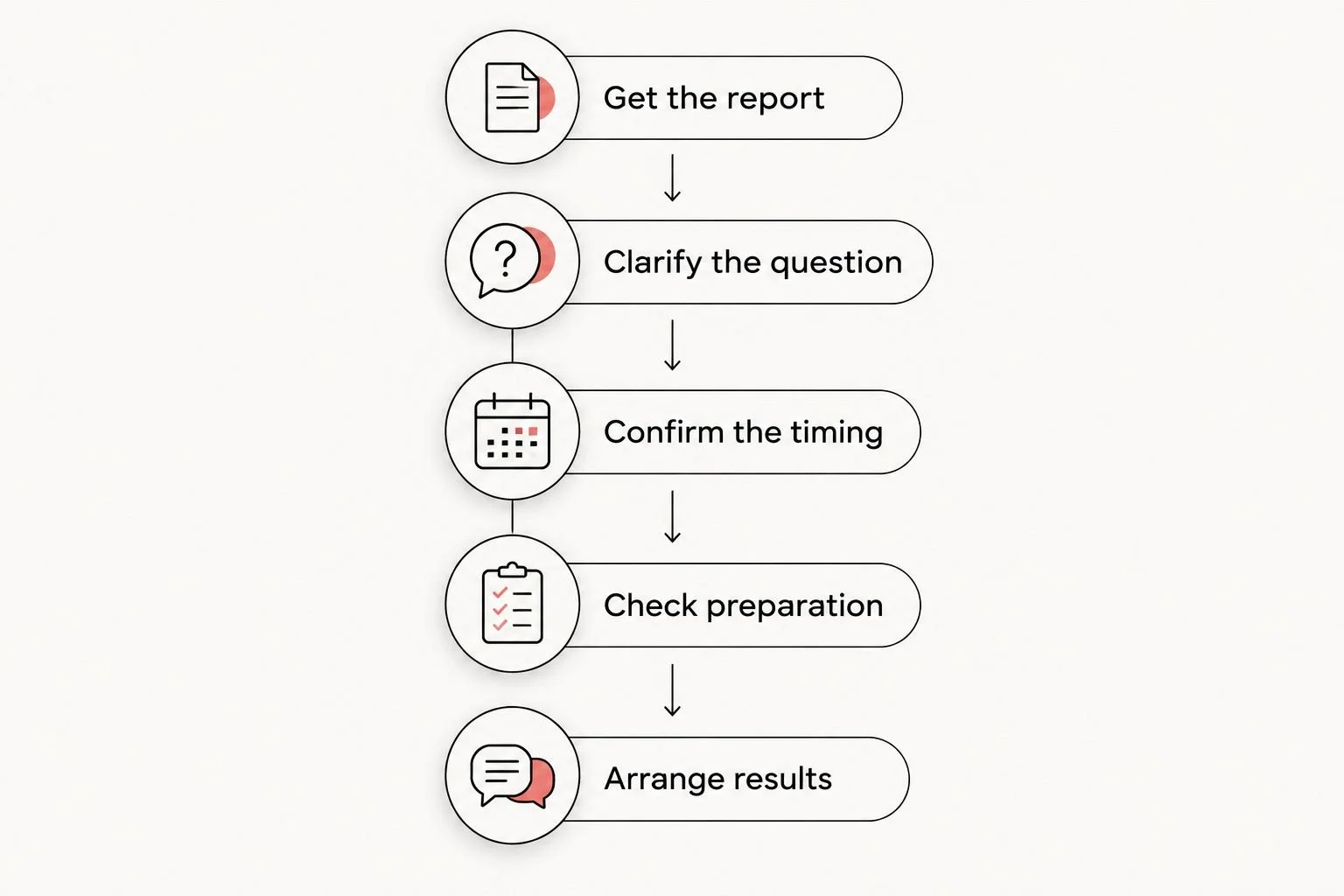
A useful follow-up plan covers the question, timing, preparation, and communication of results.
If you change imaging locations, ask how the original images and report will reach the next team. Prior records provide context that a new examination alone does not supply.
When should you seek care instead of waiting?
Do not wait for a routine repeat ultrasound if you develop severe or worsening abdominal or pelvic pain, fainting, marked dizziness, shoulder-tip pain, or heavy bleeding during a possible or confirmed pregnancy. These symptoms need urgent medical assessment, particularly when pregnancy location has not been confirmed.
Call 911 for a medical emergency. Do not drive yourself if you feel faint or unsafe to travel.
For symptoms that are new but not severe, contact your clinician for individualized advice rather than relying on the original appointment date. A scheduled follow-up is not a reason to ignore a change in how you feel.
Outside pregnancy, severe pain or rapidly worsening symptoms also warrant prompt assessment. Tell the clinician that your earlier ultrasound was inconclusive and explain what has changed.
Can a private ultrasound replace the recommended follow-up?
A private setting and a diagnostic purpose are separate considerations. An elective keepsake examination does not replace a clinician-directed assessment of pregnancy location, development, anatomy, or another medical concern.
The Ultrasound Concierge is best suited to Keller and Willow Park patients seeking private diagnostic ultrasound in a calm, personalized setting. The Ultrasound Concierge provides diagnostic and elective imaging, so review the ultrasound services and ask which examination matches your clinician’s request.
The benefit is the private, concierge-style setting described by the practice. The limitation is unchanged: choosing a setting does not guarantee a definitive result or remove the need for clinical follow-up. Confirm the requested examination, referral requirements, and results process before arranging care.
FAQ
Does an inconclusive ultrasound mean something is wrong?
An inconclusive ultrasound means the examination did not fully answer the clinical question; it does not establish either a problem or a normal result. Ask what remained unclear and what follow-up will resolve it.
How long should I wait for another early pregnancy scan?
At least 7 days is the NICE minimum for specified uncertain findings on transvaginal ultrasound; corresponding transabdominal situations require at least 14 days. These safeguards apply to defined circumstances, so your clinician must set the interval for your findings and symptoms.
Can blood tests explain an unclear early pregnancy ultrasound?
Blood hCG tests can help guide follow-up, but they cannot establish pregnancy location alone. For pregnancy of unknown location, NICE describes paired measurements as close as possible to 48 hours apart, but not earlier.
Is it safe to have another medically needed ultrasound?
Diagnostic ultrasound does not use ionizing radiation. The FDA recommends prudent use by qualified healthcare professionals for a medical purpose, rather than unnecessary or prolonged exposure.
Should I drink extra water before the repeat ultrasound?
Follow the imaging team’s instructions rather than automatically drinking extra water. Bladder preparation differs by examination type, and the instructions for an abdominal pelvic scan can differ from those for a transvaginal scan.
Can I arrange my follow-up with The Ultrasound Concierge?
The Ultrasound Concierge offers private diagnostic ultrasound in the Keller and Willow Park area. Ask whether the requested follow-up examination fits its services and confirm how the report will reach your treating clinician.
What if the second ultrasound is inconclusive too?
A second inconclusive ultrasound needs a clinician-reviewed plan, not an automatic series of identical appointments. Depending on the unresolved question, the next step includes further observation, specialist review, blood testing, or another imaging method.
One last thing
A clearer picture and a clearer diagnosis are not always the same thing. An attractive image does not prove that every required structure was assessed, while a technically limited examination can still provide useful information.
Before leaving your 2026 follow-up, ask: What question did this scan answer, and what still needs attention? That question keeps the focus on your care rather than the appearance of the images. This article provides general education; your treating clinician sets your individual follow-up plan.