
Yes, an ultrasound can confirm a miscarriage when a diagnostic scan meets established criteria for early pregnancy loss. An early scan without visible cardiac activity does not automatically confirm a loss; your clinician sometimes needs a repeat ultrasound and blood tests before making the diagnosis. This 2026 guide explains what confirms a miscarriage, what remains uncertain, and when you need urgent care.
TL;DR
Can an ultrasound confirm a miscarriage? Yes, when diagnostic findings meet established early pregnancy loss criteria.
An inconclusive early pregnancy ultrasound is not the same as a confirmed miscarriage.
The Ultrasound Concierge offers private diagnostic ultrasound; suspected miscarriage requires clinician-led evaluation, not elective reassurance imaging.
Severe pain, fainting, shoulder pain, or heavy bleeding require urgent medical assessment.
Why this matters
Waiting for answers about a pregnancy is difficult. The goal is an accurate diagnosis, not the fastest possible label. Calling a pregnancy loss too early risks interrupting a pregnancy that is still developing; delaying assessment of concerning symptoms risks missing an emergency.
For anyone seeking care in 2026, the first decision is whether symptoms require immediate assessment. Severe or worsening abdominal pain, one-sided pelvic pain, shoulder-tip pain, fainting, significant dizziness, or heavy bleeding require urgent medical attention, including assessment for ectopic pregnancy. Do not wait for a private imaging appointment if you have these symptoms.
For nonemergency imaging questions, review the available diagnostic ultrasound services, but contact your pregnancy-care clinician first when you suspect a miscarriage.
Can an ultrasound confirm a miscarriage?
Yes. A clinician can diagnose early pregnancy loss when a properly performed diagnostic ultrasound shows findings that meet accepted criteria, interpreted alongside your symptoms and previous results. These criteria deliberately leave room for uncertainty when a pregnancy is very early.
The Society of Radiologists in Ultrasound's 2013 consensus, published in The New England Journal of Medicine, established conservative criteria for diagnosing a nonviable early intrauterine pregnancy. The following thresholds concern diagnostic transvaginal ultrasound, not a home Doppler or an elective keepsake scan.
Embryo without cardiac activity
Threshold supporting early pregnancy loss: Crown–rump length of at least 7 mm
Important limit: Requires reliable measurement and adequate imaging
Gestational sac without an embryo
Threshold supporting early pregnancy loss: Mean sac diameter of at least 25 mm
Important limit: A smaller empty sac does not meet this criterion
No embryo with cardiac activity after a scan showing a gestational sac without a yolk sac
Threshold supporting early pregnancy loss: At least 14 days after that initial scan
Important limit: The earlier scan's documented findings matter
No embryo with cardiac activity after a scan showing a gestational sac with a yolk sac
Threshold supporting early pregnancy loss: At least 11 days after that initial scan
Important limit: A shorter interval does not meet this criterion
These are clinical interpretation standards, not instructions for diagnosing yourself from a photograph or report excerpt. Your clinician should confirm that the measurements, scan quality, and sequence of findings support the diagnosis. Local protocols sometimes require a second opinion or another scan before treatment.
A finding that is concerning is not necessarily a finding that confirms miscarriage. If the criteria are not met and you are medically stable, follow-up is usually the safer next step.
No heartbeat: when does that confirm a loss?
An embryo measuring at least 7 mm crown–rump length without cardiac activity meets an established diagnostic criterion on an adequate transvaginal examination. Below that measurement, absent cardiac activity alone does not establish a miscarriage.
Your last menstrual period cannot settle this question by itself. Ovulation and implantation timing vary, and irregular cycles make calendar estimates less reliable. A pregnancy that appears earlier than expected needs assessment, not an automatic diagnosis of loss.
Seeing cardiac activity confirms that it is present at that examination; it does not guarantee the rest of the pregnancy. For more context about early findings, read how soon cardiac activity can be seen on ultrasound.
An empty gestational sac: what does it mean?
A gestational sac with a mean sac diameter of at least 25 mm and no embryo meets an established diagnostic criterion for early pregnancy loss on an adequate transvaginal scan. A smaller sac without an embryo remains uncertain unless other diagnostic criteria are satisfied.
The measurement is the mean sac diameter, not whichever dimension looks largest on a saved image. Your clinician also needs to establish that the finding represents an intrauterine gestational sac rather than fluid in the uterus.
You might hear the term anembryonic pregnancy, meaning a pregnancy in which an embryo has not developed as expected. That diagnosis requires appropriate evidence; an empty-looking sac on a very early scan is not enough by itself.
Why ultrasound certainty varies
The important question in 2026 is not simply whether an image looks reassuring. It is whether the examination provides enough reliable information to answer the clinical question.
Pregnancy timing: Later ovulation changes what you would expect to see compared with menstrual dates alone.
Scan approach: Transvaginal imaging usually provides clearer detail than abdominal imaging in very early pregnancy.
Measured size: Embryo length and mean sac diameter determine whether specific diagnostic thresholds apply.
Image quality: Limited views or uncertain measurements reduce confidence and sometimes require another examination.
Previous findings: A documented yolk sac changes how the interval between scans is interpreted.
Symptoms and pregnancy location: Pain, bleeding, and an unconfirmed pregnancy location change the urgency and follow-up plan.
These factors explain why two people with similar dates can receive different next steps. The plan should follow the actual findings, not another person's scan experience.
Is a transvaginal ultrasound better than an abdominal scan?
Transvaginal ultrasound is generally the more informative approach for assessing a very early pregnancy. An abdominal scan remains useful, but an unclear abdominal examination does not establish a miscarriage.
Transvaginal ultrasound
Best for: Detailed assessment of very early pregnancy
Main benefit: Places the probe closer to the uterus for clearer early views
Main limitation: Involves an internal examination and requires your consent
Transabdominal ultrasound
Best for: An external examination or an additional view of the pelvis
Main benefit: Images through the abdomen without an internal probe
Main limitation: Early structures are sometimes difficult to see clearly
You can ask why an internal scan is recommended and what alternatives would leave unanswered. You can also ask the examiner to pause or stop. If you decline transvaginal imaging, your clinician should explain how that affects diagnostic certainty and follow-up.
Neither approach uses ionizing radiation. The relevant distinction is whether the examination can answer your medical question, not whether one produces a more appealing image.
What happens if the first scan is inconclusive?
An inconclusive scan means the available evidence does not yet establish the outcome. If you are medically stable, your clinician will usually arrange follow-up rather than make a diagnosis from uncertainty.
Review symptoms. Tell your clinician about bleeding, pain, dizziness, prior ectopic pregnancy, and fertility treatment.
Confirm location. Ask whether the pregnancy has definitely been identified inside the uterus.
Plan follow-up. Get a specific plan for repeat imaging and any blood tests, based on what the first scan showed.
Review results. Ask who will explain the report, what the findings mean, and which symptoms require immediate care.
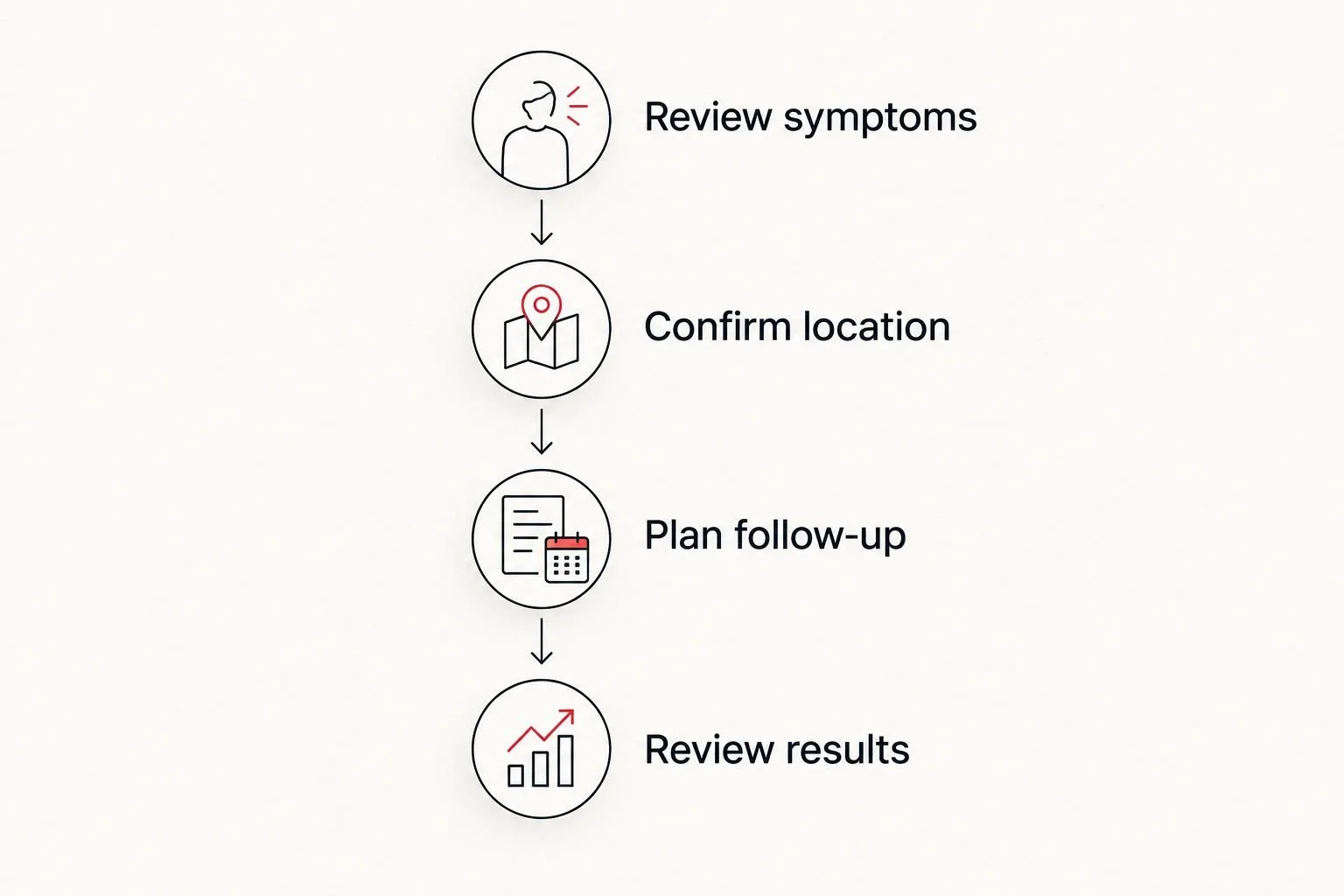
An uncertain scan needs a clear follow-up plan, including instructions for worsening symptoms.
Before you leave, ask for the written report and the reason for the recommended interval. For a 2026 appointment, bring previous ultrasound reports rather than relying only on saved photographs; documented measurements and dates help your clinician compare examinations accurately.
If no pregnancy has been definitively located inside or outside the uterus, clinicians use the term pregnancy of unknown location. This requires follow-up because the possibilities include a very early intrauterine pregnancy, a pregnancy loss, or an ectopic pregnancy.
How long do you have to wait for another scan?
At least 11 days or 14 days applies to specific diagnostic situations, not every repeat-scan appointment. Under the consensus criteria, the interval is at least 11 days after a scan showing a gestational sac with a yolk sac, or at least 14 days after a scan showing a sac without a yolk sac, when assessing persistent absence of an embryo with cardiac activity.
Your clinician can schedule an earlier reassessment for other reasons, including changing symptoms or findings that need monitoring. An earlier scan does not automatically provide a definitive answer. Ask what the next scan is intended to establish.
Can blood tests confirm a miscarriage without ultrasound?
A single hCG blood result cannot reliably establish both pregnancy viability and location. Serial results help your clinician assess the situation, but they need interpretation alongside symptoms and imaging.
Falling hCG levels often indicate a pregnancy that is not continuing. They do not, by themselves, exclude an ectopic pregnancy. Continue the recommended follow-up until your clinician confirms that the situation has resolved or establishes the diagnosis.
Can you have a miscarriage without bleeding?
Yes, a miscarriage can occur without bleeding or cramping. Sometimes ultrasound identifies a pregnancy that has stopped developing before symptoms begin; this is often called a missed miscarriage.
Changes in nausea, breast tenderness, or other pregnancy symptoms do not diagnose a loss. Symptoms fluctuate in continuing pregnancies too. Contact your clinician if you are worried rather than using symptom changes as a substitute for assessment.
Where private ultrasound fits into your care
The Ultrasound Concierge is best suited to patients seeking private diagnostic ultrasound in the Keller and Willow Park area. A calm setting supports the experience, but suspected miscarriage still requires medical interpretation and a clear connection to your pregnancy-care clinician.
The Ultrasound Concierge offers diagnostic and elective ultrasound services. Those appointments have different purposes: elective imaging is not a substitute for evaluating bleeding, pain, pregnancy location, or suspected loss. Before arranging imaging, ask whether the examination addresses your clinician's diagnostic question and how the results will reach that clinician.
If a loss is confirmed, your pregnancy-care clinician should explain the appropriate next steps, including whether observation, medication, or a procedure fits your medical circumstances and preferences. You do not have to absorb every decision immediately unless an urgent medical problem requires action.
FAQ
Can an ultrasound confirm a miscarriage at my first appointment?
Yes, a first ultrasound can confirm miscarriage when reliable findings meet established diagnostic criteria. If the pregnancy is too early or the findings are uncertain, repeat imaging is needed before a diagnosis.
Does no heartbeat at six weeks mean miscarriage?
No, absent cardiac activity at an estimated six weeks does not by itself confirm miscarriage. The scan approach, embryo measurement, and reliability of the pregnancy dates matter more than the calendar estimate alone.
Can an empty sac still become a normal pregnancy?
An early empty gestational sac can later show an embryo if the pregnancy is earlier than expected. A mean sac diameter of at least 25 mm without an embryo meets an established diagnostic criterion on an adequate transvaginal scan.
Can ultrasound rule out an ectopic pregnancy?
Ultrasound helps establish pregnancy location, but an inconclusive scan does not rule out ectopic pregnancy. Severe pain, shoulder-tip pain, fainting, or significant dizziness requires urgent assessment.
Can I use an elective ultrasound to check whether I am miscarrying?
An elective ultrasound is not a substitute for diagnostic evaluation of suspected miscarriage. Contact your pregnancy-care clinician, especially if you have bleeding or pain.
Can I ask for another opinion before miscarriage treatment?
Yes, you can ask your clinician to explain the diagnostic findings and whether a second opinion or repeat scan is appropriate. Urgent bleeding, infection, or other medical instability can require immediate treatment.
Does The Ultrasound Concierge replace my OB for miscarriage care?
No, The Ultrasound Concierge's private diagnostic ultrasound services do not replace clinician-led miscarriage care. Your pregnancy-care clinician should interpret the findings in context and direct follow-up or treatment.
One last thing
Ask whether the report says diagnostic of pregnancy loss or suspicious for pregnancy loss. Those phrases carry different levels of certainty, and the difference determines whether more assessment is needed.
For a 2026 visit, write down one question before you arrive: what evidence confirms this diagnosis, and what remains uncertain? You deserve a plain-language answer, a follow-up plan, and instructions for getting help if symptoms change. This guide provides general education, not an individual diagnosis.