
Yes—business coaching can help sonographers open their own studio by turning clinical experience into a business plan, a workable budget, and clear operating procedures. Coaching supports business decisions; it does not replace clinical training, legal advice, or qualified review of your proposed imaging services.
TL;DR
Business coaching for sonographers open studio planning should produce written decisions, not promises of guaranteed bookings.
Texas sonographers should separate business planning from legal, clinical, and tax advice before committing to a location.
Choose a coach for relevant experience, clear deliverables, and honest limits—not an opening-date promise.
Diagnostic and elective ultrasound services need distinct patient messaging and carefully defined workflows.
Can business coaching help sonographers open their own studio?
Yes, when the coaching ends in decisions you can review and use. A useful engagement connects your intended patients, proposed services, operating expenses, and daily workflow. Encouragement alone is not an opening plan.
Start by asking a prospective coach to explain the work you will receive. The distinction below helps you match each question to the right professional rather than expecting a coach to cover every part of a healthcare business.
Business coach
Best for: Founders who need structure and accountability
Practical benefit: Organizing decisions, priorities, and follow-through
Limitation: Does not replace qualified clinical or professional advice
Business consultant
Best for: Founders with a defined operational problem
Practical benefit: Analyzing a specific issue and proposing a solution
Limitation: A narrow project does not address every opening decision
Healthcare attorney
Best for: Founders reviewing their proposed legal structure and services
Practical benefit: Advising on applicable legal requirements and agreements
Limitation: Does not establish patient demand or run the studio
Accountant
Best for: Founders building financial controls
Practical benefit: Reviewing financial assumptions, bookkeeping, and tax questions
Limitation: Does not approve clinical workflows
Clinical educator or qualified clinical adviser
Best for: Sonographers developing examination skills or protocols
Practical benefit: Addressing clinical competence and examination processes
Limitation: Does not establish business viability
The patient-facing ultrasound services at The Ultrasound Concierge illustrate why service scope belongs at the beginning of planning: its stated offering includes diagnostic and elective imaging, which should not be presented as interchangeable services.
Why this matters
Being confident at the ultrasound machine and being ready to own a studio are different responsibilities. Ownership adds decisions about contracts, records, scheduling, communications, and what happens when a visit does not go as expected.
For a 2026 opening, build your plan around verified local requirements and written operating decisions. Do not treat another studio’s website, a coaching worksheet, or a vendor’s sales presentation as approval for your own business model.
The goal is not simply to open. It is to know what you can responsibly offer, how you will deliver it, and whether the business can support that work.
What should business coaching help you produce?
Ask for a sequence of deliverables rather than an open-ended promise of mentorship. The following steps give you a practical way to judge whether an engagement addresses the decisions ahead of you.
1. Define your service scope
Write a 1-page service scope before choosing equipment or signing a lease. Name your intended patients, the services you propose to offer, and the services you will not provide.
Distinguish diagnostic imaging from elective experiences. For each proposed service, identify the questions requiring clinical or legal review, including ordering arrangements, interpretation, documentation, and communication of results where applicable.
A coach can help organize this document. Qualified professionals should review the parts that require their expertise; business confidence is not a substitute for that review.
2. Build a decision-based financial model
Create 3 planning scenarios: lower demand, expected demand, and higher demand. These are your own planning assumptions, not forecasts or industry benchmarks.
Include equipment commitments, premises, software, insurance, supplies, professional services, and compensation for your work. Separate expenses that continue regardless of bookings from expenses associated with delivering an appointment.
Ask what changes if referrals develop more slowly than expected. A plan that works only when every assumption goes well needs revision before you make long-term commitments.
3. Map the complete patient visit
Follow the visit from the first inquiry through records delivery and follow-up. Include preparation instructions, consent, identity checks, the examination, cleaning, documentation, and communication after the appointment.
Do not build the schedule around scanning time alone. Your appointment structure must leave room for the work surrounding the examination and for questions that deserve an unhurried answer.
For a 2026 launch, document who owns each step. A task without a named responsible person remains an unresolved operating decision, even in a solo practice.
4. Test your patient-acquisition assumptions
Identify how your intended patients will find you and why they would choose your proposed service. Separate direct patient inquiries from professional referral relationships; each requires its own communication approach.
For a diagnostic model, review the information a referring practice would need before discussing a working relationship. The questions covered in ultrasound partnerships for OB-GYN practices belong in that planning conversation, not just in a marketing checklist.
Use actual conversations to test assumptions. Interest in your idea is not the same as a commitment to refer patients or book appointments.
5. Set opening conditions
Create a written list of conditions that must be satisfied before accepting patients. Include the professional reviews, equipment arrangements, operational procedures, and documentation relevant to your proposed services.
Assign each unresolved item an owner and a next action. An opening date should follow readiness; it should not be used to explain away unfinished decisions.
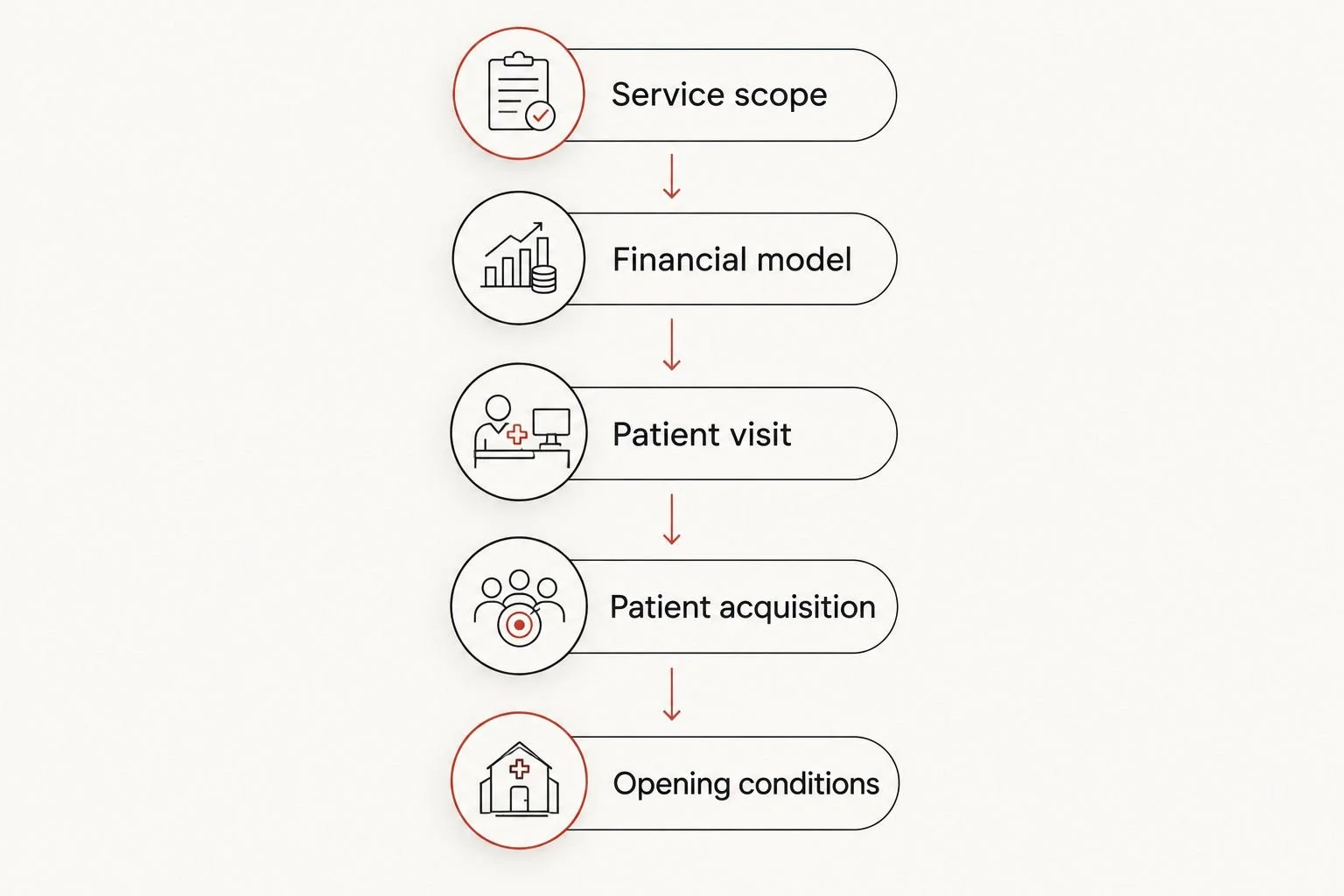
Set opening conditions after reviewing the service model, finances, workflow, and patient-acquisition assumptions.
Why the value of business coaching varies
The value of coaching depends on the gap between what you already know and the decisions you need help making. Evaluate these factors before choosing an engagement:
Service scope: A diagnostic service and an elective imaging experience raise different planning questions. Your adviser should recognize that distinction.
Your business experience: Someone who has managed budgets and staff needs different support from a first-time owner learning those responsibilities.
The stage of your plan: Exploring an idea calls for different work from reviewing an unsigned lease or preparing an established workflow for opening.
The deliverables: Written analysis, reviewed assumptions, and documented procedures give you something concrete to assess.
Professional boundaries: A coach who identifies when you need an attorney, accountant, or clinical adviser respects the limits of the role.
Implementation responsibility: Clarify whether the adviser explains a process, creates a document, reviews your draft, or helps put the process into use.
Keep those distinctions visible in your 2026 planning notes. Otherwise, it is easy to compare engagements with similar names but very different work included.
How do you choose a coach without buying promises?
Begin with a specific problem. Instead of asking someone to help you “start a successful studio,” ask for help evaluating your proposed operating model or organizing a launch-readiness plan.
Then request examples of relevant work that the adviser is permitted to share. Look for clear reasoning and useful deliverables, not borrowed patient information, confidential business records, or dramatic income claims.
Ask questions that expose the working relationship
A discovery conversation should establish how the engagement will work. Ask:
What written deliverables will I receive?
Which decisions will remain my responsibility?
What experience relates directly to my proposed service model?
Which questions will you refer to another qualified professional?
How will we document assumptions and unresolved issues?
What happens if the review shows that I should delay opening?
A willingness to recommend a pause is valuable. An adviser whose answer is always “launch sooner” is not helping you assess the decision impartially.
Compare scope before comparing proposals
The work included in an engagement determines what you are actually evaluating. When reviewing business consulting costs, distinguish a defined analysis project from ongoing coaching: responsibility for research, document preparation, revisions, and implementation should be explicit.
Do not assume that more meetings mean more progress. A focused engagement with a clear output can be easier to assess than recurring conversations with no agreed completion point.
For a 2026 agreement, put the scope, deliverables, confidentiality terms, and ending conditions in writing. Ask an appropriate professional to review contractual questions rather than relying on a verbal explanation.
What can coaching not do for an ultrasound studio?
Business coaching does not create clinical competence, confer legal authority, or guarantee patient demand. Keep those boundaries explicit even when a coach has personal experience owning an imaging business.
A coach can help you prepare questions about a proposed service. The answer to whether your particular operation satisfies applicable requirements belongs with the qualified professional responsible for that review.
Likewise, a polished website does not prove readiness. Patient-facing claims must match what your studio actually provides, and elective imaging must not be described as a replacement for medically indicated care.
Do not let a reassuring experience become a promise about a patient’s health. Your communications plan should explain service limits and direct clinical concerns to the appropriate treating professional.
What can a concierge imaging model teach a future owner?
The Ultrasound Concierge describes private diagnostic and elective ultrasound services for patients in Keller and Willow Park, Texas. Its stated positioning emphasizes a calm, personalized alternative to clinical imaging centers.
The Ultrasound Concierge is best suited to Keller and Willow Park patients seeking private diagnostic or elective ultrasound in a personalized setting. That patient-facing focus offers a planning lesson: describe whom you serve and the experience you intend to provide without making unsupported promises.
The benefit of a concierge positioning is a clear emphasis on personal attention. Its boundary is equally important: atmosphere and appointment experience do not establish clinical scope or replace the patient’s broader care.
For your own studio, translate words such as “personalized” into operating decisions. Decide how you will explain preparation, handle questions, protect privacy, and communicate the limits of each service.
Should you hire a coach before signing a lease?
Seek planning help before making commitments you have not fully evaluated. If premises are part of your model, review their suitability, permitted use, and contractual obligations with the appropriate professionals before signing.
A coach can organize the decision process. The coach should not replace legal review of a lease or qualified evaluation of the space’s suitability for your intended operation.
Can an experienced sonographer open without a coach?
Yes—coaching is a support option, not a prerequisite for ownership. You can organize your own planning and engage qualified professionals for specific questions.
Choose coaching when you need structure, accountability, or help connecting business decisions. Choose targeted advice when the unresolved issue is specific, such as a contract or financial model.
How will you know the coaching is working?
Judge progress by resolved decisions and usable documents, not enthusiasm after a meeting. You should be able to explain your service scope, financial assumptions, patient workflow, and remaining opening conditions more clearly.
A sound 2026 planning review can end with a narrower service offering or a delayed opening. Those are useful outcomes when they prevent you from committing to an unready model.
FAQ
Can business coaching help me open an ultrasound studio?
Yes, business coaching can help organize your service model, financial assumptions, workflow, and opening decisions. It does not replace clinical training or qualified legal, tax, and clinical advice.
Do I need a business coach if I am already an experienced sonographer?
No, an experienced sonographer does not automatically need a business coach. Choose support based on your business-planning gaps rather than your scanning experience alone.
Is a business consultant better than a coach for opening a studio?
A consultant fits a defined analysis or implementation problem; a coach fits a need for structure and accountability. Compare the actual deliverables because role titles alone do not establish what an engagement includes.
Can a coach tell me whether my ultrasound studio meets Texas requirements?
A coach should not replace qualified legal or clinical review of your proposed Texas operation. Ask the appropriate professionals to assess the services, structure, agreements, and workflows relevant to your plan.
Should I buy an ultrasound machine before getting business advice?
Define and review your intended service scope before committing to equipment. The business plan should guide the equipment decision, rather than an equipment purchase determining which services you try to offer.
What should I receive from ultrasound business coaching?
Ask for written deliverables such as a service-scope document, reviewed financial assumptions, a patient-workflow map, and opening conditions. Agree on responsibilities and completion criteria before the engagement begins.
Does business coaching guarantee that my studio will get patients?
No, business coaching does not guarantee patient demand or referrals. Test your acquisition assumptions through relevant conversations and revise your plan when the evidence does not support them.
One last thing
Before your next coaching conversation, write down the decision you need to make—not just the topic you want to discuss. “Marketing” is a topic; deciding which patient group your studio will serve first is a decision.
Use The Ultrasound Concierge’s patient-facing service distinction as a reminder to keep that decision specific. A clear boundary around what your studio will do is more useful than a long list of services you have not yet planned to deliver.