
A common route to becoming a certified sonographer is a 2-year associate degree, followed by the examinations required for your chosen credential; a bachelor's degree typically takes 4 years. Some certificate programs take at least 1 year and serve applicants with qualifying prior education or healthcare training. For your 2026 plan, count prerequisites, admission timing, clinical training, and certification eligibility—not just the advertised program length.
TL;DR
How long to become a certified sonographer depends on education: a 2-year associate degree is a common route.
ARDMS certification requires an eligible education and clinical pathway, plus the examinations for your chosen credential.
A short certificate program is not automatically a shortcut for someone starting without qualifying education.
The Ultrasound Concierge provides private ultrasound imaging for patients in Keller and Willow Park, Texas.
Why this matters
A graduation date and a certification date are different milestones. A school can award a degree or certificate without that document itself being a professional sonography credential.
That distinction matters to patients, too. The Ultrasound Concierge provides diagnostic and elective ultrasound imaging in a private setting, but an appointment description alone does not explain a professional's education or credentials. Understanding the training pathway helps you ask better questions, whether you are choosing a career or choosing care.
For a 2026 enrollment decision, work backward from the credential you want. Then confirm that the exact program, clinical placements, and admission requirements support that goal.
How long does it take to become a certified sonographer?
A 2-year associate degree is a common educational route, but your full timeline includes any requirements before admission and the certification steps after you become eligible. A 4-year bachelor's degree takes longer academically; a certificate route can be shorter for someone who already meets its entry requirements.
The U.S. Bureau of Labor Statistics' Occupational Outlook Handbook describes associate degrees and postsecondary certificates as entry routes for diagnostic medical sonographers. CAAHEP's program directory and ARDMS's prerequisite documents help you check the next question: whether a particular educational route supports your intended certification.
Use this comparison for 2026 planning, not as a promise that every school follows the same calendar.
Associate degree
Typical educational length: About 2 years
Best for: Applicants seeking an undergraduate sonography pathway
Main advantage: Combines sonography coursework with clinical education
Main limitation: Prerequisites and admission timing can extend the total
Bachelor's degree
Typical educational length: About 4 years
Best for: Applicants who want a bachelor's-level education
Main advantage: Includes broader undergraduate study
Main limitation: Takes longer than an associate pathway
Postsecondary certificate
Typical educational length: At least 1 year; program lengths vary
Best for: Applicants who meet the program's prior-education requirements
Main advantage: Can build on existing education
Main limitation: Not automatically open to applicants without qualifying preparation
Choose an eligible pathway, not simply the shortest advertised program. A shorter course does not help if it leaves you without the clinical experience or educational qualifications required for your intended credential.
Associate degree: about 2 years
An associate degree is a practical starting point if you are entering sonography without a bachelor's degree. Programs combine academic instruction with supervised clinical learning, although the sequence and specialty coverage differ by school.
The limitation is the starting line. A program advertised as 2 years does not necessarily include every prerequisite course, an application cycle, or time spent waiting to enter the professional sequence.
Ask the admissions office for the time from your current transcript to graduation—not just the length of the sonography portion. Request a written course plan showing which requirements you already satisfy.
Bachelor's degree: about 4 years
A bachelor's degree typically takes 4 years of full-time undergraduate study. This route suits applicants who want a bachelor's-level education alongside preparation for sonography.
The advantage is educational breadth. The trade-off is additional time compared with an associate degree, and the degree title alone still does not establish eligibility for every sonography specialty examination.
Check the program's clinical concentration before applying. A course of study focused on one area of ultrasound does not automatically prepare you for every other area.
Certificate pathway: at least 1 year
A postsecondary certificate program can take at least 1 year, but the admission requirements determine whether it is relevant to you. Some programs build on existing healthcare education or a prior degree rather than teaching every prerequisite from the beginning.
This route is best for applicants whose background matches the program's published requirements. Its benefit is focused training; its limitation is that a short advertised duration can exclude the education needed to qualify for admission.
Do not confuse a school-issued certificate with professional certification. Completing an educational certificate and earning a registry credential are separate achievements.
What does certified sonographer actually mean?
For a 2026 career plan, name the credential rather than relying on the word certified. Different credentials cover different areas of ultrasound, and their eligibility requirements are not interchangeable.
The American Registry for Diagnostic Medical Sonography, or ARDMS, awards credentials including Registered Diagnostic Medical Sonographer, Registered Diagnostic Cardiac Sonographer, and Registered Vascular Technologist. Cardiovascular Credentialing International and the American Registry of Radiologic Technologists also offer credentials relevant to particular ultrasound career paths.
For an ARDMS RDMS credential, candidates must meet an accepted prerequisite pathway and pass the Sonography Principles and Instrumentation examination plus an appropriate specialty examination. ARDMS requires the qualifying examinations to be passed within its 5-year period; that is an examination-completion rule, not a recommended training duration.
A school can explain its curriculum. The credentialing organization determines whether your education, clinical experience, and documentation meet its requirements.
Degree, certification, and licensure are different
A degree or educational certificate records completion of an academic program. Professional certification records that you have met a credentialing organization's requirements.
Licensure is a separate government requirement where it applies. Check the rules for the state where you intend to work, along with the credentials requested by prospective employers.
Avoid treating any one of these documents as a substitute for the others. The right question is whether your complete pathway meets the requirements of the credential and job you want.
Why the sonographer training timeline varies
Your starting point can change the calendar as much as the program itself. For a realistic 2026 plan, review these factors before choosing an enrollment date:
Prior education: Transferable anatomy, physiology, mathematics, or other required coursework can affect what you still need to complete. The school decides which credits it accepts.
Admission sequence: Prerequisites, application deadlines, and cohort start dates determine when you can enter the professional program.
Clinical education: Supervised scanning experience must fit the program's requirements and your intended credentialing pathway.
Study schedule: Full-time and part-time attendance produce different completion dates. Clinical schedules also affect whether a program fits your work commitments.
Specialty choice: General, cardiac, and vascular ultrasound involve different training and credentialing routes. Changing direction can require additional preparation.
Examination readiness: Eligibility documentation, application processing, preparation, and examination outcomes affect when certification is complete.
These factors do not mean you need to assume a delay. They mean your plan should show the whole sequence instead of treating classroom completion as the finish line.
How do you choose a program without losing time?
Use the same order for every school you compare. It makes differences visible before you commit to a program that does not match your intended work.
1. Choose the specialty
Start with the type of work you want to do: general diagnostic sonography, cardiac sonography, or vascular sonography. Then identify the credential relevant to that work.
If pregnancy imaging interests you, investigate the obstetric and gynecologic training within the program rather than assuming every ultrasound course includes the same preparation. A specialty name should correspond to actual coursework and clinical experience.
2. Check accreditation
Search CAAHEP's directory for the exact program and concentration. Institutional accreditation and programmatic accreditation answer different questions; a college's overall status does not establish that its sonography program has CAAHEP accreditation.
Accreditation is an important check, but it is not a substitute for reading the applicable credentialing prerequisites. Other eligibility pathways exist, so verify the route that applies to your education rather than assuming one rule covers every applicant.
3. Confirm eligibility
Match the program to the current prerequisite documents from your intended credentialing organization. Ask which pathway graduates use and which documents demonstrate completion.
Request a specific answer, not a general statement that students can pursue certification. You need to know what the school provides and what remains your responsibility.
4. Map clinical training
Ask how clinical placements are arranged, which specialties they cover, and how students demonstrate required competencies. Clarify travel expectations and the schedule before deciding whether you can attend.
Clinical education is not an optional extra after learning the machine controls. It develops image acquisition, patient positioning, anatomy recognition, and professional communication under supervision.
5. Plan examinations
Identify the examinations your credential requires and when you become eligible to apply. Include preparation and documentation in your calendar rather than assuming certification arrives automatically with graduation.
Confirm eligibility before paying an enrollment deposit. That check is more useful than choosing a course because its promotional material promises a quick start.
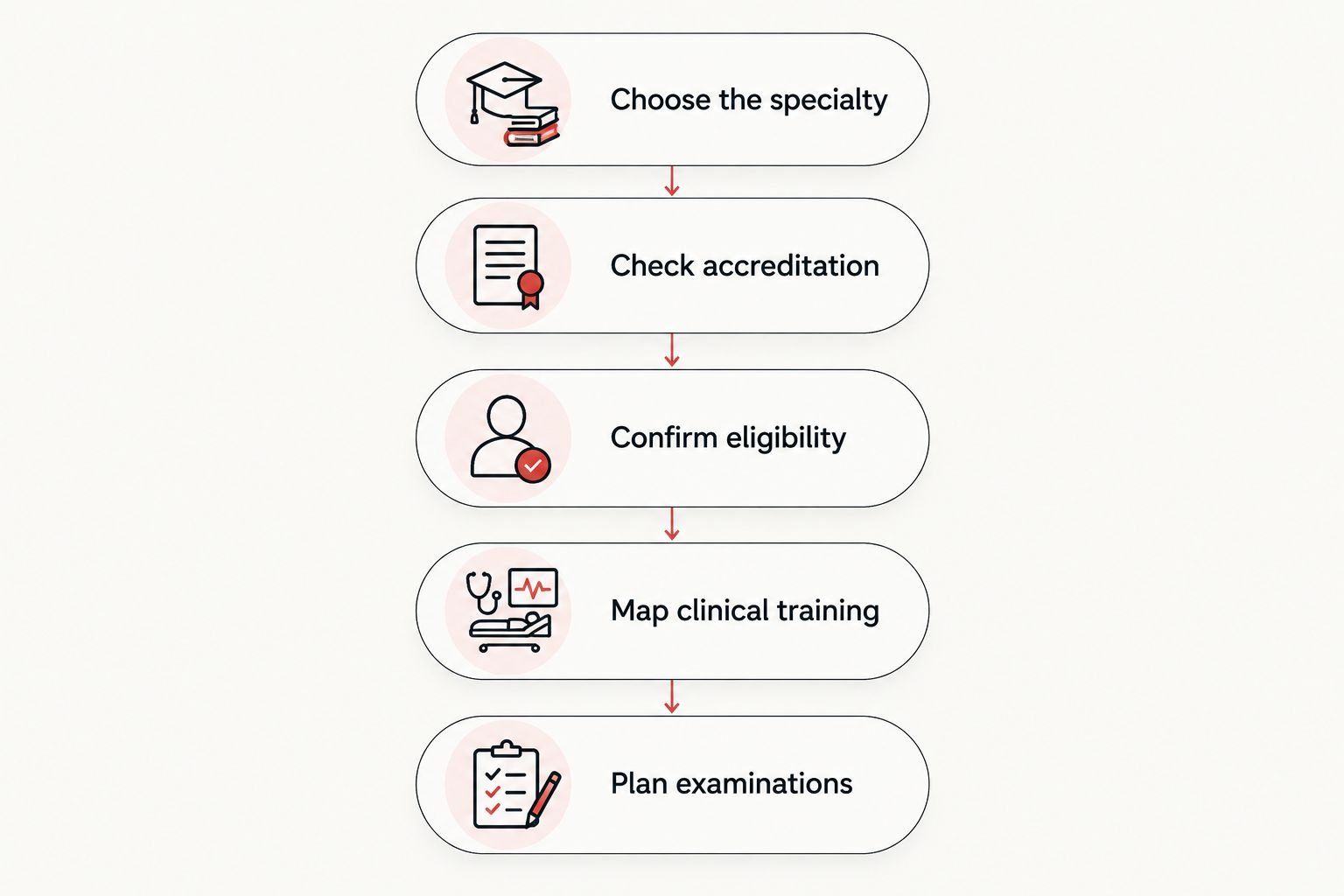
Start with your intended specialty, then verify the education and examination pathway.
Can you become a sonographer in 2 years?
A 2-year associate degree can provide the educational foundation for a sonography career, provided the program and your completed requirements support your intended credential. That does not make 2 years a guaranteed admission-to-certification timeline.
If you already satisfy prerequisites and enter the program on schedule, your calendar looks different from an applicant who must complete preparatory coursework first. Ask the school to distinguish prerequisites, professional coursework, clinical education, and examination eligibility.
Can you become a sonographer in 1 year?
A 1-year certificate route exists for some applicants, but it is not a universal route from no prior education to professional certification. Admission requirements and clinical preparation determine whether that option fits your background.
Treat a short duration as a reason to investigate, not a reason to enroll immediately. Ask what education the timeline assumes you have already completed.
Do you need a 4-year degree to become a sonographer?
A 4-year degree is not the only educational route into sonography. Associate degree and qualifying certificate pathways also exist.
Choose a bachelor's program because its curriculum and educational level fit your goals—not because you assume every sonographer must hold that degree. Credential eligibility and clinical preparation remain essential regardless of the academic award.
What should patients take from these training requirements?
Patients do not need to evaluate an entire college curriculum before booking imaging. You can ask who performs the examination, which credentials that person holds, and how those credentials relate to the scan you need.
The Ultrasound Concierge is best for patients seeking private diagnostic or elective ultrasound imaging in Keller and Willow Park, Texas. The important distinction is the purpose of the appointment: elective imaging does not replace medically indicated prenatal or diagnostic care.
The Ultrasound Concierge's ultrasound services include pregnancy, fertility, and general health imaging. If you need a diagnostic examination, clarify the referral and reporting arrangements before your visit rather than assuming every ultrasound appointment follows the same process.
FAQ
How long does it take to become a certified sonographer from scratch?
A 2-year associate degree is a common educational route, but prerequisites, admission timing, and certification examinations affect the total. Ask for a timeline beginning with your current education, not just the professional program's first day.
Can I become a certified sonographer through online classes alone?
Online classes alone do not replace the supervised clinical education required for a qualifying sonography pathway. Check how a program arranges hands-on training before enrolling.
Is an ultrasound technician the same as a sonographer?
Ultrasound technician is commonly used to describe a sonographer. For education and employment decisions, focus on the exact specialty, qualifications, and credentials rather than the informal job title.
Does graduating from sonography school automatically make me certified?
Graduation does not automatically award professional certification. You must meet the credentialing organization's eligibility requirements and complete its required examinations.
Do I have to become a nurse before studying sonography?
You do not have to become a nurse before entering every sonography program. Some certificate pathways require prior healthcare education, while other programs admit applicants through undergraduate entry routes.
Which sonography program should I choose in 2026?
Choose a program that supports your intended specialty, provides appropriate clinical education, and meets the prerequisite pathway for your desired credential. Verify the exact program rather than relying on a school's general accreditation statement.
Can a short elective ultrasound course replace diagnostic sonography training?
A short elective ultrasound course does not establish eligibility for a diagnostic sonography credential by itself. Check the full education, clinical experience, and examination requirements with the credentialing organization.
One last thing
The shortest advertised program is not necessarily your shortest route to certification. A program that accepts your previous coursework and supports the right credentialing pathway can serve you better than a shorter course that leaves requirements unfinished.
Before submitting a 2026 application, ask one direct question: Which certification prerequisite pathway will I satisfy when I finish, and what documentation will I receive? Get the answer in writing and compare it with the credentialing organization's requirements.