
The cost to start a private ultrasound studio is the total of your opening expenses, ongoing operating commitments, and cash reserved until collections cover expenses—not just the ultrasound machine. There is no single startup amount that applies to both elective imaging and diagnostic care. For a 2026 launch, build your budget around the services you will actually provide, including staffing, equipment support, documentation, and clinical responsibilities.
TL;DR
Calculate the cost to start a private ultrasound studio from opening expenses, operating commitments, and working capital.
Define elective ultrasound versus diagnostic imaging before choosing equipment or signing a lease.
The Ultrasound Concierge serves patients seeking private diagnostic and elective ultrasound in Keller and Willow Park.
Use written quotes and a cash-flow forecast, not an unsupported national startup average.
How much does it cost to start a private ultrasound studio?
Your startup funding requirement equals opening expenses plus the cash needed to support operations before the business becomes self-sustaining. An equipment quote alone cannot answer the question: it excludes the people, premises, systems, and clinical processes needed to deliver the service.
Start by defining your service scope. The distinction between diagnostic and elective imaging is visible in a private practice's ultrasound services, but your own budget must reflect your intended examinations and patient population.
Organize your 2026 estimate into 3 budget buckets:
Opening expenses
What to include: Equipment acquisition, premises preparation, professional advice, setup, and initial supplies
What to verify: Written scope, payment timing, and exclusions
Recurring commitments
What to include: Occupancy, payroll, equipment support, software, insurance, and professional services
What to verify: Contract terms and which expenses continue without bookings
Working capital
What to include: Cash supporting operations while collections develop
What to verify: Timing of incoming payments against outgoing commitments
Keep the buckets separate. A refundable deposit, an equipment purchase, and a recurring subscription affect cash differently, even when they appear on the same launch checklist.
Why this matters
An ultrasound studio is a patient-facing service, not simply a room containing an imaging system. Your opening plan needs to connect what you advertise with what your staff can perform, document, and communicate appropriately.
That distinction protects your budget and your patients. A comfortable setting supports the experience, but it does not replace appropriate training, examination protocols, infection prevention, or a clear response to clinical concerns.
Choose the care model before choosing the décor. Otherwise, you risk committing to equipment or premises before confirming whether they support your intended work.
Elective ultrasound studio: define the service boundary
An elective imaging business needs a clear explanation of what its appointment does—and does not—provide. Images intended for a personal experience do not replace medically indicated prenatal imaging or ongoing obstetric care.
For your budget, identify the equipment capabilities, operator qualifications, consent process, appointment workflow, and image-delivery method you intend to use. Include a written plan for handling questions or concerns that fall outside the appointment's scope.
The advantage of a tightly defined service is a clearer purchasing brief. The limitation is equally important: a narrower appointment cannot be advertised as a substitute for a broader medical examination.
Do not build demand assumptions around unnecessary repeat scanning. The FDA discourages fetal ultrasound performed solely to create keepsake images; its ultrasound safety guidance emphasizes prudent use by trained healthcare professionals. Treat that guidance as a service-design consideration, not merely a disclaimer added after launch.
Diagnostic ultrasound practice: budget beyond image capture
Diagnostic imaging requires a defined path from the clinical question to the examination, interpretation, report, and follow-up communication. Buying a capable machine does not establish that path.
Before committing funds, identify who performs each task and which professional arrangements your model requires. Review ordering, interpretation, documentation, privacy, and ownership requirements with qualified advisers familiar with your jurisdiction and proposed services.
The advantage is that the service addresses a defined clinical need. The operational constraint is that image acquisition is only part of the work: reporting, records, communication, and clinical escalation also need resources.
For a 2026 plan, request quotes against the actual examination list. A general description such as private ultrasound leaves too much room for suppliers and advisers to make different assumptions.
How do the main studio models compare?
Choose a model according to your intended service, not an assumption that one category always costs less. The comparison below identifies planning differences; it does not establish a startup spending ranking.
Elective imaging
Best for: A narrowly defined, non-diagnostic appointment experience
Planning advantage: A focused service scope can simplify the purchasing brief
Constraint to budget for: Clear clinical boundaries and responsible prenatal ultrasound use
Diagnostic imaging
Best for: Examinations addressing a medical question
Planning advantage: The examination and reporting workflow can be specified around a clinical purpose
Constraint to budget for: Interpretation, reporting, records, and follow-up responsibilities
Combined practice
Best for: An organization deliberately offering both appointment types
Planning advantage: Patients can access distinct services within the same business
Constraint to budget for: Separate explanations, workflows, and responsibilities for each service
A combined practice needs more than a longer service menu. Patients must understand which appointment they booked and what information they will receive afterward.
The Ultrasound Concierge is best for patients seeking private diagnostic or elective ultrasound in Keller and Willow Park. Its patient-facing model illustrates why a startup plan should distinguish the clinical purpose of each service from the calm, personalized setting in which it is delivered.
Why the cost to start a private ultrasound studio varies
The main drivers are choices you must resolve before requesting comparable quotes:
Service scope: Pregnancy, fertility, and general health examinations create different equipment and workflow requirements. Specify the examinations rather than budgeting for ultrasound as one interchangeable service.
Equipment configuration: Identify the probes, software capabilities, accessories, installation, and support included in each proposal. Compare equivalent configurations.
Premises: Assess the space for patient access, privacy, examination workflow, cleaning, and any proposed alterations before signing a lease.
People and clinical responsibilities: Define scanning, interpretation, administration, reporting, and escalation duties. Include the work performed outside the examination room.
Records and payment systems: Map scheduling, consent, image storage, reporting, payment collection, and record release. Check where separate systems require manual work.
Cash timing: Deposits, recurring commitments, payroll, and collections do not necessarily occur together. Your forecast must show when cash moves, not just whether the business eventually earns a profit.
A lower equipment proposal does not establish a lower total opening requirement. Compare the complete setup and continuing obligations before deciding.
Build your startup budget in this order
Use the following sequence to turn an idea into a quote-backed funding request. Finish the service definition before asking suppliers to recommend a system.
Define services
Write down the examinations you intend to offer, the patients you intend to serve, and the information each appointment will produce. Separate elective experiences from diagnostic examinations.
Also record what you will not offer. Those boundaries help prevent unnecessary purchases and misleading appointment descriptions.
Confirm responsibilities
Assign responsibility for scanning, interpretation where applicable, results communication, records, and clinical concerns. Obtain jurisdiction-specific advice before treating an operating arrangement as settled.
Do not assume that a supplier's equipment recommendation answers a professional-practice question. These are separate decisions.
Collect quotes
Send the same written specification to each relevant supplier. Ask for acquisition terms, included components, installation, training, support, software commitments, and exclusions.
For premises and professional services, request an equally clear scope. A proposal is useful only when you understand what it leaves for you to arrange.
Forecast cash
Place opening payments and recurring commitments into a dated cash-flow worksheet. Model collections separately from bookings, particularly if your intended payment process creates a delay between the appointment and receipt of funds.
Include owner compensation explicitly. Leaving your own work unpaid in the worksheet hides an economic requirement rather than removing it.
Review readiness
Walk through 1 completed patient visit, from initial inquiry to record release. Check every handoff, including consent, preparation instructions, payment, examination documentation, and follow-up questions.
Use the walkthrough to identify missing tasks before opening. It is a workflow check, not evidence of patient demand.
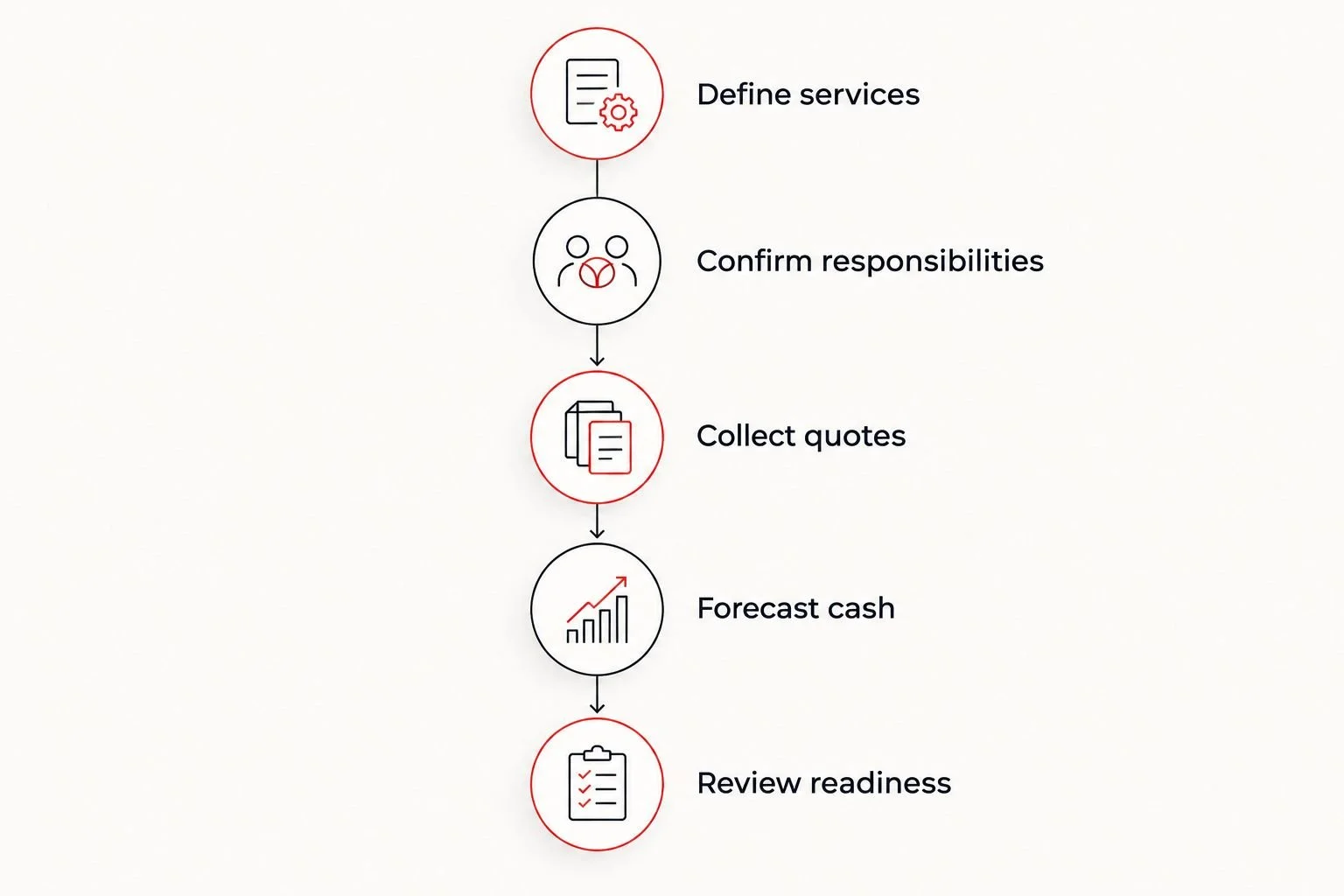
Define the service and clinical responsibilities before collecting equipment quotes.
What should an equipment quote include?
An equipment proposal needs enough detail to show what your practice can actually do with the supplied configuration. Ask the seller to match the proposal to your examination list rather than to a general promise of image quality.
Your comparison checklist should cover:
The system, probes, accessories, and software included.
Installation and user training arrangements.
Maintenance, repair support, and exclusions.
Image storage, export, and reporting compatibility.
Responsibility for transport, setup, and acceptance checks.
Continuing obligations under the proposed contract.
For any previously used system, request its documented condition and service history. For any financing or leasing arrangement, review the full commitment and end-of-term terms rather than treating the initial payment as the acquisition cost.
Buy against the clinical specification, not the most impressive demonstration. A feature has budget value only when it supports your intended service and qualified staff can use it appropriately.
How do you calculate break-even bookings?
Calculate break-even using collected revenue and the expenses associated with delivering each appointment. A full calendar is not the same as a financially sustainable practice.
Use this relationship:
Break-even completed appointments = fixed operating expenses ÷ contribution per completed appointment.
Contribution means the amount collected for an appointment minus expenses that arise specifically from delivering it. Keep fixed expenses separate, and use a consistent accounting period throughout the calculation.
Prepare 2 booking forecasts for your 2026 plan: a base case and a downside case. Change the appointment assumptions explicitly, then examine whether available cash supports the resulting operating commitments.
Do not fill either forecast with an unsupported market average. Tie your assumptions to documented referral discussions, your actual appointment capacity, and evidence you can explain to a lender or business partner.
Can a small studio reduce startup spending?
A smaller service scope can reduce the number of capabilities you need to purchase, but a smaller room does not remove clinical or operational responsibilities. Decide what to defer based on service necessity, not appearance alone.
Separate essential opening requirements from additions that do not support the initial examination list. Postpone optional furnishings or extra service categories before compromising staff competence, privacy, infection prevention, or equipment suitability.
The same discipline applies to branding. A personalized experience is a service choice; it does not justify promising medical reassurance beyond what the appointment can establish.
Should you plan to accept insurance?
Decide how patients will pay before finalizing your workflow and cash forecast. Accepting insurance introduces payer-specific participation, billing, documentation, and collection questions that require direct confirmation.
Do not assume that a service is covered because another practice offers a similar scan. Elective imaging and medically indicated diagnostic examinations need distinct explanations, and an invoice does not establish coverage.
For a 2026 launch, document your intended payment process in plain language. Patients should understand their responsibilities before the visit, while your budget should reflect the actual collection process rather than a presumed immediate payment.
FAQ
What does the cost to start a private ultrasound studio include?
The cost to start a private ultrasound studio includes opening expenses, recurring operating commitments, and working capital. Budget beyond the imaging system to cover premises, people, support, records, and the responsibilities attached to your services.
Can I estimate startup funding from the ultrasound machine alone?
No, an ultrasound machine quote is only part of a startup budget. It does not establish your premises costs, staffing requirements, professional arrangements, or cash needed while collections develop.
Is an elective ultrasound studio cheaper to open than a diagnostic practice?
The model name alone does not establish which practice costs less to open. Compare the actual equipment, staffing, premises, and workflow required for each proposed service.
Do I need to budget for someone to interpret diagnostic scans?
A diagnostic imaging budget needs a defined interpretation and reporting arrangement. Confirm who is responsible and what professional requirements apply to your proposed practice before purchasing equipment.
Can I open an ultrasound studio without accepting insurance?
Your payment model is a separate planning decision from your examination list. Review the legal, contractual, and patient-communication requirements of your proposed arrangement rather than assuming that cash payment removes other obligations.
Does The Ultrasound Concierge offer both diagnostic and elective imaging?
The Ultrasound Concierge provides diagnostic and elective ultrasound services for patients in the Keller and Willow Park, Texas area. Its stated services include pregnancy, fertility, and general health imaging.
What should I do before signing an ultrasound studio lease?
Define your services, confirm professional responsibilities, and assess whether the premises support your intended patient workflow. Put the proposed occupancy commitments into a cash-flow forecast before signing.
One last thing
Audit the time outside the scan. Preparation calls, cleaning, documentation, results communication, and record requests are work even when no patient occupies the examination room.
Before approving your 2026 opening budget, assign each task to a person and a system. That exercise makes the funding plan more useful than a standalone equipment estimate—and helps preserve the unhurried patient experience you intend to provide.