
Yes—OB scan training can help qualified providers offer in-office ultrasounds when instruction is matched to a defined examination, supervised practice, and documented competence. In 2026, completing a course alone does not establish readiness: your practice also needs appropriate equipment, a qualified interpreting clinician, clear reporting procedures, and a pathway for findings outside the office’s scope.
TL;DR
OB scan training supports in-office ultrasounds only when providers demonstrate competence in the examinations they intend to perform.
Choose training around clinical questions, supervised scanning, image review, and escalation—not a completion certificate alone.
A limited obstetric ultrasound does not replace a complete examination or specialist assessment.
The Ultrasound Concierge provides private diagnostic and pregnancy ultrasound services for patients around Keller and Willow Park, Texas.
Why this matters: Bringing imaging into your office changes more than appointment scheduling. It creates responsibility for obtaining useful images, interpreting them appropriately, communicating limitations, and arranging follow-up. If you are comparing an internal service with outside imaging, start with the practical questions in this guide to ultrasound partners for OB-GYN practices in North Texas.
Can OB scan training help providers offer in-office ultrasounds?
Yes, but training must prepare your team for the specific examinations your office will perform—not ultrasound in general. A provider learning a focused obstetric examination needs different preparation from someone developing a broader diagnostic imaging service. Your starting skills, clinical responsibilities, and access to supervision determine the appropriate training plan.
Use the following sequence to turn education into a defined clinical service. Treat each step as a decision point rather than an administrative task to complete after purchasing equipment.
1. Define the examination
Write down the clinical question your proposed scan will answer. Describe the required images, measurements, documentation, and limits of the examination before choosing a course.
Avoid broad promises such as offering “pregnancy checks” without explaining what those visits include. A focused assessment and a complete obstetric examination are not interchangeable, even when both use the same machine.
2. Match the learner
Identify who will acquire images and who will interpret the study. Review each person’s existing ultrasound education, relevant clinical experience, and permitted professional responsibilities.
A course designed for experienced sonographers is not necessarily suitable for a clinician starting ultrasound training. Equally, introductory instruction should not be treated as preparation for examinations beyond the skills actually assessed.
3. Practice under supervision
Choose instruction that includes supervised scanning and feedback on the images you obtain. Practicing probe movements matters, but so does learning when an image is inadequate or a finding needs further evaluation.
Ask how instructors assess performance beyond recognizing a normal example on a lecture slide. Your team needs practice with acquisition, measurements, documentation, and explaining an incomplete examination without offering false reassurance.
4. Verify competence
Before independent scanning, require a documented assessment for the examination you intend to offer. The assessment should address image quality, required views, measurement technique, recognition of limitations, and appropriate escalation.
Do not substitute confidence for competence. A learner who can reproduce a familiar image still needs to demonstrate that they know what the examination cannot establish.
5. Build the workflow
Decide how examinations will be ordered, recorded, interpreted, and communicated. Identify who receives the report and who takes responsibility for acting on it.
Include patient consent, privacy, equipment maintenance, and probe cleaning in the workflow. For any internal examination, use appropriate infection-prevention procedures and explain the examination before obtaining consent.
6. Review ongoing quality
Continue reviewing images and reports after the service begins. Establish a process for reviewing incomplete studies, discrepancies, unexpected findings, and referrals.
For a 2026 launch, define your review process before the first independent appointment. Quality oversight should support the service from the start rather than appear only after a difficult case.
These steps work together: training develops skills, while the clinical workflow determines how those skills are used. If your practice cannot identify who owns interpretation and follow-up, resolve those responsibilities before expanding scanning.
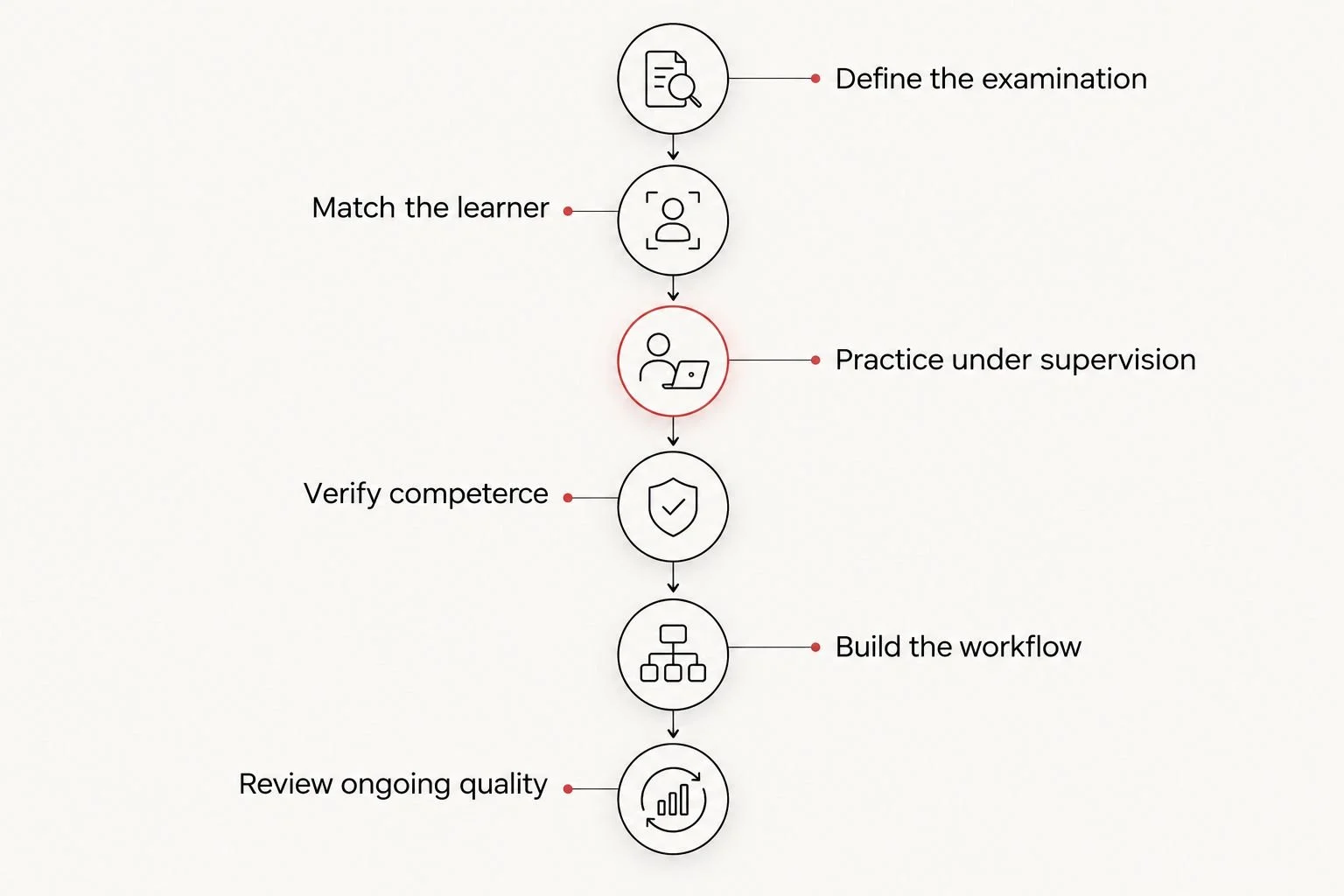
Training is one part of readiness; interpretation, follow-up, and quality review need equal attention.
Choose the service model before choosing training
Your office does not have to make every clinician an ultrasound operator. Compare provider-performed scanning, a sonographer-supported service, and external diagnostic imaging against the examinations your patients need.
None is automatically the best choice. The right model is the one that matches your team’s demonstrated capabilities and provides a clear route from examination to clinical action.
Provider-performed office scans
Best for: Defined examinations within a trained clinician’s competence
Main advantage: Connects image acquisition with the clinical encounter
Main limitation: Adds scanning, documentation, and quality responsibilities to the clinician’s workload
Sonographer-supported office imaging
Best for: Practices planning a dedicated image-acquisition workflow
Main advantage: Assigns acquisition to personnel trained for that role
Main limitation: Still requires appropriate interpretation, reporting, and follow-up arrangements
External diagnostic imaging
Best for: Examinations outside the office’s skills or equipment capabilities
Main advantage: Keeps the examination with a service selected for the required scope
Main limitation: Requires coordination of appointments, records, reports, and clinical follow-up
Choose the examination first and the staffing model second. Buying a scanner and then deciding what to offer reverses that order and leaves important clinical boundaries unresolved.
A combined approach is also possible: keep a defined examination in the office and refer other imaging needs. Make those boundaries explicit so patients and staff do not interpret “ultrasound available here” as a promise that every examination can be completed there.
What should OB scan training cover?
Useful training connects ultrasound technique with clinical judgment. Your team needs to understand how to obtain a view, assess whether it is adequate, and recognize when the examination cannot answer the question.
When reviewing a 2026 training syllabus, look beyond the list of lecture topics. Ask how the program teaches and assesses the following areas:
Image acquisition: Probe handling, orientation, image optimization, and obtaining the views required for the intended examination.
Measurements: Appropriate image selection, measurement placement, and recognition of technical limitations.
Clinical scope: What the examination answers, what it does not answer, and which findings require further assessment.
Patient communication: Consent, explanation of the examination, and clear language about incomplete or uncertain findings.
Safety and hygiene: Appropriate ultrasound use, equipment care, and cleaning or disinfection suited to the probe and examination.
Documentation: Saved images, a report that matches the examination performed, and a defined route for communicating results.
Ask who supervises practical work and how learners receive corrective feedback. A syllabus can describe a skill without showing that the learner can perform it.
Also ask what happens when someone does not meet the assessment standard. A useful educational process identifies gaps and provides a route to further supervised practice rather than treating attendance as proof of readiness.
Why OB scan training needs vary
Training needs vary because “in-office ultrasound” describes a location, not a single examination or level of expertise. Build the learning plan around the actual work rather than choosing the shortest course description.
Previous experience: Someone new to scanning needs a different starting point from a practitioner extending an established ultrasound skill set.
Examination scope: A focused clinical question and a complete obstetric study require different preparation and assessment.
Scanning approach: Transabdominal and transvaginal examinations involve different practical skills, consent considerations, and probe-handling procedures.
Patient population: Your training and referral arrangements must match the patients and clinical questions your practice accepts.
Equipment: Operators need to understand the controls, probes, image storage, and technical limitations of the equipment they will actually use.
Supervision and review: The learning plan depends on access to qualified feedback during training and quality review afterward.
These factors explain why a universal training duration is not a useful readiness standard. Ask what competence is assessed, for which examination, and under whose supervision.
Keep limited scans separate from complete examinations
A limited obstetric ultrasound answers a defined question; it does not establish that every aspect of the pregnancy has been assessed. State that distinction in your booking language, consent discussion, and report.
For example, an examination undertaken to assess fetal presentation is not a substitute for a complete fetal anatomy evaluation. Finding the feature you were looking for does not mean structures outside the examination’s scope were evaluated.
The same distinction applies to patient-facing language. Avoid describing a limited study as an “all-clear” examination, and explain when additional imaging remains necessary.
Elective images also serve a different purpose from diagnostic assessment. An appealing fetal image does not replace the views, measurements, interpretation, or follow-up required for a clinical examination.
What must your practice resolve before launching?
For a 2026 service launch, review clinical responsibility, professional requirements, and practical operations together. Confirm applicable Texas requirements, organizational policies, professional scope, and liability coverage with the appropriate qualified advisers.
Use a written readiness checklist:
Name the person responsible for interpretation and the final report.
Define which examinations the office accepts and which it refers elsewhere.
Establish how urgent or unexpected findings reach the treating clinician.
Explain what staff should do when required images cannot be obtained.
Confirm how images and reports enter the patient record.
Assign responsibility for equipment care, cleaning procedures, and quality review.
Test the workflow with a hypothetical incomplete examination. If staff cannot explain who contacts the patient, who arranges further assessment, and where that decision is documented, the pathway needs more work.
When is outside imaging the better fit?
Outside imaging is the appropriate route when the required examination exceeds your office’s demonstrated skills, equipment capabilities, or interpretation arrangements. Referral is a clinical boundary, not a failure of the training program.
Choose a receiving service based on the examination needed, then confirm referral requirements, reporting arrangements, and how questions reach the responsible clinician. Do not assume that every private ultrasound appointment includes the same diagnostic scope.
The Ultrasound Concierge is suited to patients around Keller and Willow Park seeking private diagnostic or pregnancy ultrasound services. Its ultrasound services are a starting point for discussing the examination needed; an office planning referrals should confirm the relevant clinical and reporting arrangements directly.
The benefit of this option is access to a private imaging setting without building every examination into your own office. The limitation is coordination: an outside appointment does not remove your practice’s responsibility for reviewing relevant results and arranging appropriate care.
Does a training certificate qualify someone to scan independently?
A training certificate documents the education or assessment described by its issuer; it does not automatically establish readiness for every obstetric examination. Independent practice also depends on demonstrated competence, professional scope, applicable requirements, and your organization’s clinical oversight.
Read the certificate’s meaning carefully. Distinguish participation, course completion, and assessed competence rather than treating those terms as equivalent.
Can office scans replace specialist obstetric imaging?
Office scans do not replace specialist imaging when the clinical question requires expertise or examination capabilities beyond the office’s scope. Your protocol should specify when to seek maternal-fetal medicine or another appropriate specialist assessment.
Patients with urgent symptoms need clinical assessment, not an elective appointment intended for reassurance. Keep that instruction visible in scheduling procedures and staff training.
FAQ
Can OB scan training help my practice offer in-office ultrasounds?
Yes, OB scan training can support in-office ultrasounds when it matches a defined examination and includes supervised practice and competence assessment. Your practice also needs interpretation, reporting, and follow-up arrangements.
How long does it take to become ready for independent OB scanning?
Readiness depends on demonstrated competence rather than course duration alone. Previous experience, examination scope, supervised practice, and assessment determine the learning plan.
Does completing an OB ultrasound course make me certified?
Course completion does not automatically establish a professional credential or permission to perform every obstetric examination. Check exactly what the course awards and which requirements apply to your role.
Can a limited office ultrasound replace a complete anatomy examination?
No, a limited office ultrasound does not replace a complete fetal anatomy examination. A limited study answers a defined clinical question and must be described accordingly.
Should a practice train clinicians or use a sonographer?
Choose the staffing model around the intended examinations and the team's demonstrated competence. Either model needs appropriate interpretation, documentation, quality review, and follow-up.
Does a private ultrasound service replace my patient's prenatal care?
No, private ultrasound does not replace prenatal care. Patients using The Ultrasound Concierge or another imaging service should keep their treating clinician involved in diagnostic imaging decisions and follow-up.
What happens if an office scan is incomplete?
An incomplete office scan needs a documented clinical plan rather than a reassuring conclusion unsupported by the images. The responsible clinician should determine whether repeat imaging, referral, or another assessment is appropriate.
One last thing
Write the incomplete-scan pathway before writing the appointment announcement. Your team’s response when it cannot answer a clinical question is as important as its ability to obtain a clear image.
Before your first 2026 appointment, ask every staff member involved to explain that pathway in plain language. A shared answer gives patients clearer expectations and keeps the service within its intended clinical boundaries.