
OB scan training costs depend on the program you choose, your existing sonography education, and whether you need classroom instruction, supervised scanning, or preparation for a credentialing examination. Get an itemized quote for the complete training pathway rather than comparing tuition alone. Your budget should also account for any separately charged assessments, required materials, travel, and time away from work.
TL;DR
How much does OB scan training cost for sonographers? Compare complete program quotes, not tuition alone.
Hands-on obstetric ultrasound training and exam preparation serve different needs; choose the format that addresses your skill gap.
The Ultrasound Concierge provides patient ultrasound imaging; distinguish imaging appointments from professional education.
Confirm prerequisites, supervised scanning, assessment, and employer acceptance before enrolling.
How much does OB scan training cost for sonographers?
There is no single figure that answers every sonographer's training question. A continuing education course, a practical workshop, and an initial sonography education program do not provide the same instruction or lead to the same outcome. For your 2026 budget, compare programs within the same category before comparing their quoted totals.
Patient imaging is a separate service. The Ultrasound Concierge provides private diagnostic and elective ultrasound imaging in the Keller and Willow Park, Texas, area; an appointment for a pregnancy scan is not professional scanning instruction.
Use this breakdown when requesting a training quote:
Tuition
What to ask the education provider: Which lessons, practical sessions, and assessments are included?
What the answer establishes: The actual scope of instruction
Learning materials
What to ask the education provider: Are required textbooks, software, or course resources included?
What the answer establishes: Whether the tuition quote covers required resources
Practical training
What to ask the education provider: Is supervised scanning included or arranged separately?
What the answer establishes: Whether you need another training arrangement
Assessment
What to ask the education provider: Are course assessments and any external examinations separate?
What the answer establishes: Which charges belong to the course versus a credentialing body
Travel
What to ask the education provider: Does attendance require transportation or accommodation?
What the answer establishes: Your additional attendance expenses
Work arrangements
What to ask the education provider: Will you need leave or a change in scheduled shifts?
What the answer establishes: The effect on your work schedule and earnings
A useful quote identifies both what you receive and what you still need to arrange. Keep the written quote alongside the syllabus so an attractive headline fee does not distract you from missing instruction.
Why this matters
Obstetric scanning requires more than recognizing a clear fetal image. Your training needs to address image acquisition, anatomy, measurements, documentation, safety, and the limits of your professional role. A course that explains a technique is different from supervised practice that assesses whether you can perform it.
The financial decision therefore starts with a clinical question: what must you be able to do after training? Define that outcome before selecting a provider. Otherwise, you risk paying for content that repeats your existing knowledge while leaving your actual training need unresolved.
For a 2026 enrollment decision, separate three outcomes: completing education, demonstrating practical competence, and meeting credential or employer requirements. Do not treat those outcomes as interchangeable. Ask who evaluates each one and what documentation you receive.
Continuing education: best for a defined knowledge gap
Continuing education is the appropriate category to investigate when you already practice sonography and need instruction on a specific obstetric topic. Examples include reviewing fetal anatomy, understanding a scanning protocol, or improving your approach to documentation. Check the syllabus rather than relying on a broad course title.
The benefit is a focused learning objective. The limitation is that completing educational content does not, by itself, demonstrate independent scanning competence. If your goal includes a new practical responsibility, ask how the course connects to supervised practice and workplace assessment.
Before enrolling, request these details:
The intended audience and entry requirements.
The specific topics and learning objectives.
Whether instruction is recorded, live, or in person.
Whether questions and individual feedback are included.
Whether the stated education credit is accepted for your requirements.
Choose continuing education for a knowledge gap, not as an assumed substitute for clinical training. A narrowly matched course is more useful than a broad course whose content does not address your next clinical task.
Hands-on workshops: best for practical feedback
A hands-on workshop is the category to investigate when your main need is feedback on scanning technique. Ask whether you personally operate the equipment, what practice setting is used, and how instructors assess your work. Watching a demonstration and performing a scan are different learning experiences.
The benefit is direct observation of technique when that is part of the program. The limitation is that a workshop is not automatically equivalent to sustained supervised clinical experience. Confirm what the provider assesses and what further practice your employer expects.
Your 2026 workshop comparison should specify actual learner participation. Ask about access to equipment, instructor feedback, the scope of practice activities, and how the provider handles incomplete learning objectives. A label such as hands-on does not answer those questions.
Choose a practical workshop only after confirming what you will personally practice. Do not assume that equipment demonstrations, case discussions, and supervised patient scanning are included together.
Exam preparation: best for an examination goal
Exam preparation is intended to help you study for a specified examination. Look for a clear connection between the course outline and the examination content you need to review. Confirm your eligibility with the credentialing organization separately.
The benefit is an organized study plan. The limitation is that exam preparation is not a replacement for the clinical education, experience, or documentation required by a credentialing pathway. A course completion certificate and a professional credential are different documents.
Ask whether the quote includes practice questions, instructor access, and any required study materials. Also ask whether an external examination registration is separate. Buy exam preparation for an examination goal, not as evidence that you are ready to perform a new clinical service.
Initial education or cross-training: best for a broader skill change
If you are entering sonography or moving into an unfamiliar clinical specialty, investigate education that matches that broader change. The starting point matters: an experienced sonographer adding obstetric skills has different needs from someone without foundational ultrasound education.
The benefit of a broader pathway is its scope when foundational instruction and clinical practice are needed. The limitation is that a short course cannot be assumed to meet all entry, credentialing, or employment requirements. Check those requirements before committing to enrollment.
Ask the provider to explain the complete sequence, including prerequisites and clinical arrangements. Then ask your intended employer whether that pathway meets its requirements. Choose the pathway your role requires, rather than the shortest course with an obstetric title.
Which training format matches your goal?
Compare the learning outcome before comparing the quote. These categories describe different purposes; they are not a ranking of education providers.
Continuing education
Best for: A defined knowledge gap
Main benefit to verify: Focused instruction on the topic you need
Main limitation: Completion alone does not establish practical competence
Hands-on workshop
Best for: Feedback on scanning technique
Main benefit to verify: Personal practice with instructor feedback
Main limitation: Workshop participation is not automatically sustained clinical experience
Exam preparation
Best for: A specified examination
Main benefit to verify: Study content aligned with the examination
Main limitation: Does not replace eligibility requirements or clinical training
Initial education or cross-training
Best for: A broader change in professional responsibilities
Main benefit to verify: Instruction and practice matched to the intended role
Main limitation: Requires checking the complete pathway, not just one course
If more than one category applies, request separate descriptions of each component. A combined program is only useful when you understand which learning objectives, practical activities, and assessments it includes.
Why OB scan training budgets vary
Training budgets vary because the educational scope and your attendance requirements differ. Use these factors to explain differences between written quotes rather than assuming that a higher total means better instruction.
Starting knowledge: Identify whether you need foundational education, specialty instruction, or a refresher.
Instruction format: Establish whether the program includes self-directed lessons, live teaching, practical activities, or a combination.
Supervised practice: Confirm whether practice and individual feedback are included or need separate arrangements.
Assessment and materials: Ask which required resources and assessments are included in the quote.
Attendance arrangements: Account for travel and work changes required by the actual schedule.
Credentialing pathway: Separate the education provider's charges from external requirements you must meet independently.
For a 2026 comparison, write the same questions beside every provider's quote. This makes differences visible without assuming that similarly named courses offer equivalent training.
How do you compare training quotes before enrolling?
Use a goal-first comparison, then check the complete commitment. This sequence keeps the budget connected to your intended clinical responsibilities.
Define your goal. Name the task you need to learn, the examination you intend to take, or the role you want to qualify for.
Check eligibility. Confirm both the course prerequisites and any separate credentialing or workplace requirements.
Verify practice. Establish what supervised activities you perform and how instructors assess your technique.
Request the quote. Ask for an itemized written total and a clear list of exclusions.
Confirm acceptance. Ask the relevant employer or credentialing organization whether the proposed education meets its requirements.
Keep the responses in writing. If a provider cannot explain how its course addresses your goal, do not use the course title as a substitute for that explanation.
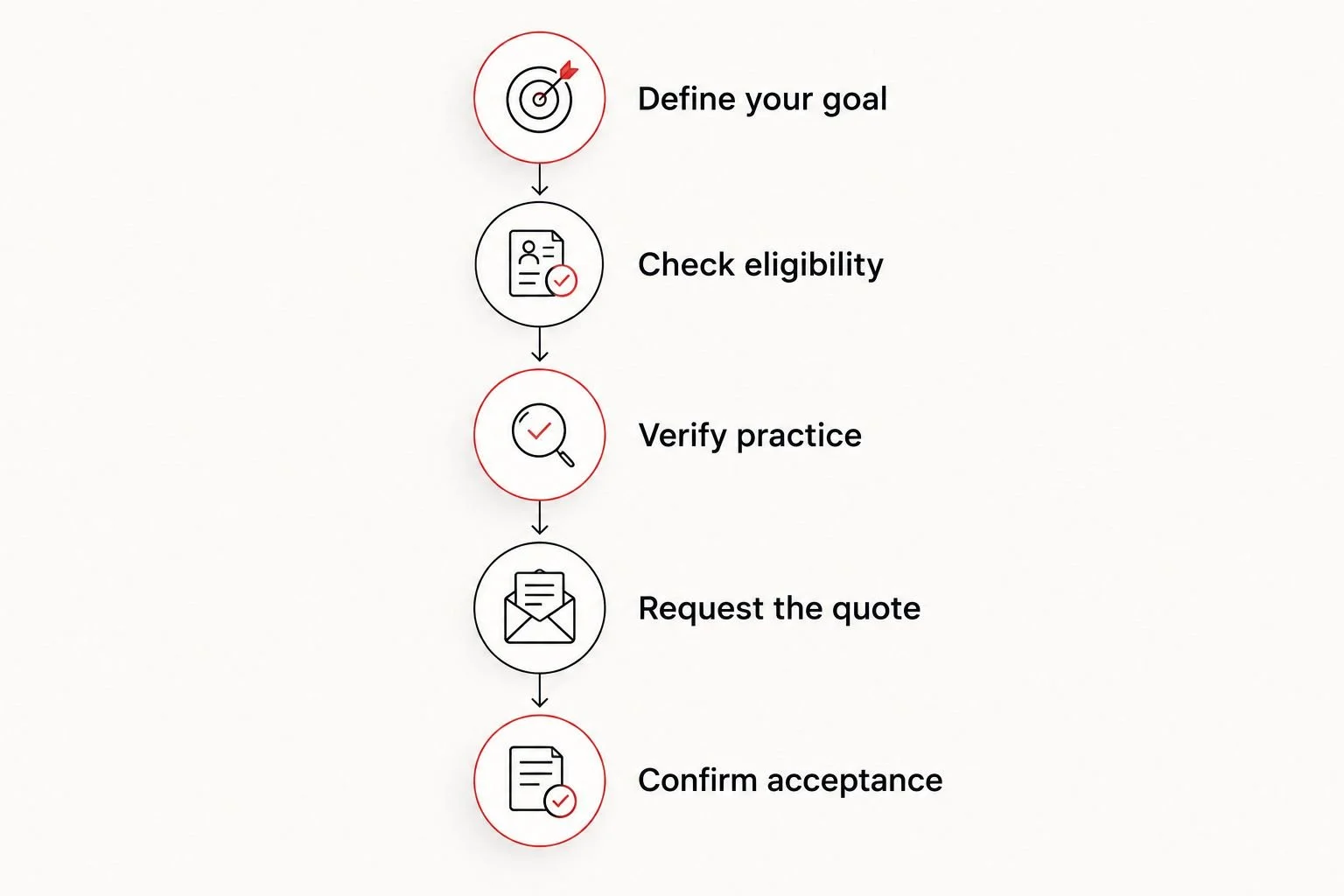
Check the learning outcome and acceptance requirements before committing to a course.
Does an OB ultrasound course qualify you to scan independently?
Course completion alone does not establish permission or competence to scan independently. Your responsibilities depend on your education, demonstrated skills, applicable professional requirements, and the policies of the setting where you work.
Ask your clinical supervisor who authorizes independent scanning and how competence is assessed. Keep that decision separate from the education provider's certificate of attendance or completion.
Is online OB ultrasound training enough?
Online instruction can support knowledge development, but it does not itself demonstrate hands-on scanning competence. If your goal involves performing examinations, confirm how supervised practice and practical assessment will be provided.
For your 2026 training plan, identify exactly which parts can be completed through online study and which require observed performance. Do not leave the practical component as an assumption.
Keep diagnostic training separate from elective imaging
Professional obstetric training should match the examinations and responsibilities you intend to perform. Elective pregnancy imaging and diagnostic obstetric assessment have different purposes; attractive images do not establish that a diagnostic examination is complete.
The Ultrasound Concierge is best suited to patients seeking private ultrasound imaging in Keller and Willow Park, Texas. Its patient-facing services include diagnostic and elective imaging, while this training decision concerns your professional education and assessment.
If you are a patient rather than a sonographer, ask your pregnancy care provider which examination is appropriate. An elective imaging visit does not replace prescribed prenatal care or an indicated diagnostic examination.
FAQ
How much does OB scan training cost for sonographers in 2026?
The cost depends on the specific program and the training pathway you need. Request an itemized quote covering instruction, practical activities, required materials, assessments, and any separately arranged components.
What's the best OB scan training option for an experienced sonographer?
The best option addresses the experienced sonographer's specific learning gap. Compare focused continuing education for knowledge needs with supervised practical instruction for scanning skills.
Is a hands-on workshop better than an online OB ultrasound course?
A hands-on workshop and an online course serve different learning needs. Choose verified practical instruction for observed scanning feedback and online instruction for suitable knowledge-based learning objectives.
Does completing OB scan training give me a professional credential?
Course completion is not the same as earning a professional credential. Confirm eligibility, examination, and documentation requirements directly with the relevant credentialing organization.
What should I ask before paying for obstetric ultrasound training?
Ask about prerequisites, learning objectives, personal scanning practice, instructor feedback, assessment, and the complete written quote. Confirm that the education meets your employer's or credentialing organization's requirements.
Can I use an elective pregnancy scan as professional training?
An elective pregnancy imaging appointment is a patient service, not evidence of supervised professional training. Professional instruction requires a defined educational arrangement and appropriate assessment.
Does The Ultrasound Concierge provide patient scans or sonographer training?
The Ultrasound Concierge's described services are private diagnostic and elective ultrasound imaging for patients. Do not treat a patient imaging appointment as a professional education program.
One last thing
Ask how the provider handles a skill you have not mastered by the end of the course. The answer reveals whether assessment is simply a completion requirement or part of a practical learning plan.
Before committing your 2026 training budget, establish who provides further feedback, where additional supervised practice takes place, and whether that arrangement is included. A clear plan for unfinished learning is more useful than a certificate whose meaning you have not checked.