
Yes, you can request placenta encapsulation after a C-section, but your hospital must first approve release of the placenta under applicable rules and your clinical circumstances. A cesarean birth does not automatically prevent release; infection concerns, necessary pathology testing, and hospital procedures can affect the decision. Permission to take your placenta home is not confirmation that consuming placenta capsules is safe or beneficial.
TL;DR
Placenta encapsulation after c-section requires a hospital release discussion, not just an arrangement with an encapsulation provider.
CDC advises avoiding placenta capsules because processing does not reliably eliminate infectious pathogens.
Ask your obstetrician about infection concerns, pathology testing, and placenta release before delivery.
Texas permits placenta release under specified conditions; your hospital must confirm how those conditions apply.
Why this matters
Your birth preferences deserve a clear conversation, including preferences about your placenta. But keeping the placenta, having it processed, and deciding whether to consume it are separate decisions with different responsibilities.
For your 2026 birth plan, discuss release with your obstetrician and delivery hospital rather than relying on an encapsulation provider's assurances. For separate prenatal imaging needs, The Ultrasound Concierge provides private diagnostic and elective ultrasound services in Keller and Willow Park, Texas; placenta-release decisions belong with your delivery team.
Can you request placenta encapsulation after a C-section?
Yes. Ask to retain your placenta after a cesarean birth, then confirm whether your hospital can release it in your circumstances. The surgical route alone does not answer that question.
Texas law allows hospitals and birthing centers to release a placenta subject to specified conditions. Those conditions include infectious-disease screening requirements and acknowledgment of risks. This is not an unconditional right to immediate release, and it does not establish a medical benefit from eating the placenta.
Use this sequence when discussing your request:
Ask your obstetrician. Explain that you want to discuss placenta release after delivery, including the possibility of a C-section. Ask whether anything about your pregnancy makes examination of the placenta especially important.
Confirm hospital rules. Contact the delivery unit about its current 2026 release procedure, paperwork, and required clinical approvals. Your obstetrician's agreement does not replace the hospital's process.
Discuss pathology. Ask what happens if the placenta needs laboratory examination. Do not assume it can be released afterward or remains appropriate for any intended use.
Assign a support person. Ask who is permitted to receive the placenta if release is approved. You should not have to manage collection while recovering from surgery.
Revisit the decision after birth. New clinical information can change the plan. Your care team should reassess infection concerns and testing needs before release.
Keep the request in your birth preferences, but make clear that necessary medical evaluation takes priority. A written preference helps start the conversation; it does not guarantee the outcome.
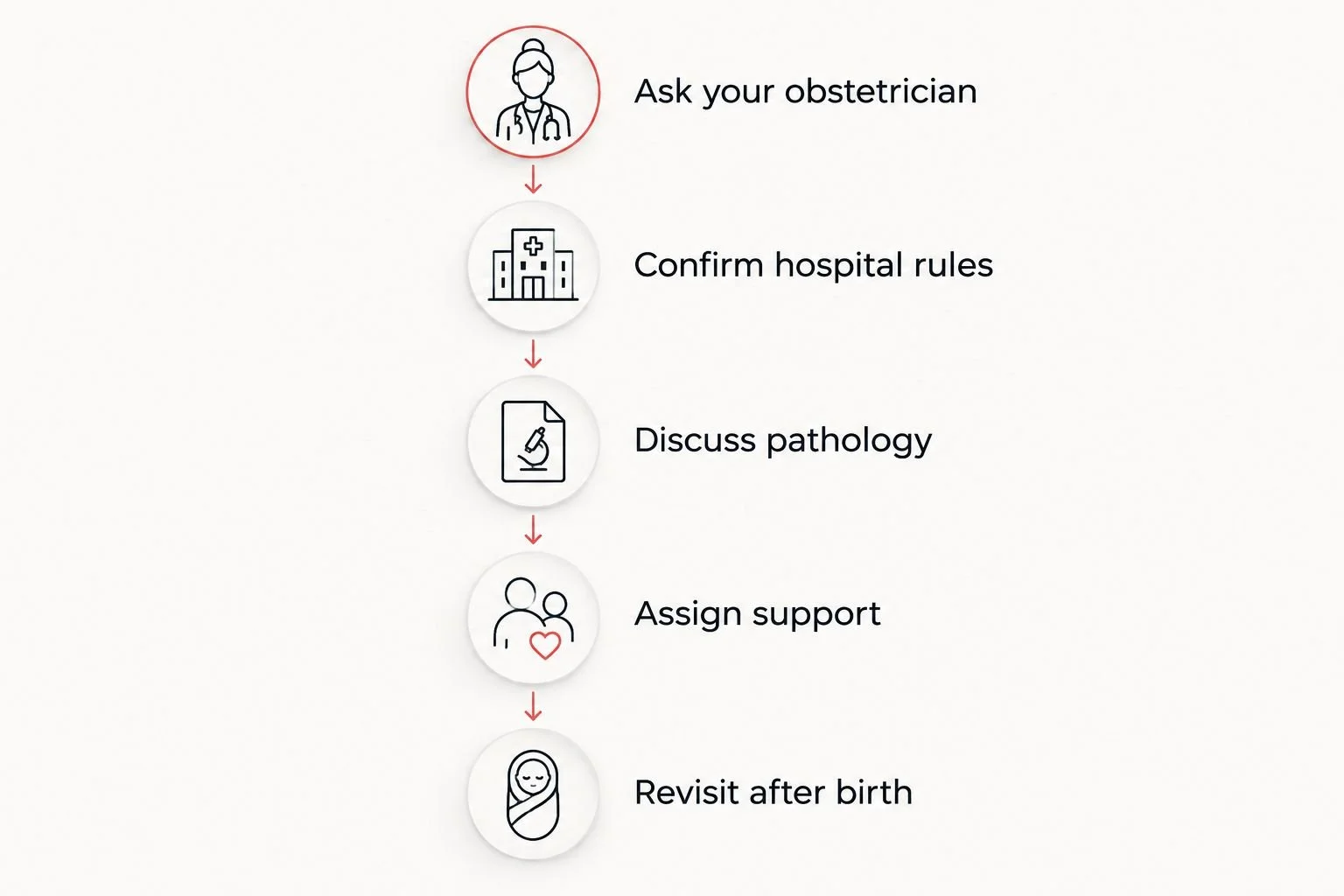
Confirm the release process before delivery, then revisit it with your care team after birth.
Planned C-section: discuss release before admission
A planned C-section gives you an opportunity to raise the request during prenatal care. Ask where the request should be documented and whether the delivery unit needs separate paperwork.
The practical advantage is preparation, not a different safety standard. Infection concerns and medical testing still take priority even when the surgery and collection arrangements were planned in advance.
For a scheduled birth in 2026, confirm the procedure with the actual hospital where you will deliver. Advice from someone who delivered elsewhere does not establish that hospital's requirements.
Unplanned C-section: tell the team when it is safe to do so
You can still express a placenta-release preference if labor ends in an unplanned C-section. Your support person can communicate an existing request while the clinical team focuses on delivery and recovery.
The limitation is timing. An urgent delivery leaves less opportunity for administrative arrangements, and new medical concerns can require placental examination. Do not delay urgent care or necessary testing to preserve an encapsulation plan.
If the request was not documented beforehand, ask the team what remains possible. Avoid assuming either that release is impossible or that someone has already arranged it.
Does the delivery method change the request?
The core questions remain the same after cesarean and vaginal birth: can the hospital release the placenta, does it need examination, and are there infection concerns? The difference is often how you organize the conversation and collection.
Planned C-section
Best planning approach: Discuss release during prenatal care
Practical advantage: Time to clarify paperwork and assign support
Limitation: Clinical findings can still change the plan
Unplanned C-section
Best planning approach: Document preferences before labor and have support communicate them
Practical advantage: Your wishes can be communicated while you receive care
Limitation: Urgent care and testing take priority
Vaginal birth
Best planning approach: Confirm the same hospital release requirements
Practical advantage: Collection can be discussed alongside other birth preferences
Limitation: Vaginal delivery does not remove infection or pathology concerns
This comparison is about planning, not recommending one delivery method. Do not choose or change a delivery method to make placenta encapsulation easier. Your obstetric team should guide delivery decisions based on your pregnancy and health.
Why placenta-release decisions vary
A friend receiving their placenta does not establish what will happen at your delivery. These factors explain why the answer requires an individual discussion:
Hospital procedures: The delivery facility determines how requests, documentation, and approved handoffs are handled within applicable law.
Infectious-disease screening: Texas release conditions include screening requirements. Ask your team how your results affect the request.
Signs of infection: New concerns during labor, delivery, or recovery can change the clinical assessment.
Pathology needs: Examination of the placenta can help clinicians investigate pregnancy or newborn complications. That evaluation takes priority.
Specimen treatment: Tissue handling for medical examination can make it inappropriate for consumption. Ask exactly what happened to the specimen rather than assuming it remained untreated.
Delivery circumstances: An urgent operation changes the immediate priorities and the opportunity to organize a handoff.
For your 2026 planning conversation, ask which factors are already known and which can only be assessed after birth. That distinction prevents an advance discussion from being mistaken for final approval.
Is placenta encapsulation safe after a C-section?
Placenta encapsulation is not established as safe after either a C-section or vaginal birth. Surgical delivery does not make the placenta sterile, and encapsulation does not provide a reliable guarantee that infectious organisms have been eliminated.
CDC guidance on placenta capsule–associated group B Streptococcus infection advises avoiding placenta capsule ingestion. The concern is that processing does not necessarily eradicate infectious pathogens; contaminated capsules can create risks beyond the person taking them.
There is also no established clinical evidence that placenta capsules reliably prevent postpartum depression, improve milk supply, or treat postpartum anemia. Personal accounts of feeling better do not establish that the capsules caused the improvement.
If your goal is more energy, better feeding support, or help with mood after birth, tell your clinician that directly. Those concerns deserve assessment and treatment rather than a product with unproven benefits.
Does steaming or dehydrating make placenta capsules safe?
Steaming or dehydrating does not establish that placenta capsules are safe to consume. A provider's description of its process is not the same as clinical evidence that the finished capsules are free of harmful pathogens.
Ask your obstetrician about the health decision before discussing processing arrangements. Hospital release, a provider's training certificate, and a reassuring preparation description are not interchangeable with evidence of safety.
Can placenta capsules help with recovery or breastfeeding?
Placenta capsules have no established clinical benefit for C-section recovery or breastfeeding. They should not replace prescribed treatment, assessment of persistent fatigue, or skilled feeding support.
If you are concerned about anemia, ask whether testing and treatment are needed. If feeding is difficult, contact your baby's clinician or a qualified lactation professional instead of waiting to see whether capsules help.
What should you ask the hospital before delivery?
Bring a short question list to your next prenatal appointment. You do not need to defend your preferences; you need clear answers about what is medically appropriate and administratively possible.
Who approves placenta release at this hospital?
What documentation and screening requirements apply?
Where should the request appear in my record?
What clinical circumstances require pathology testing?
What happens if I develop signs of infection during labor?
Who can receive the placenta if release is approved?
What happens if the birth plan changes to an urgent C-section?
Who should my support person speak with after delivery?
Ask for the hospital's current written instructions where available. A policy you find online or hear about from a previous patient might not reflect the procedure for your 2026 delivery.
Keep medical and processing questions separate. Your hospital explains release requirements; your obstetric team explains the health concerns. An encapsulation provider cannot override either decision.
What if the placenta needs pathology testing?
Allow medically indicated pathology testing to take priority over encapsulation. Examining the placenta can help explain complications affecting you or your baby and inform follow-up care.
Ask your obstetrician why the examination is recommended and whether it affects release. The answer depends on the clinical need and the laboratory's procedures; do not assume a portion can always be returned.
If tissue has been placed in a chemical preservative, it is not suitable for consumption. Do not ask a processing provider to work around that issue. Discuss any personal or cultural wishes about the placenta with the hospital while preserving necessary medical evaluation.
Where does prenatal ultrasound fit into this decision?
Ultrasound and placenta release address different questions. A prenatal ultrasound can assess aspects of placental location and pregnancy health, but a reassuring scan does not certify that a placenta is safe to consume after birth.
The Ultrasound Concierge is best for Keller and Willow Park patients seeking private pregnancy ultrasound, not placenta-release decisions. Its diagnostic and elective imaging services are separate from the hospital approvals and postpartum medical assessment discussed here.
If your obstetrician has identified a placental concern, follow that clinician's imaging and delivery recommendations. An elective ultrasound is not a substitute for medically indicated evaluation, and an imaging appointment cannot settle whether encapsulation is appropriate.
FAQ
Can I keep my placenta after a C-section in Texas?
You can request release after a C-section in Texas, subject to legal conditions and your hospital's clinical and administrative requirements. Ask your delivery hospital about screening, documentation, and pathology before birth.
Will a planned C-section stop me from requesting placenta encapsulation?
A planned C-section does not automatically prevent you from requesting placenta release. Approval still depends on applicable requirements, infection concerns, and any necessary medical examination.
Is placenta encapsulation after c-section safer than after vaginal birth?
Placenta encapsulation after c-section is not established as safer than after vaginal birth. Neither delivery route guarantees that the placenta or finished capsules are free of harmful pathogens.
Can my partner collect the placenta while I recover from surgery?
Your partner can ask about collecting it, but the hospital must confirm who is permitted to receive a released placenta. Arrange an approved support person before delivery rather than assuming collection is automatic.
Can I use my placenta if it has been sent to pathology?
Do not assume a placenta sent to pathology can later be used for encapsulation. Necessary examination, specimen handling, and chemical preservatives can prevent release or make tissue unsuitable for consumption.
Does the CDC recommend eating placenta capsules?
No. CDC guidance advises avoiding placenta capsule ingestion because encapsulation does not reliably eliminate infectious pathogens.
Can placenta capsules prevent postpartum depression or increase milk supply?
Placenta capsules have no established clinical benefit for preventing postpartum depression or increasing milk supply. Seek clinical assessment for mood symptoms and qualified feeding support for breastfeeding concerns.
Can The Ultrasound Concierge approve my placenta-release request?
Placenta-release approval belongs with your delivery hospital and obstetric team, not your ultrasound provider. A prenatal scan does not determine whether consuming placenta capsules is safe.
One last thing
Put the goal behind your request into your birth plan, not just the request itself. If you hope capsules will help with fatigue, mood, or breastfeeding, ask for a postpartum support plan that addresses those concerns directly.
For your 2026 delivery, the most useful advance arrangement is a clear conversation: who will support your recovery, whom you will contact about symptoms, and how necessary medical care will continue if birth preferences change. You can ask questions, change your mind, and decline encapsulation even after arranging collection.