
Instead of repeatedly coordinating scan dates, support preferences, and prenatal visits, use one shared planning note to plan 3D/4D ultrasound around doula birth plan priorities: check the medical purpose with your prenatal clinician, confirm appointment requirements with the imaging provider, and give your doula a clearly defined support role. Keep any optional imaging separate from the clinical decisions that guide your pregnancy and delivery.
TL;DR
To plan 3D/4D ultrasound around doula birth plan priorities, separate prenatal care from optional imaging.
The Ultrasound Concierge offers private pregnancy ultrasound services in Keller and Willow Park, Texas.
Your prenatal clinician directs medical care; your doula supports preparation, communication, and comfort.
Confirm timing, guest rules, preparation, and image-sharing consent before adding an appointment to your calendar.
Why this matters
A birth plan records your preferences for labor, delivery, and support. An ultrasound appointment serves a different purpose, so the useful connection is coordination—not using keepsake images to decide how or where you should give birth.
The Ultrasound Concierge is best for Keller and Willow Park patients seeking private pregnancy ultrasound services. Its concierge-style setting offers a personalized alternative to a clinical imaging center; an elective visit does not replace prescribed prenatal imaging or medical assessment. You can review The Ultrasound Concierge while preparing questions about your specific appointment.
For your 2026 pregnancy plan, treat medical care, emotional support, and family participation as separate needs. They can share a calendar without sharing responsibility for clinical decisions.
Before you start
Gather your care information. Have your estimated due date, prenatal clinician's contact details, upcoming medical appointments, and any relevant imaging instructions ready. Ask your clinician whether additional imaging is appropriate before arranging an elective session.
Get permission to coordinate. Decide whether your doula will attend, help prepare questions, or receive selected updates. Ask the imaging provider about guests and consent requirements rather than assuming your doula can join.
Separate booking from medical clearance. An appointment confirmation does not establish that a scan answers a medical question. A doula cannot interpret ultrasound findings or replace your obstetric clinician, and a private imaging provider's diagnostic and elective services are not interchangeable.
You need a calendar and a document you control, not a special app. The bold labels below are suggested headings for your own planning note, not names of booking fields or website buttons.
Appointment purpose and care boundaries
Create a purpose statement. Start your planning note with Purpose. Write whether you are asking about medically indicated imaging or considering an optional opportunity to see your baby; if you are unsure, ask your prenatal clinician before choosing an appointment type.
Record the clinical contact. Under Medical questions, identify the clinician who manages your pregnancy. Send questions about fetal development, placental location, growth, or delivery planning to that clinician—not to your doula for interpretation.
Define your doula's role. Under Doula support, list the help you want: preparing questions, accompanying you if permitted, supporting communication, or talking through your feelings afterward.
Keep the birth plan focused. Add communication and comfort preferences to your birth plan. Do not add a delivery recommendation based on an elective image or a family member's interpretation of it.
Expected result: You have a clear reason for the appointment, a named clinical contact, and a support role your doula understands.
Choose the pathway that matches your purpose
Different needs require different next steps. Do not choose an elective appointment to answer a diagnostic question. Use this comparison to keep the benefits and limits visible.
Clinician-directed diagnostic ultrasound
Best for: A medical question identified by your care team
Benefit: Supports clinical assessment and follow-up
Limit: Does not necessarily center family viewing or keepsake preferences
Optional 3D/4D imaging discussion
Best for: Exploring pregnancy images after discussing appropriateness with your clinician
Benefit: Lets you ask about imaging format and the visit experience
Limit: Does not replace prenatal screening, diagnosis, or evaluation of symptoms
Doula planning session without imaging
Best for: Clarifying support and communication preferences
Benefit: Keeps attention on your birth priorities without another scan
Limit: Provides no imaging or medical assessment
Three-dimensional ultrasound produces volume-based images; four-dimensional ultrasound displays those images in motion. Neither format, by itself, tells you whether an appointment is diagnostic or elective. Ask what the examination is intended to assess and who handles clinical interpretation.
Timing and appointment details
Check your prenatal schedule first. List prescribed scans and prenatal appointments before considering optional imaging. Ask your clinician whether there are reasons to defer or avoid an additional session.
Ask about timing for your circumstances. Give the imaging provider your current gestational age and explain your purpose. Do not choose a date solely because someone else's photographs looked clear at the same stage; fetal position and other imaging conditions affect what can be seen.
Confirm requirements directly. Ask about preparation, documentation, guest participation, appointment length, and how questions or concerns are handled. Request instructions for your actual appointment type rather than borrowing instructions from a previous scan.
Create separate calendar entries. If both events are needed, make 2 calendar entries: the imaging appointment and the doula conversation. Label each with its purpose so an optional visit never appears to replace a medical appointment.
Expected result: Your calendar reflects the care plan, confirmed appointment instructions, and a separate opportunity to discuss support.
For a 2026 appointment, check the full date, location, and confirmation details before sharing the event. Keep medical history out of calendar descriptions that other guests can read.
A doula does not need to attend every pregnancy-related appointment to support you effectively. If you want company, confirm the provider's rules through its guidance on bringing family to a 3D/4D ultrasound session, then ask whether those rules also cover your doula.
Comfort, consent, and sharing preferences
Write your communication preferences. Under Comfort preferences, describe what helps: explanations before touch, permission before guests enter, or a pause when you need to ask a question. Ask the provider what it can accommodate.
Choose what to disclose. Under Sharing consent, identify who can receive images or appointment updates. Decide separately whether you want fetal sex discussed, if that information is part of the visit.
Give your doula a specific task. Ask your doula to help you remember questions or express preferences. Keep interpretation of images and medical advice with the appropriate healthcare professional.
Confirm the handoff. Under Follow-up, record whom you should contact for medical questions, appointment questions, and emotional support. Do not assume images are automatically sent to your prenatal clinician or doula.
Expected result: Everyone knows what support you want, what information you consent to share, and where questions belong afterward.
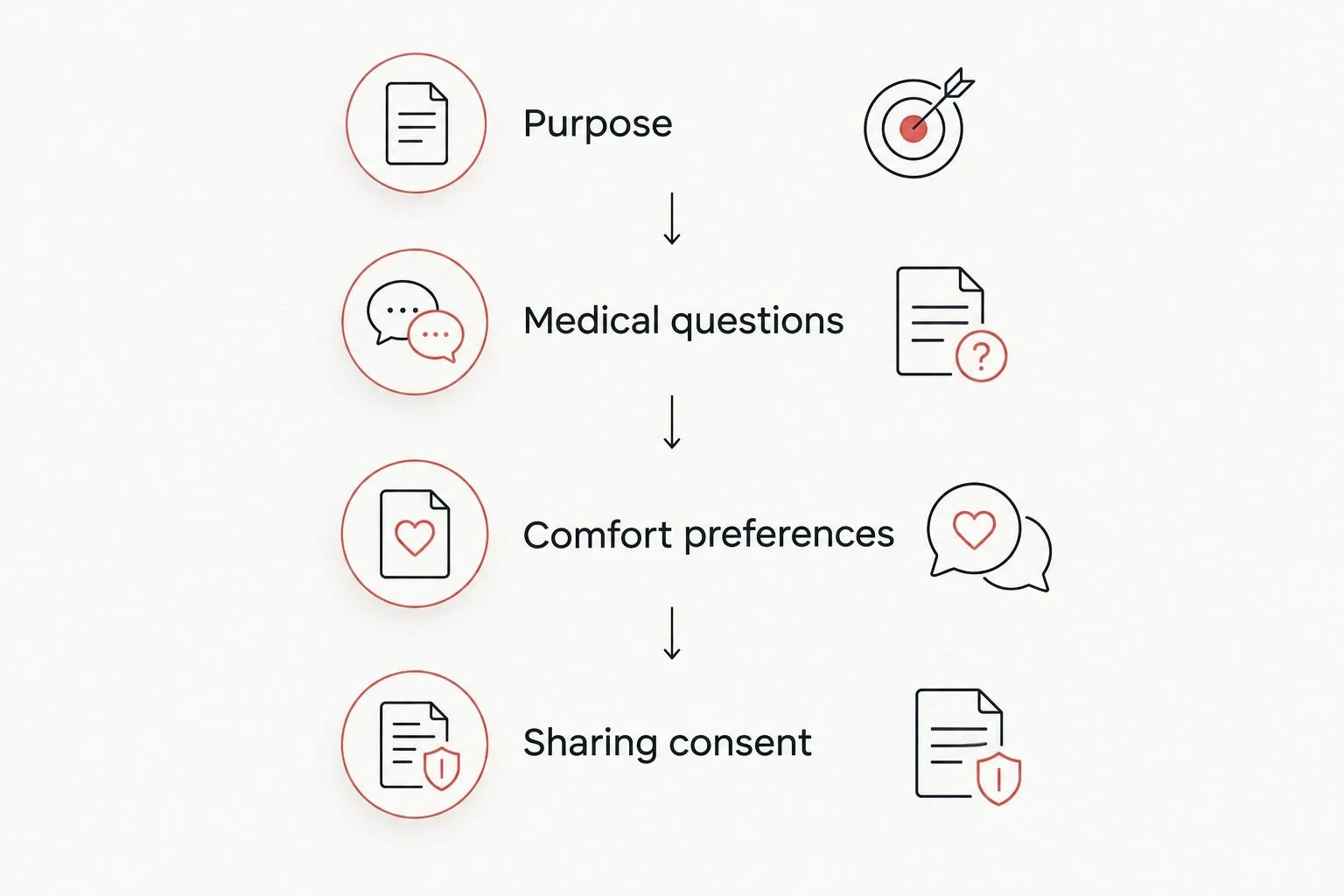
Agree on purpose and boundaries before deciding who attends or receives images.
The Ultrasound Concierge provides both diagnostic and elective pregnancy ultrasound services. Confirm which service you are discussing and what its follow-up process involves; the shared word ultrasound does not make the services equivalent.
Birth-plan review and follow-up
Prepare 3 questions. Ask yourself: What support do I want? What information am I comfortable sharing? Which questions belong with my clinician? Bring those answers to your doula conversation.
Use a 1-page summary. Keep your appointment purpose, confirmed instructions, support preferences, and contacts together. Store medical reports separately rather than copying sensitive details into a broadly shared birth plan.
Review the experience, not the images. Tell your doula what helped you feel heard and what you would change. Ask your clinician about clinical information through the recommended follow-up process.
Update only relevant preferences. Carry useful lessons into your birth plan, such as wanting explanations before procedures or limiting visitors. Do not change delivery plans because an elective image looks reassuring or unfamiliar.
Expected result: The appointment informs your support preferences without becoming a substitute for medical assessment.
Add a revision date to the summary, such as Reviewed: 2026, alongside the actual month and day. Replace older copies after meaningful changes so your support team does not work from conflicting instructions.
When your birth plan changes
A change in birth preferences does not automatically require another ultrasound. Review the coordination plan whenever your support needs change; ask your clinician whether imaging needs change.
If your doula cannot attend, keep the appointment decision separate from that scheduling problem. You can prepare questions together beforehand and discuss the experience afterward without assuming remote attendance or recording is permitted.
If your prenatal clinician recommends a different care pathway, follow that guidance first. Ask the imaging provider how the change affects your appointment, and update your doula's role without asking the doula to resolve clinical questions.
For shared 2026 planning documents, assign yourself as the person who approves updates. Your doula can help organize the note, but you decide who sees your preferences and personal information.
Troubleshooting
Your doula and imaging appointment do not align
Ask whether doula attendance is essential to your goal. If not, arrange preparation and follow-up conversations instead; do not move medically indicated care just to match a support person's calendar.
The provider cannot accommodate your guest plan
Reduce the guest list or choose a different support arrangement after discussing your priorities. Do not assume a support person's role overrides room limits, consent procedures, or examination requirements.
You receive conflicting preparation instructions
Contact the provider performing the examination and identify the exact appointment type. Follow its confirmed instructions and any relevant medical guidance; do not combine fasting, bladder, or hydration advice from unrelated scans.
The images do not match your expectations
Ask the imaging professional to explain the session's limitations. A partly hidden face or unfamiliar image is not something your doula should interpret, and image disappointment alone is not a reason to pursue repeated scans without clinical discussion.
A new symptom changes the reason for your visit
Contact your prenatal care team promptly for new bleeding, significant pain, leaking fluid, or reduced fetal movement when movement monitoring applies to your pregnancy. Do not wait for an elective appointment to evaluate symptoms; seek emergency care for severe symptoms or an emergency.
Customize your workflow
Expand the plan around communication rather than adding imaging appointments. You can use the same purpose, consent, and follow-up headings for other pregnancy-related conversations.
For a pregnancy after loss, ask what explanations and support would help without expecting a scan to remove uncertainty. For a family gathering, settle image-sharing permissions before sending invitations. If several relatives want updates, choose who communicates them so you are not repeatedly answering the same questions.
When contacting The Ultrasound Concierge about pregnancy ultrasound, bring your purpose statement and confirmed prenatal instructions. Ask what service fits the request rather than assuming that a particular image format answers it.
Discuss your pregnancy ultrasound needs
Ask about appointment purpose, preparation, support-person participation, and follow-up.
FAQ
How do I plan a 3D/4D ultrasound around my doula's birth plan?
Start with your prenatal clinician's guidance, then coordinate appointment requirements and your doula's support role. Keep medical decisions separate from comfort, attendance, and image-sharing preferences.
Should my doula choose when I get a 3D/4D ultrasound?
Your doula can help coordinate your schedule, but medical timing questions belong with your prenatal clinician and the imaging provider. Do not move prescribed imaging solely to accommodate doula attendance.
Can my doula come to my ultrasound appointment?
Doula attendance depends on the provider's guest rules and your consent. Confirm participation before booking rather than assuming a support person can enter the examination room.
Can a 3D/4D ultrasound replace my anatomy scan?
An elective 3D/4D session does not replace a prescribed anatomy scan. Three-dimensional and four-dimensional describe imaging formats, not proof that a complete diagnostic examination has been performed.
Can an elective ultrasound help decide whether I should have a home birth?
An elective ultrasound is not a basis for deciding whether home birth is appropriate. Discuss birth setting and pregnancy risk with your qualified prenatal clinician; your doula can support communication and preparation.
What if my baby does not show their face during the scan?
A clear face image is not guaranteed because fetal position and other imaging conditions affect visibility. Ask the imaging professional about the limitations rather than treating the picture as a medical finding.
Do I have to share ultrasound images with my doula?
No, you decide whether to share your ultrasound images with your doula. You can request planning and emotional support without distributing images or medical reports.
One last thing
The most useful addition to your birth plan might be a communication preference, not an ultrasound picture. After the visit, write down what helped you feel informed and in control, then ask your doula how to carry that preference into labor support.
For your 2026 birth plan, record what you want people to do—not what you think an image predicts. That keeps your preferences practical and leaves clinical interpretation with your care team.