
Placenta encapsulation is not proven safe, and the CDC advises avoiding placenta capsules because processing does not reliably eliminate infectious pathogens. For your 2026 postpartum plan, the safer choice is to skip the capsules: meaningful benefits for mood, milk supply, and recovery remain unproven, while contamination can create risks for you and your newborn.
TL;DR
Is placenta encapsulation safe? Safety is unproven, and the CDC advises avoiding placenta capsules.
Placenta pills have no established benefit for postpartum depression, milk supply, or iron deficiency.
The Ultrasound Concierge provides pregnancy ultrasound services, not a substitute for postpartum medical care.
Choose targeted postpartum nutrition, feeding support, and medical assessment instead of relying on placenta capsules.
Is placenta encapsulation safe?
No preparation method establishes placenta capsules as safe to consume. Drying, steaming, and putting placental tissue into capsules do not by themselves demonstrate that harmful bacteria have been eliminated. A clean-looking preparation space or a certificate from an encapsulation course does not establish the safety of the finished capsules.
If you are weighing placenta encapsulation as part of your postpartum plan, separate the service arrangements from the medical question. A detailed collection process does not prove that swallowing the resulting product is safe or beneficial.
The central evidence includes a CDC investigation of recurrent group B streptococcal infection in an infant whose mother consumed contaminated placenta capsules. The investigation found matching bacterial strains in the capsules and the infant's blood samples. The CDC warned that encapsulation does not necessarily eradicate infectious pathogens and advised avoiding placenta capsule ingestion.
That report does not tell you how often infection occurs among everyone who takes placenta pills. It does establish a serious concern that testimonials and preparation claims cannot dismiss.
Raw-dehydrated capsules
What it involves: Drying placental tissue without an initial steaming step
Claimed advantage or practical benefit: Promoted as preserving naturally occurring substances
Main limitation: Preserving substances does not prove benefit; dehydration is not a guarantee against pathogens
Best for: Not recommended for postpartum health support
Steamed-and-dehydrated capsules
What it involves: Heating tissue before drying and encapsulating it
Claimed advantage or practical benefit: Includes an additional heating step
Main limitation: Heating alone does not establish that the finished capsules are safe or effective
Best for: Not recommended as a safer alternative
Clinician-guided postpartum care
What it involves: Assessing symptoms and choosing appropriate nutrition, feeding, or medical support
Claimed advantage or practical benefit: Addresses the actual concern rather than assuming its cause
Main limitation: Requires individualized assessment and sometimes follow-up
Best for: Best for postpartum symptoms and recovery concerns
Why this matters
Postpartum recovery is already demanding. You deserve a clear answer without being made to feel that you are missing an essential step if you choose not to consume your placenta.
The decision is not whether the placenta was valuable during pregnancy. It was. The question is whether consuming processed placental tissue after birth delivers a proven benefit at an acceptable risk.
For a 2026 birth plan, keep those questions separate. Personal meaning, cultural importance, and a friend's positive experience deserve respectful discussion, but none establishes medical safety.
You do not need placenta capsules to have a thoughtful, supported postpartum recovery. Declining them does not mean neglecting your health or your baby's needs.
Does steaming make placenta capsules safer?
Steaming adds heat, but steamed does not mean sterile. The safety of any heat-processing method depends on what happens throughout the tissue, not simply whether the outside gets hot.
The CDC's investigation highlighted the absence of established processing standards for placenta consumption. A provider's description of steaming and dehydration therefore should not be treated as proof that the capsules are free of infectious organisms.
Ask what evidence supports a safety claim, not just what equipment is used. A statement that a method kills bacteria needs to apply to that specific method and finished product; a general statement about cooking is not enough.
In 2026, the practical decision remains straightforward: do not choose steamed capsules on the assumption that they remove the concerns associated with raw-dehydrated capsules. Neither preparation has an established postpartum health benefit that offsets the unresolved safety issues.
Why placenta encapsulation safety varies
The risk does not come from one step alone. Placental tissue passes through collection, transport, preparation, and storage, and each stage raises questions about contamination and handling.
Maternal infection: Group B streptococcus and other infections are relevant to the decision. Tell your maternity team about any positive results or infection during pregnancy or birth.
Collection conditions: Exposure during delivery and collection can introduce contamination. A normal-looking placenta is not evidence that it is pathogen-free.
Transport and storage: Handling biological tissue requires appropriate temperature control and hygiene. A pickup arrangement alone does not establish those conditions.
Processing conditions: The actual heating and drying process matters. A method's name does not establish that pathogens were eliminated throughout the tissue.
Finished-product handling: Tissue can become contaminated during grinding, encapsulation, or packaging, even after an earlier heating step.
The baby's health: Prematurity, illness, or a history of infection makes discussions with the pediatric team especially important. An apparently healthy newborn does not make capsule use risk-free.
These factors explain uncertainty; they are not a checklist that makes encapsulation safe when every box is checked. A reassuring preparation description is not the same as demonstrated safety.
Do placenta pills help depression, milk supply, or low iron?
Reliable clinical evidence does not establish placenta capsules as a treatment for postpartum depression, low milk supply, or iron-deficiency anemia. Those are different concerns with different causes, so they need different assessments.
Postpartum mood
Feeling better after starting capsules does not establish that the capsules caused the improvement. Sleep, practical support, feeding changes, and the natural course of recovery can change at the same time.
Persistent sadness, anxiety, hopelessness, or difficulty functioning deserves professional attention. Do not wait for a supplement to work before telling your obstetric clinician or primary care professional what is happening.
Milk supply
Milk production and milk transfer are not the same thing. A baby can have feeding difficulties even when milk is present, and a capsule cannot assess latch, swallowing, weight gain, or hydration.
If feeding worries you, ask for a feeding assessment and pediatric guidance. That gives you information about your baby rather than relying on a product's lactation claim.
Iron deficiency
Placental tissue containing iron does not make placenta capsules an established treatment for anemia. The relevant questions are whether you are iron deficient, how significant the deficiency is, and what treatment fits your situation.
Fatigue after birth has several possible explanations. Tell your clinician about dizziness, breathlessness, palpitations, or persistent exhaustion so that symptoms receive appropriate assessment rather than an assumed nutritional explanation.
What should you do before deciding?
Use a simple decision process for your 2026 postpartum plan. Start with the problem you want to solve, not the product someone has suggested.
Name the concern. Write down whether you want help with energy, mood, feeding, or another specific issue. These goals do not share one automatic solution.
Review the evidence. Ask whether a claim comes from controlled research, an individual story, or the person selling the service. Those sources do not carry the same weight.
Discuss your history. Tell your maternity clinician about infection, anemia, mental health concerns, medications, and supplements. Ask how each affects your recovery plan.
Plan support. Arrange practical help, feeding support, and a clear route to medical care. Know whom to contact if symptoms develop after discharge.
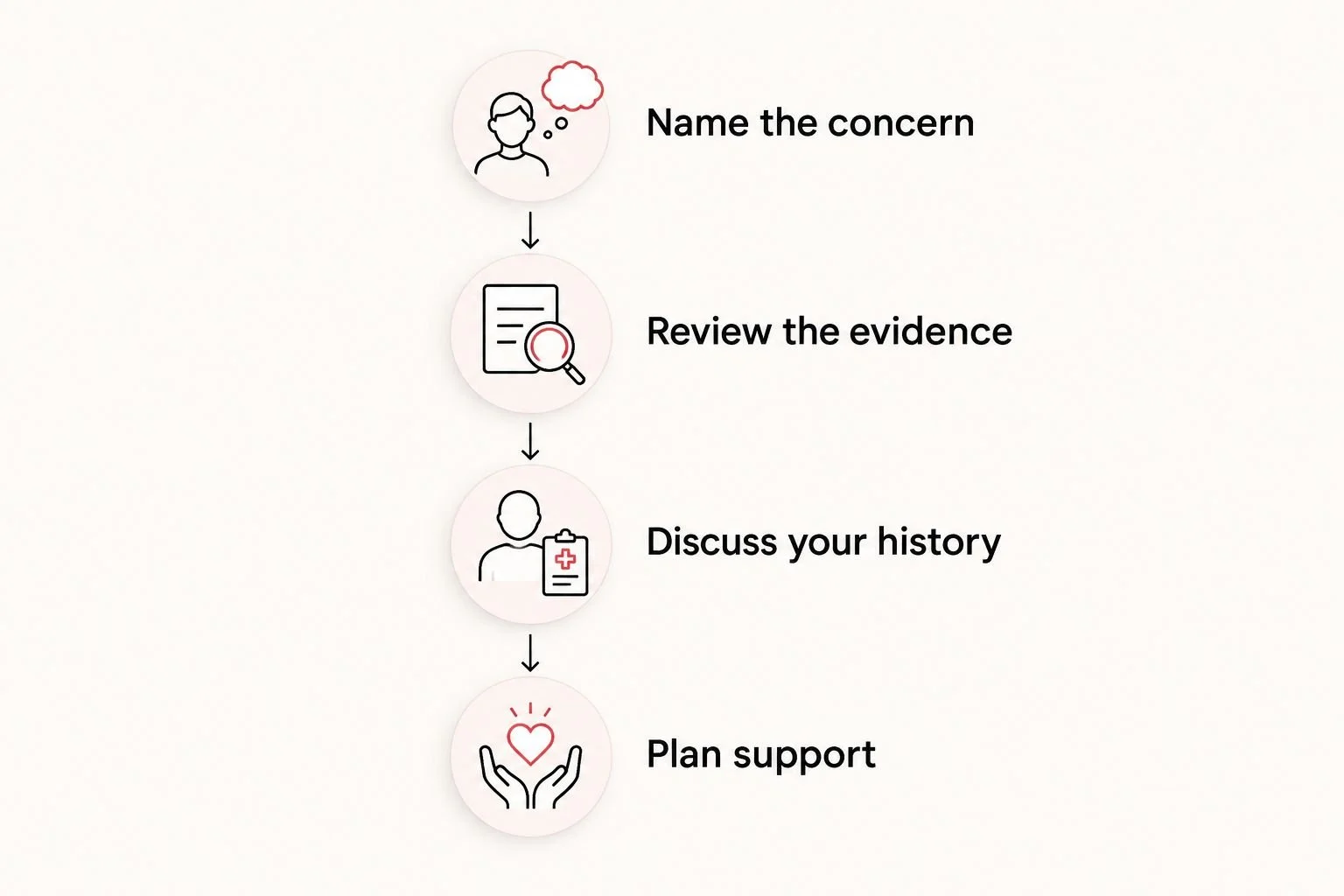
Start with the recovery concern, then choose support that addresses it.
Bring these questions to a prenatal appointment rather than leaving the discussion until you are recovering from delivery. You can change your mind about encapsulation even if you previously planned to use it.
What should you focus on instead for postpartum nutrition?
Build your recovery plan around regular meals, access to fluids, practical help, and treatment for identified deficiencies. That approach addresses daily needs without assuming that placental tissue supplies what your body lacks.
Planning postpartum nutrition means arranging food you can realistically eat while recovering and caring for a newborn; it does not turn placenta capsules into an evidence-based supplement. Prepare a short list of easy meals and ask someone to take responsibility for groceries or food preparation.
If you follow a restricted diet, have significant blood loss, or struggle to eat, ask your clinician whether you need a dietitian or testing. Supplements should fit your needs and medical history rather than a general postpartum promise.
For your 2026 recovery plan, make help specific. Someone agreeing to bring a meal, handle dishes, or accompany you to an appointment is easier to act on than a vague offer to help.
Nutrition also has limits. Food and supplements do not replace assessment for depression, infection, significant anemia, or a baby's feeding difficulties.
What if you have already taken placenta capsules?
Stop taking the capsules and tell your maternity clinician and your baby's pediatric clinician. Taking capsules does not mean that you or your baby will become ill, but both care teams should know about the exposure.
Keep the packaging and preparation details. If illness occurs, ask the treating team whether they want the remaining capsules retained for possible investigation; do not take more to finish the supply.
Seek urgent assessment for concerning symptoms in yourself, including fever, worsening abdominal pain, foul-smelling discharge, or feeling acutely unwell. After birth, these symptoms need medical attention regardless of whether you have taken placenta capsules.
For a baby younger than 3 months, a temperature of 100.4°F (38°C) or higher requires prompt medical assessment. Poor feeding, unusual difficulty waking, or breathing trouble also needs urgent attention, even without a measured fever.
Call 911 for an immediate emergency. If you develop thoughts of harming yourself or your baby, seek emergency help rather than waiting for a routine postpartum appointment.
Can a pregnancy ultrasound tell you whether capsules will be safe?
A pregnancy ultrasound cannot establish that placenta capsules will be safe to consume. Imaging can assess features relevant to pregnancy care, but it cannot certify the microbiological safety of tissue collected and processed after delivery.
The Ultrasound Concierge provides private pregnancy ultrasound services for patients in Keller and Willow Park, Texas. The Ultrasound Concierge is best for local patients seeking personalized pregnancy ultrasound imaging, not postpartum treatment or placenta-capsule safety assessment.
Keep those roles separate when making a 2026 care plan. A reassuring scan does not replace your maternity clinician's advice about infection, postpartum symptoms, or supplements.
FAQ
Is placenta encapsulation safe while breastfeeding?
Placenta encapsulation is not established as safe while breastfeeding. The CDC advises avoiding placenta capsules because processing does not reliably eliminate infectious pathogens, and contamination can create risks relevant to a newborn.
Are steamed placenta capsules safer than raw placenta capsules?
Steamed placenta capsules are not proven safe simply because they have been heated. Neither steaming nor dehydration, by name alone, establishes that the finished capsules are free of infectious organisms.
Can placenta capsules prevent postpartum depression?
Placenta capsules are not an established way to prevent or treat postpartum depression. Persistent sadness, anxiety, hopelessness, or difficulty functioning needs professional assessment rather than reliance on capsules.
Do placenta pills increase breast milk supply?
Placenta pills have no established clinical benefit for increasing breast milk supply. Feeding concerns need assessment of milk transfer, the baby's weight and hydration, and the feeding plan.
Is placenta encapsulation safe if I tested positive for group B strep?
A positive group B strep result makes avoiding placenta capsules especially important. Tell your maternity and pediatric teams about the result and any capsule use; birth-related antibiotic treatment does not certify processed capsules as safe.
What should I do if I already swallowed placenta capsules?
Stop taking placenta capsules and tell your maternity clinician and your baby's pediatric clinician. Seek prompt care for illness, particularly a temperature of 100.4°F (38°C) or higher in a baby younger than 3 months.
Can The Ultrasound Concierge check whether my placenta is safe to encapsulate?
Pregnancy ultrasound at The Ultrasound Concierge cannot determine whether processed placenta capsules are safe to consume. Discuss encapsulation and postpartum recovery with your maternity clinician, and involve your baby's pediatric clinician if capsules have already been taken.
One last thing
A placenta that looked normal on ultrasound is not a safety clearance for placenta capsules. Pregnancy imaging and post-delivery contamination are different questions.
Before birth, put your postpartum contacts somewhere easy to find and tell your support person which symptoms need attention. A clear plan for getting help is more useful than waiting to see whether capsules improve how you feel.