
You can have a fertility ultrasound after egg retrieval whenever your treating clinician considers it necessary; there is no universal waiting period that applies to every patient. A scan for recovery concerns follows a different schedule from an early pregnancy scan, and worsening symptoms need medical assessment rather than a self-booked reassurance appointment.
TL;DR
A fertility ultrasound after egg retrieval should follow your IVF clinic’s instructions, not a fixed waiting period.
Severe pain, breathing difficulty, fainting, or heavy bleeding needs urgent medical assessment.
Post-retrieval monitoring and early pregnancy ultrasound answer different questions.
Theultrasoundconcierge offers private fertility ultrasound services; confirm your clinic’s requirements before arranging outside imaging.
Why this matters
The reason for your scan matters more than how many days have passed since retrieval. An ultrasound ordered to investigate pain is not interchangeable with a scan to assess the uterine lining or confirm an established pregnancy.
For your 2026 treatment plan, ask your fertility clinic what the scan needs to answer before choosing an appointment date. If you are considering imaging outside your treating clinic, this guide to coordinating fertility ultrasound monitoring with your IVF clinic explains the coordination questions to address first.
How long after egg retrieval can you get a fertility ultrasound?
You do not need to complete a universal waiting period before a medically indicated ultrasound after egg retrieval. Your fertility team decides whether imaging is necessary and when to perform it, using your symptoms, stimulation response, examination, and treatment plan.
Some patients need assessment because symptoms develop. Others follow their clinic’s recovery instructions without an additional ultrasound. Do not assume that every retrieval requires a routine follow-up scan.
Routine follow-up
Best for: Patients whose clinic requests a recovery check
What ultrasound helps assess: Ovarian appearance, ovarian size, and pelvic findings
Important limitation: Imaging does not independently establish that recovery is complete
Urgent evaluation
Best for: Patients with concerning symptoms after retrieval
What ultrasound helps assess: Findings that help investigate pain, enlarged ovaries, or pelvic fluid
Important limitation: A scheduled outpatient scan is not a substitute for urgent medical care
Pregnancy assessment
Best for: Patients following embryo transfer and pregnancy testing
What ultrasound helps assess: Pregnancy location and development when the timing is appropriate
Important limitation: Scanning too early can leave the result inconclusive
These are different clinical pathways, not appointments you need to book in sequence. Your clinic should identify which pathway applies and who will review the result.
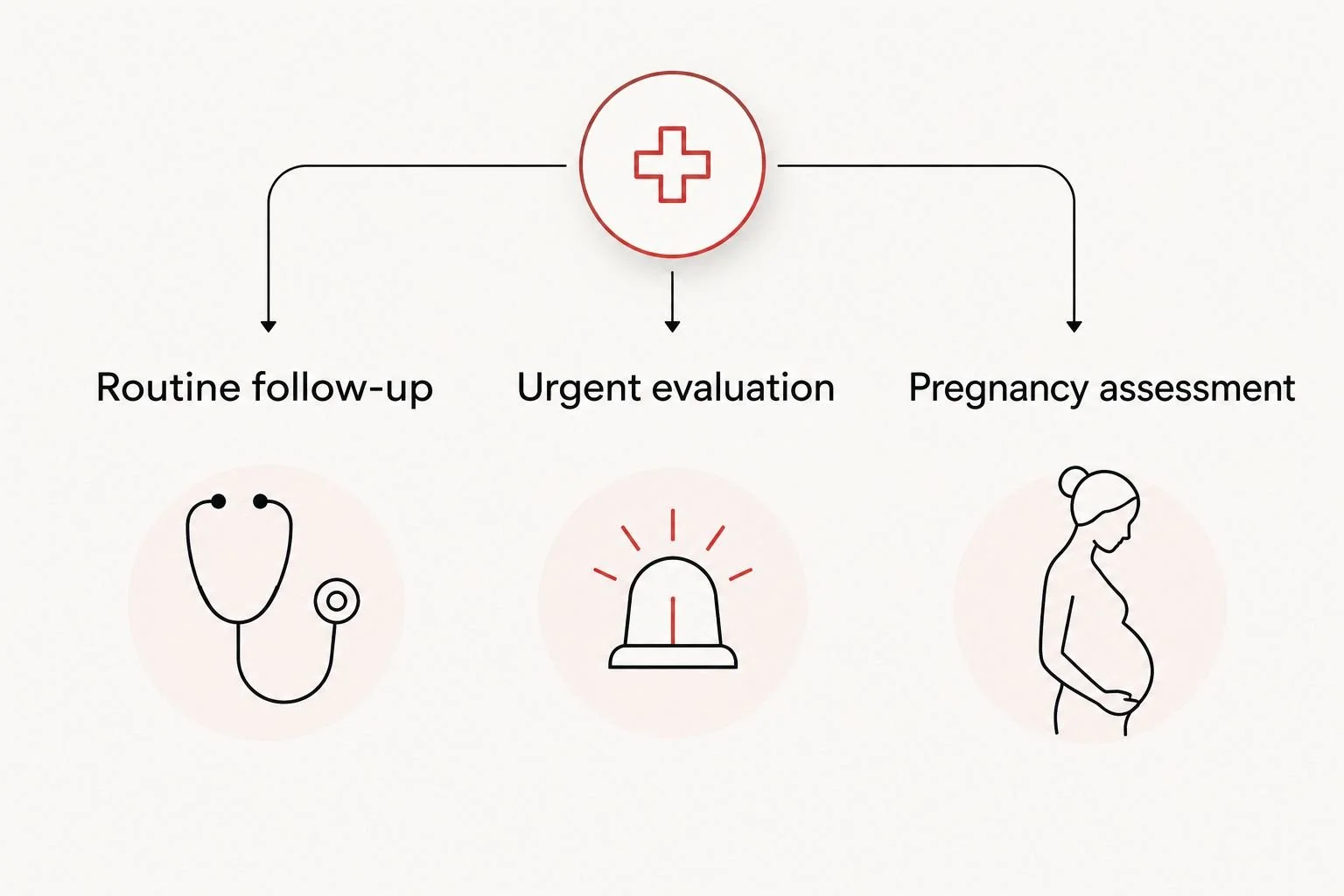
The reason for assessment determines the appropriate timing and setting.
Routine follow-up: use your clinic’s recovery plan
A routine post-retrieval ultrasound is not automatically required simply because egg collection has finished. Your clinic considers how you are recovering and whether an examination or imaging would change your care.
After ovarian stimulation, your ovaries can remain enlarged and tender. Ultrasound helps assess their appearance, but a scan does not replace a conversation about pain, bleeding, nausea, fluid intake, and urination.
The benefit of a requested follow-up scan is a focused assessment of a clinical question. The limitation is that an isolated image cannot explain every symptom or determine your medication plan.
If your discharge instructions do not mention an ultrasound, ask whether you need one rather than selecting a date yourself. Continue prescribed medication and activity restrictions unless your treating team changes them.
Urgent evaluation: do not wait for a routine appointment
Severe or worsening abdominal pain, trouble breathing, chest pain, fainting, or heavy bleeding needs urgent medical assessment. Contact your retrieval clinic immediately; use emergency services for severe symptoms or if you cannot safely reach care.
Other symptoms that warrant prompt contact with your clinic include persistent vomiting, increasing abdominal swelling, fever, or noticeably reduced urination. Explain that you recently had ovarian stimulation and egg retrieval.
Ovarian hyperstimulation syndrome, bleeding, infection, and ovarian torsion are among the complications clinicians consider after fertility treatment. You cannot reliably distinguish these conditions from expected recovery symptoms at home.
Ultrasound can contribute to the assessment, but clinicians also use your symptoms, vital signs, examination, and sometimes laboratory testing. A reassuring scan alone does not rule out every complication; ovarian torsion, in particular, cannot be excluded solely by reassuring Doppler blood flow.
Do not delay urgent care while looking for a private scan. An emergency assessment provides access to treatment as well as imaging.
Pregnancy assessment: follow transfer and pregnancy-test timing
An ultrasound immediately after retrieval cannot confirm whether a future embryo transfer will result in pregnancy. Retrieval collects eggs; pregnancy assessment follows fertilization, embryo transfer, implantation, and appropriate testing.
Your fertility clinic uses the transfer date, embryo age, pregnancy-test results, and symptoms to schedule an early pregnancy ultrasound. Do not calculate that appointment from the retrieval date alone, especially if embryos are frozen for a later transfer.
An appropriately timed scan helps assess pregnancy location and development. Its limitation is timing: an early scan can be inconclusive and require follow-up, even when there is no immediate evidence of a problem.
Pain or bleeding after a positive pregnancy test changes the question. Contact your treating team promptly rather than waiting for the scheduled scan, because an ectopic pregnancy requires medical assessment.
For a 2026 IVF cycle, keep the retrieval date and transfer details in your records, but let the fertility team set the pregnancy-imaging schedule. These dates serve different purposes.
Why ultrasound timing after egg retrieval varies
Your clinic does not choose timing from the calendar alone. These factors determine whether you need imaging and what it should assess:
Symptoms: New or worsening pain, swelling, bleeding, vomiting, or breathing difficulty changes the urgency of assessment.
Response to stimulation: Your ovarian response and risk of hyperstimulation affect monitoring decisions.
Recovery findings: Your examination, fluid balance, and any relevant laboratory results help guide the next step.
Transfer plan: A fresh transfer, a later frozen transfer, and egg freezing involve different follow-up goals.
Pregnancy-test results: After transfer, test results and symptoms help determine pregnancy-scan timing.
Purpose of imaging: Evaluating recovery, planning another treatment cycle, and assessing pregnancy require different information.
A friend’s appointment schedule is not a reliable template for yours. Even patients treated at the same clinic can receive different instructions because their symptoms and treatment plans differ.
How to arrange your follow-up ultrasound in 2026
Before you arrange outside imaging, make sure the appointment fits your treating clinic’s plan. A technically clear scan is only useful when it captures the information your clinician needs and reaches the person responsible for your care.
Confirm the purpose. Ask whether the scan is for recovery symptoms, ovarian assessment, uterine-lining assessment, or early pregnancy evaluation.
Get the timing instructions. Request the intended date or scheduling window directly from your fertility team.
Confirm the examination requirements. Ask whether your clinic requires transvaginal imaging, transabdominal imaging, particular measurements, or a written order.
Arrange the handoff. Establish how images and the report will reach your fertility clinic and who will review them.
Know the next step. Ask whom to contact about the result and what symptoms should prompt earlier assessment.
If your clinic needs information before changing medication or proceeding with treatment, confirm its reporting requirements before booking. Do not assume that an appointment automatically includes the specific documentation your clinic requests.
What should you tell the sonographer?
Tell the imaging team that you recently underwent ovarian stimulation and egg retrieval. Share the retrieval date, the reason your clinician requested the examination, your current symptoms, and any relevant transfer information.
Describe symptoms plainly. Explain where pain occurs, whether it is worsening, and whether you also have vomiting, swelling, bleeding, fever, or changes in urination. Do not minimize symptoms because you expect some discomfort after retrieval.
Bring any instructions or orders supplied by your fertility clinic. If an outside imaging team receives a request that differs from what you expected, ask the teams to clarify it rather than choosing the examination yourself.
You can also tell the sonographer if you are tender or anxious about an internal examination. Ask for an explanation before the scan begins and speak up if you need a pause.
Can you have a transvaginal ultrasound after retrieval?
A transvaginal ultrasound can be used after egg retrieval when your clinician considers it appropriate. Recent retrieval is not, by itself, a universal reason to postpone medically necessary imaging.
The advantage of transvaginal imaging is a close view of pelvic structures. The drawback is that an internal examination can feel uncomfortable when you are already tender; tell the imaging team about your procedure and symptoms before starting.
Transabdominal imaging provides another view of the pelvis, but it does not always answer the same questions with the same detail. The clinician and imaging team should choose the approach for the clinical purpose, not simply substitute one examination for another.
Follow the preparation instructions for your actual appointment. Bladder instructions differ by examination type, so avoid copying preparation advice from an unrelated pregnancy or elective ultrasound visit.
Can an ultrasound tell you when to start another IVF cycle?
An ultrasound can contribute to the decision about another IVF cycle, but it cannot make that decision alone. Your fertility specialist also considers recovery, symptoms, hormone results where relevant, and the intended treatment protocol.
A baseline assessment for another cycle is different from an urgent post-retrieval scan. Even if both examine your ovaries, they answer different questions and can occur at different points in your care.
For your next 2026 cycle, ask what findings or test results your clinic needs before treatment begins. Do not interpret an ultrasound report as permission to restart stimulation or stop medication without your specialist’s instructions.
Choosing private fertility imaging in Keller or Willow Park
Theultrasoundconcierge is best suited to patients seeking private fertility ultrasound services in the Keller and Willow Park area. Its stated services include fertility imaging in a calm, personalized setting; review the ultrasound services and confirm that the requested examination matches your clinic’s needs.
The benefit of this setting is the private, concierge-style approach described by the provider. The limitation is clinical responsibility: outside imaging does not replace your fertility specialist’s treatment decisions or an emergency assessment.
Before choosing Theultrasoundconcierge for fertility ultrasound, confirm the requested scan type, any order requirements, and how your fertility clinic will receive the findings. Do not assume that every imaging provider follows every IVF clinic’s reporting process.
FAQ
How soon can I get a fertility ultrasound after egg retrieval?
You can have a fertility ultrasound after egg retrieval when your treating clinician considers it necessary; there is no universal waiting period. Your symptoms and the purpose of the scan determine the timing.
Do I need an ultrasound if I feel well after egg retrieval?
You do not automatically need an ultrasound just because retrieval is complete. Follow your clinic’s discharge plan and ask whether your individual treatment requires imaging.
Should I book an ultrasound if my pain is getting worse?
Worsening pain needs prompt contact with your fertility clinic, not just a self-booked ultrasound. Severe pain, fainting, breathing difficulty, chest pain, or heavy bleeding requires urgent medical assessment.
Can an ultrasound diagnose ovarian hyperstimulation syndrome?
Ultrasound helps assess findings associated with ovarian hyperstimulation syndrome, but the diagnosis requires clinical assessment. Your clinician also considers symptoms, examination findings, and relevant tests.
Can I confirm pregnancy on an ultrasound right after retrieval?
An ultrasound right after retrieval cannot confirm a pregnancy from a future embryo transfer. Your fertility clinic schedules pregnancy assessment using transfer details, pregnancy testing, and symptoms.
Can I use a private ultrasound provider during IVF treatment?
Private fertility imaging can support your care when your treating clinic accepts the examination and reporting arrangements. Confirm the requirements before booking; outside imaging does not replace your specialist’s management.
What should I confirm before booking a fertility ultrasound in 2026?
Confirm the scan’s purpose, timing, examination type, and reporting requirements with your fertility clinic. Tell the imaging provider about your retrieval and any symptoms before the appointment.
One last thing
Before leaving your post-retrieval appointment, ask: Who will review this result, and what decision will it help make? That question separates a useful clinical examination from a scan that leaves you with more uncertainty.
For your 2026 follow-up, keep your discharge instructions and clinic contact details together. If your symptoms change, use those instructions rather than waiting for an appointment already on the calendar.