
Yes—an ultrasound can estimate your baby’s weight in the third trimester, which begins at 28 weeks, by combining measurements of the head, abdomen, and thigh bone. In 2026, that result remains an estimated fetal weight, not an exact weight or a promise about birth weight; your prenatal clinician interprets it alongside your pregnancy dates, growth pattern, and other findings.
TL;DR
Ultrasound can estimate baby weight in the third trimester, but it cannot weigh your baby directly.
Estimated fetal weight and growth percentile answer different questions; ask your prenatal clinician to explain both.
A diagnostic growth scan measures growth; elective pregnancy images do not replace that assessment.
The Ultrasound Concierge offers private diagnostic and elective ultrasound services in Keller and Willow Park.
Why this matters
A weight estimate can sound more certain than it is, especially when a report displays a precise result. The useful question is not simply how much your baby weighs, but whether the measurements fit the pregnancy’s overall growth pattern.
For your 2026 prenatal visits, keep the established due date with your scan records. Our guide to whether ultrasound can determine your exact due date explains why pregnancy dating and later growth assessment serve different purposes.
Can an ultrasound estimate a baby’s weight in the third trimester?
Yes. A diagnostic growth ultrasound calculates estimated fetal weight from measurements rather than measuring weight directly. The ultrasound system applies a mathematical formula to selected body measurements, and the report places that estimate in the context of gestational age.
The process follows these steps:
Confirm pregnancy dates. The care team uses your established gestational age to interpret size. An incorrect gestational age changes the meaning of the growth percentile.
Measure fetal size. The sonographer obtains standard views of the head, abdomen, and femur, or thigh bone. Depending on the formula, head measurements include head circumference, head width, or both.
Calculate estimated weight. The ultrasound system combines the measurements into an estimated fetal weight. This is a calculation, not a reading from a scale.
Review growth context. Your clinician considers the estimate, percentile, previous measurements, fluid assessment, and any other clinically relevant findings.
A complete growth assessment therefore involves more than obtaining an attractive image or hearing a weight aloud. The measurements need appropriate views, and the result needs interpretation by the clinician responsible for your pregnancy.
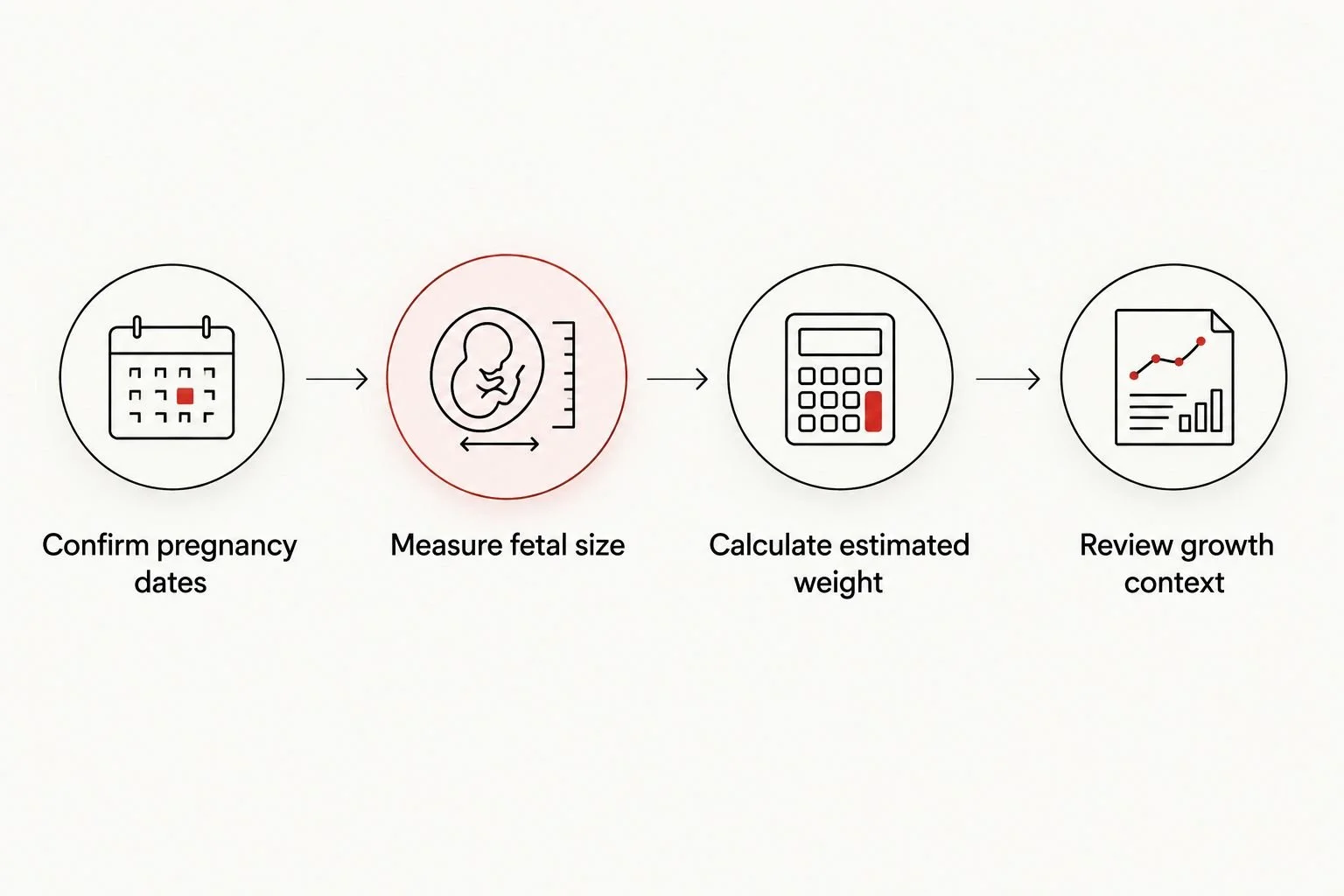
The calculated weight is one part of a growth assessment, not the entire assessment.
What does a third-trimester growth report mean in 2026?
Start with the scan date and gestational age. An estimated weight describes your baby at that examination; it does not describe a later delivery date.
Then identify these report terms:
Estimated fetal weight, or EFW: the calculated estimate of your baby’s weight at the scan.
Abdominal circumference, or AC: the measurement around your baby’s abdomen, which contributes to growth assessment.
Growth percentile: a comparison with a reference population at the same gestational age.
Interval growth: the change assessed across appropriately spaced examinations.
A percentile is not a grade, a percentage of normal development, or the probability that something is wrong. It describes relative size on the growth chart used for the report.
The Society for Maternal-Fetal Medicine defines fetal growth restriction using an estimated fetal weight or abdominal circumference below the 10th percentile for gestational age. A finding in that range needs clinical evaluation; it does not tell you the cause by itself.
An estimated weight above the 90th percentile is commonly described as large for gestational age. That label also requires context rather than an immediate conclusion about delivery.
Ask what the finding changes in your care, not just where it sits on a chart. Your clinician can explain whether the result calls for observation, another growth assessment, additional testing, or specialist review.
How accurate is an ultrasound weight estimate?
An ultrasound weight estimate has measurement and calculation uncertainty. It can overestimate or underestimate the baby’s actual weight, even when the examination is performed carefully.
That uncertainty comes from two separate steps: obtaining body measurements and converting those measurements into weight. A formula represents the relationship between body size and weight; it cannot directly account for every individual baby’s body proportions.
Precision on the printed report does not remove that uncertainty. An estimated weight displayed to the nearest gram is still an estimate, not evidence that the result is accurate to a gram.
The time between scanning and birth matters too. Your baby continues growing after the examination, so comparing a scan estimate with a later birth weight includes both estimation error and growth between those dates.
Do not treat a single estimated weight as a delivery prediction. Ask your clinician how much confidence to place in the result and whether it agrees with the rest of the assessment.
If a weight estimate raises a concern, the next step is a discussion with your prenatal clinician—not an independent decision about induction or cesarean delivery. Those decisions depend on the full clinical situation, your history, and an informed conversation about the available choices.
Why ultrasound weight estimates vary
Several factors affect how a fetal weight estimate is obtained and interpreted:
Baby’s position: the position of the head, abdomen, or limbs affects access to the standard measurement views.
Image quality: tissue between the probe and baby, movement, and other imaging conditions affect how clearly measurement boundaries appear.
Measurement technique: the imaging plane and placement of measurement markers influence the values entered into the calculation.
Formula selection: different validated formulas combine fetal measurements differently.
Growth chart selection: the reference chart affects the percentile assigned to an estimated weight.
Time between examinations: growth assessments taken too close together are harder to distinguish from ordinary measurement variation.
These factors explain why two reports do not always match perfectly. They do not mean that every difference represents a problem or that a scan is automatically unreliable.
Bring both reports to your clinician if the results seem inconsistent. Comparing the dates, measurements, formulas, and charts is more useful than comparing only the final weight figures.
Is a diagnostic growth scan different from an elective ultrasound?
Yes. A diagnostic growth scan answers a medical question about fetal size and growth, while an elective ultrasound focuses on viewing your baby and obtaining images. The appointment’s purpose matters more than how detailed the pictures look.
Diagnostic fetal growth ultrasound
Best for: Assessing a clinical question about size or growth
Main benefit: Provides measurements for estimated fetal weight and clinical interpretation
Main limitation: Still produces an estimate rather than an exact weight
Elective pregnancy ultrasound
Best for: Viewing your baby and obtaining keepsake images
Main benefit: Offers an opportunity to see your baby
Main limitation: Does not replace a diagnostic growth assessment or prenatal care
Three-dimensional images show depth, while four-dimensional imaging displays movement over time. Neither label, by itself, establishes that an appointment includes diagnostic growth measurements or a clinically interpreted report.
Choose the examination by the question you need answered. If your clinician wants to assess growth, confirm that the planned appointment addresses that request rather than assuming any pregnancy ultrasound will do.
The Ultrasound Concierge is best for Keller and Willow Park patients seeking a private setting for diagnostic or elective ultrasound. Its ultrasound services cover both categories, but an elective visit does not replace a clinician-directed growth evaluation.
What should you ask before booking a growth ultrasound?
For a 2026 appointment, start with your prenatal clinician’s reason for requesting the examination. Saying that you want to know your baby’s weight is helpful, but the imaging provider also needs to understand the clinical question.
Use this checklist before choosing an appointment:
Explain the purpose. Say whether your clinician is investigating small size, large size, a growth trend, or another concern.
Confirm the examination. Ask whether the appointment includes diagnostic fetal measurements and estimated fetal weight.
Clarify the requirements. Ask what order, referral, or clinical information the provider needs for that examination.
Ask about reporting. Confirm how the report reaches your prenatal clinician and who discusses its meaning with you.
Share previous records. Ask whether to bring earlier ultrasound reports and your established due date.
Follow preparation instructions. Use the instructions for your particular examination rather than advice intended for a different type of scan.
You can ask The Ultrasound Concierge which appointment matches your clinician’s request. Confirming that match before the visit helps keep diagnostic questions separate from elective imaging goals.
Ask about the right ultrasound appointment
Explain your clinician’s growth-scan request and ask which examination matches it.
What happens if my baby measures small or large?
A small or large estimate starts a clinical assessment; it does not settle the diagnosis by itself. Your clinician reviews the measurement quality, pregnancy dates, medical history, and other scan findings before explaining the next step.
If growth restriction is suspected, the evaluation can include blood-flow assessment with Doppler ultrasound and additional fetal monitoring. Your clinician decides which tests are appropriate and when they should occur.
If your baby measures large, your care team considers the finding alongside factors such as diabetes and your obstetric history. A large estimate alone does not establish an exact birth weight or determine how you must give birth.
Ask these questions before leaving the discussion:
Does the abdominal measurement agree with the estimated weight?
Is this a new finding or part of an established pattern?
Does the result change my monitoring or delivery planning?
Who should I contact if I have concerns before the next visit?
A normal weight estimate does not rule out every pregnancy complication. Contact your maternity care team promptly for reduced fetal movement, vaginal bleeding, leaking fluid, or other urgent symptoms rather than waiting for an elective ultrasound.
Does a small measurement always mean growth restriction?
An estimated fetal weight or abdominal circumference below the 10th percentile meets the sonographic definition used by the Society for Maternal-Fetal Medicine. Your clinician then evaluates whether the baby is constitutionally small, has impaired growth, or needs further assessment for another reason.
Does a large measurement mean I need a cesarean?
An estimated weight above the 90th percentile does not automatically mean you need a cesarean. Your clinician considers the degree of suspected size, diabetes status, previous births, and the uncertainty of the estimate when discussing delivery options.
Should a late growth scan change my due date?
A scan after 28 weeks primarily assesses current size and other clinical findings rather than independently establishing a new due date. Your clinician reviews late measurements against the pregnancy’s dating history; a size difference is not automatically a dating error.
FAQ
Can an ultrasound tell me exactly how much my baby weighs?
No. Ultrasound calculates estimated fetal weight from body measurements; it does not directly weigh your baby. Your clinician interprets the estimate alongside gestational age and other findings.
When does the third trimester start?
The third trimester begins at 28 weeks. Whether you need a growth ultrasound during that period depends on your pregnancy and your clinician’s assessment.
Is estimated fetal weight the same as birth weight?
No. Estimated fetal weight describes a calculation made at the scan, while birth weight is measured after delivery. Growth between the examination and birth also affects the comparison.
Does a growth percentile tell me whether my baby is healthy?
A growth percentile describes relative size, not overall health. Your prenatal clinician considers it with growth patterns, fluid assessment, medical history, and any additional testing.
Is a three-dimensional ultrasound better for estimating baby weight?
A three-dimensional image is not inherently better for estimating fetal weight. Diagnostic weight calculations rely on standardized body measurements, not how lifelike the images appear.
Should I book another ultrasound immediately if the weight surprises me?
Discuss the result with your prenatal clinician before arranging another scan. The timing and purpose of repeat imaging matter, and a rapid repeat does not necessarily clarify growth.
Can I ask The Ultrasound Concierge about a diagnostic pregnancy ultrasound?
Yes. The Ultrasound Concierge provides diagnostic and elective pregnancy ultrasound services in Keller and Willow Park. Ask which examination matches your prenatal clinician’s request and how reporting is handled.
One last thing
For your next growth-scan discussion in 2026, ask for the interpretation, not just the weight. A reassuring-sounding number without context tells you less than a clear explanation of whether growth is appropriate and what happens next.
Before the conversation ends, repeat the plan back in plain language: what the scan found, whether another assessment is needed, and who will arrange it. You do not need to interpret the report alone.