
Yes—a high-risk pregnancy does not automatically rule out 3D/4D ultrasound, but your obstetrician or maternal-fetal medicine specialist should determine whether it serves a medical purpose and fits your care plan. An elective keepsake session cannot replace prescribed monitoring, and the FDA discourages ultrasound performed solely to create keepsake images.
TL;DR
For a 3D 4D ultrasound high risk pregnancy decision, ask your obstetrician about medical purpose before booking.
Diagnostic ultrasound and elective keepsake imaging serve different purposes; attractive images do not establish fetal well-being.
The Ultrasound Concierge offers private pregnancy ultrasound services in Keller and Willow Park; high-risk care remains with your clinician.
New symptoms or reduced fetal movement require clinical advice, not an elective reassurance appointment.
Can you get a 3D/4D ultrasound with a high-risk pregnancy?
Yes, when your pregnancy care team determines that the examination is appropriate. The important distinction is not simply whether the machine produces a three-dimensional image. It is why you are having the scan, who interprets it, and how the results affect your care.
Before choosing among ultrasound services, establish whether you need a diagnostic examination or are considering optional images. Those appointments are not interchangeable, even when both show your baby on a screen.
Routine diagnostic ultrasound
Best for: Answering a defined prenatal question
Main benefit: Assesses the structures or measurements requested by your clinician
Important limitation: Does not detect every condition or guarantee a healthy outcome
Specialist diagnostic ultrasound, with 3D/4D when indicated
Best for: Investigating a specific concern under specialist direction
Main benefit: Adds selected views when they help answer a clinical question
Important limitation: Additional image formats do not automatically improve every examination
Elective 3D/4D keepsake imaging
Best for: Optional viewing rather than medical assessment
Main benefit: Provides images for personal viewing
Important limitation: Cannot replace diagnostic monitoring; the FDA discourages ultrasound solely for keepsakes
In 2026, your decision should start with the clinical question—not a preferred image style. If your specialist needs particular views, ask whether those views can be obtained during an already indicated examination rather than arranging a separate nonmedical session.
Why this matters
A high-risk pregnancy often brings more appointments and more uncertainty. Wanting a quiet moment to see your baby is understandable. The problem arises when a comforting picture is treated as evidence that a medical concern has resolved.
A recognizable face does not establish normal growth, adequate placental function, or the absence of a structural condition. Likewise, an unclear facial image does not, by itself, mean something is wrong. Image appearance and medical reassurance are different things.
For your 2026 care plan, keep the roles separate: your prenatal team directs medical surveillance, and any optional imaging must not interrupt that plan. You do not need to choose between a personal experience and responsible care; you do need clear boundaries around what an appointment can tell you.
What changes between 2D, 3D, and 4D ultrasound?
2-dimensional imaging displays cross-sectional views. These views remain central to prenatal diagnostic examinations because clinicians use them to assess anatomy and obtain measurements. A less recognizable picture can contain more clinically useful information than a detailed surface image.
3-dimensional imaging reconstructs a volume that can be displayed from different angles. In selected diagnostic situations, that additional perspective helps a specialist assess anatomy. It is not a universal upgrade over a standard examination.
4-dimensional imaging adds motion to three-dimensional views. Seeing movement can make an image feel more lifelike, but movement on a keepsake recording does not establish that all aspects of fetal health are normal.
The display format alone does not determine whether an examination is appropriate. The medical indication, operator training, equipment settings, exposure time, and interpretation all matter. Ask what the examination is intended to answer rather than assuming a higher-dimensional label means better medical care.
How should you decide whether to schedule a scan?
Use this sequence before arranging an additional appointment in 2026. It keeps the medical decision with the team that knows your pregnancy and gives the imaging provider a clear description of your needs.
Define the purpose. Tell your obstetrician whether you want keepsake images, have a new concern, or need an ordered examination. These are different reasons for seeking imaging.
Ask your clinician. Ask whether an additional examination is appropriate now and whether the intended images can be obtained during a medically indicated visit.
Confirm the scope. Ask the imaging provider whether the appointment is diagnostic or elective, what it includes, and what it cannot assess. Do not rely on an appointment name alone.
Keep prescribed care. Continue every ultrasound, monitoring visit, and specialist appointment your prenatal team recommends. Optional imaging does not replace any part of that schedule.
Plan follow-up. For diagnostic imaging, establish who receives the report, who explains the findings, and whom you should contact with questions afterward.
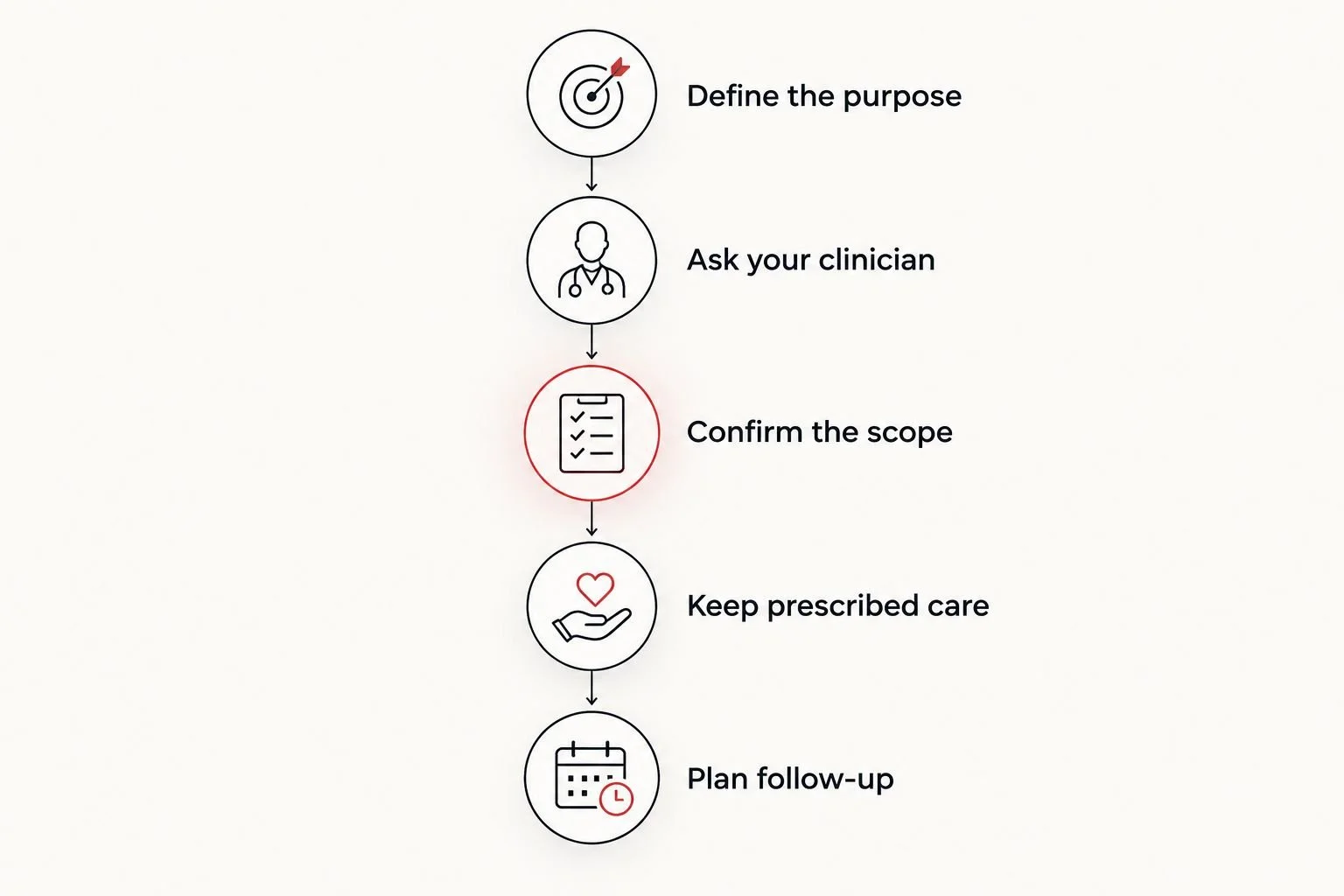
Decide the medical purpose before choosing the appointment format.
You can begin the conversation with a direct question: would this appointment answer a medical question, or would it only provide additional pictures? That distinction helps you decide whether to proceed, change the appointment type, or avoid an unnecessary examination.
Why the recommendation varies between pregnancies
The label high risk does not describe a single condition or a single imaging schedule. Your clinician considers the reason for that designation and what is happening in your pregnancy now.
Reason for monitoring: A concern about fetal growth calls for a different assessment from a question about anatomy. A keepsake session does not substitute for either.
Current symptoms: Bleeding, fluid leakage, significant pain, or reduced fetal movement change the next step from optional imaging to clinical assessment.
Gestational age: Different medical questions require assessment at different stages. There is no universal week that makes elective imaging appropriate for every high-risk pregnancy.
Existing findings: Previous results determine whether you need targeted views, follow-up measurements, or specialist interpretation rather than another general viewing session.
Imaging conditions: Fetal position, surrounding fluid, and tissue between the probe and baby affect image quality. A poor facial view is not a diagnosis.
Existing care plan: Your prescribed examinations and specialist recommendations take priority over the timing of optional images.
For planning in 2026, ask your clinician which of these factors matters most in your case. A general recommendation from another family—even one with the same high-risk label—does not account for your findings or care plan.
Is 3D/4D ultrasound safe during a high-risk pregnancy?
3D/4D ultrasound uses sound waves, not ionizing radiation, but that does not make unnecessary exposure a medical benefit. Diagnostic ultrasound is widely used in pregnancy when clinically indicated. Appropriate use includes trained operators and limiting exposure to what is needed for the examination.
For decisions in 2026, the FDA's patient guidance on ultrasound imaging and ACOG's patient information on ultrasound exams provide the relevant safety context: use ultrasound for medical reasons, and do not treat nonmedical keepsake imaging as routine prenatal care. These recommendations address the purpose and conduct of an examination, not just the appearance of its images.
There is no single safe number of additional sessions that applies to every high-risk pregnancy. Your clinician should determine what examinations you need. Avoid extending or repeating a session solely to obtain a more appealing picture.
Can a keepsake ultrasound replace a specialist scan?
No—a keepsake ultrasound cannot replace a specialist examination or prescribed fetal monitoring. A medically indicated appointment has a clinical purpose, an appropriate examination protocol, and a pathway for interpreting and acting on findings.
A specialist scan can involve measurements and assessments that are not part of an elective viewing session. A visible heartbeat or recognizable face does not answer every question about growth, anatomy, placental function, or fetal well-being.
If you are considering canceling a medical appointment because you recently saw your baby elsewhere, contact your prenatal team first. Keep the appointment unless that team changes your plan. Reassurance from an image is not equivalent to completion of an ordered assessment.
What should you ask a private ultrasound provider?
Ask these questions before committing to an appointment. Clear answers matter more than the number of images offered or the description of the viewing experience.
Is this appointment diagnostic, elective, or a combination with clearly separated purposes?
Is this service appropriate for the concern my obstetrician identified?
What qualifications does the person performing the examination hold?
For a diagnostic examination, who interprets the images and issues the report?
What records or instructions should my prenatal clinician provide?
What happens if the images are limited or an unexpected concern arises?
How will the results reach the clinician managing my pregnancy?
The Ultrasound Concierge is best for patients seeking private ultrasound services in Keller or Willow Park, not a replacement for high-risk prenatal care. Its services include diagnostic and elective pregnancy imaging in a personalized setting. Confirm the specific appointment scope rather than assuming every service includes specialist assessment.
The benefit of a private setting is the experience you are seeking; the limitation is that an elective visit cannot take over medical surveillance. Discuss your high-risk status and your clinician's instructions before scheduling with The Ultrasound Concierge.
Ask about the right appointment
Explain your imaging needs and confirm the appointment scope before scheduling.
When should you contact your prenatal team instead?
Do not book an elective scan to investigate new pregnancy symptoms. Contact your obstetrician or maternity assessment service promptly for vaginal bleeding, suspected fluid leakage, significant abdominal pain, or movement that is reduced from your baby's usual pattern once movements are established.
Severe headache, vision changes, chest pain, trouble breathing, or other severe symptoms also require urgent medical attention. Seek emergency care for severe symptoms rather than waiting for an imaging appointment. Follow the urgent-contact instructions your own care team has given you.
A previously reassuring scan does not rule out a new problem. If something changes after an appointment, report the change; do not assume the earlier images still answer the current concern.
FAQ
Can I get a 3D/4D ultrasound if my pregnancy is high risk?
A high-risk pregnancy does not automatically rule out 3D/4D ultrasound, but your prenatal clinician should determine whether it is appropriate. Diagnostic use and elective keepsake imaging have different purposes.
Do I need my OB's approval before an elective ultrasound?
Discuss an elective ultrasound with your OB or maternal-fetal medicine specialist before scheduling during a high-risk pregnancy. The provider's booking requirements are separate from your clinician's medical recommendation.
Is 4D ultrasound better than 2D for a high-risk pregnancy?
4D ultrasound is not automatically better than 2D imaging for a high-risk pregnancy. The appropriate technique depends on the clinical question, and standard cross-sectional views remain central to diagnostic assessment.
What week is best for a high-risk 3D ultrasound?
There is no universal best week for every high-risk pregnancy. Your clinician should base timing on the medical purpose, your pregnancy findings, and your existing monitoring schedule.
Can a clear picture prove my baby is healthy?
A clear facial picture cannot prove that your baby is healthy. Medical assessment depends on the appropriate examination, measurements, interpretation, and wider clinical information.
Can I book a reassurance scan if my baby is moving less?
Contact your prenatal team promptly if your baby's movements are reduced from the usual pattern once movements are established. An elective reassurance scan is not a substitute for clinical assessment.
Does The Ultrasound Concierge replace maternal-fetal medicine care?
The Ultrasound Concierge does not replace your maternal-fetal medicine specialist or prescribed prenatal monitoring. Confirm whether a proposed appointment is diagnostic or elective and how it fits your clinician's plan.
Should I repeat a scan if the baby's face is hidden?
Do not assume that a hidden face requires another scan. For diagnostic imaging, your clinician decides whether incomplete views require follow-up; an unclear keepsake image alone is not a medical indication.
One last thing
The most useful question is not whether you can get a better picture—it is whether another examination will answer a question that matters to your care. Ask whether clinically useful 3D views, if indicated, can be included in an examination you already need.
You deserve both clear information and a calm experience. Keep your specialist's plan at the center of the decision, and treat any optional images as separate from evidence about your baby's health.