
Yes—an ultrasound can detect an ectopic pregnancy early, usually with a transvaginal scan, but a very early scan cannot always locate the pregnancy or rule out an ectopic pregnancy. If the first scan is inconclusive, your clinician uses your symptoms, repeat ultrasound, and pregnancy-hormone blood tests to decide what happens next; severe pain, shoulder-tip pain, dizziness, or fainting requires emergency care rather than a scheduled scan.
TL;DR
Can an ultrasound detect ectopic pregnancy early? Yes, but an inconclusive early scan does not rule it out.
Transvaginal ultrasound provides more detail than an abdominal scan when locating a very early pregnancy.
Severe pelvic pain, shoulder-tip pain, dizziness, or fainting requires emergency assessment.
The Ultrasound Concierge offers private diagnostic ultrasound; suspected ectopic pregnancy needs clinician-directed assessment, not an elective keepsake visit.
Why this matters
The immediate question is where the pregnancy is—not whether you can see a heartbeat. An ectopic pregnancy develops outside the uterine cavity, most often in a fallopian tube, and can cause dangerous internal bleeding if it ruptures.
An empty uterus on an early scan does not automatically mean ectopic pregnancy or miscarriage. These conditions require different assessments; the guide to whether ultrasound can confirm a miscarriage explains that separate question.
For readers seeking answers in 2026, the safety rule is simple: new or worsening symptoms take priority over a previously reassuring scan or blood-test result. Contact your pregnancy-care clinician promptly about pain or bleeding, even if your first appointment is still ahead.
Can an ultrasound detect an ectopic pregnancy early?
Yes. Transvaginal ultrasound can identify an ectopic pregnancy when it shows clear evidence of a pregnancy outside the uterus, such as an extrauterine gestational sac containing a yolk sac or embryo. Other findings raise concern without proving the diagnosis on their own.
Your clinician interprets the whole examination rather than a single image. A mass near an ovary, fluid in the pelvis, or an empty uterus has different meanings depending on your symptoms, pregnancy timing, and blood-test results.
Transvaginal ultrasound
Best for: Locating a very early pregnancy
Main benefit: Provides close views of the uterus, ovaries, and surrounding structures
Important limitation: An early examination can remain inconclusive
Transabdominal ultrasound
Best for: A broader pelvic view or an alternative when an internal scan is declined
Main benefit: Examines the pelvis through your abdomen
Important limitation: Provides less detail for very early pregnancy location
Serial quantitative hCG blood tests
Best for: Following a pregnancy that has not been located
Main benefit: Shows how pregnancy-hormone levels change
Important limitation: Cannot establish pregnancy location by itself
These assessments complement one another. A blood test does not replace imaging, and an inconclusive scan does not replace clinical follow-up.
The clinical principles in this 2026 guide follow the diagnostic approach described in NICE guideline NG126, Ectopic pregnancy and miscarriage: diagnosis and initial management, and the American College of Obstetricians and Gynecologists’ patient guidance on ectopic pregnancy. Those resources address medical assessment—not elective pregnancy imaging.
How early can a scan show the pregnancy’s location?
Around 5 weeks of pregnancy, a transvaginal scan often begins to show an intrauterine gestational sac. Around 6 weeks of pregnancy, additional structures are often visible, but neither timing is a guaranteed deadline for diagnosing or excluding an ectopic pregnancy.
Pregnancy weeks are usually counted from the first day of your last menstrual period, not from conception. Later ovulation or an uncertain period date can make a pregnancy younger than the calendar suggests.
Do not wait for a particular week if you have concerning symptoms. Clinicians assess suspected ectopic pregnancy based on symptoms and findings, even when it is too early to see a pregnancy clearly.
A small fluid collection inside the uterus is not always enough to confirm an intrauterine pregnancy. Your clinician looks for convincing pregnancy structures and considers the rest of the examination before giving you a conclusion.
What happens if the first ultrasound is inconclusive?
A positive pregnancy test with no pregnancy identified inside or outside the uterus is called a pregnancy of unknown location. This is a temporary clinical description, not a diagnosis of ectopic pregnancy and not confirmation that everything is normal.
There are several possible explanations: a pregnancy inside the uterus that is too early to see, a pregnancy that is ending or has ended, or an ectopic pregnancy. Follow-up continues until your clinician establishes the location or confirms that the pregnancy has resolved.
The usual assessment follows this sequence:
Review symptoms. Your clinician asks about pain, bleeding, dizziness, prior ectopic pregnancy, fertility treatment, and relevant medical history.
Assess pregnancy location. Ultrasound examines the uterus and surrounding structures for a definite pregnancy or concerning findings.
Repeat blood tests. If you are clinically stable and the location remains unknown, quantitative hCG testing helps guide the next assessment.
Confirm follow-up. Leave with a clear testing plan, instructions for worsening symptoms, and a contact for questions.
An inconclusive result needs an explicit plan—not simply advice to book another scan whenever convenient. Ask who is responsible for reviewing the next result and contacting you.
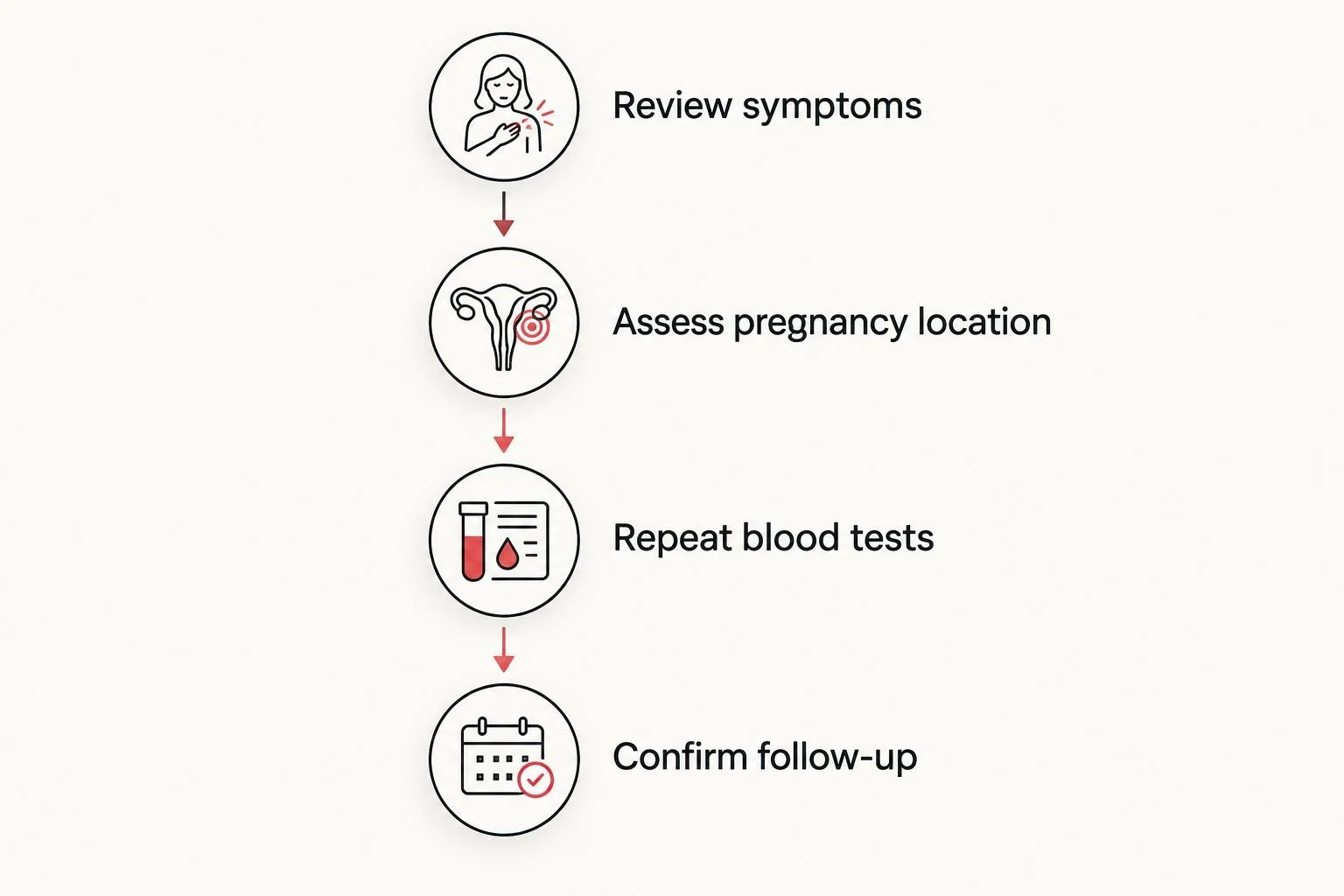
An inconclusive scan requires clinical follow-up rather than an assumption about pregnancy location.
Why early ectopic pregnancy detection varies
There is no single earliest day when every ectopic pregnancy becomes visible. The usefulness of a scan depends on what has developed, what can be seen, and how the findings fit your clinical picture.
Actual pregnancy timing: Later ovulation can make menstrual dates overestimate how far along you are.
Scan approach: Transvaginal imaging generally provides better early-pregnancy detail than imaging through the abdomen.
Pregnancy location: An ectopic pregnancy’s position affects how readily it can be identified.
Image visibility: Pelvic anatomy, fibroids, and other structures can make interpretation more difficult.
Findings over time: A repeat scan can reveal changes that were not visible during the first examination.
Symptoms and examination: Pain, bleeding, and signs of instability change how urgently clinicians investigate and act.
These factors explain why another person’s scan date is not a reliable benchmark for yours. In 2026, an online pregnancy calendar still cannot determine whether your pregnancy is safely located.
Can hCG blood tests rule out an ectopic pregnancy?
No single hCG result can rule out an ectopic pregnancy or identify its location. Quantitative hCG measures the amount of pregnancy hormone in your blood; the pattern over time adds information, but it does not show where implantation occurred.
For a pregnancy of unknown location, clinicians often compare blood samples taken approximately 48 hours apart. NICE NG126 recommends measurements as close as possible to that interval, but not earlier, when using this pathway.
A rising level does not automatically establish a normal intrauterine pregnancy. A falling level also does not mean you can ignore pain or stop follow-up without your clinician’s instructions.
You might hear about an hCG level above which a pregnancy is expected to be visible. That concept is not a stand-alone diagnosis: your clinician must account for the scan findings and your individual circumstances before making treatment decisions.
Does an empty uterus mean an ectopic pregnancy?
An empty uterus does not by itself diagnose an ectopic pregnancy. It can reflect a pregnancy that is too early to visualize, a completed pregnancy loss, or a pregnancy outside the uterus.
The wording on your report matters. Ask whether the report describes a definite intrauterine pregnancy, a suspected ectopic pregnancy, or a pregnancy of unknown location, and ask what evidence supports that assessment.
If your clinician recommends observation, make sure you understand what observation involves. It means planned monitoring with safety instructions—not assuming the risk has passed because you feel well today.
Can a normal-looking scan completely exclude ectopic pregnancy?
A confirmed intrauterine pregnancy makes a typical tubal ectopic pregnancy much less likely, but a rare simultaneous pregnancy inside and outside the uterus—called a heterotopic pregnancy—is possible. This matters particularly after assisted reproductive treatment.
Tell your clinician if you used fertility treatment, even if an earlier scan showed a pregnancy in the uterus. Persistent or worsening pain still needs assessment rather than reassurance based only on that earlier image.
A scan that merely looks normal is also different from a report that definitively confirms pregnancy location. Ask for the clinical conclusion, not just whether the pictures looked reassuring.
Which symptoms mean you should seek emergency care?
Seek emergency care now for severe or worsening abdominal or pelvic pain, shoulder-tip pain, fainting, marked dizziness, or weakness with a possible pregnancy. These symptoms can signal internal bleeding, including when vaginal bleeding is light or absent.
Call emergency services if you collapse, feel close to fainting, or cannot travel safely. Do not drive yourself if you are dizzy or faint.
For less severe pelvic pain or vaginal bleeding, contact your OB-GYN or another qualified clinician promptly for triage. Do not wait for an elective appointment, a repeat home pregnancy test, or the next scheduled blood draw if symptoms worsen.
You do not need every symptom on a checklist to justify asking for help. Equally, the absence of known risk factors does not exclude ectopic pregnancy.
What should you ask before arranging an ultrasound?
For a nonemergency assessment in 2026, confirm that the visit matches the medical question. An appointment designed for keepsake pictures is not a substitute for evaluation of a possible ectopic pregnancy.
Ask these questions before booking:
Is this a diagnostic examination intended to assess pregnancy location?
Is transvaginal imaging part of the assessment when clinically appropriate?
Who interprets the images and communicates the clinical findings?
Who arranges blood tests or additional assessment if the scan is inconclusive?
What should I do if symptoms change before or after the visit?
You can ask the clinician to explain an internal scan before consenting. If you decline it, discuss the limitations of an abdominal scan and the follow-up needed to keep your assessment safe.
The Ultrasound Concierge is a private diagnostic ultrasound option for Keller and Willow Park patients seeking a personalized setting. Its ultrasound services include diagnostic and elective imaging, but those appointment purposes are different. Before arranging diagnostic ultrasound with The Ultrasound Concierge, confirm the appropriate examination and follow-up with your treating clinician; emergency symptoms belong in emergency care.
FAQ
Can an ultrasound detect ectopic pregnancy early before I have symptoms?
Yes, ultrasound can detect an ectopic pregnancy before symptoms develop when the findings are visible. An early inconclusive scan still requires follow-up because the absence of symptoms does not rule it out.
Can you see an ectopic pregnancy at 5 weeks?
At 5 weeks of pregnancy, ultrasound sometimes identifies an ectopic pregnancy, but a scan can also be inconclusive. Pregnancy timing and the actual findings determine what your clinician can conclude.
Is a transvaginal ultrasound better than an abdominal scan for ectopic pregnancy?
Transvaginal ultrasound generally provides better detail for locating a very early pregnancy than an abdominal scan. Neither approach guarantees a definite answer during the earliest stage.
Why do I need another hCG test after 48 hours?
Blood tests approximately 48 hours apart help your clinician assess the pregnancy-hormone trend when the pregnancy location is unknown. The trend guides follow-up but cannot identify the location by itself.
Can an ectopic pregnancy happen without vaginal bleeding?
Yes, an ectopic pregnancy can occur without vaginal bleeding. Severe pain, shoulder-tip pain, dizziness, or fainting requires emergency assessment even when there is no visible bleeding.
Does an empty uterus on ultrasound mean I have miscarried?
An empty uterus does not by itself confirm miscarriage. A very early intrauterine pregnancy and an ectopic pregnancy are also possible, so your clinician must interpret the scan with your history and follow-up results.
Can I book a keepsake ultrasound to rule out ectopic pregnancy?
An elective keepsake ultrasound is not an appropriate substitute for a medical evaluation of suspected ectopic pregnancy. Contact your pregnancy-care clinician for diagnostic assessment, or seek emergency care for severe symptoms.
One last thing
Before you leave an inconclusive assessment, ask: Who is following this pregnancy until its location or resolution is confirmed? A booked scan is not the same as an established follow-up plan.
Keep your report, blood-test results, and return instructions together. If symptoms change, tell the assessing clinician that the pregnancy location has not yet been confirmed—even if you were recently examined.
For your 2026 pregnancy-care decisions, use this guide to prepare questions, not to interpret images or blood results yourself. The Ultrasound Concierge’s patient education supports an informed conversation; your treating clinician directs diagnosis and treatment.