
A 4D sonogram is better for watching your baby’s face move, but it is not automatically better than 3D for a clear facial picture. A 3D sonogram captures a still, three-dimensional view; 4D shows those views changing over time. Both depend on your baby’s position and the available view, so neither guarantees an unobstructed portrait.
TL;DR
For 3d vs 4d sonogram decisions, choose 3D for still facial images and 4D for movement.
Neither format guarantees a clear face when a hand, cord, or nearby tissue blocks the view.
The Ultrasound Concierge offers private pregnancy ultrasound services for patients around Keller and Willow Park, Texas.
Elective facial imaging does not replace your medically indicated prenatal ultrasound examinations.
Is a 4D sonogram better than a 3D sonogram for seeing baby’s face?
4D adds movement, not a guaranteed improvement in facial detail. If you want a still image of your baby’s nose, lips, and cheeks, 3D serves that purpose. If you want to watch a changing expression or mouth movement when visible, 4D adds that experience.
When comparing pregnancy ultrasound services in 2026, separate what you want to watch from what you want to save. The imaging format and the files you receive are different questions.
Best for
3D sonogram: Viewing a still facial image
4D sonogram: Watching facial movement as it happens
What it displays
3D sonogram: A three-dimensional volume rendered as an image
4D sonogram: Three-dimensional views updated over time
Main advantage
3D sonogram: You can study one captured view
4D sonogram: You can watch changes in expression and position
Main limitation
3D sonogram: One still image does not show a movement sequence
4D sonogram: Motion does not remove an obstruction or guarantee sharper detail
Clear-face guarantee
3D sonogram: No
4D sonogram: No
Replaces prenatal screening
3D sonogram: No
4D sonogram: No
The practical difference is simple: choose based on stillness versus movement, not an assumption that the higher number means a clearer face. A well-captured 3D image can show facial features more clearly than a 4D sequence with an obstructed view.
Why this matters
You are choosing an experience, not buying a promise about how your baby will appear on the screen. Understanding that distinction helps you ask useful questions before your appointment and avoid disappointment if your baby faces away.
For a 2026 booking, start with your goal: a keepsake portrait, the experience of watching movement, or a medical question. A medical question belongs with your prenatal care team and the appropriate diagnostic examination, rather than a choice based only on image appearance.
A facial image is also a reconstruction from ultrasound information, not a photograph taken inside the uterus. Shadows, missing surface information, and rendering can change its appearance. An unfamiliar-looking patch on a keepsake image is not something to interpret on your own.
3D sonogram: best for a still facial image
A 3D ultrasound collects information about a volume and displays a view with depth. Its 3 spatial dimensions are width, height, and depth. That allows a surface-rendered image to show facial contours rather than only a flat cross-section.
3D is the better match when your main goal is a still facial portrait. You can look closely at a captured image without following a moving sequence. Whether a particular image is suitable to save depends on the view obtained, not just the name of the imaging mode.
The limitation is that a still image captures one moment. It does not show how an expression changed, and it cannot display a facial surface that was hidden during acquisition.
Before choosing a visit, ask whether still images are included and how they are delivered. Do not assume a service description tells you the file format, image selection process, or delivery method. Those details need confirmation from the provider.
4D sonogram: best for watching facial movement
A 4D ultrasound displays three-dimensional views over time. The additional 1 dimension is time, not another direction of depth. You watch a changing sequence rather than only a single captured view.
4D is the better match when watching movement matters most to you. If your baby’s face is visible and moving, you can watch those movements as the examination proceeds. A still, turned-away, or covered face limits what you see.
The main drawback is that movement and detail are not the same thing. A moving image can remain unclear throughout a sequence, while a brief favorable position can produce a useful still image.
In 2026, ask specifically whether you will watch movement during the visit, receive a saved recording, or both. A 4D description identifies an imaging approach; it does not establish what files a particular appointment includes.
Why facial image quality varies
Both formats depend on sound waves reaching the area being imaged and returning useful information. Switching from a still display to a moving display does not remove the physical limits of the view.
These factors explain why one baby’s facial image can look different from another’s:
Face direction: A face turned toward an accessible scanning view is easier to display than a face turned away.
Nearby structures: Hands, feet, the umbilical cord, or contact with surrounding tissue can obscure parts of the face.
Fluid around the face: A fluid space helps distinguish the facial surface from nearby structures. Limited separation makes surface rendering more difficult.
Pregnancy stage: Facial contours and the space available for imaging change as pregnancy progresses. Later does not automatically mean clearer.
Sound transmission: The path between the probe and the baby affects the returning ultrasound signal. Image quality is not determined by the imaging label alone.
These are imaging constraints, not a preparation test you pass or fail. An unclear facial image is not your fault. Follow the provider’s instructions rather than trying unverified tricks to make the baby move or change the picture.
A provider can explain which constraint is affecting the view. That explanation is more useful than a general promise that a different display mode will solve it.
How should you choose between a 3D and 4D appointment?
Choose around your goal and keep the medical purpose separate. This sequence helps you compare appointments without assuming that every provider includes the same experience or keepsakes.
Define your goal. Decide whether you mainly want a still facial image or the chance to watch facial movement. Neither goal requires a promise of a perfect portrait.
Confirm the format. Ask whether the appointment uses 3D, 4D, or both. Find out what you will see during the visit rather than relying only on a package name.
Check the keepsakes. Ask which images or recordings you receive, how you receive them, and whether you need to arrange anything beforehand.
Discuss limitations. Ask what happens if the face is covered or turned away. Confirm the provider’s actual policy rather than assuming another attempt is included.
Keep prenatal care. Continue the scans and follow-up recommended by your obstetric clinician. A keepsake visit is not a substitute for medical assessment.
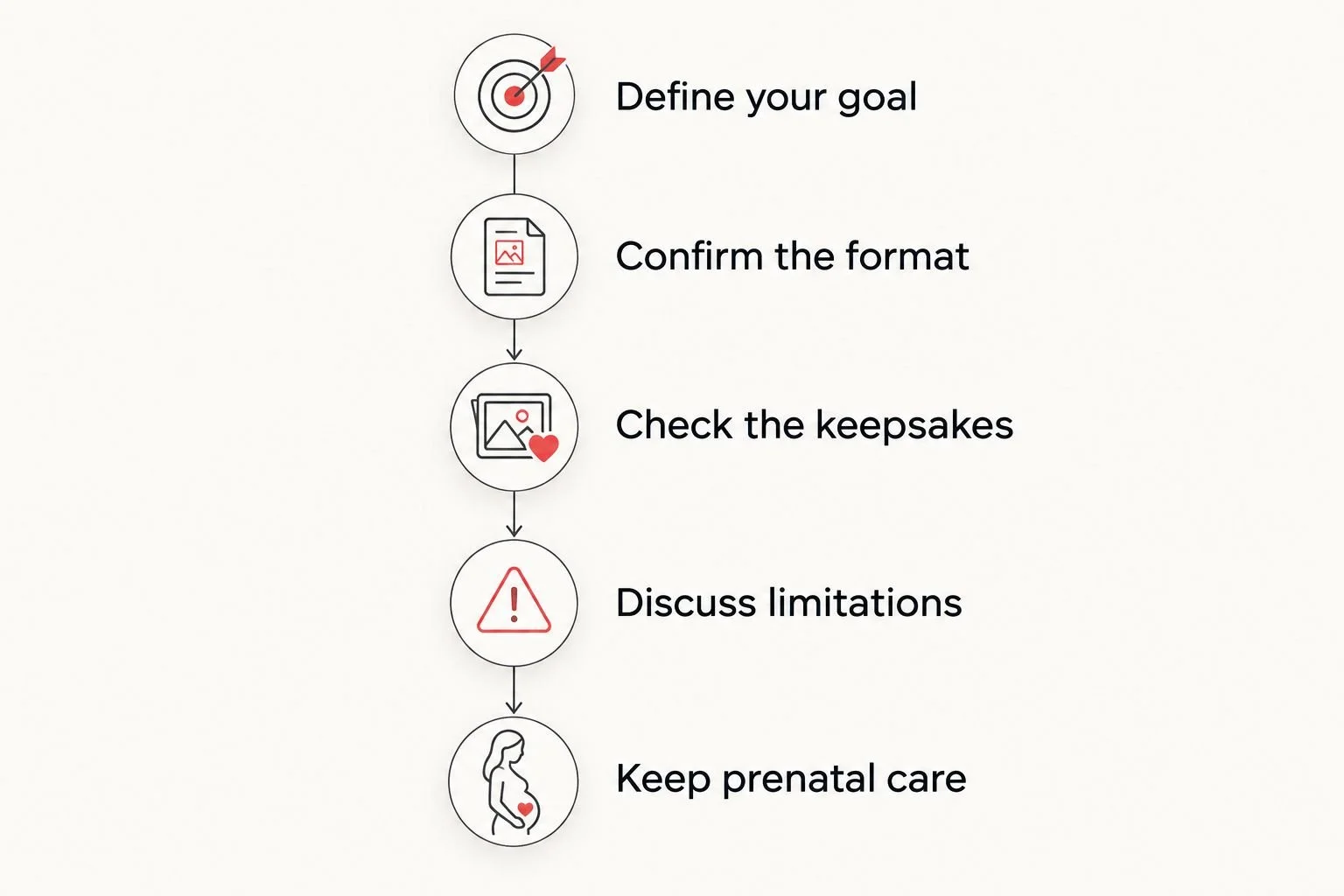
Choose the viewing experience first, then confirm what the appointment actually includes.
For your 2026 appointment, bring these questions to the provider before making plans around a recording or a particular facial image. Clear expectations help you focus on the visit instead of discovering afterward that you expected a different deliverable.
Where does a private ultrasound visit fit?
The Ultrasound Concierge is best suited to patients seeking private pregnancy ultrasound services around Keller and Willow Park, Texas. Its stated offering includes diagnostic and elective ultrasound imaging in a calm, personalized setting.
That setting addresses how you experience a visit; it does not eliminate the limitations of ultrasound. The Ultrasound Concierge’s 3D/4D services remain subject to fetal position and the available imaging view, just as the formats described above do.
If that approach matches your preferences, ask about the specific purpose of your visit, the imaging offered, and what you receive afterward. Keep diagnostic questions separate from keepsake expectations so you book the examination that matches your need.
Discuss your ultrasound goals
Ask about 3D/4D imaging, preparation, and what your appointment includes.
Does 4D show more facial detail than 3D?
4D does not inherently show more facial detail than 3D; it adds movement over time. Detail depends on the acquired ultrasound information, the available view, and how the image is displayed.
Ask the provider to distinguish image clarity from movement. A changing sequence and a sharply defined still image are different outcomes.
Can 3D and 4D both be used during one visit?
3D and 4D can both be used during an ultrasound visit when the equipment and service support them. Whether your appointment includes both, or includes saved images and recordings, depends on the provider’s actual offering.
Confirm those details before booking. Do not treat the imaging terms as a complete list of what you will take home.
Does a clear facial image mean my baby is healthy?
A clear facial image does not establish that your baby is healthy. A surface-rendered keepsake view is different from a diagnostic examination that evaluates specific anatomy and clinical questions.
The reverse also matters: an unclear keepsake image is not, by itself, evidence of a problem. Ask your prenatal clinician about medical findings rather than judging health from facial image quality.
FAQ
What’s the main difference in a 3d vs 4d sonogram?
A 3D sonogram shows a still three-dimensional view, while a 4D sonogram shows three-dimensional views changing over time. For a baby’s face, the main distinction is a captured image versus visible movement, not a guarantee of better clarity.
Is 4D better if I want to see my baby smile?
4D is better for watching facial movement when the face is visible and movement occurs. It cannot guarantee a particular expression, and a facial movement does not establish an emotional state.
Can a hand over the face make both formats unclear?
A hand over the face can obscure facial features in both 3D and 4D imaging. A moving display does not see through the obstruction simply because it updates over time.
Should I wait longer in pregnancy for a clearer face?
Waiting longer does not guarantee a clearer facial image. Pregnancy stage, fetal position, and the space around the face all affect the view, so discuss timing with your prenatal clinician and imaging provider.
Is a 3D or 4D ultrasound a replacement for my anatomy scan?
An elective 3D or 4D facial ultrasound is not a replacement for your anatomy scan or other medically indicated examinations. Keep the imaging and follow-up recommended by your prenatal care team.
Is it safe to keep scanning until the face looks clear?
Do not extend or repeat ultrasound exposure solely to pursue a perfect facial picture. The FDA discourages ultrasound performed only to create keepsake images, and medical ultrasound should be used prudently by appropriately trained professionals.
Does The Ultrasound Concierge offer pregnancy ultrasound imaging?
The Ultrasound Concierge offers private diagnostic and elective pregnancy ultrasound imaging, including 3D/4D services, for patients around Keller and Willow Park, Texas. Confirm the appropriate appointment type and included images or recordings directly with the provider.
One last thing
The most useful question is not whether 4D is newer or more impressive; it is whether you want a still picture or the experience of watching movement. That distinction remains the practical starting point for your 2026 comparison.
Before the scan begins, tell the sonographer what matters most to you. Then let the available view guide expectations. A meaningful visit does not depend on obtaining a perfectly unobstructed portrait, and your baby’s medical care should never depend on how a keepsake image looks.