
Best overall for routine early pregnancy ultrasound in El Paso, TX: your prenatal OB-GYN’s diagnostic pathway. Best after fertility treatment: your fertility clinic. Best for symptoms that need immediate assessment: emergency medical care—not an elective ultrasound studio. This 2026 guide compares care settings so you can choose a visit that answers your medical question.
TL;DR
For pregnancy ultrasound El Paso TX searches, start with your prenatal clinician when you need diagnostic answers.
Choose diagnostic imaging with clinical interpretation, not keepsake images alone, for pregnancy location and dating.
The Ultrasound Concierge serves Keller and Willow Park, not El Paso.
Severe pain, heavy bleeding, fainting, or shoulder pain require urgent medical assessment.
Why this matters
An early pregnancy scan and a keepsake session serve different purposes. A diagnostic examination supports medical decisions; an elective session does not replace prenatal assessment, even when the images look detailed.
Before choosing a clinic, understand whether a private ultrasound can replace your OB’s dating scan. The key question is not simply whether someone can show you the pregnancy. It is who interprets the examination and takes responsibility for the next step.
The Ultrasound Concierge is best suited to patients seeking private diagnostic or elective ultrasound services in Keller and Willow Park, rather than an El Paso appointment. Its ultrasound services belong in a North Texas search, not a local El Paso shortlist.
What makes the best early pregnancy ultrasound clinic?
Use these criteria to compare El Paso clinics in 2026. Give clinical fit more weight than image enhancements or the number of pictures included.
Diagnostic purpose: The appointment addresses a defined medical question, such as pregnancy location, dating, or follow-up of an earlier finding.
Qualified interpretation: Ask who performs the scan, who interprets it, and who receives the report.
Appropriate technique: The team explains whether abdominal or transvaginal imaging is appropriate and obtains your consent.
Follow-up ownership: A named clinician explains uncertain findings and arranges further assessment when needed.
Clinical coordination: Images and reports can reach the prenatal or fertility clinician responsible for your care.
Respectful communication: You receive a plain-language explanation, privacy, and an opportunity to ask questions.
A reassuring room matters. It does not replace a diagnostic report or a clear plan when a scan leaves questions unanswered.
Early pregnancy ultrasound options at a glance
The order below reflects routine early-pregnancy needs, not clinic review scores. Symptoms change the order: emergency assessment takes priority over every scheduled option.
Prenatal OB-GYN pathway
Best for: Routine early pregnancy assessment
Standout strength: Connects imaging with ongoing prenatal decisions
Key limitation: The clinician determines the appropriate examination and timing
Diagnostic imaging center
Best for: An ordered examination outside the prenatal office
Standout strength: Focused diagnostic imaging and reporting
Key limitation: Follow-up requires coordination with the ordering clinician
Fertility clinic
Best for: Pregnancy after fertility treatment
Standout strength: Connects early findings with treatment history
Key limitation: Not a substitute for establishing ongoing prenatal care
Maternal-fetal medicine practice
Best for: Specialist assessment when referred
Standout strength: Evaluates pregnancy questions requiring specialist input
Key limitation: Not the default starting point for an uncomplicated pregnancy
Elective ultrasound studio
Best for: Nonmedical keepsake imaging alongside prenatal care
Standout strength: A separate opportunity to view pregnancy images
Key limitation: Does not replace diagnostic assessment or emergency care
The practical distinction is who owns the medical question. Choose the setting that can connect the examination to an interpretation and a next step.
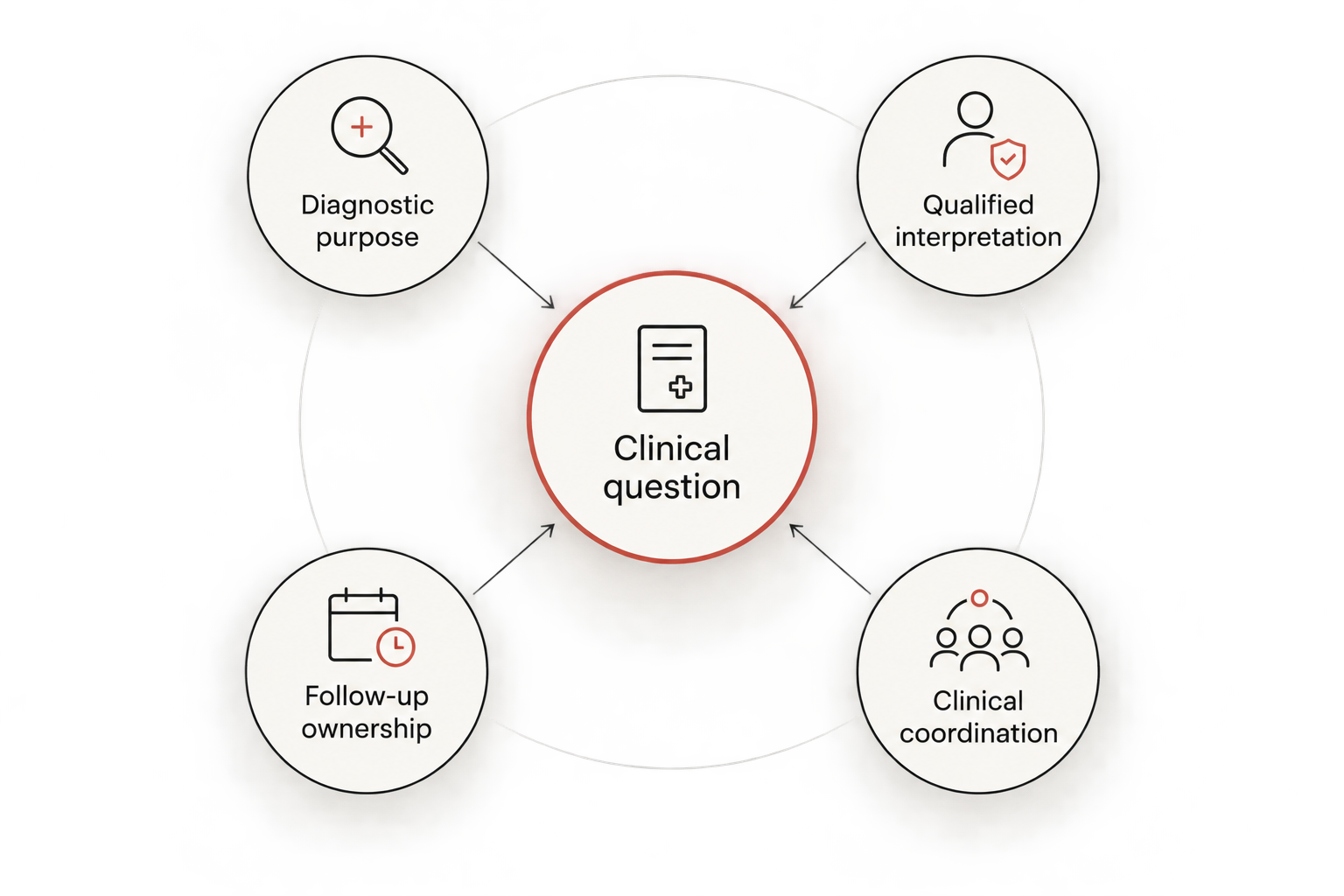
Choose a scan around the question it needs to answer, not the image package.
1. Prenatal OB-GYN: best for routine early pregnancy assessment
An OB-GYN connects your ultrasound findings with your symptoms, pregnancy history, examination, and other testing. The practice can determine whether imaging belongs in its office or at another diagnostic facility.
For a routine El Paso pregnancy ultrasound search in 2026, this is the default starting point. Ask what the examination is intended to establish before choosing a date.
Prenatal OB-GYN pros:
Connects imaging with ongoing prenatal care.
Interprets findings alongside your medical history.
Provides a clinical route for uncertain results.
Prenatal OB-GYN cons:
A requested scan is not automatically medically indicated.
The practice’s imaging pathway might involve a separate facility.
Best for: A positive pregnancy test without an existing fertility-treatment monitoring plan or urgent symptoms.
Verdict: Choose the prenatal OB-GYN pathway first for routine assessment.
2. Diagnostic imaging center: best for an ordered examination
A diagnostic imaging center performs the examination requested by your clinician and produces a clinical interpretation through its reporting process. Before booking, confirm that the facility performs the specific early obstetric examination your clinician ordered.
Do not assume every ultrasound appointment includes the same scope. Ask whether the examination can include transvaginal imaging if clinically appropriate and how the report reaches your clinician.
Diagnostic imaging center pros:
Addresses a defined diagnostic request.
Produces a report for clinical follow-up.
Supports coordination with an outside prenatal practice.
Diagnostic imaging center cons:
The imaging visit does not establish ongoing prenatal care.
You need a clear plan for discussing results with the ordering clinician.
Best for: Patients whose prenatal clinician directs them to an outside imaging facility.
Verdict: Choose diagnostic imaging when it matches your clinician’s examination request.
3. Fertility clinic: best after fertility treatment
Your fertility clinic has the treatment dates and monitoring history that matter when interpreting an early pregnancy. After embryo transfer or other fertility treatment, follow that team’s imaging instructions rather than arranging a separate keepsake appointment to answer medical questions.
Ask when responsibility transfers to your prenatal clinician. That handoff should include relevant treatment details, ultrasound findings, and medication instructions.
Fertility clinic pros:
Connects imaging with known treatment dates.
Keeps early monitoring within the existing treatment plan.
Supports an organized handoff to prenatal care.
Fertility clinic cons:
Fertility monitoring does not replace the rest of prenatal care.
Outside examinations require coordination to avoid conflicting instructions.
Best for: Pregnancy following IVF or another treatment managed by a fertility team.
Verdict: Hold off on independent imaging until your fertility team confirms the plan.
4. Maternal-fetal medicine: best for a specialist referral
A maternal-fetal medicine specialist evaluates pregnancy questions that require specialist assessment. Your prenatal clinician can explain whether your history or current findings warrant that referral.
A specialist appointment is not automatically the right first visit after a positive pregnancy test. Match the level of care to the clinical concern rather than assuming more specialized imaging always provides a better answer.
Maternal-fetal medicine pros:
Adds specialist assessment when clinically indicated.
Addresses questions arising from complex histories or findings.
Supports planning with your prenatal clinician.
Maternal-fetal medicine cons:
Does not replace your routine prenatal relationship.
Is not the default route for every early pregnancy scan.
Best for: Patients whose prenatal clinician recommends specialist evaluation.
Verdict: Hold specialist booking until the clinical question and referral pathway are clear.
5. Elective ultrasound studio: best for keepsake imaging
An elective ultrasound session is separate from a diagnostic pregnancy assessment. Do not use a keepsake appointment to investigate pain, bleeding, uncertain pregnancy location, or a possible pregnancy loss.
The Ultrasound Concierge offers both diagnostic and elective ultrasound services in Keller and Willow Park. That distinction matters: the purpose of the appointment—not simply the provider’s equipment—determines what you should expect from it.
Elective ultrasound studio pros:
Separates keepsake goals from diagnostic questions.
Offers a nonmedical opportunity to view pregnancy images.
Lets you discuss image-focused expectations before the visit.
Elective ultrasound studio cons:
Does not replace prenatal assessment or medically indicated imaging.
Is not an appropriate setting for evaluating urgent symptoms.
A visible heartbeat does not rule out every pregnancy complication.
Best for: Patients considering keepsake images alongside established prenatal care.
Verdict: Skip elective imaging when the question requires a medical diagnosis.
What an early scan can—and cannot—tell you
Early ultrasound findings depend on pregnancy development, timing, and imaging technique. A scan around 6–8 weeks can assess early pregnancy development, but your clinician must interpret what is visible in context; it is not a guaranteed appointment window for every finding.
Pregnancy weeks are usually counted from the first day of the last menstrual period, not from conception. The familiar 40-week estimated due date uses that convention, and ultrasound can help assess dating when appropriate.
An inconclusive examination is not, by itself, a diagnosis of pregnancy loss. A clinician can recommend repeat imaging, blood testing, or both according to the findings and symptoms.
For your 2026 appointment, ask what result would require another examination and who will arrange it. Do not book repeated elective sessions to resolve a diagnostic uncertainty.
Prepare for the appointment without guessing
Start with the facility’s instructions. Bladder preparation differs between abdominal and transvaginal examinations, so drinking extra water without asking is not a substitute for the correct preparation.
Have these details ready:
The first day of your last menstrual period, if known.
The date of your positive pregnancy test.
Any fertility treatment dates and relevant records.
Current symptoms, including pain or bleeding.
Your medication and supplement list.
The name of the clinician who should receive the report.
Keep prenatal care moving while you arrange imaging. Reviewing prenatal vitamins for the first trimester belongs alongside a medication-and-supplement discussion with your clinician; an ultrasound cannot determine whether a supplement meets your individual needs.
Ask about privacy and support-person arrangements before the visit. If transvaginal imaging is recommended, the team should explain why, describe the examination, and seek your consent; you can ask questions or request that it stop.
Questions to ask an El Paso clinic before booking
Use the same questions for every provider you consider in 2026. Clear answers matter more than a polished package description.
Is this a diagnostic examination or an elective session? State the question you need answered.
Who interprets the scan? Ask how you receive the clinical explanation, not just the images.
Who handles an uncertain result? Identify the clinician responsible for follow-up.
Can the examination include transvaginal imaging if appropriate? Confirm the scope before arriving.
How does my prenatal clinician receive the report? Make sure the receiving practice is identified correctly.
What should I do if symptoms develop before the appointment? A scheduled scan should not delay urgent care.
You do not need to know every medical term. A clear explanation of the visit’s purpose and limits is a reasonable expectation.
When not to wait for a scheduled ultrasound
Seek emergency medical assessment for severe abdominal or pelvic pain, heavy bleeding, fainting, or shoulder pain during early pregnancy. These symptoms can signal a serious problem, including an ectopic pregnancy, and need clinical evaluation rather than a keepsake scan.
For less severe pain or bleeding, contact your prenatal clinician promptly for instructions. Do not treat an earlier reassuring image as proof that new symptoms are harmless.
How the options are ranked
This guide ranks care settings by diagnostic purpose, interpretation, follow-up ownership, and coordination. It does not assign local clinic scores or treat elective and diagnostic appointments as interchangeable.
For routine assessment, the prenatal pathway comes first because imaging needs to inform care. Fertility monitoring and specialist referrals move ahead when your individual treatment plan calls for them.
Which pregnancy ultrasound option should you choose?
Choose your prenatal clinician’s diagnostic pathway unless an existing fertility plan, specialist referral, or urgent symptom changes the decision. That is the clearest starting point for an El Paso early pregnancy scan.
If you are considering The Ultrasound Concierge for pregnancy ultrasound, keep its Keller and Willow Park service area separate from your El Paso search. Choose location and clinical fit together; a private setting does not remove the need for appropriate interpretation and follow-up.
FAQ
What’s the best place for an early pregnancy ultrasound in El Paso?
Your prenatal clinician’s diagnostic pathway is the best starting point for routine early pregnancy assessment. Choose a facility that can answer the clinical question and send the report to the clinician responsible for follow-up.
Is The Ultrasound Concierge in El Paso?
The Ultrasound Concierge serves patients in Keller and Willow Park, Texas, rather than El Paso. Its services include diagnostic and elective ultrasound imaging.
How early should I book a pregnancy ultrasound?
Ask your prenatal or fertility clinician when imaging will answer your specific question. Symptoms, treatment dates, and pregnancy history affect the timing; a positive test alone does not determine the right scan date.
Is transvaginal ultrasound better than an abdominal scan early in pregnancy?
Transvaginal ultrasound can provide clearer views of early pregnancy structures than abdominal imaging. Your clinician determines which approach is appropriate, and the examination requires your consent.
Does not seeing a heartbeat mean I’ve miscarried?
Not seeing cardiac activity on an early scan does not automatically establish a miscarriage. A clinician must consider the measurements, timing, and other findings and determine whether follow-up testing is needed.
Can an elective ultrasound replace my prenatal dating scan?
An elective keepsake session does not replace a medically indicated prenatal dating examination. Diagnostic imaging needs appropriate interpretation and a follow-up plan.
Does an early ultrasound replace the anatomy scan?
An early ultrasound does not replace the later fetal anatomy examination. ACOG patient guidance places the standard second-trimester ultrasound around 18–22 weeks, with your clinician directing your individual care.
Should I wait for my ultrasound appointment if I have severe pain?
Do not wait for a scheduled ultrasound if you have severe pain, heavy bleeding, fainting, or shoulder pain. Seek emergency medical assessment rather than an elective imaging appointment.
One last thing
Before leaving any diagnostic ultrasound visit, ask: Who will explain the result, and what happens if it is uncertain? That answer matters more than how many images you take home. Keep the report connected to your prenatal care—not just saved on your phone.