
You should not assume you can pay for a SneakPeek test with FSA or HSA funds: testing solely to learn fetal sex generally does not meet the federal definition of a qualified medical expense. Before using either account in 2026, confirm the exact service’s eligibility; a successful card transaction does not establish that the expense qualifies.
TL;DR
Do not assume you can pay for SneakPeek test with FSA or HSA funds; elective fetal-sex testing generally does not qualify.
IRS medical-expense rules distinguish medical care from testing performed solely for personal interest.
FSA card approval and HSA card acceptance do not establish tax eligibility.
The Ultrasound Concierge offers SneakPeek testing; confirm account eligibility separately before using tax-advantaged funds.
Can you pay for a SneakPeek gender test with FSA or HSA funds?
For a SneakPeek test purchased solely to learn fetal sex, plan to use personal funds unless eligibility is established for the actual service. Pregnancy-related spending is not automatically qualified medical spending, and a blood test does not qualify simply because someone collects the sample in a healthcare setting.
The federal starting point is Internal Revenue Code Section 213(d), which defines medical care around diagnosing, treating, mitigating, or preventing disease, and affecting a body structure or function. IRS Publication 502 explains medical-expense categories, while Publication 969 explains HSA and health FSA rules. These are the relevant federal references for a 2026 eligibility review, rather than a merchant’s ability to process your card.
Personal funds
Best for: Elective testing without established account eligibility
Benefit: Avoids an unsupported FSA claim or HSA distribution
Limitation: Does not provide tax-advantaged reimbursement
Health FSA
Best for: Expenses meeting federal rules and the employer plan’s requirements
Benefit: Reimburses eligible expenses under the plan
Limitation: Requires substantiation; plan deadlines also apply
HSA
Best for: Qualified medical expenses supported by retained records
Benefit: Allows tax-free payment of qualified expenses
Limitation: You are responsible for the distribution’s tax treatment
The Ultrasound Concierge provides private ultrasound and SneakPeek testing for patients in Keller and Willow Park. Review the services you are considering, then ask about the documentation available for that specific service. A provider’s service description and your account’s eligibility requirements answer different questions.
Why this matters
Using a healthcare account feels like a straightforward payment choice. The problem is that payment acceptance, insurance coverage, and tax eligibility are separate decisions. A transaction can go through without resolving whether the underlying expense meets federal requirements.
For an HSA, a nonqualified distribution is generally included in taxable income. It also generally carries a 20% additional tax before age 65 years, unless an exception applies, including disability or death. At age 65 years, the additional tax no longer applies, but a nonqualified distribution generally remains taxable.
An FSA handles unsupported expenses through its plan’s substantiation and correction procedures. Ask the administrator what to do rather than assuming the issue disappears after checkout.
The same distinction matters when considering an elective ultrasound. This guide to insurance for elective ultrasound addresses a separate payment question; an insurance answer alone does not settle FSA or HSA eligibility.
Health FSA: establish eligibility before submitting a claim
A health FSA reimburses qualifying expenses under an employer-sponsored plan. Its administrator reviews claims against federal requirements and the plan’s terms, so the exact description of the service matters.
Ask specifically about a SneakPeek fetal-sex test performed for personal interest. Do not ask only whether pregnancy testing, laboratory testing, or prenatal care is covered: those broader categories do not accurately describe every elective service.
Best for: expenses that satisfy both federal medical-expense rules and your FSA plan’s requirements. The benefit is reimbursement through the plan; the limitation is that a receipt alone does not establish eligibility. An administrator can require supporting information and reject an expense that does not qualify.
For a 2026 appointment, check the applicable service-date and claim-submission rules before paying. Your plan documents control its deadlines and any available carryover or grace-period provisions. An approaching deadline does not make an otherwise ineligible expense eligible.
HSA: account access does not establish eligibility
An HSA puts more recordkeeping responsibility on you. Being able to withdraw funds, swipe a card, or reimburse yourself does not mean the distribution is tax-free.
For a qualified HSA distribution, you need records showing that the expense qualifies, was not reimbursed elsewhere, and was not also taken as an itemized medical deduction. The expense must also have been incurred after the HSA was established.
Best for: qualified medical expenses you can substantiate and track. An HSA offers flexibility in when you reimburse yourself, but that flexibility does not expand the definition of medical care. Keep the service documentation with your tax records rather than relying on a card statement alone.
If eligibility remains unresolved, paying personally keeps you from taking an unsupported HSA distribution. You can revisit reimbursement only if the expense actually qualifies and the other HSA requirements are met; keeping a receipt does not create eligibility by itself.
Why FSA and HSA eligibility differs between services
The relevant difference is not whether the appointment feels medical. It is what the service actually does and whether the expense meets the applicable rules.
Purpose of testing: Testing solely to learn fetal sex differs from testing used to diagnose or manage a medical condition.
Actual service: A laboratory test, blood collection, diagnostic examination, and keepsake service are not interchangeable descriptions.
Clinical circumstances: Genuine diagnostic care requires an accurate clinical basis, not a new label added for reimbursement.
Account requirements: An FSA uses plan claim-review procedures; an HSA requires you to substantiate tax-free distributions.
Supporting records: Documentation must describe the expense accurately enough to support its treatment.
Other reimbursement: You cannot receive duplicate tax-free reimbursement for the same expense.
An administrator can explain requirements and review documents, but cannot turn a nonqualified expense into qualified medical care. Ask for an eligibility explanation tied to the actual service, not simply permission to try the card.
How do you check eligibility before the appointment?
Use this sequence before authorizing an FSA payment or taking an HSA distribution. It separates the provider’s role from the account administrator’s role and gives you a clear record of the question you asked.
Identify the service. Write down the test name, its purpose, and whether you are purchasing any separate services. State clearly if your only purpose is learning fetal sex.
Describe the purpose. Give the administrator the accurate service description. Do not substitute a broader phrase such as prenatal screening if that is not what you are receiving.
Check eligibility. For an FSA, request the plan’s determination and documentation requirements. For an HSA, review qualified-expense guidance and seek tax advice if the classification remains unclear.
Keep records. Save the response, receipt, service description, and any relevant clinical documentation. Written guidance helps preserve what was reviewed, but does not override federal law.
Choose payment. Use tax-advantaged funds only when the expense qualifies. If eligibility is unresolved, use personal funds rather than treating card acceptance as approval.
A useful question is whether an elective blood test performed solely to identify fetal sex qualifies under the applicable rules. Follow that with a request for the documents required to support the answer. Specific wording prevents a response about a different kind of prenatal test.
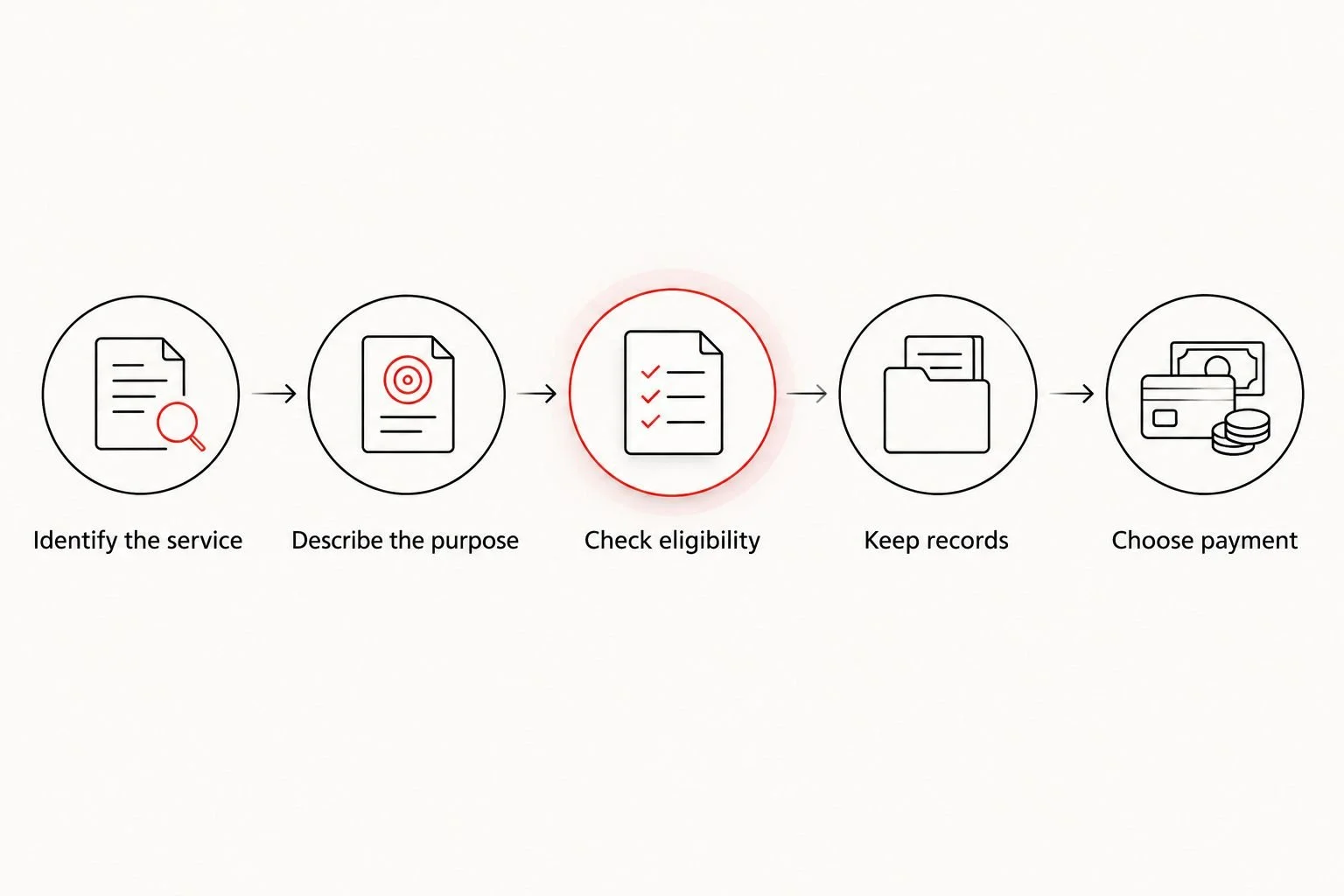
Confirm the actual service’s eligibility before choosing the payment account.
What documents should you keep?
Keep an itemized receipt that identifies the patient, provider, service date, service description, and amount paid. A card statement generally shows a transaction, not the medical purpose of the expense.
Also retain any eligibility correspondence and documentation supporting a genuine medical purpose. Ask what is needed before the appointment so you are not trying to reconstruct the service afterward.
For your 2026 records, organize the documents by expense rather than by payment card. Keep the receipt, claim decision, reimbursement record, and any correction together. That makes it easier to see whether the same expense has already been reimbursed.
Documentation supports eligibility; it does not manufacture it. A detailed receipt for an elective service remains a receipt for that elective service. Ask for accurate records, never a diagnosis or billing description added solely to obtain reimbursement.
Does a doctor’s order make SneakPeek eligible?
A doctor’s order does not automatically make an elective SneakPeek test eligible. The expense must still satisfy the federal definition of medical care and any applicable plan requirements.
A clinician recommending a test for a genuine diagnostic purpose is different from signing paperwork for a test purchased only for personal interest. If a medical question exists, let the clinician identify the appropriate test and document the actual reason for it.
A letter of medical necessity is supporting evidence, not a universal exception. Do not ask a provider to reclassify an elective service as diagnostic care simply to access account funds.
Is SneakPeek treated the same as diagnostic prenatal testing?
SneakPeek fetal-sex testing should not be treated as interchangeable with diagnostic prenatal testing. The purpose and scope of the actual test determine which medical-expense rules apply; sharing a pregnancy-related context does not make separate tests equivalent.
If your clinician recommends prenatal screening or diagnostic testing, ask about that exact service. A coverage or eligibility decision for one test should not be transferred to another without review.
What if your FSA or HSA card already went through?
A completed transaction does not establish eligibility. Keep the receipt and contact the appropriate administrator or tax professional promptly if you used account funds for an expense that does not qualify.
For an FSA, request the plan’s correction instructions and follow its documentation process. Do not submit an unrelated receipt as though it supports the original service.
For an HSA, ask the custodian and a qualified tax professional about the applicable correction or reporting process. Do not assume that moving money back into the account yourself resolves the distribution correctly.
Choosing a private testing appointment
The Ultrasound Concierge is best for Keller and Willow Park patients seeking private ultrasound and SneakPeek testing in a calm, personalized setting. That service fit is separate from whether a particular expense qualifies for tax-advantaged payment.
The practical benefit is a private alternative to clinical imaging centers. The payment limitation is unchanged: choosing a concierge setting does not establish FSA or HSA eligibility. Ask about the actual service and available documentation, then resolve account eligibility separately.
FAQ
Can I pay for a SneakPeek test with my FSA in 2026?
Do not assume an elective SneakPeek fetal-sex test qualifies for FSA reimbursement in 2026. Ask your administrator to review the exact service and purpose against federal rules and your plan’s requirements before using the account.
Can I use my HSA card if the provider accepts it?
Card acceptance does not establish that a SneakPeek test is a qualified medical expense. You remain responsible for substantiating a tax-free HSA distribution.
Does being pregnant make every test FSA or HSA eligible?
Pregnancy does not automatically make every related purchase a qualified medical expense. The actual service and its medical purpose determine eligibility.
Does a doctor’s note guarantee reimbursement for a gender test?
A doctor’s note does not guarantee eligibility for an elective fetal-sex test. Documentation must support a service that actually meets the applicable medical-expense requirements.
Can I reimburse myself later if I pay personally first?
Later reimbursement is possible only if the expense qualifies and the account’s requirements are met. For an HSA, the expense must have been incurred after the account was established; FSA claims must meet the plan’s timing rules.
What happens if I use HSA money for a nonqualified test?
A nonqualified HSA distribution is generally taxable and generally carries a 20% additional tax before age 65 years, unless an exception applies. Ask a tax professional about correction or reporting requirements for your situation.
Can I claim the same test through insurance and my healthcare account?
You cannot receive duplicate tax-free reimbursement for the same expense. Account reimbursement must be limited to an eligible expense that has not already been reimbursed elsewhere.
One last thing
The useful question is not whether your card works; it is whether the expense qualifies. A successful transaction answers only the first question, and a declined transaction does not necessarily answer the second.
Before your 2026 appointment, save the exact service description and resolve eligibility without changing how the service is described. This article provides general education, not an individual tax determination; use your plan administrator and a qualified tax professional for advice about your circumstances.