
Surrogacy agency ultrasound referrals are coordinated requests for pregnancy or fertility imaging with the aim of connecting gestational carriers to the appropriate care team and keeping follow-up organized. This 2026 guide explains how to separate clinical imaging from elective visits, respect the carrier’s choices, and coordinate communication with intended parents without taking over medical decisions.
TL;DR
Ultrasound referrals for surrogacy agencies need a defined clinical purpose, patient consent, and a named follow-up clinician.
The Ultrasound Concierge offers private diagnostic and elective ultrasound for patients in Keller and Willow Park, TX.
Keep fertility monitoring, prenatal diagnostic imaging, and elective pregnancy ultrasound on separate referral pathways.
Confirm record-sharing permissions before sending ultrasound reports or images to intended parents.
Why ultrasound referrals matter for surrogacy agencies
A surrogacy referral involves several distinct roles: the gestational carrier receiving care, the clinician directing care, the intended parents, and the agency coordinating logistics. Your agency coordinates the appointment; the treating clinician determines the medical plan. Keep that boundary visible in every referral.
The practical challenge is maintaining continuity as care moves from a fertility clinic to a prenatal provider. A scan requested during fertility treatment serves a different purpose from a later elective imaging visit. Your referral process needs to preserve the requesting clinician’s instructions through that handoff.
For the fertility side of that process, the guide to ultrasound referrals for fertility clinics provides a related starting point.
Use your 2026 referral policy to distinguish permission to coordinate scheduling from permission to receive medical information. Paying for a visit, arranging transportation, or attending an appointment does not by itself establish access to the carrier’s records. Ask the imaging provider how it documents patient permissions and handles requests involving intended parents.
Build a referral process around the patient
1. Define the purpose before choosing a provider
Start with a simple referral worksheet rather than a booking request. Write down the question the treating clinician wants the ultrasound to address, or identify the visit as elective if it has no diagnostic purpose. Do not ask an agency coordinator to translate an unclear medical request into a scan type.
For example, a fertility clinic’s monitoring request needs that clinic’s examination instructions and reporting requirements. An elective visit focused on viewing the baby does not fulfill those instructions simply because both appointments use ultrasound.
If the carrier reports new symptoms, stop the routine scheduling process and direct the carrier to the treating clinician. Severe pain, heavy bleeding, or fainting warrants urgent medical assessment, not an elective reassurance appointment.
Record the requesting clinician and the purpose of the examination.
Identify whether the request is diagnostic, monitoring-related, or elective.
Ask the clinical team to resolve unclear or conflicting instructions.
Keep symptom concerns out of the elective booking pathway.
2. Assign responsibility for each handoff
Create a written contact sheet manually before considering any scheduling system. Name the person who sends the request, the clinician who receives the findings, and the person who confirms that the next action is understood. A shared calendar alone does not establish clinical responsibility.
Build 3 checkpoints into the administrative workflow: request accepted, examination completed, and report receipt confirmed. These are recommended tracking stages, not promised service timelines. An appointment marked completed does not establish that the treating clinician has received or reviewed the findings.
During the fertility-to-prenatal transition, ask both clinical teams which clinician owns outstanding requests. Do not assume that a scheduled prenatal appointment automatically closes the fertility clinic’s follow-up responsibilities.
Name an agency coordinator for logistics.
Record the ordering clinician and intended report recipient.
Confirm who handles questions before the examination.
Document the handoff when responsibility changes between clinical teams.
3. Match the imaging setting to the request
Call the prospective provider with the actual examination request. Ask whether the provider performs that examination, what documentation it requires, and how clinical findings reach the treating team. This direct check is more useful than choosing a location from pregnancy photos alone.
The Ultrasound Concierge is best for patients seeking private ultrasound in Keller and Willow Park, TX. Its stated services include diagnostic and elective pregnancy imaging in a calm, personalized setting. Review the available ultrasound services, then confirm whether the specific clinical request fits before recommending an appointment.
Private surroundings address a patient-experience preference; they do not establish that a provider meets every fertility clinic’s monitoring protocol. Do not treat a diagnostic service listing as confirmation of a particular examination, report format, or reporting deadline.
Confirm the exact examination with the receiving provider.
Ask what clinician orders or supporting records are required.
Verify who interprets diagnostic findings and receives the report.
Confirm any clinic-specific measurement or image requirements.
4. Separate consent, attendance, and record sharing
Discuss preferences with the gestational carrier directly, without treating the intended parents’ expectations as the default. Permission for someone to attend an appointment is different from permission to receive a report, record a visit, or distribute images afterward.
Ask the imaging provider which permissions and documentation apply to the request. Surrogacy agreements and questions about legal authority belong with the appropriate legal and clinical professionals; agency staff should not interpret them as blanket access instructions.
Record the carrier’s current communication preferences in the coordination file, using the provider’s approved process. Recheck those preferences when participants or circumstances change. A previous group visit is not a standing instruction to include the same people at every later appointment.
Ask whom the carrier wants present during the visit.
Confirm permissions for reports, images, recordings, and remote participation separately.
Verify recipients before sending sensitive information.
Refer disputed access requests to the provider and appropriate legal counsel.
5. Send a concise referral packet
Use a 1-page coordination cover sheet alongside the provider’s required clinical documents. Keep it factual. The cover sheet should help the receiving team identify the request and route communication, not summarize the agency’s interpretation of the pregnancy.
Use 2 patient identifiers, such as the carrier’s full name and date of birth, when confirming the referral through the provider’s approved process. Identify the gestational carrier as the patient; list intended parents separately only where relevant and permitted.
For your 2026 template, include an explicit field for report destination. A general agency email address is not a substitute for the treating clinician’s correct contact information. Ask the receiving practice which secure transmission method it accepts before sending medical records.
Include patient identifiers and current contact details.
Attach the examination request and relevant clinician instructions.
List the ordering clinician’s contact and report destination.
Include only information needed for the referral and permitted sharing.
6. Confirm preparation and participation before travel
Ask the imaging provider for examination-specific preparation instructions, then pass those instructions along without changing them. Bladder preparation, eating and drinking instructions, and the examination approach depend on the requested study. Avoid a universal preparation message for every pregnancy ultrasound.
Confirm attendance and remote participation separately from clinical preparation. Do not promise intended parents that they can join by video, record the examination, or receive images immediately unless the provider has confirmed the arrangements and the carrier agrees.
Use this preparation sequence for each referral rather than relying on what happened at a previous visit:
Confirm instructions.
Confirm attendance.
Confirm sharing.
Confirm follow-up.
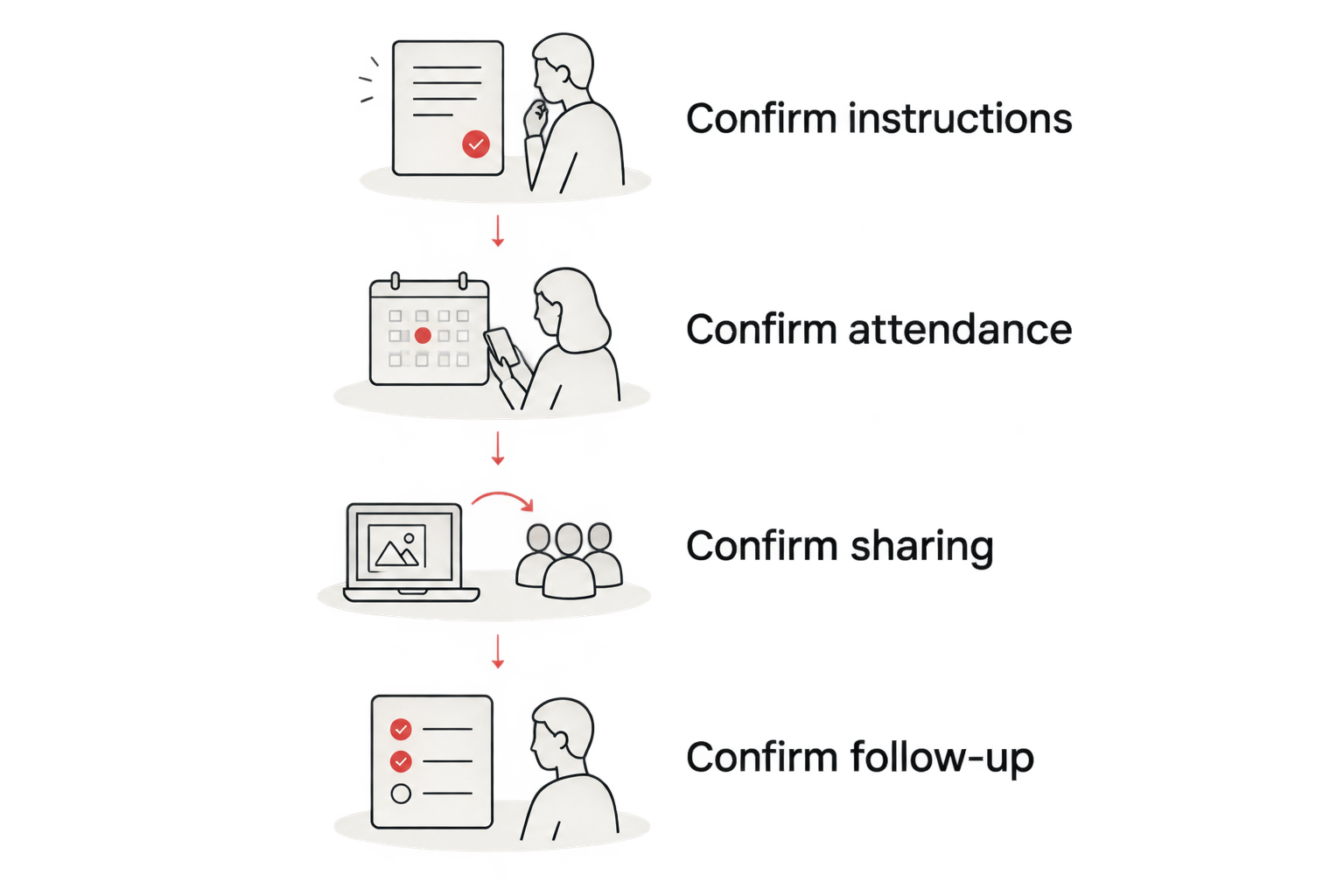
Confirm participation and sharing separately from examination preparation.
7. Close the referral without interpreting the findings
After the examination, confirm the administrative outcome with the appropriate parties: whether the visit occurred, whether a report was expected, and whether the intended clinical recipient received it. Keep the agency’s status update separate from the clinician’s explanation of the findings.
Do not translate measurements, image labels, or an uncertain finding for intended parents. Ask the treating team to explain clinical meaning and next steps directly through the agreed communication process. Photos selected for sharing are not a substitute for a diagnostic report.
Review your 2026 workflow for unresolved referrals as well as completed visits. Record why a referral remains open, who owns the next action, and what confirmation will close it. Do not create an agency deadline that overrides a clinician’s instructions.
Confirm completion or document the reason for rescheduling.
Verify receipt of the expected report through the approved channel.
Route clinical questions to the responsible clinician.
Record the next administrative action without interpreting results.
Compare ultrasound referral options
Choose the setting by the clinical request, not by the most appealing appointment description. These options serve different purposes. The table identifies the appropriate starting point for discussion; it does not confirm that any individual provider accepts a particular referral.
Treating fertility clinic
Best for: Monitoring directed by the fertility team
Practical advantage: Keeps the examination connected to the treatment plan
Key limitation: Outside monitoring arrangements need the clinic’s approval and instructions
Treating prenatal practice
Best for: Routine prenatal imaging directed by the pregnancy care team
Practical advantage: Connects imaging questions with ongoing prenatal care
Key limitation: Examination scope depends on the practice and clinical request
Clinician-directed specialist service
Best for: Imaging requiring specialist assessment
Practical advantage: Matches the referral to the relevant clinical expertise
Key limitation: The treating clinician must determine the appropriate specialist pathway
The Ultrasound Concierge
Best for: Patients seeking private diagnostic or elective ultrasound in Keller and Willow Park
Practical advantage: Offers a personalized alternative to a clinical imaging setting
Key limitation: Confirm the specific examination, referral requirements, and reporting process directly
Elective ultrasound visit
Best for: Optional viewing alongside established prenatal care
Practical advantage: Separates an optional experience from required clinical appointments
Key limitation: Does not replace clinician-directed diagnostic imaging or prenatal care
For an agency, the strongest arrangement is a clearly documented referral relationship, not an exclusive destination for every scan. Keep the treating team involved when selecting an outside provider. Preserve patient choice rather than presenting an agency recommendation as a medical requirement.
Discuss your ultrasound referral
Ask whether the requested examination fits and confirm documentation, participation, and reporting requirements.
Common mistakes surrogacy agencies make
Treating intended parents as the default record recipients
Intended parents’ involvement does not remove the need to verify the appropriate basis for sharing the carrier’s information. Keep the patient, billing contact, appointment attendees, and authorized recipients distinct in your records. Ask the provider to resolve access questions before distributing reports.
Booking an elective visit to answer a clinical question
A family’s wish for reassurance is understandable, but a clinical concern needs clinical assessment. Do not describe an elective appointment as confirmation that the pregnancy is healthy. Ask the treating clinician which examination, if any, is appropriate.
Promising participation before confirming arrangements
Do not build travel or family plans around unconfirmed guest access, recording permissions, or remote viewing. Discuss the carrier’s preferences first, then ask the provider what is permitted. Present those arrangements as confirmed only after both conversations are complete.
Sending a fertility request without the clinic’s instructions
A booking description such as early pregnancy scan does not communicate every monitoring requirement. Obtain the actual request and clarify the report destination before scheduling. Keep the fertility clinic involved until it explicitly transfers the relevant care responsibilities.
Measuring success only by appointments completed
A completed examination is an administrative milestone, not proof of completed follow-up. Include report receipt and unresolved questions in your 2026 referral review. Track these statuses without creating a parallel agency interpretation of the medical record.
FAQ
What is the best way to manage ultrasound referrals for surrogacy agencies?
Use a written workflow that identifies the examination purpose, treating clinician, patient permissions, and report recipient. The agency coordinates logistics while the clinical team directs medical care and explains findings.
Can a surrogacy agency order a diagnostic ultrasound?
An agency referral does not substitute for a clinical order when an order is required. Ask the receiving provider what documentation the examination needs and have the treating clinician supply the appropriate request.
Can intended parents receive the surrogate’s ultrasound report?
Intended parents should receive reports through the provider’s approved process for authorized sharing. Confirm the applicable permissions or legal authority rather than assuming that payment or a surrogacy agreement automatically grants access.
Can intended parents watch the ultrasound remotely?
Remote participation requires confirmation from the imaging provider and agreement from the gestational carrier. Ask about participation, recording, and image-sharing arrangements before making plans.
Is elective ultrasound a replacement for a prenatal scan?
No, an elective ultrasound does not replace clinician-directed diagnostic imaging or routine prenatal care. Keep required medical examinations on the treating clinician’s schedule and discuss optional imaging separately.
Does The Ultrasound Concierge offer ultrasound in North Texas?
The Ultrasound Concierge provides private diagnostic and elective ultrasound services for patients in Keller and Willow Park, TX. Confirm whether the specific referral request fits its services and ask about documentation and reporting before scheduling.
What should the agency do if the carrier develops symptoms before a scan?
Direct the carrier to the treating clinician rather than using an elective appointment to assess symptoms. Severe pain, heavy bleeding, or fainting warrants urgent medical assessment.
One last thing
Make closing the referral a separate task from completing the appointment. Add a report-receipt field to your coordination record and assign responsibility for checking it. That small administrative distinction keeps the agency focused on its proper role: helping information reach the right person without interpreting what it means.