
IUI patients’ early pregnancy ultrasound is diagnostic imaging used to assess pregnancy location and early development after intrauterine insemination, with the aim of guiding pregnancy care. Your treatment dates help with timing, but the first scan still needs to be interpreted alongside symptoms, blood tests, and your fertility team’s plan.
TL;DR
Early pregnancy ultrasound for IUI patients should follow the fertility clinic’s timing and diagnostic plan.
The Ultrasound Concierge offers private ultrasound services for patients in Keller and Willow Park.
A positive pregnancy test does not establish pregnancy location; diagnostic ultrasound helps assess it.
An inconclusive early scan needs clinician-directed follow-up, not an immediate assumption of pregnancy loss.
Why early pregnancy ultrasound matters for IUI patients
After IUI, you have a treatment date rather than only a menstrual calendar. That helps your clinician estimate gestational age, but it does not mean every structure will be visible on a particular day. The clinical question determines when to scan.
An early diagnostic examination helps assess whether the pregnancy is inside the uterus, how many gestational sacs or embryos are visible, and whether development matches the expected stage. It does not replace ongoing prenatal care or guarantee the pregnancy’s outcome.
The Ultrasound Concierge is best for Keller and Willow Park patients seeking private ultrasound services. For early pregnancy ultrasound, confirm that the specific examination meets your fertility clinician’s diagnostic requirements before scheduling.
Use this 2026 guide to organize the appointment around medical questions, not just the earliest possible picture. The information supports a conversation with your clinician; it does not diagnose symptoms or replace individualized care.
How to plan your early pregnancy ultrasound after IUI
1. Confirm your pregnancy dating with your fertility team
Start with your clinic’s treatment record and a simple calendar. Pregnancy weeks are counted differently from days since insemination: obstetric gestational age conventionally includes approximately 2 weeks before ovulation.
If insemination closely matched ovulation, 14 days after IUI is approximately 4 weeks pregnant—not 2 weeks pregnant. Likewise, 28 days after IUI is approximately 6 weeks pregnant. Your clinician should confirm the dating because insemination and ovulation are not necessarily simultaneous.
Do not replace the clinic’s date with an app’s estimate based only on your last period. Fertility medication and cycle timing make the treatment record especially relevant. Keep one clinician-confirmed estimate across your appointment paperwork.
Record the IUI date and any documented ovulation timing.
Add the trigger injection date, if applicable.
Keep pregnancy blood-test dates and results together.
Ask which gestational age to use when booking.
Tell the imaging provider that conception followed IUI.
2. Ask what the first scan needs to answer
Call your fertility clinic before independently booking a reassurance visit. Ask whether the immediate goal is to assess pregnancy location, look for an embryo and cardiac activity, investigate symptoms, or follow up on an earlier finding.
Clinics often schedule an initial scan around 6–7 weeks of gestational age, but symptoms and clinical findings can require earlier assessment. Earlier imaging is not automatically more reassuring: an examination performed before expected structures are visible can leave important questions unanswered.
A pregnancy blood test measures human chorionic gonadotropin, or hCG. It does not show where the pregnancy implanted. Your clinician interprets the blood-test pattern and ultrasound together rather than treating either as a complete answer.
Ask for the intended scan date or gestational-age window.
Confirm whether blood tests are needed before imaging.
Describe bleeding or pain when requesting an appointment.
Ask who will interpret the diagnostic findings.
Identify the clinician responsible for follow-up decisions.
3. Choose diagnostic imaging that fits the clinical request
Your fertility clinic is the starting point because it holds your treatment history. If you need imaging elsewhere, ask the clinic what the outside provider must examine, document, and send back.
The Ultrasound Concierge provides diagnostic and pregnancy ultrasound services in a private setting. Review the ultrasound services, then confirm whether the requested early-pregnancy examination, imaging approach, and reporting arrangements match your clinician’s needs. Do not assume that an elective appointment includes diagnostic assessment.
Choose the examination for its clinical purpose, not its image format. An elective keepsake scan is not a substitute for evaluating pregnancy location, pain, bleeding, or uncertain development. This distinction belongs at the center of your 2026 appointment plan.
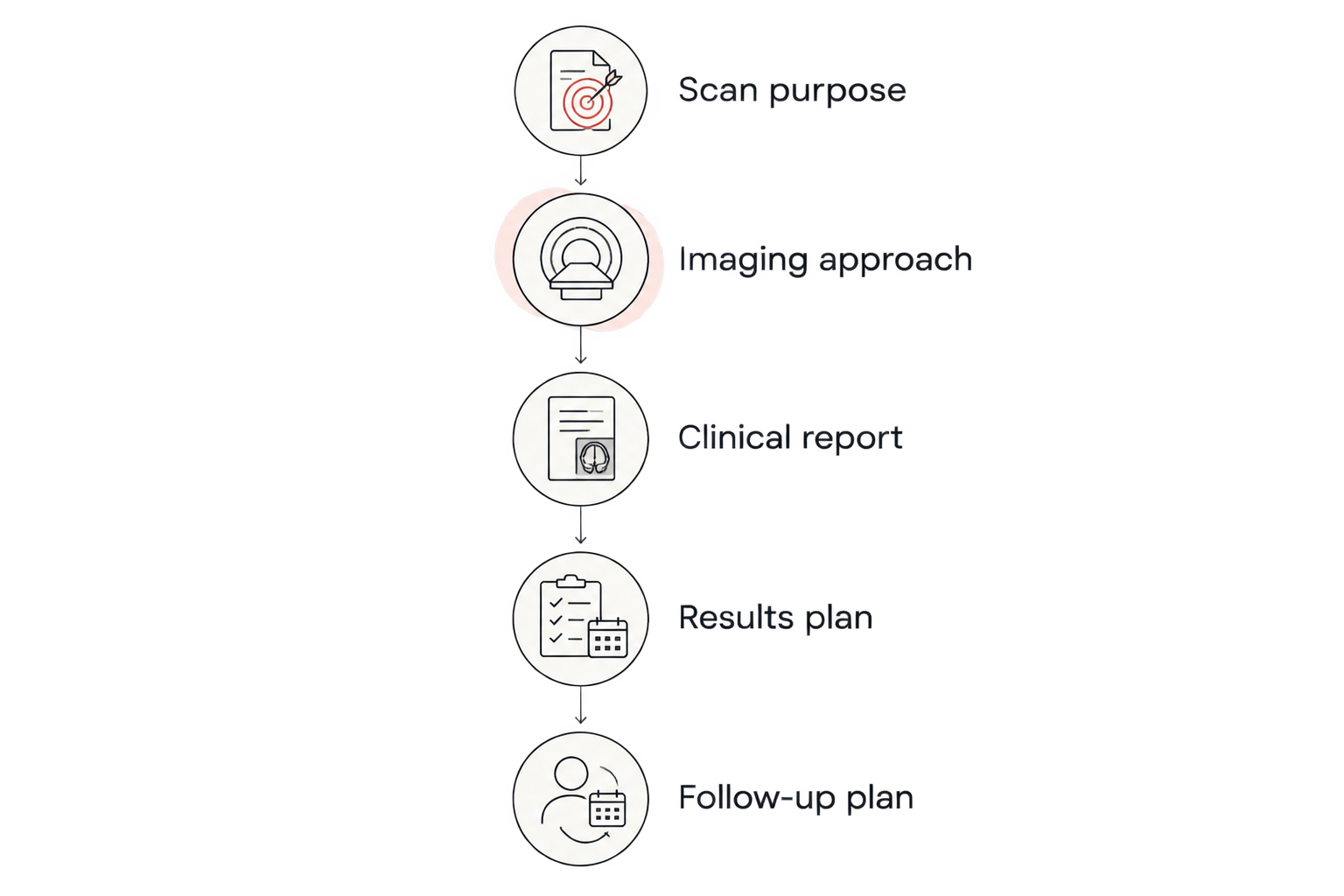
Scan purpose: state the question your clinician needs answered.
Imaging approach: confirm whether transvaginal imaging is offered when needed.
Clinical report: ask what written findings you will receive.
Results plan: establish who receives and discusses the report.
Follow-up plan: identify where unresolved questions will be evaluated.
These details form a connected process: the scan purpose determines the imaging approach, and the clinical report must reach someone responsible for acting on it. A comfortable setting supports the visit; it does not replace that process.
4. Prepare for the imaging approach and your comfort
Ask the imaging provider for preparation instructions rather than copying advice from a later-pregnancy appointment. Early examinations frequently use transvaginal ultrasound because it gives closer views of the uterus and early pregnancy structures.
A transabdominal scan uses a probe over your abdomen and sometimes requires a fuller bladder. Transvaginal imaging generally uses an empty bladder. Follow the instructions for your examination rather than choosing a water amount yourself.
You should receive an explanation and have the opportunity to consent before an internal examination. Tell the team about discomfort, previous difficult examinations, or accommodations you need. You can ask to pause or stop.
Confirm whether the appointment starts abdominally or transvaginally.
Request the provider’s specific bladder instructions.
Bring the imaging order if your clinician or provider requires it.
Ask about support-person arrangements before attending.
Explain any comfort, privacy, or accessibility needs.
5. Review findings with the clinician managing your pregnancy
Ask for a plain-language explanation of what the examination established and what remains uncertain. Early findings can include a gestational sac, yolk sac, embryo, and cardiac activity, depending on the pregnancy’s stage and the examination.
One early scan does not always settle viability. If the pregnancy is too early for a definite assessment, your clinician uses established diagnostic criteria and an appropriate repeat interval. An inconclusive examination is not, by itself, a diagnosis of miscarriage.
If a positive pregnancy test is accompanied by no identified pregnancy location on ultrasound, clinicians use the term pregnancy of unknown location. This requires follow-up because the possibilities include a very early intrauterine pregnancy, pregnancy loss, or an ectopic pregnancy. Do not let an unanswered location question disappear between providers.
Ask whether pregnancy location was definitively established.
Ask which structures were identified and measured.
Request an explanation of any uncertain finding.
Confirm whether repeat blood tests or imaging are needed.
Obtain the next appointment plan and symptom instructions.
6. Coordinate medications, supplements, and the prenatal handoff
Use your existing medication list as the starting point. Send it to the fertility team, including prescribed progesterone, other prescriptions, prenatal vitamins, and nonprescription products. Do not stop prescribed fertility support because of a home test, a symptom change, or an ultrasound image without speaking to the prescriber.
Reviewing fertility supplements after a positive test belongs in the same medication conversation: a supplement used while trying to conceive is not automatically appropriate during pregnancy. Your clinician or pharmacist should review its ingredients, doses, and overlap with your prenatal vitamin.
Before leaving fertility care, identify the clinician who will manage the next stage. A completed scan is not a completed handoff. Your 2026 care plan should connect the treatment history, ultrasound report, medication instructions, and next prenatal appointment.
Send a complete prescription and supplement list.
Confirm who decides when prescribed support changes.
Request copies of relevant blood tests and ultrasound reports.
Identify the receiving obstetric clinician or midwife.
Confirm who handles questions before the first prenatal visit.
Compare early pregnancy imaging options after IUI
The right setting depends on the question being asked. Continuing with your fertility clinic keeps treatment and interpretation together; outside diagnostic imaging requires deliberate communication. Emergency assessment serves a different purpose and must not be replaced by a routine appointment.
Fertility clinic ultrasound
Best for: Initial assessment linked to IUI treatment
Main advantage: Connects imaging with treatment history and blood tests
Key limitation: A separate handoff is needed when care transfers to an obstetric clinician
Obstetric practice ultrasound
Best for: Establishing ongoing prenatal care
Main advantage: Connects findings with subsequent pregnancy management
Key limitation: The practice needs your fertility records to understand the treatment timeline
The Ultrasound Concierge diagnostic ultrasound
Best for: Patients seeking a private setting in Keller or Willow Park
Main advantage: Offers diagnostic and pregnancy imaging in a concierge-style setting
Key limitation: Confirm the specific examination, reporting, and coordination requirements before booking
Elective keepsake ultrasound
Best for: Non-diagnostic pregnancy images
Main advantage: Focuses on the viewing experience
Key limitation: Does not replace medically indicated early-pregnancy assessment
Emergency department assessment
Best for: Severe or concerning acute symptoms
Main advantage: Provides urgent medical evaluation rather than imaging alone
Key limitation: Is not the setting for a routine reassurance appointment
For early pregnancy ultrasound, The Ultrasound Concierge’s private setting is a preference benefit—not a replacement for fertility-clinic oversight. Choose a provider only after confirming that the examination answers the clinical request and that results will reach the responsible clinician.
Common mistakes IUI patients make
Counting pregnancy weeks from insemination alone
Days after IUI and gestational age are different measures. Using them interchangeably can make normal early findings seem delayed. Ask your clinic to write the gestational age on your appointment instructions.
Booking an elective scan to answer a diagnostic question
A viewing appointment cannot substitute for assessment of pregnancy location or suspected complications. Explain the medical question before booking, especially if you have pain, bleeding, or an unresolved earlier result.
Treating a single hCG result as an ultrasound prediction
A blood-test value does not guarantee that a particular structure will be visible. Your clinician considers the trend, symptoms, dating, and scan findings together. Avoid comparing your result with another patient’s image online.
Adding scans without a follow-up plan
More appointments do not automatically produce clearer answers. Clinician-directed timing allows meaningful reassessment, while disconnected visits can leave reports scattered across providers. Keep one clinician responsible for interpreting the sequence.
Know when not to wait for your appointment
Seek emergency care for severe or worsening abdominal or pelvic pain, fainting, marked dizziness, shoulder-tip pain, or heavy bleeding. These symptoms need urgent assessment in early pregnancy, including evaluation for ectopic pregnancy or internal bleeding. Call 911 if you feel faint, collapse, or cannot travel safely.
Contact your fertility team promptly about new bleeding or persistent pain, even if symptoms do not feel severe. Do not use a scheduled reassurance scan—or a previously reassuring image—as a reason to delay medical advice.
FAQ
When should I have my first ultrasound after IUI?
Your fertility clinician should set the timing; an initial scan is often scheduled around 6–7 weeks of gestational age. Pain, bleeding, blood-test findings, or a previous inconclusive examination can change that plan.
How many weeks pregnant am I two weeks after IUI?
You are approximately 4 weeks pregnant two weeks after IUI if insemination closely matched ovulation. Obstetric dating conventionally includes approximately 2 weeks before ovulation; your fertility clinic should confirm your dates.
Will an early ultrasound after IUI be transvaginal?
Transvaginal ultrasound is commonly used in early pregnancy because it gives closer views of early structures. Ask the provider which approach is planned and request an explanation before consenting.
Does no heartbeat on the first ultrasound mean miscarriage?
No cardiac activity on an early scan does not automatically mean miscarriage. Your clinician must interpret the measurements, gestational age, imaging findings, and any repeat examination using established diagnostic criteria.
Can an ultrasound show twins after IUI?
An ultrasound can identify multiple gestational sacs or embryos when they are visible. A very early examination does not always establish the final number, so follow-up depends on the findings.
Can I book a private ultrasound instead of returning to my fertility clinic?
Private diagnostic imaging can be part of your care if it meets your fertility clinician’s requirements. Confirm the examination, reporting arrangements, and follow-up responsibility before replacing a planned clinic visit.
Should I stop progesterone after a reassuring ultrasound?
Do not stop prescribed progesterone unless your prescribing clinician tells you to. A reassuring image does not determine your medication schedule.
What should my 2026 IUI ultrasound checklist include?
Include your treatment dates, pregnancy blood-test results, medication list, scan purpose, and follow-up contact. Add preparation instructions and confirm who will explain the diagnostic report.
One last thing
Ask who will explain an uncertain result before the scan happens. That single question connects the appointment to actual care: you know whom to contact, how the report will reach them, and who decides what happens next. Put that contact beside your appointment details in your 2026 pregnancy notes.