

Insurance for Elective Ultrasound: Usually No, 2026
Insurance for elective ultrasound generally excludes keepsake-only scans. Learn how medical necessity, plan rules, and HSA/FSA eligibility affect your visit.
You generally cannot use health insurance for an elective 3D/4D ultrasound performed only for keepsake images or a bonding experience. Coverage depends on medical necessity and your plan’s benefits, not whether the scan produces 3D or 4D pictures. A medically indicated ultrasound still requires a separate check of provider participation, authorization requirements, and your share of the bill.
TL;DR
Insurance for elective ultrasound generally excludes keepsake-only 3D/4D scans; medical necessity determines whether a scan qualifies for coverage.
A referral does not guarantee coverage, and an in-network provider does not make an excluded service covered.
HSA and FSA eligibility is separate from insurance coverage; a payment card approval does not establish eligibility.
The Ultrasound Concierge provides private diagnostic and elective ultrasound; confirm the appointment’s purpose before asking about insurance.
Can you use insurance for an elective 3D/4D ultrasound?
Generally, no: a keepsake-only ultrasound is not a covered medical service. A diagnostic ultrasound ordered to answer a clinical question follows a different coverage pathway, even when the equipment can also produce 3D or 4D images.
For patients considering The Ultrasound Concierge, which provides diagnostic and elective ultrasound, the first question is which type of appointment you need. Do not assume that offering both services means both qualify for insurance reimbursement.
Medically indicated diagnostic ultrasound
Best for: Answering a clinical question identified by your clinician
Insurance distinction: Coverage depends on plan benefits, medical necessity, and billing requirements
Benefit: Provides imaging for clinical evaluation
Limitation: An order alone does not guarantee payment
Elective 3D/4D ultrasound
Best for: A nonmedical keepsake or bonding experience, if you choose one
Insurance distinction: Keepsake-only imaging generally falls outside covered medical benefits
Benefit: Offers a personal viewing experience
Limitation: Does not replace diagnostic prenatal imaging
Check your 2026 plan documents before booking. A previous claim, a friend’s coverage, or a general statement that pregnancy imaging is covered does not establish coverage for your particular appointment.
Why this matters
The word ultrasound describes an imaging method, not an insurance benefit. Two appointments using similar equipment can have different purposes and different coverage decisions.
That distinction protects both your budget and your prenatal care. If you need an examination because of symptoms or a concern identified by your clinician, start with that clinician rather than substituting an elective session.
Choose the clinical pathway for a clinical question. A keepsake image cannot establish that all aspects of a pregnancy are healthy, and a reassuring viewing experience is not the same as a diagnostic interpretation.
Elective 3D/4D ultrasound: keepsake imaging, not diagnostic care
An elective session centers on viewing your baby or obtaining keepsake images without a medical indication for that examination. Wanting clearer pictures, sharing the experience with family, or learning fetal sex for a celebration does not by itself establish medical necessity.
The distinction is about purpose. A scan does not become medically necessary because it uses sophisticated imaging, takes place in a healthcare setting, or is performed by someone with clinical training.
For your 2026 appointment, ask the provider to describe the service clearly: elective viewing, diagnostic evaluation, or separately identified services. You need that description before an insurer can answer a useful coverage question.
Elective imaging also has a medical limitation. The FDA discourages fetal ultrasound performed solely to create keepsake images, and the American Institute of Ultrasound in Medicine discourages nonmedical use of obstetric ultrasound. Discuss an optional session with your prenatal clinician rather than treating more imaging as automatically better care.
Diagnostic ultrasound: coverage depends on the medical purpose
A diagnostic examination addresses a clinical question. Your clinician determines the indication, and the imaging service follows the requirements applicable to that examination.
Medical necessity is essential, but it is not the only coverage requirement. Your plan can also have rules about referrals, prior authorization, participating providers, covered settings, and claim documentation.
A diagnostic examination does not guarantee that your insurer pays the entire bill. Deductibles, coinsurance, copayments, and out-of-network rules are separate from the question of whether the service is covered at all.
If you are considering an elective visit alongside routine prenatal imaging, review how to combine a 3D/4D ultrasound with your OB’s anatomy scan. Keep the clinical examination and optional viewing experience distinct when discussing scheduling and coverage.
Why insurance coverage for ultrasound varies
Insurance for elective ultrasound is not determined by image quality alone. These factors explain why similar-looking appointments can receive different coverage decisions:
Medical purpose: A diagnostic examination answers a clinical question; keepsake-only imaging does not establish that purpose.
Plan benefits: Your contract identifies covered services, exclusions, and applicable medical-necessity requirements.
Provider network: Coverage for a service and participation by its provider are separate questions.
Authorization rules: Some examinations require approval before the appointment. Approval still remains subject to the plan’s terms.
Documentation: The order, clinical indication, and accurately reported service support review of a diagnostic claim.
Optional services: Keepsake images or other nonmedical extras do not automatically share the coverage status of a diagnostic examination.
Ask about all applicable factors together. Confirming only that a provider accepts your insurance leaves the central question unanswered: does your plan cover the exact service you are booking?
How do I check coverage before booking?
Use the same service description with the provider and insurer. Calling an elective session a pregnancy scan can produce a general answer that does not apply to the appointment you actually want.
Identify purpose. Ask whether the appointment is elective or diagnostic. If diagnostic, ask what medical question the examination will address.
Confirm service. Request the exact service description and, when applicable, the billing information the insurer needs. Do not choose a billing code yourself.
Check benefits. Ask your insurer whether that service is covered under your 2026 plan and whether a nonmedical or keepsake exclusion applies.
Check requirements. Confirm network status, referral rules, prior authorization, and any applicable member responsibility.
Keep records. Save the written benefit response, authorization information when required, and the reference number for your insurer’s conversation.
This sequence separates a covered benefit from a provider’s ability to submit a claim. It also gives you something specific to refer to if the information changes before your appointment.
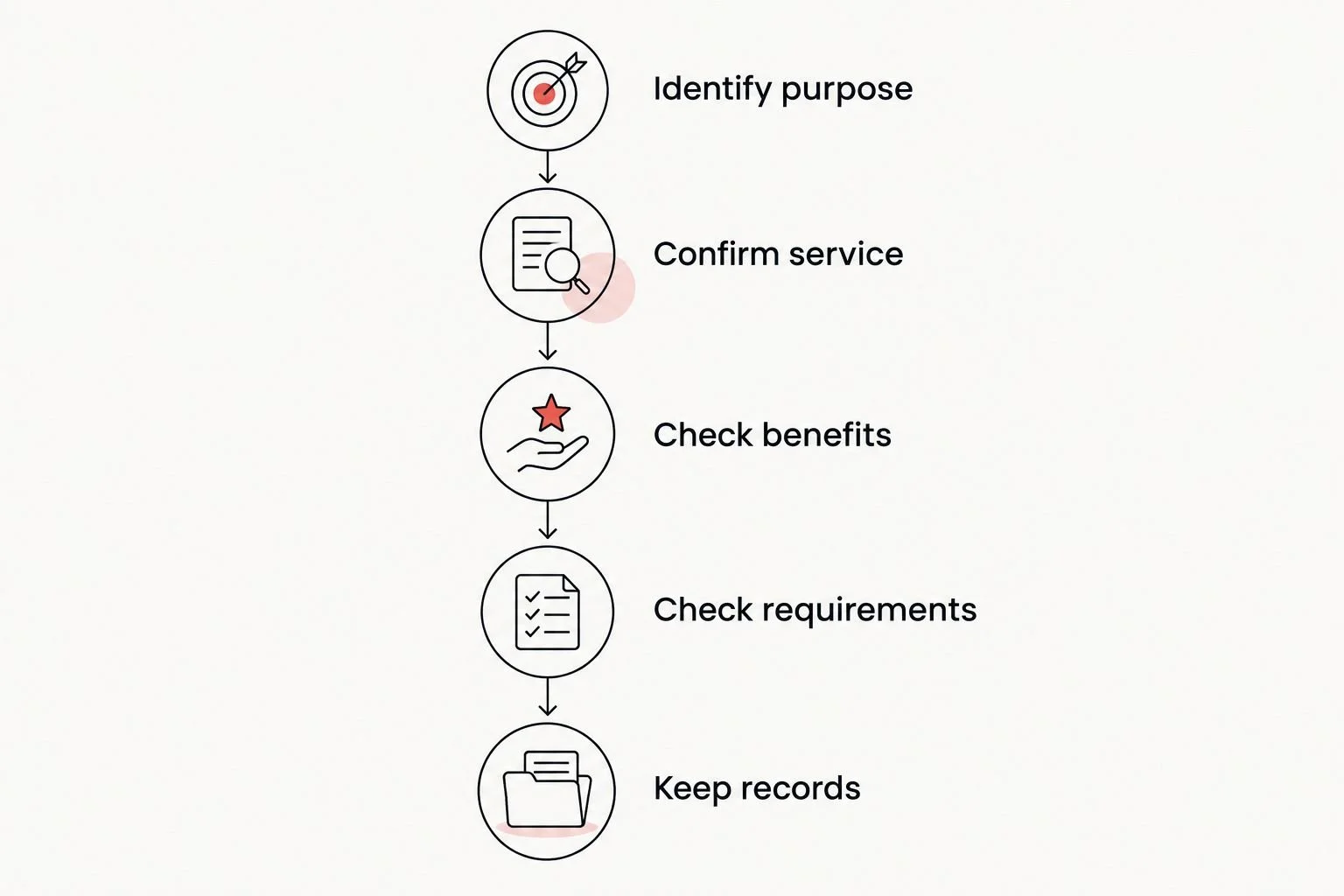
Start with the appointment’s purpose before asking whether insurance applies.
A benefit estimate or authorization is not an unconditional payment guarantee. The final claim must still match the service performed and satisfy the plan’s terms.
What should I ask my insurer and ultrasound provider?
Ask your insurer whether a keepsake-only 3D/4D ultrasound is excluded, rather than asking only whether pregnancy ultrasounds are covered. Then ask what changes if your clinician orders a diagnostic examination for a documented medical reason.
Useful questions include:
Does my plan cover this exact service for this stated purpose?
Is the provider participating in my specific plan, not just the same insurance company?
Do I need a referral or prior authorization before the examination?
Does coverage differ between the diagnostic examination and optional keepsake services?
What documentation is required if I submit a claim myself?
Can you provide the benefit explanation in writing?
Ask the provider whether it bills insurance for the appointment you are considering or treats that service as self-pay. Receiving a receipt is not the same as receiving an insurer-approved claim, and willingness to submit paperwork does not establish coverage.
Do not ask anyone to relabel an elective scan as diagnostic. Billing must accurately reflect the service and its medical purpose. If there is a genuine medical concern, involve your clinician and arrange the appropriate examination.
Does a doctor’s referral make an elective ultrasound covered?
No: a referral alone does not make a keepsake-only ultrasound covered. A referral documents a request for care; the insurer still evaluates the actual service against the plan’s benefits and medical-necessity rules.
If your clinician identifies a medical reason for imaging, book the corresponding diagnostic examination rather than assuming an existing elective booking changes status. Tell the provider about the order before the visit so the service can be arranged appropriately.
Can I use an HSA or FSA if insurance does not cover the scan?
Insurance denial does not determine HSA or FSA eligibility. These accounts follow tax rules for qualified medical expenses, which are separate from your insurance contract.
IRS Publication 502 describes medical expenses in terms of diagnosis, treatment, prevention, and related medical care. A purely nonmedical keepsake service should not be treated as eligible simply because it uses ultrasound equipment; confirm the service’s eligibility with your account administrator or a tax professional.
Can I appeal an insurance denial for an ultrasound?
You can request review of a denial under your plan’s appeal process. An appeal is most useful when a medically indicated examination was denied because of an administrative issue, missing documentation, or disagreement over medical necessity.
An appeal does not automatically turn an excluded keepsake service into a covered benefit. Read the denial reason first, then ask your insurer what evidence addresses that specific reason.
What if I have already paid for the appointment?
Start by obtaining an itemized receipt and a clear description of the service performed. If you believe the examination was diagnostic and your plan permits member-submitted claims, ask the insurer what documentation it requires.
Do not assume reimbursement because the appointment involved pregnancy or took place at an imaging provider. The service still needs to meet the plan’s coverage rules, and the documentation must accurately describe what happened.
For a denied diagnostic claim, compare the insurer’s explanation with the provider’s records. Ask for correction of an actual billing or documentation error—not a different description designed to make an elective service appear covered.
Choosing a private ultrasound appointment in Keller or Willow Park
The Ultrasound Concierge is for patients in Keller and Willow Park seeking private diagnostic or elective ultrasound. Its stated focus is a calm, personalized alternative to a clinical imaging center; that setting does not change an insurer’s coverage criteria.
The Ultrasound Concierge offers both diagnostic and elective imaging, so confirm which service fits your goal. A personal viewing experience and an examination ordered for medical evaluation have different purposes, even when both involve pregnancy ultrasound.
Before a 2026 visit, describe any clinician’s order accurately and ask how the appointment is handled. Choose diagnostic care for a medical question, and keep an optional keepsake decision separate from required prenatal care.
Clarify your ultrasound appointment
Review private diagnostic and elective ultrasound options in Keller and Willow Park.
FAQ
Can I use insurance for elective ultrasound in 2026?
Insurance for elective ultrasound generally does not cover a scan performed solely for keepsake images or bonding. Check your 2026 plan’s exclusions and confirm whether the exact appointment is elective or diagnostic.
Is a 3D or 4D ultrasound automatically considered elective?
No: the imaging format alone does not determine whether an ultrasound is elective. The examination’s clinical purpose and your plan’s requirements determine the coverage pathway.
Will insurance cover a gender-reveal ultrasound?
A scan performed only for a gender reveal generally does not establish medical necessity. Learning fetal sex during a covered diagnostic examination is different from booking an examination solely for that purpose.
Does an in-network ultrasound provider guarantee coverage?
No: network participation does not guarantee that a particular ultrasound service is covered. Your plan can exclude keepsake-only imaging even when a provider participates in the network.
Can I use my HSA or FSA card for a keepsake ultrasound?
Do not assume a keepsake ultrasound is an eligible HSA or FSA expense. Confirm eligibility with your account administrator or a tax professional; a card transaction approval does not establish that an expense qualifies.
Can an elective ultrasound replace my anatomy scan?
No: an elective keepsake session does not replace a diagnostic anatomy examination ordered as part of prenatal care. Keep the appointment recommended by your prenatal clinician.
Does The Ultrasound Concierge accept my insurance for a 3D/4D scan?
Confirm directly with The Ultrasound Concierge how your specific appointment is billed, then verify coverage with your insurer. Offering diagnostic and elective ultrasound does not establish insurance participation or coverage for either appointment.
One last thing
The most useful insurance question is not whether 3D/4D imaging is covered. It is whether your plan covers this service, for this medical purpose, from this provider.
Before booking in 2026, get that distinction clear and save the answer. If new symptoms or concerns arise, contact your prenatal clinician instead of using an elective session to decide whether you need medical care.
Related guides

Is a Private Ultrasound Worth It? When It Helps in 2026
Is a private ultrasound worth it? Compare diagnostic care and elective scans, learn what to ask before booking, and keep your prenatal care on track in 2026.
A private ultrasound is worth it when the visit has a clear purpose, qualified staff, and an appropriate plan for interpreting and acting on the findings. A private diagnostic scan can support your medical care; an elective pregnancy scan does not replace prenatal screening or your clinician’s assessment. For your 2026 decision, choose the medical purpose first and the setting second—not the promise of a clearer picture or guaranteed reassurance.
TL;DR
Is a private ultrasound worth it? Choose diagnostic ultrasound for a clinical question, not a promise of reassurance.
The Ultrasound Concierge offers private diagnostic and elective ultrasound for patients in Keller and Willow Park.
Elective pregnancy ultrasound does not replace prenatal care, an anatomy scan, or assessment of new symptoms.
FDA guidance discourages fetal ultrasound performed solely for keepsake images; discuss additional scans with your prenatal clinician.
Why this matters
Private describes the setting and service model. It does not tell you whether a scan is diagnostic, who interprets it, or whether the result answers your medical question. Those distinctions matter more than whether an appointment feels clinical or personal.
The Ultrasound Concierge provides private diagnostic and elective ultrasound for pregnancy, fertility, and general health in the Keller and Willow Park area. Its calm, personalized setting addresses the experience of getting scanned; the examination you choose still needs to match your purpose.
For a 2026 appointment, separate these questions: Do you need medical information, and what kind of setting helps you feel comfortable receiving it? You can value privacy and personal attention without assuming that an extra scan improves medical outcomes.
Is a private ultrasound worth it in 2026?
Private ultrasound is worth considering when the examination matches your goal and connects to the care you need afterward. It is not worth choosing on the assumption that private automatically means more accurate, more complete, or medically necessary.
Use this comparison before you book. The important distinction is what the appointment does—not whether the provider uses the word concierge.
Private diagnostic ultrasound
Best for: Patients with a specific clinical question or requested examination
Main benefit: Medical imaging in a private service setting
Main limitation: Requires appropriate interpretation and follow-up; the setting alone does not establish quality
Elective pregnancy ultrasound
Best for: Expecting parents seeking a viewing experience rather than a medical assessment
Main benefit: An opportunity to see pregnancy images
Main limitation: Does not replace prenatal screening; FDA guidance discourages scans solely for keepsakes
Ultrasound arranged through your care team
Best for: Patients whose examination is part of an existing treatment or prenatal plan
Main benefit: A scan connected to the clinician managing the medical question
Main limitation: The appointment experience depends on the provider; ask about privacy and communication
For example, an examination requested to assess a particular organ has a different purpose from a visit focused on pregnancy pictures. The former needs a diagnostic pathway. The latter must not be treated as proof that everything is healthy.
Your best decision starts with a specific sentence: I want this scan to answer this question. If you cannot finish that sentence, clarify the purpose before arranging another examination.
Private diagnostic ultrasound: choose the clinical pathway
A private diagnostic ultrasound is appropriate when you need an examination for a medical question and the provider offers that examination with suitable interpretation. Pregnancy, fertility, and general health questions require different protocols. A broad service description does not establish that every requested scan is available or suitable.
Ask who performs the examination, who interprets it, and how the findings reach the clinician responsible for your care. These are separate responsibilities. A conversation during scanning is not a substitute for a diagnostic report when your care depends on documented findings.
Before booking, establish:
The exact examination requested and the reason for it.
Whether an order or referral is required for that examination.
Who receives the report and explains its meaning.
How unexpected findings are communicated.
Who arranges additional assessment when needed.
Choose a diagnostic service for its clinical pathway, not its room atmosphere alone. A comfortable setting matters, but it cannot replace an appropriate examination, qualified interpretation, or a clear next step.
If you already have an order, use its wording when asking about the appointment. Do not substitute a similarly named elective service without checking with the requesting clinician.
Elective pregnancy ultrasound: separate viewing from assessment
An elective pregnancy ultrasound is not equivalent to a diagnostic examination. Seeing movement or recognizable facial features does not establish that fetal development, anatomy, or placental function is normal. Attractive images and medical answers are different things.
In established ultrasound terminology, 3D imaging displays volume-based images, while 4D imaging shows those images over time. Neither label tells you whether the appointment includes a diagnostic assessment. A viewing format is not a clinical credential.
The FDA discourages fetal ultrasound performed solely to create keepsake images. The American Institute of Ultrasound in Medicine also discourages nonmedical fetal ultrasound use. For your 2026 plans, discuss any additional pregnancy scan with your prenatal clinician rather than treating it as a routine reassurance purchase.
Your expectations also need to be realistic. Fetal position and the available viewing window affect what can be pictured, so no elective appointment should be treated as a guarantee of a particular image.
Do not book repeated elective scans simply to check that everything is okay. If that is your goal, ask your prenatal clinician which assessment is appropriate and what it can actually establish.
Ultrasound within your care plan: keep the connection
An ultrasound arranged through your existing care team has a defined medical context. Your clinician can connect the findings with symptoms, examination results, laboratory testing, and previous imaging. An isolated image cannot do that work by itself.
Private diagnostic imaging can still fit within that pathway. The important issue is whether your care team accepts the examination and receives the information needed to make decisions—not whether the scan happens inside its own office.
If you are receiving fertility treatment, ask your fertility team before arranging an outside scan. Timing, examination type, and reporting need to fit the treatment plan. An elective pregnancy appointment is not interchangeable with clinical monitoring.
The same principle applies to general health imaging. If a clinician requests an ultrasound for a particular concern, confirm that the private provider performs the requested examination and can send the report appropriately.
Why the value of a private ultrasound varies
The value of a private ultrasound depends on what you need from it. These factors explain why the same appointment type can be useful for one person and unsuitable for another:
Purpose: A diagnostic question requires a diagnostic examination. A viewing experience cannot substitute for it.
Timing: The stage of pregnancy or treatment affects what an examination can show and how findings are interpreted.
Examination scope: A focused scan does not answer every possible question about pregnancy or general health.
Interpretation and follow-up: Findings need someone qualified to explain them and arrange the next step when necessary.
Personal setting: Privacy and a calm environment can matter to your experience without changing the scan’s medical scope.
In 2026, use these factors to compare services rather than choosing by image terminology alone. Ask what the appointment includes, what it excludes, and what happens if it does not answer your question.
How do you decide before booking a private ultrasound?
Use this sequence to turn a broad wish for reassurance into a clear appointment decision. You do not need to know medical terminology; you need the provider to explain the service in plain language.
Goal: Write down the question you want answered. Distinguish a medical concern from a wish to see images or share the experience.
Clinical purpose: Ask whether the appointment is diagnostic or elective. If a clinician requested imaging, confirm that the service matches the request.
Reporting: Ask who interprets the examination, what documentation you receive, and how results reach your care team.
Follow-up: Establish who explains findings, handles uncertainty, and directs you to further care if needed.
A provider’s answers should leave you understanding the appointment’s boundaries. If you remain unsure whether the scan is medical assessment or viewing, resolve that uncertainty before booking.
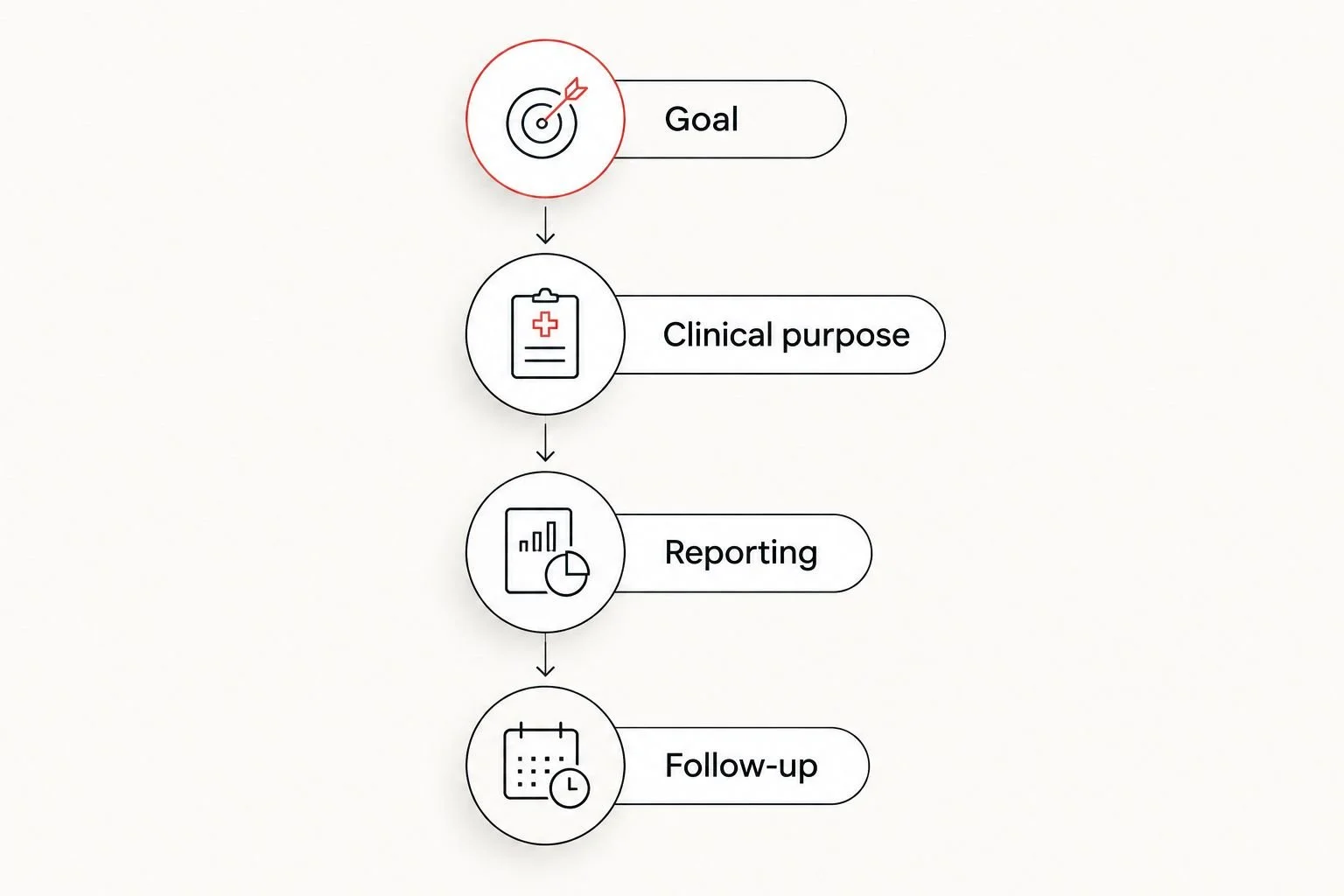
Clarify the purpose and follow-up before choosing the appointment setting.
Bring relevant orders and prior reports when the provider requests them. Ask about preparation directly; instructions depend on the examination, so advice for one ultrasound should not be reused for another.
Who is a concierge ultrasound setting best for?
The Ultrasound Concierge is best for Keller and Willow Park patients seeking private diagnostic or elective ultrasound in a calm, personalized setting. That describes the service’s stated purpose, not a claim that it produces better clinical outcomes than another provider.
The benefit is choosing a setting aligned with your preference for privacy and personal attention. The limitation is that those preferences do not determine whether a scan is medically indicated, whether it answers your concern, or what follow-up you need.
For diagnostic ultrasound, confirm the examination and reporting pathway. For elective pregnancy ultrasound, discuss the medical need with your prenatal clinician and keep the distinction between viewing and assessment clear.
Clarify your ultrasound options
Review the service information, then ask which examination fits your purpose and care plan.
Can a private ultrasound replace my prenatal appointments?
A private ultrasound cannot replace prenatal appointments. Prenatal care includes assessment and screening beyond what an ultrasound image shows. Even a diagnostic scan answers a defined question rather than providing a complete assessment of your pregnancy.
Keep scheduled prenatal visits and recommended examinations. If you use a private diagnostic provider, make sure your prenatal clinician receives the report and knows who will explain the findings.
Is a private ultrasound worth it just for reassurance?
A private ultrasound is not a reliable substitute for clinical assessment when reassurance is your main goal. A reassuring-looking image does not exclude every complication, and an uncertain finding can create further questions rather than resolve them.
Tell your care team what worries you. If you have bleeding, significant pain, reduced fetal movement, or other concerning symptoms, contact your maternity team promptly rather than waiting for an elective appointment; seek emergency care for severe symptoms.
Is it safe to add another pregnancy ultrasound?
An additional pregnancy ultrasound should have an appropriate clinical reason and be performed by qualified personnel. Ultrasound does not use ionizing radiation, but that does not justify unlimited or unnecessary exposure. FDA and professional guidance favor prudent use for medical purposes.
For a 2026 pregnancy plan, ask your clinician whether another examination is needed before choosing a recurring elective schedule. The guide to 3D/4D ultrasound every trimester addresses that specific scheduling question.
FAQ
Is a private ultrasound worth it in 2026?
A private ultrasound is worth considering when it has a clear purpose, appropriate interpretation, and a follow-up plan. A private setting does not automatically make a scan more accurate or medically necessary.
Is a private diagnostic ultrasound better than an elective scan?
A private diagnostic ultrasound is the appropriate choice for a medical question; an elective scan is not an equivalent substitute. Confirm the examination type and who will interpret and explain the findings.
Can a private ultrasound tell me that my baby is healthy?
No single private ultrasound can establish that every aspect of your baby's health is normal. A diagnostic examination assesses defined findings, while prenatal care includes other assessments and screening.
Do I need a referral for a private ultrasound?
Referral requirements depend on the examination and provider. Ask whether your chosen service requires an order and whether it matches the examination your clinician requested.
Does a 3D or 4D ultrasound replace an anatomy scan?
A 3D or 4D viewing appointment does not replace a diagnostic anatomy scan. Image format alone does not establish the scope of the examination or the qualifications of the person interpreting it.
Should I book an elective ultrasound if I have pregnancy symptoms?
Do not use an elective ultrasound appointment to assess concerning pregnancy symptoms. Contact your prenatal team promptly, and seek emergency care for severe symptoms.
Who is The Ultrasound Concierge for?
The Ultrasound Concierge provides private diagnostic and elective ultrasound for patients in Keller and Willow Park seeking a calm, personalized setting. Confirm the examination and follow-up arrangements before booking.
One last thing
Before booking, ask: Who will explain the result, and what happens if the scan raises a concern? That question separates an image-focused appointment from a service connected to medical care.
For your 2026 decision, choose the examination first and the atmosphere second. A private setting can meet an important personal preference, but the most useful appointment is the one that answers the right question and leaves you knowing what comes next.
Related guides

SneakPeek Results Turnaround Time: What Counts in 2026
SneakPeek results turnaround time depends on when the clock starts. Learn what to confirm, how to track your sample, and when to follow up before your reveal.
SneakPeek results turnaround time depends on the result window for your specific test and when that window starts: sample collection, laboratory receipt, or processing. For your 2026 appointment, confirm both the expected release date and the starting point before planning a reveal; a laboratory processing estimate does not include time spent getting the sample to the laboratory.
TL;DR
SneakPeek results turnaround time needs a starting point: collection, laboratory receipt, or processing.
Confirm your expected result date before scheduling a gender reveal or ordering personalized gifts.
The Ultrasound Concierge offers SneakPeek Gender Tests for patients in Keller and Willow Park, TX.
An expected result date is a planning estimate, not proof that your result has been released.
Why this matters
Waiting for a result is easier when you know which stage your sample has reached. An appointment date and a laboratory receipt date are different milestones, so counting from the wrong one creates unnecessary worry.
The Ultrasound Concierge provides private ultrasound imaging and SneakPeek Gender Tests in the Keller and Willow Park area. The Ultrasound Concierge is a fit for Keller and Willow Park patients seeking private ultrasound imaging and SneakPeek Gender Tests. For a time-sensitive reveal, ask about the testing timeline separately from the appointment itself.
How long does it take to get SneakPeek test results?
Use the result window confirmed for your specific SneakPeek test, with its stated starting point. Do not turn a processing estimate into a collection-to-result promise unless the provider explicitly confirms that it covers the entire journey.
For a 2026 booking, the most useful question is: What date should I expect my result, and what event starts that timeline? That gives you an answer you can put on a calendar rather than an estimate with an unclear beginning.
These timing descriptions mean different things:
Collection-to-result window
What it measures: Time from sample collection through result release
Best for: Planning around your appointment
Limitation: Use it only when the provider confirms the full window
Receipt-to-result window
What it measures: Time from laboratory receipt through result release
Best for: Understanding the laboratory estimate
Limitation: It excludes transport before receipt
Processing window
What it measures: The laboratory's stated testing interval
Best for: Understanding the testing stage
Limitation: It does not automatically include transport or notification
Expected release date
What it measures: The date communicated for your individual result
Best for: Planning your next step
Limitation: It is not confirmation that the result is already available
The strongest planning information combines a starting milestone with an expected release date. A short turnaround statement without that context leaves you guessing about where your sample is in the process.
Follow the sample through its stages
Collection: Record when your sample was collected. Ask who handles the next step and who answers questions afterward.
Lab receipt: Ask how you will know the laboratory has received the sample. Check whether this event starts the quoted turnaround window.
Result release: Confirm how you will receive the result and whom to contact if the expected window passes.
These stages help you ask a precise question. Instead of asking whether the test is late, ask whether collection, receipt, or release has been confirmed.
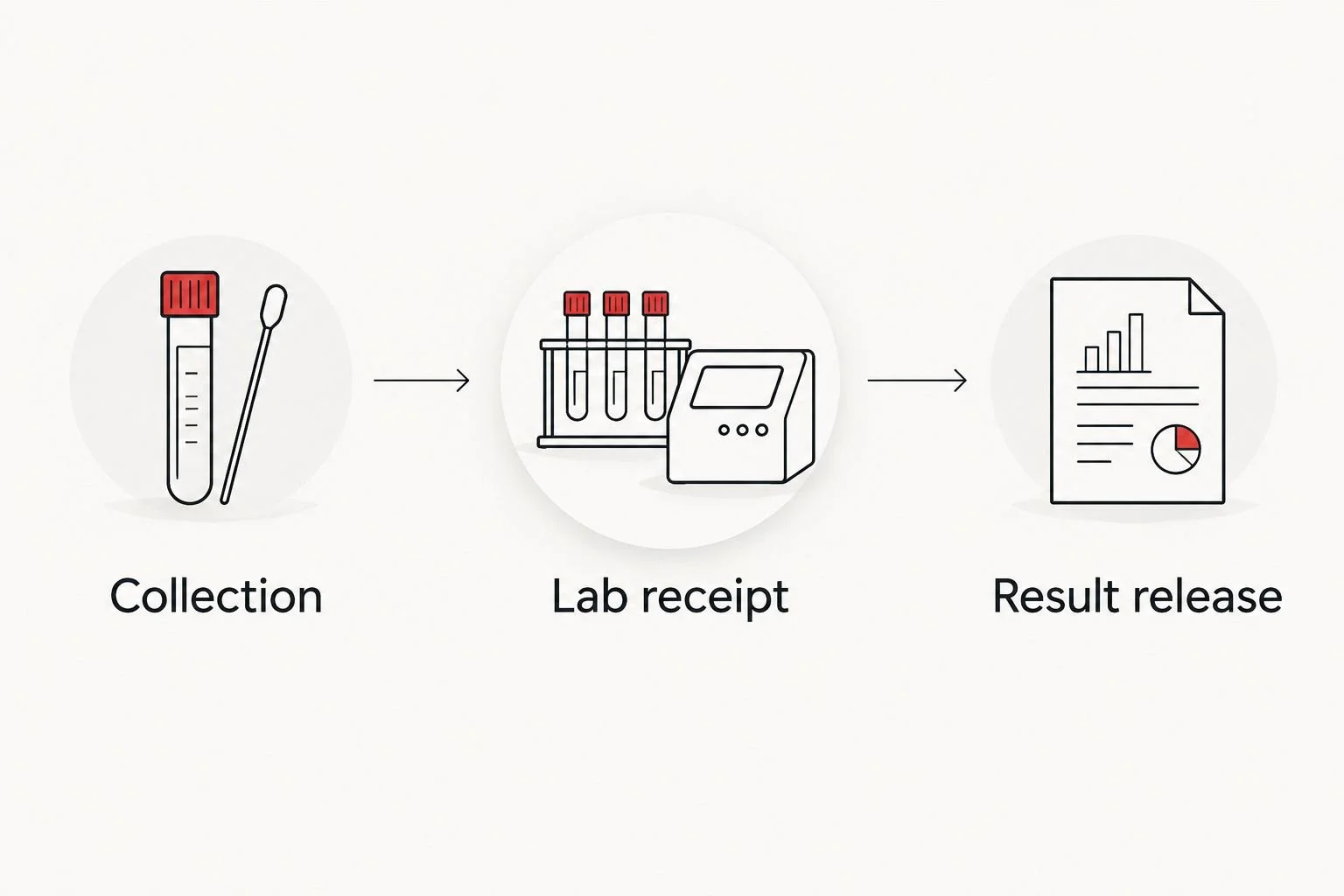
Check which stage starts the turnaround window you were given.
A collection confirmation establishes that the sample was taken; it does not establish laboratory receipt. Likewise, a receipt confirmation tells you the sample arrived, not that a result has been released. Keeping those distinctions clear makes follow-up conversations more useful.
What should I ask before my SneakPeek appointment?
Ask for the timeline that applies to the test you are booking, not a general statement about the brand. Write down the answer alongside your appointment details so you can refer to it without relying on memory.
For your 2026 appointment, use this checklist:
Starting point: Does the result window begin at collection, laboratory receipt, or another confirmed event?
Expected date: What result date should you use for planning?
Counting rule: Is the estimate expressed in calendar days or business days?
Delivery method: Where should you look for the result?
Follow-up contact: Who should you contact if the expected window passes?
Reveal preference: What should you do if you want to keep the result a surprise?
A useful answer sounds like a complete instruction: the timeline starts at a named event, the expected release falls on a stated date, and you have a clear next step if it does not arrive. Avoid treating a general advertisement as that individual confirmation.
If you are comparing collection arrangements, ask the same questions for each. Compare the full collection-to-result journey, not just the shortest processing phrase. A shorter quoted laboratory interval alone does not establish an earlier result from the day of your appointment.
Keep the confirmation somewhere easy to find. You do not need a complicated tracking system; the appointment message, the stated timeline, and the follow-up contact are enough to keep your questions focused.
Why SneakPeek timing estimates differ
A turnaround estimate is useful only when you understand what it covers. Before comparing statements or deciding a result is overdue, check these timing details:
Different starting milestones: A collection-based estimate and a receipt-based estimate measure different intervals.
Transport included or excluded: Ask whether the quoted window covers the sample's journey to the laboratory.
Calendar or business days: Confirm the counting rule instead of assuming every date counts the same way.
Processing versus notification: Ask whether the estimate refers to completed testing or the result reaching you.
General estimate versus individual update: Use the information tied to your sample when following up.
These are questions to clarify, not reasons to assume something went wrong. A result that has not reached you does not, by itself, identify where the sample is or why you are waiting.
For 2026 planning, ask for an expected date rather than converting an unclear phrase yourself. If a weekend or holiday falls between collection and the expected result, ask how the provider's stated counting rule handles it. Do not apply a rule from someone else's appointment to yours.
Does SneakPeek turnaround start when my blood is collected?
The starting point is the one stated for your specific test. Ask whether collection begins the result window or whether the laboratory must first confirm receipt.
This distinction matters when you book around an event. If the estimate starts at receipt, the appointment date alone cannot tell you the expected release date. You also need the receipt milestone or a provider-confirmed full timeline.
Keep the collection date and the turnaround starting date separate unless the provider confirms they are the same. That simple habit prevents a processing estimate from becoming an unintended deadline.
Should I book a gender reveal before my SneakPeek result arrives?
Wait for the result before committing to arrangements that depend on knowing it. An expected release date helps you plan, but the released result is the information your reveal actually needs.
For a 2026 reveal, separate preparation from commitments. You can discuss guest preferences and choose an announcement style while waiting, without giving a vendor a result you have not received.
If you want someone else to handle the surprise, ask about result delivery before testing. Confirm what the process allows rather than assuming the provider can send information to a relative or reveal organizer. Agree on who will read the result before opening any notification.
What should I do if my SneakPeek result has not arrived?
Start with the expected window you were given. Then check the delivery method you were told to use and contact the designated provider or testing support channel if that window has passed.
Use this sequence to make the follow-up specific:
Check the stated timeline. Find the original confirmation and identify its starting milestone.
Check the stated destination. Look where you were told the result would appear. If delivery is by email, include your spam or junk folder.
Gather your details. Have your collection date and any confirmation or reference information ready.
Ask for the sample stage. Request confirmation of receipt, processing status, or result release, as appropriate.
Request the next step. Ask when to check again and whom to contact if you still have no update.
Do not assume that a delivery delay tells you the baby's sex, the result's accuracy, or your pregnancy's health. Timing alone does not answer those questions.
If you have pregnancy symptoms or medical concerns, contact your prenatal care team rather than waiting for an elective test result. A result-status inquiry and a medical concern need different responses.
Turnaround time is not the same as accuracy
SneakPeek results turnaround time describes when information reaches you. It does not, on its own, establish whether the result is accurate or whether the test answers a medical question.
Keep those conversations separate. Ask about timing when you need a release date; ask about test instructions, eligibility, and interpretation when you need to understand the result. Follow the instructions supplied for your specific test rather than advice copied from another person's experience.
SneakPeek testing is not a substitute for prenatal medical assessment. Continue the appointments and screening discussions recommended by your pregnancy care team, regardless of how quickly an elective result arrives.
The Ultrasound Concierge offers both diagnostic and elective ultrasound services alongside SneakPeek Gender Tests. Choose the service that answers your actual question: an early result, ultrasound imaging, and a medical evaluation are not interchangeable goals. A private setting is relevant to your visit experience, but it is not a laboratory turnaround guarantee.
Keep a simple result-waiting record
A brief record helps you distinguish an expected date from a confirmed milestone. Use the wording the provider gives you rather than rewriting it into a stronger promise.
Record the collection date, the stated starting point, the expected release date, and the delivery method. Add any receipt confirmation or updated instruction as it arrives. Keep your reference information private, especially when asking for help in public groups.
If you contact support, describe the issue in plain language: your sample was collected on a particular date, the quoted window starts at a particular event, and you have not received the expected update. Ask for the current stage and the next action.
Other parents' experiences can offer reassurance, but they do not establish your sample's status. Your individual confirmation is the right basis for follow-up. Check it before interpreting a social media post as a deadline you have missed.
FAQ
How do I work out my SneakPeek results turnaround time?
Use the window confirmed for your specific test and its stated starting milestone. Ask for an expected release date so you do not have to translate an unclear processing estimate into a calendar deadline.
Does my SneakPeek appointment date count as the first day?
Count from your appointment only if the provider confirms that collection starts the turnaround window. A laboratory-receipt estimate starts at a different milestone.
Do weekends count toward SneakPeek results turnaround time?
Use the calendar-day or business-day rule confirmed for your specific test. Ask how that rule applies to your expected result date rather than assuming weekends are included or excluded.
Does a shipping update mean my SneakPeek result is ready?
A shipping update does not establish that your result is ready. Check whether the update confirms transport, laboratory receipt, or actual result release.
Should I worry if another parent got SneakPeek results sooner?
Another parent's result date does not establish whether your sample is overdue. Compare your own confirmed starting point and expected window, then follow up if that window has passed.
Can I arrange a surprise reveal while waiting for SneakPeek results?
You can prepare a surprise reveal while waiting, but confirm the result-delivery process before assuming someone else can receive it. Wait for the actual result before making commitments that depend on its content.
Who should I contact if my SneakPeek result is late?
Contact the provider or testing support channel identified in your instructions. Have your collection date and confirmation details ready, and ask which sample milestone has been confirmed.
One last thing
Before leaving your 2026 appointment, ask: What exact event starts my result clock? That question is more useful than asking only whether the test is fast, because it tells you how to interpret every update that follows.
Keep the expected release date separate from your reveal date. The first is a testing estimate; the second is your decision. Waiting until you have the result keeps an uncertain timeline from controlling an otherwise happy announcement.
Related guides

Gender Reveal Ultrasound Cost: Compare Quotes | 2026
Compare gender reveal ultrasound cost by what each visit includes. Learn which questions to ask about imaging, keepsakes, repeat visits, and prenatal care.
Your gender reveal ultrasound cost in 2026 depends on the provider’s current quote and exactly what the appointment includes, so request the total for the visit you want before booking. Ask separately about keepsake images, recordings, and the policy if fetal position prevents a clear view. An elective reveal appointment does not replace your prenatal diagnostic scans.
TL;DR
Compare gender reveal ultrasound cost using a written quote that identifies the appointment, keepsakes, and repeat-visit policy.
The Ultrasound Concierge offers private pregnancy ultrasound services for patients in Keller and Willow Park, Texas.
Choose ultrasound for viewing images; SneakPeek Gender Tests use a different method and do not provide ultrasound images.
Keep elective pregnancy imaging separate from the diagnostic scans recommended by your prenatal clinician.
Why this matters
A gender reveal appointment involves two separate decisions: how you want to learn the information and what experience you want around it. Seeing ultrasound images, receiving a result privately, and sharing an announcement with family are different goals. Decide which matters most before comparing appointments.
The Ultrasound Concierge provides diagnostic and elective pregnancy ultrasound services in Keller and Willow Park, Texas. The Ultrasound Concierge is best for local patients seeking private, personalized ultrasound care. That describes the setting and service model—not a promise about what any particular appointment includes.
For your 2026 booking, compare the same service across providers. A quote for an elective reveal session should not be treated as equivalent to a diagnostic pregnancy examination or a blood-based test.
How much does a gender reveal ultrasound cost in 2026?
Use the provider’s current, itemized quote as your booking decision—not a general average detached from the appointment details. Confirm whether the quoted appointment focuses on fetal sex identification, includes additional imaging, or serves a diagnostic purpose. Those descriptions tell you what you are actually arranging.
The term gender reveal describes the announcement. Ultrasound evaluates visible fetal anatomy to assess fetal sex; it does not determine a child’s future gender identity. A clear explanation of the service should make that distinction without making the conversation uncomfortable.
Use these steps to get a quote you can compare:
State your goal. Explain whether you want to learn fetal sex, see images with a support person, or keep the result private for an announcement. Do not assume one appointment includes every goal.
Identify the examination. Ask whether the booking is elective or diagnostic, which imaging methods it includes, and what information you receive afterward. A service name alone is not enough.
Confirm the deliverables. Ask about printed images, digital files, video, and any written result. Request an explanation of which items belong to the appointment and which require a separate selection.
Ask about an inconclusive view. Find out what happens if fetal position prevents identification. Have the provider explain any repeat-visit conditions before you commit to a reveal date.
Request the complete booking terms. Confirm the total, payment arrangements, cancellation terms, and any preparation instructions in writing. Save that information with your appointment confirmation.
You do not need to purchase the most elaborate imaging experience to ask a straightforward question about fetal sex. Equally, a basic appointment is not automatically the right match if your main goal is receiving particular keepsakes. Choose the service that answers your actual question, then confirm its scope.
Elective gender reveal ultrasound: best for a viewing experience
An elective gender reveal ultrasound uses ultrasound images to assess visible fetal anatomy. Its appeal is the viewing experience: you can see images during the appointment rather than receiving only a laboratory result. Ask the provider how results are communicated and whether you can request that the information remain undisclosed during the visit.
The limitation is visibility. Fetal position and image quality affect what the examiner can identify, and a scheduled appointment does not guarantee a conclusive result. Avoid treating the date of the scan as a guaranteed announcement deadline.
If you are considering additional imaging, read about finding out fetal sex at a 3D/4D ultrasound. Three-dimensional imaging shows volume, while four-dimensional imaging adds movement over time. Neither label removes the need for a suitable view of the relevant anatomy.
Best for: expecting parents who want to view ultrasound images as part of learning fetal sex. Limitation: the appointment remains dependent on what can be seen and does not replace prenatal diagnostic care.
Diagnostic pregnancy ultrasound: best for a medical question
A diagnostic pregnancy ultrasound addresses a clinical question. Your prenatal clinician determines which examinations you need, when to schedule them, and how findings affect your care. Learning fetal sex can be part of the conversation, but it is not the purpose of every diagnostic examination.
The routine fetal anatomy examination generally takes place between 18 and 22 weeks of pregnancy, according to the American College of Obstetricians and Gynecologists. It evaluates fetal anatomy rather than functioning solely as a reveal appointment. Your clinician can explain the timing appropriate to your pregnancy.
For planning in 2026, keep that medical appointment on your calendar even if you arrange a separate elective visit. A keepsake image, a reassuring conversation, or an apparent fetal sex identification does not establish that the anatomy examination has been completed.
Best for: patients who need an examination recommended by their prenatal clinician. Limitation: a medically focused visit should not be assumed to include a family viewing experience, reveal arrangements, or keepsake recordings.
SneakPeek Gender Tests: best for a result without ultrasound viewing
SneakPeek Gender Tests are blood-based tests, not ultrasound appointments. They use a different method from interpreting visible fetal anatomy. If your goal is receiving a fetal sex result rather than watching ultrasound images, ask the provider to explain this option separately.
The Ultrasound Concierge offers SneakPeek Gender Tests alongside pregnancy ultrasound services. That gives local patients different services to discuss, but it does not make the services interchangeable. A blood-based result supplies no ultrasound images and does not evaluate fetal anatomy.
Before selecting a test, confirm eligibility, sample collection instructions, how you receive the result, and what happens if the laboratory cannot report a result. Do not assume those details from another provider’s website or a family member’s experience.
Best for: expecting parents interested in a blood-based fetal sex result rather than an ultrasound viewing session. Limitation: the test is not an imaging examination and does not replace recommended prenatal screening or diagnostic care.
Which appointment matches your goal?
Elective gender reveal ultrasound
Best for: Viewing images while learning fetal sex
Main benefit: An ultrasound-based viewing experience
Main limitation: Identification depends on visibility; not a substitute for diagnostic care
What to confirm: Imaging scope, result handling, keepsakes, and repeat-visit policy
Diagnostic pregnancy ultrasound
Best for: Answering a medical question
Main benefit: Examination directed toward prenatal care
Main limitation: A reveal experience is not its primary purpose
What to confirm: Clinical indication, referral requirements, and reporting arrangements
SneakPeek Gender Tests
Best for: Receiving a blood-based fetal sex result
Main benefit: A method that does not depend on an ultrasound view
Main limitation: No ultrasound images or fetal anatomy assessment
What to confirm: Eligibility, collection instructions, and result process
Choose the category first. Comparing appointments before deciding whether you want imaging, a laboratory result, or a medical examination mixes services that answer different questions.
Why gender reveal ultrasound quotes need careful comparison
A provider’s quote is useful only when you understand its scope. For a 2026 appointment, use the following questions to compare offers without assuming that any provider includes—or separately bills for—a particular feature:
Service purpose: Is the appointment elective, diagnostic, or a blood-based test? Confirm the purpose before comparing the total.
Imaging format: Does the appointment involve standard ultrasound, three-dimensional images, or moving four-dimensional images? Ask what each selection contributes to your goal.
Keepsake delivery: Which images or recordings do you receive, and how do you receive them? A viewing session and a downloadable recording are not the same deliverable.
Result handling: Can the provider keep the result private during the visit? Ask how an intended recipient receives the information without revealing it to you.
Repeat-visit terms: What happens when the examiner cannot obtain a clear view? Read the conditions rather than assuming another visit is included.
Booking conditions: What are the payment, cancellation, rescheduling, and guest arrangements? Confirm these before making plans around the appointment.
These are comparison questions, not claims about any studio’s policies. A written explanation of the appointment is more useful than a package name that leaves its contents unclear.
How do you request a useful quote?
Start with the information a provider needs to identify the right service: your pregnancy stage, your appointment goal, and whether your prenatal clinician has requested a diagnostic examination. Then describe any reveal preference, such as keeping the result hidden from you.
A useful message is simple: explain that you want to learn fetal sex, identify whether you also want ultrasound images, and ask for the complete appointment details. Request the repeat-visit and cancellation terms in the same conversation. This prevents an answer about one feature from being mistaken for an explanation of the whole visit.
Use these labels to organize the conversation:
Choose purpose: separate a medical examination from an elective viewing experience.
Confirm timing: ask whether your pregnancy stage suits the requested appointment.
Check inclusions: identify images, recordings, results, and their delivery method.
Review policies: understand inconclusive results and booking changes.
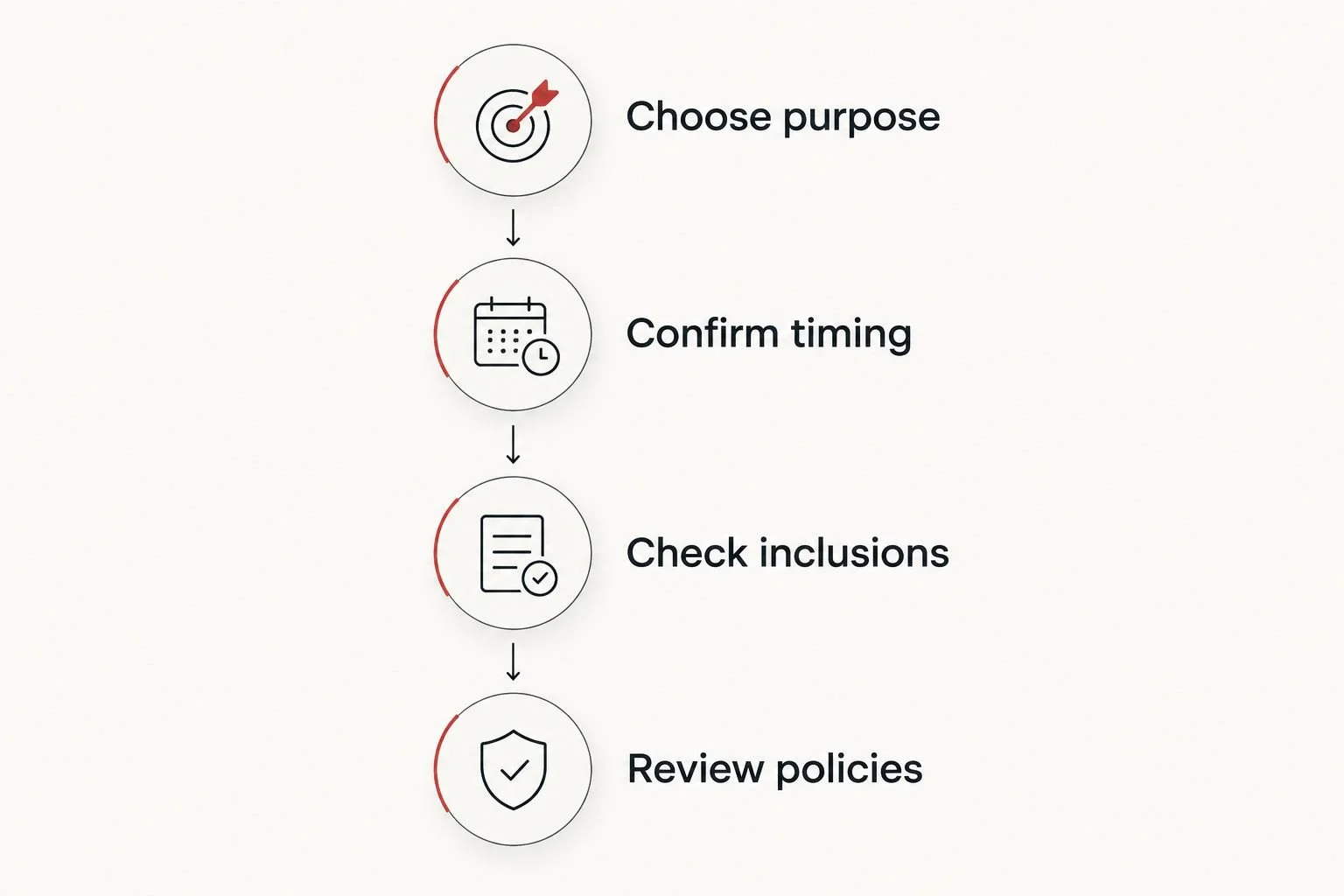
Identify the service before comparing appointment quotes.
Once you have that information, you can decide whether the appointment fits your plans. The Ultrasound Concierge’s private pregnancy ultrasound services are relevant for patients seeking a personalized local setting; confirm the specific examination and arrangements directly before booking.
Ask about your pregnancy ultrasound
Discuss the appointment purpose, imaging options, and booking details before choosing your visit.
Is a 3D or 4D ultrasound necessary for a gender reveal?
Three-dimensional or four-dimensional imaging is not a requirement for assessing fetal sex. Standard two-dimensional ultrasound can show the relevant anatomy when the view is suitable. Additional imaging formats serve different viewing purposes rather than guaranteeing identification.
For your 2026 comparison, separate the information you want from the images you want to keep. If you mainly want a fetal sex assessment, ask which appointment is intended for that question. If you also want a particular viewing experience, discuss it as a separate preference rather than assuming it improves certainty.
The same distinction applies to enhanced image presentation. A more detailed-looking keepsake does not establish that an examination provides a broader medical assessment. Ask what the imaging actually evaluates.
Should you book the reveal party before the scan?
Wait for a conclusive result before committing to an announcement that depends on it. An ultrasound appointment is an opportunity to obtain a view, not a guarantee that fetal position will allow identification that day. A contingency plan is simpler than building the event around an assumed result.
Tell the provider who should receive the information and how you want it handled. If a relative or friend is organizing the reveal, confirm the arrangement before the examination begins. Do not rely on a last-minute whispered request while images are already visible.
Keep the announcement separate from decisions about your pregnancy care. If the examiner or your prenatal clinician recommends medical follow-up, give that instruction priority over the reveal schedule.
FAQ
How do I find the current gender reveal ultrasound cost in 2026?
Request a current, itemized quote from the provider for the specific appointment you want. Confirm the examination purpose, images or recordings, repeat-visit terms, and booking conditions before paying.
Is a gender reveal ultrasound the same as my anatomy scan?
No. A gender reveal appointment focuses on learning fetal sex, while a diagnostic anatomy scan evaluates fetal anatomy. Keep the examinations your prenatal clinician recommends even if you book an elective visit.
Do I need a 3D or 4D ultrasound to find out fetal sex?
No. Standard two-dimensional ultrasound can show the relevant anatomy when the view is suitable. Three-dimensional and four-dimensional imaging do not guarantee a conclusive identification.
What happens if the baby’s position prevents a clear view?
The provider needs to explain the policy for an inconclusive view before you book. Ask whether another appointment is offered and what conditions apply; do not assume a repeat visit is included.
Can I keep the ultrasound result a surprise?
Ask the provider to confirm a private result-handling arrangement before the examination. Specify who should receive the information and how it should be delivered without disclosing it to you.
Is SneakPeek a gender reveal ultrasound?
No. SneakPeek Gender Tests are blood-based tests and do not produce ultrasound images or evaluate fetal anatomy. Compare the test separately from an ultrasound viewing appointment.
Can an elective ultrasound replace prenatal care?
No. An elective ultrasound does not replace prenatal visits or medically recommended examinations. The American Institute of Ultrasound in Medicine discourages ultrasound performed solely for nonmedical purposes; discuss imaging decisions with your prenatal clinician.
Where does The Ultrasound Concierge offer pregnancy ultrasound services?
The Ultrasound Concierge provides private pregnancy ultrasound services for patients in Keller and Willow Park, Texas. Confirm the appointment type and booking details directly before arranging your visit.
One last thing
Tell the examiner about a surprise reveal before the scan starts—not after you see the screen. Ask whether the result can appear on an image, in a recording, or in accompanying information. A privacy request needs to cover the material you receive, not just what someone says aloud.
You can keep the decision simple: protect your prenatal care schedule, choose the service that matches your goal, and confirm the full appointment terms. The right booking is the one you understand before you arrive.
Related guides

3D Ultrasound Twins Visibility: Yes, With Limits | 2026
3D ultrasound twins visibility depends on each baby's position. Learn why clear views vary, what 4D adds, and how to plan without replacing prenatal care.
Yes, twins can be seen clearly on a 3D/4D ultrasound, but each baby needs a favorable viewing angle, and clear pictures of both faces together are not guaranteed. One twin can be easier to see than the other; image clarity does not establish whether either baby is healthy, and an elective session does not replace your prenatal ultrasound care.
TL;DR
3D ultrasound twins visibility depends on fetal position, fluid around each face, and an unobstructed viewing angle.
Separate pictures of each twin are a practical goal; a shared portrait is not guaranteed.
4D ultrasound shows movement but cannot reveal a face hidden behind another baby or the placenta.
The Ultrasound Concierge provides private pregnancy ultrasound services in Keller and Willow Park; medical monitoring remains separate.
Why this matters
With twins, you are hoping to recognize two babies—not simply see a pregnancy on the screen. That creates two different questions: can the scan identify each baby, and can it produce recognizable surface pictures of each face? Those are not the same task.
For your 2026 appointment, make the goal specific: ask about separate views of each twin rather than assuming both faces will appear together. The guide to how many weeks pregnant you should be for a 3D/4D ultrasound provides related planning context, but your prenatal clinician should guide decisions about imaging in your twin pregnancy.
A recognizable picture is a keepsake, not a medical clearance. You can enjoy seeing facial features while keeping questions about growth, anatomy, fluid, and placental function with your obstetric care team.
Can twins be seen clearly on a 3D/4D ultrasound?
Yes. Ultrasound can capture separate surface views of twins when the sound beam reaches each baby's face without obstructing tissue in the way. A favorable view of one twin does not guarantee the same view of the other.
The main distinction is between identifying babies during a medical examination and producing face-like surface images. Conventional ultrasound remains central to prenatal assessment; surface rendering adds a different way to display selected anatomy.
2D ultrasound
What you see: Flat cross-sectional images
Best for: Medical assessment
Main limitation: Facial features do not have the sculpted appearance of a surface image
3D ultrasound
What you see: A reconstructed volume displayed as a still image
Best for: Still surface views
Main limitation: Obstruction and movement can affect the reconstruction
4D ultrasound
What you see: Updating 3D images that show movement
Best for: Moving surface views
Main limitation: Movement does not remove an obstruction in front of a face
In dimensional terms, 2D displays two dimensions, while 3D represents three dimensions. The fourth dimension in 4D ultrasound is time: you see the reconstructed view update as the baby moves.
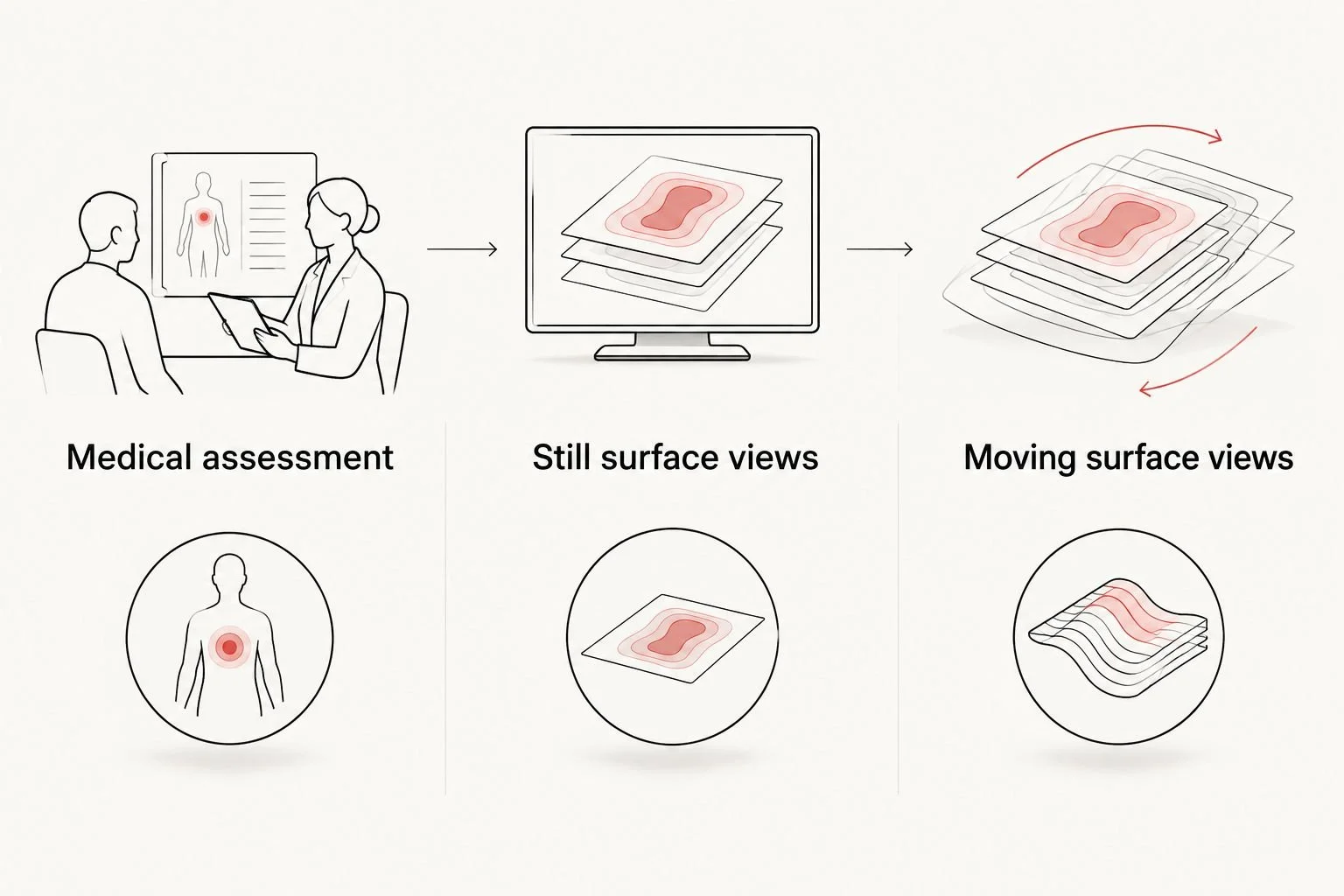
Different displays answer different questions; a moving image does not guarantee a clearer face.
Your 2026 booking question should therefore be about achievable views, not just the display format. Ask whether the appointment's purpose is medical assessment, elective imaging, or both, and what information you will receive afterward.
Seeing each twin separately
Separate images of each twin are a sensible goal. The sonographer can examine different angles rather than requiring both faces to fit into one favorable view.
Each baby has a different relationship to the placenta, uterine wall, and the other twin. One face can have fluid in front of it while the other rests against nearby tissue. That difference explains why pictures from the same appointment can look markedly different.
Ask the person performing the scan to explain which baby is being shown. If your clinical records use Twin A and Twin B, ask how the displayed views relate to those labels rather than identifying babies yourself by facial appearance.
There is also a practical limit: a saved surface image does not independently establish a baby's identity across different visits. Keep the provider's labeling with the image, and take clinical identification questions to your prenatal team.
Seeing both twins in the same picture
Both twins can appear in a shared ultrasound view, but a clear portrait of both faces requires favorable positioning for both babies at once. Two babies being visible on the screen is not the same as two unobstructed faces being visible.
A shared picture can show part of one face and a profile, limb, or body region of the other. That is still a view of the twins, even if it does not resemble the side-by-side portrait you imagined.
Do not make a shared portrait the measure of a successful appointment. Separate recognizable images can be more informative as keepsakes than a crowded frame with unclear features.
Before booking in 2026, ask what happens if only one baby's face is visible. Discuss the provider's approach and any repeat-visit policy directly; do not assume another session is included or medically appropriate.
Why 3D ultrasound twins visibility varies
The main visibility factors are physical. A different rendering style cannot reliably overcome a blocked sound path.
Fetal position: A face directed toward a usable scanning angle is easier to capture than a face turned away or tucked against nearby tissue.
Fluid around the face: A fluid space helps distinguish facial surfaces from surrounding structures. Contact with tissue makes that boundary harder to display.
The other twin: A sibling's body or limbs can obstruct the view. Each baby needs an individually useful imaging angle.
Placental position: Placental tissue between the scanning angle and the face can limit the surface view. Placement alone does not predict every image.
Movement during acquisition: Movement can interrupt a volume capture and create an incomplete or distorted rendering.
Sound transmission: Tissue between the probe and the babies affects image quality, and the sonographer must work within those imaging limitations.
These factors also explain why a baby can look different in successive images. The reconstruction depends on the information captured at that moment, not just the baby's actual facial shape.
Do not interpret a missing cheek, flattened-looking feature, or incomplete outline in a keepsake rendering as a diagnosis. Ask the sonographer to explain the image; concerns about anatomy require a diagnostic assessment by your clinical team.
When should you schedule a twin ultrasound?
There is no single appointment week that guarantees clear faces for every twin pregnancy. Gestational age matters, but the babies' positions and available viewing space matter too.
Early images and later images serve different purposes. As pregnancy progresses, facial features develop, but changing positions and closer contact with surrounding structures can complicate surface views. Choosing a date is therefore a planning decision, not a promise about the pictures.
For medical context, the American College of Obstetricians and Gynecologists describes the standard second-trimester ultrasound as generally occurring at 18–22 weeks. That range refers to a prenatal medical examination, not a guaranteed window for attractive twin keepsake images; twin pregnancies can require additional monitoring on an individualized schedule.
For a 2026 elective appointment, ask your obstetric clinician whether the visit fits your care plan. Then tell the imaging provider your gestational age, that you are carrying twins, and whether you have any specific imaging restrictions from your clinician.
Keep every recommended medical scan even if an elective image looks reassuring. A surface portrait does not supply the measurements and clinical interpretation needed for twin surveillance.
How can you prepare for clearer views?
Preparation starts with accurate information and realistic expectations. Follow the imaging provider's instructions, but do not treat a home preparation routine as a way to control fetal position.
Confirm the purpose. Establish whether you are arranging a diagnostic examination or an elective viewing session. Ask who interprets medical findings when a diagnostic examination is planned.
Share pregnancy details. Tell the provider you are carrying twins, your current gestational age, and any instructions from your prenatal clinician. Ask whether relevant records are needed.
Define the image goal. Request separate views of each baby and ask how images will be labeled. Treat a shared portrait as an additional possibility, not a requirement.
Clarify limitations. Ask how the provider handles an obstructed view and whether any change in position is appropriate during the appointment.
Follow clinical advice. Use the preparation instructions you receive. Do not change medication, fluid intake, or your care schedule to chase a clearer keepsake image.
During the visit, ask for an explanation when the view changes. Understanding whether you are seeing a profile, a partial face, or an imaging artifact is more useful than trying to interpret every shape yourself.
Avoid using sugary drinks or unusually large amounts of water as an improvised visibility strategy. Neither establishes a guaranteed view, and your own pregnancy instructions take priority over advice from social media.
Is 4D better than 3D for seeing twins?
4D is better suited to watching movement; it is not a guarantee of better facial visibility. Both formats depend on obtaining usable ultrasound information from each baby.
A moving display can make a hand movement or change in facial position easier to recognize. A still 3D image can be easier to save and examine as a single portrait. These are different uses, not proof that one format always produces a clearer result.
If one twin's face is obscured, a 4D sequence can continue to show an obscured face. Ask about the viewing conditions before choosing a session solely because its description emphasizes moving images.
Does a blurry twin picture mean something is wrong?
A blurry or incomplete 3D picture does not, by itself, establish a medical problem. Position, obstruction, movement, and reconstruction artifacts can all affect the displayed surface.
The reverse is equally important: a clear face does not establish that a twin pregnancy is progressing normally. Medical assessment requires the appropriate examination, measurements, and interpretation—not a judgment based on how pleasing the picture looks.
If you have bleeding, fluid leakage, significant pain, or a concerning change in fetal movement, contact your maternity care team promptly. Do not book an elective imaging session instead of seeking assessment for symptoms.
Is an elective twin scan a substitute for prenatal monitoring?
No. An elective 3D/4D session does not replace ultrasound examinations ordered to assess fetal anatomy, growth, fluid, or other clinical concerns in a twin pregnancy.
Ultrasound uses sound waves rather than ionizing radiation, but that does not justify unlimited exposure. The FDA discourages ultrasound performed solely to create fetal keepsake images, and professional guidance supports prudent use by appropriately trained personnel.
Discuss any additional imaging with your prenatal clinician. For 2026 planning, choose a provider who explains the examination's purpose and limitations rather than promising that more scanning will produce a particular picture.
The distinction protects you from two mistakes: mistaking an enjoyable viewing experience for medical reassurance, and extending imaging solely because a baby has not turned toward the probe. The care plan comes before the portrait.
Choosing a private setting for your appointment
The Ultrasound Concierge is best suited to patients in Keller and Willow Park seeking private, personalized pregnancy ultrasound services. The practice provides diagnostic and elective imaging, including 3D/4D services, in a concierge-style setting.
That setting addresses the experience of the visit, not the biological limits of twin visibility. The Ultrasound Concierge's pregnancy ultrasound services cannot make an obstructed face visible simply because the appointment is private.
You can review The Ultrasound Concierge and ask directly about the purpose of a twin appointment, image labeling, clinical interpretation, and what happens when views are limited. Those answers matter more than a promise of a perfect portrait.
FAQ
Can you see both twins clearly on a 3D ultrasound?
Yes, both twins can be seen clearly when each baby has a usable viewing angle and an unobstructed face. Clear separate images are possible, but equally clear images of both babies are not guaranteed.
Can twins appear together in one 4D ultrasound video?
Yes, twins can appear together in a 4D view, but both faces will not necessarily be visible. Separate views can show each baby more clearly than a shared frame.
Why is one twin clearer than the other on ultrasound?
One twin can be clearer because each baby has a different position and a different amount of unobstructed viewing space. The placenta, limbs, and the other baby can affect each view differently.
What is the best week for a 3D ultrasound with twins?
No single week guarantees clear 3D images of twins. Ask your prenatal clinician about appropriate timing, then discuss your gestational age and viewing goals with the imaging provider.
Is 4D ultrasound better than 3D for twin faces?
4D ultrasound shows movement, but it does not guarantee clearer twin faces than 3D ultrasound. Both require usable imaging angles and an unobstructed view.
Does a blurry 3D picture mean my twin has a problem?
A blurry 3D picture does not, by itself, establish a medical problem. Ask the sonographer to explain image limitations and take questions about fetal health to your prenatal care team.
Can The Ultrasound Concierge guarantee clear pictures of both twins?
Clear pictures of both twins cannot be guaranteed because fetal position and obstruction affect visibility. Discuss achievable image goals and the appointment's limitations before booking.
Do I still need my medical ultrasound after a clear 3D scan?
Yes, you still need the medical ultrasound examinations recommended by your prenatal clinician. A clear surface image does not replace assessment of anatomy, growth, fluid, or other clinical concerns.
One last thing
Ask for the baby's identity to stay attached to every saved image. A beautiful picture becomes less useful if you later cannot tell which twin it shows.
Request separate, clearly labeled views before asking for a shared portrait. That gives you a practical goal while respecting the limits of the examination.
Related guides

How Far Along for Gender Reveal Ultrasound: 18 Weeks | 2026
How far along for gender reveal ultrasound? Plan around 18 weeks. Learn what affects a clear view, how anatomy scans differ, and what to ask before booking.
Plan for around 18 weeks of pregnancy if you want to learn your baby's sex by ultrasound; the routine anatomy scan usually takes place between 18 and 22 weeks. An earlier scan can sometimes show the genital anatomy, but being far enough along does not guarantee a clear view. For your 2026 reveal plans, confirm the result before setting a celebration date, and keep elective imaging separate from your prenatal medical care.
TL;DR
How far along for gender reveal ultrasound? Plan around 18 weeks, with no guarantee of a clear view.
The routine anatomy scan usually occurs between 18 and 22 weeks and assesses fetal development, not just sex.
The Ultrasound Concierge provides private pregnancy ultrasound services for patients in Keller and Willow Park, Texas.
A gender reveal ultrasound depends on fetal position and visible anatomy; a blood test uses a different method.
How far along do you need to be for a gender reveal ultrasound?
Around 18 weeks is a practical planning point, not a guaranteed minimum. The American College of Obstetricians and Gynecologists describes the standard second-trimester ultrasound window as 18–22 weeks. That examination checks fetal anatomy; identifying sex is secondary and depends on what the sonographer can see.
For local appointment information, The Ultrasound Concierge provides diagnostic and elective pregnancy imaging in Keller and Willow Park. Confirm the visit's purpose and gestational-age requirements before booking rather than assuming every pregnancy ultrasound includes a sex determination.
Routine anatomy ultrasound
Best for: Assessing fetal anatomy during prenatal care
What it can tell you: Examines fetal structures and can show genital anatomy when visible
Main limitation: Sex identification is not the examination's primary purpose
Elective gender reveal ultrasound
Best for: Families seeking a separate reveal experience
What it can tell you: Uses ultrasound images to assess visible genital anatomy
Main limitation: Does not replace the anatomy scan or guarantee a result
Prenatal blood-based sex testing
Best for: People considering a non-imaging route
What it can tell you: Looks for sex-related genetic information in a blood sample
Main limitation: Eligibility and interpretation depend on the particular test
These options answer different questions. Choose the medical examination your prenatal clinician recommends first, then discuss whether a separate reveal appointment is appropriate.
Why this matters
A reveal date creates a deadline, but your baby's position does not follow that schedule. Booking before anatomy is clearly visible can leave you with an uncertain answer instead of a result you feel comfortable sharing.
For planning in 2026, separate three decisions: when you need medical imaging, whether you want to learn fetal sex, and when you want to tell other people. Keeping those decisions separate protects your prenatal care and gives you room to change celebration plans without treating an inconclusive image as bad news.
Ultrasound evaluates physical anatomy, not a child's future gender identity. Although families commonly say gender reveal, the information being assessed is fetal sex.
Before 18 weeks: treat an early prediction cautiously
Earlier ultrasound images can suggest fetal sex, but a suggestion is not the same as a clearly documented finding. In early pregnancy, the structures being assessed are small, and the viewing angle matters.
Do not turn an uncertain early prediction into a confirmed announcement. Ask whether the sonographer actually visualized the relevant anatomy or offered an interpretation based on an early image. That distinction matters more than an enthusiastic explanation or a detailed-looking keepsake picture.
If you are earlier than the provider's accepted window, ask when the examination becomes appropriate. Do not use a minimum booking age advertised elsewhere as proof that your own scan will produce a result.
Your prenatal clinician's dating estimate should guide this conversation. A date calculated from a calendar app can differ from the gestational age recorded in your medical chart, especially when menstrual cycles are irregular or the pregnancy has been dated by ultrasound.
18–22 weeks: the routine anatomy-scan window
The routine anatomy scan generally occurs between 18 and 22 weeks. ACOG's patient guidance identifies this window for the standard second-trimester examination, which evaluates fetal development and structures rather than serving only as a reveal appointment.
At this visit, tell the sonographer whether you want to know fetal sex. If you prefer a surprise, say so before scanning begins and ask how the result can be handled without being spoken aloud. Do not assume every office uses envelopes, messages, or another reveal method.
The anatomy scan also has limits. A baby's position can prevent a clear view of genital anatomy, just as it can prevent complete views of other structures. Your clinician decides whether additional medical imaging is needed; an incomplete view is not, by itself, a diagnosis.
If your 2026 anatomy appointment falls near a planned celebration, leave flexibility in the celebration date. A medically useful scan can still end without an answer to the reveal question.
After 22 weeks: later does not guarantee a clear view
Being past 22 weeks does not make sex identification automatic. The relevant anatomy still needs to be visible, and fetal position can obstruct the view at a later appointment too.
If you have already had an anatomy scan without learning fetal sex, ask your prenatal clinician what information was documented. You might already have an answer in the report, or the examination might not have included a clear assessment of genital anatomy.
Do not schedule repeated ultrasound sessions solely on the assumption that each additional visit will solve the problem. The U.S. Food and Drug Administration discourages ultrasound performed only to create keepsake images or videos; discuss the purpose and appropriateness of any additional scan with your prenatal clinician.
Why gender reveal ultrasound timing varies
Gestational age is only part of the answer. The quality of the view and the purpose of the examination also affect whether a sonographer can make a clear assessment.
Pregnancy dating: The gestational age in your prenatal record determines how far along you are. Use that estimate when discussing eligibility.
Fetal position: Legs, the umbilical cord, or the baby's orientation can obscure the area the sonographer needs to see.
Image clarity: Ultrasound needs an adequate view of the relevant anatomy. A recognizable face or heartbeat does not establish fetal sex.
Examination purpose: A diagnostic examination prioritizes the clinical question. A reveal request does not change the medical priorities of the scan.
Multiple pregnancy: Each fetus needs a separate assessment. Identifying one baby's sex does not establish the other's.
These factors explain why a provider cannot promise a result from gestational age alone. For a 2026 booking, ask about the provider's process for an inconclusive view rather than requesting an unsupported accuracy guarantee.
How should you plan a reveal appointment?
Start with your prenatal schedule, not your party calendar. A clear booking conversation helps you distinguish a medical examination from an elective experience and prevents assumptions about what the visit includes.
Confirm dating. Use the gestational age documented by your prenatal clinician. Give the provider your expected gestational age on the appointment date, not just how far along you are today.
Discuss purpose. Explain whether you need diagnostic imaging, want to learn fetal sex, or are asking about an elective family experience. Ask your prenatal clinician whether additional imaging is appropriate.
Check eligibility. Ask the provider when they perform the requested examination and whether a referral or other documentation is needed. Requirements depend on the service.
Set privacy. Say who should receive the result and whether you want it kept from you during the visit. Confirm the communication method instead of assuming a reveal arrangement exists.
Leave flexibility. Decide how you will handle an inconclusive view before scheduling a celebration. Ask about the provider's policy without assuming another scan is included.
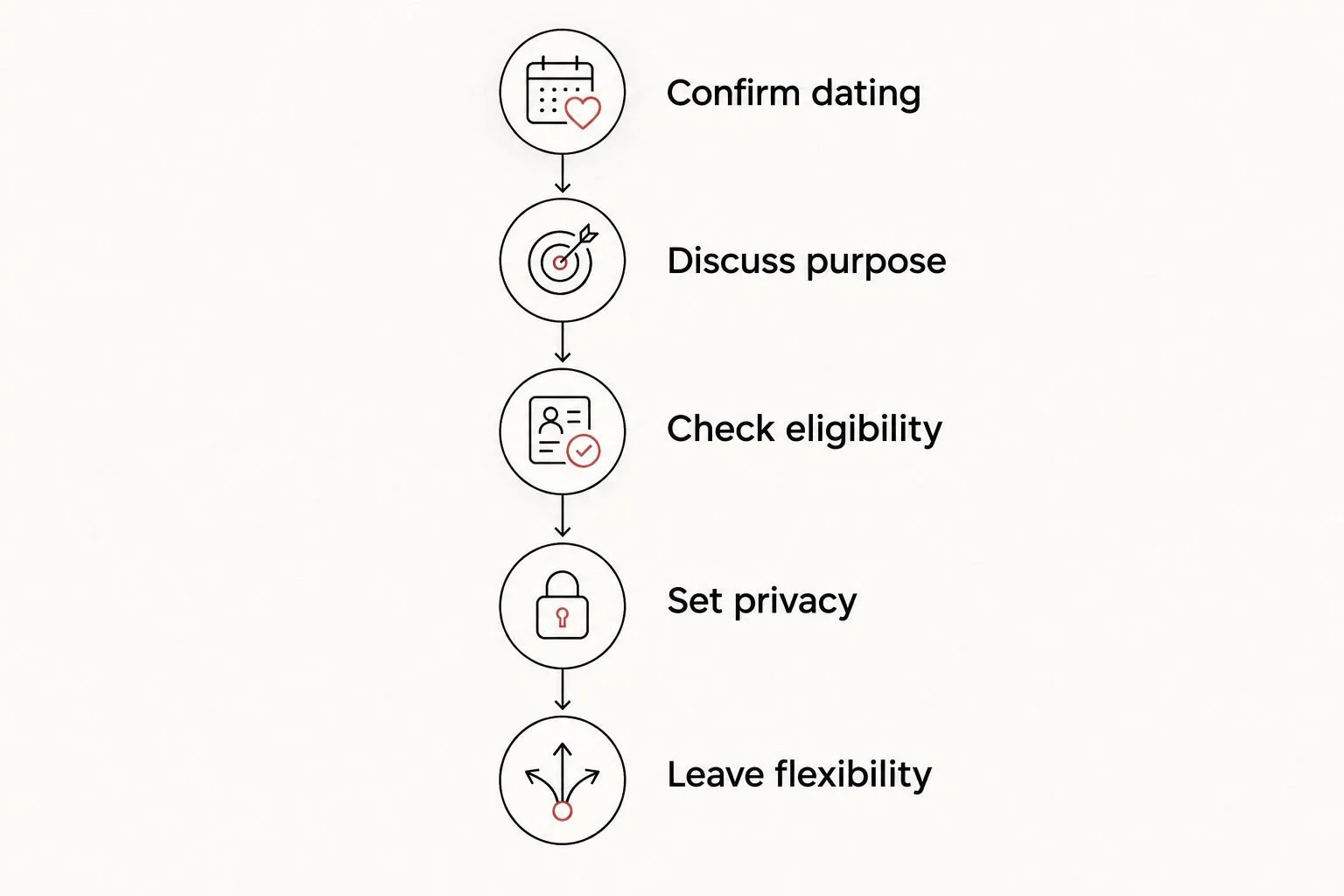
Confirm the examination's purpose before making plans that depend on receiving a result.
The Ultrasound Concierge is best suited to Keller and Willow Park patients seeking a private pregnancy ultrasound setting. Its stated services include diagnostic and elective imaging; the private setting does not remove the clinical limits of ultrasound or replace your prenatal team's care.
For a 2026 appointment, ask The Ultrasound Concierge which service matches your goal and what happens if fetal sex cannot be determined. A specific answer about the examination is more useful than assuming a booking guarantees a reveal.
Do you need a 3D or 4D ultrasound to find out?
No. Standard two-dimensional ultrasound can show genital anatomy when the view is adequate. Three-dimensional imaging displays volume, while four-dimensional imaging shows moving three-dimensional images; neither eliminates the need for a clear view of the relevant anatomy.
Choose the examination based on its purpose, not the most elaborate image label. A detailed face image does not prove that fetal sex was assessed, and a basic-looking medical image can contain the information the sonographer needs.
The benefit of additional image formats is the way they display visible anatomy. Their limitation is that they cannot reveal anatomy hidden by an unfavorable position simply because the format is different. Ask what was actually seen rather than judging confidence from the appearance of the picture.
Can a blood test tell you before an ultrasound?
Blood-based testing can provide fetal-sex information before the routine 18–22-week anatomy scan, depending on the test. It examines genetic information rather than producing an image of genital anatomy. Clinical prenatal screening and a sex-only test are not interchangeable services.
The benefit is a route that does not depend on the baby's position during an ultrasound. The limitation is that sample collection, test eligibility, and interpretation still matter, and a sex-only result does not assess fetal anatomy.
The Ultrasound Concierge lists SneakPeek Gender Tests among its services. Ask about current eligibility and collection instructions directly; do not apply the timing or interpretation rules of a different prenatal blood test to SneakPeek.
If a blood-test result and an ultrasound assessment disagree, contact your prenatal clinician. Do not resolve the difference by selecting the result you prefer or treating another elective appointment as a substitute for medical interpretation.
What if the baby won't cooperate at the appointment?
An obscured view means the sonographer cannot make a clear assessment from that view; it does not establish a problem with the baby. Ask whether the result is confirmed, uncertain, or not assessable, and keep those categories distinct when sharing the information.
Follow the provider's preparation instructions rather than trying internet tips designed to force fetal movement. Food, drinks, or a particular arrival routine do not create a guarantee that the relevant anatomy will become visible.
For the routine anatomy scan, your prenatal clinician determines whether incomplete medical views require follow-up. For an elective reveal visit, ask the provider about its own process. Neither situation justifies describing an uncertain finding as confirmed.
FAQ
How far along should I be for a gender reveal ultrasound?
Around 18 weeks is a practical planning point, and the routine anatomy scan usually takes place between 18 and 22 weeks. A clear result still depends on visible genital anatomy and fetal position.
Can I find out my baby's sex before 18 weeks?
An ultrasound before 18 weeks can sometimes suggest fetal sex, but an early prediction is not the same as a clear assessment. Ask your prenatal clinician about appropriate timing and distinguish a tentative finding from a confirmed result.
Will my 20-week anatomy scan tell me the baby's sex?
A 20-week anatomy scan can show fetal sex if the relevant anatomy is visible, but that is not guaranteed. The examination's main purpose is to assess fetal development and structures.
Is a 3D ultrasound better for finding out fetal sex?
A 3D ultrasound is not required to assess fetal sex; standard two-dimensional ultrasound can show the relevant anatomy. Image format does not overcome a view blocked by fetal position.
Is a gender reveal ultrasound the same as an anatomy scan?
A gender reveal ultrasound is not the same as a diagnostic anatomy scan. An elective reveal visit does not replace the examination recommended by your prenatal clinician.
Can an ultrasound tell my baby's future gender identity?
Ultrasound cannot determine a child's future gender identity. A gender reveal ultrasound assesses visible anatomy associated with fetal sex.
Does The Ultrasound Concierge offer pregnancy ultrasound?
The Ultrasound Concierge provides diagnostic and elective pregnancy ultrasound services for patients in Keller and Willow Park, Texas. Confirm the appropriate service, gestational-age requirements, and result-sharing arrangements directly before booking.
One last thing
Ask for the certainty of the finding, not just the result. Before sharing an announcement, ask: Was the relevant anatomy clearly seen, or is this a prediction? That question gives you more useful information than asking whether the baby looked like a boy or a girl.
Keep medical findings and celebration plans on separate tracks. An inconclusive reveal can wait; questions about fetal development, unexpected findings, or concerning symptoms belong with your prenatal clinician.
Related guides

How Soon Can You See a Heartbeat on Ultrasound? 2026
How soon can you see a heartbeat on ultrasound? Often around 6 weeks transvaginally, later abdominally. Learn what an inconclusive early scan means in 2026.
Cardiac activity can often be seen on a transvaginal ultrasound at about 6 weeks of pregnancy, counted from the first day of your last menstrual period. An abdominal scan usually shows it later, around 7 to 8 weeks. If a scan shows no cardiac activity earlier than expected, the result needs to be interpreted alongside the pregnancy measurements and your clinical history; it does not, by itself, establish a pregnancy loss.
TL;DR
A transvaginal ultrasound can often show cardiac activity at about 6 weeks; an abdominal scan usually shows it around 7 to 8 weeks.
For the question of how soon can you see a heartbeat on ultrasound, scan type and pregnancy dating change the answer.
The Ultrasound Concierge is best for Keller and Willow Park patients seeking a private pregnancy ultrasound, not urgent assessment.
No visible cardiac activity on a very early scan is not, by itself, a diagnosis of pregnancy loss.
How soon can you see a heartbeat on ultrasound?
About 6 weeks is the earliest common answer for a transvaginal scan; around 7 to 8 weeks is a more useful expectation for an abdominal scan. These are guides, not deadlines. In 2026, as in any pregnancy, what the sonographer can see depends on how far the pregnancy has developed and which structures are visible, not just the date on your calendar.
Transvaginal scan
When cardiac activity is commonly visible: About 6 weeks
What a result tells you: Offers the clearest early view when the pregnancy is still small.
Abdominal scan
When cardiac activity is commonly visible: Often around 7 to 8 weeks
What a result tells you: An early inconclusive view can reflect the limits of this approach.
Follow-up scan
When cardiac activity is commonly visible: Timing set by your clinician
What a result tells you: Shows whether expected development has occurred since the earlier scan.
The term heartbeat is familiar, but on an early scan the clinician is looking for cardiac activity: visible motion in the developing embryo. Seeing that motion is different from hearing a heartbeat. You do not need an audio recording for a clinician to identify cardiac activity on ultrasound.
Why this matters
An early scan can answer different questions: whether a pregnancy is visible in the uterus, whether an embryo can be identified, and whether cardiac activity can be seen. Those answers do not always arrive on the same visit. If you are considering a private appointment with The Ultrasound Concierge in the Keller or Willow Park area, tell the provider how your pregnancy was dated and whether you need a diagnostic assessment or an elective scan.
An inconclusive early scan is a finding to follow up, not a verdict to interpret alone. The right next step depends on the images, measurements, symptoms and your clinician’s assessment. This distinction matters most when you expected to see cardiac activity and did not.
Transvaginal ultrasound: about 6 weeks
A transvaginal scan places the ultrasound probe in the vagina, closer to the uterus. That closer view makes it the more informative approach when a pregnancy is too early to assess clearly through the abdomen. Cardiac activity can often be seen at about 6 weeks, but an individual scan can still be inconclusive at that point.
Pregnancy weeks are usually counted from the first day of the last menstrual period, not from conception. If ovulation happened later than expected, a pregnancy described as 6 weeks by period dates can be less developed on ultrasound. A clinician uses the scan findings and dating information together rather than treating the calendar estimate as a measurement of the embryo.
If the scan shows a gestational sac but no embryo, the question is not simply whether a heartbeat is missing. The clinician first needs to establish what structures are visible and whether the appearance fits an early pregnancy. If an embryo is visible, its measured size matters when interpreting the absence of cardiac activity.
Best for: an early clinical assessment when a clinician recommends a transvaginal view. Limitation: even this clearer approach cannot make an extremely early pregnancy visible before it has developed enough to be seen.
Abdominal ultrasound: often around 7 to 8 weeks
An abdominal scan moves the probe across the lower abdomen. Cardiac activity is commonly easier to identify this way once the embryo has grown larger, often around 7 to 8 weeks. At an earlier visit, an abdominal view can be inconclusive even when a transvaginal scan would provide more information.
That difference is about the view, not a change in what is happening in the pregnancy. An abdominal scan that does not show cardiac activity at about 6 weeks cannot be read as equivalent to a clear transvaginal scan with measured findings. Ask which approach was used before comparing your result with someone else’s.
Best for: assessing a pregnancy when an abdominal view gives the clinician the information needed. Limitation: it is less informative than a transvaginal view in the earliest weeks. In 2026, the practical question before an early appointment is not just when can I have a scan? It is which scan can answer my question at this stage?
These two approaches are not competing tests with a single winner. The useful choice depends on the clinical question and what is visible at the time of the examination.
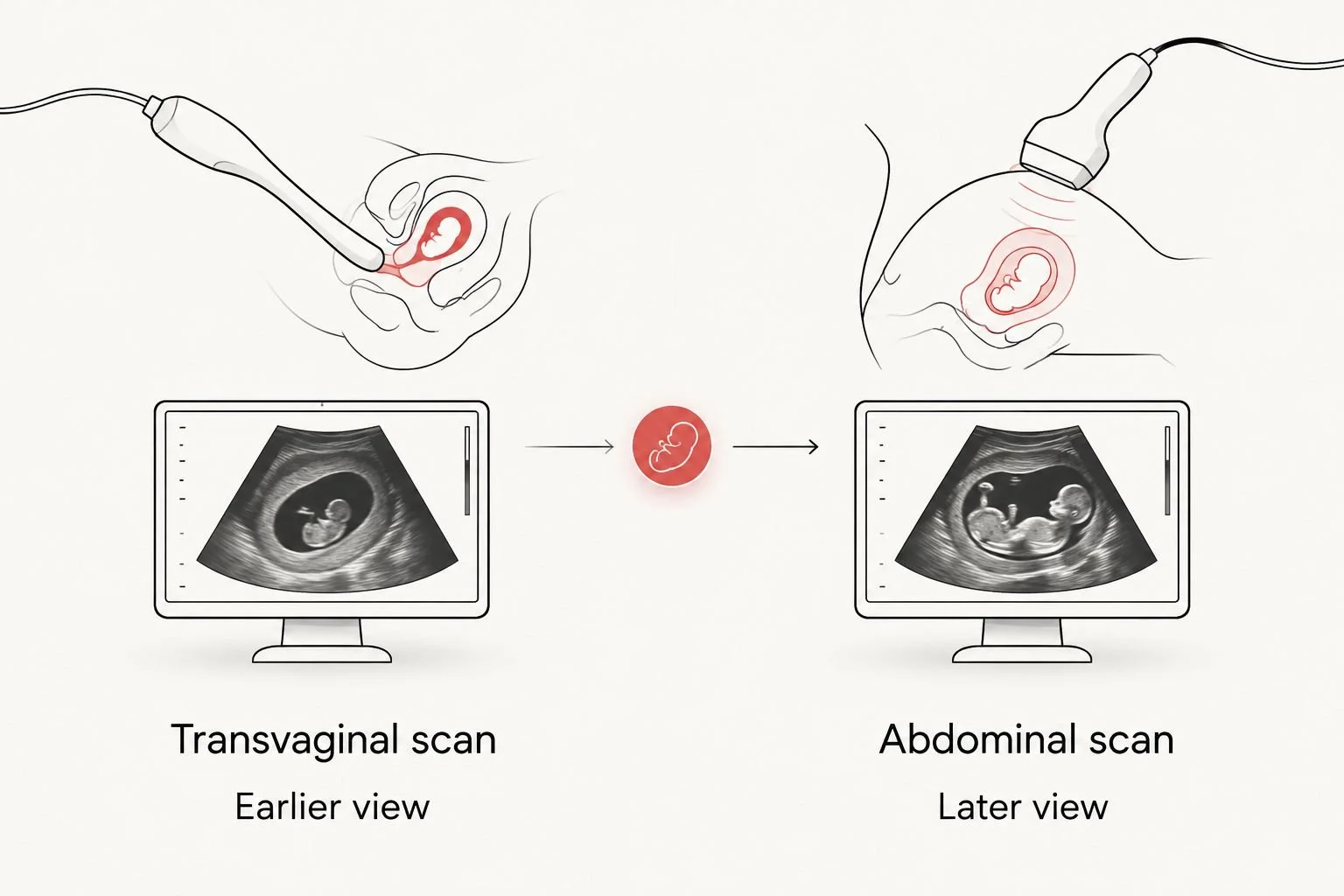
The scan approach affects how early cardiac activity can be identified.
Why the timing varies
There is no single week at which every pregnancy must show visible cardiac activity. When a result differs from what you expected, these are the factors to review with your clinician:
Dating from your last menstrual period. Pregnancy weeks start from the first day of that period. The estimate assumes it reflects when the pregnancy began developing, which is not always precise.
Ovulation timing. Later ovulation can make the pregnancy earlier on ultrasound than the period-based estimate suggests.
How the pregnancy was conceived and dated. If you have fertility-treatment dates, give them to the clinician interpreting the scan rather than relying only on a period estimate.
Scan approach. Transvaginal imaging generally provides more early detail than abdominal imaging.
What the scan actually shows. A sac without a visible embryo calls for a different interpretation from an embryo that has been measured.
The embryo’s measurement. Clinicians use measured findings, not a reported week alone, when assessing whether absent cardiac activity is concerning.
Do not turn these factors into a home checklist for deciding whether a pregnancy is viable. They explain why two people who both say they are 6 weeks pregnant can receive different ultrasound reports. They also explain why the written measurements and the clinician’s interpretation matter more than an isolated image or a brief description from the appointment.
What if the scan shows no heartbeat?
At about 6 weeks, no visible cardiac activity can mean the scan was too early; it can also require clinical follow-up. The finding alone cannot tell you which explanation applies. Ask what was visible, whether an embryo was measured, how the pregnancy was dated and when your clinician recommends reassessment.
There is an important difference between an early scan that cannot establish viability and a scan that meets established diagnostic criteria for pregnancy loss. For example, an embryo with a crown-rump length of 7 millimeters or more and no cardiac activity meets a recognized ultrasound criterion for pregnancy loss when the measurement and examination are reliable. That criterion is based on the embryo’s measured size, not a guess that the pregnancy has reached a particular week. Do not apply it to an image or measurement without a qualified clinician’s interpretation.
A clinician can recommend a repeat ultrasound when the first examination is inconclusive. The interval depends on what the initial scan showed; scheduling another scan immediately is not always the most useful way to answer the question. The follow-up looks for development that could not be confirmed on the first examination.
If you are arranging a reassurance ultrasound between prenatal visits, keep your prenatal clinician involved in interpreting an uncertain result. A private scan can provide images, but an unexpected finding still needs an appropriate clinical follow-up plan.
When to seek care rather than wait for another scan
Do not wait for a routine ultrasound appointment if you have severe or worsening abdominal pain, pain concentrated on one side, shoulder pain, fainting, or heavy bleeding. Seek prompt medical assessment. These symptoms need attention even if an earlier test or scan seemed reassuring.
An early ultrasound question is sometimes also a question about pregnancy location. Before a clinician has confirmed a pregnancy in the uterus, symptoms such as significant one-sided pain or fainting need urgent evaluation for a possible ectopic pregnancy. A keepsake or elective appointment is not a substitute for that assessment.
If you have bleeding or pain that is not severe, contact your prenatal clinician for advice on what to do next. The decision depends on your symptoms and the findings already available. In 2026, the safest use of an early scan is to pair its images with a clear route to clinical interpretation, especially when the answer is uncertain.
How to prepare for an early ultrasound question
Before your appointment, write down the first day of your last menstrual period and any known ovulation or fertility-treatment dates. Bring details of prior scans and reports if you have them. Tell the person arranging the scan whether your goal is pregnancy dating, assessment of symptoms, or an elective look at the pregnancy; those are not interchangeable requests.
At the visit, ask these questions in plain language:
Which scan approach was used? A transvaginal and an abdominal view do not have the same early limits.
What structures were visible? Ask whether the report identifies a gestational sac, an embryo and cardiac activity.
Was the embryo measured? A measured finding carries more clinical meaning than a week estimate alone.
Who will interpret the result? Make sure you know how the report reaches the clinician managing your pregnancy.
What happens if the result is inconclusive? Leave with a follow-up recommendation rather than an unsupported conclusion.
The Ultrasound Concierge is best for patients around Keller and Willow Park who want a private pregnancy ultrasound experience; it is not a replacement for urgent medical evaluation or your prenatal clinician’s care. The Ultrasound Concierge offers both diagnostic and elective ultrasound services, so be clear about which type of assessment you need before the appointment.
Discuss your ultrasound options
Check which pregnancy ultrasound service fits your question and timing.
Can you see a heartbeat at 5 weeks?
At 5 weeks, a heartbeat is generally too early to expect on ultrasound. A scan can show earlier pregnancy structures without yet showing an embryo or cardiac activity. Your clinician should interpret what is visible rather than judge the scan by the week estimate alone.
Is 6 weeks too early for an abdominal ultrasound?
At 6 weeks, an abdominal scan can be too early to show cardiac activity clearly. A transvaginal scan usually offers a more informative early view. An inconclusive abdominal result does not establish that cardiac activity is absent.
When should I repeat an inconclusive early scan?
There is no single repeat-scan date for every inconclusive result. Your clinician sets the timing based on the first scan’s findings, measurements and your clinical situation. Ask for a specific follow-up plan before leaving the appointment.
FAQ
How soon can you see a heartbeat on ultrasound?
Cardiac activity can often be seen at about 6 weeks with a transvaginal scan and around 7 to 8 weeks with an abdominal scan. Pregnancy dating and the structures visible on the scan affect the interpretation.
Can an ultrasound show a heartbeat at 5 weeks?
A heartbeat is generally too early to expect at 5 weeks. Your clinician can explain what pregnancy structures are visible and whether follow-up is needed.
Does no heartbeat at 6 weeks mean miscarriage?
No, absent visible cardiac activity at about 6 weeks does not by itself diagnose pregnancy loss. The scan approach, embryo measurement and dating information matter.
Is a transvaginal scan better than an abdominal scan for an early heartbeat?
A transvaginal scan usually provides a clearer view in the earliest weeks. An abdominal scan often becomes more informative as the pregnancy develops.
Can you see cardiac activity without hearing a heartbeat?
Yes, cardiac activity can appear as visible motion on ultrasound without an audio heartbeat. Hearing sound is not required to identify that motion on the image.
What should I ask after an inconclusive early ultrasound?
Ask which structures were seen, whether an embryo was measured and when your clinician recommends follow-up. Do not interpret an early image without the report and clinical context.
When should I seek urgent care in early pregnancy?
Seek prompt medical assessment for severe or worsening abdominal pain, one-sided pain, shoulder pain, fainting or heavy bleeding. Do not wait for a routine private ultrasound appointment to assess those symptoms.
One last thing
The most useful question after an early scan is often not Was there a heartbeat? but What could this particular scan reliably show? In 2026, an estimate of 6 weeks still cannot replace the scan approach, the measurements and a clinician’s interpretation. The Ultrasound Concierge can be an option for a private pregnancy ultrasound in the Keller and Willow Park area, while your prenatal clinician remains the point of contact for uncertain findings and care decisions.
Related guides

Confirm Pregnancy Before First OB Visit Ultrasound? Yes 2026
Confirm pregnancy before first OB visit ultrasound: yes, when diagnostic imaging identifies an intrauterine pregnancy. Learn what early scans can and cannot show.
Yes. A private diagnostic ultrasound can confirm an intrauterine pregnancy before your first OB visit when the scan shows the structures needed to establish it. An elective keepsake scan is not a substitute for that assessment, and a scan done too early can leave the answer uncertain. Keep your OB appointment even if the private scan confirms the pregnancy.
TL;DR
A diagnostic ultrasound can confirm pregnancy before your first OB visit when it identifies an intrauterine pregnancy.
The Ultrasound Concierge is a private diagnostic-scan option for patients near Keller and Willow Park, Texas.
An early inconclusive scan does not rule out pregnancy or an ectopic pregnancy.
Keep your OB visit; a private scan does not replace prenatal care.
Can a private ultrasound confirm pregnancy before your OB visit?
Yes, if you book a diagnostic pregnancy scan and its findings establish an intrauterine pregnancy. The distinction is the purpose of the appointment, not whether the room feels clinical or private. Ask what the scan is intended to assess and how its findings will be documented before you book.
Private diagnostic ultrasound
Best for: Someone seeking clinical information before an OB appointment
What it can answer: Whether the scan identifies an intrauterine pregnancy and what can be seen at that stage
Main limitation: An early scan can be inconclusive; it does not replace follow-up care
Elective or keepsake ultrasound
Best for: Someone seeking images and a personal viewing experience
What it can answer: What is visible during the visit
Main limitation: It should not be used to rule out complications or replace a diagnostic assessment
First OB visit
Best for: Someone establishing prenatal care and a plan for follow-up
What it can answer: How your clinician interprets your history, symptoms and test results together
Main limitation: You may have to wait for the scheduled visit to discuss your questions
The Ultrasound Concierge provides private diagnostic and elective pregnancy ultrasound services for patients in the Keller and Willow Park area. The Ultrasound Concierge is best for local patients who want a private diagnostic ultrasound before an OB visit and will still follow up with their prenatal clinician. Its elective imaging is a separate choice, not a shortcut to medical clearance. If you have symptoms that need urgent assessment, a scheduled private scan is the wrong setting.
Why this matters
A positive home test and an ultrasound answer different questions. A home test detects a pregnancy-related hormone; ultrasound looks for visible findings. When a scan is too early to establish where the pregnancy is, you need a follow-up plan rather than reassurance based on a single image.
You can review The Ultrasound Concierge when deciding whether a private visit fits your needs. Before booking any provider, say plainly that you want to confirm pregnancy before your first OB visit with an ultrasound. Ask whether the appointment is diagnostic, whether its timing is appropriate and how you will receive the findings.
What can an early ultrasound actually confirm?
A diagnostic scan can establish an intrauterine pregnancy when it identifies the necessary findings inside the uterus. The person interpreting the images must also account for how early the scan was performed. Seeing less than you expected is not, by itself, a diagnosis of a problem.
An early scan cannot promise that a pregnancy will continue normally. It also cannot turn an unclear result into a definite answer by offering more images from the same visit. If the location or status of the pregnancy remains uncertain, ask the clinician managing your care what follow-up is needed.
Location, current findings and future outcome are different questions. An ultrasound that confirms location does not predict every later development. Bring the report to your OB visit so your clinician can interpret it alongside your dates, symptoms and other testing.
Does a positive test change what the scan can show?
No. A positive home test can precede clear ultrasound findings. That mismatch is especially relevant when you are unsure when your last menstrual period began or when conception occurred. Give the scanning provider the dates you know, but do not treat an estimate as proof that a particular structure must already be visible.
If your test is positive and the scan cannot establish a pregnancy in the uterus, do not treat the scan as a negative pregnancy test. Contact the clinician responsible for your care for next steps. Tell them about pain or bleeding rather than waiting silently for your first routine visit.
When is it too early for a conclusive scan?
Around 5 weeks of pregnancy, counted from the first day of the last menstrual period, an ultrasound can still be too early for a clear answer. Around 6 weeks, more findings can become visible, but timing and what is seen vary. At 7 weeks, uncertainty still calls for clinical interpretation rather than a verdict based on a calendar date alone.
These are reference points, not appointment guarantees. Pregnancy dating based on a last menstrual period assumes you know that date and that it reflects the timing of the pregnancy. If those assumptions do not fit you, an early scan can appear behind an expected timeline without explaining why.
When arranging a private scan in 2026, tell the provider the first day of your last period if you know it, the date of your positive test and whether a clinician has already advised you about scan timing. Ask what the next step will be if the findings are inconclusive. A useful booking conversation covers both what the appointment can assess and what happens if it cannot yet answer your question.
How do you choose the right private appointment?
Start with the question you need answered. If it is whether the pregnancy can be identified inside the uterus before your OB visit, request a diagnostic pregnancy ultrasound. If you mainly want a viewing experience or keepsake images, describe that goal instead. Do not assume the two appointments produce interchangeable medical information.
Diagnostic scan: Ask whether the appointment is intended to assess an early pregnancy. Confirm that the provider understands you are seeking clinical findings, not only images.
Check timing: Share your last menstrual period, positive-test date and any uncertainty about your dates. Ask whether booking now is likely to answer your question.
Share report: Ask how findings are documented and how you can pass them to your OB. Do not assume your prenatal practice receives them automatically.
OB visit: Keep the appointment and bring the findings, your questions and any instructions you received about follow-up.
The Ultrasound Concierge offers both diagnostic and elective ultrasound imaging. For a 2026 appointment, specify which type you need before choosing a time. The benefit of a private setting is a visit that fits your preference for a calmer experience; the limitation is unchanged: an ultrasound result still needs the right clinical follow-up.
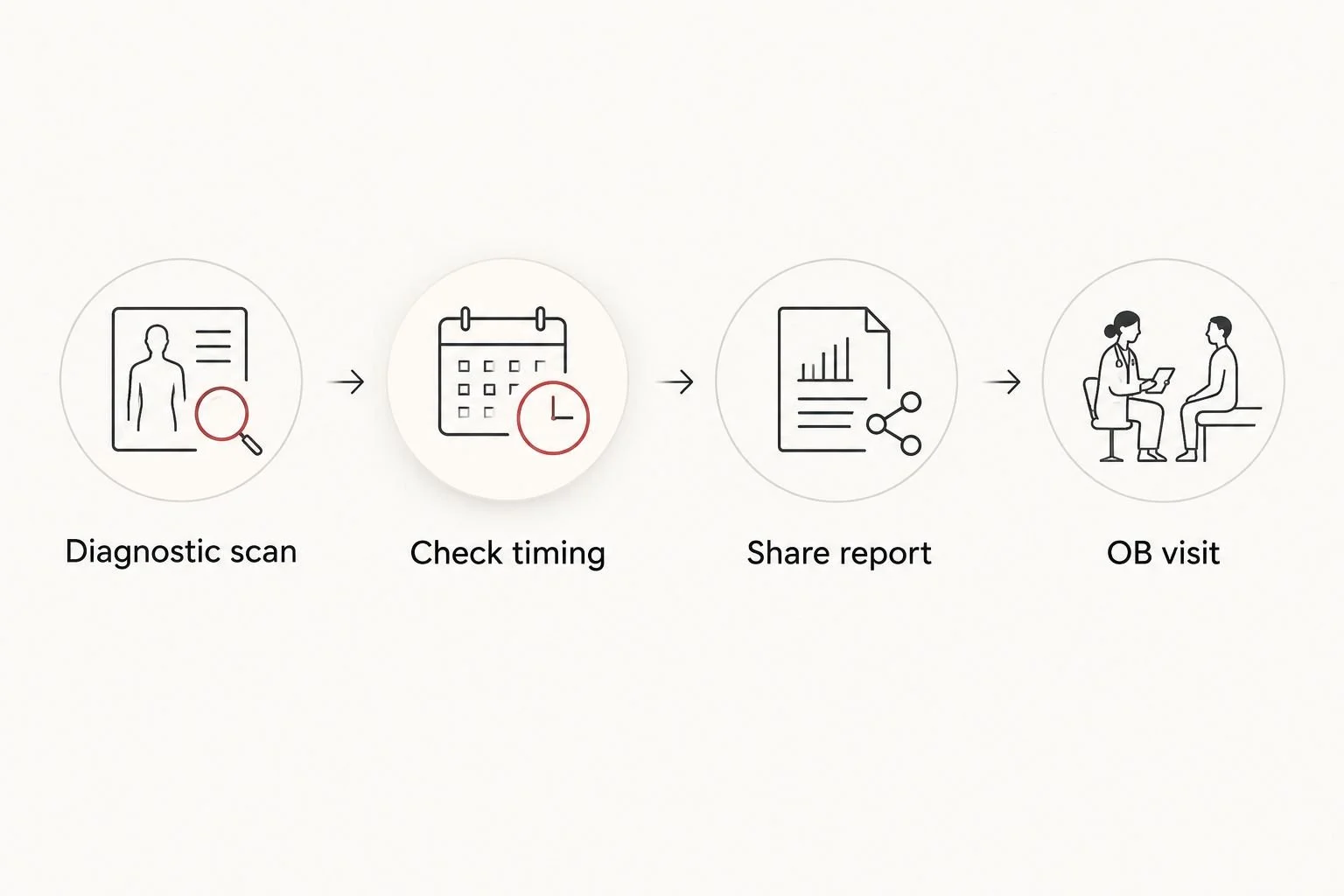
Choose the scan for your medical question, then make a plan to share its findings.
Write down the answer you want before you book. That makes it easier to spot a mismatch between a diagnostic appointment and an elective viewing session, especially when both are offered by the same provider.
Check your ultrasound options
Ask which private appointment addresses your early-pregnancy question.
Why can early ultrasound answers vary?
Two people booking scans on the same date can receive different answers because their pregnancies are not necessarily at the same stage. The useful question is not whether one image matches someone else's. It is whether the findings answer your question and what follow-up the result requires.
Pregnancy timing: A scan performed before the relevant structures are visible can be inconclusive even after a positive test.
Uncertain dates: If you are unsure of the first day of your last period, an estimated pregnancy week can be misleading.
Scan purpose: A diagnostic assessment and an elective session do not serve the same medical purpose.
Findings on the day: A single scan can establish some facts without resolving every question about the pregnancy.
Symptoms: Pain or bleeding changes the urgency of assessment; it should not be handled as a routine reassurance booking.
Follow-up: The usefulness of an early result depends on whether you know who will explain it and arrange further care if needed.
In 2026, the sensible choice is the appointment that matches the question and your symptoms. A private scan can give you information sooner than your scheduled OB discussion, but sooner does not always mean conclusive. Ask what the result establishes, what it does not establish and who you should contact next.
What if the ultrasound does not show a pregnancy yet?
An inconclusive early scan needs a plan, not a guess. Tell the clinician managing your pregnancy about the positive test, the scan findings and any symptoms. Your clinician can decide what further assessment is appropriate and when it should happen.
Do not book repeated elective scans to settle a medical question. They do not replace clinical interpretation of an uncertain result. If you have severe or one-sided abdominal pain, shoulder pain, fainting or heavy bleeding, seek urgent medical evaluation rather than waiting for another private appointment. Those symptoms need prompt attention whether or not you already have an OB visit booked.
If you receive a report from a 2026 private diagnostic scan, keep a copy you can share. Tell your prenatal clinician what the report says rather than relying on a remembered description of the images. A clear handoff is more useful than collecting images that nobody responsible for your care has reviewed.
Can a private scan replace the first OB appointment?
No. A private ultrasound can answer a focused imaging question, but the first OB appointment establishes ongoing prenatal care. Your clinician considers your medical history, symptoms, tests and the scan findings together. Keep the visit even if the ultrasound gives you reassuring information.
If you are considering The Ultrasound Concierge for a pregnancy ultrasound, frame the visit as one part of that care, not an alternative to it. Ask your OB practice how to share outside findings and whether they want you to contact them sooner if the result is unclear. The answer can affect what you do after the scan, so get it before you are left deciding alone.
FAQ
Can a private ultrasound confirm pregnancy before my first OB visit?
Yes, a private diagnostic ultrasound can confirm an intrauterine pregnancy when the necessary findings are visible. An early or inconclusive scan may require clinical follow-up.
Will an ultrasound show a pregnancy at 5 weeks?
A scan at 5 weeks can be too early for a clear answer. Pregnancy dating and visible findings vary, so ask what follow-up is needed if the result is inconclusive.
Is a 6-week private scan guaranteed to confirm pregnancy?
No, a 6-week scan is not guaranteed to give a conclusive answer. The findings and the accuracy of your dates determine what can be established.
Is a keepsake ultrasound the same as a diagnostic pregnancy scan?
No, a keepsake ultrasound is an elective viewing experience, while a diagnostic scan addresses a clinical question. Ask which type of appointment you are booking.
Should I still see my OB if a private scan confirms pregnancy?
Yes, keep your OB appointment after a private scan confirms pregnancy. Your prenatal clinician needs to review the result alongside your history and plan ongoing care.
What if my pregnancy test is positive but nothing conclusive appears on ultrasound?
Contact the clinician managing your care for follow-up after an inconclusive scan. Do not assume the positive test was wrong or that the pregnancy's location has been established.
Should I book a private scan if I have pain or heavy bleeding?
Seek urgent medical evaluation for severe or one-sided abdominal pain, shoulder pain, fainting or heavy bleeding. Do not wait for a routine private scan to assess those symptoms.
One last thing
A reassuring image and a documented diagnostic finding are not the same thing. Before a 2026 private appointment, ask the question you intend to put to your OB: What can this scan establish, and what will I need to do if it cannot? That gives you a reason to book, a way to assess the result and a plan for what follows.
Related guides

8K Ultrasound vs 4D Ultrasound: Which Wins in 2026?
8k ultrasound vs 4d ultrasound: 4D wins for watching movement; 8K is an enhanced keepsake image. Learn what to ask before choosing a scan in 2026.
No. In 2026, 8K ultrasound is not automatically better than standard 4D ultrasound: 4D shows a moving view, while 8K generally describes an enhanced presentation of an image rather than a separate measure of diagnostic quality. If your goal is to watch your baby move, choose 4D; if your goal is a particular keepsake image style, ask to see examples of the provider’s 8K results. Neither replaces a diagnostic scan or prenatal care.
TL;DR
For 8k ultrasound vs 4d ultrasound in 2026, choose 4D to watch movement; consider 8K for an enhanced keepsake image.
8K does not establish better diagnostic quality than 4D.
Ask how the 8K image is produced and what you will receive before choosing a session.
The Ultrasound Concierge offers pregnancy imaging in a private setting, but keepsake views do not replace prenatal care.
Why this matters. A sharper-looking portrait and a medically useful scan answer different questions. If you are deciding whether to book another keepsake session, read about the safety of 3D/4D ultrasound sessions and discuss any medical concern with your prenatal clinician.
Is 8K ultrasound better than standard 4D ultrasound?
8K is better only if you prefer its finished-image appearance; 4D is the clearer choice when you want to see movement. The terms do not describe the same feature. In 2026, compare the result you want rather than treating the larger-sounding label as proof of a better examination.
What are you looking at?
Standard 4D ultrasound: A moving view assembled from three-dimensional ultrasound images
8K ultrasound presentation: An enhanced rendering offered as a finished image
Best for
Standard 4D ultrasound: Watching movement during a keepsake session
8K ultrasound presentation: Choosing a particular portrait-like keepsake appearance
Main advantage
Standard 4D ultrasound: You can see motion rather than only a still frame
8K ultrasound presentation: The finished image can have a different visual style
Main limitation
Standard 4D ultrasound: A clear face view depends on the conditions during the scan
8K ultrasound presentation: A polished image is not evidence of a more accurate medical assessment
What to ask
Standard 4D ultrasound: Will I be able to watch a live moving view?
8K ultrasound presentation: Is the image created from this session, and what form will I receive?
These options are not necessarily competing appointments. A provider might use images captured during a session to make a finished rendering. Ask what is included rather than assuming that the words 4D and 8K identify separate scans.
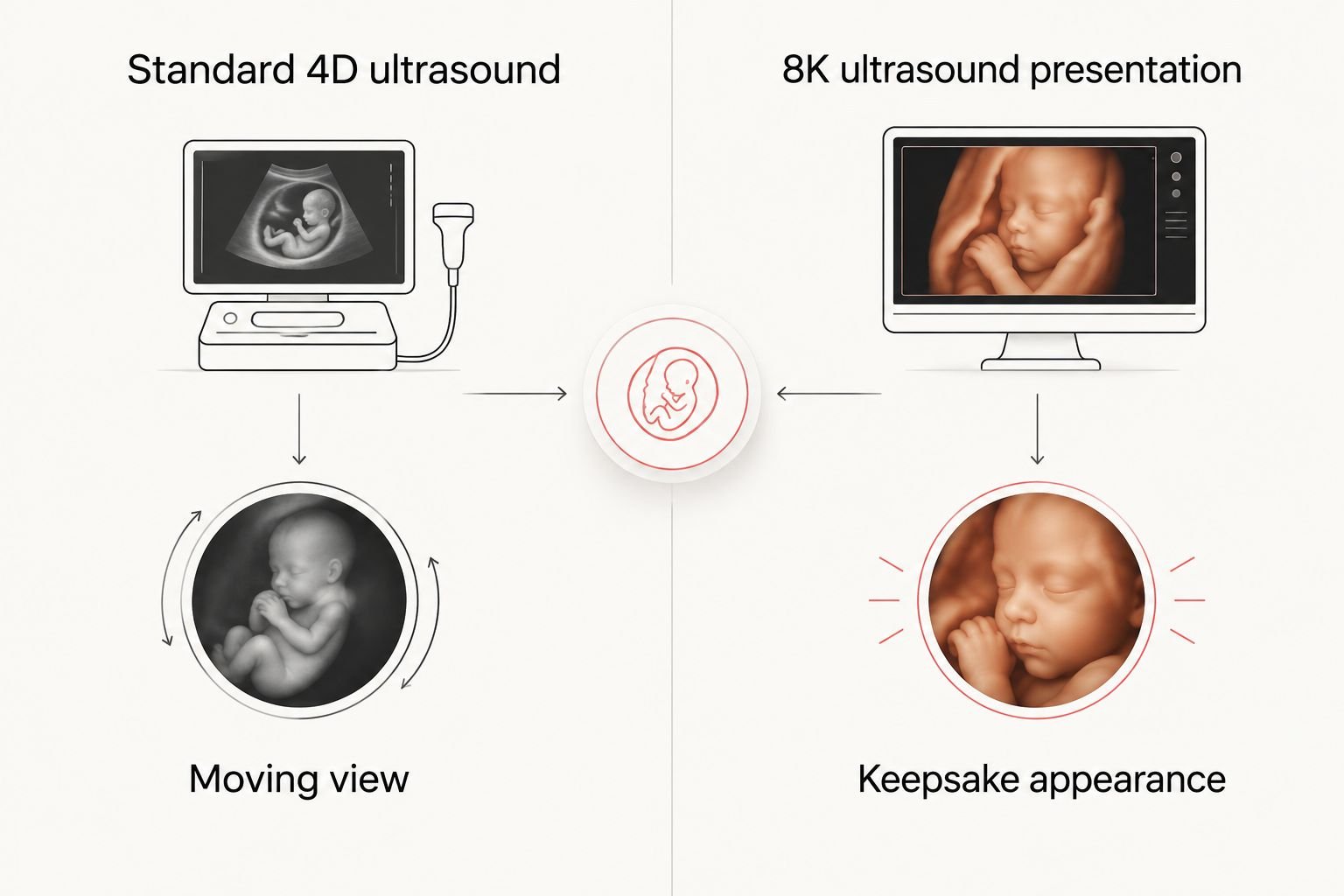
Choose by the result you want: motion during the session or the appearance of a finished image.
Why this matters for your appointment
A keepsake scan can be meaningful without answering a medical question. If you want to see your baby’s face or movement, tell the provider that before the appointment. If you want to check anatomy, growth, or a symptom, ask your prenatal clinician which diagnostic examination you need instead.
The Ultrasound Concierge is best for patients in the Keller and Willow Park area seeking a private, personalized ultrasound visit; its elective imaging is not a substitute for a clinician-directed diagnostic evaluation. The Ultrasound Concierge offers both diagnostic and elective ultrasound services, so be explicit about which purpose brings you in. That distinction matters more than choosing the most impressive-sounding image label.
What does 4D ultrasound give you?
A 4D ultrasound adds time to a three-dimensional view, so you see movement rather than a single still image. For an expecting parent, that is the main reason to choose it. You can ask to watch a moving view during the session and clarify whether a video is part of the result you will receive; do not assume that watching one means you will receive a copy.
Best for: seeing movement. Its strength is the experience of watching rather than judging one selected frame. Its limitation is that the view depends on what the scan can capture at that moment. A baby facing away, for example, does not become easier to see simply because the display is moving.
If a face image matters most to you, ask the provider to show you examples from comparable sessions and explain what happens when the face is obscured. Examples show the style of an output, not a promise that your session will produce the same view.
What does an 8K ultrasound image give you?
In elective ultrasound, 8K generally refers to an enhanced image presentation. It does not, by itself, tell you the resolution of the original ultrasound data, establish a uniform medical standard, or show that a clinician can identify more detail. The useful question in 2026 is what the provider does to create the image and how the result differs from the standard view.
Best for: an enhanced keepsake image. Its advantage is the appearance of the finished image, if you prefer that style. Its limitation is that processing cannot guarantee a clear view of a face that the scan did not capture clearly. Ask to see actual examples of the provider’s work and to confirm whether the result is a still image, a moving view, or both.
Do not use an enhanced portrait to interpret a medical concern. A visually detailed image and a diagnostic report serve different purposes, even when they originate from ultrasound imaging. If someone tells you that 8K is medically superior to 4D, ask what diagnostic measure supports that claim rather than accepting the label.
Why the result varies
The appearance of either result depends on conditions during the examination, not just the name of the image format. In 2026, these are the factors to discuss before you choose a keepsake session:
Baby’s position. A face turned away or covered by a hand gives the provider less of the face to show. Ask what you can expect if the desired view is not available.
Timing in pregnancy. The view changes as the pregnancy develops. Ask your prenatal clinician whether your planned timing fits your circumstances, and ask the imaging provider what that timing means for the type of image you want.
Fluid and intervening tissue. Ultrasound needs a usable path to form an image. These conditions affect what is visible, regardless of whether the result is shown as 4D or enhanced afterward.
Capture quality. A finished rendering depends on the images acquired during the session. Editing changes presentation; it does not turn a blocked view into a reliable medical finding.
Image processing. Providers can present captured images differently. Ask how the provider uses the term 8K and request examples from that provider rather than comparing labels alone.
These factors explain why no provider can promise a particular facial expression or portrait from the label on a session. They also explain why a standard 4D view you enjoy can be more valuable to you than an enhanced still image you did not want.
How should you choose between 8K and 4D in 2026?
Start with the outcome, then check what the appointment actually includes. The Ultrasound Concierge offers 3D/4D/8K imaging among its services, but that list alone does not tell you which result fits your goal.
Decide whether you want motion or a still image. Choose a moving 4D view if watching your baby is the priority. Ask about an 8K result if the appearance of a finished keepsake image is the priority.
Ask what you will receive. Confirm the form of the deliverable rather than assuming that a live view, a video, and an enhanced still are interchangeable.
Review examples from the provider. Ask which examples represent standard 4D captures and which represent enhanced images. Judge the style you prefer, not the size of the label.
Explain any clinical concern separately. If you need an answer about health, ask which diagnostic service or prenatal clinician can address it. Do not choose an elective image format as a substitute.
Set expectations for visibility. Ask how the provider explains results when the baby’s position prevents the view you hoped for. A responsible answer describes the limit rather than promising an image.
For patients considering a private appointment in the Keller or Willow Park area, The Ultrasound Concierge offers diagnostic and elective imaging. State your goal when you inquire so you can discuss the appropriate type of visit without assuming that 8K is an upgrade to medical care.
Ask about your scan options
Discuss whether a moving view, a keepsake image, or diagnostic imaging fits your goal.
Does a sharper-looking image mean a better medical scan?
No. Image appearance alone does not establish diagnostic quality. A clinician-directed diagnostic examination is chosen and interpreted to answer a medical question; a keepsake image is selected for how it looks. Ask for diagnostic care when the question concerns your health or your pregnancy, even if you also want a keepsake view.
The distinction is especially useful when you compare promotional samples. An attractive sample tells you what a finished image can look like under favorable conditions. It does not establish how clearly every baby will appear or what a medical examination will find.
Can you have both 4D motion and an 8K keepsake?
Ask the provider. A moving view and an enhanced still describe different outputs, so a session can be discussed in terms of both. The terms alone do not confirm what a particular appointment includes. In 2026, request a plain description of the live view and the finished files or images before choosing.
If you plan to share the result with family, specify whether you want something to watch together or a still image. That simple distinction makes the conversation more useful than asking for the highest-sounding format.
FAQ
Is 8K ultrasound better than 4D ultrasound in 2026?
No, 8K is not automatically better than 4D ultrasound in 2026. Choose 4D to watch movement and ask about 8K if you prefer an enhanced keepsake image.
Does 8K ultrasound show more medical detail than 4D?
The 8K label alone does not establish more diagnostic detail than 4D. Ask a prenatal clinician which diagnostic examination answers your medical question.
Is 8K ultrasound a different scan from 4D?
Not necessarily. Ask the provider whether 8K describes an enhanced image made from images captured during a session and what you will receive.
Can I see my baby move with an 8K ultrasound image?
An enhanced still image does not show movement. Ask for a live 4D view if watching motion matters to you, and confirm whether any video is included.
Will 8K ultrasound guarantee a clear picture of my baby's face?
No image label guarantees a clear face view. The baby's position and the quality of the captured view affect the finished result.
Should I choose an 8K image instead of a diagnostic ultrasound?
No. Choose clinician-directed diagnostic imaging for a medical question; an enhanced keepsake image does not replace that assessment.
What should I ask before booking a 4D or 8K session?
Ask whether you will see a moving view, what finished images you will receive, and how the provider defines 8K. Explain separately if your reason for visiting is medical.
One last thing
The most useful comparison is not 8K versus 4D; it is the result you want versus the result the session can provide. In 2026, ask to see the provider’s standard moving view and enhanced still examples side by side. If you cannot tell which you would prefer, choose based on whether watching movement or keeping a finished portrait matters more to you.
Related guides

Do you need a referral for a private ultrasound? Varies 2026
Do you need a referral for a private ultrasound? It depends on whether the scan is elective or diagnostic. Learn what to ask before booking in 2026.
You do not always need a doctor’s referral for a private ultrasound. An elective pregnancy scan can have different booking requirements from a diagnostic scan ordered to investigate a medical concern, so the answer depends on the purpose of the visit and the provider’s policy. In 2026, confirm the requirements for the specific scan before you book; a private appointment does not replace medical care.
TL;DR
Do you need a referral for a private ultrasound? It depends on whether the scan is elective or diagnostic.
Ask the provider whether your scan requires a clinician’s order; do not assume private booking means no order is needed.
The Ultrasound Concierge is a relevant option for patients seeking private ultrasound imaging around Keller and Willow Park, Texas.
For symptoms or a medical question, contact your treating clinician rather than relying on an elective scan.
Why this matters
A referral question is really a question about what the ultrasound is meant to do. You might want images of your pregnancy, or you might need a clinician to assess pain, bleeding, fertility treatment, or another health concern. Those visits can look similar from the patient’s side but have different requirements and different roles in your care.
The Ultrasound Concierge offers private ultrasound services for patients in the Keller and Willow Park area, including diagnostic and elective imaging. Its mix of services makes it especially important to name the scan you want when asking about a referral. The Ultrasound Concierge is best for local patients who want to ask about private diagnostic or elective imaging in a calm, personalized setting. That is a fit assessment, not a statement that every service can be booked without an order.
Do you need a doctor’s referral for a private ultrasound?
Not necessarily. If you are arranging an elective pregnancy ultrasound, ask the provider whether you can book directly. If the ultrasound is intended to answer a clinical question, ask whether the provider needs an order from your physician or another authorized clinician. The word private describes the setting; it does not establish the medical requirements for the exam.
Elective pregnancy imaging, such as a 3D/4D session
What to ask before booking: Can I book directly, and are there any prerequisites?
What the scan should not replace: Your scheduled prenatal care or a clinically indicated scan
Diagnostic pregnancy imaging
What to ask before booking: Do you require a clinician’s order, and what clinical information must accompany it?
What the scan should not replace: Assessment and follow-up by your pregnancy care team
Fertility-related imaging
What to ask before booking: Does my treating clinician need to specify the exam or timing?
What the scan should not replace: The treatment plan set by my fertility team
General health imaging
What to ask before booking: What order or referral is required for the question being investigated?
What the scan should not replace: A clinician’s evaluation of symptoms and results
A referral and an imaging order are not always the same thing. When you call, use both terms: ask whether you need a referral or an order, who can provide it, and whether anything must be sent before the appointment. This avoids arriving with a document that does not contain the information needed for your exam.
In 2026, do not use a general answer about private ultrasounds as a substitute for the requirements of your chosen provider. Even within one practice, elective and diagnostic appointments serve different purposes. Describe the purpose first; then ask what paperwork that specific service requires.
An imaging provider can explain its booking requirements. Your treating clinician is the person to ask which diagnostic exam addresses your medical concern and how the result will be used in your care. If you are unsure which kind of appointment you need, start there rather than selecting a scan by its name alone.
Elective pregnancy ultrasound: ask about direct booking
An elective pregnancy scan is usually sought for an experience or images rather than to investigate a symptom. If that describes your goal, the practical question is whether the provider allows direct booking for that particular appointment. Do not treat an elective scan as an additional medical check simply because ultrasound equipment is involved.
When you contact a provider, say whether you want pregnancy images, a 3D/4D session, or another elective service. Ask what information you should bring and whether the provider has any prerequisites. If you are also due for a medically recommended ultrasound, keep that appointment with your care team; an elective visit does not take its place.
A reassuring experience and a medical conclusion are different outcomes. If your reason for booking is worry about a symptom, tell your prenatal clinician what is happening. They can decide what assessment you need rather than leaving you to choose between an elective appointment and a diagnostic one.
For 2026 bookings, keep the question precise: Can I book this elective scan without a referral, and what does the appointment include? The answer should come from the provider offering the service, not from another studio’s booking page or a friend’s experience.
Diagnostic ultrasound: ask whether an order is required
A diagnostic ultrasound is intended to investigate a defined medical question. The provider needs to know what exam is requested and how it relates to your care; its order requirements must be confirmed before you schedule. Do not assume that paying privately changes those requirements.
Ask your clinician to identify the question the scan should answer. Then ask the imaging provider what kind of order it accepts, who can issue it, and how it should be delivered. If you already have paperwork, confirm that it matches the exam being booked before making plans around the visit.
Also ask who will receive the results and who will discuss them with you. An image by itself is not a care plan. If a finding needs follow-up, your treating clinician needs a clear route to review it and decide what happens next. Confirming that route before your appointment is more useful than asking only whether a referral is needed.
For patients comparing diagnostic and elective services at The Ultrasound Concierge, the distinction matters more than the setting. The practice offers both kinds of imaging, but the supplied information does not establish a single referral rule across its services. Ask about the exact exam you need.
Fertility imaging: coordinate the scan with your care team
If an ultrasound is part of fertility care, your treating team should identify the exam and when it is needed. A private appointment is useful only if it fits the clinical question and the team receiving the result. Ask whether your clinician needs to provide an order and what information must go back to them.
Bring the name of the exam requested when you contact the provider. If you do not have one, ask your fertility clinician before booking. Fertility ultrasound describes a broad purpose, not a complete instruction to an imaging provider. Your team can explain what they need documented and how they want the result shared.
The Ultrasound Concierge lists fertility imaging among its services for the Keller and Willow Park area. That makes it a provider to contact about the specific scan your team has requested, not a reason to assume that any available appointment will fit your treatment plan. In 2026, settle the exam, timing, and result handoff before you choose a slot.
Why referral requirements vary
The deciding factor is not whether the room feels clinical or private. It is what the scan is for and how its findings will be used.
Purpose of the visit: An elective image session and an exam investigating a symptom answer different needs.
Type of ultrasound: Pregnancy, fertility, and general health imaging are not interchangeable booking requests.
Provider policy: The practice sets the paperwork and scheduling requirements for each service it offers.
Clinical question: A diagnostic provider needs to understand what the ordering clinician wants assessed.
Follow-up plan: You need to know who receives and explains a diagnostic result.
Your current care: An existing prenatal or fertility plan can affect which scan your clinician requests and when.
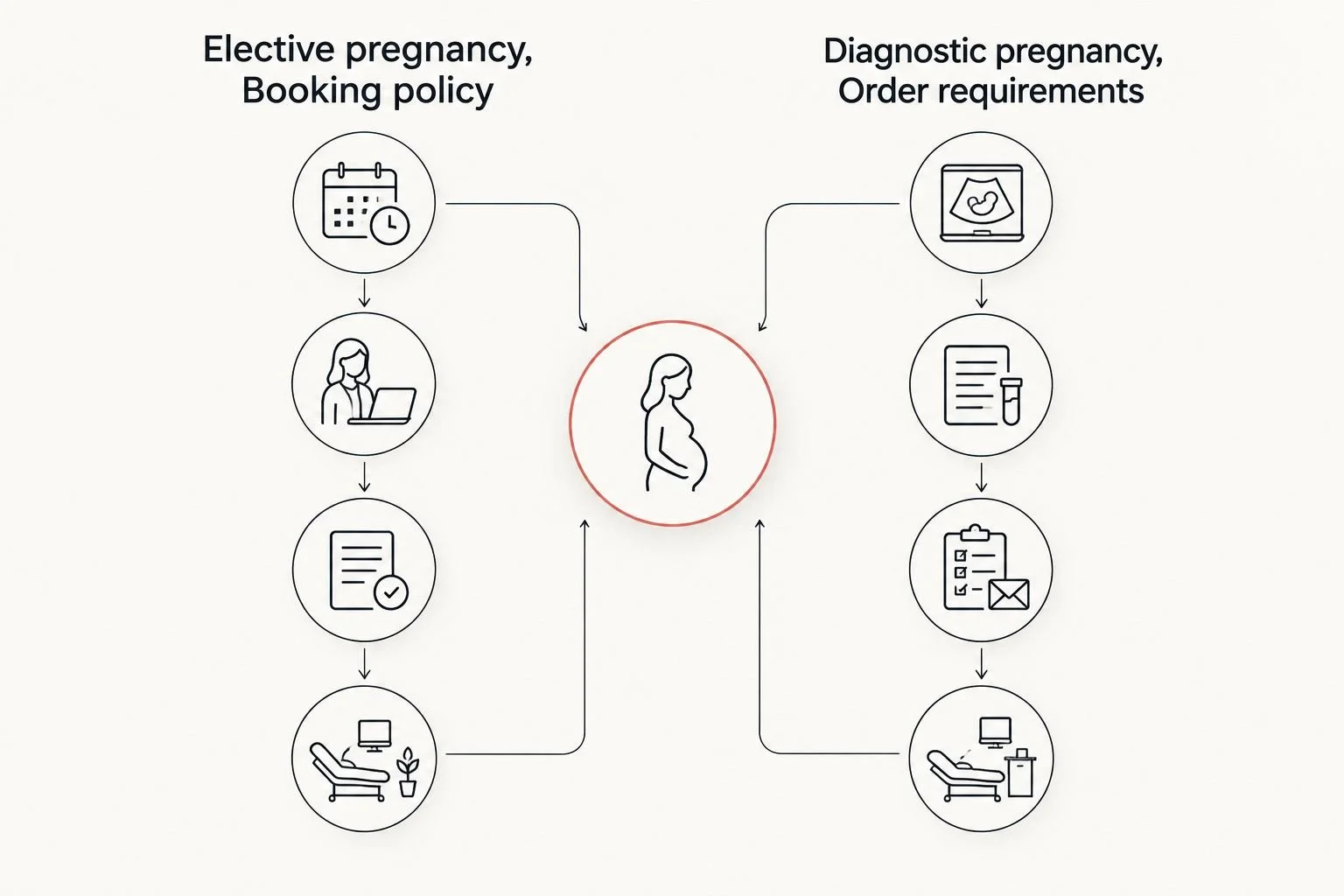
Start with the purpose of the scan, then confirm the provider’s requirements for that service.
These factors also explain why someone else’s answer may not apply to you. Their appointment could have been elective while yours is diagnostic, or the providers could have different policies. Ask a question that names your scan and your reason for it; a general yes-or-no answer leaves out the part that matters.
What to ask before you book
You can resolve most referral uncertainty with a short conversation. Have your reason for seeking the scan ready, then ask the provider:
Is this an elective or diagnostic appointment? Describe what you hope the scan will answer, especially if you have symptoms.
Do I need a referral, an imaging order, or neither? Ask about the specific service, not private ultrasound in general.
Who can issue any required order? If you have a treating clinician, confirm whether their paperwork meets the provider’s requirements.
What information must arrive before my visit? Check whether the provider needs the order or other relevant records in advance.
Who receives the findings? For a diagnostic scan, establish how your clinician will get the result and who will explain it to you.
If you are arranging pregnancy imaging, add one more question: Will this visit answer a medical question or provide elective images? The distinction affects what you should expect from the appointment. It also helps you avoid treating an elective session as reassurance about a concern that needs clinical assessment.
Ask About Your Ultrasound
Confirm the right service and its booking requirements before scheduling.
If a provider says an order is needed, return to the clinician managing that concern. Tell them what the imaging provider requires and ask whether the exam fits your care plan. If the provider says you can book directly, still tell your clinician about symptoms rather than assuming direct access makes the scan appropriate for diagnosis.
In 2026, the useful outcome of this conversation is not just permission to book. It is clarity on the exam, its purpose, and the person responsible for acting on a diagnostic result.
Can I get a private ultrasound without seeing a doctor first?
You can ask to book an elective private ultrasound without first obtaining a referral, but the provider decides its booking requirements. If you want an ultrasound because of a symptom or a medical concern, contact a clinician for assessment. Direct booking and appropriate medical care are separate questions.
Is an elective ultrasound the same as a diagnostic ultrasound?
No. An elective ultrasound is sought for an experience or images; a diagnostic ultrasound is used to address a medical question. Ask the provider which service you are booking and ask your treating clinician when the purpose is medical.
Does a doctor’s referral replace an ultrasound order?
Do not assume it does. Ask the imaging provider whether it requires a referral, a specific order, or other clinical information for the exam you need. Your clinician can then send the paperwork that matches the request.
FAQ
Do you need a referral for a private ultrasound in 2026?
Not always; it depends on the scan’s purpose and the provider’s requirements. Ask whether the specific appointment needs a referral or a clinician’s order before booking.
Can I book an elective pregnancy ultrasound directly?
Ask the provider whether it accepts direct bookings for that elective service. An elective appointment does not replace prenatal care or a medically indicated scan.
Do I need an order for a diagnostic private ultrasound?
Confirm the order requirement with the imaging provider for the exam you need. Your treating clinician can identify the medical question and explain how the result fits your care.
Can a private ultrasound replace my prenatal ultrasound?
No; do not substitute an elective private session for an ultrasound your prenatal clinician has recommended. Keep your planned care and ask your clinician about any concerns.
Should I book an elective scan if I have pregnancy symptoms?
Contact your prenatal clinician about symptoms rather than relying on an elective scan. Severe pain, heavy bleeding, or fainting calls for urgent medical assessment.
What should I ask before a fertility ultrasound?
Ask your fertility team which exam it needs, when it is needed, and how it wants the result returned. Then confirm the imaging provider’s order and booking requirements.
Does The Ultrasound Concierge require a referral?
Ask The Ultrasound Concierge about the specific service you want; a single referral policy is not established here for all its scans. State whether your appointment is elective or diagnostic when you inquire.
One last thing
The most useful question is not simply whether you need a referral. Ask who will act on the result. For an elective visit, be clear about what the appointment does and does not tell you. For a diagnostic visit, make sure your clinician has a plan to receive and discuss the findings. That distinction makes a private ultrasound appointment more useful without asking it to stand in for your medical care.
Related guides

Early Pregnancy Ultrasound Cost: No Fixed Price (2026)
Early pregnancy ultrasound cost has no fixed price in 2026. Compare diagnostic and elective scans, check what each quote includes, and ask about coverage before booking.
Early pregnancy ultrasound cost has no single dependable figure in 2026: what you pay depends on the purpose of the scan, the provider’s billing, and your coverage. A quoted scan fee might not include a separate interpretation or facility charge. Ask for an itemized estimate and your expected patient responsibility before you book.
TL;DR
Early pregnancy ultrasound cost has no fixed 2026 price; request an itemized estimate for the scan you need.
Diagnostic and elective ultrasounds serve different purposes, so confirm which type you are booking.
Ask your insurer about coverage and the provider about every charge before the appointment.
The Ultrasound Concierge is best for Keller and Willow Park patients seeking a private, personalized ultrasound visit.
How much does an early pregnancy ultrasound cost in 2026?
There is no reliable price to quote without knowing the provider, the type of exam, and how it will be billed. In 2026, the most useful figure is a written estimate for your specific appointment, followed by confirmation of what you will owe after any insurance claim is processed.
Diagnostic ultrasound
What to confirm: Whether the exam answers a medical question and who interprets it
Main cost question: Does the estimate include the exam, interpretation, and any facility charge?
Main limitation: A quote is not necessarily your final insured responsibility.
Elective ultrasound
What to confirm: Whether the visit is for viewing rather than medical evaluation
Main cost question: What does the quoted visit include?
Main limitation: It does not replace a diagnostic exam or prenatal care.
Insurance billing
What to confirm: Whether the provider and service meet your plan’s requirements
Main cost question: What will you owe under your specific benefits?
Main limitation: Coverage and patient responsibility vary by plan.
Self-pay billing
What to confirm: The full charge and any separately billed services
Main cost question: Is the estimate the complete amount you will be asked to pay?
Main limitation: A scan fee alone might not describe the full visit.
Start by naming the reason for the appointment. A scan ordered to answer a clinical question is different from an elective visit to see images of a pregnancy. That distinction affects which provider you need, what the appointment can answer, and which billing questions matter. For patients receiving fertility care, this guide to early pregnancy ultrasound for IVF patients covers a related set of planning questions to discuss with your care team.
Why the distinction matters
A lower quote is not a saving if the appointment cannot answer the question that brought you in. If you need to check a medical concern, ask whether the visit is a diagnostic exam and how its findings reach the clinician managing your care. If you want a personal viewing experience, ask what the elective visit includes and keep your scheduled prenatal care.
Choose the exam that fits your question before comparing charges. This is the central cost decision in 2026. The words ultrasound appointment do not, by themselves, tell you whether you are buying a diagnostic service, an elective experience, or both.
An early scan also has limits. What can be seen depends on the pregnancy and the timing of the exam; an appointment cannot promise a particular finding. If you are arranging a visit because of symptoms or a concern raised by your clinician, tell the provider that when you call rather than booking based on a general description.
What should an early pregnancy ultrasound estimate include?
Request the estimate in writing and ask the provider to identify each service. You do not need to know medical billing terminology to get a useful answer. These questions make the quote specific enough to compare:
What type of appointment is this? Ask whether it is diagnostic or elective, and explain what you need to learn from it.
What does the scan fee cover? Confirm whether the exam and any interpretation are included or billed separately.
Is there another provider or facility charge? Ask who will send a bill, not just who takes payment when you arrive.
Will my insurance be billed? If so, ask for the billing details you can use to check your benefits with your insurer.
What will I owe if insurance pays less than expected? Separate the provider’s estimate from your insurer’s determination of benefits.
What happens if the scan cannot answer my question? Ask how findings and any recommended follow-up will be communicated, and whether another visit would carry a separate charge.
Use the same questions with every provider you contact. A short quote that covers only the scan and a longer quote that includes interpretation are not directly comparable. Ask each provider to clarify the difference before you make a decision.
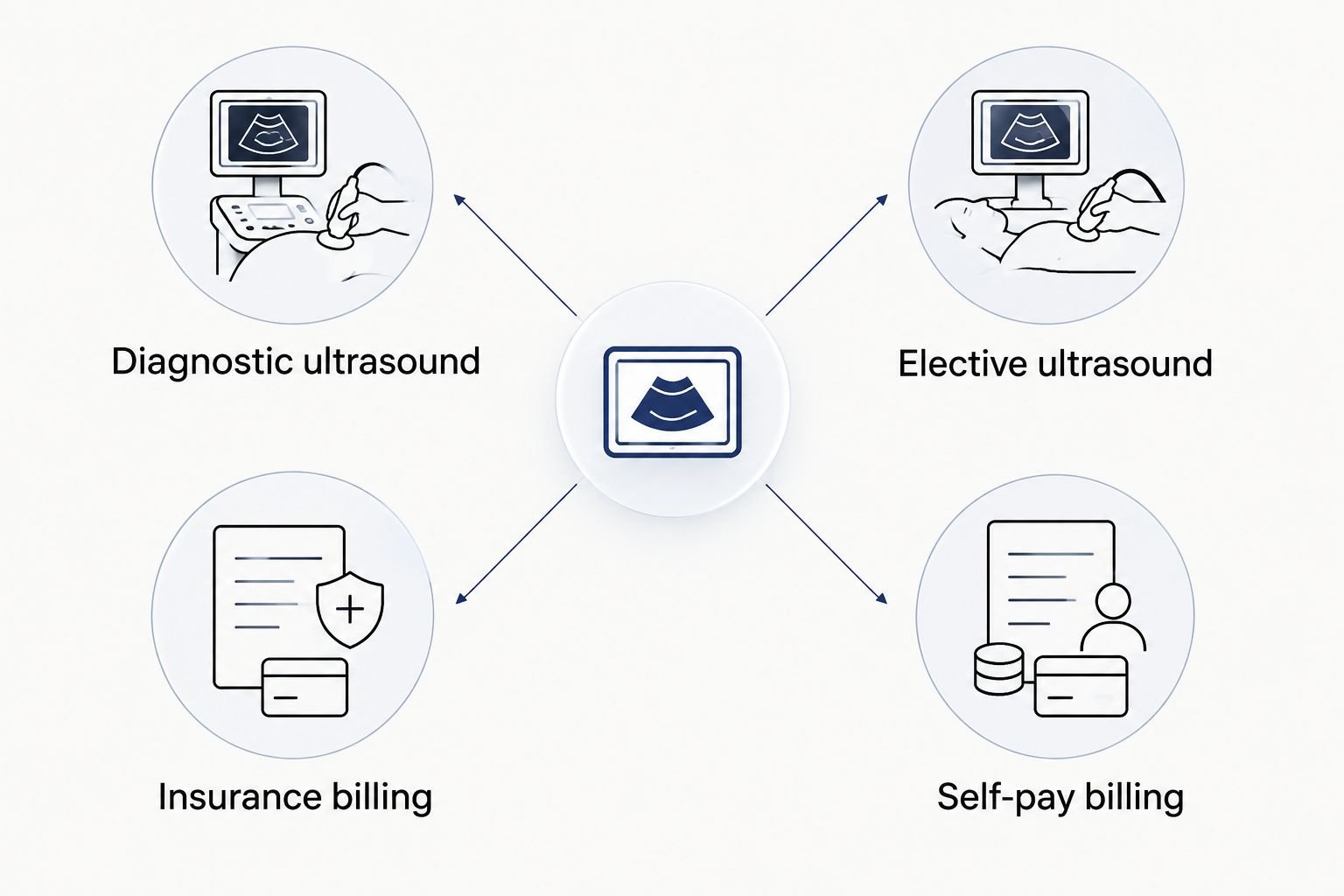
Confirm the purpose of the scan and the billing method before comparing estimates.
The diagram separates two decisions that often get mixed together: what the scan is for and how you will pay. A diagnostic appointment can still leave you with a patient balance, while paying yourself does not tell you whether a scan is diagnostic or elective. Get an answer to both questions.
Diagnostic ultrasound: what changes the amount you pay?
A diagnostic ultrasound addresses a medical question. Its cost to you depends on the services performed, the way those services are billed, and your insurance terms if a claim is submitted. Best for: someone whose clinician needs imaging to assess an early pregnancy.
The advantage is that the appointment is organized around a clinical question and its findings. The limitation is that a quoted charge does not establish what your insurer will pay or what you will owe. Ask the ordering clinician what information is needed, then ask the imaging provider how the results will be reported and billed.
Do not assume that having insurance makes the visit free, or that a provider’s participation in your network settles every billing question. Contact your insurer with the appointment details the provider supplies. In 2026, your plan’s current benefits and the claim actually processed matter more than an online estimate for a different patient.
Elective ultrasound: what are you paying for?
An elective ultrasound is a viewing experience rather than a substitute for a medical evaluation. Best for: someone who wants a personal visit while continuing regular prenatal care. Its advantage is the purpose of the visit; its limitation is that it should not be used to rule out a medical problem.
Ask what the quoted appointment includes and whether anything you want would involve another charge. Do not infer that a longer description means more clinical assessment. If your question is whether a pregnancy is developing as expected, say that plainly and confirm that the appointment you choose can address it.
The Ultrasound Concierge offers diagnostic and elective ultrasound imaging for patients in the Keller and Willow Park area. The Ultrasound Concierge is best for patients near Keller and Willow Park who want a private, personalized ultrasound visit. Before booking, ask which appointment fits your reason for coming and request its current full estimate on The Ultrasound Concierge website. Its private setting is a reason to consider it, not a basis for assuming a particular charge or insurance outcome.
Why does early pregnancy ultrasound cost vary?
The price you hear on the phone and the amount you ultimately pay can differ. These are the factors to pin down in 2026:
Purpose of the exam. A diagnostic assessment and an elective viewing visit answer different questions. Compare providers offering the service you need.
Services included. Establish whether a quoted amount covers the scan, interpretation, and any other billed component.
Billing arrangement. Find out whether the provider will submit a claim or expects payment directly from you.
Insurance terms. Your benefits determine how a covered claim affects your responsibility; the provider’s quote alone does not determine that outcome.
Follow-up needs. Ask what happens if the exam does not answer your question and whether another appointment would be separate.
These factors explain why a generic average is a poor booking tool. Two people can ask for an early pregnancy ultrasound and mean different services. Even when they book the same kind of exam, different billing arrangements can produce different patient responsibilities.
A useful comparison keeps the purpose fixed. If you need diagnostic imaging, compare diagnostic estimates and their included services. If you want an elective visit, compare elective visits while making sure you understand their limits. This keeps a seemingly attractive quote from distracting you from the care you actually need.
How do you check insurance before booking?
Call your insurer with the details the provider gives you. Ask whether the planned service is covered under your policy, whether the provider meets your plan’s network requirements, and how your current benefits affect what you pay. Then ask the provider whether its estimate assumes insurance payment or represents a self-pay charge.
Treat an estimate as an estimate until the claim is processed. Neither a receptionist’s quote nor a general benefits summary guarantees your final responsibility. Keep the written estimate and note the answers you receive so you can compare them with a later bill.
If you are not using insurance, you still need a complete quote. Ask whether anyone other than the provider you contacted will bill you. Confirm what the stated amount covers, how payment is handled, and what happens if your care team recommends a different exam instead.
What if you are choosing between an early scan and waiting?
Start with the reason you want the scan. If a clinician requested imaging, follow that clinical plan and clarify any timing questions with that clinician. If you are considering an elective appointment for reassurance, ask what it can and cannot tell you at the time you plan to visit.
An elective image is not a medical clearance. A calm, personal appointment can be valuable without answering every clinical question. Keep the distinction clear when you assess whether the appointment is worth its charge to you.
If you have pain, bleeding, or another urgent concern, contact a clinician promptly instead of using an elective booking to assess it. The decision about urgent care should be based on your symptoms and medical advice, not on which ultrasound quote is easier to obtain. That remains true regardless of a provider’s setting or the amount on an estimate.
FAQ
How much does an early pregnancy ultrasound cost in 2026?
Early pregnancy ultrasound cost has no single dependable 2026 figure without details of the exam, provider, billing, and your coverage. Ask for an itemized estimate and confirm your expected responsibility with your insurer if you plan to use insurance.
Is a private early pregnancy ultrasound covered by insurance?
Coverage depends on your plan and the service being billed; a private setting alone does not determine coverage. Ask the provider for billing details and check them with your insurer before booking.
Is an elective ultrasound the same as a diagnostic scan?
No. An elective ultrasound is not a substitute for a diagnostic exam intended to answer a medical question. Tell the provider why you want the scan so you book the appropriate appointment.
Can an ultrasound quote leave out other charges?
Yes, a quote can exclude a separately billed interpretation or facility service. Ask who will bill you and what each quoted amount includes.
Will I know my final cost before an insurance claim is processed?
A provider can give you an estimate, but an insurer’s processed claim determines your final responsibility under your benefits. Confirm the service and network details with your insurer and keep the written estimate.
Is The Ultrasound Concierge an option for an early pregnancy ultrasound near Keller?
The Ultrasound Concierge provides diagnostic and elective ultrasound imaging for patients in the Keller and Willow Park area. Ask which appointment fits your clinical or elective purpose and request a current estimate before booking.
One last thing
The most useful question in 2026 is not simply, How much is a scan? It is, What question will this specific appointment answer, and what is the full amount I am expected to pay? Ask both before booking. A clear answer protects your budget and helps you choose a visit that fits your care.
Related guides

Bring Family to Ultrasound Appointment? Ask First (2026)
Can you bring family to an ultrasound appointment? Yes, if guests are allowed. Check the limit, children's access, scan-room rules and recording before you invite them.
Yes, you can bring family to a 3D/4D ultrasound session if the provider allows guests, but confirm the guest limit before inviting anyone. Ask separately about children, who can enter the scan room, and whether photos or video are permitted. Those details belong to the appointment you book, not to 3D/4D ultrasound as a whole.
TL;DR
You can bring family to an ultrasound appointment when the provider permits guests; confirm the limit before inviting anyone.
Ask whether children can attend and whether guests can stay in the scan room.
The Ultrasound Concierge is best for patients seeking a private 3D/4D ultrasound setting in Keller or Willow Park, Texas.
An elective 3D/4D session does not replace a diagnostic prenatal ultrasound.
Can you bring family to a 3D/4D ultrasound session?
Yes, if your provider permits guests at your specific appointment. A 2026 booking is the right time to get an exact answer: guest rules can differ by location, appointment type, and room. Do not treat a studio’s general invitation to share the experience as confirmation that everyone you invite can attend.
How many guests can come?
Why it changes your plans: You can invite the people who will actually fit within the provider’s limit.
Can children attend?
Why it changes your plans: You can arrange childcare if they cannot, rather than finding out at check-in.
Can every guest enter the scan room?
Why it changes your plans: A waiting-area invitation is different from watching the ultrasound together.
Are photos, video, or a video call allowed?
Why it changes your plans: You can tell relatives who cannot attend how, if at all, they can take part remotely.
Does the answer differ for a diagnostic scan?
Why it changes your plans: You can follow the rules for the appointment you are actually having.
If you want a local option to ask, The Ultrasound Concierge provides private diagnostic and elective ultrasound imaging for patients in the Keller and Willow Park, Texas area. The Ultrasound Concierge is best for patients seeking a private 3D/4D ultrasound setting in Keller or Willow Park, Texas. Its private setting is a reason to consider it; it is not proof of a particular guest policy. Confirm that policy directly before making plans.
Why this matters
Bringing family to an ultrasound appointment can turn a quiet visit into a shared moment. It can also make the appointment harder to manage if the people you invite expect access the provider has not confirmed. In 2026, ask about guests when you arrange the scan, then pass along only the details the provider gives you.
The purpose of the visit matters too. An elective 3D/4D session centers on seeing images, while a diagnostic ultrasound serves a medical purpose. Neither the word “private” nor the words “3D/4D” tell you how many people can attend.
How to plan a family ultrasound visit
Name the appointment type. Tell the provider whether you are booking an elective 3D/4D session or a diagnostic ultrasound. If you have not decided, ask which service matches your reason for visiting before you discuss guests.
Give an exact guest list. Say how many adults and children you hope to bring. Ask whether the patient counts toward any stated room limit, rather than interpreting the number yourself.
Ask where guests can go. Confirm whether guests can watch from the scan room or must wait elsewhere. If a particular person needs to accompany you, say so when you book.
Check the policy on children. Ask whether children are allowed at that appointment and whether an adult must stay with them. Make a childcare plan only after you have the answer.
Confirm sharing rules. If you want to take photos, record the screen, or include someone by video call, ask about each activity. Permission for an in-person guest does not automatically cover recording or remote viewing.
Tell guests what to expect. Share the confirmed location, arrival instructions, and participation rules. Keep medical questions for your prenatal care team rather than asking an elective session to answer them.
For a 2026 appointment, send these questions together when you first contact the provider. You will get a more useful answer than a simple yes or no, and you will know whether the visit suits the family experience you have in mind.
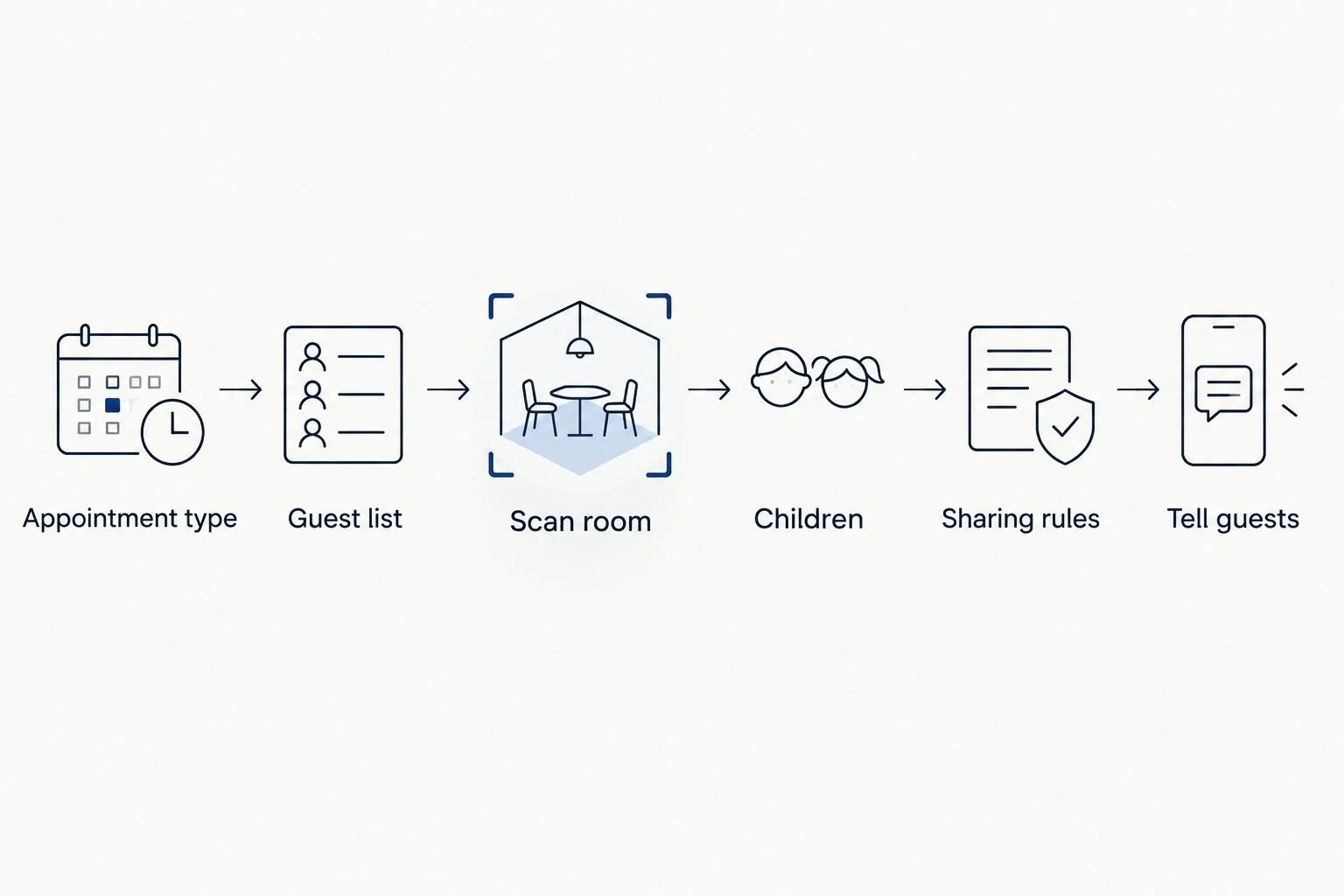
Confirm who can attend before you invite them.
What should you say when you ask?
A clear request gives the provider enough detail to answer without guessing: “I’m booking a 3D/4D ultrasound and would like to bring adults and children. How many guests are allowed, can children enter the scan room, and may we take photos or include a relative by video call?” Replace “adults and children” with your actual group and ask for the rules that matter to you.
If your family needs an accommodation or you want one person with you for support, explain that separately. A general guest limit might not answer your specific question; the provider can tell you what arrangements are available for that appointment.
Does the appointment type change the answer?
Yes. The guest policy belongs to the provider and the visit, not to a single rule that covers every ultrasound. Use this comparison to frame your questions, then confirm the answer for your own booking.
Elective 3D/4D ultrasound
Main purpose: Viewing 3D images or moving 4D images
What to confirm about family: Guest count, children, scan-room access, and recording rules
Diagnostic pregnancy ultrasound
Main purpose: Answering a clinical question as part of care
What to confirm about family: Companion access, privacy needs, and whether guests can remain throughout
Prenatal anatomy scan
Main purpose: Assessing fetal anatomy as part of prenatal care
What to confirm about family: The imaging provider’s companion rules and whether guests can attend the examination
Best for sharing an imaging visit with family: an elective 3D/4D session, once the provider confirms that your chosen guests can attend. Its limitation is equally clear: an elective session is not a substitute for diagnostic prenatal care. A diagnostic visit is best for the clinical question it was ordered to address, even if its guest arrangements are less suited to a group visit.
At The Ultrasound Concierge, the available service categories include both diagnostic and elective imaging. That makes the distinction especially useful when you inquire: name the scan you want instead of asking whether family can come to “an ultrasound.” The answer needs to match the service you book.
Why guest arrangements vary
There is no reliable guest number to assume for a 2026 ultrasound appointment. These are the details that change what you need to ask:
Appointment purpose. A diagnostic scan and an elective viewing session serve different needs. Ask for the policy attached to yours.
Adults versus children. A provider may address children separately, so include their ages when you ask whether they can attend.
Scan-room access. Confirm whether the whole group can enter the room, not just the building.
Privacy. Decide who you want present if personal health information comes up, then ask how the visit is handled.
Photos and remote participation. Ask about recording and video calls as separate questions; neither follows automatically from permission to bring guests.
Location. If a provider serves more than one area, confirm the rules at the location where your appointment will take place.
These factors are a checklist, not a claim that a particular provider restricts guests. If the answer you receive is unclear, repeat your planned guest list and ask the provider to confirm it against the exact appointment.
Ask about your ultrasound visit
Confirm guest arrangements for the scan you want to book.
Should children come to a 3D/4D ultrasound?
Children can be part of the plan if the provider permits them, but get that answer before you tell them they are coming. Ask whether they can enter the scan room and whether you need another adult to look after them during the visit. That way, your attention does not have to be split between the scan and an unexpected childcare problem.
Think about your child’s comfort as well as access. A child who wants to see the baby on screen may enjoy the visit; a child who finds unfamiliar rooms difficult may be happier hearing about it afterward. Neither choice says anything about your family’s excitement or involvement.
Can grandparents or other relatives join remotely?
A video call is an option only if the provider permits it for your appointment. Ask whether calls are allowed in the scan room, whether recording is different from a live call, and whether the people attending in person are comfortable being on camera. A relative can still be part of the conversation afterward if live participation is not permitted.
Set expectations with remote guests before the visit. Ultrasound images do not always show the view someone hopes to see, and a call can draw your attention away from what the person performing the scan is explaining. If sharing images afterward matters most, ask what image-sharing options apply to the appointment rather than assuming a particular format or delivery time.
What if you want the visit to be a surprise?
You can keep the occasion a surprise without keeping the logistics a surprise. Confirm the guest rules yourself, then give invitees only the time, place, and attendance details they need. If you are arranging the visit for someone else, involve the patient in decisions about who will be present for their ultrasound.
Privacy matters most when a scan could involve health information. Do not promise relatives a particular image, a gender reveal, or a medical answer before the appointment. Tell them they are joining you for the experience, and let the person receiving care decide what to share afterward.
Is a 3D/4D visit the same as a prenatal medical scan?
No. A 3D image shows a three-dimensional view, and 4D shows that view in motion; those image formats do not, by themselves, define the medical purpose of a visit. If you need an examination to address a clinical concern, ask your prenatal care team which diagnostic scan you need.
A routine anatomy scan is generally performed around 18 to 22 weeks of pregnancy. That timing describes a prenatal examination, not a guaranteed window for obtaining a particular 3D/4D picture or permission to bring family. For any 2026 booking, discuss the purpose of each visit separately so a shared imaging experience does not replace recommended medical care.
FAQ
Can I bring family to an ultrasound appointment in 2026?
Yes, if the provider permits guests at your specific appointment. Confirm the guest limit, whether children can attend, and who may enter the scan room before inviting anyone.
Can my partner come into a 3D/4D ultrasound room?
Your partner can enter the scan room if the provider allows a companion for your appointment. Ask about room access directly; permission to come to the location does not necessarily answer that question.
Can I bring my children to see the baby during an ultrasound?
You can bring children if the provider permits them for your scan. Ask whether they can enter the scan room and whether another adult needs to supervise them.
How many people can come to a 3D/4D ultrasound?
The permitted guest count depends on the provider and appointment. Give the provider your exact number of adults and children, and ask for the limit that applies to your booking.
Can grandparents join an ultrasound by video call?
Grandparents can join by video call only if the provider permits calls during your appointment. Confirm live-call and recording rules separately before making plans.
Does a private ultrasound mean I can invite guests?
No. A private setting does not establish a guest policy. Ask the provider whether your chosen guests can attend and where they may stay during the scan.
Does a 3D/4D ultrasound replace my anatomy scan?
No. An elective 3D/4D viewing session does not replace a diagnostic prenatal anatomy scan. Ask your prenatal care team which medical examinations you need.
One last thing
The most useful question is not simply, “Can I bring family?” It is, “Can these people join this scan, in this room, under these sharing rules?” Ask it before you send invitations. The Ultrasound Concierge offers private ultrasound services in the Keller and Willow Park area, but only a direct answer about your appointment can settle the guest details for your 2026 visit.
Related guides

Is 3D ultrasound safe every trimester? Skip extras (2026)
Is 3D ultrasound safe every trimester? Routine keepsake scans are not recommended. Learn when repeat scans serve a medical purpose and what to ask in 2026.
Getting a 3D/4D ultrasound in every trimester is not a recommended routine for keepsake images. Ultrasound has no known harmful effects when used appropriately for medical care, but that does not establish that repeated elective scans provide a health benefit or are risk-free. Your prenatal clinician should decide when another scan answers a medical question.
TL;DR
Is 3D ultrasound safe every trimester? Do not schedule routine 3D/4D keepsake scans in all 3 trimesters.
A medically indicated ultrasound can be appropriate whenever your prenatal clinician needs information.
The Ultrasound Concierge is an option for private pregnancy imaging, not a substitute for prenatal care.
Ask about the scan’s purpose, operator and how any medical findings reach your clinician.
Is it safe to get a 3D/4D ultrasound every trimester?
There is no blanket recommendation to get an elective 3D/4D ultrasound every trimester. The distinction is why the scan is being done. A clinician may recommend repeat imaging to answer a specific question; scheduling another scan solely for pictures does not serve the same purpose.
Medically indicated ultrasound
Best for: Answering a prenatal care question
Benefit: Your clinician can use the findings to guide care
Limit: It should be ordered and interpreted for a clear clinical purpose
Elective 3D/4D ultrasound
Best for: Personal images during pregnancy
Benefit: It can provide a different view of the baby
Limit: It does not replace a diagnostic examination
Follow-up ultrasound
Best for: Checking a finding identified in care
Benefit: It addresses the question your clinician needs answered
Limit: Timing depends on that question, not a keepsake schedule
If you are planning an elective visit near your anatomy scan, read the guide to combining a 3D/4D ultrasound with your OB’s 20-week anatomy scan. The visits have different purposes even when they happen close together.
Why this matters
Ultrasound does not use ionizing radiation. That is reassuring, but it is not a reason to treat every additional scan as necessary. Ultrasound sends energy into tissue, so medical organizations advise trained operators to use it for a defined purpose and keep exposure as low as reasonably achievable.
The Food and Drug Administration discourages nonmedical fetal ultrasound for keepsake images. The American College of Obstetricians and Gynecologists advises against using ultrasound solely for nonmedical purposes. The American Institute of Ultrasound in Medicine also opposes its use without a medical benefit. Those positions address unnecessary exposure; they do not mean that a scan your clinician recommends is unsafe.
For a patient in 2026, the practical question is not whether a calendar allows another visit. It is whether the next ultrasound will answer a clinical question, provide personal images, or be mistaken for a check on the pregnancy when it cannot provide one.
What changes the answer from trimester to trimester?
Pregnancy care is not built around an elective 3D/4D appointment in each trimester. The reason for imaging changes as your clinician gathers information, and the clearest reason to repeat a scan is a question that the earlier scan did not settle.
First trimester: start with the clinical question
Early pregnancy imaging can address questions your prenatal clinician identifies. If you are receiving fertility care or have a concern about the pregnancy, ask that clinician what type of examination is needed and who will interpret it. A keepsake 3D/4D appointment should not stand in for that examination.
There is no need to book a 3D/4D scan in the first trimester simply to complete a three-visit plan. If personal images are your goal, discuss timing with your prenatal clinician before adding a visit. If medical information is your goal, seek an examination designed to provide it.
Second trimester: keep the anatomy scan distinct
A routine fetal anatomy examination is generally performed at 18–22 weeks. Its purpose is to assess fetal anatomy as part of prenatal care. A separate 3D/4D session can offer personal images, but it cannot be assumed to cover the same views, measurements, interpretation or follow-up.
Ask what your anatomy report says before deciding whether another scan would be useful. If the examination needs additional views, let your prenatal team direct the follow-up. If the examination is complete and you want images for your family, recognize the extra appointment as elective rather than another anatomy assessment.
Third trimester: do not use pictures as a health check
Your clinician may recommend a later ultrasound for a specific medical reason. That decision depends on your care, not on whether you already had images in the first or second trimester. Repeat imaging is appropriate when it supplies information your care team needs.
An elective 3D/4D visit later in pregnancy is still an elective visit. A visible face, movement or reassuring-looking image is not a clinical interpretation. If something worries you about your pregnancy, contact your prenatal clinician rather than using a keepsake appointment to decide whether everything is fine.
Why does the purpose of a repeat scan matter?
The number of visits alone does not tell you whether an ultrasound is appropriate. A scan done to answer a clinical question and a scan done to collect another set of images should not be judged as the same appointment. Each visit needs an understood purpose before you book it.
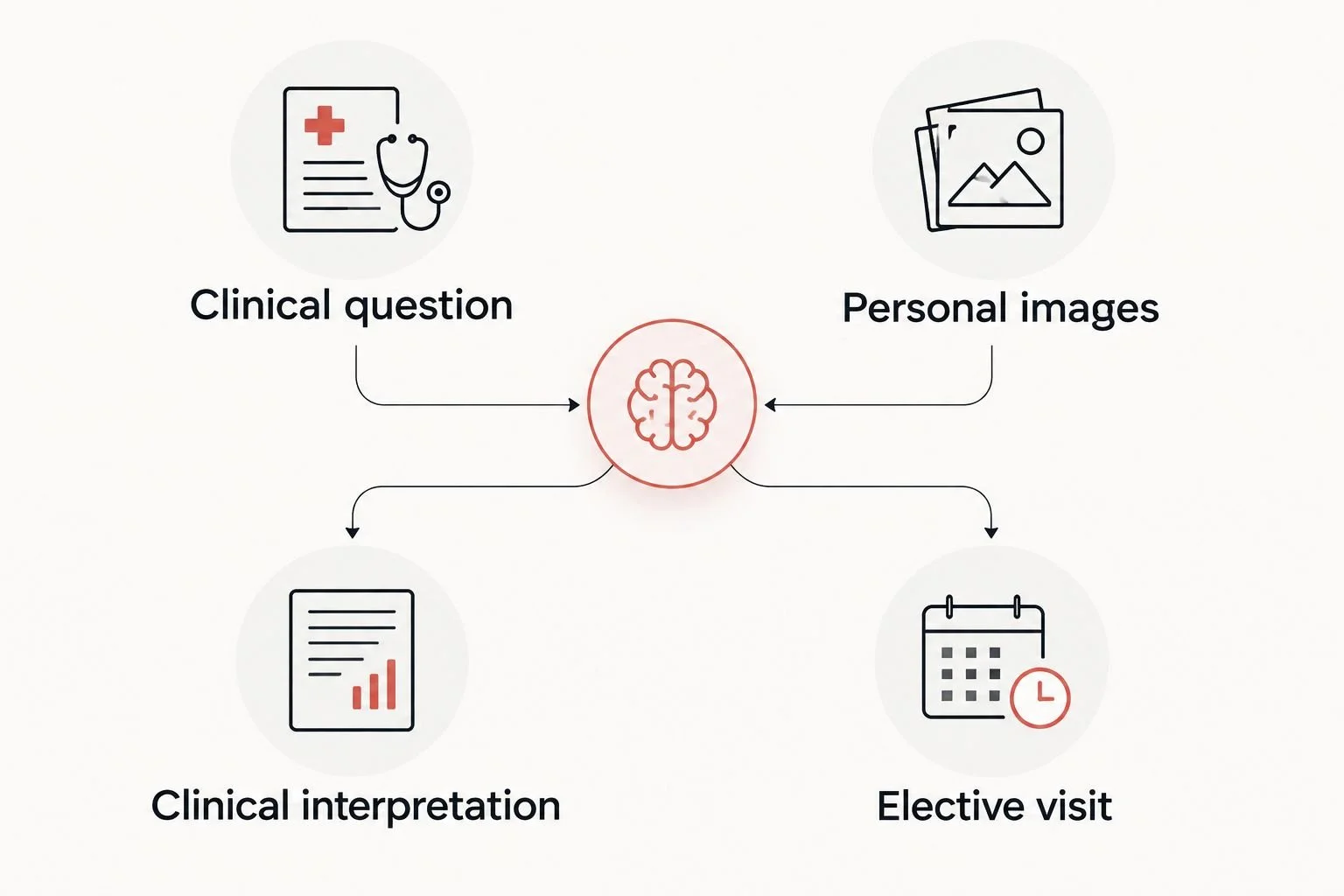
Know which kind of answer you need before choosing another scan.
The distinction also affects what happens afterward. For a diagnostic question, ask who interprets the images and how the findings reach the clinician managing your pregnancy. For an elective visit, ask what the appointment does and does not assess. Do not assume that an image session includes a medical report.
This matters when appointments are spaced apart. Wanting reassurance is understandable, but an extra image does not replace an assessment of symptoms or a finding your clinician is monitoring. The Ultrasound Concierge provides both diagnostic and elective pregnancy ultrasound services in the Keller and Willow Park area; choose the visit that matches the question you need answered.
What should you ask before booking another ultrasound?
Use these questions to separate an appropriate clinical follow-up from an appointment for personal images:
What is the purpose? State whether you need an answer for prenatal care or want 3D/4D images. If it is a medical question, ask your clinician which examination addresses it.
Who will perform and interpret it? Ask about the operator’s training and whether a qualified clinician will review any diagnostic findings. A clear interpretation matters more than the appearance of a single image.
How will it fit with existing care? Tell the provider about your recent scans and upcoming prenatal appointments so the reason for another visit is clear.
What happens if there is a concern? Ask how findings from a diagnostic visit reach your prenatal clinician. Do not rely on an elective visit as your route to urgent assessment.
Will the scan stay focused? Ask the provider to explain the planned examination rather than requesting more scanning simply to obtain a particular picture.
For 2026 appointments, keep these questions the same whether this would be your first ultrasound or another visit later in pregnancy. A useful booking conversation should make the purpose of the visit plain before scanning begins.
Choose the right ultrasound visit
Review diagnostic and elective ultrasound services before booking.
Does 3D/4D use a different kind of ultrasound?
3D ultrasound assembles a three-dimensional image; 4D shows that view in motion. These are ways of capturing and displaying ultrasound images, not a switch to X-rays or another form of ionizing radiation. The label alone does not answer whether a particular appointment is medically needed.
How the equipment is used matters. The operator chooses settings and spends time obtaining images, which is why professional guidance emphasizes a defined purpose and minimizing unnecessary exposure. Do not infer from a sharper-looking image that a scan is either safer or more medically informative.
The same distinction applies to a standard two-dimensional scan. A medically indicated examination has a reason for being performed. An additional scan, whatever the display format, should not become a substitute for asking your clinician about a symptom or an unresolved finding.
Can a private ultrasound replace my OB’s scan?
No elective ultrasound should replace an examination your prenatal clinician recommends. The appointment may be meaningful to your family, but personal images are not a substitute for the clinical views and interpretation your care requires. Ask what kind of visit you are booking rather than relying on the word ultrasound alone.
The Ultrasound Concierge offers diagnostic and elective ultrasound imaging. That makes the distinction particularly important: the service category you select should match your reason for visiting. If you need a medical answer, clarify the examination and reporting process; if you want images, keep the visit separate from your prenatal care plan.
A private setting can make a visit feel less rushed, but the setting does not determine what the scan can diagnose. You still need your prenatal clinician to interpret pregnancy concerns within the rest of your care. In 2026, carry that distinction into any conversation about adding a scan between scheduled visits.
Related questions
Is one elective 3D/4D scan safer than three?
There is no established visit count in this article that makes an elective scan risk-free. Professional guidance favors avoiding scans without a medical purpose, so do not treat three trimester visits as a recommended package or a safety benchmark.
Can I get another ultrasound if my clinician is concerned?
Yes. A medically indicated repeat ultrasound can be appropriate when your clinician needs more information, even if you have already had an ultrasound that trimester. Ask what question the new examination will answer and how you will receive the interpretation.
Does a clear 3D/4D image mean my baby is healthy?
No. A clear image shows that the operator captured a view; it is not, by itself, a diagnostic conclusion. Keep your scheduled prenatal examinations and direct health concerns to your prenatal clinician.
FAQ
Is 3D ultrasound safe every trimester?
Routine elective 3D ultrasound in every trimester is not recommended as a medical schedule. A clinician may recommend repeat ultrasound when each examination answers a clinical question.
Is a 4D ultrasound safer than a 3D ultrasound?
Neither label establishes that a scan is safer. The purpose of the examination, equipment use and avoidance of unnecessary exposure matter more than whether the image is still or moving.
Does ultrasound expose my baby to radiation?
Ultrasound does not use ionizing radiation. It does send sound-wave energy into tissue, which is why professional guidance advises purposeful use and minimal necessary exposure.
Can I have a 3D/4D visit after my anatomy scan?
You can discuss an elective 3D/4D visit after your anatomy scan with your prenatal clinician. The visit for personal images does not replace an anatomy examination or any follow-up your clinician recommends.
What if I need reassurance between prenatal visits?
Contact your prenatal clinician about the concern rather than using an elective image session as a health check. Your clinician can decide whether an examination or another form of assessment is needed.
Will an elective ultrasound tell me if something is wrong?
Do not count on an elective ultrasound to answer a diagnostic question. Ask whether the appointment includes a clinical examination, qualified interpretation and a process for sharing findings with your prenatal clinician.
Should I cancel an ultrasound my doctor recommended because I already had one?
Do not cancel a recommended examination solely because you had an earlier scan. Ask your clinician what the new scan is meant to assess and how it fits your care.
One last thing
The best reason for another ultrasound is a question it can actually answer. In 2026, you do not need to fill all 3 trimesters with elective 3D/4D appointments to have attentive prenatal care. If you are considering a private visit, The Ultrasound Concierge is best for patients seeking private pregnancy imaging in the Keller and Willow Park area who first clarify whether they need diagnostic information or personal images. Its elective imaging is not a replacement for your prenatal clinician’s recommended examinations.
Related guides

Know your rights
Knowing your rights as a patient in Texas
KNOW YOUR RIGHTS: ULTRASOUND CARE IN TEXAS
You have choices. Here’s what to know.
As a patient in Texas, you have the right to be informed and to participate in decisions about your healthcare — including where you receive ultrasound services.
You CAN:
Choose where you receive ultrasound imaging
Obtain additional or supplemental ultrasounds outside your OB or provider’s office
Self-pay for ultrasound services at a licensed diagnostic imaging facility
Request copies of your images and reports (this is protected by federal law)
Share your ultrasound results with any provider of your choosing
Texas law does not prohibit patients from obtaining ultrasounds outside their primary provider’s office.
What your provider MAY do:
Require an in-house ultrasound for their own medical decision-making
Repeat an ultrasound done elsewhere for clinical or liability reasons
Decide whether or not to rely on outside imaging in your official medical record
This is a provider policy — not a restriction on your rights as a patient.
What is NOT accurate:
“You’re not allowed to go anywhere else for ultrasounds.”
“It’s illegal to have ultrasounds done outside our office.”
“You cannot get imaging elsewhere while you’re our patient.”
These statements are not supported by Texas or federal law.
Your medical records belong to YOU.
Under federal HIPAA law:
You have the right to access your ultrasound images and reports
You may request that records be released to another facility or provider
Records cannot be withheld to prevent you from seeking care elsewhere
Important to understand:
Having an ultrasound done elsewhere does not replace the care of your OB or provider. Some offices may still require their own scans — and that’s okay.
What matters is that you are allowed to make informed choices about your care.
Questions to ask your provider:
If you’re unsure how outside ultrasounds fit into your care, you can ask:
“Will you still require an in-office ultrasound for medical decisions?”
“Can outside imaging be added to my chart?”
“What is your policy on outside diagnostic imaging?”
Clear communication helps everyone stay on the same page.
This information is for educational purposes and is not legal advice.
We want what’s best for you, and for you to go where you’re comfortable and informed.
TUC- Improving the ultraound experience. Changing the way healthcare feels.
-Callie