

How much does a fertility ultrasound cost in 2026?
Compare fertility ultrasound cost with an itemized quote. Learn what to ask about scan scope, reporting, insurance, and repeat monitoring before booking.
Your fertility ultrasound cost in 2026 depends on the examination your clinician requests, what the imaging provider includes, and how you pay; get an itemized quote for that exact scan before booking. A scan-only quote does not necessarily include interpretation, blood tests, a fertility consultation, or repeat monitoring. Compare the complete care plan, not just the appointment charge.
TL;DR
Compare fertility ultrasound cost using the exact examination and all included services, not an appointment label.
The Ultrasound Concierge provides private fertility ultrasound services for patients in Keller and Willow Park, Texas.
Confirm whether your quote includes interpretation, a written report, and delivery to your treating clinician.
A monitoring appointment and a complete fertility evaluation answer different questions; do not compare them as identical services.
How much does a fertility ultrasound cost in 2026?
The useful figure is your written quote for the prescribed examination, including any separately billed services. Ask whether the amount covers imaging alone or imaging plus interpretation and reporting. Then confirm whether your clinician expects a single examination or a sequence of monitoring visits.
For patients seeking a private setting, The Ultrasound Concierge provides fertility and diagnostic ultrasound services in the Keller and Willow Park, Texas area. Confirm the requested examination and reporting arrangements before scheduling; a private imaging visit does not replace your clinician's fertility assessment or treatment decisions.
Use this breakdown to make a quote understandable:
Ultrasound examination
What to confirm: The exact examination and imaging approach requested
Why it matters: A generic appointment label does not identify the clinical work needed
Interpretation
What to confirm: Whether professional interpretation is included
Why it matters: Image acquisition and interpretation are distinct tasks
Written report
What to confirm: Whether a report is included and where it goes
Why it matters: Your treating clinician needs usable findings, not just pictures
Monitoring visits
What to confirm: Whether the quote covers one appointment or a planned series
Why it matters: An individual visit is not the same as a treatment-cycle total
Related care
What to confirm: Whether consultation, laboratory work, or follow-up is separate
Why it matters: Ultrasound is only one part of a fertility evaluation
Ask for the total attached to the exact examination, with exclusions listed underneath. This gives you a practical basis for comparison without assuming that every provider packages care the same way.
Why this matters
Fertility care involves both information and timing. An ultrasound can assess pelvic structures and support monitoring, but your clinician must interpret those findings alongside your history and any other tests.
A quote that looks simpler is not automatically a better fit. If the appointment does not produce the measurements or report your clinician needs, it does not serve the same purpose as the requested scan. Resolve that question before comparing payment arrangements.
For your 2026 planning, keep the imaging appointment and the broader fertility plan separate on paper. You should know who performs the scan, who interprets it, and who explains the next step. These responsibilities matter as much as the quoted total.
A baseline fertility ultrasound: best for an initial assessment
A baseline ultrasound helps a clinician assess the uterus and ovaries as part of a fertility evaluation. Depending on the clinical question, the examination can include assessment of the uterine lining and ovarian follicles. Your clinician determines the appropriate timing and scope.
Its strength is providing structural information that a conversation or blood test alone cannot supply. Its limitation is equally important: a baseline ultrasound is not a complete fertility diagnosis. It does not establish every possible cause of difficulty conceiving.
When requesting a quote, give the provider the wording on your order rather than asking only for a fertility scan. Ask whether the examination includes the requested measurements and how the findings reach your clinician. Do not assume that an appointment marketed under a broad category includes every assessment your clinician wants.
Best for: patients whose clinician requests an initial ultrasound assessment. Choose the examination that matches the order, rather than adding scans without a clinical reason.
Follicle monitoring: best for tracking changes during treatment
Follicle monitoring uses ultrasound to follow ovarian follicles during a clinician-directed fertility plan. The clinician can use changes across examinations, together with other clinical information, to guide treatment. A single image is not equivalent to a series showing change over time.
The benefit is information tied to the treatment plan. The limitation is that a monitoring visit represents only one part of that plan; ultrasound alone does not determine medication instructions or guarantee ovulation, conception, or a pregnancy outcome.
For a 2026 monitoring quote, ask whether the quoted amount applies to an individual visit and whether each visit includes a report. Your treating clinic should specify when examinations are needed and what measurements must be recorded. Do not choose the schedule yourself to reduce the number of appointments.
Best for: patients whose fertility clinician has requested ultrasound monitoring. Confirm coordination with that clinician before booking imaging elsewhere.
Baseline assessment versus monitoring: what are you comparing?
Baseline assessment and follicle monitoring both use ultrasound, but they serve different purposes. Compare quotes within the same examination category before comparing providers. The table below separates their uses and limitations without treating either as a substitute for the other.
Baseline assessment
Best for: An initial clinician-requested evaluation
Main benefit: Structural information about the uterus and ovaries
Main limitation: Does not identify every cause of infertility
Quote question: Does this include the assessments on my order?
Follicle monitoring
Best for: Following changes during a treatment plan
Main benefit: Measurements that support clinician-directed decisions
Main limitation: One visit does not represent the entire monitoring plan
Quote question: Is this quote per visit, and is reporting included?
Neither option is universally better. The right examination is the one that answers your clinician's current question. An unrelated ultrasound package is not a useful substitute, even if the appointment description sounds similar.
What should you clarify when quotes differ?
When two quotes do not match, first check whether they describe the same service. Ask the provider to explain the scope in plain language rather than comparing totals without context.
Examination scope: Confirm the requested organs, measurements, and clinical purpose.
Imaging approach: Ask whether the order calls for transabdominal imaging, transvaginal imaging, or both.
Interpretation and reporting: Establish whether these are included or handled separately.
Visit coverage: Clarify whether the quote covers one examination or a stated monitoring arrangement.
Payment arrangements: Ask the provider and your insurer how the examination will be handled under your circumstances.
Related services: Separate the scan from consultation, laboratory testing, and treatment follow-up.
These questions expose differences in what you are comparing. They do not establish that a more expensive appointment provides better care, or that a lower total leaves something out. Ask for the explanation and use the written answer.
How do you get a quote you can actually compare?
Start with your clinician's order or written imaging instructions. If you do not yet have those instructions, ask what examination is needed before shopping for an appointment. A precise request makes the conversation more useful for everyone.
Confirm the examination. Share the requested scan and clinical purpose with the imaging provider.
Check inclusions. Ask about image acquisition, interpretation, reporting, and anything billed separately.
Verify payment. Confirm the applicable self-pay or insurance arrangements without assuming coverage.
Arrange reporting. Identify the receiving clinician and check how the findings will reach that office.
Confirm timing. Match the appointment to your clinician's instructions and ask about preparation.
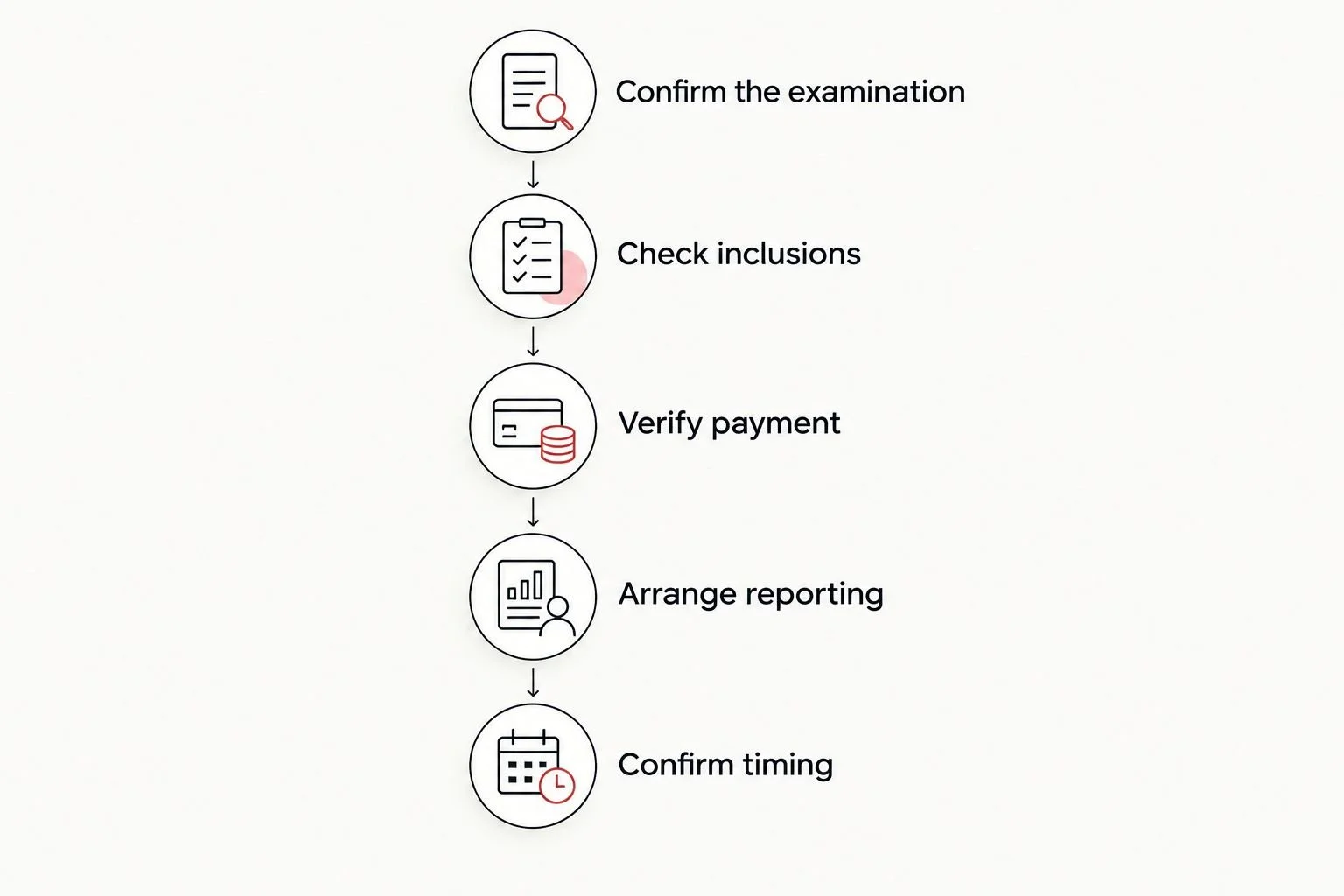
Match the examination and reporting requirements before comparing quotes.
Keep the answers together in a message or document. You should be able to identify the examination, what the quoted total includes, and who receives the report without relying on memory. If something is unclear, resolve it before confirming the appointment.
You can ask: Please quote the examination on my order, explain what is included, identify any separate services, and confirm how the report reaches my clinician. This is a request for clarity, not a request for additional testing.
Does insurance cover a fertility ultrasound?
Insurance coverage depends on your plan, the reason for the examination, and the provider's billing arrangements. A diagnostic ultrasound and an elective pregnancy imaging session are not interchangeable coverage questions. Ask about the exact examination your clinician requested.
For coverage verification in 2026, give your insurer the provider details and the billing information supplied by the imaging office. Ask about network status, referral or authorization requirements, applicable benefits, and your share of payment. A general statement that a plan covers ultrasound does not settle those questions.
Also ask how fertility-related services are treated under your policy. Do not assume that coverage for a pelvic ultrasound establishes coverage for a complete fertility treatment plan. Keep any verification reference with your appointment paperwork.
Do you pay for each fertility monitoring ultrasound separately?
Confirm whether the provider quotes monitoring per examination or under another stated arrangement. There is no reason to assume that an initial quote covers every scan your clinician later requests. Get the scope in writing.
Your treating clinician determines the monitoring schedule based on the clinical plan. Ask that office how imaging is coordinated, especially if you want to use an outside provider. A separate appointment must still meet the clinic's requirements for measurements, reporting, and timing.
If the plan changes, request an updated explanation of the services involved. Do not cancel medically directed monitoring solely because the original quote described a different appointment sequence.
Is a private fertility ultrasound the right fit?
The Ultrasound Concierge is best for patients seeking private fertility ultrasound services in Keller or Willow Park, Texas. Its stated service model emphasizes a calm, personalized alternative to clinical imaging centers. That setting can be relevant when you want a more personal appointment experience.
The clinical boundary remains the same: private imaging does not replace a fertility clinician's evaluation or treatment management. Confirm that the requested examination and report meet your treating clinician's needs. Do not assume referral rules, insurance arrangements, or reporting commitments without asking.
The Ultrasound Concierge fertility ultrasound services belong within your care plan, not alongside an independently chosen treatment schedule. For preparation and scheduling questions, the guide to how long a fertility ultrasound appointment takes provides a relevant next read.
Clarify your fertility imaging needs
Ask about the requested examination, included services, and reporting arrangements before scheduling.
FAQ
How do I find my fertility ultrasound cost in 2026?
Get an itemized quote for the exact examination your clinician requests. Confirm whether interpretation, reporting, related tests, and repeat monitoring are included or separate.
Is a fertility ultrasound the same as a complete fertility evaluation?
No, a fertility ultrasound is one part of a fertility evaluation. Your clinician considers imaging alongside your history and other indicated tests.
Will insurance pay for my fertility ultrasound?
Coverage depends on your insurance plan, the examination's purpose, and the provider's billing arrangements. Verify the specific service, network status, and any authorization requirements before booking.
Does one ultrasound tell me exactly when I will ovulate?
A single ultrasound does not reliably establish the exact time you will ovulate. Clinicians use follicle findings alongside timing, repeat examinations when indicated, and other clinical information.
Should I ask for a transvaginal or abdominal fertility ultrasound?
Ask your clinician which imaging approach answers the clinical question. Tell the imaging provider about concerns or preferences so you can discuss the examination before it begins.
Can I book private imaging during fertility treatment?
Coordinate private imaging with your treating fertility clinic before booking. The clinic should confirm the examination, timing, measurements, and reporting requirements.
Who is The Ultrasound Concierge best for?
The Ultrasound Concierge is best for patients seeking private fertility ultrasound services in Keller or Willow Park, Texas. Confirm the requested examination and care coordination before scheduling.
One last thing
The most useful question is not just what the scan costs, but what decision the scan will support. Ask your clinician what they need to learn and what happens after the findings arrive. That answer helps you distinguish necessary imaging from an appointment that does not address your current concern.
For your 2026 appointment, bring that clinical question with your order. A clear purpose, an itemized quote, and an agreed reporting pathway give you a firmer basis for booking than an appointment label alone.
Related guides

How long do you need to wait between ultrasound scans?
How long between ultrasound scans depends on the reason for your exam. Learn when repeat imaging helps, when to wait, and when symptoms need urgent medical care.
There is no universal minimum waiting period between ultrasound scans; the right interval depends on what your clinician needs to assess and what the previous scan showed. A medically necessary repeat scan should follow your care plan, while an elective scan should never replace an examination for new symptoms or an unresolved medical concern.
TL;DR
How long between ultrasound scans depends on the clinical question, not a universal waiting period.
FDA guidance discourages ultrasound performed solely for pregnancy keepsake images; spacing alone does not establish safety.
Early pregnancy and fertility ultrasound follow-up should follow the treating clinician’s instructions.
New or worsening symptoms need medical assessment, not a later elective ultrasound appointment.
The Ultrasound Concierge is best for patients in Keller and Willow Park seeking private ultrasound imaging. Diagnostic appointments and elective pregnancy visits serve different purposes, so confirm which you need before choosing a date.
How long do you need to wait between ultrasound scans?
Wait for the interval your treating clinician recommends, rather than applying a fixed rule to every ultrasound. Ultrasound does not use ionizing radiation, but that does not make every additional examination necessary. The timing should match a question that imaging can answer.
Early pregnancy follow-up
What determines the interval: Previous findings, pregnancy dating, and symptoms
Best for: Clarifying an uncertain early finding
Benefit and limitation: A repeat examination can clarify development; repeating too soon can leave the same uncertainty.
Pregnancy growth monitoring
What determines the interval: The monitoring plan and previous measurements
Best for: Tracking growth when clinically indicated
Benefit and limitation: Comparison helps assess growth; measurements need an appropriate interval to be meaningful.
Fertility monitoring
What determines the interval: Cycle stage, treatment, and clinic instructions
Best for: Guiding fertility treatment
Benefit and limitation: Timely scans support treatment decisions; a generic waiting rule can disrupt the plan.
General diagnostic ultrasound
What determines the interval: The organ being examined and the clinical question
Best for: Investigating or following a medical concern
Benefit and limitation: A repeat scan can answer a specific question; ultrasound is not the right test for every condition.
Elective pregnancy imaging
What determines the interval: Prenatal care, medical advice, and the purpose of the visit
Best for: Discussing optional pregnancy images
Benefit and limitation: Images can be meaningful to families; an elective visit does not replace diagnostic prenatal care.
These distinctions apply in 2026 whether your appointment is at a hospital, an imaging center, or a private ultrasound practice. The setting does not determine the medically appropriate interval.
Why this matters
An ultrasound appointment and a follow-up plan are not the same thing. A calendar opening tells you when a provider can see you; it does not tell you when a repeat examination will answer your medical question.
Repeating an examination too soon can mean another inconclusive result. Delaying a recommended examination can postpone an assessment your clinician needs for treatment or monitoring. The useful question is not simply whether you can have another scan, but what that scan is expected to establish.
For your 2026 care plan, keep the previous report and the follow-up instructions together. If the instructions are unclear, contact the clinician who requested the scan before booking another one.
Early pregnancy follow-up: use the previous findings
An early pregnancy scan can leave questions unanswered because the pregnancy is earlier than expected or because the findings need further assessment. Your clinician interprets those findings alongside your symptoms, pregnancy history, and any other relevant testing.
The route of the examination matters, too. A transvaginal ultrasound and an abdominal ultrasound do not provide identical views in early pregnancy, so their follow-up instructions are not interchangeable.
Ask what the next examination is intended to confirm. Is the clinician checking pregnancy location, looking for expected development, or reassessing a finding that was uncertain? Knowing the purpose helps you understand why a particular date was recommended.
Do not shorten an early-pregnancy follow-up interval solely to obtain reassurance. An examination performed before an expected change is visible can repeat the uncertainty rather than resolve it. However, new symptoms require medical advice even if your planned repeat scan is still ahead.
Pregnancy growth monitoring: follow the monitoring plan
Growth assessment relies on comparing measurements over time. Your maternity clinician chooses the interval based on the reason for monitoring, the previous findings, and the wider pregnancy assessment.
Not every pregnancy ultrasound is a growth scan. An examination checking another concern can have a different timetable from one intended to measure growth. That distinction explains why two patients at a similar stage of pregnancy can receive different follow-up instructions.
Ask whether your next appointment is for growth, anatomy, fluid assessment, or another specific purpose. You do not need to interpret the measurements yourself; you need to know what the appointment contributes to your care.
For pregnancy monitoring in 2026, keep the schedule set by your maternity team unless that team changes it. An elective appointment between medical examinations does not reset or replace that schedule.
Fertility ultrasound: let the treatment schedule lead
Fertility ultrasound timing depends on the treatment plan and what your clinic is monitoring. Follicle development and the uterine lining can inform treatment decisions, so follow-up timing is tied to your cycle rather than a general ultrasound waiting period.
Do not postpone a fertility scan because you recently had another ultrasound. Contact your fertility clinic if an appointment conflicts with work, travel, or another medical visit; the clinic needs to decide how to adjust the schedule.
The advantage of repeated monitoring is that it gives the treating team information relevant to the current cycle. Its limitation is that an isolated image, without the treatment context, does not provide a complete plan.
Before using a separate imaging provider, ask your fertility clinic what examination and reporting details it requires. Confirm where the report should go and who will review it before any treatment decision.
General diagnostic ultrasound: match the scan to the question
Abdominal, pelvic, and other diagnostic ultrasound examinations do not share a single repeat interval. Follow-up depends on the finding being assessed, whether symptoms have changed, and whether ultrasound remains the appropriate test.
An unchanged medical concern does not automatically require another scan. Equally, a recent normal examination does not rule out every cause of new symptoms. Your clinician decides whether you need repeat imaging, a different test, or an examination first.
Ask what the repeat diagnostic ultrasound will change about your care. A clear answer might involve checking an unresolved finding or assessing a response to treatment. If you are unsure why the repeat was requested, clarify the purpose rather than cancelling it yourself.
Bring the previous report when you attend another provider. Comparing examinations requires more than knowing that your last scan was described as normal.
Elective pregnancy ultrasound: spacing is not a safety guarantee
There is no calendar interval that turns an unnecessary pregnancy ultrasound into a medically indicated examination. The FDA discourages ultrasound performed solely to create fetal keepsake images, and the American Institute of Ultrasound in Medicine supports prudent use by appropriately trained professionals.
Ultrasound energy can produce biological effects, so responsible practice considers the reason for the examination, exposure settings, and examination time. Waiting longer between visits is not a substitute for appropriate use. This remains the relevant safety distinction when planning an elective visit in 2026.
The Ultrasound Concierge offers diagnostic and elective pregnancy ultrasound services. Confirm the purpose of the appointment, how it fits with your prenatal care, and where medical questions should be directed. The limitation of an elective visit is clear: it does not replace a diagnostic examination or your maternity team’s advice.
If you are considering repeat elective visits, read about 3D/4D ultrasound safety across pregnancy trimesters. Keep the decision connected to your clinical care rather than treating each trimester as an automatic reason for another scan.
Why the interval between ultrasound scans varies
The next appointment should reflect the circumstances of the examination, not a rule borrowed from someone else’s pregnancy or treatment.
Clinical purpose: Checking early pregnancy development is different from monitoring fertility treatment or examining an abdominal concern.
Previous findings: A clearly answered question and an unresolved finding require different follow-up decisions.
Pregnancy or cycle stage: The timing affects what the examination can show and how the findings are interpreted.
Symptoms: New or worsening symptoms can change the need for assessment before a scheduled follow-up.
Examination method: The views available from abdominal and transvaginal examinations differ, particularly in early pregnancy.
Care plan: Treatment decisions and planned monitoring determine when the next report is needed.
How do I choose the right date for a repeat ultrasound?
Use the following sequence before arranging your next appointment. It keeps the scheduling decision connected to the reason for the examination.
Confirm purpose. Ask what the next scan is intended to establish and whether it is diagnostic or elective.
Review findings. Check the previous report and the clinician’s follow-up instructions, rather than relying only on what you remember from the appointment.
Confirm timing. Ask the treating clinician when the next examination should happen and whether that timing depends on other results.
Report symptoms. Tell the clinical team about new or worsening symptoms before deciding to wait for the planned scan.
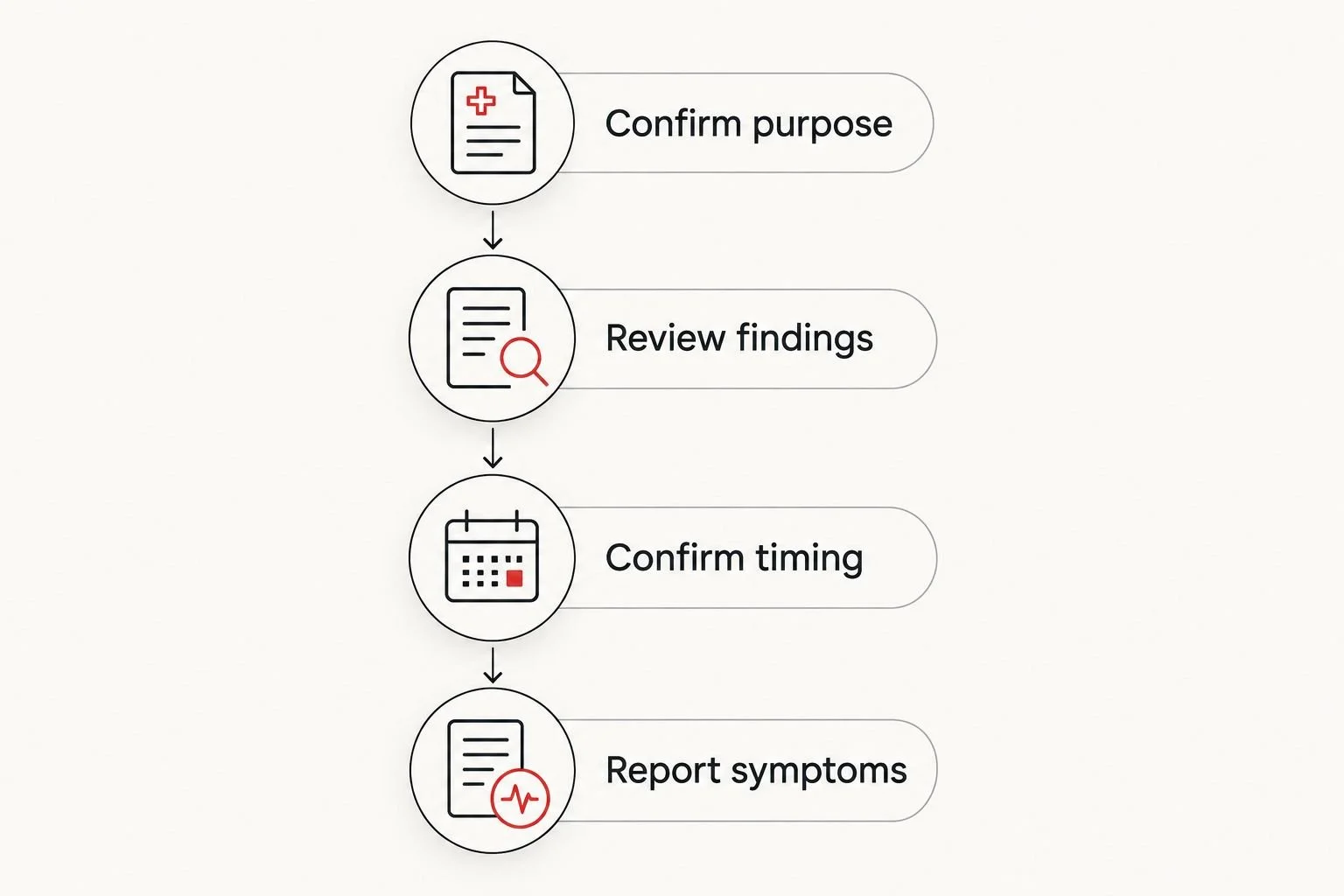
Choose the next appointment from the care plan, not from a generic waiting rule.
Also confirm who will receive the report and who will explain the result. A completed scan still needs the right clinical follow-up; collecting images alone does not finish the process.
Can I have another ultrasound soon after my last one?
Another ultrasound can be appropriate soon after a previous examination when a clinician needs additional information. A recent scan does not create a mandatory waiting period that overrides a medical need.
Do not arrange repeated elective examinations simply because there is no universal minimum interval. The reason for scanning still matters, particularly during pregnancy.
Should I wait if my symptoms change before the next scan?
Do not wait for a scheduled ultrasound when symptoms need urgent medical assessment. During pregnancy, severe abdominal pain, heavy bleeding, fainting, or feeling seriously unwell require urgent care. Reduced or changed fetal movement also requires prompt advice from your maternity team.
A private imaging appointment is not an emergency assessment. Contact the appropriate medical service rather than using an elective scan to decide whether a concerning symptom is serious.
FAQ
How long between ultrasound scans is safe during pregnancy?
There is no universal waiting interval that establishes safety between pregnancy ultrasound scans. Medically indicated examinations should follow your clinician’s plan, and spacing alone does not make elective scanning appropriate.
Can I get another ultrasound after a recent scan?
Yes, another ultrasound can be appropriate after a recent scan when your clinician needs additional information. Ask what the repeat examination will assess and when it should be performed.
Why did my clinician ask me to wait before another early pregnancy scan?
Your clinician can recommend waiting so a repeat examination has a better chance of clarifying development or an uncertain finding. Follow the instructions for your specific report, and seek medical advice if symptoms change.
Is an elective ultrasound the same as a diagnostic ultrasound?
No, an elective pregnancy ultrasound does not replace a diagnostic examination. Diagnostic imaging addresses a medical question and needs appropriate interpretation and follow-up.
Do fertility ultrasound scans need the same spacing as pregnancy scans?
No, fertility ultrasound timing follows the cycle and treatment plan. Follow your fertility clinic’s instructions rather than applying another patient’s pregnancy scan schedule.
Should I wait for my next ultrasound if I have pain or bleeding?
Do not wait for a planned scan if pain, bleeding, or other symptoms need urgent medical assessment. Contact your pregnancy care team, and seek urgent care for severe pain, heavy bleeding, fainting, or feeling seriously unwell.
Can The Ultrasound Concierge replace my scheduled prenatal scans?
An elective pregnancy visit at The Ultrasound Concierge does not replace scheduled diagnostic prenatal scans. Keep your maternity team’s appointments and confirm the purpose of any additional imaging.
One last thing
A repeat ultrasound can be more useful because it happens at the right time, not because it happens sooner. Before booking, ask your clinician what change the next examination is expected to show and who will act on the result.
For your next ultrasound appointment with The Ultrasound Concierge in 2026, keep those questions beside your previous report. That gives the visit a clear purpose while keeping medical decisions connected to your treating team.
Related guides

Can an ultrasound check for ovarian cysts?
Need an ultrasound check ovarian cysts evaluation? Yes, pelvic imaging can find cysts. Learn scan options, preparation, limits, and when to seek urgent care.
Yes—an ultrasound can check for ovarian cysts by showing their location, size, and whether they contain fluid, solid tissue, or both. A diagnostic pelvic ultrasound often uses an abdominal scan, a transvaginal scan, or both to examine the ovaries. Ultrasound findings guide the next step, but they do not by themselves establish whether every ovarian mass is benign or explain every cause of pelvic pain.
TL;DR
For an ultrasound check ovarian cysts evaluation, choose diagnostic pelvic imaging—not an elective pregnancy keepsake scan.
Transvaginal ultrasound provides close-up ovarian images; abdominal ultrasound gives a broader pelvic view.
The Ultrasound Concierge offers private diagnostic imaging; confirm the requested pelvic examination before booking.
Sudden severe pelvic pain, especially with vomiting or faintness, needs urgent medical assessment.
Can an ultrasound check for ovarian cysts?
Yes. Pelvic ultrasound is a standard imaging examination for evaluating suspected ovarian cysts. It uses sound waves rather than ionizing radiation, and it helps your clinician distinguish a simple fluid-filled cyst from a finding that needs closer assessment.
For your 2026 appointment, ask for the examination that answers the clinical question—not simply an appointment labeled ultrasound. The Ultrasound Concierge provides private diagnostic imaging in Keller and Willow Park, TX; confirm whether the requested ovarian examination is available before scheduling.
Your pelvis normally contains 2 ovaries, although surgery or other circumstances can change your anatomy. The examination aims to assess both when present, along with nearby structures relevant to the reason for your scan.
Transabdominal pelvic ultrasound
Best for: A broad overview of the pelvis
Main advantage: Examines pelvic structures through the lower abdomen without an internal probe
Main limitation: Bowel gas, body tissues, and bladder filling can limit detail
Transvaginal pelvic ultrasound
Best for: Close-up assessment of the ovaries and uterus when appropriate and consented to
Main advantage: Places the probe closer to pelvic organs
Main limitation: Requires an internal examination and your consent; it is not appropriate for every patient
Combined pelvic examination
Best for: Questions that benefit from both views
Main advantage: Uses complementary views rather than relying on one approach
Main limitation: Involves both examination methods and their preparation requirements
These approaches are not competing packages. Your symptoms, medical history, consent, and the imaging question determine which approach fits.
Why this matters
Pelvic pain does not automatically mean you have an ovarian cyst. Some cysts cause no symptoms and are found during imaging for another reason; pain can also come from conditions involving the uterus, urinary tract, bowel, or other pelvic structures.
A useful scan therefore needs a clear reason and a plan for reviewing the findings. Finding a cyst and deciding what to do about it are separate steps. Your clinician connects the images with your symptoms, examination, pregnancy status, and medical history.
The American College of Obstetricians and Gynecologists' patient guidance on ovarian cysts describes ultrasound as part of cyst evaluation. RadiologyInfo's pelvic ultrasound guidance explains the abdominal and transvaginal approaches. Those clinical distinctions—not elective image enhancements—are the basis of this 2026 guide.
Transabdominal ultrasound: a broader pelvic view
During a transabdominal pelvic ultrasound, the sonographer applies gel to your lower abdomen and moves a handheld probe over your skin. A full bladder is often requested because it helps create a clearer viewing window for pelvic structures.
Transabdominal ultrasound is best for a broad pelvic overview without an internal examination. It can help show the location of a pelvic finding and its relationship to surrounding organs. It also complements closer views when a finding extends beyond the area easily seen with a transvaginal probe.
Its limitation is image detail. Bowel gas and the distance between the probe and ovaries can make an ovary harder to see, so an abdominal scan alone does not always answer the question.
Do not choose this approach solely because it sounds more comfortable. Explain your preferences and concerns, then ask whether an abdominal-only examination can adequately address your clinician's request.
Transvaginal ultrasound: a closer view of the ovaries
During a transvaginal ultrasound, a covered, lubricated probe is placed in the vagina with your consent. Because the probe sits closer to the ovaries and uterus, it often provides more detailed images than an abdominal approach alone.
Transvaginal ultrasound is best for detailed pelvic assessment when it is appropriate and you agree to it. The examination can show a cyst's wall, internal contents, and surrounding ovarian tissue. Doppler imaging can add information about blood flow when the clinical assessment requires it.
The limitation is that this is an internal examination. You can ask how it will be performed, discuss discomfort or previous difficult experiences, decline it, or ask for it to stop. If you decline, ask what information the alternative examination can and cannot provide.
Where is the probe used?
Abdominal view: Lower abdomen
Transvaginal view: Inside the vagina
What bladder preparation is commonly requested?
Abdominal view: Full bladder
Transvaginal view: Empty bladder
What should you confirm?
Abdominal view: Drinking instructions
Transvaginal view: Consent and examination process
Preparation instructions for your 2026 visit should come from the imaging provider. Do not assume instructions from a previous pregnancy scan apply to a diagnostic pelvic examination.
What can an ovarian cyst ultrasound show?
Ultrasound helps describe a finding rather than simply report that a cyst exists. That description matters because different appearances lead to different follow-up decisions.
Location: Whether the finding appears to arise from an ovary or another nearby structure.
Size: Measurements that establish a baseline for comparison with later imaging.
Contents: Whether the finding looks fluid-filled, contains internal echoes, or includes solid-appearing components.
Walls and partitions: Whether the wall is thin and smooth or contains features needing further assessment.
Blood flow: Doppler findings that add information about the ovary or a component of the mass.
Nearby findings: Fluid or other pelvic changes relevant to the clinical question.
A report commonly records a finding in 3 dimensions, using measurements in centimeters or millimeters. Comparing measurements is useful, but your clinician also considers whether the appearance has changed and whether the studies are directly comparable.
A simple cyst has a different ultrasound appearance from a complex cyst. Complex does not automatically mean cancer. Blood within a cyst and other benign processes can create internal features, but those findings still need interpretation rather than reassurance based on the word cyst alone.
Ultrasound also has limits. It cannot provide a tissue diagnosis, and a normal-looking scan does not rule out every cause of pelvic pain.
Why ovarian cyst findings and follow-up vary
There is no single follow-up plan for every ovarian cyst. The appropriate next step depends on the finding and the person—not just its largest measurement.
Ultrasound appearance: A simple fluid-filled cyst differs from a mass with solid components or irregular features.
Symptoms: Persistent discomfort requires a different clinical discussion from an incidental finding without symptoms.
Menopausal status: Clinicians assess ovarian findings differently before and after menopause.
Pregnancy status: Pregnancy changes the context of pelvic pain and influences evaluation.
Change over time: A resolving finding differs from one that persists, grows, or changes appearance.
Medical history: Prior ovarian findings, surgery, and relevant personal or family history inform interpretation.
Some findings need observation, some need repeat imaging, and others need specialist assessment or additional testing. Do not choose your own rescan interval from a general article. Ask the clinician reviewing your report to explain the recommendation and what symptoms should prompt earlier contact.
For a follow-up scan in 2026, bring the previous report and ask how earlier images can be made available. A comparison is more useful when the reviewing clinician can assess the actual prior findings rather than rely on your memory of a measurement.
How do I prepare for an ultrasound to check my ovaries?
Preparation starts with confirming the examination, not guessing how much water to drink. A pregnancy keepsake scan and a diagnostic pelvic ultrasound do not answer the same questions.
Clarify the clinical question. Tell your clinician about pelvic pain, pressure, cycle changes, or a previously identified cyst. Include when symptoms started and whether they are worsening.
Confirm the examination. Ask whether the requested study is transabdominal, transvaginal, or both, and whether the provider performs that study.
Check referral requirements. Requirements depend on the examination and provider. The guide to whether you need a doctor's referral for a private ultrasound addresses this scheduling question.
Follow bladder instructions. Ask when to drink, when to avoid emptying your bladder, and whether you will empty it between examination methods. Follow the provider's specific directions.
Bring useful records. Have prior imaging reports, relevant surgery history, medication information, and pregnancy information available.
Arrange results review. Confirm who will interpret the examination, who receives the report, and whom you should contact about next steps.
The Ultrasound Concierge is best for patients seeking private diagnostic ultrasound in Keller or Willow Park, TX. Confirm the specific pelvic study, preparation, and results process before booking; private imaging does not replace treatment or follow-up with your clinician.
Discuss your diagnostic imaging needs
Confirm the requested pelvic examination and preparation before scheduling.
Can ultrasound tell whether an ovarian cyst is cancerous?
Ultrasound can identify features that help estimate concern, but it cannot definitively establish whether every ovarian mass is cancerous. A clinician assesses the scan alongside your age, menopausal status, symptoms, and relevant history.
Suspicious findings can lead to additional imaging, blood tests, or specialist evaluation. When a definitive tissue diagnosis is necessary, imaging alone does not supply it.
Avoid interpreting an isolated report term as a diagnosis. Ask what the finding means in your situation and whether the report recommends monitoring or further assessment.
Can a normal ultrasound explain why I still have pelvic pain?
A normal pelvic ultrasound does not explain or exclude every cause of pelvic pain. Some conditions are not reliably visible on routine ultrasound, and pain can originate outside the ovaries.
If symptoms continue, return to your clinician even when no cyst is found. Tell them whether the pain relates to your cycle, urination, bowel movements, movement, or sexual activity; that information helps guide further evaluation.
When should I seek urgent care instead of booking a scan?
Sudden severe pelvic or abdominal pain needs urgent medical assessment, especially with nausea, vomiting, fainting, marked weakness, or fever. These symptoms can occur with complications such as ovarian torsion or cyst rupture, but they can also have other urgent causes.
Do not wait for a routine ultrasound appointment to rule out an emergency. A clinician needs to assess your symptoms and decide which tests are appropriate.
Pelvic pain with possible pregnancy also needs prompt attention, particularly with bleeding, dizziness, fainting, or shoulder pain. An ectopic pregnancy is one reason urgent assessment matters.
Doppler ultrasound can help assess blood flow, but visible blood flow does not by itself exclude ovarian torsion. Persistent or severe symptoms still require clinical evaluation.
FAQ
Can an ultrasound check for ovarian cysts even if I have no pain?
Yes, pelvic ultrasound can identify ovarian cysts in people without pain. Whether you need imaging depends on your clinical situation; ultrasound is not recommended as routine ovarian cancer screening for asymptomatic people at average risk.
Is a transvaginal ultrasound better than an abdominal ultrasound for ovarian cysts?
Transvaginal ultrasound often provides more detailed ovarian images because the probe is closer to the ovaries. An abdominal view adds broader context, and the two approaches can complement each other.
Can I refuse a transvaginal ultrasound?
Yes, you can decline a transvaginal ultrasound or ask for it to stop. Ask your clinician whether an abdominal examination can answer the question and what limitations remain without internal imaging.
Does finding an ovarian cyst mean I need surgery?
No, finding an ovarian cyst does not automatically mean you need surgery. Management depends on symptoms, ultrasound appearance, menopausal status, and other clinical factors.
Can an ultrasound diagnose PCOS from ovarian cysts alone?
No, ovarian ultrasound findings alone do not establish a diagnosis of polycystic ovary syndrome. PCOS assessment considers ovulation, signs or tests of androgen excess, and exclusion of other causes; the small follicles associated with PCOS are not the same as a single ovarian cyst.
Can I have a pelvic ultrasound during my period?
Yes, a pelvic ultrasound can generally be performed during your period. Confirm any examination-specific timing instructions, particularly when the scan also addresses fertility or another cycle-related question.
Can an elective pregnancy ultrasound check my ovaries?
An elective pregnancy keepsake scan is not a substitute for a diagnostic ovarian examination. Ask for a pelvic study designed to assess the ovaries and a clinical report that your treating clinician can review.
What should I ask The Ultrasound Concierge before booking in 2026?
Ask The Ultrasound Concierge whether it performs the specific diagnostic pelvic examination your clinician requested. Confirm referral requirements, bladder preparation, examination methods, and how the report reaches the clinician managing your care.
One last thing
An ovary that is not visualized on ultrasound is not the same as an ovary confirmed to be normal. Position, bowel gas, prior surgery, and other factors can affect visibility.
Before you leave your 2026 results discussion, ask: Were both ovaries assessed, what did the scan establish, and what remains unanswered? That question keeps the focus on a useful clinical answer rather than the reassurance of simply having completed a scan.
Related guides

How much does a general health ultrasound scan cost?
General health ultrasound scan cost depends on the exam and billing route. Learn what to ask about interpretation, insurance, and follow-up before booking.
Your general health ultrasound scan cost in 2026 depends on the exact examination, where you receive it, and whether you pay directly or use insurance; request an exam-specific written estimate before booking. Ask whether that estimate includes the imaging, professional interpretation, and any facility charges, because a scan quote does not automatically describe your complete financial responsibility.
TL;DR
General health ultrasound scan cost requires an exam-specific estimate, not a pregnancy package comparison.
Confirm whether imaging, interpretation, and facility charges are included before booking a diagnostic ultrasound.
Insurance coverage and your out-of-pocket responsibility are separate questions; verify both.
The Ultrasound Concierge suits patients seeking private general health ultrasound imaging in Keller and Willow Park.
Why this matters
An ultrasound estimate is useful only when you know what it covers. A quote for taking images is not necessarily the same as a quote that includes interpreting those images and sending a diagnostic report to your clinician.
For patients considering The Ultrasound Concierge, the starting point is the examination you need, not the appearance of the images or the name of an elective package. Compare the same examination and the same included services before comparing providers.
Keep the medical question separate from the payment question. Your clinician helps determine which examination is appropriate; the imaging provider and your insurer help explain how that examination will be billed.
How much does a general health ultrasound scan cost?
The useful answer is a written estimate for your specific examination, with included services and exclusions clearly listed. General health ultrasound is a broad service description, not enough information to establish a single total.
For a 2026 appointment, use this sequence to obtain a quote you can actually compare:
Identify the exam. Give the provider the examination name from your clinician's order, if you have one. Describe the medical question rather than requesting a general check of everything.
Confirm the scope. Ask which body area the examination covers and whether the requested study is complete or limited. Do not choose a narrower examination solely to reduce your bill.
Choose the billing route. Ask about direct payment and insurance billing separately. Confirm which routes the provider offers for that examination.
Check the inclusions. Ask whether image acquisition, professional interpretation, the written report, and any facility charges are included.
Request the estimate. Get the details in writing, including who bills you and what would trigger an additional charge.
A receptionist can help with scheduling and billing questions, but those answers do not replace clinical advice about which examination you need. If the exam name is unclear, ask your ordering clinician to clarify it before you commit to an appointment.
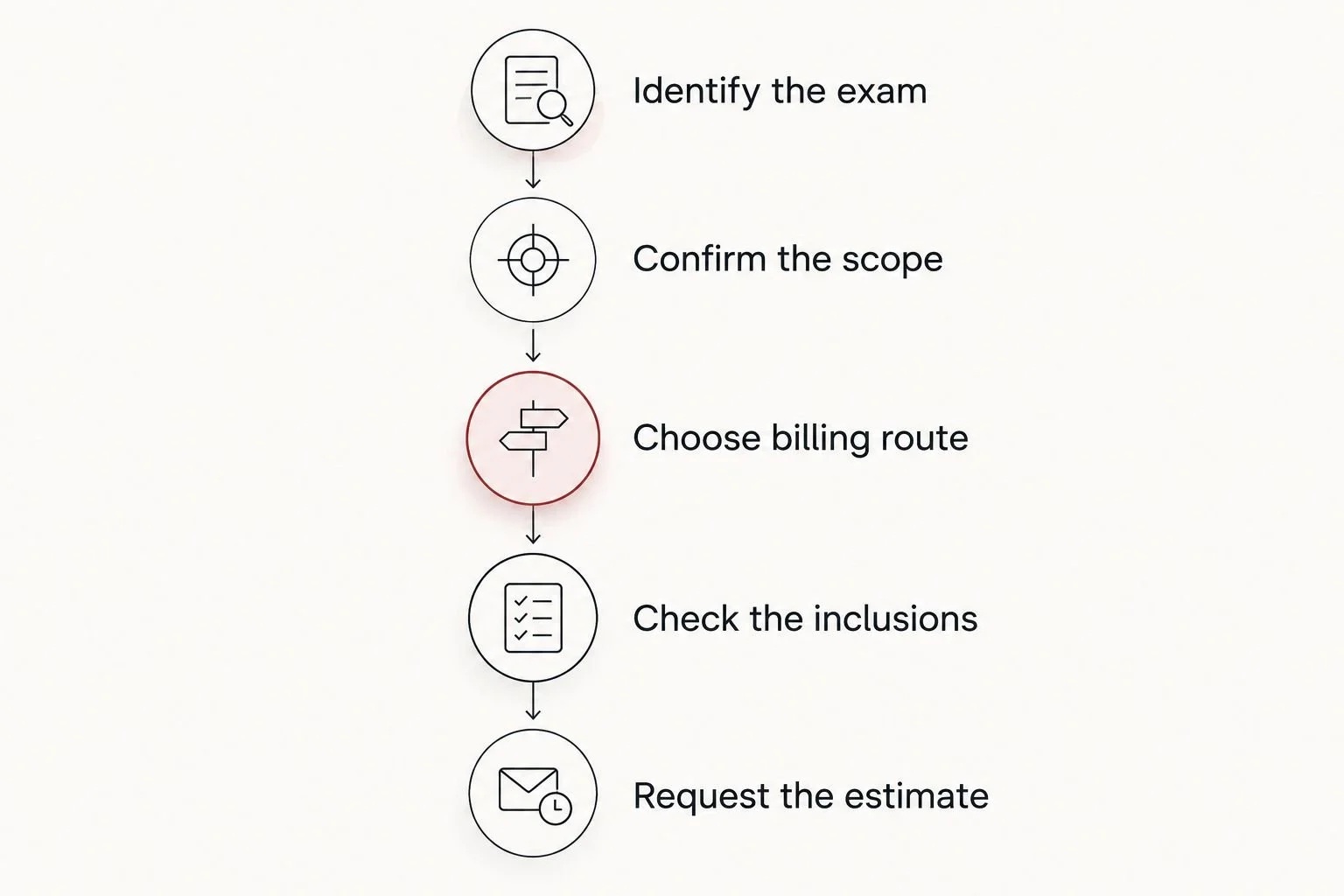
Identify the examination before comparing estimates.
What should an ultrasound estimate include?
Ask for each part of the service to be identified, even when the provider combines them into a single charge. That makes the estimate easier to understand and exposes unanswered questions before your visit.
Image acquisition
What to confirm: Whether performing the examination is included
Why it matters: This is the imaging portion of the visit
Professional interpretation
What to confirm: Who interprets the study and whether that service is included
Why it matters: Diagnostic interpretation is distinct from taking images
Written report
What to confirm: Whether a report is produced and where it is sent
Why it matters: Your clinician needs findings that support follow-up care
Facility billing
What to confirm: Whether a separate facility charge applies
Why it matters: The appointment location can affect how services are billed
Additional services
What to confirm: Whether another examination or consultation requires a separate estimate
Why it matters: A quote should define its boundaries
Treat this as a checklist, not a statement that every provider bills each component separately. The goal is to establish what applies to your appointment.
Paying directly versus using insurance
Neither billing route is automatically the better choice. Compare the direct-payment estimate with your insurer's estimate of patient responsibility for the same examination and provider.
Insurance coverage does not mean that you owe nothing. A deductible, copayment, or coinsurance can affect your responsibility under your plan; your insurer can explain which applies.
Direct payment
Best for: Patients seeking a written estimate outside insurance billing
Advantage: You can ask the provider directly what the quoted service includes
Limitation: You must confirm how payment relates to your insurance benefits and deductible
Insurance billing
Best for: Patients using benefits for a covered diagnostic examination
Advantage: The examination can be processed under the plan's applicable benefits
Limitation: Coverage, network status, authorization, and patient responsibility require verification
What to ask when paying directly
Ask whether the estimate is for the complete diagnostic service or only the imaging portion. Confirm whether another organization will send you a separate bill for interpretation.
If you have insurance but intend to pay directly, ask your insurer how that choice affects your benefits. Do not assume a direct payment will count toward your deductible or that you can submit it for reimbursement.
What to ask when using insurance
Give your insurer the provider's details and the examination information supplied by the imaging office. Ask about coverage, network participation, referral requirements, prior authorization, and your remaining deductible.
For a 2026 appointment, verify your current plan rather than relying on what happened at a previous visit. An imaging office accepting insurance is not the same as your specific examination being covered under your specific plan.
Keep a record of the answers. If the imaging provider and insurer give different information, resolve that difference before the appointment rather than treating either answer as a guarantee.
Why general health ultrasound estimates vary
These are the details to check when estimates differ. They help you identify whether you are comparing equivalent services rather than assuming one office simply charges differently.
Examination scope: Confirm that both estimates describe the same body area and the same complete or limited study.
Included interpretation: Ask whether professional interpretation is included or billed separately.
Billing setting: Establish whether the appointment carries a separate facility charge.
Payment arrangement: Keep direct-payment terms separate from insurance-based estimates of patient responsibility.
Additional examinations: Ask whether another requested body area or study needs its own estimate.
Follow-up services: Confirm whether a later consultation or repeat examination is outside the original quote.
A difference in scope is not a reason to choose the smaller examination without medical guidance. The right comparison starts with the examination your clinician considers appropriate.
Similarly, an estimate that excludes interpretation should not be treated as equivalent to one that includes it. Compare the complete service, not just the first charge you see.
How do I know which ultrasound to request?
Start with the concern you want addressed and ask your clinician which examination answers that question. A general health scan is not a universal test for every symptom or every organ.
If you already have an order, use its exact wording when contacting an imaging provider. Ask whether the provider performs that examination and what documentation is needed to schedule it.
If you do not have an order, ask about the provider's requirements before booking. The guide to whether you need a doctor's referral for a private ultrasound addresses that separate scheduling question; do not assume that requirements for elective imaging also apply to diagnostic imaging.
Ultrasound uses sound waves rather than ionizing radiation, but that does not make every ultrasound examination appropriate for every concern. Its usefulness depends on the body area, the clinical question, and the examination performed.
Do not choose a diagnostic scan solely because it sounds reassuring. Ask what the examination can assess, what it cannot assess, and who will explain the findings.
What should I confirm before booking in 2026?
Before you book a general health ultrasound in 2026, make sure the clinical and billing details agree. A clear appointment description should tell you what happens before, during, and after the scan.
Before the visit
Confirm the examination name, any referral or order requirement, and the preparation instructions for that specific study. Preparation differs by examination, so do not reuse instructions from a pregnancy scan or another person's appointment.
Ask whom to contact if you cannot follow those instructions. Do not change medication use or fast without the appropriate instructions from your care team.
During the visit
Ask what the examination involves and whether you can raise questions before it begins. You should understand the purpose of the appointment and have an opportunity to discuss comfort or accessibility needs.
Do not assume the person acquiring the images will provide a final diagnosis during the scan. Ask in advance how interpretation is handled and who is responsible for communicating the results.
After the visit
Confirm who receives the written report and whom you should contact to discuss it. Ask how you can obtain your records if another clinician needs them.
An appointment is not a complete care plan by itself. If the examination identifies a finding that needs attention, your treating clinician determines the next step.
Is a private ultrasound a good choice for general health imaging?
The Ultrasound Concierge is best for patients seeking private general health ultrasound imaging in Keller and Willow Park. Its stated services include diagnostic imaging in a calm, personalized setting.
That setting addresses the experience of the visit, but you still need to confirm the particular examination, interpretation arrangements, referral requirements, and payment details. A private environment does not replace those practical checks.
The advantage is the fit with patients who prefer a concierge-style visit. The limitation is that the service description alone does not establish whether a particular examination meets your clinician's requirements or your insurance plan's rules.
Does a general health ultrasound check everything?
A general health ultrasound does not check everything. An ultrasound examination is directed at particular anatomy and clinical questions, and some concerns require other tests or imaging methods.
Ask your clinician what a normal result would mean for your symptoms. A normal scan does not automatically rule out every possible cause or eliminate the need for follow-up.
Will the estimate include follow-up care?
The estimate includes follow-up care only when the provider explicitly identifies it as part of the quoted service. Ask separately about discussing the report, additional consultations, and any later examination.
For your 2026 visit, make the next-step question concrete: who explains the findings, and who decides whether more evaluation is needed? That answer matters as much as knowing who sends the bill.
FAQ
How do I find out my general health ultrasound scan cost?
Request a written estimate for the exact examination you need. Confirm whether imaging, professional interpretation, the written report, and any facility charges are included, and compare equivalent services.
Does insurance cover a general health ultrasound?
Coverage depends on your plan and the specific examination. Ask your insurer about medical necessity, network status, authorization requirements, and your share of the bill before booking.
Is paying directly better than using insurance for an ultrasound?
Neither option is automatically better. Compare the provider's direct-payment estimate with your insurer's estimate of responsibility for the same examination, and confirm how direct payment affects your benefits.
Do I need a doctor's referral for a diagnostic ultrasound?
Confirm the referral or order requirement with the imaging provider and your insurer. Do not assume that scheduling rules for elective pregnancy imaging apply to a diagnostic general health examination.
Can a general health ultrasound tell me whether everything is normal?
No, a general health ultrasound cannot establish that everything is normal. The examination assesses particular anatomy and clinical questions, and your clinician interprets its findings alongside your symptoms and other information.
Will someone explain my ultrasound results during the appointment?
Ask the provider who interprets the examination and how results are communicated. Image acquisition and final diagnostic interpretation are distinct parts of the process, so do not assume you will receive a diagnosis during the scan.
Is The Ultrasound Concierge an option for general health ultrasound?
The Ultrasound Concierge provides private diagnostic and general health ultrasound services for patients in the Keller and Willow Park, Texas area. Confirm your specific examination, preparation, reporting, and billing requirements before scheduling.
One last thing
The most useful question is not simply what the scan costs. It is what exactly am I paying for, and who helps me understand the result?
For a 2026 appointment, ask the provider to put the examination name, included services, billing parties, and report destination in writing. That turns a vague quote into a decision you can make with confidence, without confusing a comfortable visit with a complete diagnostic pathway.
Related guides

SneakPeek Gender Test Twins Accuracy: Limits in 2026
SneakPeek gender test twins accuracy depends on interpretation: a boy result means at least one boy. Learn what results establish and when ultrasound helps.
SneakPeek can provide an early fetal-sex result in a twin pregnancy, but it cannot identify each twin’s sex separately. A boy result means at least one twin is male; a girl result means both twins are predicted to be female, assuming a valid sample and the usual test conditions. For twins, an accurate result is not necessarily a complete answer about both babies.
TL;DR
SneakPeek gender test twins accuracy depends on interpreting a shared blood sample, not identifying each baby separately.
A SneakPeek boy result means at least one male twin, not necessarily two boys.
A SneakPeek girl result predicts two female twins when the sample and testing conditions are valid.
Prenatal ultrasound can assess each twin individually; SneakPeek does not replace your prenatal care.
Is SneakPeek accurate for twin pregnancies?
Yes, but the result has a narrower meaning than it does in a singleton pregnancy. SneakPeek’s published twin-pregnancy explanation distinguishes between detecting male DNA and determining the sex of each baby. For individual views, read about whether twins can be seen clearly on ultrasound.
Boy
What it means for twins: At least one twin is predicted to be male
What it does not establish: Whether the other twin is male or female
Girl
What it means for twins: Both twins are predicted to be female
What it does not establish: Each baby’s anatomy or overall health
Inconclusive or invalid
What it means for twins: The test has not supplied an interpretable result
What it does not establish: Either twin’s sex
The test looks for Y-chromosome DNA in the pregnant patient’s blood. It does not collect a separate sample from Twin A and Twin B, so a detected Y-chromosome signal cannot tell you which baby contributed it.
The practical rule for 2026: interpret a boy result as “at least one boy,” not “two boys.” That distinction matters more than a headline accuracy percentage when you are planning a twin announcement.
Why this matters
You might be asking two different questions: whether the blood test correctly detects male DNA, and whether it tells you the sex of both twins. Those are not the same measurement. A correct boy result still leaves the second baby’s sex unresolved.
That does not make the result useless. It gives you early information, but it does not support every possible announcement. If you want to announce a boy-and-girl pair or two boys, wait until your prenatal team can assess each fetus individually.
For your 2026 pregnancy, decide what you need to know before choosing a test. An early clue and an individual answer serve different purposes.
Boy result: at least one male twin
A boy result means the sample contains the Y-chromosome signal the test uses to predict male fetal sex. In an ongoing twin pregnancy under ordinary testing conditions, that is consistent with either two male fetuses or one male and one female fetus.
You cannot choose between those combinations from a SneakPeek boy result alone. A stronger-looking result or a repeat boy result does not turn a shared sample into two individual samples.
The benefit is straightforward: you have information that at least one baby is predicted to be male. The limitation is just as important: you do not know whether that describes one baby or both.
If you already know you are carrying twins, tell the person organizing your reveal how to interpret the report. Otherwise, a standard boy-themed announcement can unintentionally imply that both babies are boys.
Girl result: both twins predicted female
A girl result means the test did not detect the Y-chromosome signal used to predict male fetal sex. For twins, the manufacturer’s interpretation is that both babies are female, provided the sample is valid and collected under the appropriate testing conditions.
This result answers the combination question more directly than a boy result. It predicts two female fetuses rather than leaving two different combinations open.
Still, a girl result is a prediction, not an assessment of each baby’s anatomy. It does not confirm that the pregnancy is developing normally, establish whether the twins are identical, or replace scheduled prenatal imaging.
If you receive a girl result and a later scan suggests a male fetus, contact your prenatal clinician and the testing provider. Keep the original report so they can review the result, collection circumstances, and pregnancy history together.
Identical and fraternal twins: what changes?
Identical twins arise from the same fertilized egg and ordinarily have the same chromosomal sex. Fraternal twins arise from separate fertilized eggs and can have the same or different sexes. That biological difference changes how you think about possible combinations, but it does not change what a shared blood sample measures.
Do not use SneakPeek to decide whether your twins are identical. Two boys or two girls can be identical or fraternal, so a same-sex result does not settle that question.
Your prenatal team also assesses whether the twins share a placenta or an amniotic sac. Those findings affect pregnancy monitoring and are not supplied by an elective fetal-sex blood test.
If you have been told your twins are identical, ask your clinician what established that conclusion. Do not infer it from a boy or girl report, the babies’ appearance on a keepsake image, or the number of placentas alone.
Why SneakPeek results and interpretation vary
Several factors affect whether a fetal-sex result is dependable and what you can reasonably conclude from it:
Pregnancy timing: Collection before the test’s permitted gestational age can leave too little pregnancy-derived DNA for reliable interpretation. Follow the current instructions rather than estimating from a positive pregnancy test.
Sample contamination: Outside male DNA can interfere with a test designed to detect Y-chromosome DNA. Follow the collection procedure closely.
Sample quality: Collection, handling, and laboratory acceptance determine whether the sample is usable. An invalid result is not a girl result.
Twin combination: A boy result cannot distinguish two male twins from a male-and-female pair. This is an interpretation limit, not necessarily a laboratory error.
A vanished twin: DNA associated with a demised co-twin can complicate blood-based fetal-sex interpretation. Tell your prenatal clinician about any earlier scan showing an additional fetus.
Other relevant medical history: A transplant or another unusual source of circulating DNA requires individual review. Ask your clinician and the laboratory before relying on an elective result.
These factors deserve different responses. Collection concerns belong with the testing provider; pregnancy-history concerns belong with your prenatal clinician as well. Neither is resolved by comparing your report with another parent’s experience online.
For testing in 2026, use the instructions supplied with your actual test. Do not substitute a social-media collection checklist for the manufacturer’s procedure.
Which option answers your actual question?
Choose the method by the question you need answered. SneakPeek addresses an early fetal-sex prediction, ultrasound examines each fetus, and prenatal screening addresses specific health-related screening questions.
SneakPeek
Best for: An early indication of whether male fetal DNA is detected
Main benefit: Provides a fetal-sex prediction from a blood sample
Main limitation: Cannot assign sex separately to each twin
Prenatal ultrasound
Best for: Assessing each baby individually
Main benefit: Shows anatomy and allows separate fetal assessment
Main limitation: Position and gestational age can limit the view
Clinical cell-free DNA screening
Best for: Prenatal screening discussed with your clinician
Main benefit: Screens for specified chromosomal conditions
Main limitation: Twin eligibility and fetal-sex reporting depend on the laboratory
Clinical cell-free DNA screening is not interchangeable with SneakPeek. A prenatal screening report also should not be assumed to assign sex to each twin: ask the ordering clinician what that particular laboratory reports.
Ultrasound offers an individual view, but a scan is not automatically conclusive. If one baby’s position blocks the relevant anatomy, the sonographer needs to record that limitation rather than guess.
Elective imaging also does not replace a diagnostic examination. Your prenatal clinician determines which medical scans and screening tests your twin pregnancy needs.
How do you confirm each twin’s sex?
Ask your prenatal team to assess each fetus separately during an appropriate ultrasound examination. The American College of Obstetricians and Gynecologists describes the standard second-trimester ultrasound window as 18–22 weeks of pregnancy; twin pregnancies can require additional imaging according to the clinical plan.
That window is not a guarantee that fetal sex will be visible. At 18 weeks of pregnancy, one twin’s position can obstruct the view; at 22 weeks of pregnancy, visibility still depends on the examination. The purpose of the anatomy scan is medical assessment, not guaranteeing a reveal.
Use this sequence when discussing confirmation:
Share history. Tell the clinician you have twins and disclose any earlier finding of a vanished twin.
Bring results. Provide the actual SneakPeek report, not just a recollection of the result.
Ask separately. Ask whether the assessment applies to Twin A, Twin B, or both.
Clarify uncertainty. Ask whether both views were adequate or one baby’s sex remains unconfirmed.
Plan follow-up. Follow the prenatal team’s recommendation instead of arranging extra scans solely to resolve uncertainty.
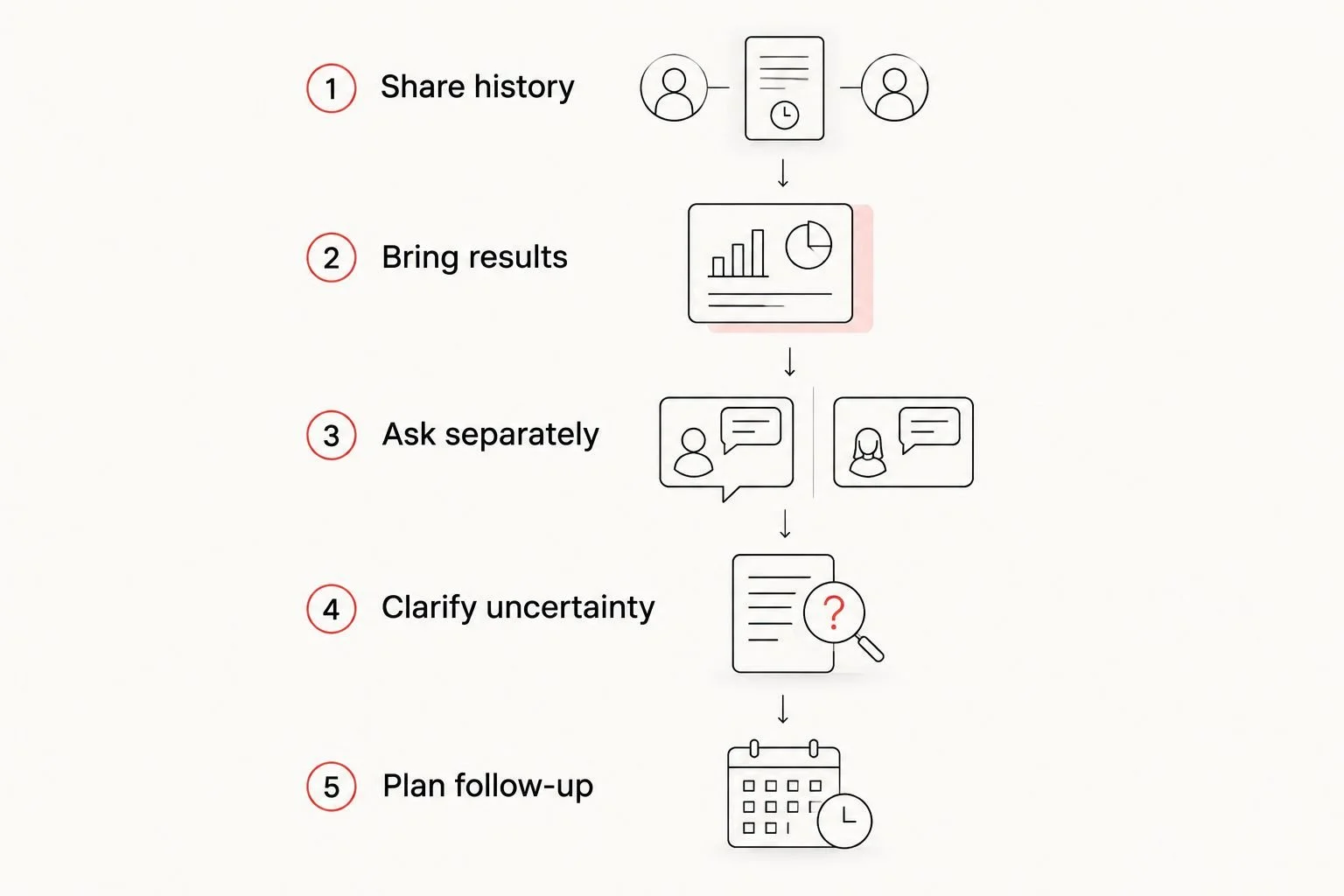
An individual answer requires a clear assessment of each twin, not just a shared blood-test result.
For your 2026 appointments, write down which findings apply to which twin. Keep the clinical labels consistent with your prenatal team’s records rather than assigning them yourself based on where a baby appears in a photograph.
What if SneakPeek and ultrasound disagree?
A disagreement needs review, not a quick declaration that one method is wrong. A boy result followed by one female-appearing fetus is not necessarily a conflict: the other twin can be male.
The more meaningful discrepancy is a boy result followed by adequate ultrasound views suggesting both twins are female, or a girl result followed by a clearly identified male fetus. Bring both reports to your prenatal clinician and ask what needs clarification.
The clinician can review gestational dating, the quality of the ultrasound views, sample collection, and any history of a vanished twin. Additional evaluation depends on the circumstances; repeating an elective blood test is not automatically the right next step.
Do not let a fetal-sex disagreement delay ordinary prenatal care. If a clinician identifies a medical concern, follow the medical evaluation rather than treating it as a gender-reveal problem.
Can you plan a twin gender reveal from the result?
Yes, if the announcement matches what the result actually establishes. A boy result supports saying that at least one baby is predicted to be a boy, but it does not support announcing two boys or a boy-and-girl pair.
A girl result predicts two girls under valid testing conditions. If you want individual confirmation before announcing, wait for adequate ultrasound assessment of both babies.
Give the reveal organizer explicit instructions about uncertainty. You do not need separate envelopes, matching decorations, or a fixed announcement date before you have an answer that supports those choices.
Where does a private appointment fit?
The Ultrasound Concierge is best for Keller and Willow Park patients seeking private pregnancy ultrasound and SneakPeek testing. Its stated service model offers a calm, personalized alternative to a clinical imaging center.
For twin pregnancies, the useful question is not whether a private setting makes the blood test more accurate. Ask The Ultrasound Concierge how the visit fits your goal: an early fetal-sex prediction, elective imaging, or diagnostic ultrasound coordinated with your prenatal care.
The Ultrasound Concierge’s pregnancy ultrasound and SneakPeek services serve different purposes. The same twin-result limits apply in a private setting, and an elective visit does not replace medically indicated monitoring.
FAQ
Does SneakPeek work if I’m pregnant with twins?
SneakPeek can provide a fetal-sex prediction in a twin pregnancy, but it cannot identify each twin separately. A boy result means at least one male twin; a girl result predicts both twins are female under valid testing conditions.
Does a SneakPeek boy result mean both twins are boys?
No. A SneakPeek boy result means at least one twin is predicted to be male; the other twin can be male or female.
Does a SneakPeek girl result mean both twins are girls?
Yes, that is the manufacturer’s interpretation for a valid twin-pregnancy result. It remains a fetal-sex prediction and does not replace individual prenatal ultrasound assessment.
Can SneakPeek tell me whether my twins are identical?
No. SneakPeek does not establish whether twins are identical or fraternal, and two babies of the same sex can be either.
Can a vanished twin affect a SneakPeek result?
A vanished twin can complicate blood-based fetal-sex interpretation because pregnancy-derived DNA from the demised co-twin can influence the sample. Discuss that history with your prenatal clinician and the laboratory before relying on the result.
When can an ultrasound check each twin’s sex?
The routine second-trimester anatomy ultrasound is generally performed at 18–22 weeks of pregnancy, when individual fetal anatomy can be assessed. Fetal position can still prevent a clear view, and your clinician determines the imaging schedule for your twin pregnancy.
Can The Ultrasound Concierge replace my OB’s twin monitoring?
No. The Ultrasound Concierge offers private diagnostic and elective ultrasound services, but an elective fetal-sex appointment does not replace your prenatal clinician’s twin-pregnancy monitoring plan.
One last thing
Write “at least one boy” beside a boy result before sharing it. Those four words prevent the most consequential interpretation mistake: turning one detected signal into two individual answers.
For a twin reveal in 2026, let the certainty of the result set the announcement—not the announcement date set the certainty you expect from the test.
Related guides

Fertility Ultrasound Appointment Length: Plan Your Visit 2026
Fertility ultrasound appointment length covers more than scan time. Learn what affects your visit, how to prepare, and what to confirm before booking in 2026.
The fertility ultrasound appointment length depends on the examination ordered and what your provider includes in the visit, so confirm the total arrival-to-departure time before arranging work, travel, or childcare. The imaging portion alone does not include registration, preparation, or any separately scheduled bloodwork or medical review. For a 2026 appointment, ask for the full reserved visit time—not just the time spent scanning.
TL;DR
Confirm fertility ultrasound appointment length for the complete visit, not just the scan.
The Ultrasound Concierge provides private fertility ultrasound imaging for patients in Keller and Willow Park, Texas.
Ask whether fertility monitoring includes bloodwork, report delivery, or a separate clinician review.
Follow your provider’s bladder instructions; preparation depends on the ultrasound approach.
Why this matters
Fertility care can involve appointments tied to your treatment plan, making an unclear schedule particularly frustrating. Knowing when you need to arrive, what happens during the visit, and who reviews the results helps you plan without rushing.
The Ultrasound Concierge is best suited to Keller and Willow Park patients seeking a private, personalized setting for fertility ultrasound imaging. You can explore The Ultrasound Concierge when considering that setting; confirm the requested examination and coordination requirements before booking.
A comfortable setting and a medically useful examination serve different needs. Your fertility clinician still needs the appropriate images, measurements, and report to guide care. Choose an appointment that supports both your comfort and the clinical question being asked.
How long does a fertility ultrasound appointment take?
A fertility ultrasound appointment takes more than the time needed to capture images. The useful scheduling estimate is the complete visit: arrival, preparation, examination, and any included discussion before you leave.
Ask the booking team to explain these stages rather than accepting an estimate labeled only as scan time. If you have another commitment afterward, explain that constraint before confirming the appointment.
Check-in
What happens: Identity, paperwork, and examination details are checked
What to confirm before booking: Whether forms can be completed beforehand
Preparation
What happens: Staff explain the examination and any changing or bladder instructions
What to confirm before booking: Whether the reserved appointment includes preparation
Imaging
What happens: The sonographer obtains the requested views and measurements
What to confirm before booking: Which examination your clinician ordered
Next steps
What happens: You receive instructions about reporting or follow-up
What to confirm before booking: Whether medical review occurs separately
Do not treat a scan-time estimate as a guaranteed departure time. Registration delays, examination requirements, and separate appointments affect the schedule differently.
For your 2026 booking, request an estimated departure time based on the actual appointment arrangement. Also ask what happens if your referring clinician needs additional views or measurements.
What should I say when I call?
Explain whether the appointment is for an initial fertility assessment, treatment monitoring, or early pregnancy after fertility treatment. These are different clinical purposes, even when they all involve pelvic ultrasound.
Then ask: Does the appointment estimate include check-in and preparation? Are bloodwork and the results discussion separate? Who sends the report to my fertility clinician?
That conversation gives you a more useful planning answer than a generic ultrasound duration. Keep the booking instructions with your treatment paperwork so you can check them before leaving home.
What happens during a fertility ultrasound appointment?
The exact examination follows the clinical request, but you can prepare around a straightforward sequence. Confirm the purpose first; preparation and reporting should follow that purpose.
Confirm the order. Make sure the imaging provider knows which examination your fertility clinician requested and whether particular measurements are needed.
Follow preparation. Use the provider’s instructions for bladder filling, clothing, and paperwork. Do not substitute instructions from a previous appointment.
Complete imaging. The sonographer explains the approach and obtains the required views. Tell staff about discomfort or concerns before and during the examination.
Clarify follow-up. Before leaving, establish who receives the report and who will explain what it means for your care.
A scheduled ultrasound does not automatically include a fertility consultation. Confirm that distinction before the visit, particularly if you expect to discuss medication, treatment timing, or the next stage of care.
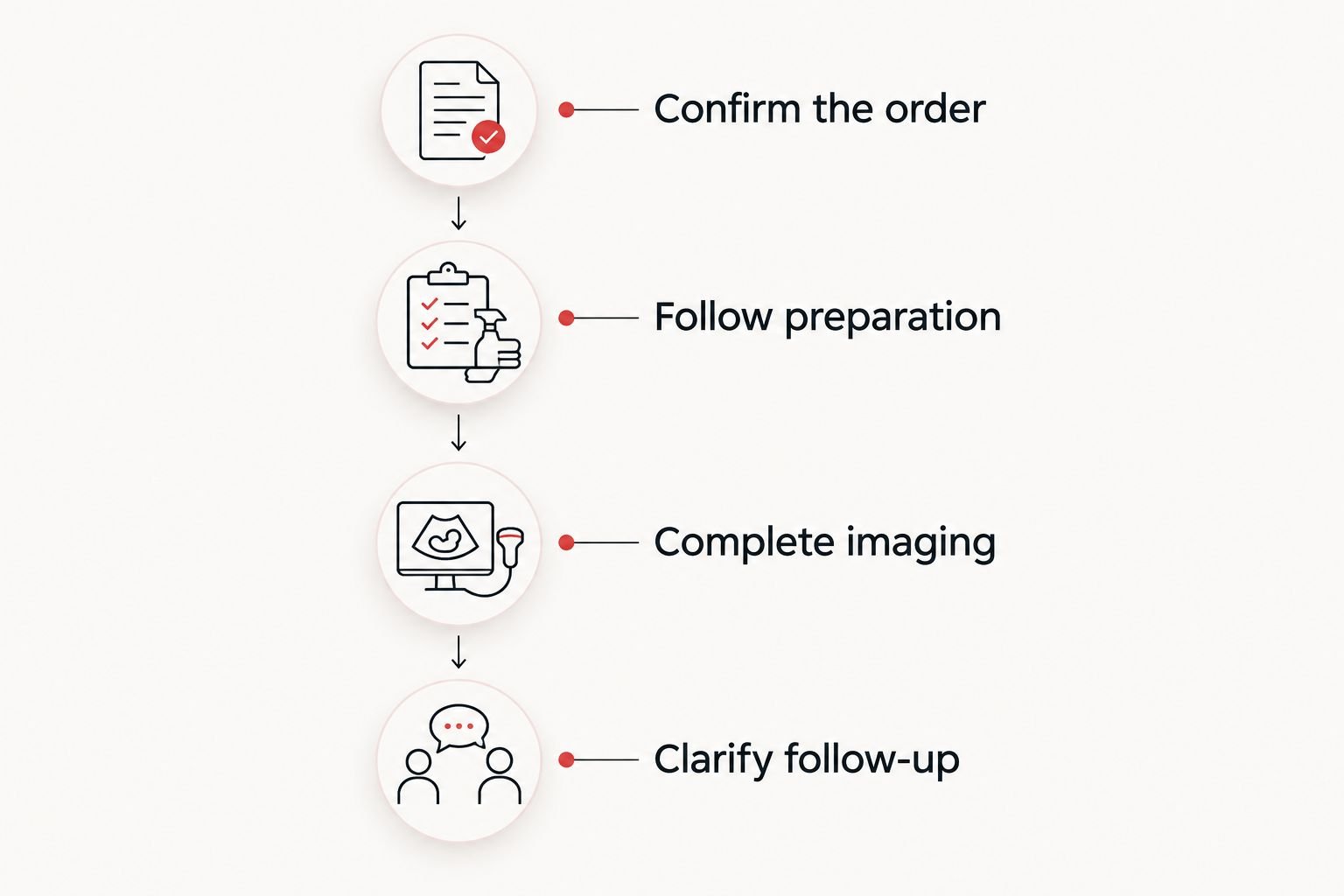
The appointment is easier to plan when preparation and follow-up are confirmed before arrival.
Does the ultrasound approach change the visit?
Pelvic ultrasound can use a transabdominal approach, a transvaginal approach, or both, depending on the examination. The preparation and experience differ, so ask which approach is planned rather than assuming every fertility visit works the same way.
Transabdominal ultrasound
Best for: A broader pelvic view when requested
Benefit: Imaging takes place through the lower abdomen
Limitation or consideration: A full bladder is commonly required; some structures need closer assessment
Transvaginal ultrasound
Best for: Detailed assessment of the uterus and ovaries when appropriate
Benefit: The probe sits closer to the pelvic structures
Limitation or consideration: It is an internal examination requiring consent and attention to comfort
Combined examination
Best for: Assessment requiring both broader and closer views
Benefit: The approaches provide complementary information
Limitation or consideration: Preparation can involve changing bladder instructions during the visit
Transabdominal fertility ultrasound
For a transabdominal examination, the sonographer moves a probe over your lower abdomen. A full bladder commonly helps create a viewing window for pelvic structures.
Follow the imaging provider’s specific instructions instead of choosing your own drinking schedule. If bladder filling is painful or difficult, tell staff rather than trying to endure it silently.
Transvaginal fertility ultrasound
For a transvaginal examination, a covered ultrasound probe is inserted into the vagina to obtain closer views of pelvic structures. This approach commonly forms part of fertility assessment and monitoring.
Ask staff to explain the procedure before it begins. You can raise concerns, ask about a chaperone, and request that the examination pause or stop; discuss alternatives with the clinical team if you do not consent.
A combined examination
When both approaches are requested, staff guide you through the preparation needed for each part. That can include using the bathroom between portions of the examination.
A combined examination is not interchangeable with a single-view appointment. Confirm what was ordered so the reserved visit matches the clinical request.
Why fertility ultrasound appointment length varies
Fertility ultrasound timing depends on the work required during the visit, not simply the name of the service. These are the factors to clarify when arranging your appointment:
Examination purpose: An initial assessment and a treatment-monitoring examination answer different clinical questions.
Imaging approach: Transabdominal, transvaginal, and combined examinations involve different preparation.
Requested measurements: Your clinician’s order determines the structures and measurements that need assessment.
Image access: Anatomy, bowel gas, and bladder preparation can affect how readily the required views are obtained.
Included services: Bloodwork, medical consultation, and imaging are not automatically part of the same appointment.
Comfort and consent: Questions, position changes, and pauses belong in the examination when you need them.
A longer visit does not, by itself, establish that something is wrong. Equally, a brief scan does not tell you whether the findings are normal. Only the clinical assessment and report address those questions.
When arranging care in 2026, explain any scheduling constraints without asking staff to shorten the ordered examination. A suitable appointment is one that allows the required assessment and respects your comfort.
How can I keep the appointment from running behind?
You can reduce avoidable disruption by confirming the order, preparation, and reporting details before arrival. You cannot control every part of the schedule, but clear instructions prevent unnecessary confusion.
Use this preparation checklist:
Confirm the location and requested arrival time.
Ask whether registration happens before the reserved imaging slot.
Check whether the imaging provider has the examination request.
Follow the bladder instructions supplied for this appointment.
Bring the documents the provider specifically requests.
Identify the fertility clinician who should receive the report.
Explain mobility, positioning, privacy, or examination concerns beforehand.
If your clinician changes the requested examination, tell the imaging provider before the visit. Do not assume a booking made for one purpose automatically covers a different assessment.
For questions about examination requests, the guide to whether a private ultrasound needs a doctor’s referral provides related context. Confirm the requirements for your fertility examination directly with your treating clinician and imaging provider.
Will I get my fertility ultrasound results before I leave?
Receiving images and receiving a medical interpretation are different steps. Ask who prepares the report, how it reaches your fertility clinician, and who will explain its implications for your treatment.
The person obtaining the images does not necessarily make treatment decisions. Do not interpret a sonographer’s silence, facial expression, or time spent on a particular view as a result.
Before a 2026 monitoring visit, confirm the reporting arrangement with your fertility team. If the findings will inform a treatment decision, ask what to do if the report has not reached the clinician when expected.
Do not change fertility medication based on your own reading of ultrasound images. Follow the treating clinician’s instructions and contact that team when you need clarification.
Can I return to work after a fertility ultrasound?
A routine transabdominal or transvaginal ultrasound generally does not require a recovery period or sedation. Your ability to return to work also depends on any separate procedure, medication, or appointment scheduled alongside it.
Ask about the complete visit before planning your return. Travel, check-in, and a separate consultation still occupy time even when the ultrasound itself does not require recovery.
If you experience significant discomfort or feel unwell, tell the clinical team. Do not use a general scheduling guide to dismiss symptoms or override instructions specific to your care.
FAQ
What does fertility ultrasound appointment length include?
Fertility ultrasound appointment length should cover check-in, preparation, imaging, and any included discussion before departure. Ask whether bloodwork and clinician review are separate appointments.
Does The Ultrasound Concierge offer fertility ultrasound imaging?
The Ultrasound Concierge provides private fertility ultrasound imaging for patients in the Keller and Willow Park, Texas area. Confirm the requested examination, preparation, and report coordination before booking.
Do I need a full bladder for a fertility ultrasound?
Bladder preparation depends on the ultrasound approach. Transabdominal pelvic imaging commonly requires a full bladder, while transvaginal imaging is commonly performed with an empty bladder; follow your provider’s specific instructions.
Is a longer fertility ultrasound a sign that something is wrong?
A longer fertility ultrasound does not, by itself, mean something is wrong. Image access, requested measurements, preparation, and comfort can all affect the examination.
Will a fertility ultrasound appointment include bloodwork?
Do not assume a fertility ultrasound appointment includes bloodwork. Ask your fertility team whether blood tests are needed and whether they take place at the same location or in a separate visit.
Can I ask the sonographer to stop a transvaginal ultrasound?
Yes, you can ask the sonographer to pause or stop a transvaginal ultrasound. Discuss your concerns and any alternative examination with the clinical team so you understand what information is still needed.
How should I plan a fertility ultrasound appointment in 2026?
For a fertility ultrasound appointment in 2026, confirm the full arrival-to-departure estimate and the reporting plan before booking. Keep travel, preparation, and any separate consultation distinct from the scan-time estimate.
One last thing
The most useful scheduling question is not just how long the scan takes—it is when your fertility clinician will receive the information needed for your care. A convenient appointment and a clear reporting plan solve different problems.
Before confirming your 2026 visit, check both. Knowing your expected departure time helps you organize the day; knowing the next clinical step helps you leave without guessing what happens afterward.
Related guides

Fertility Ultrasound Ovulation Timing: Yes, in 2026
Fertility ultrasound ovulation timing can estimate approaching ovulation, not its exact moment. Learn what scans show and when to ask for clinician-led monitoring.
Yes—a fertility ultrasound can help estimate when you’re approaching ovulation, and repeat scans can show changes consistent with an egg having been released. It cannot pinpoint the exact moment of ovulation or confirm egg quality; your clinician interprets the images alongside your cycle history and, when needed, hormone testing. This 2026 guide explains what the scan tells you and how to use that information without treating it as a countdown clock.
TL;DR
Fertility ultrasound ovulation timing is an estimate; repeat scans provide more information than a single image.
Ultrasound tracks ovarian follicles; urine LH tests detect a hormone surge that usually precedes ovulation.
A follicle measurement does not prove egg quality, fertilization, or pregnancy.
The Ultrasound Concierge provides private fertility ultrasound imaging for patients in Keller and Willow Park.
Can a fertility ultrasound tell you when you’re ovulating?
A fertility ultrasound can help predict approaching ovulation and provide evidence that ovulation has occurred, but it cannot give you an exact release time. The useful distinction is between seeing a follicle develop and seeing changes after that follicle releases an egg.
A clinician usually gets the clearest picture from a sequence rather than an isolated scan. Before arranging imaging, ask who will interpret the report and whether an order is needed; this guide explains referral questions for a private ultrasound.
Before ovulation: Ultrasound measures fluid-filled ovarian follicles and assesses the uterine lining. A developing dominant follicle helps your clinician estimate whether ovulation is approaching.
Across repeat scans: Changes in follicle size help your clinician follow development. The interval between scans depends on your cycle and treatment plan, not a universal schedule.
After suspected ovulation: A follicle that has collapsed or disappeared, a developing corpus luteum, and pelvic fluid can support the assessment that ovulation occurred. Your clinician considers these findings together rather than treating any one sign as proof.
An ultrasound shows the follicle surrounding an egg, not the egg itself. That means a reassuring-looking follicle is useful information, but it is not a direct assessment of the egg’s maturity or ability to become a pregnancy.
Why this matters
Timing matters because your fertile window begins before ovulation, not after you receive confirmation that it happened. The American Society for Reproductive Medicine’s patient guidance describes a 6-day fertile window ending on the day of ovulation, reflecting how long sperm can remain capable of fertilization before an egg is released.
Sperm can survive for up to 5 days in the reproductive tract under favorable conditions. An egg generally remains capable of fertilization for about 12–24 hours after release. These are biological windows, not guarantees about an individual cycle.
For your 2026 conception plan, the practical lesson is simple: do not wait for a post-ovulation scan to begin following your clinician’s timing advice. If you are undergoing fertility treatment, follow the clinic’s instructions for intercourse, insemination, medication, or procedures rather than calculating your own schedule from a measurement.
What can a single fertility ultrasound tell you?
A single scan can describe what your ovaries and uterine lining look like at that appointment. It can identify and measure follicles, assess the lining, and identify findings that need clinical interpretation.
Its main limitation is the missing timeline. Without earlier images or supporting information, a clinician has less evidence about whether a follicle is growing as expected, has stopped developing, or has recently changed after ovulation.
Best for: Assessing ovarian and uterine findings at a particular point in your cycle. The benefit is direct imaging; the limitation is that one appointment cannot show the full sequence of development and release.
Bring the date your last period started, recent ovulation-test results, and your medication list. Those details give the image context and help your clinician decide whether another scan or a different test answers the remaining question.
What do repeat fertility ultrasounds add?
Repeat ultrasounds let your clinician compare the same cycle over time. A series can track follicle development and then look for changes consistent with ovulation, which is more informative than estimating from an isolated measurement.
Best for: Clinician-directed follicle monitoring, including cycles in which fertility medication makes monitoring part of treatment. The benefit is a record of change; the limitation is that imaging still does not establish an exact release time or guarantee conception.
The scan schedule must match the clinical question. An early-cycle assessment, a scan near expected ovulation, and a scan after suspected ovulation serve different purposes, so booking them interchangeably can leave your original question unanswered.
Ask your treating clinician to specify the purpose before you schedule. If another imaging provider performs the scan, confirm how the report will reach the clinician responsible for your next step.
How does ultrasound compare with other ovulation tests?
Ultrasound, urine luteinizing hormone tests, and progesterone testing answer different questions. Your 2026 tracking plan should distinguish prediction before ovulation from evidence after ovulation, rather than treating every result as interchangeable.
Urine LH tests detect a hormone surge that usually precedes ovulation by 1–2 days, according to American Society for Reproductive Medicine guidance on fertility evaluation. A positive result suggests that ovulation is approaching; it does not prove that an egg was released.
Fertility ultrasound
What it tells you: Follicle development and findings consistent with recent ovulation
Best for: Clinician-directed monitoring
Main benefit: Directly assesses ovaries and uterine lining
Main limitation: A single scan cannot establish exact release time
Urine LH test
What it tells you: Whether a urinary hormone surge is detected
Best for: At-home prediction of approaching ovulation
Main benefit: Provides a signal before expected release
Main limitation: A positive test does not confirm ovulation
Progesterone blood test
What it tells you: Whether hormone levels support recent ovulation
Best for: Clinician-directed confirmation afterward
Main benefit: Adds biochemical evidence
Main limitation: Correct timing matters; it does not predict the next release
Calendar or cycle app
What it tells you: An estimate based on cycle dates
Best for: Recording patterns and planning discussions
Main benefit: Organizes your cycle history
Main limitation: Does not measure current follicle development or hormone changes
No method in this table assesses egg quality or confirms pregnancy. Combining information is useful when your clinician has a specific question—not simply because collecting more results feels reassuring.
Why fertility ultrasound ovulation timing varies
The interpretation depends on your cycle, the scan’s timing, and whether treatment is involved. These factors explain why a follicle measurement should not become a self-directed medication or insemination decision.
Cycle pattern: Ovulation does not always fall on the same cycle day. A calendar estimate is less informative when cycle lengths vary.
Appointment timing: A scan before release and a scan afterward capture different findings. Neither is a continuous recording of what happened between appointments.
Follicle development: A visible follicle does not necessarily release an egg. Clinical interpretation must distinguish development from evidence of ovulation.
Fertility medication: Treatment can change follicle development and the number of developing follicles. Monitoring and timing decisions belong to the prescribing clinician.
Underlying hormonal conditions: Conditions such as polycystic ovary syndrome can complicate cycle prediction and LH-test interpretation. Your clinician decides which evidence is most useful.
There is no single follicle-size rule that lets every patient identify the exact hour of ovulation. Use the report to support your clinician’s plan, not to replace it.
How should you plan a scan around ovulation?
Start with the decision you need the scan to support. For a 2026 fertility appointment, a clear clinical question is more useful than asking for a general scan and hoping it explains the entire cycle.
Define the question. Tell your clinician whether you want to assess follicle development, investigate irregular cycles, or look for evidence of recent ovulation.
Share cycle history. Provide period dates, recent LH-test results, relevant symptoms, and fertility medications. Do not stop or change medication to prepare for imaging unless your prescriber instructs you.
Confirm scan instructions. Ask whether transvaginal imaging is planned and what preparation is required. Bladder instructions differ by examination type, so follow the imaging provider’s directions.
Arrange report review. Confirm who receives and interprets the report. Knowing when and how you will receive clinical advice prevents a measurement from becoming an unanswered question.
Follow clinical advice. Ask what the findings change about your plan and whether repeat imaging or hormone testing is needed. Obtain medication and procedure instructions from your treating team.
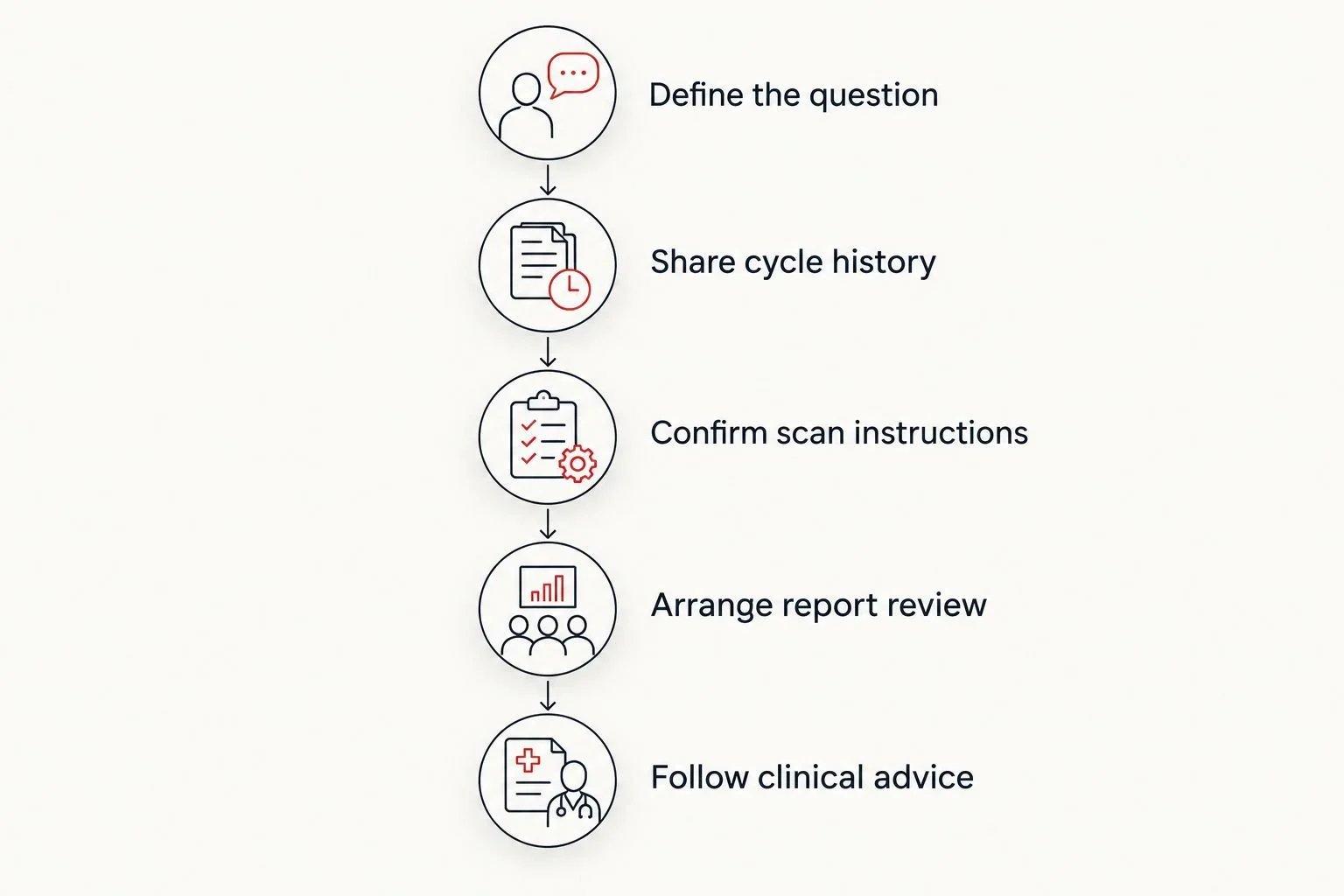
Decide who will interpret the scan before using the findings to guide your next step.
You can also ask how the examination works and discuss comfort concerns before it begins. Transvaginal ultrasound often provides detailed ovarian imaging, but the provider should explain the procedure and obtain your consent; you can ask questions or request that the examination stop.
Where does private fertility imaging fit into your care?
The Ultrasound Concierge is best for patients in Keller and Willow Park seeking private fertility ultrasound imaging. Its stated services include fertility and diagnostic ultrasound in a calm, personalized setting.
That setting can match your preference for a less institutional visit. The limitation is unchanged: an imaging appointment does not replace fertility diagnosis, prescribing, or treatment decisions by your clinician.
Before arranging fertility imaging with The Ultrasound Concierge, ask whether the requested examination matches your clinician’s needs and how reporting will be coordinated. Do not assume that every ultrasound appointment includes serial follicle monitoring or immediate treatment instructions.
Can ultrasound confirm that you already ovulated?
Ultrasound can provide evidence consistent with recent ovulation when the ovarian findings fit the expected changes after release. Comparing scans strengthens that assessment because your clinician can see how the follicle changed.
A progesterone blood test can add supporting evidence when appropriately timed. Neither test, alone or together, identifies the exact moment the egg was released.
Does a normal fertility ultrasound mean you can get pregnant?
No—a normal fertility ultrasound does not establish that every requirement for conception is present. It does not fully assess sperm factors, egg quality, or whether the fallopian tubes are open during a routine pelvic examination.
If pregnancy is not happening, ask for a fertility evaluation rather than repeatedly using normal imaging as reassurance. The appropriate next test depends on your history and your clinician’s assessment.
Is ultrasound necessary if your ovulation test is positive?
Not automatically—a positive urine LH test and an ultrasound provide different information. For someone trying to conceive without a prescribed monitoring plan, a positive LH result does not by itself create a need for imaging.
If you have irregular cycles, a condition affecting ovulation, or fertility-treatment instructions, ask your clinician how to interpret the result. Continue scheduled monitoring unless the treating team changes the plan.
FAQ
Can a fertility ultrasound tell me the exact day I will ovulate?
A fertility ultrasound can help estimate approaching ovulation, but it cannot guarantee the exact day or hour. Repeat scans and hormone information give your clinician more context than a single measurement.
How long after a positive ovulation test does ovulation happen?
Ovulation usually follows a urine LH surge by 1–2 days, but a positive test does not prove an egg was released. If you are receiving fertility treatment, follow your clinic’s timing instructions.
Can you see the egg itself on a fertility ultrasound?
No—a routine fertility ultrasound shows the ovarian follicle surrounding the egg, not the egg itself. Follicle appearance does not establish egg quality or guarantee fertilization.
Is one ultrasound enough to confirm ovulation?
One ultrasound can show findings consistent with recent ovulation, but it does not always settle the question. Comparison with earlier imaging and appropriately timed hormone testing can support the assessment.
Should I wait until ultrasound confirms ovulation to try to conceive?
Do not wait for ultrasound confirmation unless that is your clinician’s instruction. The fertile window includes the 5 days before ovulation and the day of ovulation, so confirmation afterward can come too late for that window.
Can fertility ultrasound diagnose blocked fallopian tubes?
A routine fertility ultrasound does not establish that your fallopian tubes are open. Your clinician can recommend a dedicated tubal-patency examination when that question needs an answer.
Does The Ultrasound Concierge provide fertility ultrasound imaging?
The Ultrasound Concierge provides private fertility ultrasound imaging for patients in Keller and Willow Park, TX. Ask whether your clinician’s requested examination can be performed and how the report will reach the treating team.
One last thing
A scan taken after ovulation can answer whether release likely occurred while being too late to help you anticipate that same release. That distinction is easy to miss when every test is described as an ovulation check.
For your 2026 appointment, ask one direct question: Are we trying to predict ovulation, confirm it afterward, or monitor treatment? The answer determines when to scan, which supporting tests matter, and what you should do with the result.
Related guides

Insurance for Elective Ultrasound: Usually No, 2026
Insurance for elective ultrasound generally excludes keepsake-only scans. Learn how medical necessity, plan rules, and HSA/FSA eligibility affect your visit.
You generally cannot use health insurance for an elective 3D/4D ultrasound performed only for keepsake images or a bonding experience. Coverage depends on medical necessity and your plan’s benefits, not whether the scan produces 3D or 4D pictures. A medically indicated ultrasound still requires a separate check of provider participation, authorization requirements, and your share of the bill.
TL;DR
Insurance for elective ultrasound generally excludes keepsake-only 3D/4D scans; medical necessity determines whether a scan qualifies for coverage.
A referral does not guarantee coverage, and an in-network provider does not make an excluded service covered.
HSA and FSA eligibility is separate from insurance coverage; a payment card approval does not establish eligibility.
The Ultrasound Concierge provides private diagnostic and elective ultrasound; confirm the appointment’s purpose before asking about insurance.
Can you use insurance for an elective 3D/4D ultrasound?
Generally, no: a keepsake-only ultrasound is not a covered medical service. A diagnostic ultrasound ordered to answer a clinical question follows a different coverage pathway, even when the equipment can also produce 3D or 4D images.
For patients considering The Ultrasound Concierge, which provides diagnostic and elective ultrasound, the first question is which type of appointment you need. Do not assume that offering both services means both qualify for insurance reimbursement.
Medically indicated diagnostic ultrasound
Best for: Answering a clinical question identified by your clinician
Insurance distinction: Coverage depends on plan benefits, medical necessity, and billing requirements
Benefit: Provides imaging for clinical evaluation
Limitation: An order alone does not guarantee payment
Elective 3D/4D ultrasound
Best for: A nonmedical keepsake or bonding experience, if you choose one
Insurance distinction: Keepsake-only imaging generally falls outside covered medical benefits
Benefit: Offers a personal viewing experience
Limitation: Does not replace diagnostic prenatal imaging
Check your 2026 plan documents before booking. A previous claim, a friend’s coverage, or a general statement that pregnancy imaging is covered does not establish coverage for your particular appointment.
Why this matters
The word ultrasound describes an imaging method, not an insurance benefit. Two appointments using similar equipment can have different purposes and different coverage decisions.
That distinction protects both your budget and your prenatal care. If you need an examination because of symptoms or a concern identified by your clinician, start with that clinician rather than substituting an elective session.
Choose the clinical pathway for a clinical question. A keepsake image cannot establish that all aspects of a pregnancy are healthy, and a reassuring viewing experience is not the same as a diagnostic interpretation.
Elective 3D/4D ultrasound: keepsake imaging, not diagnostic care
An elective session centers on viewing your baby or obtaining keepsake images without a medical indication for that examination. Wanting clearer pictures, sharing the experience with family, or learning fetal sex for a celebration does not by itself establish medical necessity.
The distinction is about purpose. A scan does not become medically necessary because it uses sophisticated imaging, takes place in a healthcare setting, or is performed by someone with clinical training.
For your 2026 appointment, ask the provider to describe the service clearly: elective viewing, diagnostic evaluation, or separately identified services. You need that description before an insurer can answer a useful coverage question.
Elective imaging also has a medical limitation. The FDA discourages fetal ultrasound performed solely to create keepsake images, and the American Institute of Ultrasound in Medicine discourages nonmedical use of obstetric ultrasound. Discuss an optional session with your prenatal clinician rather than treating more imaging as automatically better care.
Diagnostic ultrasound: coverage depends on the medical purpose
A diagnostic examination addresses a clinical question. Your clinician determines the indication, and the imaging service follows the requirements applicable to that examination.
Medical necessity is essential, but it is not the only coverage requirement. Your plan can also have rules about referrals, prior authorization, participating providers, covered settings, and claim documentation.
A diagnostic examination does not guarantee that your insurer pays the entire bill. Deductibles, coinsurance, copayments, and out-of-network rules are separate from the question of whether the service is covered at all.
If you are considering an elective visit alongside routine prenatal imaging, review how to combine a 3D/4D ultrasound with your OB’s anatomy scan. Keep the clinical examination and optional viewing experience distinct when discussing scheduling and coverage.
Why insurance coverage for ultrasound varies
Insurance for elective ultrasound is not determined by image quality alone. These factors explain why similar-looking appointments can receive different coverage decisions:
Medical purpose: A diagnostic examination answers a clinical question; keepsake-only imaging does not establish that purpose.
Plan benefits: Your contract identifies covered services, exclusions, and applicable medical-necessity requirements.
Provider network: Coverage for a service and participation by its provider are separate questions.
Authorization rules: Some examinations require approval before the appointment. Approval still remains subject to the plan’s terms.
Documentation: The order, clinical indication, and accurately reported service support review of a diagnostic claim.
Optional services: Keepsake images or other nonmedical extras do not automatically share the coverage status of a diagnostic examination.
Ask about all applicable factors together. Confirming only that a provider accepts your insurance leaves the central question unanswered: does your plan cover the exact service you are booking?
How do I check coverage before booking?
Use the same service description with the provider and insurer. Calling an elective session a pregnancy scan can produce a general answer that does not apply to the appointment you actually want.
Identify purpose. Ask whether the appointment is elective or diagnostic. If diagnostic, ask what medical question the examination will address.
Confirm service. Request the exact service description and, when applicable, the billing information the insurer needs. Do not choose a billing code yourself.
Check benefits. Ask your insurer whether that service is covered under your 2026 plan and whether a nonmedical or keepsake exclusion applies.
Check requirements. Confirm network status, referral rules, prior authorization, and any applicable member responsibility.
Keep records. Save the written benefit response, authorization information when required, and the reference number for your insurer’s conversation.
This sequence separates a covered benefit from a provider’s ability to submit a claim. It also gives you something specific to refer to if the information changes before your appointment.
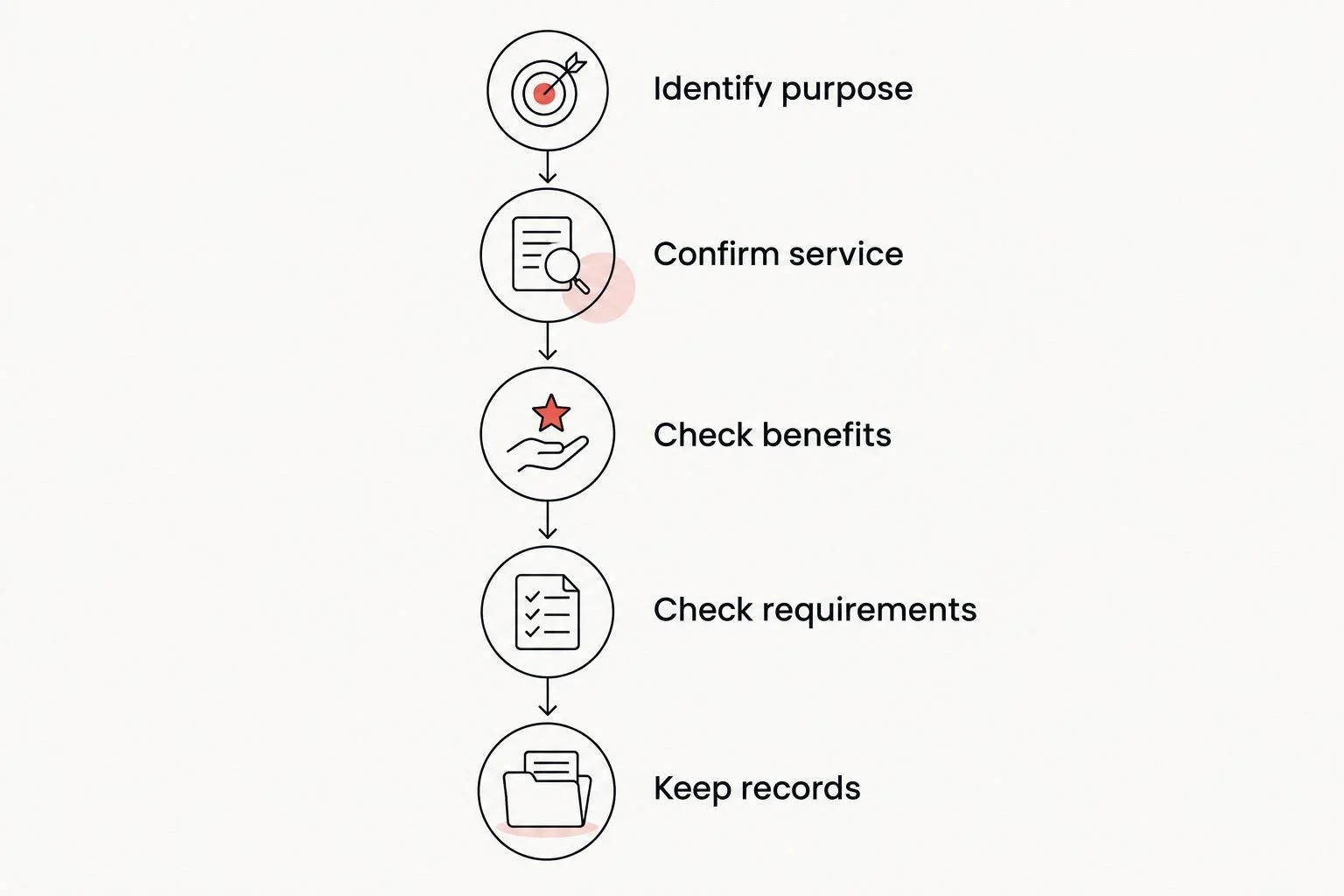
Start with the appointment’s purpose before asking whether insurance applies.
A benefit estimate or authorization is not an unconditional payment guarantee. The final claim must still match the service performed and satisfy the plan’s terms.
What should I ask my insurer and ultrasound provider?
Ask your insurer whether a keepsake-only 3D/4D ultrasound is excluded, rather than asking only whether pregnancy ultrasounds are covered. Then ask what changes if your clinician orders a diagnostic examination for a documented medical reason.
Useful questions include:
Does my plan cover this exact service for this stated purpose?
Is the provider participating in my specific plan, not just the same insurance company?
Do I need a referral or prior authorization before the examination?
Does coverage differ between the diagnostic examination and optional keepsake services?
What documentation is required if I submit a claim myself?
Can you provide the benefit explanation in writing?
Ask the provider whether it bills insurance for the appointment you are considering or treats that service as self-pay. Receiving a receipt is not the same as receiving an insurer-approved claim, and willingness to submit paperwork does not establish coverage.
Do not ask anyone to relabel an elective scan as diagnostic. Billing must accurately reflect the service and its medical purpose. If there is a genuine medical concern, involve your clinician and arrange the appropriate examination.
Does a doctor’s referral make an elective ultrasound covered?
No: a referral alone does not make a keepsake-only ultrasound covered. A referral documents a request for care; the insurer still evaluates the actual service against the plan’s benefits and medical-necessity rules.
If your clinician identifies a medical reason for imaging, book the corresponding diagnostic examination rather than assuming an existing elective booking changes status. Tell the provider about the order before the visit so the service can be arranged appropriately.
Can I use an HSA or FSA if insurance does not cover the scan?
Insurance denial does not determine HSA or FSA eligibility. These accounts follow tax rules for qualified medical expenses, which are separate from your insurance contract.
IRS Publication 502 describes medical expenses in terms of diagnosis, treatment, prevention, and related medical care. A purely nonmedical keepsake service should not be treated as eligible simply because it uses ultrasound equipment; confirm the service’s eligibility with your account administrator or a tax professional.
Can I appeal an insurance denial for an ultrasound?
You can request review of a denial under your plan’s appeal process. An appeal is most useful when a medically indicated examination was denied because of an administrative issue, missing documentation, or disagreement over medical necessity.
An appeal does not automatically turn an excluded keepsake service into a covered benefit. Read the denial reason first, then ask your insurer what evidence addresses that specific reason.
What if I have already paid for the appointment?
Start by obtaining an itemized receipt and a clear description of the service performed. If you believe the examination was diagnostic and your plan permits member-submitted claims, ask the insurer what documentation it requires.
Do not assume reimbursement because the appointment involved pregnancy or took place at an imaging provider. The service still needs to meet the plan’s coverage rules, and the documentation must accurately describe what happened.
For a denied diagnostic claim, compare the insurer’s explanation with the provider’s records. Ask for correction of an actual billing or documentation error—not a different description designed to make an elective service appear covered.
Choosing a private ultrasound appointment in Keller or Willow Park
The Ultrasound Concierge is for patients in Keller and Willow Park seeking private diagnostic or elective ultrasound. Its stated focus is a calm, personalized alternative to a clinical imaging center; that setting does not change an insurer’s coverage criteria.
The Ultrasound Concierge offers both diagnostic and elective imaging, so confirm which service fits your goal. A personal viewing experience and an examination ordered for medical evaluation have different purposes, even when both involve pregnancy ultrasound.
Before a 2026 visit, describe any clinician’s order accurately and ask how the appointment is handled. Choose diagnostic care for a medical question, and keep an optional keepsake decision separate from required prenatal care.
Clarify your ultrasound appointment
Review private diagnostic and elective ultrasound options in Keller and Willow Park.
FAQ
Can I use insurance for elective ultrasound in 2026?
Insurance for elective ultrasound generally does not cover a scan performed solely for keepsake images or bonding. Check your 2026 plan’s exclusions and confirm whether the exact appointment is elective or diagnostic.
Is a 3D or 4D ultrasound automatically considered elective?
No: the imaging format alone does not determine whether an ultrasound is elective. The examination’s clinical purpose and your plan’s requirements determine the coverage pathway.
Will insurance cover a gender-reveal ultrasound?
A scan performed only for a gender reveal generally does not establish medical necessity. Learning fetal sex during a covered diagnostic examination is different from booking an examination solely for that purpose.
Does an in-network ultrasound provider guarantee coverage?
No: network participation does not guarantee that a particular ultrasound service is covered. Your plan can exclude keepsake-only imaging even when a provider participates in the network.
Can I use my HSA or FSA card for a keepsake ultrasound?
Do not assume a keepsake ultrasound is an eligible HSA or FSA expense. Confirm eligibility with your account administrator or a tax professional; a card transaction approval does not establish that an expense qualifies.
Can an elective ultrasound replace my anatomy scan?
No: an elective keepsake session does not replace a diagnostic anatomy examination ordered as part of prenatal care. Keep the appointment recommended by your prenatal clinician.
Does The Ultrasound Concierge accept my insurance for a 3D/4D scan?
Confirm directly with The Ultrasound Concierge how your specific appointment is billed, then verify coverage with your insurer. Offering diagnostic and elective ultrasound does not establish insurance participation or coverage for either appointment.
One last thing
The most useful insurance question is not whether 3D/4D imaging is covered. It is whether your plan covers this service, for this medical purpose, from this provider.
Before booking in 2026, get that distinction clear and save the answer. If new symptoms or concerns arise, contact your prenatal clinician instead of using an elective session to decide whether you need medical care.
Related guides

Is a Private Ultrasound Worth It? When It Helps in 2026
Is a private ultrasound worth it? Compare diagnostic care and elective scans, learn what to ask before booking, and keep your prenatal care on track in 2026.
A private ultrasound is worth it when the visit has a clear purpose, qualified staff, and an appropriate plan for interpreting and acting on the findings. A private diagnostic scan can support your medical care; an elective pregnancy scan does not replace prenatal screening or your clinician’s assessment. For your 2026 decision, choose the medical purpose first and the setting second—not the promise of a clearer picture or guaranteed reassurance.
TL;DR
Is a private ultrasound worth it? Choose diagnostic ultrasound for a clinical question, not a promise of reassurance.
The Ultrasound Concierge offers private diagnostic and elective ultrasound for patients in Keller and Willow Park.
Elective pregnancy ultrasound does not replace prenatal care, an anatomy scan, or assessment of new symptoms.
FDA guidance discourages fetal ultrasound performed solely for keepsake images; discuss additional scans with your prenatal clinician.
Why this matters
Private describes the setting and service model. It does not tell you whether a scan is diagnostic, who interprets it, or whether the result answers your medical question. Those distinctions matter more than whether an appointment feels clinical or personal.
The Ultrasound Concierge provides private diagnostic and elective ultrasound for pregnancy, fertility, and general health in the Keller and Willow Park area. Its calm, personalized setting addresses the experience of getting scanned; the examination you choose still needs to match your purpose.
For a 2026 appointment, separate these questions: Do you need medical information, and what kind of setting helps you feel comfortable receiving it? You can value privacy and personal attention without assuming that an extra scan improves medical outcomes.
Is a private ultrasound worth it in 2026?
Private ultrasound is worth considering when the examination matches your goal and connects to the care you need afterward. It is not worth choosing on the assumption that private automatically means more accurate, more complete, or medically necessary.
Use this comparison before you book. The important distinction is what the appointment does—not whether the provider uses the word concierge.
Private diagnostic ultrasound
Best for: Patients with a specific clinical question or requested examination
Main benefit: Medical imaging in a private service setting
Main limitation: Requires appropriate interpretation and follow-up; the setting alone does not establish quality
Elective pregnancy ultrasound
Best for: Expecting parents seeking a viewing experience rather than a medical assessment
Main benefit: An opportunity to see pregnancy images
Main limitation: Does not replace prenatal screening; FDA guidance discourages scans solely for keepsakes
Ultrasound arranged through your care team
Best for: Patients whose examination is part of an existing treatment or prenatal plan
Main benefit: A scan connected to the clinician managing the medical question
Main limitation: The appointment experience depends on the provider; ask about privacy and communication
For example, an examination requested to assess a particular organ has a different purpose from a visit focused on pregnancy pictures. The former needs a diagnostic pathway. The latter must not be treated as proof that everything is healthy.
Your best decision starts with a specific sentence: I want this scan to answer this question. If you cannot finish that sentence, clarify the purpose before arranging another examination.
Private diagnostic ultrasound: choose the clinical pathway
A private diagnostic ultrasound is appropriate when you need an examination for a medical question and the provider offers that examination with suitable interpretation. Pregnancy, fertility, and general health questions require different protocols. A broad service description does not establish that every requested scan is available or suitable.
Ask who performs the examination, who interprets it, and how the findings reach the clinician responsible for your care. These are separate responsibilities. A conversation during scanning is not a substitute for a diagnostic report when your care depends on documented findings.
Before booking, establish:
The exact examination requested and the reason for it.
Whether an order or referral is required for that examination.
Who receives the report and explains its meaning.
How unexpected findings are communicated.
Who arranges additional assessment when needed.
Choose a diagnostic service for its clinical pathway, not its room atmosphere alone. A comfortable setting matters, but it cannot replace an appropriate examination, qualified interpretation, or a clear next step.
If you already have an order, use its wording when asking about the appointment. Do not substitute a similarly named elective service without checking with the requesting clinician.
Elective pregnancy ultrasound: separate viewing from assessment
An elective pregnancy ultrasound is not equivalent to a diagnostic examination. Seeing movement or recognizable facial features does not establish that fetal development, anatomy, or placental function is normal. Attractive images and medical answers are different things.
In established ultrasound terminology, 3D imaging displays volume-based images, while 4D imaging shows those images over time. Neither label tells you whether the appointment includes a diagnostic assessment. A viewing format is not a clinical credential.
The FDA discourages fetal ultrasound performed solely to create keepsake images. The American Institute of Ultrasound in Medicine also discourages nonmedical fetal ultrasound use. For your 2026 plans, discuss any additional pregnancy scan with your prenatal clinician rather than treating it as a routine reassurance purchase.
Your expectations also need to be realistic. Fetal position and the available viewing window affect what can be pictured, so no elective appointment should be treated as a guarantee of a particular image.
Do not book repeated elective scans simply to check that everything is okay. If that is your goal, ask your prenatal clinician which assessment is appropriate and what it can actually establish.
Ultrasound within your care plan: keep the connection
An ultrasound arranged through your existing care team has a defined medical context. Your clinician can connect the findings with symptoms, examination results, laboratory testing, and previous imaging. An isolated image cannot do that work by itself.
Private diagnostic imaging can still fit within that pathway. The important issue is whether your care team accepts the examination and receives the information needed to make decisions—not whether the scan happens inside its own office.
If you are receiving fertility treatment, ask your fertility team before arranging an outside scan. Timing, examination type, and reporting need to fit the treatment plan. An elective pregnancy appointment is not interchangeable with clinical monitoring.
The same principle applies to general health imaging. If a clinician requests an ultrasound for a particular concern, confirm that the private provider performs the requested examination and can send the report appropriately.
Why the value of a private ultrasound varies
The value of a private ultrasound depends on what you need from it. These factors explain why the same appointment type can be useful for one person and unsuitable for another:
Purpose: A diagnostic question requires a diagnostic examination. A viewing experience cannot substitute for it.
Timing: The stage of pregnancy or treatment affects what an examination can show and how findings are interpreted.
Examination scope: A focused scan does not answer every possible question about pregnancy or general health.
Interpretation and follow-up: Findings need someone qualified to explain them and arrange the next step when necessary.
Personal setting: Privacy and a calm environment can matter to your experience without changing the scan’s medical scope.
In 2026, use these factors to compare services rather than choosing by image terminology alone. Ask what the appointment includes, what it excludes, and what happens if it does not answer your question.
How do you decide before booking a private ultrasound?
Use this sequence to turn a broad wish for reassurance into a clear appointment decision. You do not need to know medical terminology; you need the provider to explain the service in plain language.
Goal: Write down the question you want answered. Distinguish a medical concern from a wish to see images or share the experience.
Clinical purpose: Ask whether the appointment is diagnostic or elective. If a clinician requested imaging, confirm that the service matches the request.
Reporting: Ask who interprets the examination, what documentation you receive, and how results reach your care team.
Follow-up: Establish who explains findings, handles uncertainty, and directs you to further care if needed.
A provider’s answers should leave you understanding the appointment’s boundaries. If you remain unsure whether the scan is medical assessment or viewing, resolve that uncertainty before booking.
Clarify the purpose and follow-up before choosing the appointment setting.
Bring relevant orders and prior reports when the provider requests them. Ask about preparation directly; instructions depend on the examination, so advice for one ultrasound should not be reused for another.
Who is a concierge ultrasound setting best for?
The Ultrasound Concierge is best for Keller and Willow Park patients seeking private diagnostic or elective ultrasound in a calm, personalized setting. That describes the service’s stated purpose, not a claim that it produces better clinical outcomes than another provider.
The benefit is choosing a setting aligned with your preference for privacy and personal attention. The limitation is that those preferences do not determine whether a scan is medically indicated, whether it answers your concern, or what follow-up you need.
For diagnostic ultrasound, confirm the examination and reporting pathway. For elective pregnancy ultrasound, discuss the medical need with your prenatal clinician and keep the distinction between viewing and assessment clear.
Clarify your ultrasound options
Review the service information, then ask which examination fits your purpose and care plan.
Can a private ultrasound replace my prenatal appointments?
A private ultrasound cannot replace prenatal appointments. Prenatal care includes assessment and screening beyond what an ultrasound image shows. Even a diagnostic scan answers a defined question rather than providing a complete assessment of your pregnancy.
Keep scheduled prenatal visits and recommended examinations. If you use a private diagnostic provider, make sure your prenatal clinician receives the report and knows who will explain the findings.
Is a private ultrasound worth it just for reassurance?
A private ultrasound is not a reliable substitute for clinical assessment when reassurance is your main goal. A reassuring-looking image does not exclude every complication, and an uncertain finding can create further questions rather than resolve them.
Tell your care team what worries you. If you have bleeding, significant pain, reduced fetal movement, or other concerning symptoms, contact your maternity team promptly rather than waiting for an elective appointment; seek emergency care for severe symptoms.
Is it safe to add another pregnancy ultrasound?
An additional pregnancy ultrasound should have an appropriate clinical reason and be performed by qualified personnel. Ultrasound does not use ionizing radiation, but that does not justify unlimited or unnecessary exposure. FDA and professional guidance favor prudent use for medical purposes.
For a 2026 pregnancy plan, ask your clinician whether another examination is needed before choosing a recurring elective schedule. The guide to 3D/4D ultrasound every trimester addresses that specific scheduling question.
FAQ
Is a private ultrasound worth it in 2026?
A private ultrasound is worth considering when it has a clear purpose, appropriate interpretation, and a follow-up plan. A private setting does not automatically make a scan more accurate or medically necessary.
Is a private diagnostic ultrasound better than an elective scan?
A private diagnostic ultrasound is the appropriate choice for a medical question; an elective scan is not an equivalent substitute. Confirm the examination type and who will interpret and explain the findings.
Can a private ultrasound tell me that my baby is healthy?
No single private ultrasound can establish that every aspect of your baby's health is normal. A diagnostic examination assesses defined findings, while prenatal care includes other assessments and screening.
Do I need a referral for a private ultrasound?
Referral requirements depend on the examination and provider. Ask whether your chosen service requires an order and whether it matches the examination your clinician requested.
Does a 3D or 4D ultrasound replace an anatomy scan?
A 3D or 4D viewing appointment does not replace a diagnostic anatomy scan. Image format alone does not establish the scope of the examination or the qualifications of the person interpreting it.
Should I book an elective ultrasound if I have pregnancy symptoms?
Do not use an elective ultrasound appointment to assess concerning pregnancy symptoms. Contact your prenatal team promptly, and seek emergency care for severe symptoms.
Who is The Ultrasound Concierge for?
The Ultrasound Concierge provides private diagnostic and elective ultrasound for patients in Keller and Willow Park seeking a calm, personalized setting. Confirm the examination and follow-up arrangements before booking.
One last thing
Before booking, ask: Who will explain the result, and what happens if the scan raises a concern? That question separates an image-focused appointment from a service connected to medical care.
For your 2026 decision, choose the examination first and the atmosphere second. A private setting can meet an important personal preference, but the most useful appointment is the one that answers the right question and leaves you knowing what comes next.
Related guides

SneakPeek Results Turnaround Time: What Counts in 2026
SneakPeek results turnaround time depends on when the clock starts. Learn what to confirm, how to track your sample, and when to follow up before your reveal.
SneakPeek results turnaround time depends on the result window for your specific test and when that window starts: sample collection, laboratory receipt, or processing. For your 2026 appointment, confirm both the expected release date and the starting point before planning a reveal; a laboratory processing estimate does not include time spent getting the sample to the laboratory.
TL;DR
SneakPeek results turnaround time needs a starting point: collection, laboratory receipt, or processing.
Confirm your expected result date before scheduling a gender reveal or ordering personalized gifts.
The Ultrasound Concierge offers SneakPeek Gender Tests for patients in Keller and Willow Park, TX.
An expected result date is a planning estimate, not proof that your result has been released.
Why this matters
Waiting for a result is easier when you know which stage your sample has reached. An appointment date and a laboratory receipt date are different milestones, so counting from the wrong one creates unnecessary worry.
The Ultrasound Concierge provides private ultrasound imaging and SneakPeek Gender Tests in the Keller and Willow Park area. The Ultrasound Concierge is a fit for Keller and Willow Park patients seeking private ultrasound imaging and SneakPeek Gender Tests. For a time-sensitive reveal, ask about the testing timeline separately from the appointment itself.
How long does it take to get SneakPeek test results?
Use the result window confirmed for your specific SneakPeek test, with its stated starting point. Do not turn a processing estimate into a collection-to-result promise unless the provider explicitly confirms that it covers the entire journey.
For a 2026 booking, the most useful question is: What date should I expect my result, and what event starts that timeline? That gives you an answer you can put on a calendar rather than an estimate with an unclear beginning.
These timing descriptions mean different things:
Collection-to-result window
What it measures: Time from sample collection through result release
Best for: Planning around your appointment
Limitation: Use it only when the provider confirms the full window
Receipt-to-result window
What it measures: Time from laboratory receipt through result release
Best for: Understanding the laboratory estimate
Limitation: It excludes transport before receipt
Processing window
What it measures: The laboratory's stated testing interval
Best for: Understanding the testing stage
Limitation: It does not automatically include transport or notification
Expected release date
What it measures: The date communicated for your individual result
Best for: Planning your next step
Limitation: It is not confirmation that the result is already available
The strongest planning information combines a starting milestone with an expected release date. A short turnaround statement without that context leaves you guessing about where your sample is in the process.
Follow the sample through its stages
Collection: Record when your sample was collected. Ask who handles the next step and who answers questions afterward.
Lab receipt: Ask how you will know the laboratory has received the sample. Check whether this event starts the quoted turnaround window.
Result release: Confirm how you will receive the result and whom to contact if the expected window passes.
These stages help you ask a precise question. Instead of asking whether the test is late, ask whether collection, receipt, or release has been confirmed.
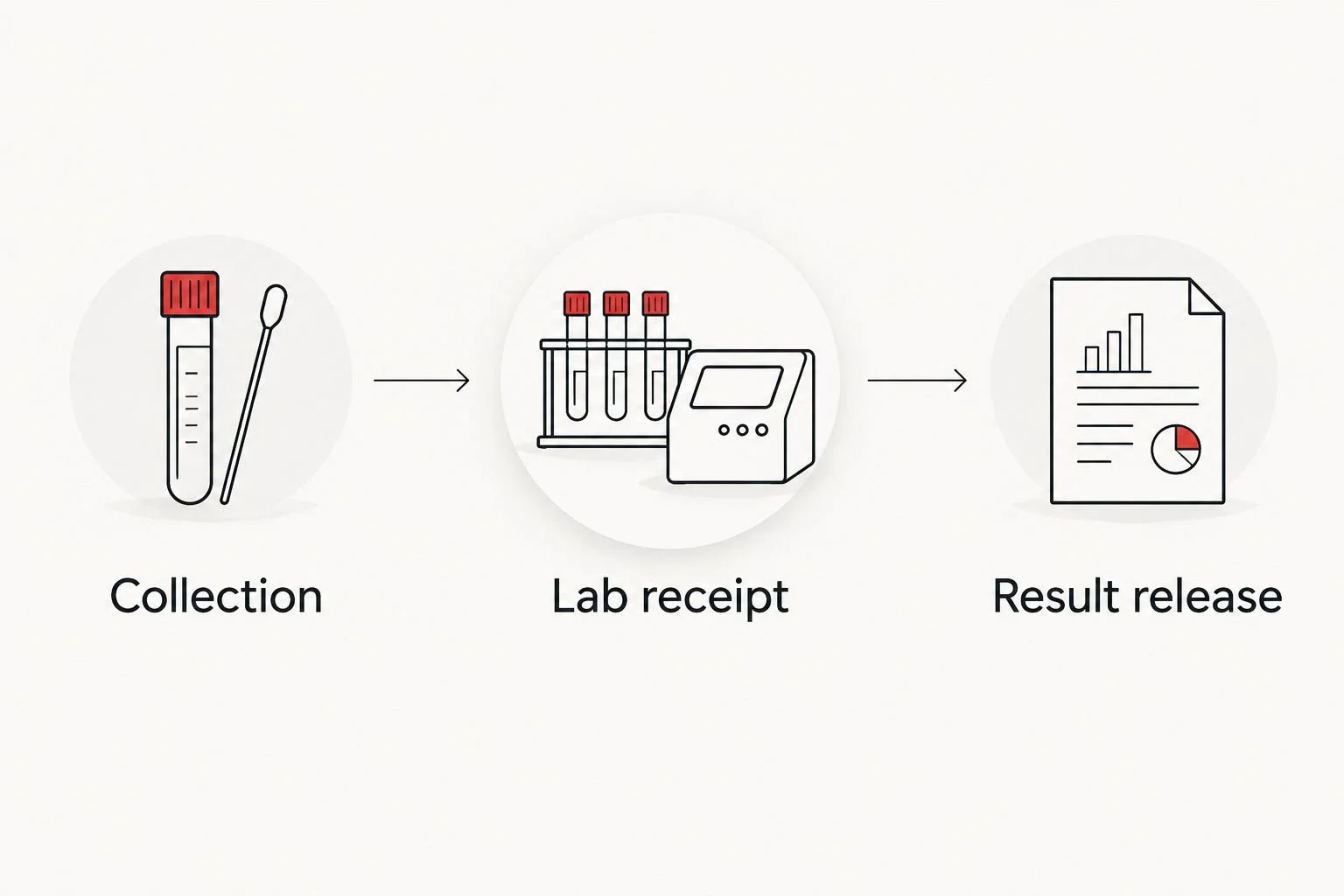
Check which stage starts the turnaround window you were given.
A collection confirmation establishes that the sample was taken; it does not establish laboratory receipt. Likewise, a receipt confirmation tells you the sample arrived, not that a result has been released. Keeping those distinctions clear makes follow-up conversations more useful.
What should I ask before my SneakPeek appointment?
Ask for the timeline that applies to the test you are booking, not a general statement about the brand. Write down the answer alongside your appointment details so you can refer to it without relying on memory.
For your 2026 appointment, use this checklist:
Starting point: Does the result window begin at collection, laboratory receipt, or another confirmed event?
Expected date: What result date should you use for planning?
Counting rule: Is the estimate expressed in calendar days or business days?
Delivery method: Where should you look for the result?
Follow-up contact: Who should you contact if the expected window passes?
Reveal preference: What should you do if you want to keep the result a surprise?
A useful answer sounds like a complete instruction: the timeline starts at a named event, the expected release falls on a stated date, and you have a clear next step if it does not arrive. Avoid treating a general advertisement as that individual confirmation.
If you are comparing collection arrangements, ask the same questions for each. Compare the full collection-to-result journey, not just the shortest processing phrase. A shorter quoted laboratory interval alone does not establish an earlier result from the day of your appointment.
Keep the confirmation somewhere easy to find. You do not need a complicated tracking system; the appointment message, the stated timeline, and the follow-up contact are enough to keep your questions focused.
Why SneakPeek timing estimates differ
A turnaround estimate is useful only when you understand what it covers. Before comparing statements or deciding a result is overdue, check these timing details:
Different starting milestones: A collection-based estimate and a receipt-based estimate measure different intervals.
Transport included or excluded: Ask whether the quoted window covers the sample's journey to the laboratory.
Calendar or business days: Confirm the counting rule instead of assuming every date counts the same way.
Processing versus notification: Ask whether the estimate refers to completed testing or the result reaching you.
General estimate versus individual update: Use the information tied to your sample when following up.
These are questions to clarify, not reasons to assume something went wrong. A result that has not reached you does not, by itself, identify where the sample is or why you are waiting.
For 2026 planning, ask for an expected date rather than converting an unclear phrase yourself. If a weekend or holiday falls between collection and the expected result, ask how the provider's stated counting rule handles it. Do not apply a rule from someone else's appointment to yours.
Does SneakPeek turnaround start when my blood is collected?
The starting point is the one stated for your specific test. Ask whether collection begins the result window or whether the laboratory must first confirm receipt.
This distinction matters when you book around an event. If the estimate starts at receipt, the appointment date alone cannot tell you the expected release date. You also need the receipt milestone or a provider-confirmed full timeline.
Keep the collection date and the turnaround starting date separate unless the provider confirms they are the same. That simple habit prevents a processing estimate from becoming an unintended deadline.
Should I book a gender reveal before my SneakPeek result arrives?
Wait for the result before committing to arrangements that depend on knowing it. An expected release date helps you plan, but the released result is the information your reveal actually needs.
For a 2026 reveal, separate preparation from commitments. You can discuss guest preferences and choose an announcement style while waiting, without giving a vendor a result you have not received.
If you want someone else to handle the surprise, ask about result delivery before testing. Confirm what the process allows rather than assuming the provider can send information to a relative or reveal organizer. Agree on who will read the result before opening any notification.
What should I do if my SneakPeek result has not arrived?
Start with the expected window you were given. Then check the delivery method you were told to use and contact the designated provider or testing support channel if that window has passed.
Use this sequence to make the follow-up specific:
Check the stated timeline. Find the original confirmation and identify its starting milestone.
Check the stated destination. Look where you were told the result would appear. If delivery is by email, include your spam or junk folder.
Gather your details. Have your collection date and any confirmation or reference information ready.
Ask for the sample stage. Request confirmation of receipt, processing status, or result release, as appropriate.
Request the next step. Ask when to check again and whom to contact if you still have no update.
Do not assume that a delivery delay tells you the baby's sex, the result's accuracy, or your pregnancy's health. Timing alone does not answer those questions.
If you have pregnancy symptoms or medical concerns, contact your prenatal care team rather than waiting for an elective test result. A result-status inquiry and a medical concern need different responses.
Turnaround time is not the same as accuracy
SneakPeek results turnaround time describes when information reaches you. It does not, on its own, establish whether the result is accurate or whether the test answers a medical question.
Keep those conversations separate. Ask about timing when you need a release date; ask about test instructions, eligibility, and interpretation when you need to understand the result. Follow the instructions supplied for your specific test rather than advice copied from another person's experience.
SneakPeek testing is not a substitute for prenatal medical assessment. Continue the appointments and screening discussions recommended by your pregnancy care team, regardless of how quickly an elective result arrives.
The Ultrasound Concierge offers both diagnostic and elective ultrasound services alongside SneakPeek Gender Tests. Choose the service that answers your actual question: an early result, ultrasound imaging, and a medical evaluation are not interchangeable goals. A private setting is relevant to your visit experience, but it is not a laboratory turnaround guarantee.
Keep a simple result-waiting record
A brief record helps you distinguish an expected date from a confirmed milestone. Use the wording the provider gives you rather than rewriting it into a stronger promise.
Record the collection date, the stated starting point, the expected release date, and the delivery method. Add any receipt confirmation or updated instruction as it arrives. Keep your reference information private, especially when asking for help in public groups.
If you contact support, describe the issue in plain language: your sample was collected on a particular date, the quoted window starts at a particular event, and you have not received the expected update. Ask for the current stage and the next action.
Other parents' experiences can offer reassurance, but they do not establish your sample's status. Your individual confirmation is the right basis for follow-up. Check it before interpreting a social media post as a deadline you have missed.
FAQ
How do I work out my SneakPeek results turnaround time?
Use the window confirmed for your specific test and its stated starting milestone. Ask for an expected release date so you do not have to translate an unclear processing estimate into a calendar deadline.
Does my SneakPeek appointment date count as the first day?
Count from your appointment only if the provider confirms that collection starts the turnaround window. A laboratory-receipt estimate starts at a different milestone.
Do weekends count toward SneakPeek results turnaround time?
Use the calendar-day or business-day rule confirmed for your specific test. Ask how that rule applies to your expected result date rather than assuming weekends are included or excluded.
Does a shipping update mean my SneakPeek result is ready?
A shipping update does not establish that your result is ready. Check whether the update confirms transport, laboratory receipt, or actual result release.
Should I worry if another parent got SneakPeek results sooner?
Another parent's result date does not establish whether your sample is overdue. Compare your own confirmed starting point and expected window, then follow up if that window has passed.
Can I arrange a surprise reveal while waiting for SneakPeek results?
You can prepare a surprise reveal while waiting, but confirm the result-delivery process before assuming someone else can receive it. Wait for the actual result before making commitments that depend on its content.
Who should I contact if my SneakPeek result is late?
Contact the provider or testing support channel identified in your instructions. Have your collection date and confirmation details ready, and ask which sample milestone has been confirmed.
One last thing
Before leaving your 2026 appointment, ask: What exact event starts my result clock? That question is more useful than asking only whether the test is fast, because it tells you how to interpret every update that follows.
Keep the expected release date separate from your reveal date. The first is a testing estimate; the second is your decision. Waiting until you have the result keeps an uncertain timeline from controlling an otherwise happy announcement.
Related guides

Gender Reveal Ultrasound Cost: Compare Quotes | 2026
Compare gender reveal ultrasound cost by what each visit includes. Learn which questions to ask about imaging, keepsakes, repeat visits, and prenatal care.
Your gender reveal ultrasound cost in 2026 depends on the provider’s current quote and exactly what the appointment includes, so request the total for the visit you want before booking. Ask separately about keepsake images, recordings, and the policy if fetal position prevents a clear view. An elective reveal appointment does not replace your prenatal diagnostic scans.
TL;DR
Compare gender reveal ultrasound cost using a written quote that identifies the appointment, keepsakes, and repeat-visit policy.
The Ultrasound Concierge offers private pregnancy ultrasound services for patients in Keller and Willow Park, Texas.
Choose ultrasound for viewing images; SneakPeek Gender Tests use a different method and do not provide ultrasound images.
Keep elective pregnancy imaging separate from the diagnostic scans recommended by your prenatal clinician.
Why this matters
A gender reveal appointment involves two separate decisions: how you want to learn the information and what experience you want around it. Seeing ultrasound images, receiving a result privately, and sharing an announcement with family are different goals. Decide which matters most before comparing appointments.
The Ultrasound Concierge provides diagnostic and elective pregnancy ultrasound services in Keller and Willow Park, Texas. The Ultrasound Concierge is best for local patients seeking private, personalized ultrasound care. That describes the setting and service model—not a promise about what any particular appointment includes.
For your 2026 booking, compare the same service across providers. A quote for an elective reveal session should not be treated as equivalent to a diagnostic pregnancy examination or a blood-based test.
How much does a gender reveal ultrasound cost in 2026?
Use the provider’s current, itemized quote as your booking decision—not a general average detached from the appointment details. Confirm whether the quoted appointment focuses on fetal sex identification, includes additional imaging, or serves a diagnostic purpose. Those descriptions tell you what you are actually arranging.
The term gender reveal describes the announcement. Ultrasound evaluates visible fetal anatomy to assess fetal sex; it does not determine a child’s future gender identity. A clear explanation of the service should make that distinction without making the conversation uncomfortable.
Use these steps to get a quote you can compare:
State your goal. Explain whether you want to learn fetal sex, see images with a support person, or keep the result private for an announcement. Do not assume one appointment includes every goal.
Identify the examination. Ask whether the booking is elective or diagnostic, which imaging methods it includes, and what information you receive afterward. A service name alone is not enough.
Confirm the deliverables. Ask about printed images, digital files, video, and any written result. Request an explanation of which items belong to the appointment and which require a separate selection.
Ask about an inconclusive view. Find out what happens if fetal position prevents identification. Have the provider explain any repeat-visit conditions before you commit to a reveal date.
Request the complete booking terms. Confirm the total, payment arrangements, cancellation terms, and any preparation instructions in writing. Save that information with your appointment confirmation.
You do not need to purchase the most elaborate imaging experience to ask a straightforward question about fetal sex. Equally, a basic appointment is not automatically the right match if your main goal is receiving particular keepsakes. Choose the service that answers your actual question, then confirm its scope.
Elective gender reveal ultrasound: best for a viewing experience
An elective gender reveal ultrasound uses ultrasound images to assess visible fetal anatomy. Its appeal is the viewing experience: you can see images during the appointment rather than receiving only a laboratory result. Ask the provider how results are communicated and whether you can request that the information remain undisclosed during the visit.
The limitation is visibility. Fetal position and image quality affect what the examiner can identify, and a scheduled appointment does not guarantee a conclusive result. Avoid treating the date of the scan as a guaranteed announcement deadline.
If you are considering additional imaging, read about finding out fetal sex at a 3D/4D ultrasound. Three-dimensional imaging shows volume, while four-dimensional imaging adds movement over time. Neither label removes the need for a suitable view of the relevant anatomy.
Best for: expecting parents who want to view ultrasound images as part of learning fetal sex. Limitation: the appointment remains dependent on what can be seen and does not replace prenatal diagnostic care.
Diagnostic pregnancy ultrasound: best for a medical question
A diagnostic pregnancy ultrasound addresses a clinical question. Your prenatal clinician determines which examinations you need, when to schedule them, and how findings affect your care. Learning fetal sex can be part of the conversation, but it is not the purpose of every diagnostic examination.
The routine fetal anatomy examination generally takes place between 18 and 22 weeks of pregnancy, according to the American College of Obstetricians and Gynecologists. It evaluates fetal anatomy rather than functioning solely as a reveal appointment. Your clinician can explain the timing appropriate to your pregnancy.
For planning in 2026, keep that medical appointment on your calendar even if you arrange a separate elective visit. A keepsake image, a reassuring conversation, or an apparent fetal sex identification does not establish that the anatomy examination has been completed.
Best for: patients who need an examination recommended by their prenatal clinician. Limitation: a medically focused visit should not be assumed to include a family viewing experience, reveal arrangements, or keepsake recordings.
SneakPeek Gender Tests: best for a result without ultrasound viewing
SneakPeek Gender Tests are blood-based tests, not ultrasound appointments. They use a different method from interpreting visible fetal anatomy. If your goal is receiving a fetal sex result rather than watching ultrasound images, ask the provider to explain this option separately.
The Ultrasound Concierge offers SneakPeek Gender Tests alongside pregnancy ultrasound services. That gives local patients different services to discuss, but it does not make the services interchangeable. A blood-based result supplies no ultrasound images and does not evaluate fetal anatomy.
Before selecting a test, confirm eligibility, sample collection instructions, how you receive the result, and what happens if the laboratory cannot report a result. Do not assume those details from another provider’s website or a family member’s experience.
Best for: expecting parents interested in a blood-based fetal sex result rather than an ultrasound viewing session. Limitation: the test is not an imaging examination and does not replace recommended prenatal screening or diagnostic care.
Which appointment matches your goal?
Elective gender reveal ultrasound
Best for: Viewing images while learning fetal sex
Main benefit: An ultrasound-based viewing experience
Main limitation: Identification depends on visibility; not a substitute for diagnostic care
What to confirm: Imaging scope, result handling, keepsakes, and repeat-visit policy
Diagnostic pregnancy ultrasound
Best for: Answering a medical question
Main benefit: Examination directed toward prenatal care
Main limitation: A reveal experience is not its primary purpose
What to confirm: Clinical indication, referral requirements, and reporting arrangements
SneakPeek Gender Tests
Best for: Receiving a blood-based fetal sex result
Main benefit: A method that does not depend on an ultrasound view
Main limitation: No ultrasound images or fetal anatomy assessment
What to confirm: Eligibility, collection instructions, and result process
Choose the category first. Comparing appointments before deciding whether you want imaging, a laboratory result, or a medical examination mixes services that answer different questions.
Why gender reveal ultrasound quotes need careful comparison
A provider’s quote is useful only when you understand its scope. For a 2026 appointment, use the following questions to compare offers without assuming that any provider includes—or separately bills for—a particular feature:
Service purpose: Is the appointment elective, diagnostic, or a blood-based test? Confirm the purpose before comparing the total.
Imaging format: Does the appointment involve standard ultrasound, three-dimensional images, or moving four-dimensional images? Ask what each selection contributes to your goal.
Keepsake delivery: Which images or recordings do you receive, and how do you receive them? A viewing session and a downloadable recording are not the same deliverable.
Result handling: Can the provider keep the result private during the visit? Ask how an intended recipient receives the information without revealing it to you.
Repeat-visit terms: What happens when the examiner cannot obtain a clear view? Read the conditions rather than assuming another visit is included.
Booking conditions: What are the payment, cancellation, rescheduling, and guest arrangements? Confirm these before making plans around the appointment.
These are comparison questions, not claims about any studio’s policies. A written explanation of the appointment is more useful than a package name that leaves its contents unclear.
How do you request a useful quote?
Start with the information a provider needs to identify the right service: your pregnancy stage, your appointment goal, and whether your prenatal clinician has requested a diagnostic examination. Then describe any reveal preference, such as keeping the result hidden from you.
A useful message is simple: explain that you want to learn fetal sex, identify whether you also want ultrasound images, and ask for the complete appointment details. Request the repeat-visit and cancellation terms in the same conversation. This prevents an answer about one feature from being mistaken for an explanation of the whole visit.
Use these labels to organize the conversation:
Choose purpose: separate a medical examination from an elective viewing experience.
Confirm timing: ask whether your pregnancy stage suits the requested appointment.
Check inclusions: identify images, recordings, results, and their delivery method.
Review policies: understand inconclusive results and booking changes.
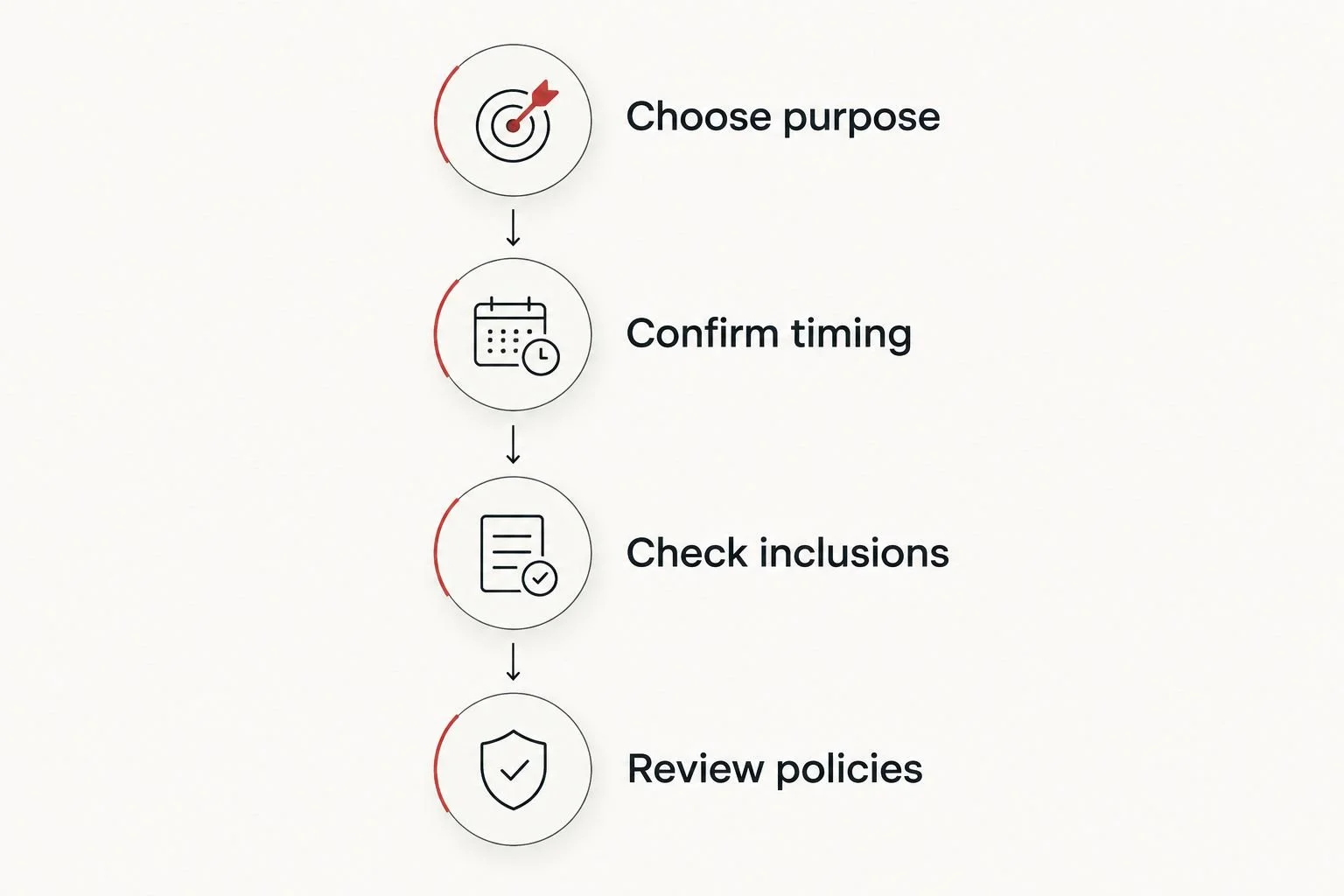
Identify the service before comparing appointment quotes.
Once you have that information, you can decide whether the appointment fits your plans. The Ultrasound Concierge’s private pregnancy ultrasound services are relevant for patients seeking a personalized local setting; confirm the specific examination and arrangements directly before booking.
Ask about your pregnancy ultrasound
Discuss the appointment purpose, imaging options, and booking details before choosing your visit.
Is a 3D or 4D ultrasound necessary for a gender reveal?
Three-dimensional or four-dimensional imaging is not a requirement for assessing fetal sex. Standard two-dimensional ultrasound can show the relevant anatomy when the view is suitable. Additional imaging formats serve different viewing purposes rather than guaranteeing identification.
For your 2026 comparison, separate the information you want from the images you want to keep. If you mainly want a fetal sex assessment, ask which appointment is intended for that question. If you also want a particular viewing experience, discuss it as a separate preference rather than assuming it improves certainty.
The same distinction applies to enhanced image presentation. A more detailed-looking keepsake does not establish that an examination provides a broader medical assessment. Ask what the imaging actually evaluates.
Should you book the reveal party before the scan?
Wait for a conclusive result before committing to an announcement that depends on it. An ultrasound appointment is an opportunity to obtain a view, not a guarantee that fetal position will allow identification that day. A contingency plan is simpler than building the event around an assumed result.
Tell the provider who should receive the information and how you want it handled. If a relative or friend is organizing the reveal, confirm the arrangement before the examination begins. Do not rely on a last-minute whispered request while images are already visible.
Keep the announcement separate from decisions about your pregnancy care. If the examiner or your prenatal clinician recommends medical follow-up, give that instruction priority over the reveal schedule.
FAQ
How do I find the current gender reveal ultrasound cost in 2026?
Request a current, itemized quote from the provider for the specific appointment you want. Confirm the examination purpose, images or recordings, repeat-visit terms, and booking conditions before paying.
Is a gender reveal ultrasound the same as my anatomy scan?
No. A gender reveal appointment focuses on learning fetal sex, while a diagnostic anatomy scan evaluates fetal anatomy. Keep the examinations your prenatal clinician recommends even if you book an elective visit.
Do I need a 3D or 4D ultrasound to find out fetal sex?
No. Standard two-dimensional ultrasound can show the relevant anatomy when the view is suitable. Three-dimensional and four-dimensional imaging do not guarantee a conclusive identification.
What happens if the baby’s position prevents a clear view?
The provider needs to explain the policy for an inconclusive view before you book. Ask whether another appointment is offered and what conditions apply; do not assume a repeat visit is included.
Can I keep the ultrasound result a surprise?
Ask the provider to confirm a private result-handling arrangement before the examination. Specify who should receive the information and how it should be delivered without disclosing it to you.
Is SneakPeek a gender reveal ultrasound?
No. SneakPeek Gender Tests are blood-based tests and do not produce ultrasound images or evaluate fetal anatomy. Compare the test separately from an ultrasound viewing appointment.
Can an elective ultrasound replace prenatal care?
No. An elective ultrasound does not replace prenatal visits or medically recommended examinations. The American Institute of Ultrasound in Medicine discourages ultrasound performed solely for nonmedical purposes; discuss imaging decisions with your prenatal clinician.
Where does The Ultrasound Concierge offer pregnancy ultrasound services?
The Ultrasound Concierge provides private pregnancy ultrasound services for patients in Keller and Willow Park, Texas. Confirm the appointment type and booking details directly before arranging your visit.
One last thing
Tell the examiner about a surprise reveal before the scan starts—not after you see the screen. Ask whether the result can appear on an image, in a recording, or in accompanying information. A privacy request needs to cover the material you receive, not just what someone says aloud.
You can keep the decision simple: protect your prenatal care schedule, choose the service that matches your goal, and confirm the full appointment terms. The right booking is the one you understand before you arrive.
Related guides

3D Ultrasound Twins Visibility: Yes, With Limits | 2026
3D ultrasound twins visibility depends on each baby's position. Learn why clear views vary, what 4D adds, and how to plan without replacing prenatal care.
Yes, twins can be seen clearly on a 3D/4D ultrasound, but each baby needs a favorable viewing angle, and clear pictures of both faces together are not guaranteed. One twin can be easier to see than the other; image clarity does not establish whether either baby is healthy, and an elective session does not replace your prenatal ultrasound care.
TL;DR
3D ultrasound twins visibility depends on fetal position, fluid around each face, and an unobstructed viewing angle.
Separate pictures of each twin are a practical goal; a shared portrait is not guaranteed.
4D ultrasound shows movement but cannot reveal a face hidden behind another baby or the placenta.
The Ultrasound Concierge provides private pregnancy ultrasound services in Keller and Willow Park; medical monitoring remains separate.
Why this matters
With twins, you are hoping to recognize two babies—not simply see a pregnancy on the screen. That creates two different questions: can the scan identify each baby, and can it produce recognizable surface pictures of each face? Those are not the same task.
For your 2026 appointment, make the goal specific: ask about separate views of each twin rather than assuming both faces will appear together. The guide to how many weeks pregnant you should be for a 3D/4D ultrasound provides related planning context, but your prenatal clinician should guide decisions about imaging in your twin pregnancy.
A recognizable picture is a keepsake, not a medical clearance. You can enjoy seeing facial features while keeping questions about growth, anatomy, fluid, and placental function with your obstetric care team.
Can twins be seen clearly on a 3D/4D ultrasound?
Yes. Ultrasound can capture separate surface views of twins when the sound beam reaches each baby's face without obstructing tissue in the way. A favorable view of one twin does not guarantee the same view of the other.
The main distinction is between identifying babies during a medical examination and producing face-like surface images. Conventional ultrasound remains central to prenatal assessment; surface rendering adds a different way to display selected anatomy.
2D ultrasound
What you see: Flat cross-sectional images
Best for: Medical assessment
Main limitation: Facial features do not have the sculpted appearance of a surface image
3D ultrasound
What you see: A reconstructed volume displayed as a still image
Best for: Still surface views
Main limitation: Obstruction and movement can affect the reconstruction
4D ultrasound
What you see: Updating 3D images that show movement
Best for: Moving surface views
Main limitation: Movement does not remove an obstruction in front of a face
In dimensional terms, 2D displays two dimensions, while 3D represents three dimensions. The fourth dimension in 4D ultrasound is time: you see the reconstructed view update as the baby moves.

Different displays answer different questions; a moving image does not guarantee a clearer face.
Your 2026 booking question should therefore be about achievable views, not just the display format. Ask whether the appointment's purpose is medical assessment, elective imaging, or both, and what information you will receive afterward.
Seeing each twin separately
Separate images of each twin are a sensible goal. The sonographer can examine different angles rather than requiring both faces to fit into one favorable view.
Each baby has a different relationship to the placenta, uterine wall, and the other twin. One face can have fluid in front of it while the other rests against nearby tissue. That difference explains why pictures from the same appointment can look markedly different.
Ask the person performing the scan to explain which baby is being shown. If your clinical records use Twin A and Twin B, ask how the displayed views relate to those labels rather than identifying babies yourself by facial appearance.
There is also a practical limit: a saved surface image does not independently establish a baby's identity across different visits. Keep the provider's labeling with the image, and take clinical identification questions to your prenatal team.
Seeing both twins in the same picture
Both twins can appear in a shared ultrasound view, but a clear portrait of both faces requires favorable positioning for both babies at once. Two babies being visible on the screen is not the same as two unobstructed faces being visible.
A shared picture can show part of one face and a profile, limb, or body region of the other. That is still a view of the twins, even if it does not resemble the side-by-side portrait you imagined.
Do not make a shared portrait the measure of a successful appointment. Separate recognizable images can be more informative as keepsakes than a crowded frame with unclear features.
Before booking in 2026, ask what happens if only one baby's face is visible. Discuss the provider's approach and any repeat-visit policy directly; do not assume another session is included or medically appropriate.
Why 3D ultrasound twins visibility varies
The main visibility factors are physical. A different rendering style cannot reliably overcome a blocked sound path.
Fetal position: A face directed toward a usable scanning angle is easier to capture than a face turned away or tucked against nearby tissue.
Fluid around the face: A fluid space helps distinguish facial surfaces from surrounding structures. Contact with tissue makes that boundary harder to display.
The other twin: A sibling's body or limbs can obstruct the view. Each baby needs an individually useful imaging angle.
Placental position: Placental tissue between the scanning angle and the face can limit the surface view. Placement alone does not predict every image.
Movement during acquisition: Movement can interrupt a volume capture and create an incomplete or distorted rendering.
Sound transmission: Tissue between the probe and the babies affects image quality, and the sonographer must work within those imaging limitations.
These factors also explain why a baby can look different in successive images. The reconstruction depends on the information captured at that moment, not just the baby's actual facial shape.
Do not interpret a missing cheek, flattened-looking feature, or incomplete outline in a keepsake rendering as a diagnosis. Ask the sonographer to explain the image; concerns about anatomy require a diagnostic assessment by your clinical team.
When should you schedule a twin ultrasound?
There is no single appointment week that guarantees clear faces for every twin pregnancy. Gestational age matters, but the babies' positions and available viewing space matter too.
Early images and later images serve different purposes. As pregnancy progresses, facial features develop, but changing positions and closer contact with surrounding structures can complicate surface views. Choosing a date is therefore a planning decision, not a promise about the pictures.
For medical context, the American College of Obstetricians and Gynecologists describes the standard second-trimester ultrasound as generally occurring at 18–22 weeks. That range refers to a prenatal medical examination, not a guaranteed window for attractive twin keepsake images; twin pregnancies can require additional monitoring on an individualized schedule.
For a 2026 elective appointment, ask your obstetric clinician whether the visit fits your care plan. Then tell the imaging provider your gestational age, that you are carrying twins, and whether you have any specific imaging restrictions from your clinician.
Keep every recommended medical scan even if an elective image looks reassuring. A surface portrait does not supply the measurements and clinical interpretation needed for twin surveillance.
How can you prepare for clearer views?
Preparation starts with accurate information and realistic expectations. Follow the imaging provider's instructions, but do not treat a home preparation routine as a way to control fetal position.
Confirm the purpose. Establish whether you are arranging a diagnostic examination or an elective viewing session. Ask who interprets medical findings when a diagnostic examination is planned.
Share pregnancy details. Tell the provider you are carrying twins, your current gestational age, and any instructions from your prenatal clinician. Ask whether relevant records are needed.
Define the image goal. Request separate views of each baby and ask how images will be labeled. Treat a shared portrait as an additional possibility, not a requirement.
Clarify limitations. Ask how the provider handles an obstructed view and whether any change in position is appropriate during the appointment.
Follow clinical advice. Use the preparation instructions you receive. Do not change medication, fluid intake, or your care schedule to chase a clearer keepsake image.
During the visit, ask for an explanation when the view changes. Understanding whether you are seeing a profile, a partial face, or an imaging artifact is more useful than trying to interpret every shape yourself.
Avoid using sugary drinks or unusually large amounts of water as an improvised visibility strategy. Neither establishes a guaranteed view, and your own pregnancy instructions take priority over advice from social media.
Is 4D better than 3D for seeing twins?
4D is better suited to watching movement; it is not a guarantee of better facial visibility. Both formats depend on obtaining usable ultrasound information from each baby.
A moving display can make a hand movement or change in facial position easier to recognize. A still 3D image can be easier to save and examine as a single portrait. These are different uses, not proof that one format always produces a clearer result.
If one twin's face is obscured, a 4D sequence can continue to show an obscured face. Ask about the viewing conditions before choosing a session solely because its description emphasizes moving images.
Does a blurry twin picture mean something is wrong?
A blurry or incomplete 3D picture does not, by itself, establish a medical problem. Position, obstruction, movement, and reconstruction artifacts can all affect the displayed surface.
The reverse is equally important: a clear face does not establish that a twin pregnancy is progressing normally. Medical assessment requires the appropriate examination, measurements, and interpretation—not a judgment based on how pleasing the picture looks.
If you have bleeding, fluid leakage, significant pain, or a concerning change in fetal movement, contact your maternity care team promptly. Do not book an elective imaging session instead of seeking assessment for symptoms.
Is an elective twin scan a substitute for prenatal monitoring?
No. An elective 3D/4D session does not replace ultrasound examinations ordered to assess fetal anatomy, growth, fluid, or other clinical concerns in a twin pregnancy.
Ultrasound uses sound waves rather than ionizing radiation, but that does not justify unlimited exposure. The FDA discourages ultrasound performed solely to create fetal keepsake images, and professional guidance supports prudent use by appropriately trained personnel.
Discuss any additional imaging with your prenatal clinician. For 2026 planning, choose a provider who explains the examination's purpose and limitations rather than promising that more scanning will produce a particular picture.
The distinction protects you from two mistakes: mistaking an enjoyable viewing experience for medical reassurance, and extending imaging solely because a baby has not turned toward the probe. The care plan comes before the portrait.
Choosing a private setting for your appointment
The Ultrasound Concierge is best suited to patients in Keller and Willow Park seeking private, personalized pregnancy ultrasound services. The practice provides diagnostic and elective imaging, including 3D/4D services, in a concierge-style setting.
That setting addresses the experience of the visit, not the biological limits of twin visibility. The Ultrasound Concierge's pregnancy ultrasound services cannot make an obstructed face visible simply because the appointment is private.
You can review The Ultrasound Concierge and ask directly about the purpose of a twin appointment, image labeling, clinical interpretation, and what happens when views are limited. Those answers matter more than a promise of a perfect portrait.
FAQ
Can you see both twins clearly on a 3D ultrasound?
Yes, both twins can be seen clearly when each baby has a usable viewing angle and an unobstructed face. Clear separate images are possible, but equally clear images of both babies are not guaranteed.
Can twins appear together in one 4D ultrasound video?
Yes, twins can appear together in a 4D view, but both faces will not necessarily be visible. Separate views can show each baby more clearly than a shared frame.
Why is one twin clearer than the other on ultrasound?
One twin can be clearer because each baby has a different position and a different amount of unobstructed viewing space. The placenta, limbs, and the other baby can affect each view differently.
What is the best week for a 3D ultrasound with twins?
No single week guarantees clear 3D images of twins. Ask your prenatal clinician about appropriate timing, then discuss your gestational age and viewing goals with the imaging provider.
Is 4D ultrasound better than 3D for twin faces?
4D ultrasound shows movement, but it does not guarantee clearer twin faces than 3D ultrasound. Both require usable imaging angles and an unobstructed view.
Does a blurry 3D picture mean my twin has a problem?
A blurry 3D picture does not, by itself, establish a medical problem. Ask the sonographer to explain image limitations and take questions about fetal health to your prenatal care team.
Can The Ultrasound Concierge guarantee clear pictures of both twins?
Clear pictures of both twins cannot be guaranteed because fetal position and obstruction affect visibility. Discuss achievable image goals and the appointment's limitations before booking.
Do I still need my medical ultrasound after a clear 3D scan?
Yes, you still need the medical ultrasound examinations recommended by your prenatal clinician. A clear surface image does not replace assessment of anatomy, growth, fluid, or other clinical concerns.
One last thing
Ask for the baby's identity to stay attached to every saved image. A beautiful picture becomes less useful if you later cannot tell which twin it shows.
Request separate, clearly labeled views before asking for a shared portrait. That gives you a practical goal while respecting the limits of the examination.
Related guides

How Far Along for Gender Reveal Ultrasound: 18 Weeks | 2026
How far along for gender reveal ultrasound? Plan around 18 weeks. Learn what affects a clear view, how anatomy scans differ, and what to ask before booking.
Plan for around 18 weeks of pregnancy if you want to learn your baby's sex by ultrasound; the routine anatomy scan usually takes place between 18 and 22 weeks. An earlier scan can sometimes show the genital anatomy, but being far enough along does not guarantee a clear view. For your 2026 reveal plans, confirm the result before setting a celebration date, and keep elective imaging separate from your prenatal medical care.
TL;DR
How far along for gender reveal ultrasound? Plan around 18 weeks, with no guarantee of a clear view.
The routine anatomy scan usually occurs between 18 and 22 weeks and assesses fetal development, not just sex.
The Ultrasound Concierge provides private pregnancy ultrasound services for patients in Keller and Willow Park, Texas.
A gender reveal ultrasound depends on fetal position and visible anatomy; a blood test uses a different method.
How far along do you need to be for a gender reveal ultrasound?
Around 18 weeks is a practical planning point, not a guaranteed minimum. The American College of Obstetricians and Gynecologists describes the standard second-trimester ultrasound window as 18–22 weeks. That examination checks fetal anatomy; identifying sex is secondary and depends on what the sonographer can see.
For local appointment information, The Ultrasound Concierge provides diagnostic and elective pregnancy imaging in Keller and Willow Park. Confirm the visit's purpose and gestational-age requirements before booking rather than assuming every pregnancy ultrasound includes a sex determination.
Routine anatomy ultrasound
Best for: Assessing fetal anatomy during prenatal care
What it can tell you: Examines fetal structures and can show genital anatomy when visible
Main limitation: Sex identification is not the examination's primary purpose
Elective gender reveal ultrasound
Best for: Families seeking a separate reveal experience
What it can tell you: Uses ultrasound images to assess visible genital anatomy
Main limitation: Does not replace the anatomy scan or guarantee a result
Prenatal blood-based sex testing
Best for: People considering a non-imaging route
What it can tell you: Looks for sex-related genetic information in a blood sample
Main limitation: Eligibility and interpretation depend on the particular test
These options answer different questions. Choose the medical examination your prenatal clinician recommends first, then discuss whether a separate reveal appointment is appropriate.
Why this matters
A reveal date creates a deadline, but your baby's position does not follow that schedule. Booking before anatomy is clearly visible can leave you with an uncertain answer instead of a result you feel comfortable sharing.
For planning in 2026, separate three decisions: when you need medical imaging, whether you want to learn fetal sex, and when you want to tell other people. Keeping those decisions separate protects your prenatal care and gives you room to change celebration plans without treating an inconclusive image as bad news.
Ultrasound evaluates physical anatomy, not a child's future gender identity. Although families commonly say gender reveal, the information being assessed is fetal sex.
Before 18 weeks: treat an early prediction cautiously
Earlier ultrasound images can suggest fetal sex, but a suggestion is not the same as a clearly documented finding. In early pregnancy, the structures being assessed are small, and the viewing angle matters.
Do not turn an uncertain early prediction into a confirmed announcement. Ask whether the sonographer actually visualized the relevant anatomy or offered an interpretation based on an early image. That distinction matters more than an enthusiastic explanation or a detailed-looking keepsake picture.
If you are earlier than the provider's accepted window, ask when the examination becomes appropriate. Do not use a minimum booking age advertised elsewhere as proof that your own scan will produce a result.
Your prenatal clinician's dating estimate should guide this conversation. A date calculated from a calendar app can differ from the gestational age recorded in your medical chart, especially when menstrual cycles are irregular or the pregnancy has been dated by ultrasound.
18–22 weeks: the routine anatomy-scan window
The routine anatomy scan generally occurs between 18 and 22 weeks. ACOG's patient guidance identifies this window for the standard second-trimester examination, which evaluates fetal development and structures rather than serving only as a reveal appointment.
At this visit, tell the sonographer whether you want to know fetal sex. If you prefer a surprise, say so before scanning begins and ask how the result can be handled without being spoken aloud. Do not assume every office uses envelopes, messages, or another reveal method.
The anatomy scan also has limits. A baby's position can prevent a clear view of genital anatomy, just as it can prevent complete views of other structures. Your clinician decides whether additional medical imaging is needed; an incomplete view is not, by itself, a diagnosis.
If your 2026 anatomy appointment falls near a planned celebration, leave flexibility in the celebration date. A medically useful scan can still end without an answer to the reveal question.
After 22 weeks: later does not guarantee a clear view
Being past 22 weeks does not make sex identification automatic. The relevant anatomy still needs to be visible, and fetal position can obstruct the view at a later appointment too.
If you have already had an anatomy scan without learning fetal sex, ask your prenatal clinician what information was documented. You might already have an answer in the report, or the examination might not have included a clear assessment of genital anatomy.
Do not schedule repeated ultrasound sessions solely on the assumption that each additional visit will solve the problem. The U.S. Food and Drug Administration discourages ultrasound performed only to create keepsake images or videos; discuss the purpose and appropriateness of any additional scan with your prenatal clinician.
Why gender reveal ultrasound timing varies
Gestational age is only part of the answer. The quality of the view and the purpose of the examination also affect whether a sonographer can make a clear assessment.
Pregnancy dating: The gestational age in your prenatal record determines how far along you are. Use that estimate when discussing eligibility.
Fetal position: Legs, the umbilical cord, or the baby's orientation can obscure the area the sonographer needs to see.
Image clarity: Ultrasound needs an adequate view of the relevant anatomy. A recognizable face or heartbeat does not establish fetal sex.
Examination purpose: A diagnostic examination prioritizes the clinical question. A reveal request does not change the medical priorities of the scan.
Multiple pregnancy: Each fetus needs a separate assessment. Identifying one baby's sex does not establish the other's.
These factors explain why a provider cannot promise a result from gestational age alone. For a 2026 booking, ask about the provider's process for an inconclusive view rather than requesting an unsupported accuracy guarantee.
How should you plan a reveal appointment?
Start with your prenatal schedule, not your party calendar. A clear booking conversation helps you distinguish a medical examination from an elective experience and prevents assumptions about what the visit includes.
Confirm dating. Use the gestational age documented by your prenatal clinician. Give the provider your expected gestational age on the appointment date, not just how far along you are today.
Discuss purpose. Explain whether you need diagnostic imaging, want to learn fetal sex, or are asking about an elective family experience. Ask your prenatal clinician whether additional imaging is appropriate.
Check eligibility. Ask the provider when they perform the requested examination and whether a referral or other documentation is needed. Requirements depend on the service.
Set privacy. Say who should receive the result and whether you want it kept from you during the visit. Confirm the communication method instead of assuming a reveal arrangement exists.
Leave flexibility. Decide how you will handle an inconclusive view before scheduling a celebration. Ask about the provider's policy without assuming another scan is included.
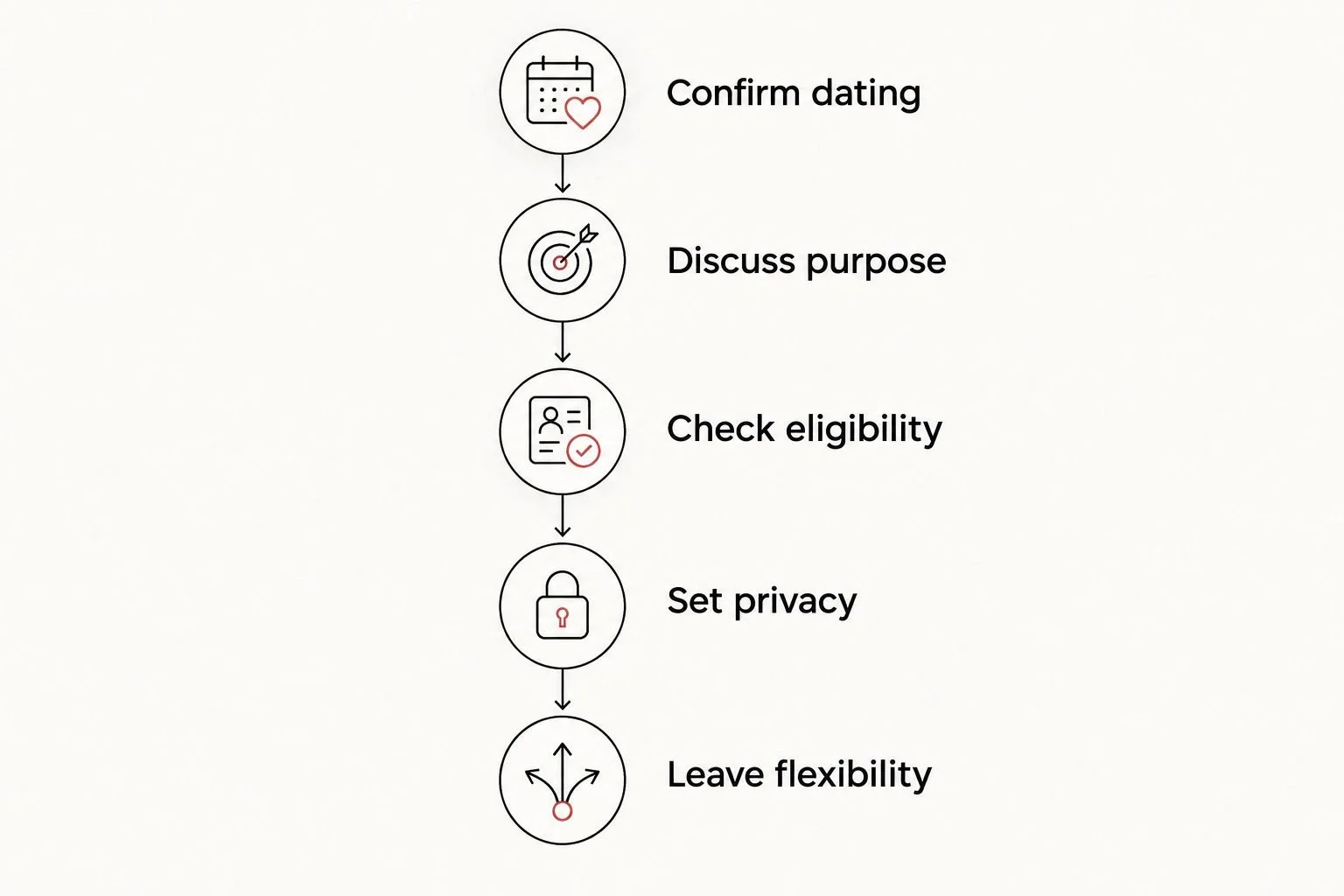
Confirm the examination's purpose before making plans that depend on receiving a result.
The Ultrasound Concierge is best suited to Keller and Willow Park patients seeking a private pregnancy ultrasound setting. Its stated services include diagnostic and elective imaging; the private setting does not remove the clinical limits of ultrasound or replace your prenatal team's care.
For a 2026 appointment, ask The Ultrasound Concierge which service matches your goal and what happens if fetal sex cannot be determined. A specific answer about the examination is more useful than assuming a booking guarantees a reveal.
Do you need a 3D or 4D ultrasound to find out?
No. Standard two-dimensional ultrasound can show genital anatomy when the view is adequate. Three-dimensional imaging displays volume, while four-dimensional imaging shows moving three-dimensional images; neither eliminates the need for a clear view of the relevant anatomy.
Choose the examination based on its purpose, not the most elaborate image label. A detailed face image does not prove that fetal sex was assessed, and a basic-looking medical image can contain the information the sonographer needs.
The benefit of additional image formats is the way they display visible anatomy. Their limitation is that they cannot reveal anatomy hidden by an unfavorable position simply because the format is different. Ask what was actually seen rather than judging confidence from the appearance of the picture.
Can a blood test tell you before an ultrasound?
Blood-based testing can provide fetal-sex information before the routine 18–22-week anatomy scan, depending on the test. It examines genetic information rather than producing an image of genital anatomy. Clinical prenatal screening and a sex-only test are not interchangeable services.
The benefit is a route that does not depend on the baby's position during an ultrasound. The limitation is that sample collection, test eligibility, and interpretation still matter, and a sex-only result does not assess fetal anatomy.
The Ultrasound Concierge lists SneakPeek Gender Tests among its services. Ask about current eligibility and collection instructions directly; do not apply the timing or interpretation rules of a different prenatal blood test to SneakPeek.
If a blood-test result and an ultrasound assessment disagree, contact your prenatal clinician. Do not resolve the difference by selecting the result you prefer or treating another elective appointment as a substitute for medical interpretation.
What if the baby won't cooperate at the appointment?
An obscured view means the sonographer cannot make a clear assessment from that view; it does not establish a problem with the baby. Ask whether the result is confirmed, uncertain, or not assessable, and keep those categories distinct when sharing the information.
Follow the provider's preparation instructions rather than trying internet tips designed to force fetal movement. Food, drinks, or a particular arrival routine do not create a guarantee that the relevant anatomy will become visible.
For the routine anatomy scan, your prenatal clinician determines whether incomplete medical views require follow-up. For an elective reveal visit, ask the provider about its own process. Neither situation justifies describing an uncertain finding as confirmed.
FAQ
How far along should I be for a gender reveal ultrasound?
Around 18 weeks is a practical planning point, and the routine anatomy scan usually takes place between 18 and 22 weeks. A clear result still depends on visible genital anatomy and fetal position.
Can I find out my baby's sex before 18 weeks?
An ultrasound before 18 weeks can sometimes suggest fetal sex, but an early prediction is not the same as a clear assessment. Ask your prenatal clinician about appropriate timing and distinguish a tentative finding from a confirmed result.
Will my 20-week anatomy scan tell me the baby's sex?
A 20-week anatomy scan can show fetal sex if the relevant anatomy is visible, but that is not guaranteed. The examination's main purpose is to assess fetal development and structures.
Is a 3D ultrasound better for finding out fetal sex?
A 3D ultrasound is not required to assess fetal sex; standard two-dimensional ultrasound can show the relevant anatomy. Image format does not overcome a view blocked by fetal position.
Is a gender reveal ultrasound the same as an anatomy scan?
A gender reveal ultrasound is not the same as a diagnostic anatomy scan. An elective reveal visit does not replace the examination recommended by your prenatal clinician.
Can an ultrasound tell my baby's future gender identity?
Ultrasound cannot determine a child's future gender identity. A gender reveal ultrasound assesses visible anatomy associated with fetal sex.
Does The Ultrasound Concierge offer pregnancy ultrasound?
The Ultrasound Concierge provides diagnostic and elective pregnancy ultrasound services for patients in Keller and Willow Park, Texas. Confirm the appropriate service, gestational-age requirements, and result-sharing arrangements directly before booking.
One last thing
Ask for the certainty of the finding, not just the result. Before sharing an announcement, ask: Was the relevant anatomy clearly seen, or is this a prediction? That question gives you more useful information than asking whether the baby looked like a boy or a girl.
Keep medical findings and celebration plans on separate tracks. An inconclusive reveal can wait; questions about fetal development, unexpected findings, or concerning symptoms belong with your prenatal clinician.
Related guides

How Soon Can You See a Heartbeat on Ultrasound? 2026
How soon can you see a heartbeat on ultrasound? Often around 6 weeks transvaginally, later abdominally. Learn what an inconclusive early scan means in 2026.
Cardiac activity can often be seen on a transvaginal ultrasound at about 6 weeks of pregnancy, counted from the first day of your last menstrual period. An abdominal scan usually shows it later, around 7 to 8 weeks. If a scan shows no cardiac activity earlier than expected, the result needs to be interpreted alongside the pregnancy measurements and your clinical history; it does not, by itself, establish a pregnancy loss.
TL;DR
A transvaginal ultrasound can often show cardiac activity at about 6 weeks; an abdominal scan usually shows it around 7 to 8 weeks.
For the question of how soon can you see a heartbeat on ultrasound, scan type and pregnancy dating change the answer.
The Ultrasound Concierge is best for Keller and Willow Park patients seeking a private pregnancy ultrasound, not urgent assessment.
No visible cardiac activity on a very early scan is not, by itself, a diagnosis of pregnancy loss.
How soon can you see a heartbeat on ultrasound?
About 6 weeks is the earliest common answer for a transvaginal scan; around 7 to 8 weeks is a more useful expectation for an abdominal scan. These are guides, not deadlines. In 2026, as in any pregnancy, what the sonographer can see depends on how far the pregnancy has developed and which structures are visible, not just the date on your calendar.
Transvaginal scan
When cardiac activity is commonly visible: About 6 weeks
What a result tells you: Offers the clearest early view when the pregnancy is still small.
Abdominal scan
When cardiac activity is commonly visible: Often around 7 to 8 weeks
What a result tells you: An early inconclusive view can reflect the limits of this approach.
Follow-up scan
When cardiac activity is commonly visible: Timing set by your clinician
What a result tells you: Shows whether expected development has occurred since the earlier scan.
The term heartbeat is familiar, but on an early scan the clinician is looking for cardiac activity: visible motion in the developing embryo. Seeing that motion is different from hearing a heartbeat. You do not need an audio recording for a clinician to identify cardiac activity on ultrasound.
Why this matters
An early scan can answer different questions: whether a pregnancy is visible in the uterus, whether an embryo can be identified, and whether cardiac activity can be seen. Those answers do not always arrive on the same visit. If you are considering a private appointment with The Ultrasound Concierge in the Keller or Willow Park area, tell the provider how your pregnancy was dated and whether you need a diagnostic assessment or an elective scan.
An inconclusive early scan is a finding to follow up, not a verdict to interpret alone. The right next step depends on the images, measurements, symptoms and your clinician’s assessment. This distinction matters most when you expected to see cardiac activity and did not.
Transvaginal ultrasound: about 6 weeks
A transvaginal scan places the ultrasound probe in the vagina, closer to the uterus. That closer view makes it the more informative approach when a pregnancy is too early to assess clearly through the abdomen. Cardiac activity can often be seen at about 6 weeks, but an individual scan can still be inconclusive at that point.
Pregnancy weeks are usually counted from the first day of the last menstrual period, not from conception. If ovulation happened later than expected, a pregnancy described as 6 weeks by period dates can be less developed on ultrasound. A clinician uses the scan findings and dating information together rather than treating the calendar estimate as a measurement of the embryo.
If the scan shows a gestational sac but no embryo, the question is not simply whether a heartbeat is missing. The clinician first needs to establish what structures are visible and whether the appearance fits an early pregnancy. If an embryo is visible, its measured size matters when interpreting the absence of cardiac activity.
Best for: an early clinical assessment when a clinician recommends a transvaginal view. Limitation: even this clearer approach cannot make an extremely early pregnancy visible before it has developed enough to be seen.
Abdominal ultrasound: often around 7 to 8 weeks
An abdominal scan moves the probe across the lower abdomen. Cardiac activity is commonly easier to identify this way once the embryo has grown larger, often around 7 to 8 weeks. At an earlier visit, an abdominal view can be inconclusive even when a transvaginal scan would provide more information.
That difference is about the view, not a change in what is happening in the pregnancy. An abdominal scan that does not show cardiac activity at about 6 weeks cannot be read as equivalent to a clear transvaginal scan with measured findings. Ask which approach was used before comparing your result with someone else’s.
Best for: assessing a pregnancy when an abdominal view gives the clinician the information needed. Limitation: it is less informative than a transvaginal view in the earliest weeks. In 2026, the practical question before an early appointment is not just when can I have a scan? It is which scan can answer my question at this stage?
These two approaches are not competing tests with a single winner. The useful choice depends on the clinical question and what is visible at the time of the examination.
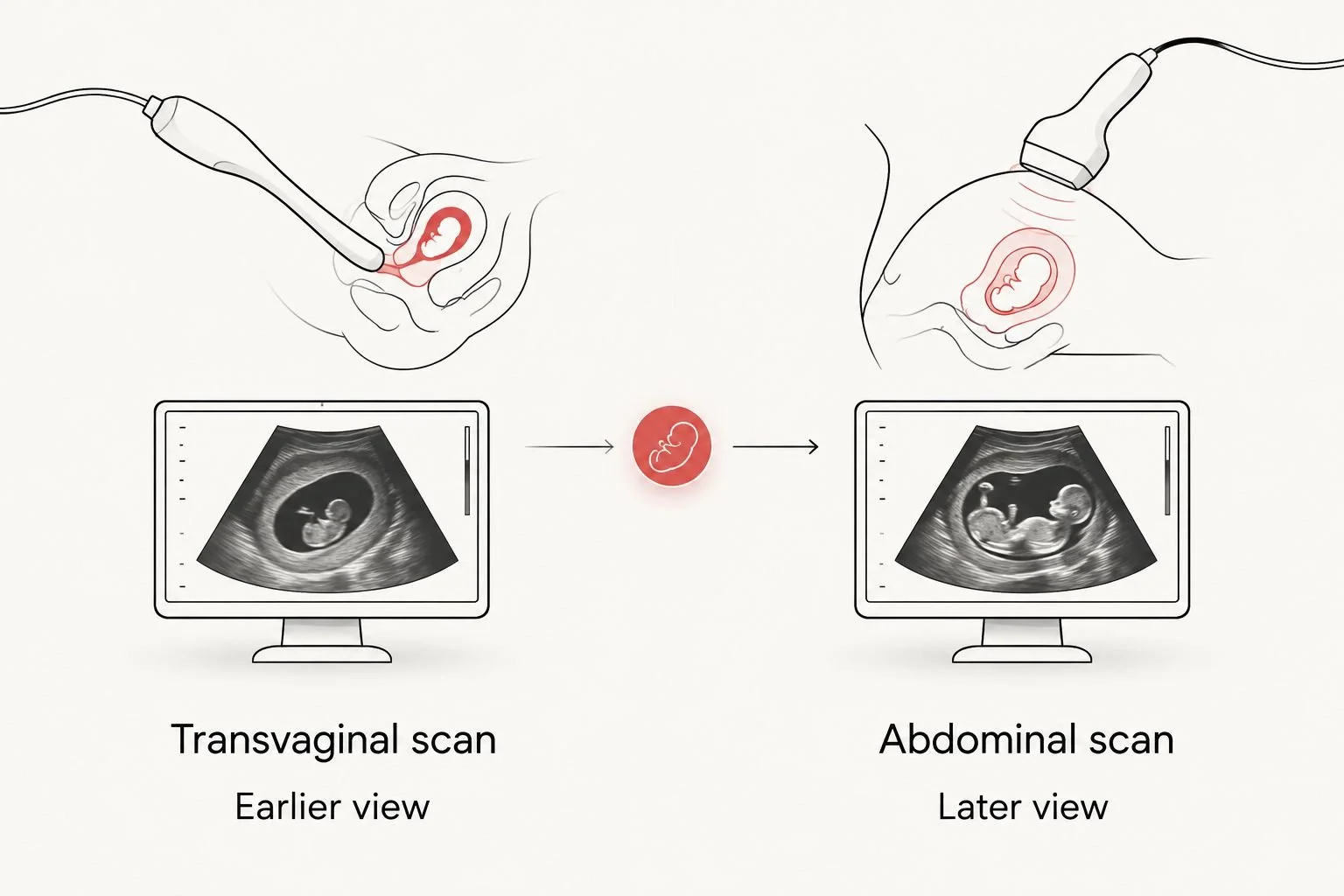
The scan approach affects how early cardiac activity can be identified.
Why the timing varies
There is no single week at which every pregnancy must show visible cardiac activity. When a result differs from what you expected, these are the factors to review with your clinician:
Dating from your last menstrual period. Pregnancy weeks start from the first day of that period. The estimate assumes it reflects when the pregnancy began developing, which is not always precise.
Ovulation timing. Later ovulation can make the pregnancy earlier on ultrasound than the period-based estimate suggests.
How the pregnancy was conceived and dated. If you have fertility-treatment dates, give them to the clinician interpreting the scan rather than relying only on a period estimate.
Scan approach. Transvaginal imaging generally provides more early detail than abdominal imaging.
What the scan actually shows. A sac without a visible embryo calls for a different interpretation from an embryo that has been measured.
The embryo’s measurement. Clinicians use measured findings, not a reported week alone, when assessing whether absent cardiac activity is concerning.
Do not turn these factors into a home checklist for deciding whether a pregnancy is viable. They explain why two people who both say they are 6 weeks pregnant can receive different ultrasound reports. They also explain why the written measurements and the clinician’s interpretation matter more than an isolated image or a brief description from the appointment.
What if the scan shows no heartbeat?
At about 6 weeks, no visible cardiac activity can mean the scan was too early; it can also require clinical follow-up. The finding alone cannot tell you which explanation applies. Ask what was visible, whether an embryo was measured, how the pregnancy was dated and when your clinician recommends reassessment.
There is an important difference between an early scan that cannot establish viability and a scan that meets established diagnostic criteria for pregnancy loss. For example, an embryo with a crown-rump length of 7 millimeters or more and no cardiac activity meets a recognized ultrasound criterion for pregnancy loss when the measurement and examination are reliable. That criterion is based on the embryo’s measured size, not a guess that the pregnancy has reached a particular week. Do not apply it to an image or measurement without a qualified clinician’s interpretation.
A clinician can recommend a repeat ultrasound when the first examination is inconclusive. The interval depends on what the initial scan showed; scheduling another scan immediately is not always the most useful way to answer the question. The follow-up looks for development that could not be confirmed on the first examination.
If you are arranging a reassurance ultrasound between prenatal visits, keep your prenatal clinician involved in interpreting an uncertain result. A private scan can provide images, but an unexpected finding still needs an appropriate clinical follow-up plan.
When to seek care rather than wait for another scan
Do not wait for a routine ultrasound appointment if you have severe or worsening abdominal pain, pain concentrated on one side, shoulder pain, fainting, or heavy bleeding. Seek prompt medical assessment. These symptoms need attention even if an earlier test or scan seemed reassuring.
An early ultrasound question is sometimes also a question about pregnancy location. Before a clinician has confirmed a pregnancy in the uterus, symptoms such as significant one-sided pain or fainting need urgent evaluation for a possible ectopic pregnancy. A keepsake or elective appointment is not a substitute for that assessment.
If you have bleeding or pain that is not severe, contact your prenatal clinician for advice on what to do next. The decision depends on your symptoms and the findings already available. In 2026, the safest use of an early scan is to pair its images with a clear route to clinical interpretation, especially when the answer is uncertain.
How to prepare for an early ultrasound question
Before your appointment, write down the first day of your last menstrual period and any known ovulation or fertility-treatment dates. Bring details of prior scans and reports if you have them. Tell the person arranging the scan whether your goal is pregnancy dating, assessment of symptoms, or an elective look at the pregnancy; those are not interchangeable requests.
At the visit, ask these questions in plain language:
Which scan approach was used? A transvaginal and an abdominal view do not have the same early limits.
What structures were visible? Ask whether the report identifies a gestational sac, an embryo and cardiac activity.
Was the embryo measured? A measured finding carries more clinical meaning than a week estimate alone.
Who will interpret the result? Make sure you know how the report reaches the clinician managing your pregnancy.
What happens if the result is inconclusive? Leave with a follow-up recommendation rather than an unsupported conclusion.
The Ultrasound Concierge is best for patients around Keller and Willow Park who want a private pregnancy ultrasound experience; it is not a replacement for urgent medical evaluation or your prenatal clinician’s care. The Ultrasound Concierge offers both diagnostic and elective ultrasound services, so be clear about which type of assessment you need before the appointment.
Discuss your ultrasound options
Check which pregnancy ultrasound service fits your question and timing.
Can you see a heartbeat at 5 weeks?
At 5 weeks, a heartbeat is generally too early to expect on ultrasound. A scan can show earlier pregnancy structures without yet showing an embryo or cardiac activity. Your clinician should interpret what is visible rather than judge the scan by the week estimate alone.
Is 6 weeks too early for an abdominal ultrasound?
At 6 weeks, an abdominal scan can be too early to show cardiac activity clearly. A transvaginal scan usually offers a more informative early view. An inconclusive abdominal result does not establish that cardiac activity is absent.
When should I repeat an inconclusive early scan?
There is no single repeat-scan date for every inconclusive result. Your clinician sets the timing based on the first scan’s findings, measurements and your clinical situation. Ask for a specific follow-up plan before leaving the appointment.
FAQ
How soon can you see a heartbeat on ultrasound?
Cardiac activity can often be seen at about 6 weeks with a transvaginal scan and around 7 to 8 weeks with an abdominal scan. Pregnancy dating and the structures visible on the scan affect the interpretation.
Can an ultrasound show a heartbeat at 5 weeks?
A heartbeat is generally too early to expect at 5 weeks. Your clinician can explain what pregnancy structures are visible and whether follow-up is needed.
Does no heartbeat at 6 weeks mean miscarriage?
No, absent visible cardiac activity at about 6 weeks does not by itself diagnose pregnancy loss. The scan approach, embryo measurement and dating information matter.
Is a transvaginal scan better than an abdominal scan for an early heartbeat?
A transvaginal scan usually provides a clearer view in the earliest weeks. An abdominal scan often becomes more informative as the pregnancy develops.
Can you see cardiac activity without hearing a heartbeat?
Yes, cardiac activity can appear as visible motion on ultrasound without an audio heartbeat. Hearing sound is not required to identify that motion on the image.
What should I ask after an inconclusive early ultrasound?
Ask which structures were seen, whether an embryo was measured and when your clinician recommends follow-up. Do not interpret an early image without the report and clinical context.
When should I seek urgent care in early pregnancy?
Seek prompt medical assessment for severe or worsening abdominal pain, one-sided pain, shoulder pain, fainting or heavy bleeding. Do not wait for a routine private ultrasound appointment to assess those symptoms.
One last thing
The most useful question after an early scan is often not Was there a heartbeat? but What could this particular scan reliably show? In 2026, an estimate of 6 weeks still cannot replace the scan approach, the measurements and a clinician’s interpretation. The Ultrasound Concierge can be an option for a private pregnancy ultrasound in the Keller and Willow Park area, while your prenatal clinician remains the point of contact for uncertain findings and care decisions.
Related guides

Confirm Pregnancy Before First OB Visit Ultrasound? Yes 2026
Confirm pregnancy before first OB visit ultrasound: yes, when diagnostic imaging identifies an intrauterine pregnancy. Learn what early scans can and cannot show.
Yes. A private diagnostic ultrasound can confirm an intrauterine pregnancy before your first OB visit when the scan shows the structures needed to establish it. An elective keepsake scan is not a substitute for that assessment, and a scan done too early can leave the answer uncertain. Keep your OB appointment even if the private scan confirms the pregnancy.
TL;DR
A diagnostic ultrasound can confirm pregnancy before your first OB visit when it identifies an intrauterine pregnancy.
The Ultrasound Concierge is a private diagnostic-scan option for patients near Keller and Willow Park, Texas.
An early inconclusive scan does not rule out pregnancy or an ectopic pregnancy.
Keep your OB visit; a private scan does not replace prenatal care.
Can a private ultrasound confirm pregnancy before your OB visit?
Yes, if you book a diagnostic pregnancy scan and its findings establish an intrauterine pregnancy. The distinction is the purpose of the appointment, not whether the room feels clinical or private. Ask what the scan is intended to assess and how its findings will be documented before you book.
Private diagnostic ultrasound
Best for: Someone seeking clinical information before an OB appointment
What it can answer: Whether the scan identifies an intrauterine pregnancy and what can be seen at that stage
Main limitation: An early scan can be inconclusive; it does not replace follow-up care
Elective or keepsake ultrasound
Best for: Someone seeking images and a personal viewing experience
What it can answer: What is visible during the visit
Main limitation: It should not be used to rule out complications or replace a diagnostic assessment
First OB visit
Best for: Someone establishing prenatal care and a plan for follow-up
What it can answer: How your clinician interprets your history, symptoms and test results together
Main limitation: You may have to wait for the scheduled visit to discuss your questions
The Ultrasound Concierge provides private diagnostic and elective pregnancy ultrasound services for patients in the Keller and Willow Park area. The Ultrasound Concierge is best for local patients who want a private diagnostic ultrasound before an OB visit and will still follow up with their prenatal clinician. Its elective imaging is a separate choice, not a shortcut to medical clearance. If you have symptoms that need urgent assessment, a scheduled private scan is the wrong setting.
Why this matters
A positive home test and an ultrasound answer different questions. A home test detects a pregnancy-related hormone; ultrasound looks for visible findings. When a scan is too early to establish where the pregnancy is, you need a follow-up plan rather than reassurance based on a single image.
You can review The Ultrasound Concierge when deciding whether a private visit fits your needs. Before booking any provider, say plainly that you want to confirm pregnancy before your first OB visit with an ultrasound. Ask whether the appointment is diagnostic, whether its timing is appropriate and how you will receive the findings.
What can an early ultrasound actually confirm?
A diagnostic scan can establish an intrauterine pregnancy when it identifies the necessary findings inside the uterus. The person interpreting the images must also account for how early the scan was performed. Seeing less than you expected is not, by itself, a diagnosis of a problem.
An early scan cannot promise that a pregnancy will continue normally. It also cannot turn an unclear result into a definite answer by offering more images from the same visit. If the location or status of the pregnancy remains uncertain, ask the clinician managing your care what follow-up is needed.
Location, current findings and future outcome are different questions. An ultrasound that confirms location does not predict every later development. Bring the report to your OB visit so your clinician can interpret it alongside your dates, symptoms and other testing.
Does a positive test change what the scan can show?
No. A positive home test can precede clear ultrasound findings. That mismatch is especially relevant when you are unsure when your last menstrual period began or when conception occurred. Give the scanning provider the dates you know, but do not treat an estimate as proof that a particular structure must already be visible.
If your test is positive and the scan cannot establish a pregnancy in the uterus, do not treat the scan as a negative pregnancy test. Contact the clinician responsible for your care for next steps. Tell them about pain or bleeding rather than waiting silently for your first routine visit.
When is it too early for a conclusive scan?
Around 5 weeks of pregnancy, counted from the first day of the last menstrual period, an ultrasound can still be too early for a clear answer. Around 6 weeks, more findings can become visible, but timing and what is seen vary. At 7 weeks, uncertainty still calls for clinical interpretation rather than a verdict based on a calendar date alone.
These are reference points, not appointment guarantees. Pregnancy dating based on a last menstrual period assumes you know that date and that it reflects the timing of the pregnancy. If those assumptions do not fit you, an early scan can appear behind an expected timeline without explaining why.
When arranging a private scan in 2026, tell the provider the first day of your last period if you know it, the date of your positive test and whether a clinician has already advised you about scan timing. Ask what the next step will be if the findings are inconclusive. A useful booking conversation covers both what the appointment can assess and what happens if it cannot yet answer your question.
How do you choose the right private appointment?
Start with the question you need answered. If it is whether the pregnancy can be identified inside the uterus before your OB visit, request a diagnostic pregnancy ultrasound. If you mainly want a viewing experience or keepsake images, describe that goal instead. Do not assume the two appointments produce interchangeable medical information.
Diagnostic scan: Ask whether the appointment is intended to assess an early pregnancy. Confirm that the provider understands you are seeking clinical findings, not only images.
Check timing: Share your last menstrual period, positive-test date and any uncertainty about your dates. Ask whether booking now is likely to answer your question.
Share report: Ask how findings are documented and how you can pass them to your OB. Do not assume your prenatal practice receives them automatically.
OB visit: Keep the appointment and bring the findings, your questions and any instructions you received about follow-up.
The Ultrasound Concierge offers both diagnostic and elective ultrasound imaging. For a 2026 appointment, specify which type you need before choosing a time. The benefit of a private setting is a visit that fits your preference for a calmer experience; the limitation is unchanged: an ultrasound result still needs the right clinical follow-up.
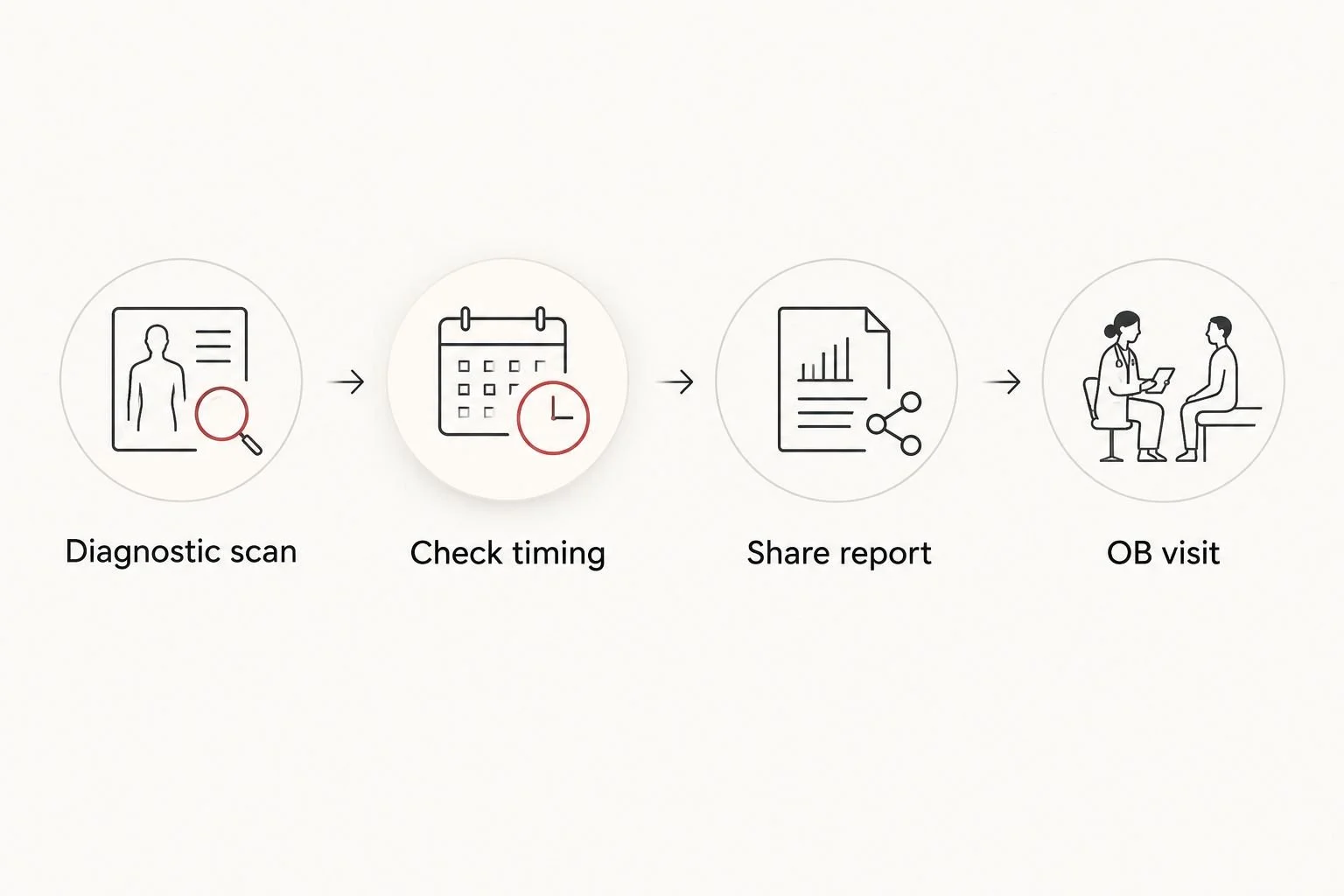
Choose the scan for your medical question, then make a plan to share its findings.
Write down the answer you want before you book. That makes it easier to spot a mismatch between a diagnostic appointment and an elective viewing session, especially when both are offered by the same provider.
Check your ultrasound options
Ask which private appointment addresses your early-pregnancy question.
Why can early ultrasound answers vary?
Two people booking scans on the same date can receive different answers because their pregnancies are not necessarily at the same stage. The useful question is not whether one image matches someone else's. It is whether the findings answer your question and what follow-up the result requires.
Pregnancy timing: A scan performed before the relevant structures are visible can be inconclusive even after a positive test.
Uncertain dates: If you are unsure of the first day of your last period, an estimated pregnancy week can be misleading.
Scan purpose: A diagnostic assessment and an elective session do not serve the same medical purpose.
Findings on the day: A single scan can establish some facts without resolving every question about the pregnancy.
Symptoms: Pain or bleeding changes the urgency of assessment; it should not be handled as a routine reassurance booking.
Follow-up: The usefulness of an early result depends on whether you know who will explain it and arrange further care if needed.
In 2026, the sensible choice is the appointment that matches the question and your symptoms. A private scan can give you information sooner than your scheduled OB discussion, but sooner does not always mean conclusive. Ask what the result establishes, what it does not establish and who you should contact next.
What if the ultrasound does not show a pregnancy yet?
An inconclusive early scan needs a plan, not a guess. Tell the clinician managing your pregnancy about the positive test, the scan findings and any symptoms. Your clinician can decide what further assessment is appropriate and when it should happen.
Do not book repeated elective scans to settle a medical question. They do not replace clinical interpretation of an uncertain result. If you have severe or one-sided abdominal pain, shoulder pain, fainting or heavy bleeding, seek urgent medical evaluation rather than waiting for another private appointment. Those symptoms need prompt attention whether or not you already have an OB visit booked.
If you receive a report from a 2026 private diagnostic scan, keep a copy you can share. Tell your prenatal clinician what the report says rather than relying on a remembered description of the images. A clear handoff is more useful than collecting images that nobody responsible for your care has reviewed.
Can a private scan replace the first OB appointment?
No. A private ultrasound can answer a focused imaging question, but the first OB appointment establishes ongoing prenatal care. Your clinician considers your medical history, symptoms, tests and the scan findings together. Keep the visit even if the ultrasound gives you reassuring information.
If you are considering The Ultrasound Concierge for a pregnancy ultrasound, frame the visit as one part of that care, not an alternative to it. Ask your OB practice how to share outside findings and whether they want you to contact them sooner if the result is unclear. The answer can affect what you do after the scan, so get it before you are left deciding alone.
FAQ
Can a private ultrasound confirm pregnancy before my first OB visit?
Yes, a private diagnostic ultrasound can confirm an intrauterine pregnancy when the necessary findings are visible. An early or inconclusive scan may require clinical follow-up.
Will an ultrasound show a pregnancy at 5 weeks?
A scan at 5 weeks can be too early for a clear answer. Pregnancy dating and visible findings vary, so ask what follow-up is needed if the result is inconclusive.
Is a 6-week private scan guaranteed to confirm pregnancy?
No, a 6-week scan is not guaranteed to give a conclusive answer. The findings and the accuracy of your dates determine what can be established.
Is a keepsake ultrasound the same as a diagnostic pregnancy scan?
No, a keepsake ultrasound is an elective viewing experience, while a diagnostic scan addresses a clinical question. Ask which type of appointment you are booking.
Should I still see my OB if a private scan confirms pregnancy?
Yes, keep your OB appointment after a private scan confirms pregnancy. Your prenatal clinician needs to review the result alongside your history and plan ongoing care.
What if my pregnancy test is positive but nothing conclusive appears on ultrasound?
Contact the clinician managing your care for follow-up after an inconclusive scan. Do not assume the positive test was wrong or that the pregnancy's location has been established.
Should I book a private scan if I have pain or heavy bleeding?
Seek urgent medical evaluation for severe or one-sided abdominal pain, shoulder pain, fainting or heavy bleeding. Do not wait for a routine private scan to assess those symptoms.
One last thing
A reassuring image and a documented diagnostic finding are not the same thing. Before a 2026 private appointment, ask the question you intend to put to your OB: What can this scan establish, and what will I need to do if it cannot? That gives you a reason to book, a way to assess the result and a plan for what follows.
Related guides

8K Ultrasound vs 4D Ultrasound: Which Wins in 2026?
8k ultrasound vs 4d ultrasound: 4D wins for watching movement; 8K is an enhanced keepsake image. Learn what to ask before choosing a scan in 2026.
No. In 2026, 8K ultrasound is not automatically better than standard 4D ultrasound: 4D shows a moving view, while 8K generally describes an enhanced presentation of an image rather than a separate measure of diagnostic quality. If your goal is to watch your baby move, choose 4D; if your goal is a particular keepsake image style, ask to see examples of the provider’s 8K results. Neither replaces a diagnostic scan or prenatal care.
TL;DR
For 8k ultrasound vs 4d ultrasound in 2026, choose 4D to watch movement; consider 8K for an enhanced keepsake image.
8K does not establish better diagnostic quality than 4D.
Ask how the 8K image is produced and what you will receive before choosing a session.
The Ultrasound Concierge offers pregnancy imaging in a private setting, but keepsake views do not replace prenatal care.
Why this matters. A sharper-looking portrait and a medically useful scan answer different questions. If you are deciding whether to book another keepsake session, read about the safety of 3D/4D ultrasound sessions and discuss any medical concern with your prenatal clinician.
Is 8K ultrasound better than standard 4D ultrasound?
8K is better only if you prefer its finished-image appearance; 4D is the clearer choice when you want to see movement. The terms do not describe the same feature. In 2026, compare the result you want rather than treating the larger-sounding label as proof of a better examination.
What are you looking at?
Standard 4D ultrasound: A moving view assembled from three-dimensional ultrasound images
8K ultrasound presentation: An enhanced rendering offered as a finished image
Best for
Standard 4D ultrasound: Watching movement during a keepsake session
8K ultrasound presentation: Choosing a particular portrait-like keepsake appearance
Main advantage
Standard 4D ultrasound: You can see motion rather than only a still frame
8K ultrasound presentation: The finished image can have a different visual style
Main limitation
Standard 4D ultrasound: A clear face view depends on the conditions during the scan
8K ultrasound presentation: A polished image is not evidence of a more accurate medical assessment
What to ask
Standard 4D ultrasound: Will I be able to watch a live moving view?
8K ultrasound presentation: Is the image created from this session, and what form will I receive?
These options are not necessarily competing appointments. A provider might use images captured during a session to make a finished rendering. Ask what is included rather than assuming that the words 4D and 8K identify separate scans.
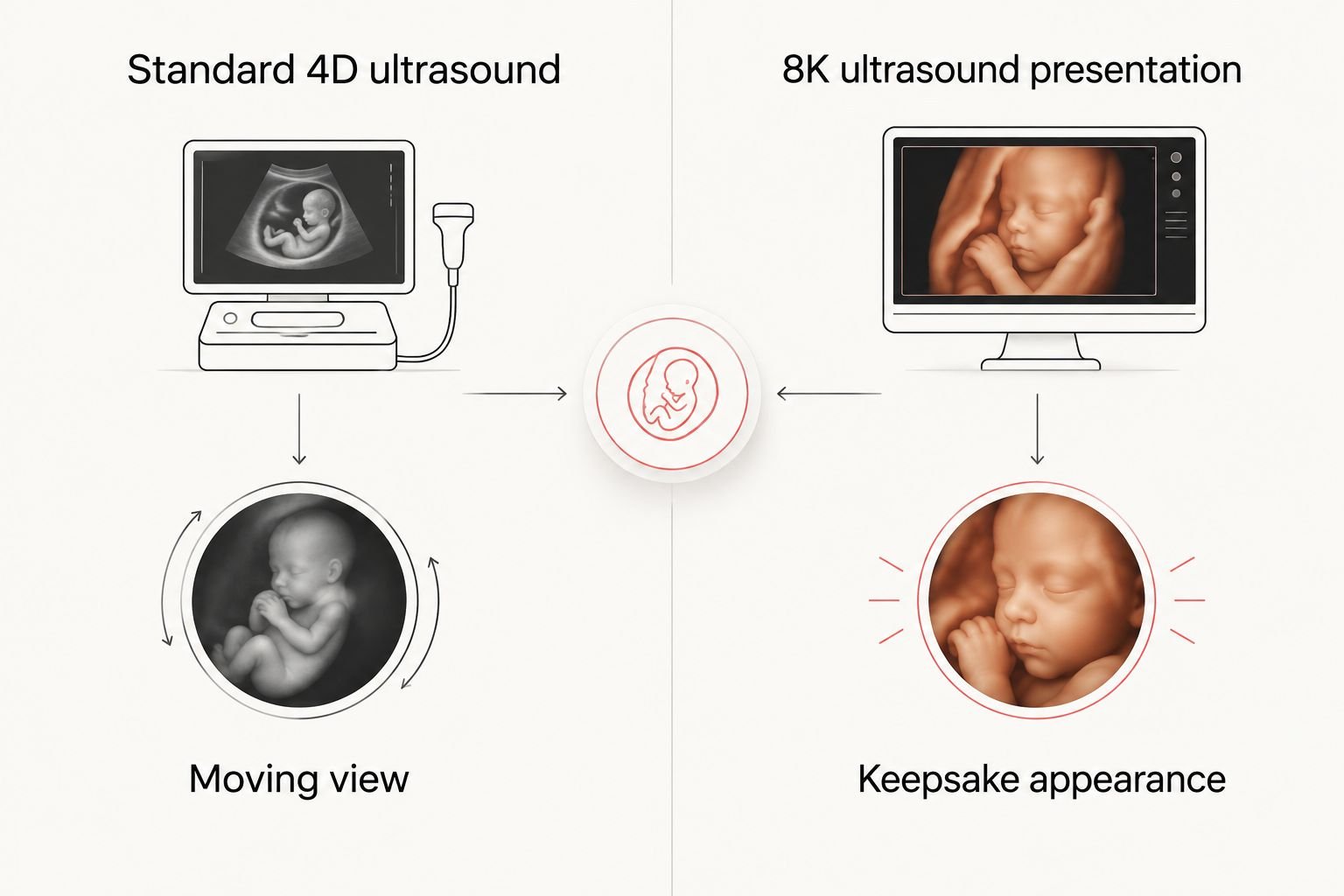
Choose by the result you want: motion during the session or the appearance of a finished image.
Why this matters for your appointment
A keepsake scan can be meaningful without answering a medical question. If you want to see your baby’s face or movement, tell the provider that before the appointment. If you want to check anatomy, growth, or a symptom, ask your prenatal clinician which diagnostic examination you need instead.
The Ultrasound Concierge is best for patients in the Keller and Willow Park area seeking a private, personalized ultrasound visit; its elective imaging is not a substitute for a clinician-directed diagnostic evaluation. The Ultrasound Concierge offers both diagnostic and elective ultrasound services, so be explicit about which purpose brings you in. That distinction matters more than choosing the most impressive-sounding image label.
What does 4D ultrasound give you?
A 4D ultrasound adds time to a three-dimensional view, so you see movement rather than a single still image. For an expecting parent, that is the main reason to choose it. You can ask to watch a moving view during the session and clarify whether a video is part of the result you will receive; do not assume that watching one means you will receive a copy.
Best for: seeing movement. Its strength is the experience of watching rather than judging one selected frame. Its limitation is that the view depends on what the scan can capture at that moment. A baby facing away, for example, does not become easier to see simply because the display is moving.
If a face image matters most to you, ask the provider to show you examples from comparable sessions and explain what happens when the face is obscured. Examples show the style of an output, not a promise that your session will produce the same view.
What does an 8K ultrasound image give you?
In elective ultrasound, 8K generally refers to an enhanced image presentation. It does not, by itself, tell you the resolution of the original ultrasound data, establish a uniform medical standard, or show that a clinician can identify more detail. The useful question in 2026 is what the provider does to create the image and how the result differs from the standard view.
Best for: an enhanced keepsake image. Its advantage is the appearance of the finished image, if you prefer that style. Its limitation is that processing cannot guarantee a clear view of a face that the scan did not capture clearly. Ask to see actual examples of the provider’s work and to confirm whether the result is a still image, a moving view, or both.
Do not use an enhanced portrait to interpret a medical concern. A visually detailed image and a diagnostic report serve different purposes, even when they originate from ultrasound imaging. If someone tells you that 8K is medically superior to 4D, ask what diagnostic measure supports that claim rather than accepting the label.
Why the result varies
The appearance of either result depends on conditions during the examination, not just the name of the image format. In 2026, these are the factors to discuss before you choose a keepsake session:
Baby’s position. A face turned away or covered by a hand gives the provider less of the face to show. Ask what you can expect if the desired view is not available.
Timing in pregnancy. The view changes as the pregnancy develops. Ask your prenatal clinician whether your planned timing fits your circumstances, and ask the imaging provider what that timing means for the type of image you want.
Fluid and intervening tissue. Ultrasound needs a usable path to form an image. These conditions affect what is visible, regardless of whether the result is shown as 4D or enhanced afterward.
Capture quality. A finished rendering depends on the images acquired during the session. Editing changes presentation; it does not turn a blocked view into a reliable medical finding.
Image processing. Providers can present captured images differently. Ask how the provider uses the term 8K and request examples from that provider rather than comparing labels alone.
These factors explain why no provider can promise a particular facial expression or portrait from the label on a session. They also explain why a standard 4D view you enjoy can be more valuable to you than an enhanced still image you did not want.
How should you choose between 8K and 4D in 2026?
Start with the outcome, then check what the appointment actually includes. The Ultrasound Concierge offers 3D/4D/8K imaging among its services, but that list alone does not tell you which result fits your goal.
Decide whether you want motion or a still image. Choose a moving 4D view if watching your baby is the priority. Ask about an 8K result if the appearance of a finished keepsake image is the priority.
Ask what you will receive. Confirm the form of the deliverable rather than assuming that a live view, a video, and an enhanced still are interchangeable.
Review examples from the provider. Ask which examples represent standard 4D captures and which represent enhanced images. Judge the style you prefer, not the size of the label.
Explain any clinical concern separately. If you need an answer about health, ask which diagnostic service or prenatal clinician can address it. Do not choose an elective image format as a substitute.
Set expectations for visibility. Ask how the provider explains results when the baby’s position prevents the view you hoped for. A responsible answer describes the limit rather than promising an image.
For patients considering a private appointment in the Keller or Willow Park area, The Ultrasound Concierge offers diagnostic and elective imaging. State your goal when you inquire so you can discuss the appropriate type of visit without assuming that 8K is an upgrade to medical care.
Ask about your scan options
Discuss whether a moving view, a keepsake image, or diagnostic imaging fits your goal.
Does a sharper-looking image mean a better medical scan?
No. Image appearance alone does not establish diagnostic quality. A clinician-directed diagnostic examination is chosen and interpreted to answer a medical question; a keepsake image is selected for how it looks. Ask for diagnostic care when the question concerns your health or your pregnancy, even if you also want a keepsake view.
The distinction is especially useful when you compare promotional samples. An attractive sample tells you what a finished image can look like under favorable conditions. It does not establish how clearly every baby will appear or what a medical examination will find.
Can you have both 4D motion and an 8K keepsake?
Ask the provider. A moving view and an enhanced still describe different outputs, so a session can be discussed in terms of both. The terms alone do not confirm what a particular appointment includes. In 2026, request a plain description of the live view and the finished files or images before choosing.
If you plan to share the result with family, specify whether you want something to watch together or a still image. That simple distinction makes the conversation more useful than asking for the highest-sounding format.
FAQ
Is 8K ultrasound better than 4D ultrasound in 2026?
No, 8K is not automatically better than 4D ultrasound in 2026. Choose 4D to watch movement and ask about 8K if you prefer an enhanced keepsake image.
Does 8K ultrasound show more medical detail than 4D?
The 8K label alone does not establish more diagnostic detail than 4D. Ask a prenatal clinician which diagnostic examination answers your medical question.
Is 8K ultrasound a different scan from 4D?
Not necessarily. Ask the provider whether 8K describes an enhanced image made from images captured during a session and what you will receive.
Can I see my baby move with an 8K ultrasound image?
An enhanced still image does not show movement. Ask for a live 4D view if watching motion matters to you, and confirm whether any video is included.
Will 8K ultrasound guarantee a clear picture of my baby's face?
No image label guarantees a clear face view. The baby's position and the quality of the captured view affect the finished result.
Should I choose an 8K image instead of a diagnostic ultrasound?
No. Choose clinician-directed diagnostic imaging for a medical question; an enhanced keepsake image does not replace that assessment.
What should I ask before booking a 4D or 8K session?
Ask whether you will see a moving view, what finished images you will receive, and how the provider defines 8K. Explain separately if your reason for visiting is medical.
One last thing
The most useful comparison is not 8K versus 4D; it is the result you want versus the result the session can provide. In 2026, ask to see the provider’s standard moving view and enhanced still examples side by side. If you cannot tell which you would prefer, choose based on whether watching movement or keeping a finished portrait matters more to you.
Related guides

Do you need a referral for a private ultrasound? Varies 2026
Do you need a referral for a private ultrasound? It depends on whether the scan is elective or diagnostic. Learn what to ask before booking in 2026.
You do not always need a doctor’s referral for a private ultrasound. An elective pregnancy scan can have different booking requirements from a diagnostic scan ordered to investigate a medical concern, so the answer depends on the purpose of the visit and the provider’s policy. In 2026, confirm the requirements for the specific scan before you book; a private appointment does not replace medical care.
TL;DR
Do you need a referral for a private ultrasound? It depends on whether the scan is elective or diagnostic.
Ask the provider whether your scan requires a clinician’s order; do not assume private booking means no order is needed.
The Ultrasound Concierge is a relevant option for patients seeking private ultrasound imaging around Keller and Willow Park, Texas.
For symptoms or a medical question, contact your treating clinician rather than relying on an elective scan.
Why this matters
A referral question is really a question about what the ultrasound is meant to do. You might want images of your pregnancy, or you might need a clinician to assess pain, bleeding, fertility treatment, or another health concern. Those visits can look similar from the patient’s side but have different requirements and different roles in your care.
The Ultrasound Concierge offers private ultrasound services for patients in the Keller and Willow Park area, including diagnostic and elective imaging. Its mix of services makes it especially important to name the scan you want when asking about a referral. The Ultrasound Concierge is best for local patients who want to ask about private diagnostic or elective imaging in a calm, personalized setting. That is a fit assessment, not a statement that every service can be booked without an order.
Do you need a doctor’s referral for a private ultrasound?
Not necessarily. If you are arranging an elective pregnancy ultrasound, ask the provider whether you can book directly. If the ultrasound is intended to answer a clinical question, ask whether the provider needs an order from your physician or another authorized clinician. The word private describes the setting; it does not establish the medical requirements for the exam.
Elective pregnancy imaging, such as a 3D/4D session
What to ask before booking: Can I book directly, and are there any prerequisites?
What the scan should not replace: Your scheduled prenatal care or a clinically indicated scan
Diagnostic pregnancy imaging
What to ask before booking: Do you require a clinician’s order, and what clinical information must accompany it?
What the scan should not replace: Assessment and follow-up by your pregnancy care team
Fertility-related imaging
What to ask before booking: Does my treating clinician need to specify the exam or timing?
What the scan should not replace: The treatment plan set by my fertility team
General health imaging
What to ask before booking: What order or referral is required for the question being investigated?
What the scan should not replace: A clinician’s evaluation of symptoms and results
A referral and an imaging order are not always the same thing. When you call, use both terms: ask whether you need a referral or an order, who can provide it, and whether anything must be sent before the appointment. This avoids arriving with a document that does not contain the information needed for your exam.
In 2026, do not use a general answer about private ultrasounds as a substitute for the requirements of your chosen provider. Even within one practice, elective and diagnostic appointments serve different purposes. Describe the purpose first; then ask what paperwork that specific service requires.
An imaging provider can explain its booking requirements. Your treating clinician is the person to ask which diagnostic exam addresses your medical concern and how the result will be used in your care. If you are unsure which kind of appointment you need, start there rather than selecting a scan by its name alone.
Elective pregnancy ultrasound: ask about direct booking
An elective pregnancy scan is usually sought for an experience or images rather than to investigate a symptom. If that describes your goal, the practical question is whether the provider allows direct booking for that particular appointment. Do not treat an elective scan as an additional medical check simply because ultrasound equipment is involved.
When you contact a provider, say whether you want pregnancy images, a 3D/4D session, or another elective service. Ask what information you should bring and whether the provider has any prerequisites. If you are also due for a medically recommended ultrasound, keep that appointment with your care team; an elective visit does not take its place.
A reassuring experience and a medical conclusion are different outcomes. If your reason for booking is worry about a symptom, tell your prenatal clinician what is happening. They can decide what assessment you need rather than leaving you to choose between an elective appointment and a diagnostic one.
For 2026 bookings, keep the question precise: Can I book this elective scan without a referral, and what does the appointment include? The answer should come from the provider offering the service, not from another studio’s booking page or a friend’s experience.
Diagnostic ultrasound: ask whether an order is required
A diagnostic ultrasound is intended to investigate a defined medical question. The provider needs to know what exam is requested and how it relates to your care; its order requirements must be confirmed before you schedule. Do not assume that paying privately changes those requirements.
Ask your clinician to identify the question the scan should answer. Then ask the imaging provider what kind of order it accepts, who can issue it, and how it should be delivered. If you already have paperwork, confirm that it matches the exam being booked before making plans around the visit.
Also ask who will receive the results and who will discuss them with you. An image by itself is not a care plan. If a finding needs follow-up, your treating clinician needs a clear route to review it and decide what happens next. Confirming that route before your appointment is more useful than asking only whether a referral is needed.
For patients comparing diagnostic and elective services at The Ultrasound Concierge, the distinction matters more than the setting. The practice offers both kinds of imaging, but the supplied information does not establish a single referral rule across its services. Ask about the exact exam you need.
Fertility imaging: coordinate the scan with your care team
If an ultrasound is part of fertility care, your treating team should identify the exam and when it is needed. A private appointment is useful only if it fits the clinical question and the team receiving the result. Ask whether your clinician needs to provide an order and what information must go back to them.
Bring the name of the exam requested when you contact the provider. If you do not have one, ask your fertility clinician before booking. Fertility ultrasound describes a broad purpose, not a complete instruction to an imaging provider. Your team can explain what they need documented and how they want the result shared.
The Ultrasound Concierge lists fertility imaging among its services for the Keller and Willow Park area. That makes it a provider to contact about the specific scan your team has requested, not a reason to assume that any available appointment will fit your treatment plan. In 2026, settle the exam, timing, and result handoff before you choose a slot.
Why referral requirements vary
The deciding factor is not whether the room feels clinical or private. It is what the scan is for and how its findings will be used.
Purpose of the visit: An elective image session and an exam investigating a symptom answer different needs.
Type of ultrasound: Pregnancy, fertility, and general health imaging are not interchangeable booking requests.
Provider policy: The practice sets the paperwork and scheduling requirements for each service it offers.
Clinical question: A diagnostic provider needs to understand what the ordering clinician wants assessed.
Follow-up plan: You need to know who receives and explains a diagnostic result.
Your current care: An existing prenatal or fertility plan can affect which scan your clinician requests and when.
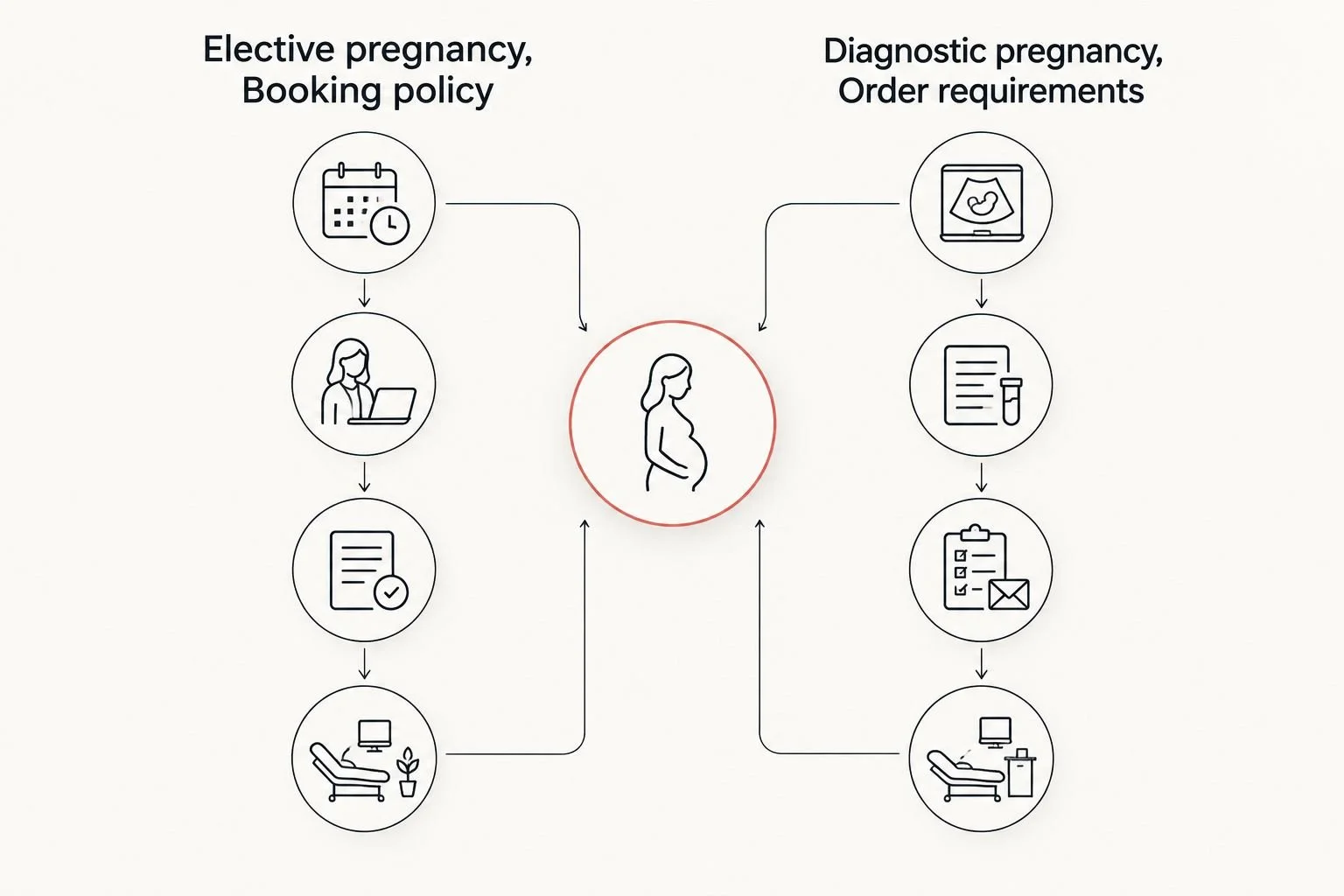
Start with the purpose of the scan, then confirm the provider’s requirements for that service.
These factors also explain why someone else’s answer may not apply to you. Their appointment could have been elective while yours is diagnostic, or the providers could have different policies. Ask a question that names your scan and your reason for it; a general yes-or-no answer leaves out the part that matters.
What to ask before you book
You can resolve most referral uncertainty with a short conversation. Have your reason for seeking the scan ready, then ask the provider:
Is this an elective or diagnostic appointment? Describe what you hope the scan will answer, especially if you have symptoms.
Do I need a referral, an imaging order, or neither? Ask about the specific service, not private ultrasound in general.
Who can issue any required order? If you have a treating clinician, confirm whether their paperwork meets the provider’s requirements.
What information must arrive before my visit? Check whether the provider needs the order or other relevant records in advance.
Who receives the findings? For a diagnostic scan, establish how your clinician will get the result and who will explain it to you.
If you are arranging pregnancy imaging, add one more question: Will this visit answer a medical question or provide elective images? The distinction affects what you should expect from the appointment. It also helps you avoid treating an elective session as reassurance about a concern that needs clinical assessment.
Ask About Your Ultrasound
Confirm the right service and its booking requirements before scheduling.
If a provider says an order is needed, return to the clinician managing that concern. Tell them what the imaging provider requires and ask whether the exam fits your care plan. If the provider says you can book directly, still tell your clinician about symptoms rather than assuming direct access makes the scan appropriate for diagnosis.
In 2026, the useful outcome of this conversation is not just permission to book. It is clarity on the exam, its purpose, and the person responsible for acting on a diagnostic result.
Can I get a private ultrasound without seeing a doctor first?
You can ask to book an elective private ultrasound without first obtaining a referral, but the provider decides its booking requirements. If you want an ultrasound because of a symptom or a medical concern, contact a clinician for assessment. Direct booking and appropriate medical care are separate questions.
Is an elective ultrasound the same as a diagnostic ultrasound?
No. An elective ultrasound is sought for an experience or images; a diagnostic ultrasound is used to address a medical question. Ask the provider which service you are booking and ask your treating clinician when the purpose is medical.
Does a doctor’s referral replace an ultrasound order?
Do not assume it does. Ask the imaging provider whether it requires a referral, a specific order, or other clinical information for the exam you need. Your clinician can then send the paperwork that matches the request.
FAQ
Do you need a referral for a private ultrasound in 2026?
Not always; it depends on the scan’s purpose and the provider’s requirements. Ask whether the specific appointment needs a referral or a clinician’s order before booking.
Can I book an elective pregnancy ultrasound directly?
Ask the provider whether it accepts direct bookings for that elective service. An elective appointment does not replace prenatal care or a medically indicated scan.
Do I need an order for a diagnostic private ultrasound?
Confirm the order requirement with the imaging provider for the exam you need. Your treating clinician can identify the medical question and explain how the result fits your care.
Can a private ultrasound replace my prenatal ultrasound?
No; do not substitute an elective private session for an ultrasound your prenatal clinician has recommended. Keep your planned care and ask your clinician about any concerns.
Should I book an elective scan if I have pregnancy symptoms?
Contact your prenatal clinician about symptoms rather than relying on an elective scan. Severe pain, heavy bleeding, or fainting calls for urgent medical assessment.
What should I ask before a fertility ultrasound?
Ask your fertility team which exam it needs, when it is needed, and how it wants the result returned. Then confirm the imaging provider’s order and booking requirements.
Does The Ultrasound Concierge require a referral?
Ask The Ultrasound Concierge about the specific service you want; a single referral policy is not established here for all its scans. State whether your appointment is elective or diagnostic when you inquire.
One last thing
The most useful question is not simply whether you need a referral. Ask who will act on the result. For an elective visit, be clear about what the appointment does and does not tell you. For a diagnostic visit, make sure your clinician has a plan to receive and discuss the findings. That distinction makes a private ultrasound appointment more useful without asking it to stand in for your medical care.
Related guides

Early Pregnancy Ultrasound Cost: No Fixed Price (2026)
Early pregnancy ultrasound cost has no fixed price in 2026. Compare diagnostic and elective scans, check what each quote includes, and ask about coverage before booking.
Early pregnancy ultrasound cost has no single dependable figure in 2026: what you pay depends on the purpose of the scan, the provider’s billing, and your coverage. A quoted scan fee might not include a separate interpretation or facility charge. Ask for an itemized estimate and your expected patient responsibility before you book.
TL;DR
Early pregnancy ultrasound cost has no fixed 2026 price; request an itemized estimate for the scan you need.
Diagnostic and elective ultrasounds serve different purposes, so confirm which type you are booking.
Ask your insurer about coverage and the provider about every charge before the appointment.
The Ultrasound Concierge is best for Keller and Willow Park patients seeking a private, personalized ultrasound visit.
How much does an early pregnancy ultrasound cost in 2026?
There is no reliable price to quote without knowing the provider, the type of exam, and how it will be billed. In 2026, the most useful figure is a written estimate for your specific appointment, followed by confirmation of what you will owe after any insurance claim is processed.
Diagnostic ultrasound
What to confirm: Whether the exam answers a medical question and who interprets it
Main cost question: Does the estimate include the exam, interpretation, and any facility charge?
Main limitation: A quote is not necessarily your final insured responsibility.
Elective ultrasound
What to confirm: Whether the visit is for viewing rather than medical evaluation
Main cost question: What does the quoted visit include?
Main limitation: It does not replace a diagnostic exam or prenatal care.
Insurance billing
What to confirm: Whether the provider and service meet your plan’s requirements
Main cost question: What will you owe under your specific benefits?
Main limitation: Coverage and patient responsibility vary by plan.
Self-pay billing
What to confirm: The full charge and any separately billed services
Main cost question: Is the estimate the complete amount you will be asked to pay?
Main limitation: A scan fee alone might not describe the full visit.
Start by naming the reason for the appointment. A scan ordered to answer a clinical question is different from an elective visit to see images of a pregnancy. That distinction affects which provider you need, what the appointment can answer, and which billing questions matter. For patients receiving fertility care, this guide to early pregnancy ultrasound for IVF patients covers a related set of planning questions to discuss with your care team.
Why the distinction matters
A lower quote is not a saving if the appointment cannot answer the question that brought you in. If you need to check a medical concern, ask whether the visit is a diagnostic exam and how its findings reach the clinician managing your care. If you want a personal viewing experience, ask what the elective visit includes and keep your scheduled prenatal care.
Choose the exam that fits your question before comparing charges. This is the central cost decision in 2026. The words ultrasound appointment do not, by themselves, tell you whether you are buying a diagnostic service, an elective experience, or both.
An early scan also has limits. What can be seen depends on the pregnancy and the timing of the exam; an appointment cannot promise a particular finding. If you are arranging a visit because of symptoms or a concern raised by your clinician, tell the provider that when you call rather than booking based on a general description.
What should an early pregnancy ultrasound estimate include?
Request the estimate in writing and ask the provider to identify each service. You do not need to know medical billing terminology to get a useful answer. These questions make the quote specific enough to compare:
What type of appointment is this? Ask whether it is diagnostic or elective, and explain what you need to learn from it.
What does the scan fee cover? Confirm whether the exam and any interpretation are included or billed separately.
Is there another provider or facility charge? Ask who will send a bill, not just who takes payment when you arrive.
Will my insurance be billed? If so, ask for the billing details you can use to check your benefits with your insurer.
What will I owe if insurance pays less than expected? Separate the provider’s estimate from your insurer’s determination of benefits.
What happens if the scan cannot answer my question? Ask how findings and any recommended follow-up will be communicated, and whether another visit would carry a separate charge.
Use the same questions with every provider you contact. A short quote that covers only the scan and a longer quote that includes interpretation are not directly comparable. Ask each provider to clarify the difference before you make a decision.
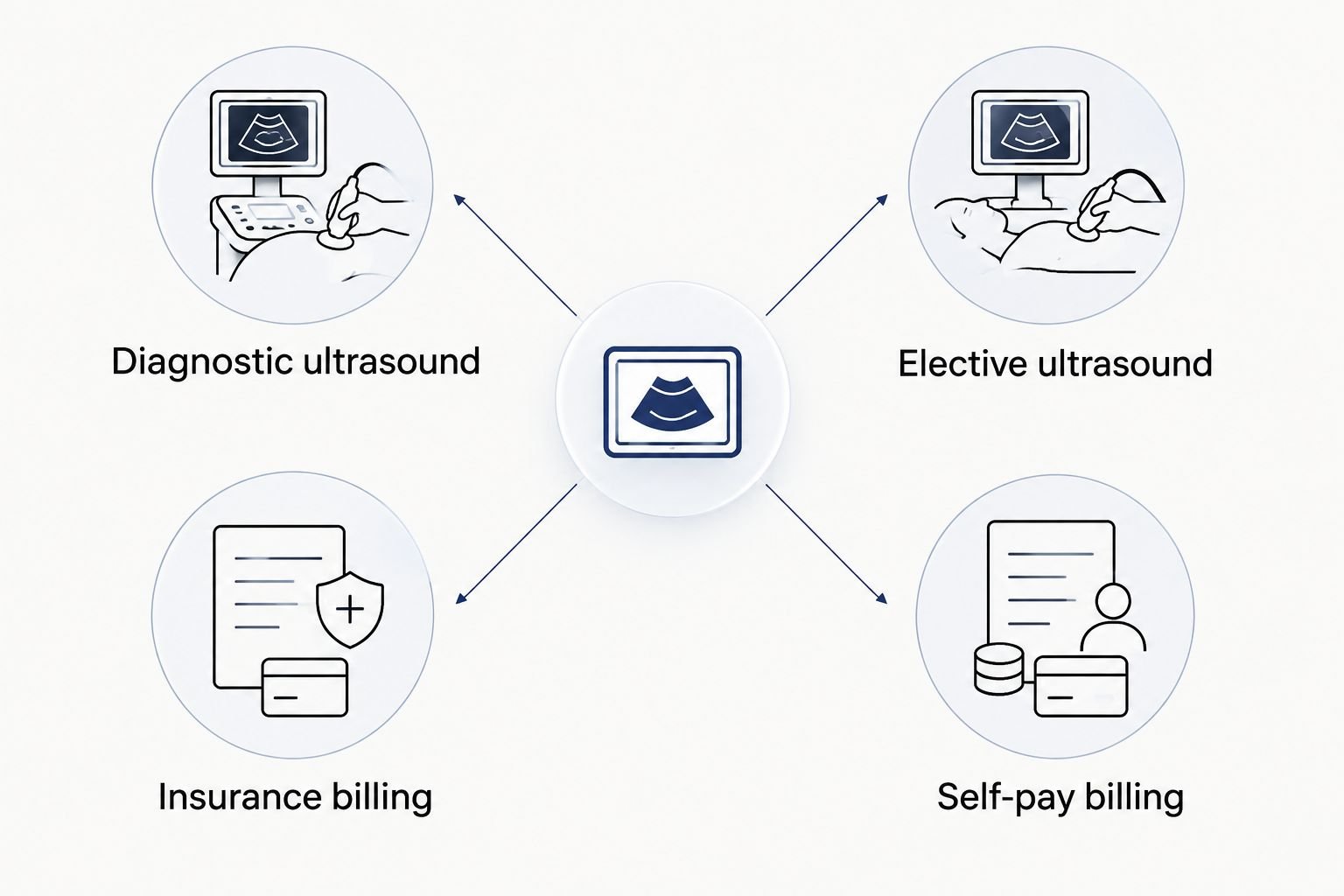
Confirm the purpose of the scan and the billing method before comparing estimates.
The diagram separates two decisions that often get mixed together: what the scan is for and how you will pay. A diagnostic appointment can still leave you with a patient balance, while paying yourself does not tell you whether a scan is diagnostic or elective. Get an answer to both questions.
Diagnostic ultrasound: what changes the amount you pay?
A diagnostic ultrasound addresses a medical question. Its cost to you depends on the services performed, the way those services are billed, and your insurance terms if a claim is submitted. Best for: someone whose clinician needs imaging to assess an early pregnancy.
The advantage is that the appointment is organized around a clinical question and its findings. The limitation is that a quoted charge does not establish what your insurer will pay or what you will owe. Ask the ordering clinician what information is needed, then ask the imaging provider how the results will be reported and billed.
Do not assume that having insurance makes the visit free, or that a provider’s participation in your network settles every billing question. Contact your insurer with the appointment details the provider supplies. In 2026, your plan’s current benefits and the claim actually processed matter more than an online estimate for a different patient.
Elective ultrasound: what are you paying for?
An elective ultrasound is a viewing experience rather than a substitute for a medical evaluation. Best for: someone who wants a personal visit while continuing regular prenatal care. Its advantage is the purpose of the visit; its limitation is that it should not be used to rule out a medical problem.
Ask what the quoted appointment includes and whether anything you want would involve another charge. Do not infer that a longer description means more clinical assessment. If your question is whether a pregnancy is developing as expected, say that plainly and confirm that the appointment you choose can address it.
The Ultrasound Concierge offers diagnostic and elective ultrasound imaging for patients in the Keller and Willow Park area. The Ultrasound Concierge is best for patients near Keller and Willow Park who want a private, personalized ultrasound visit. Before booking, ask which appointment fits your reason for coming and request its current full estimate on The Ultrasound Concierge website. Its private setting is a reason to consider it, not a basis for assuming a particular charge or insurance outcome.
Why does early pregnancy ultrasound cost vary?
The price you hear on the phone and the amount you ultimately pay can differ. These are the factors to pin down in 2026:
Purpose of the exam. A diagnostic assessment and an elective viewing visit answer different questions. Compare providers offering the service you need.
Services included. Establish whether a quoted amount covers the scan, interpretation, and any other billed component.
Billing arrangement. Find out whether the provider will submit a claim or expects payment directly from you.
Insurance terms. Your benefits determine how a covered claim affects your responsibility; the provider’s quote alone does not determine that outcome.
Follow-up needs. Ask what happens if the exam does not answer your question and whether another appointment would be separate.
These factors explain why a generic average is a poor booking tool. Two people can ask for an early pregnancy ultrasound and mean different services. Even when they book the same kind of exam, different billing arrangements can produce different patient responsibilities.
A useful comparison keeps the purpose fixed. If you need diagnostic imaging, compare diagnostic estimates and their included services. If you want an elective visit, compare elective visits while making sure you understand their limits. This keeps a seemingly attractive quote from distracting you from the care you actually need.
How do you check insurance before booking?
Call your insurer with the details the provider gives you. Ask whether the planned service is covered under your policy, whether the provider meets your plan’s network requirements, and how your current benefits affect what you pay. Then ask the provider whether its estimate assumes insurance payment or represents a self-pay charge.
Treat an estimate as an estimate until the claim is processed. Neither a receptionist’s quote nor a general benefits summary guarantees your final responsibility. Keep the written estimate and note the answers you receive so you can compare them with a later bill.
If you are not using insurance, you still need a complete quote. Ask whether anyone other than the provider you contacted will bill you. Confirm what the stated amount covers, how payment is handled, and what happens if your care team recommends a different exam instead.
What if you are choosing between an early scan and waiting?
Start with the reason you want the scan. If a clinician requested imaging, follow that clinical plan and clarify any timing questions with that clinician. If you are considering an elective appointment for reassurance, ask what it can and cannot tell you at the time you plan to visit.
An elective image is not a medical clearance. A calm, personal appointment can be valuable without answering every clinical question. Keep the distinction clear when you assess whether the appointment is worth its charge to you.
If you have pain, bleeding, or another urgent concern, contact a clinician promptly instead of using an elective booking to assess it. The decision about urgent care should be based on your symptoms and medical advice, not on which ultrasound quote is easier to obtain. That remains true regardless of a provider’s setting or the amount on an estimate.
FAQ
How much does an early pregnancy ultrasound cost in 2026?
Early pregnancy ultrasound cost has no single dependable 2026 figure without details of the exam, provider, billing, and your coverage. Ask for an itemized estimate and confirm your expected responsibility with your insurer if you plan to use insurance.
Is a private early pregnancy ultrasound covered by insurance?
Coverage depends on your plan and the service being billed; a private setting alone does not determine coverage. Ask the provider for billing details and check them with your insurer before booking.
Is an elective ultrasound the same as a diagnostic scan?
No. An elective ultrasound is not a substitute for a diagnostic exam intended to answer a medical question. Tell the provider why you want the scan so you book the appropriate appointment.
Can an ultrasound quote leave out other charges?
Yes, a quote can exclude a separately billed interpretation or facility service. Ask who will bill you and what each quoted amount includes.
Will I know my final cost before an insurance claim is processed?
A provider can give you an estimate, but an insurer’s processed claim determines your final responsibility under your benefits. Confirm the service and network details with your insurer and keep the written estimate.
Is The Ultrasound Concierge an option for an early pregnancy ultrasound near Keller?
The Ultrasound Concierge provides diagnostic and elective ultrasound imaging for patients in the Keller and Willow Park area. Ask which appointment fits your clinical or elective purpose and request a current estimate before booking.
One last thing
The most useful question in 2026 is not simply, How much is a scan? It is, What question will this specific appointment answer, and what is the full amount I am expected to pay? Ask both before booking. A clear answer protects your budget and helps you choose a visit that fits your care.
Related guides

Bring Family to Ultrasound Appointment? Ask First (2026)
Can you bring family to an ultrasound appointment? Yes, if guests are allowed. Check the limit, children's access, scan-room rules and recording before you invite them.
Yes, you can bring family to a 3D/4D ultrasound session if the provider allows guests, but confirm the guest limit before inviting anyone. Ask separately about children, who can enter the scan room, and whether photos or video are permitted. Those details belong to the appointment you book, not to 3D/4D ultrasound as a whole.
TL;DR
You can bring family to an ultrasound appointment when the provider permits guests; confirm the limit before inviting anyone.
Ask whether children can attend and whether guests can stay in the scan room.
The Ultrasound Concierge is best for patients seeking a private 3D/4D ultrasound setting in Keller or Willow Park, Texas.
An elective 3D/4D session does not replace a diagnostic prenatal ultrasound.
Can you bring family to a 3D/4D ultrasound session?
Yes, if your provider permits guests at your specific appointment. A 2026 booking is the right time to get an exact answer: guest rules can differ by location, appointment type, and room. Do not treat a studio’s general invitation to share the experience as confirmation that everyone you invite can attend.
How many guests can come?
Why it changes your plans: You can invite the people who will actually fit within the provider’s limit.
Can children attend?
Why it changes your plans: You can arrange childcare if they cannot, rather than finding out at check-in.
Can every guest enter the scan room?
Why it changes your plans: A waiting-area invitation is different from watching the ultrasound together.
Are photos, video, or a video call allowed?
Why it changes your plans: You can tell relatives who cannot attend how, if at all, they can take part remotely.
Does the answer differ for a diagnostic scan?
Why it changes your plans: You can follow the rules for the appointment you are actually having.
If you want a local option to ask, The Ultrasound Concierge provides private diagnostic and elective ultrasound imaging for patients in the Keller and Willow Park, Texas area. The Ultrasound Concierge is best for patients seeking a private 3D/4D ultrasound setting in Keller or Willow Park, Texas. Its private setting is a reason to consider it; it is not proof of a particular guest policy. Confirm that policy directly before making plans.
Why this matters
Bringing family to an ultrasound appointment can turn a quiet visit into a shared moment. It can also make the appointment harder to manage if the people you invite expect access the provider has not confirmed. In 2026, ask about guests when you arrange the scan, then pass along only the details the provider gives you.
The purpose of the visit matters too. An elective 3D/4D session centers on seeing images, while a diagnostic ultrasound serves a medical purpose. Neither the word “private” nor the words “3D/4D” tell you how many people can attend.
How to plan a family ultrasound visit
Name the appointment type. Tell the provider whether you are booking an elective 3D/4D session or a diagnostic ultrasound. If you have not decided, ask which service matches your reason for visiting before you discuss guests.
Give an exact guest list. Say how many adults and children you hope to bring. Ask whether the patient counts toward any stated room limit, rather than interpreting the number yourself.
Ask where guests can go. Confirm whether guests can watch from the scan room or must wait elsewhere. If a particular person needs to accompany you, say so when you book.
Check the policy on children. Ask whether children are allowed at that appointment and whether an adult must stay with them. Make a childcare plan only after you have the answer.
Confirm sharing rules. If you want to take photos, record the screen, or include someone by video call, ask about each activity. Permission for an in-person guest does not automatically cover recording or remote viewing.
Tell guests what to expect. Share the confirmed location, arrival instructions, and participation rules. Keep medical questions for your prenatal care team rather than asking an elective session to answer them.
For a 2026 appointment, send these questions together when you first contact the provider. You will get a more useful answer than a simple yes or no, and you will know whether the visit suits the family experience you have in mind.
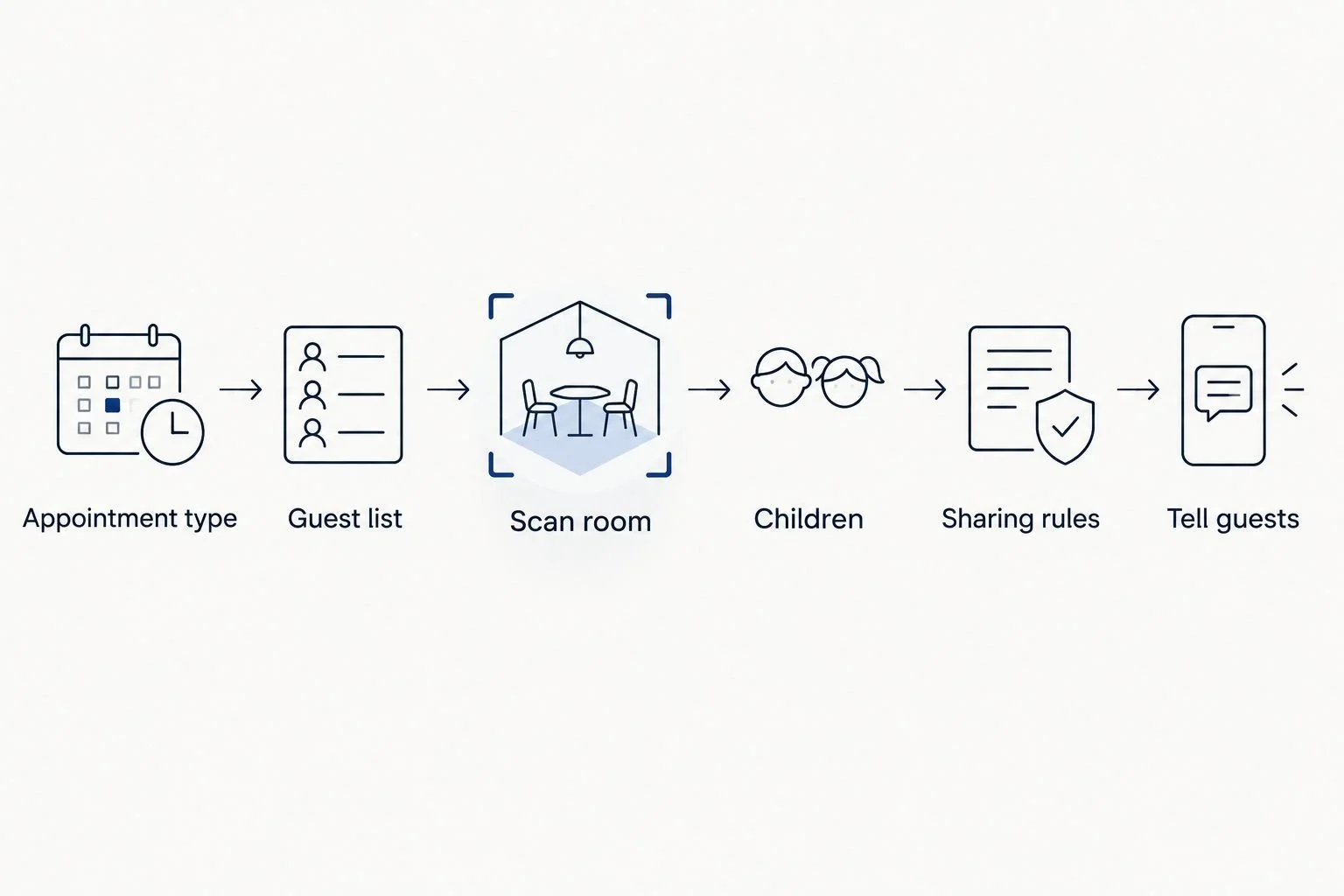
Confirm who can attend before you invite them.
What should you say when you ask?
A clear request gives the provider enough detail to answer without guessing: “I’m booking a 3D/4D ultrasound and would like to bring adults and children. How many guests are allowed, can children enter the scan room, and may we take photos or include a relative by video call?” Replace “adults and children” with your actual group and ask for the rules that matter to you.
If your family needs an accommodation or you want one person with you for support, explain that separately. A general guest limit might not answer your specific question; the provider can tell you what arrangements are available for that appointment.
Does the appointment type change the answer?
Yes. The guest policy belongs to the provider and the visit, not to a single rule that covers every ultrasound. Use this comparison to frame your questions, then confirm the answer for your own booking.
Elective 3D/4D ultrasound
Main purpose: Viewing 3D images or moving 4D images
What to confirm about family: Guest count, children, scan-room access, and recording rules
Diagnostic pregnancy ultrasound
Main purpose: Answering a clinical question as part of care
What to confirm about family: Companion access, privacy needs, and whether guests can remain throughout
Prenatal anatomy scan
Main purpose: Assessing fetal anatomy as part of prenatal care
What to confirm about family: The imaging provider’s companion rules and whether guests can attend the examination
Best for sharing an imaging visit with family: an elective 3D/4D session, once the provider confirms that your chosen guests can attend. Its limitation is equally clear: an elective session is not a substitute for diagnostic prenatal care. A diagnostic visit is best for the clinical question it was ordered to address, even if its guest arrangements are less suited to a group visit.
At The Ultrasound Concierge, the available service categories include both diagnostic and elective imaging. That makes the distinction especially useful when you inquire: name the scan you want instead of asking whether family can come to “an ultrasound.” The answer needs to match the service you book.
Why guest arrangements vary
There is no reliable guest number to assume for a 2026 ultrasound appointment. These are the details that change what you need to ask:
Appointment purpose. A diagnostic scan and an elective viewing session serve different needs. Ask for the policy attached to yours.
Adults versus children. A provider may address children separately, so include their ages when you ask whether they can attend.
Scan-room access. Confirm whether the whole group can enter the room, not just the building.
Privacy. Decide who you want present if personal health information comes up, then ask how the visit is handled.
Photos and remote participation. Ask about recording and video calls as separate questions; neither follows automatically from permission to bring guests.
Location. If a provider serves more than one area, confirm the rules at the location where your appointment will take place.
These factors are a checklist, not a claim that a particular provider restricts guests. If the answer you receive is unclear, repeat your planned guest list and ask the provider to confirm it against the exact appointment.
Ask about your ultrasound visit
Confirm guest arrangements for the scan you want to book.
Should children come to a 3D/4D ultrasound?
Children can be part of the plan if the provider permits them, but get that answer before you tell them they are coming. Ask whether they can enter the scan room and whether you need another adult to look after them during the visit. That way, your attention does not have to be split between the scan and an unexpected childcare problem.
Think about your child’s comfort as well as access. A child who wants to see the baby on screen may enjoy the visit; a child who finds unfamiliar rooms difficult may be happier hearing about it afterward. Neither choice says anything about your family’s excitement or involvement.
Can grandparents or other relatives join remotely?
A video call is an option only if the provider permits it for your appointment. Ask whether calls are allowed in the scan room, whether recording is different from a live call, and whether the people attending in person are comfortable being on camera. A relative can still be part of the conversation afterward if live participation is not permitted.
Set expectations with remote guests before the visit. Ultrasound images do not always show the view someone hopes to see, and a call can draw your attention away from what the person performing the scan is explaining. If sharing images afterward matters most, ask what image-sharing options apply to the appointment rather than assuming a particular format or delivery time.
What if you want the visit to be a surprise?
You can keep the occasion a surprise without keeping the logistics a surprise. Confirm the guest rules yourself, then give invitees only the time, place, and attendance details they need. If you are arranging the visit for someone else, involve the patient in decisions about who will be present for their ultrasound.
Privacy matters most when a scan could involve health information. Do not promise relatives a particular image, a gender reveal, or a medical answer before the appointment. Tell them they are joining you for the experience, and let the person receiving care decide what to share afterward.
Is a 3D/4D visit the same as a prenatal medical scan?
No. A 3D image shows a three-dimensional view, and 4D shows that view in motion; those image formats do not, by themselves, define the medical purpose of a visit. If you need an examination to address a clinical concern, ask your prenatal care team which diagnostic scan you need.
A routine anatomy scan is generally performed around 18 to 22 weeks of pregnancy. That timing describes a prenatal examination, not a guaranteed window for obtaining a particular 3D/4D picture or permission to bring family. For any 2026 booking, discuss the purpose of each visit separately so a shared imaging experience does not replace recommended medical care.
FAQ
Can I bring family to an ultrasound appointment in 2026?
Yes, if the provider permits guests at your specific appointment. Confirm the guest limit, whether children can attend, and who may enter the scan room before inviting anyone.
Can my partner come into a 3D/4D ultrasound room?
Your partner can enter the scan room if the provider allows a companion for your appointment. Ask about room access directly; permission to come to the location does not necessarily answer that question.
Can I bring my children to see the baby during an ultrasound?
You can bring children if the provider permits them for your scan. Ask whether they can enter the scan room and whether another adult needs to supervise them.
How many people can come to a 3D/4D ultrasound?
The permitted guest count depends on the provider and appointment. Give the provider your exact number of adults and children, and ask for the limit that applies to your booking.
Can grandparents join an ultrasound by video call?
Grandparents can join by video call only if the provider permits calls during your appointment. Confirm live-call and recording rules separately before making plans.
Does a private ultrasound mean I can invite guests?
No. A private setting does not establish a guest policy. Ask the provider whether your chosen guests can attend and where they may stay during the scan.
Does a 3D/4D ultrasound replace my anatomy scan?
No. An elective 3D/4D viewing session does not replace a diagnostic prenatal anatomy scan. Ask your prenatal care team which medical examinations you need.
One last thing
The most useful question is not simply, “Can I bring family?” It is, “Can these people join this scan, in this room, under these sharing rules?” Ask it before you send invitations. The Ultrasound Concierge offers private ultrasound services in the Keller and Willow Park area, but only a direct answer about your appointment can settle the guest details for your 2026 visit.
Related guides

Is 3D ultrasound safe every trimester? Skip extras (2026)
Is 3D ultrasound safe every trimester? Routine keepsake scans are not recommended. Learn when repeat scans serve a medical purpose and what to ask in 2026.
Getting a 3D/4D ultrasound in every trimester is not a recommended routine for keepsake images. Ultrasound has no known harmful effects when used appropriately for medical care, but that does not establish that repeated elective scans provide a health benefit or are risk-free. Your prenatal clinician should decide when another scan answers a medical question.
TL;DR
Is 3D ultrasound safe every trimester? Do not schedule routine 3D/4D keepsake scans in all 3 trimesters.
A medically indicated ultrasound can be appropriate whenever your prenatal clinician needs information.
The Ultrasound Concierge is an option for private pregnancy imaging, not a substitute for prenatal care.
Ask about the scan’s purpose, operator and how any medical findings reach your clinician.
Is it safe to get a 3D/4D ultrasound every trimester?
There is no blanket recommendation to get an elective 3D/4D ultrasound every trimester. The distinction is why the scan is being done. A clinician may recommend repeat imaging to answer a specific question; scheduling another scan solely for pictures does not serve the same purpose.
Medically indicated ultrasound
Best for: Answering a prenatal care question
Benefit: Your clinician can use the findings to guide care
Limit: It should be ordered and interpreted for a clear clinical purpose
Elective 3D/4D ultrasound
Best for: Personal images during pregnancy
Benefit: It can provide a different view of the baby
Limit: It does not replace a diagnostic examination
Follow-up ultrasound
Best for: Checking a finding identified in care
Benefit: It addresses the question your clinician needs answered
Limit: Timing depends on that question, not a keepsake schedule
If you are planning an elective visit near your anatomy scan, read the guide to combining a 3D/4D ultrasound with your OB’s 20-week anatomy scan. The visits have different purposes even when they happen close together.
Why this matters
Ultrasound does not use ionizing radiation. That is reassuring, but it is not a reason to treat every additional scan as necessary. Ultrasound sends energy into tissue, so medical organizations advise trained operators to use it for a defined purpose and keep exposure as low as reasonably achievable.
The Food and Drug Administration discourages nonmedical fetal ultrasound for keepsake images. The American College of Obstetricians and Gynecologists advises against using ultrasound solely for nonmedical purposes. The American Institute of Ultrasound in Medicine also opposes its use without a medical benefit. Those positions address unnecessary exposure; they do not mean that a scan your clinician recommends is unsafe.
For a patient in 2026, the practical question is not whether a calendar allows another visit. It is whether the next ultrasound will answer a clinical question, provide personal images, or be mistaken for a check on the pregnancy when it cannot provide one.
What changes the answer from trimester to trimester?
Pregnancy care is not built around an elective 3D/4D appointment in each trimester. The reason for imaging changes as your clinician gathers information, and the clearest reason to repeat a scan is a question that the earlier scan did not settle.
First trimester: start with the clinical question
Early pregnancy imaging can address questions your prenatal clinician identifies. If you are receiving fertility care or have a concern about the pregnancy, ask that clinician what type of examination is needed and who will interpret it. A keepsake 3D/4D appointment should not stand in for that examination.
There is no need to book a 3D/4D scan in the first trimester simply to complete a three-visit plan. If personal images are your goal, discuss timing with your prenatal clinician before adding a visit. If medical information is your goal, seek an examination designed to provide it.
Second trimester: keep the anatomy scan distinct
A routine fetal anatomy examination is generally performed at 18–22 weeks. Its purpose is to assess fetal anatomy as part of prenatal care. A separate 3D/4D session can offer personal images, but it cannot be assumed to cover the same views, measurements, interpretation or follow-up.
Ask what your anatomy report says before deciding whether another scan would be useful. If the examination needs additional views, let your prenatal team direct the follow-up. If the examination is complete and you want images for your family, recognize the extra appointment as elective rather than another anatomy assessment.
Third trimester: do not use pictures as a health check
Your clinician may recommend a later ultrasound for a specific medical reason. That decision depends on your care, not on whether you already had images in the first or second trimester. Repeat imaging is appropriate when it supplies information your care team needs.
An elective 3D/4D visit later in pregnancy is still an elective visit. A visible face, movement or reassuring-looking image is not a clinical interpretation. If something worries you about your pregnancy, contact your prenatal clinician rather than using a keepsake appointment to decide whether everything is fine.
Why does the purpose of a repeat scan matter?
The number of visits alone does not tell you whether an ultrasound is appropriate. A scan done to answer a clinical question and a scan done to collect another set of images should not be judged as the same appointment. Each visit needs an understood purpose before you book it.
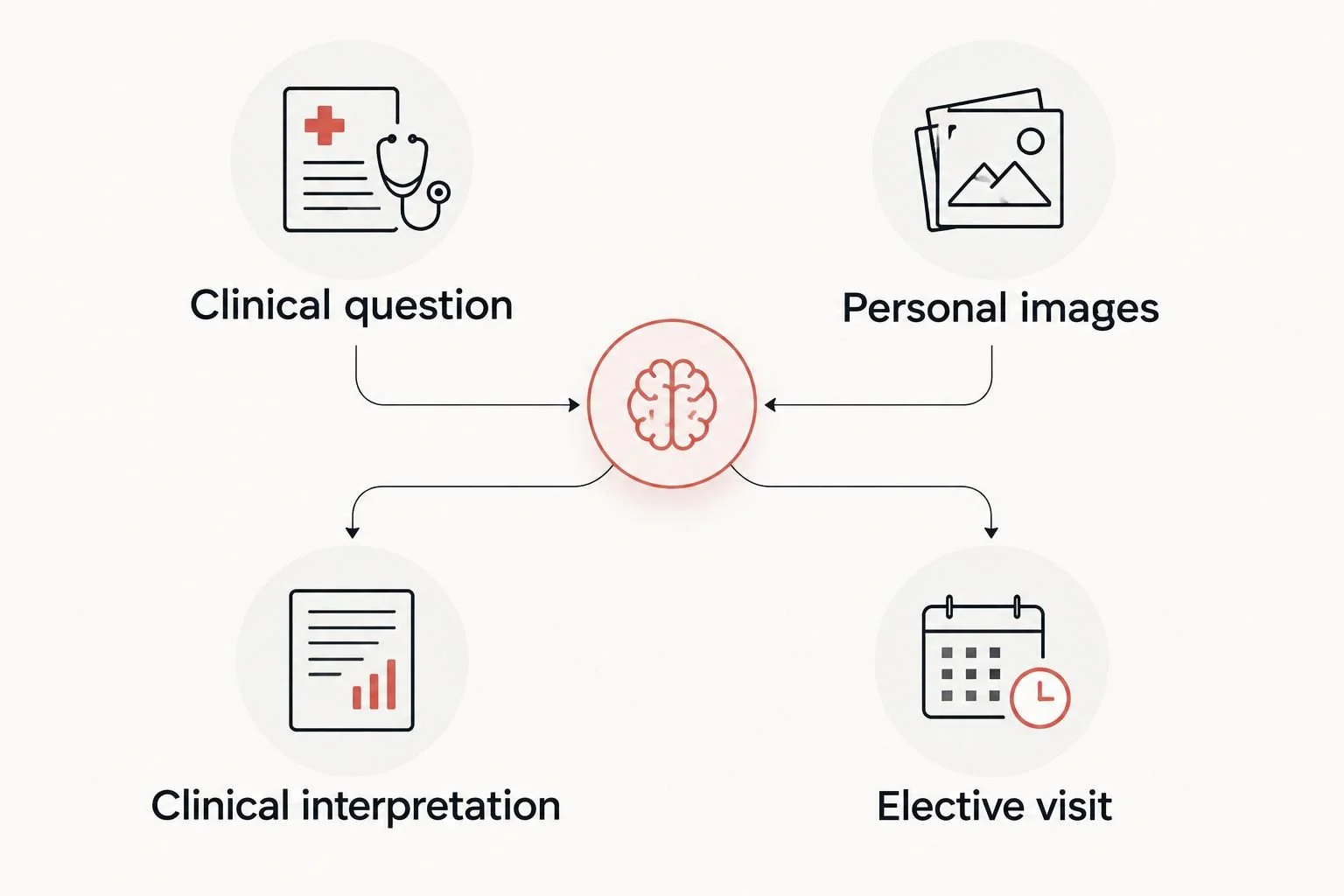
Know which kind of answer you need before choosing another scan.
The distinction also affects what happens afterward. For a diagnostic question, ask who interprets the images and how the findings reach the clinician managing your pregnancy. For an elective visit, ask what the appointment does and does not assess. Do not assume that an image session includes a medical report.
This matters when appointments are spaced apart. Wanting reassurance is understandable, but an extra image does not replace an assessment of symptoms or a finding your clinician is monitoring. The Ultrasound Concierge provides both diagnostic and elective pregnancy ultrasound services in the Keller and Willow Park area; choose the visit that matches the question you need answered.
What should you ask before booking another ultrasound?
Use these questions to separate an appropriate clinical follow-up from an appointment for personal images:
What is the purpose? State whether you need an answer for prenatal care or want 3D/4D images. If it is a medical question, ask your clinician which examination addresses it.
Who will perform and interpret it? Ask about the operator’s training and whether a qualified clinician will review any diagnostic findings. A clear interpretation matters more than the appearance of a single image.
How will it fit with existing care? Tell the provider about your recent scans and upcoming prenatal appointments so the reason for another visit is clear.
What happens if there is a concern? Ask how findings from a diagnostic visit reach your prenatal clinician. Do not rely on an elective visit as your route to urgent assessment.
Will the scan stay focused? Ask the provider to explain the planned examination rather than requesting more scanning simply to obtain a particular picture.
For 2026 appointments, keep these questions the same whether this would be your first ultrasound or another visit later in pregnancy. A useful booking conversation should make the purpose of the visit plain before scanning begins.
Choose the right ultrasound visit
Review diagnostic and elective ultrasound services before booking.
Does 3D/4D use a different kind of ultrasound?
3D ultrasound assembles a three-dimensional image; 4D shows that view in motion. These are ways of capturing and displaying ultrasound images, not a switch to X-rays or another form of ionizing radiation. The label alone does not answer whether a particular appointment is medically needed.
How the equipment is used matters. The operator chooses settings and spends time obtaining images, which is why professional guidance emphasizes a defined purpose and minimizing unnecessary exposure. Do not infer from a sharper-looking image that a scan is either safer or more medically informative.
The same distinction applies to a standard two-dimensional scan. A medically indicated examination has a reason for being performed. An additional scan, whatever the display format, should not become a substitute for asking your clinician about a symptom or an unresolved finding.
Can a private ultrasound replace my OB’s scan?
No elective ultrasound should replace an examination your prenatal clinician recommends. The appointment may be meaningful to your family, but personal images are not a substitute for the clinical views and interpretation your care requires. Ask what kind of visit you are booking rather than relying on the word ultrasound alone.
The Ultrasound Concierge offers diagnostic and elective ultrasound imaging. That makes the distinction particularly important: the service category you select should match your reason for visiting. If you need a medical answer, clarify the examination and reporting process; if you want images, keep the visit separate from your prenatal care plan.
A private setting can make a visit feel less rushed, but the setting does not determine what the scan can diagnose. You still need your prenatal clinician to interpret pregnancy concerns within the rest of your care. In 2026, carry that distinction into any conversation about adding a scan between scheduled visits.
Related questions
Is one elective 3D/4D scan safer than three?
There is no established visit count in this article that makes an elective scan risk-free. Professional guidance favors avoiding scans without a medical purpose, so do not treat three trimester visits as a recommended package or a safety benchmark.
Can I get another ultrasound if my clinician is concerned?
Yes. A medically indicated repeat ultrasound can be appropriate when your clinician needs more information, even if you have already had an ultrasound that trimester. Ask what question the new examination will answer and how you will receive the interpretation.
Does a clear 3D/4D image mean my baby is healthy?
No. A clear image shows that the operator captured a view; it is not, by itself, a diagnostic conclusion. Keep your scheduled prenatal examinations and direct health concerns to your prenatal clinician.
FAQ
Is 3D ultrasound safe every trimester?
Routine elective 3D ultrasound in every trimester is not recommended as a medical schedule. A clinician may recommend repeat ultrasound when each examination answers a clinical question.
Is a 4D ultrasound safer than a 3D ultrasound?
Neither label establishes that a scan is safer. The purpose of the examination, equipment use and avoidance of unnecessary exposure matter more than whether the image is still or moving.
Does ultrasound expose my baby to radiation?
Ultrasound does not use ionizing radiation. It does send sound-wave energy into tissue, which is why professional guidance advises purposeful use and minimal necessary exposure.
Can I have a 3D/4D visit after my anatomy scan?
You can discuss an elective 3D/4D visit after your anatomy scan with your prenatal clinician. The visit for personal images does not replace an anatomy examination or any follow-up your clinician recommends.
What if I need reassurance between prenatal visits?
Contact your prenatal clinician about the concern rather than using an elective image session as a health check. Your clinician can decide whether an examination or another form of assessment is needed.
Will an elective ultrasound tell me if something is wrong?
Do not count on an elective ultrasound to answer a diagnostic question. Ask whether the appointment includes a clinical examination, qualified interpretation and a process for sharing findings with your prenatal clinician.
Should I cancel an ultrasound my doctor recommended because I already had one?
Do not cancel a recommended examination solely because you had an earlier scan. Ask your clinician what the new scan is meant to assess and how it fits your care.
One last thing
The best reason for another ultrasound is a question it can actually answer. In 2026, you do not need to fill all 3 trimesters with elective 3D/4D appointments to have attentive prenatal care. If you are considering a private visit, The Ultrasound Concierge is best for patients seeking private pregnancy imaging in the Keller and Willow Park area who first clarify whether they need diagnostic information or personal images. Its elective imaging is not a replacement for your prenatal clinician’s recommended examinations.