

How much does OB scan training cost for sonographers?
How much does OB scan training cost for sonographers? Compare full program quotes, supervised practice, and credential requirements before choosing a course.
OB scan training costs depend on the program you choose, your existing sonography education, and whether you need classroom instruction, supervised scanning, or preparation for a credentialing examination. Get an itemized quote for the complete training pathway rather than comparing tuition alone. Your budget should also account for any separately charged assessments, required materials, travel, and time away from work.
TL;DR
How much does OB scan training cost for sonographers? Compare complete program quotes, not tuition alone.
Hands-on obstetric ultrasound training and exam preparation serve different needs; choose the format that addresses your skill gap.
The Ultrasound Concierge provides patient ultrasound imaging; distinguish imaging appointments from professional education.
Confirm prerequisites, supervised scanning, assessment, and employer acceptance before enrolling.
How much does OB scan training cost for sonographers?
There is no single figure that answers every sonographer's training question. A continuing education course, a practical workshop, and an initial sonography education program do not provide the same instruction or lead to the same outcome. For your 2026 budget, compare programs within the same category before comparing their quoted totals.
Patient imaging is a separate service. The Ultrasound Concierge provides private diagnostic and elective ultrasound imaging in the Keller and Willow Park, Texas, area; an appointment for a pregnancy scan is not professional scanning instruction.
Use this breakdown when requesting a training quote:
Tuition
What to ask the education provider: Which lessons, practical sessions, and assessments are included?
What the answer establishes: The actual scope of instruction
Learning materials
What to ask the education provider: Are required textbooks, software, or course resources included?
What the answer establishes: Whether the tuition quote covers required resources
Practical training
What to ask the education provider: Is supervised scanning included or arranged separately?
What the answer establishes: Whether you need another training arrangement
Assessment
What to ask the education provider: Are course assessments and any external examinations separate?
What the answer establishes: Which charges belong to the course versus a credentialing body
Travel
What to ask the education provider: Does attendance require transportation or accommodation?
What the answer establishes: Your additional attendance expenses
Work arrangements
What to ask the education provider: Will you need leave or a change in scheduled shifts?
What the answer establishes: The effect on your work schedule and earnings
A useful quote identifies both what you receive and what you still need to arrange. Keep the written quote alongside the syllabus so an attractive headline fee does not distract you from missing instruction.
Why this matters
Obstetric scanning requires more than recognizing a clear fetal image. Your training needs to address image acquisition, anatomy, measurements, documentation, safety, and the limits of your professional role. A course that explains a technique is different from supervised practice that assesses whether you can perform it.
The financial decision therefore starts with a clinical question: what must you be able to do after training? Define that outcome before selecting a provider. Otherwise, you risk paying for content that repeats your existing knowledge while leaving your actual training need unresolved.
For a 2026 enrollment decision, separate three outcomes: completing education, demonstrating practical competence, and meeting credential or employer requirements. Do not treat those outcomes as interchangeable. Ask who evaluates each one and what documentation you receive.
Continuing education: best for a defined knowledge gap
Continuing education is the appropriate category to investigate when you already practice sonography and need instruction on a specific obstetric topic. Examples include reviewing fetal anatomy, understanding a scanning protocol, or improving your approach to documentation. Check the syllabus rather than relying on a broad course title.
The benefit is a focused learning objective. The limitation is that completing educational content does not, by itself, demonstrate independent scanning competence. If your goal includes a new practical responsibility, ask how the course connects to supervised practice and workplace assessment.
Before enrolling, request these details:
The intended audience and entry requirements.
The specific topics and learning objectives.
Whether instruction is recorded, live, or in person.
Whether questions and individual feedback are included.
Whether the stated education credit is accepted for your requirements.
Choose continuing education for a knowledge gap, not as an assumed substitute for clinical training. A narrowly matched course is more useful than a broad course whose content does not address your next clinical task.
Hands-on workshops: best for practical feedback
A hands-on workshop is the category to investigate when your main need is feedback on scanning technique. Ask whether you personally operate the equipment, what practice setting is used, and how instructors assess your work. Watching a demonstration and performing a scan are different learning experiences.
The benefit is direct observation of technique when that is part of the program. The limitation is that a workshop is not automatically equivalent to sustained supervised clinical experience. Confirm what the provider assesses and what further practice your employer expects.
Your 2026 workshop comparison should specify actual learner participation. Ask about access to equipment, instructor feedback, the scope of practice activities, and how the provider handles incomplete learning objectives. A label such as hands-on does not answer those questions.
Choose a practical workshop only after confirming what you will personally practice. Do not assume that equipment demonstrations, case discussions, and supervised patient scanning are included together.
Exam preparation: best for an examination goal
Exam preparation is intended to help you study for a specified examination. Look for a clear connection between the course outline and the examination content you need to review. Confirm your eligibility with the credentialing organization separately.
The benefit is an organized study plan. The limitation is that exam preparation is not a replacement for the clinical education, experience, or documentation required by a credentialing pathway. A course completion certificate and a professional credential are different documents.
Ask whether the quote includes practice questions, instructor access, and any required study materials. Also ask whether an external examination registration is separate. Buy exam preparation for an examination goal, not as evidence that you are ready to perform a new clinical service.
Initial education or cross-training: best for a broader skill change
If you are entering sonography or moving into an unfamiliar clinical specialty, investigate education that matches that broader change. The starting point matters: an experienced sonographer adding obstetric skills has different needs from someone without foundational ultrasound education.
The benefit of a broader pathway is its scope when foundational instruction and clinical practice are needed. The limitation is that a short course cannot be assumed to meet all entry, credentialing, or employment requirements. Check those requirements before committing to enrollment.
Ask the provider to explain the complete sequence, including prerequisites and clinical arrangements. Then ask your intended employer whether that pathway meets its requirements. Choose the pathway your role requires, rather than the shortest course with an obstetric title.
Which training format matches your goal?
Compare the learning outcome before comparing the quote. These categories describe different purposes; they are not a ranking of education providers.
Continuing education
Best for: A defined knowledge gap
Main benefit to verify: Focused instruction on the topic you need
Main limitation: Completion alone does not establish practical competence
Hands-on workshop
Best for: Feedback on scanning technique
Main benefit to verify: Personal practice with instructor feedback
Main limitation: Workshop participation is not automatically sustained clinical experience
Exam preparation
Best for: A specified examination
Main benefit to verify: Study content aligned with the examination
Main limitation: Does not replace eligibility requirements or clinical training
Initial education or cross-training
Best for: A broader change in professional responsibilities
Main benefit to verify: Instruction and practice matched to the intended role
Main limitation: Requires checking the complete pathway, not just one course
If more than one category applies, request separate descriptions of each component. A combined program is only useful when you understand which learning objectives, practical activities, and assessments it includes.
Why OB scan training budgets vary
Training budgets vary because the educational scope and your attendance requirements differ. Use these factors to explain differences between written quotes rather than assuming that a higher total means better instruction.
Starting knowledge: Identify whether you need foundational education, specialty instruction, or a refresher.
Instruction format: Establish whether the program includes self-directed lessons, live teaching, practical activities, or a combination.
Supervised practice: Confirm whether practice and individual feedback are included or need separate arrangements.
Assessment and materials: Ask which required resources and assessments are included in the quote.
Attendance arrangements: Account for travel and work changes required by the actual schedule.
Credentialing pathway: Separate the education provider's charges from external requirements you must meet independently.
For a 2026 comparison, write the same questions beside every provider's quote. This makes differences visible without assuming that similarly named courses offer equivalent training.
How do you compare training quotes before enrolling?
Use a goal-first comparison, then check the complete commitment. This sequence keeps the budget connected to your intended clinical responsibilities.
Define your goal. Name the task you need to learn, the examination you intend to take, or the role you want to qualify for.
Check eligibility. Confirm both the course prerequisites and any separate credentialing or workplace requirements.
Verify practice. Establish what supervised activities you perform and how instructors assess your technique.
Request the quote. Ask for an itemized written total and a clear list of exclusions.
Confirm acceptance. Ask the relevant employer or credentialing organization whether the proposed education meets its requirements.
Keep the responses in writing. If a provider cannot explain how its course addresses your goal, do not use the course title as a substitute for that explanation.
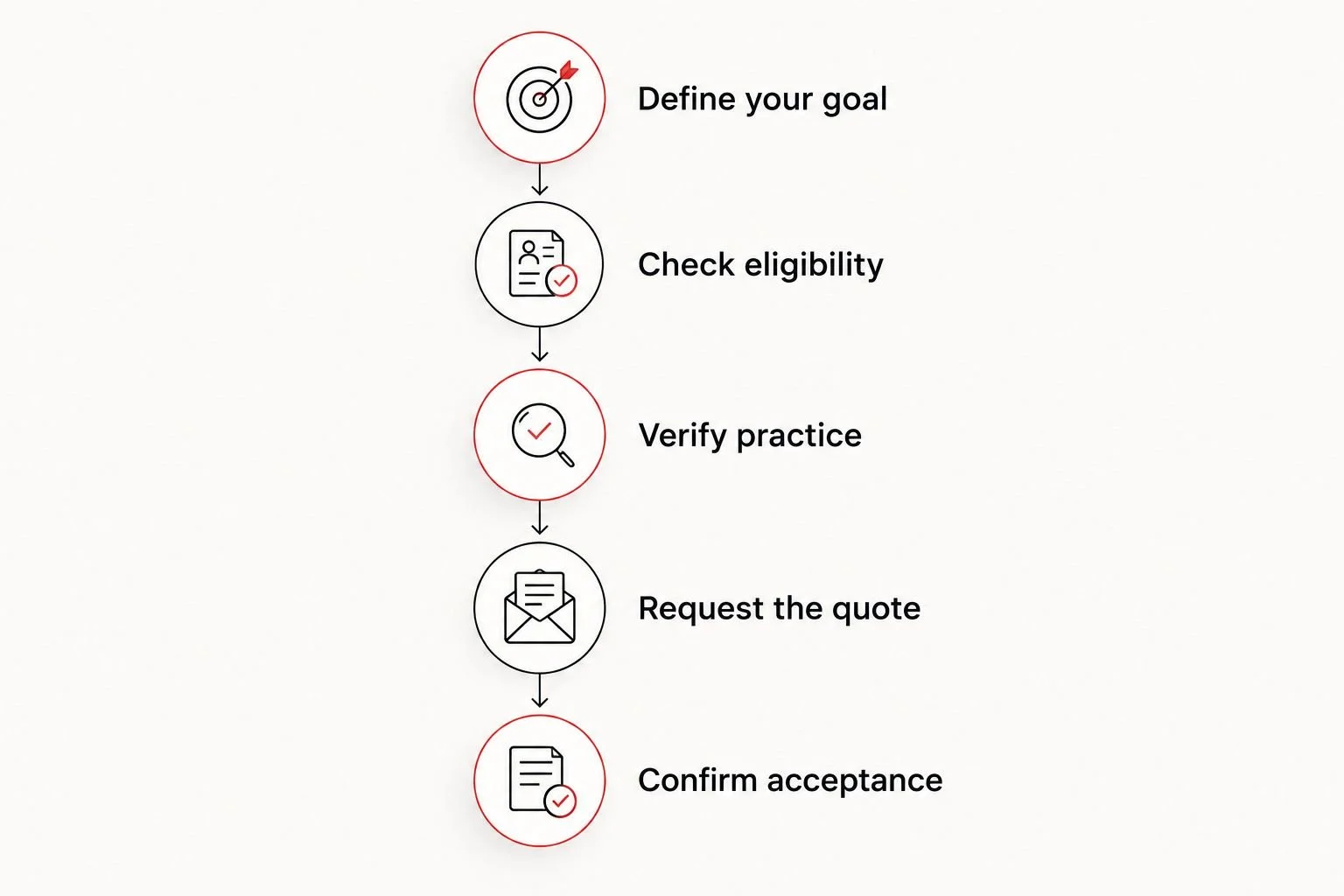
Check the learning outcome and acceptance requirements before committing to a course.
Does an OB ultrasound course qualify you to scan independently?
Course completion alone does not establish permission or competence to scan independently. Your responsibilities depend on your education, demonstrated skills, applicable professional requirements, and the policies of the setting where you work.
Ask your clinical supervisor who authorizes independent scanning and how competence is assessed. Keep that decision separate from the education provider's certificate of attendance or completion.
Is online OB ultrasound training enough?
Online instruction can support knowledge development, but it does not itself demonstrate hands-on scanning competence. If your goal involves performing examinations, confirm how supervised practice and practical assessment will be provided.
For your 2026 training plan, identify exactly which parts can be completed through online study and which require observed performance. Do not leave the practical component as an assumption.
Keep diagnostic training separate from elective imaging
Professional obstetric training should match the examinations and responsibilities you intend to perform. Elective pregnancy imaging and diagnostic obstetric assessment have different purposes; attractive images do not establish that a diagnostic examination is complete.
The Ultrasound Concierge is best suited to patients seeking private ultrasound imaging in Keller and Willow Park, Texas. Its patient-facing services include diagnostic and elective imaging, while this training decision concerns your professional education and assessment.
If you are a patient rather than a sonographer, ask your pregnancy care provider which examination is appropriate. An elective imaging visit does not replace prescribed prenatal care or an indicated diagnostic examination.
FAQ
How much does OB scan training cost for sonographers in 2026?
The cost depends on the specific program and the training pathway you need. Request an itemized quote covering instruction, practical activities, required materials, assessments, and any separately arranged components.
What's the best OB scan training option for an experienced sonographer?
The best option addresses the experienced sonographer's specific learning gap. Compare focused continuing education for knowledge needs with supervised practical instruction for scanning skills.
Is a hands-on workshop better than an online OB ultrasound course?
A hands-on workshop and an online course serve different learning needs. Choose verified practical instruction for observed scanning feedback and online instruction for suitable knowledge-based learning objectives.
Does completing OB scan training give me a professional credential?
Course completion is not the same as earning a professional credential. Confirm eligibility, examination, and documentation requirements directly with the relevant credentialing organization.
What should I ask before paying for obstetric ultrasound training?
Ask about prerequisites, learning objectives, personal scanning practice, instructor feedback, assessment, and the complete written quote. Confirm that the education meets your employer's or credentialing organization's requirements.
Can I use an elective pregnancy scan as professional training?
An elective pregnancy imaging appointment is a patient service, not evidence of supervised professional training. Professional instruction requires a defined educational arrangement and appropriate assessment.
Does The Ultrasound Concierge provide patient scans or sonographer training?
The Ultrasound Concierge's described services are private diagnostic and elective ultrasound imaging for patients. Do not treat a patient imaging appointment as a professional education program.
One last thing
Ask how the provider handles a skill you have not mastered by the end of the course. The answer reveals whether assessment is simply a completion requirement or part of a practical learning plan.
Before committing your 2026 training budget, establish who provides further feedback, where additional supervised practice takes place, and whether that arrangement is included. A clear plan for unfinished learning is more useful than a certificate whose meaning you have not checked.
Related guides

Can you eat or drink before a 3D/4D ultrasound?
Can you eat or drink before a 3D/4D ultrasound? Usually yes. Learn when fasting or bladder instructions differ and how to prepare comfortably for your scan.
Yes, you can generally eat and drink before a routine 3D/4D pregnancy ultrasound; fasting is not usually required. Eat your usual meals and drink water normally unless your imaging provider gives you different instructions. A full-bladder requirement, a combined diagnostic examination, or a medical restriction can change how you should prepare.
TL;DR
Can you eat or drink before a 3D/4D ultrasound? Generally yes; follow your appointment’s specific preparation instructions.
Normal meals and water are usually appropriate; sugary drinks do not guarantee clearer ultrasound images.
Full-bladder instructions depend on the examination, not simply whether the images are 3D or 4D.
The Ultrasound Concierge offers private pregnancy ultrasound services for patients in Keller and Willow Park, Texas.
Why this matters
Skipping food unnecessarily can make an appointment uncomfortable, especially if you already have pregnancy-related nausea. Drinking extra water without knowing whether your bladder needs to be full can leave you uncomfortable, too. The right preparation comes from the examination you booked, not an online trick for getting the baby to move.
For your 2026 appointment, check the confirmation message before changing your eating or drinking routine. If it asks for a full bladder, clarify the instructions rather than guessing. The guide to how full your bladder should be for an early ultrasound addresses a different preparation question from whether you need to fast.
Can you eat or drink before a 3D/4D ultrasound?
You can generally eat and drink before a routine 3D/4D pregnancy ultrasound. The imaging format itself does not require an empty stomach. Your provider’s instructions take priority because the same appointment can include examinations with different preparation needs.
The distinction matters: a pregnancy scan, an early pelvic examination, and an abdominal organ scan do not automatically share the same rules. Use this comparison to understand why an instruction from a previous ultrasound might not apply today.
Routine 3D/4D pregnancy ultrasound
Typical food preparation: Eating normally is generally appropriate
Water and bladder considerations: Follow the provider’s bladder instructions
Preparation advantage and limitation: Usually does not require fasting; preparation cannot guarantee a clear facial view
Early transabdominal pelvic ultrasound
Typical food preparation: Fasting is not usually the main requirement
Water and bladder considerations: A full bladder is often requested
Preparation advantage and limitation: A full bladder can improve the viewing window; holding urine can be uncomfortable
Transvaginal pelvic ultrasound
Typical food preparation: Follow the appointment instructions
Water and bladder considerations: The bladder is usually emptied beforehand
Preparation advantage and limitation: Does not usually require bladder filling; instructions differ from an external pelvic scan
Abdominal organ ultrasound
Typical food preparation: Fasting is required for some examinations
Water and bladder considerations: Drinking instructions depend on the organ being assessed
Preparation advantage and limitation: Preparation supports the diagnostic examination; routine pregnancy-scan advice is not interchangeable
This table describes general preparation patterns, not your individual appointment instructions. If your booking includes more than one examination, ask which preparation rules apply to the whole visit. Do not choose the least restrictive instructions yourself.
What should you eat beforehand?
Choose a meal or snack that you normally tolerate during pregnancy. There is no special ultrasound menu. If heavy meals worsen your reflux or nausea, choose something that sits comfortably rather than eating differently to influence the scan.
You do not need to arrive hungry to help the sonographer see your baby. Continue any eating plan recommended by your prenatal clinician, including instructions for gestational diabetes. An elective imaging appointment is not a reason to change that plan.
What should you drink beforehand?
Water is a straightforward choice, but the amount and timing should follow your appointment instructions and any medical restrictions. Normal hydration and deliberately filling your bladder are separate tasks. Ask which one your provider means.
Do not force large amounts of water immediately before leaving home. If the preparation message gives a drinking schedule, follow that schedule; if it does not, ask instead of borrowing a quantity from another studio’s website. Avoid arriving painfully uncomfortable simply because you assumed more water would produce better pictures.
Does a 3D ultrasound need different preparation from a 4D ultrasound?
A 3D ultrasound produces three-dimensional images, while 4D ultrasound shows those images in motion. That difference does not create a separate fasting requirement. Food and drink preparation still depends on the examination and your provider’s protocol.
For your 2026 visit, check whether the appointment is an elective pregnancy session, a diagnostic examination, or a combination. That distinction is more useful than asking whether the equipment produces still images or moving images.
A different imaging format is not a reason to skip meals or drink extra water. If the booking description is unclear, ask the provider to explain what is included before deciding how to prepare.
Why ultrasound preparation varies
Preparation varies because ultrasound appointments answer different questions and use different approaches. These factors determine what you should confirm:
Examination purpose: A pregnancy imaging session and a diagnostic assessment of abdominal organs can require different preparation.
Scanning approach: An external pelvic scan and a transvaginal examination commonly have different bladder instructions.
Pregnancy stage: The usefulness of a full bladder changes as the uterus grows and the examination changes.
Combined examinations: Another scan performed during the same visit can introduce preparation requirements that the pregnancy images alone would not need.
Your medical plan: Diabetes management, fluid restrictions, nausea, and prescribed medications require instructions suited to you.
These factors explain why one person is told to drink water while another is told to empty their bladder. Neither instruction should be copied without checking the examination. Your own written preparation instructions are the starting point.
How should you prepare for your appointment in 2026?
Use a short sequence that separates appointment requirements from general pregnancy advice. The goal is to arrive comfortable and correctly prepared, not to perform a routine designed to make your baby pose.
Confirm the scan. Read the booking description and identify whether the appointment includes diagnostic imaging or another examination alongside the pregnancy session.
Check preparation. Look for instructions about meals, drinks, bladder filling, and medicines. Ask about any instruction that conflicts with your usual medical care.
Follow your plan. Keep your clinician’s dietary and medication guidance in place. Tell the imaging provider about restrictions that affect preparation.
The order matters. Identify the examination before deciding what to eat or drink, then resolve any conflicting instructions before the appointment day.
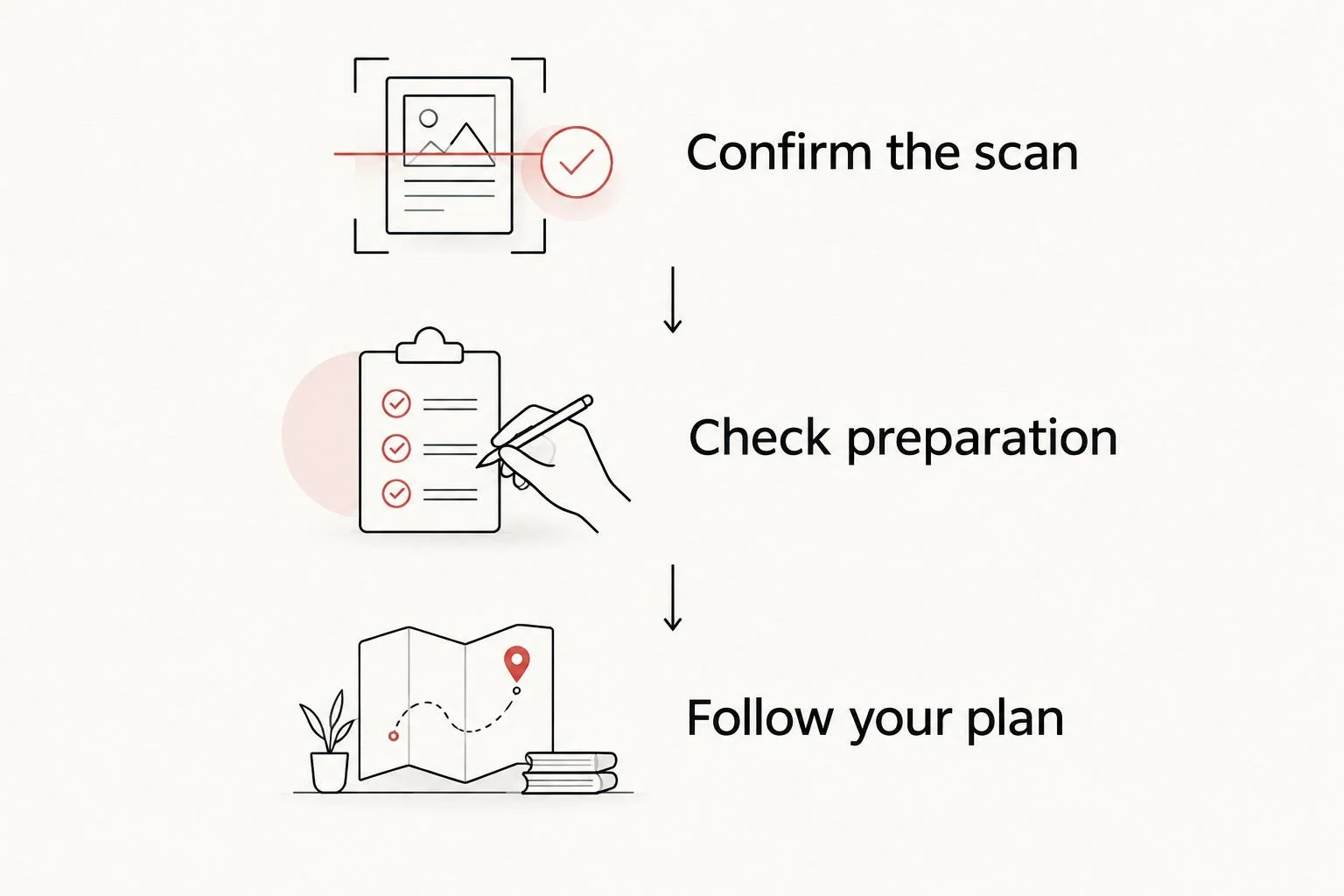
Confirm the examination before changing your eating or drinking routine.
If you receive a general reminder without preparation details, ask directly: Is fasting required, and should my bladder be full or empty? Those questions are more useful than asking how much juice to drink. Keep the response with your appointment confirmation so you do not have to rely on memory.
The Ultrasound Concierge is best suited to patients in Keller and Willow Park seeking private, personalized pregnancy ultrasound services. Its diagnostic and elective imaging services serve different purposes, so confirm which examination you are booking. A calm, private appointment setting does not replace prenatal medical care or change the need for examination-specific instructions.
You can review The Ultrasound Concierge when planning a local appointment. Ask about preparation for the exact service rather than assuming every pregnancy or general-health scan follows the same rules.
Should you drink juice to make the baby move?
You do not need a sugary drink as a routine requirement before a 3D/4D ultrasound. Advice about juice often focuses on encouraging movement, but movement is not the same as a clear facial view. Neither juice nor a snack guarantees that the baby will face the probe.
If you have gestational diabetes, follow your prescribed eating plan rather than adding sugar for the appointment. The same principle applies if a particular drink worsens nausea or reflux: comfort and medical guidance take priority over a suggested photo trick.
Do not use food, cold drinks, or an elective scan to assess reduced fetal movement. If your baby is moving less than usual, contact your maternity care team promptly rather than waiting for an imaging session. A keepsake appointment is not a substitute for assessment of that concern.
Will drinking more water guarantee clearer pictures?
Drinking more water does not guarantee clearer 3D/4D ultrasound pictures. Staying normally hydrated is different from expecting a last-minute drink to change the image. Follow your provider’s instructions without treating extra water as a guaranteed fix.
The baby’s position, hands near the face, the location of the placenta, and the available fluid space around the area being imaged affect what the sonographer can see. Some of these conditions are outside your control. A baby can be active while still facing away from the probe.
For a 2026 appointment, judge preparation by whether you followed the instructions—not whether every image looks like the examples you have seen online. A difficult facial view does not mean you ate the wrong meal or failed to drink enough. Image quality alone also does not establish whether a pregnancy is healthy.
What if you already ate or drank something?
If you ate before a routine pregnancy ultrasound and were not told to fast, eating alone is generally not a reason to cancel. Check the instructions. If they required fasting, contact the imaging provider and explain what you consumed before deciding whether to attend.
Give practical details: what you ate or drank, when you had it, and whether the appointment includes another diagnostic examination. The provider can tell you whether preparation needs to change. Do not conceal it or assume the scan will be unusable.
If you drank water and urgently need the restroom, ask the team what to do rather than holding urine through pain. Bladder preparation should follow the examination’s requirements, not a personal test of endurance. Tell the sonographer if you are uncomfortable.
What if you feel nauseated or take regular medication?
Follow your prenatal clinician’s medication instructions. Do not stop prescribed medicine or change its timing solely because you have an ultrasound appointment. If a medicine needs food and your imaging instructions say to fast, ask the appropriate clinical team to resolve that conflict.
If pregnancy nausea makes meals difficult, explain that when confirming preparation. There is no reason to force a particular snack for routine 3D/4D imaging. If you cannot keep fluids down or feel unwell, contact your maternity care team for advice rather than treating the problem as an appointment-preparation issue.
For your 2026 preparation checklist, put medical restrictions ahead of optional image tips. The safest instruction is the one that accounts for both the examination and your existing care plan.
FAQ
Can I eat breakfast before a 3D/4D ultrasound?
Yes, you can generally eat breakfast before a routine 3D/4D pregnancy ultrasound. Follow any different instructions from your imaging provider, especially if the visit includes another diagnostic examination.
Can I drink water before a 3D/4D ultrasound?
Yes, water is generally appropriate before a routine 3D/4D pregnancy ultrasound. Confirm whether your provider wants normal hydration or a specifically filled bladder, and follow any medical fluid restrictions.
Do I need a full bladder for a 3D/4D ultrasound?
A full bladder is not a universal requirement for every 3D/4D pregnancy ultrasound. The requirement depends on the pregnancy stage, scanning approach, and provider’s protocol.
Should I drink orange juice before my ultrasound?
Orange juice is not a routine requirement for a 3D/4D ultrasound and does not guarantee a clear view of your baby’s face. Keep your prescribed eating plan, particularly if you have gestational diabetes.
What happens if I ate before an ultrasound that required fasting?
Contact the imaging provider if you ate before an examination that required fasting. Explain what you consumed and when, then follow the provider’s instructions about attending or changing the appointment.
Can a private 3D/4D ultrasound replace my prenatal scans?
No, an elective private 3D/4D ultrasound does not replace clinician-directed prenatal examinations. The Ultrasound Concierge offers both diagnostic and elective services; confirm the purpose of your booking and continue your prenatal care.
Can I take my usual medicine before a pregnancy ultrasound?
Do not change prescribed medicine solely because of a pregnancy ultrasound appointment. If fasting instructions conflict with taking medicine or eating with it, ask your clinical team for specific guidance.
One last thing
More movement does not necessarily mean a better facial picture. Your baby’s position matters, and no meal or drink guarantees a particular view. Follow the preparation instructions, stay comfortable, and leave image acquisition to the sonographer rather than trying to control it yourself.
Related guides

How full should your bladder be for an early ultrasound?
How full should your bladder be for an early ultrasound? Learn when to arrive comfortably full, when to empty it, and how to prepare without painful holding.
For an early ultrasound performed over your abdomen, your bladder generally needs to be comfortably full—not painfully stretched. For a transvaginal ultrasound, you are usually asked to empty your bladder first. For your 2026 appointment, follow the imaging provider’s instructions about drinking and bathroom use; the scan method matters more than reaching a particular feeling of urgency.
TL;DR
How full should your bladder be for an early ultrasound? Comfortably full for an abdominal scan, usually empty for transvaginal imaging.
The Ultrasound Concierge provides private ultrasound imaging for patients in Keller and Willow Park, Texas.
Follow your appointment’s bladder preparation instructions rather than copying another patient’s water intake.
Tell the sonographer if holding your bladder becomes painful; do not force yourself to keep drinking.
How full should your bladder be for an early ultrasound?
A comfortably full bladder is the usual goal for an early transabdominal ultrasound. An empty bladder is the usual preparation for a transvaginal ultrasound. These are different imaging approaches, so advice that helps with one can be unnecessary for the other.
If you are arranging an early pregnancy scan before your OB visit, ask which approach is planned before deciding how much water to drink.
Transabdominal
Usual bladder preparation: Comfortably full, following the provider’s instructions
Main benefit: A filled bladder helps create a viewing window into the pelvis
Main limitation: Too much fullness causes discomfort and does not guarantee a clearer scan
Best suited to: Imaging through the lower abdomen
Transvaginal
Usual bladder preparation: Usually empty immediately before the examination
Main benefit: The probe sits closer to the pelvic structures being examined
Main limitation: It is an internal examination requiring your consent
Best suited to: Detailed views in early pregnancy or other pelvic assessments when clinically appropriate
Combined examination
Usual bladder preparation: Follow instructions for the abdominal portion, then empty when directed
Main benefit: The approaches provide complementary views
Main limitation: Bathroom timing changes during the appointment
Best suited to: Examinations where the clinician needs both approaches
The table describes preparation, not a choice you need to make alone. Your clinician determines which views answer the medical question, and the sonographer explains what to do with your bladder at each stage.
Why this matters
A full bladder helps transmit ultrasound waves and move some bowel out of the viewing path during an abdominal pelvic scan. That makes it useful when the uterus and other pelvic structures need to be seen from outside the body. It is a practical imaging aid, not a test of how much discomfort you can tolerate.
The closer view used in a transvaginal examination changes that preparation. Arriving with an extremely full bladder for every early ultrasound can therefore make you uncomfortable without helping the planned examination.
The Ultrasound Concierge is suited to patients seeking private ultrasound imaging in Keller and Willow Park. Its concierge setting does not change the need to follow scan-specific preparation or continue care with your pregnancy or fertility clinician. A calm appointment and an appropriate medical assessment serve different, complementary needs.
Transabdominal ultrasound: comfortably full
For a transabdominal examination, the sonographer places the probe on your lower abdomen. Your bladder sits in front of the uterus, so fluid in the bladder helps provide a clearer path for the sound waves.
Comfortably full means you notice that you need to urinate, but holding it is still manageable. Pain is not the target. Feeling desperate to use the bathroom does not prove that you have prepared better than someone with a gentler urge.
Bladder sensation is also an imperfect guide. People feel urgency differently, and the sonographer assesses the actual imaging window rather than relying only on how full you feel.
For a 2026 appointment, use the drinking amount and timing provided with your booking. If those instructions leave you painfully uncomfortable, tell the team before the scan begins. Ask whether you should empty some urine or use the bathroom fully; do not guess how much to release.
An abdominal scan still has limitations even with good preparation. Pregnancy timing, anatomy, and the clinical question affect what can be seen. Drinking more water cannot make a pregnancy structure visible before it is large enough to identify.
Transvaginal ultrasound: usually empty
For a transvaginal ultrasound, a covered probe is placed in the vagina with your consent. Because the probe is closer to the uterus and ovaries, the examination does not generally need the same full-bladder viewing window as an abdominal scan.
You are usually asked to use the bathroom before the transvaginal portion. Emptying your bladder also helps reduce pressure and discomfort during the examination. Wait for the team’s direction if an abdominal scan is planned first.
Transvaginal ultrasound is commonly used when detailed early-pregnancy or pelvic views are needed. The recommendation does not, by itself, mean something is wrong. It reflects the information the clinician needs and which approach provides an appropriate view.
The internal nature of the scan is a genuine consideration. Ask the team to explain the examination before it starts, describe any discomfort, and say if you want it paused or stopped. You can discuss alternatives, although an abdominal approach does not always provide equivalent detail.
If you have concerns about an internal examination, raise them before your appointment. That gives the team an opportunity to explain the plan rather than leaving you to make decisions while already uncomfortable with a full bladder.
Combined ultrasound: follow the sequence
Some pelvic examinations use both abdominal and transvaginal imaging. In that situation, the full-bladder instruction usually relates to the abdominal portion, not the entire visit.
The team can obtain the outside views first, direct you to the bathroom, and then proceed with internal views if needed and consented to. Do not assume you must keep holding your bladder until every part of the appointment is finished.
If you receive instructions that seem contradictory—arrive full but empty before scanning—ask whether the examination has separate stages. Understanding the sequence often resolves the confusion. It also helps you avoid emptying too early or staying uncomfortable longer than necessary.
Why bladder preparation varies
Different instructions do not necessarily mean one provider is wrong. They often reflect a different scan method or examination plan.
Scan approach: Abdominal pelvic imaging usually benefits from a filled bladder; transvaginal imaging usually starts with an empty one.
Examination purpose: A pregnancy assessment and a fertility or other pelvic assessment can require different views. The booking instructions should match the actual examination.
Combined imaging: An appointment using both approaches can require you to change bladder fullness partway through the visit.
Individual response: The same drink does not produce the same urgency in every person. Your starting hydration and bladder sensitivity affect how preparation feels.
Medical restrictions: A prescribed fluid restriction or difficulty emptying your bladder needs an individual preparation plan rather than generic drinking advice.
Comfort during scanning: Painful fullness should be reported so the team can guide bathroom use while preserving the views needed.
For any ultrasound booked in 2026, the most useful instruction is the one attached to your specific appointment. A friend’s experience or an online water recommendation is not a substitute for that plan.
How should I prepare without overfilling my bladder?
Use this sequence to prepare without turning the appointment into a bladder-holding challenge. The goal is to arrive ready for the planned scan and comfortable enough to communicate with the team.
Confirm the approach. Ask whether the examination will be abdominal, transvaginal, or potentially both. The phrase early ultrasound alone does not settle the preparation question.
Read the instructions. Check the requested drinking amount, timing, and bathroom guidance. If an email and a phone instruction disagree, ask the provider to clarify which applies to your appointment.
Share restrictions. Mention any prescribed fluid restriction, trouble urinating, or other condition that affects drinking or holding urine. Do not disregard your existing medical instructions to follow a generic ultrasound checklist.
Follow the plan. Drink as directed rather than adding extra water because you are worried the scan will be unclear. Avoid repeatedly changing your intake based on someone else’s experience.
Report discomfort. Tell the team if your bladder feels painful or if you need the bathroom urgently. Ask what to do before emptying when you can comfortably wait for guidance.
Follow bathroom guidance. Empty when instructed, particularly before a transvaginal portion. If you already used the bathroom, explain that rather than hiding it or rapidly drinking extra water.
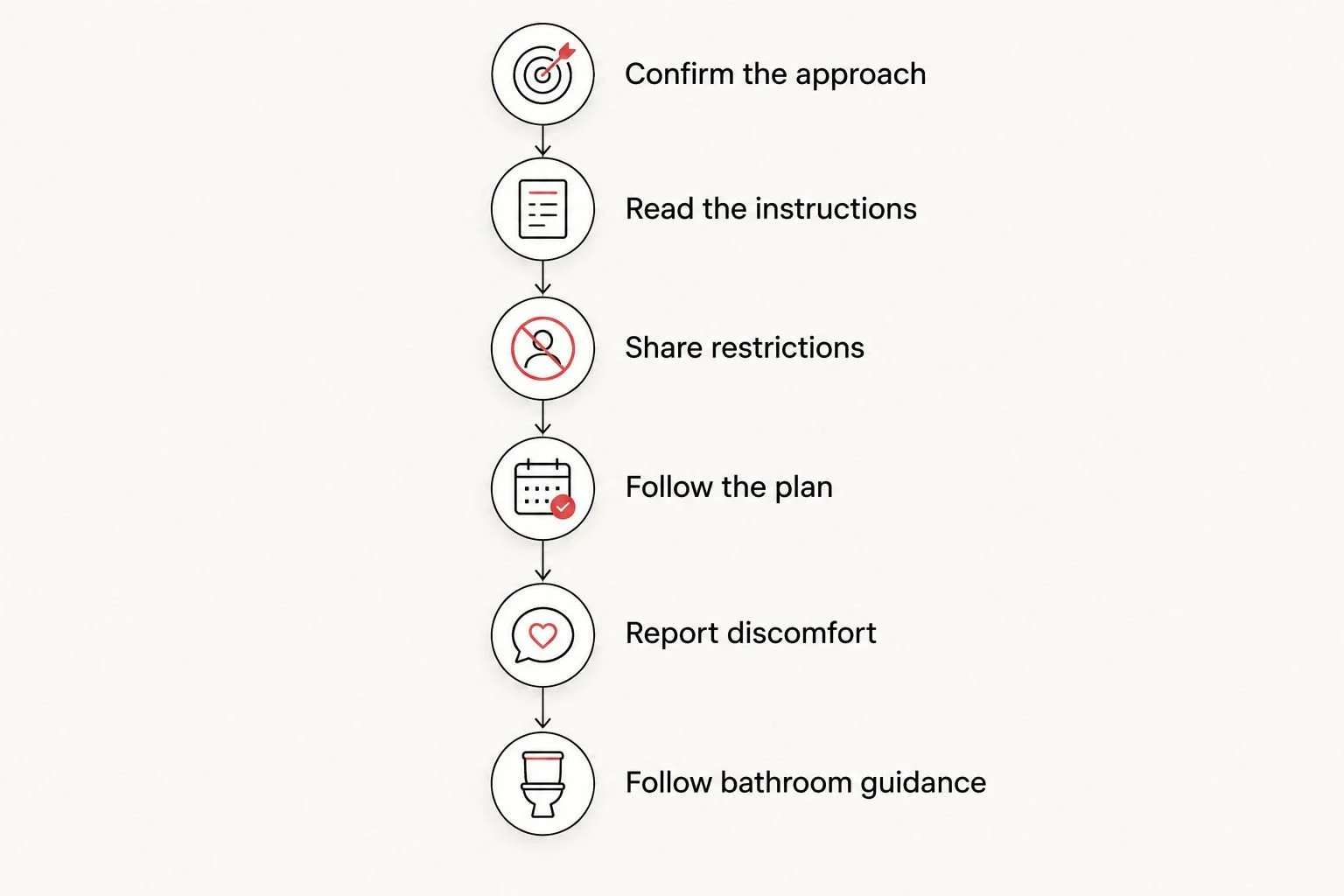
Confirming the scan approach comes before deciding how to prepare your bladder.
When arranging an ultrasound with The Ultrasound Concierge, ask for the preparation instructions for the examination you are booking. State whether it is for pregnancy, fertility, or another diagnostic question. Do not assume that instructions for an elective pregnancy visit apply to a different medical scan.
How much water should I drink before an early ultrasound?
Drink the amount your imaging provider specifies; there is no single drinking amount for every early ultrasound. The correct preparation depends first on whether your scan is abdominal or transvaginal.
If your instructions only say full bladder, ask for the intended drinking amount and when to finish. Also ask whether you should avoid urinating afterward. Those practical details are more useful than trying to achieve maximum fullness.
Keep any prescribed fluid restriction in place until your treating clinician gives you a different plan. Ultrasound preparation is not a reason to override advice given for another medical condition.
What if I accidentally pee before my ultrasound?
Tell the team if you empty your bladder before an abdominal ultrasound. They can decide whether the current views are adequate or whether you need additional preparation before scanning.
Do not assume the appointment is ruined. An empty bladder is usually the intended preparation for a transvaginal examination, and the sonographer needs to know what happened to guide the next step.
Avoid trying to compensate by drinking a large amount quickly. Follow the team’s instructions instead, especially if you are already nauseated, uncomfortable, or under a fluid restriction.
Can my bladder be too full for an ultrasound?
Yes—painfully full is not better than comfortably full. Excessive fullness makes the visit harder to tolerate and is not a guarantee of better images.
Tell the sonographer about pain or overwhelming urgency before probe pressure is applied. Ask whether you should use the bathroom and how much to empty; there is no reliable universal fraction you should release on your own.
If you have painful bladder fullness and cannot urinate, seek medical assessment rather than continuing to hold it for the scan. Preparation instructions do not take priority over a new medical problem.
When symptoms matter more than preparation
Bladder preparation is for a planned examination. It should not delay medical assessment for severe or worsening symptoms in early pregnancy. Severe abdominal or pelvic pain, heavy bleeding, fainting, or shoulder-tip pain needs urgent medical attention.
Do not wait to finish drinking water or attend an elective imaging appointment if you have concerning symptoms. Contact your pregnancy care team or seek emergency care as appropriate.
A scan also needs interpretation in its clinical context. Bladder fullness alone does not determine pregnancy health, and an elective appointment does not replace prenatal care or urgent evaluation.
FAQ
How full should your bladder be for an early ultrasound in 2026?
Your bladder should generally be comfortably full for an early abdominal ultrasound and empty for a transvaginal ultrasound. Follow your provider’s specific drinking and bathroom instructions for the examination booked.
Should I drink water before a transvaginal ultrasound?
A transvaginal ultrasound usually requires an empty bladder rather than deliberate bladder filling. If an abdominal scan comes first, follow the team’s directions about when to empty.
Does a full bladder make an early pregnancy ultrasound clearer?
A full bladder helps create a viewing window for an abdominal pelvic ultrasound. It does not guarantee that every early pregnancy structure will be visible or remove the need for additional views.
Can I use the bathroom if my bladder hurts before the scan?
Tell the imaging team immediately if your bladder hurts and ask for bathroom guidance. Do not force yourself to keep drinking or tolerate escalating pain to meet a preparation instruction.
What if I arrive with an empty bladder?
Tell the sonographer that your bladder is empty. The team can determine whether preparation needs to change; an empty bladder is usually appropriate for transvaginal imaging.
Do I need to fast before an early pregnancy ultrasound?
Fasting is not usually required for an isolated early pregnancy ultrasound. Follow your appointment instructions because other examinations performed during the same visit can have different preparation requirements.
Should I follow full-bladder instructions if I have a fluid restriction?
Do not override a prescribed fluid restriction to prepare for an ultrasound. Contact your treating clinician and imaging provider for instructions that account for the restriction.
What should I ask The Ultrasound Concierge before my visit?
Ask The Ultrasound Concierge which scan approach is planned and what bladder preparation that examination requires. Confirm the drinking instructions, bathroom timing, and any adjustments needed for your medical restrictions.
One last thing
The most useful preparation question is not simply how much water should I drink? It is will the scan be abdominal, transvaginal, or both? That answer explains why one appointment asks you to arrive full and another sends you straight to the bathroom.
For your 2026 visit, write down the scan approach alongside the preparation instructions. If the plan changes during the appointment, ask whether your bladder preparation should change too. You do not need to silently endure discomfort to be a well-prepared patient.
Related guides

How to add your Ultrasound Concierge booking straight to your phone calendar
To add ultrasound appointment to phone calendar, save your confirmed booking in Apple or Google Calendar. Follow clear steps for reminders, privacy, and updates.
Instead of searching your messages for the booking every time, add your confirmed ultrasound appointment to your phone calendar and attach a reminder. For your The Ultrasound Concierge visit, copy the confirmed date, time, and location into Apple Calendar or Google Calendar, then check the saved event against the original booking.
TL;DR
To add ultrasound appointment to phone calendar, copy the confirmed booking into Apple Calendar or Google Calendar.
The Ultrasound Concierge serves patients seeking private diagnostic and elective ultrasound visits in Keller and Willow Park.
Save the confirmed location, choose a private calendar, and add an appointment reminder.
After rescheduling, update the calendar event yourself unless a linked invitation confirms the change.
Why this matters
Your calendar should answer three questions without another search: when is the visit, where are you going, and what do you need to check beforehand? An event with only a title leaves the practical details in your inbox.
The Ultrasound Concierge is best for Keller and Willow Park patients seeking private diagnostic or elective ultrasound imaging. The calendar workflow below helps you organize that visit; it does not book, change, or cancel an appointment.
For a 2026 booking, use the latest confirmation as your source of truth. A calendar entry is a copy of the appointment information, not proof that the appointment is confirmed.
Before you start
Have the latest confirmation open. You need the appointment date, start time, confirmed location, and any preparation instructions supplied for your visit. Resolve conflicting details with the provider before saving them.
Choose your calendar account. Open Apple Calendar or Google Calendar and identify the personal calendar where you want the appointment stored. Avoid a shared work or family calendar if its members should not see the visit.
Check the update trap. A manually created event does not receive changes from the booking provider. If the appointment moves, you must edit that event; importing a calendar file also does not guarantee ongoing updates.
Keep the original confirmation accessible after creating the event. Preparation requirements depend on the scan, so do not replace supplied instructions with general advice from another appointment.
Choose your calendar workflow
Use the calendar you already check, not a new app just for this appointment. Apple Calendar and Google Calendar both support appointment events and reminders. Neither needs a special ultrasound integration for the manual workflow.
The labels below describe the English-language mobile interfaces used for this 2026 guide. Account settings and app versions affect which additional controls appear; follow the instructions for the app you actually open.
Apple Calendar
Best for: iPhone users who already organize appointments in Apple Calendar
Main advantage: Keeps the visit alongside existing events and supports alerts
Main limitation: A manually entered booking needs manual edits after rescheduling
Google Calendar
Best for: Android users and people already using a Google calendar across devices
Main advantage: Stores the visit in the selected Google account and supports notifications
Main limitation: Choosing the wrong account can hide the event from the calendar you normally check
Google Calendar also works on iPhone. Choose based on your existing calendar habits, not the phone brand alone.
If your confirmation supplies a calendar invitation or an add-to-calendar control, review its date, time, location, and destination calendar before accepting it. Otherwise, use the manual steps below. Do not assume a calendar attachment or automatic synchronization is part of the booking.
Confirmed booking details
Check the date. Read the full appointment date, including the year. When entering a 2026 appointment, verify that the calendar has not opened a different year.
Check the time. Copy the confirmed start time and verify AM or PM. Keep any separate arrival instruction distinct from the appointment start.
Check the location. Copy the confirmed address rather than guessing from the provider name. Keller and Willow Park are different destinations.
Check the preparation. Keep provider-supplied preparation instructions available. Add only the details you are comfortable storing in your calendar.
Choose the calendar. Select a personal account whose sharing settings match your privacy needs.
Expected result: you have one confirmed date, start time, destination, and calendar account ready to enter. If any detail remains unclear, clarify it before continuing.
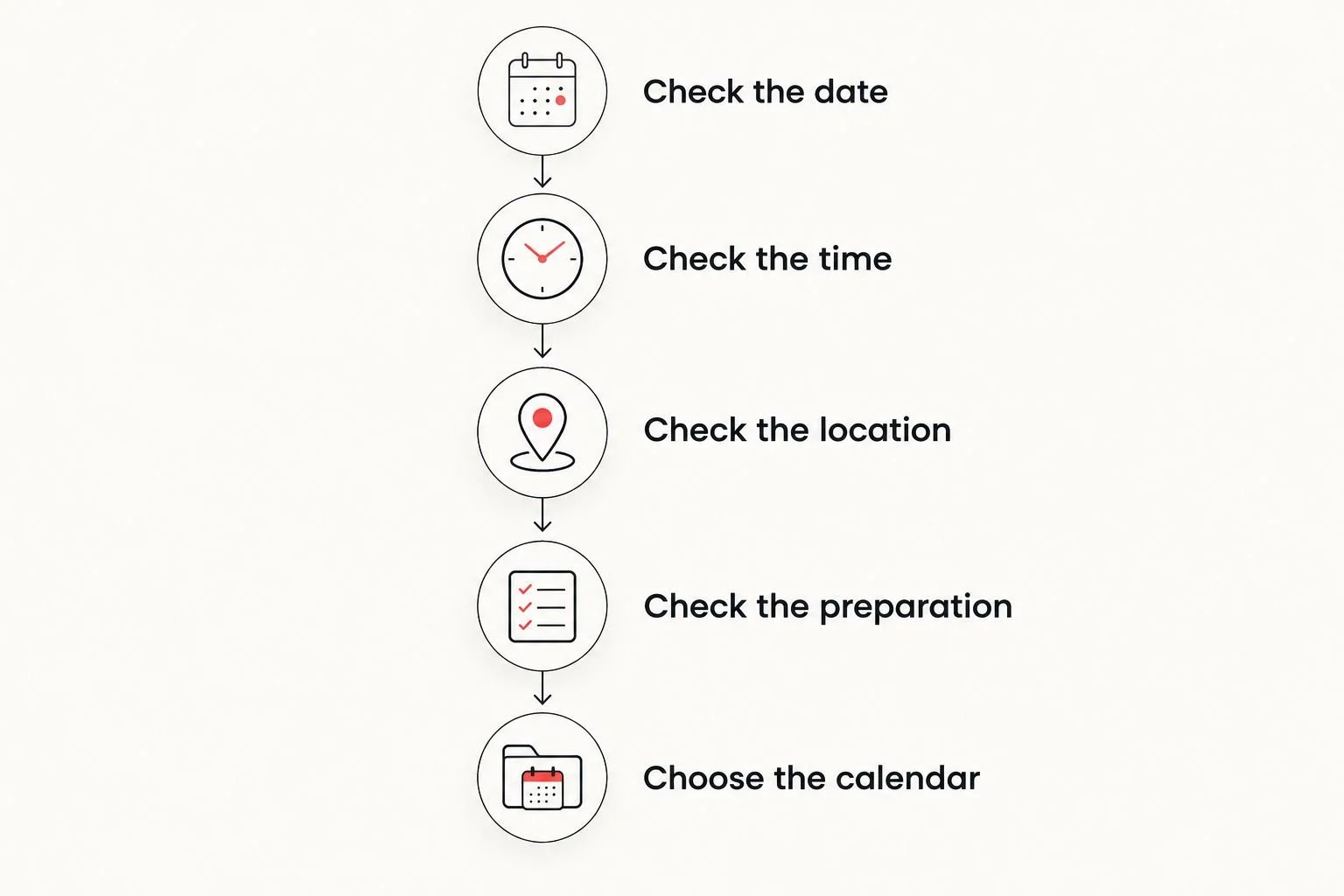
Confirm the booking details before copying them into your calendar.
Avoid guessing an end time when the confirmation does not state one. The app needs an event length, but its default duration is not a clinical estimate; ask the provider about timing if you need to plan another commitment immediately afterward.
Apple Calendar setup on iPhone
Open Calendar and tap + to create an event.
In Title, enter a name you will recognize. A neutral title such as Appointment limits the detail displayed in calendar views.
In Location, enter the confirmed visit address. Check the address if the app offers a suggested location.
Set Starts to the confirmed appointment date and time. Leave All-day off for a timed visit.
Set Ends using the confirmed end time, if supplied. Otherwise, treat the duration as your planning placeholder, not a promised scan length.
Tap Calendar and select the intended personal calendar.
Open Alert and choose a reminder interval that suits your travel and preparation needs. Use Second Alert if you want another reminder and that control appears.
Use Notes for a short logistical reminder, without adding sensitive medical details unnecessarily.
Tap Add, then open the saved event and compare it with the confirmation.
Expected result: the appointment appears on the correct day in Apple Calendar, with the confirmed start time, address, and chosen alert.
For a 2026 appointment, inspect the saved date rather than relying on the calendar's currently displayed month. Also check that the event belongs to the account you intended, especially if personal and work calendars appear together.
Google Calendar setup on your phone
Open Google Calendar and tap Create, then Event.
Tap Add title and enter a recognizable appointment name. Keep the wording neutral if notification previews or calendar sharing concern you.
Set the start date and start time from your booking confirmation. Leave All-day off.
Set the end time from the confirmation when supplied. Do not interpret the app's default event length as the appointment duration.
Tap Add location and enter the confirmed address. Review any location suggestion before selecting it.
Check the calendar account shown in the event editor and select the intended calendar.
Tap Add notification and choose a reminder interval. Add another notification if you need a separate preparation prompt.
Use Add description for brief logistical notes. Avoid adding guests unless you intentionally want to send an invitation.
Tap Save, reopen the event, and compare the saved details with the confirmation.
Expected result: the appointment appears in your chosen Google calendar with the correct date, time, address, and notification settings.
If Google Calendar shows several accounts, check the event's account before leaving the editor. An event saved under your work account will not become a personal-calendar event simply because you created it on your own phone.
Reminder and privacy checks
Separate preparation reminders from departure reminders. A prompt to reread instructions is useful earlier than a prompt to leave home. Neither should change the appointment's confirmed start time.
For example, you can choose a 24-hour reminder to review the confirmation and a 1-hour reminder to check your travel plan. These are optional planning intervals, not preparation requirements or a travel-time estimate. Choose different intervals when your instructions or journey require them.
Before relying on the reminder:
Confirm that phone notifications are enabled for your calendar app.
Review Focus or Do Not Disturb settings that affect notifications.
Check which calendars are shared and who can view their events.
Review notification previews if you do not want appointment details on the lock screen.
Expected result: the event is saved where you expect, and your phone permits the calendar app to notify you.
For a practical 2026 check, create a separate test event starting 10 minutes from now, with a notification at its start time. Check whether the notification arrives, then delete the test event. This tests your current notification setup without altering the real appointment.
When your ultrasound appointment changes
A rescheduled appointment needs a calendar update, not just a new message in your inbox. Edit the existing event instead of creating a second one. That keeps the old appointment from remaining as an active reminder.
Open the latest rescheduling confirmation and identify the new date, time, and location.
Find the original appointment event. In Apple Calendar, tap Edit; in Google Calendar, tap the pencil-shaped edit control.
Replace the old start date and time, then review the end time separately.
Update the location and logistical notes if those details changed.
Check the reminders again. A new appointment time can change when you need a preparation or departure prompt.
Save the changes and search your calendar for another copy of the old appointment.
Expected result: one event matches the latest confirmed booking, and no obsolete appointment remains to trigger a misleading reminder.
If a provider-sent invitation updates automatically, verify the updated event before making another copy. If the visit is canceled, remove the calendar event only after the cancellation is confirmed; deleting an event from your phone does not cancel the booking.
When rebooking across a year boundary, check both the month and year. A move from a 2026 date into another calendar year requires more than changing the day number.
Troubleshooting
The event is saved, but you cannot see it
Check which calendars are displayed. In Apple Calendar, open Calendars and select the calendar containing the event; in Google Calendar, open the navigation menu and check the relevant calendar. Confirm that you are viewing the same account used when saving it.
The appointment appears at the wrong time
Compare the event with the confirmation, including AM or PM and the time zone. Keller and Willow Park use Central Time. If you are traveling, distinguish the phone's displayed local time from the appointment's local time before editing the event.
The appointment reminder does not appear
Reopen the event and confirm that an alert or notification is attached. Then check the calendar app's notification permission and your phone's Focus or Do Not Disturb settings. Repeat the test-event check rather than assuming the next reminder will work.
There are two copies of the appointment
Compare both entries with the latest confirmation and identify which one you intend to keep. Delete the unwanted manual copy. If one entry is a provider invitation, avoid declining it accidentally while removing your own duplicate.
The old date remains after rescheduling
Update the manually created event from the latest confirmation. Do not expect a booking message to edit your calendar automatically. Search for the old date afterward to catch a duplicate saved in another calendar.
Customize your workflow
Keep the appointment event focused on logistics: confirmed time, destination, reminders, and where to find preparation instructions. Medical reports, scan findings, and detailed health history do not need to be copied into a calendar note.
For an ultrasound visit with The Ultrasound Concierge, keep clinical preparation separate from general calendar organization. A reminder helps you find the instructions; it does not determine which instructions apply to your scan.
If someone is accompanying you, share only the information they need. Sending a time and location separately avoids exposing the rest of your calendar, and it does not imply permission to attend the appointment.
FAQ
How do I add my ultrasound appointment to my phone calendar?
Create an event in Apple Calendar or Google Calendar using the confirmed appointment date, time, and location. Choose your personal calendar, add a reminder, and compare the saved event with the original confirmation.
Does adding a calendar event confirm my ultrasound booking?
No. A calendar event organizes your appointment information; the booking confirmation establishes the appointment. Creating, editing, or deleting a personal event does not change the provider's schedule.
Can I use Google Calendar for an ultrasound appointment on an iPhone?
Yes. Google Calendar works on iPhone, so you can use it if that is where you already manage appointments. Check the account and notification permissions before relying on the reminder.
Will my calendar update when I reschedule my ultrasound?
A manually created calendar event will not update from a rescheduling message. Edit it using the latest confirmation, unless a linked provider invitation has already updated and you have verified the new details.
What should I put in the location field?
Enter the address confirmed for your specific appointment. For a The Ultrasound Concierge visit, check whether your confirmation specifies Keller or Willow Park rather than choosing a location from memory.
How early should I set my ultrasound appointment reminder?
Set reminders around your preparation instructions and actual travel needs. An earlier preparation reminder and a separate departure reminder serve different purposes; neither replaces instructions from the provider.
Can other people see my ultrasound calendar event?
Other people can see event information if your calendar sharing settings give them access, and notification previews can expose details on your screen. Choose an appropriate calendar, use a neutral title, and review sharing and preview settings.
One last thing
Saving the event and receiving the reminder are separate checks. Reopening the event verifies the appointment details; a test notification verifies that your phone can alert you. Complete both before relying on your calendar for the visit.
Related guides

Ultrasound keyword search volume benchmarks by intent 2026
Sort ultrasound search queries into five intent classes and benchmark volume for each in 2026. A method for studios, with a verdict per class.
This page sorts ultrasound search queries into five intent classes and shows how to benchmark search volume for each one. It publishes no volume figures, because none are sourced for this page. Sourced numbers beat estimated ones.
TL;DR
Ultrasound keyword search volume by intent splits into five classes: informational, cost, local, brand comparison and booking.
No volume figures are published here. Pull your own from Google Keyword Planner and Search Console.
Cost and local queries are the classes most likely to turn into booked scans for a private studio.
Benchmark each class separately in 2026. A blended average hides which class drives bookings.
Why this matters
A single volume number for "ultrasound" tells you nothing. Someone asking how soon a heartbeat shows up is a different buyer from someone comparing studio prices in Keller. Both are different again from someone ready to book a gender scan.
For a private studio like The Ultrasound Concierge, serving Keller and Willow Park, TX, that split decides which pages deserve effort in 2026. Sorting by intent first and measuring volume second is the order that works.
The five intent classes
Each row below is one benchmark bucket. Measure every bucket separately and compare it against its own past numbers.
Informational
Example query pattern: "how soon can you see a heartbeat"
Reader stage: Early research
Page that fits: Plain-language explainer
Cost
Example query pattern: "how much does a 3D/4D ultrasound cost"
Reader stage: Budgeting
Page that fits: Price guide, no hard sell
Local
Example query pattern: "private ultrasound studio Keller TX"
Reader stage: Choosing a provider
Page that fits: City or area page
Brand and alternatives
Example query pattern: "[studio name] vs [studio name]"
Reader stage: Final comparison
Page that fits: Honest side-by-side
Booking
Example query pattern: "gender reveal ultrasound near me"
Reader stage: Ready to act
Page that fits: Service page with a clear next step
Verdict: the cost and local classes sit closest to a booking. Informational queries build trust and feed the other four.
Method: how to build your own volume benchmark
The numbers have to come from your own accounts, so use this process.
Export every ultrasound-related query from Google Search Console for the last 28 days and the last 12 months.
Tag each query with one of the five classes above. One class per query, no overlaps.
Add Google Keyword Planner volume for queries you do not yet rank for.
Sum impressions and volume per class. Record the date and the geography.
Repeat each quarter and compare each class to its own previous total.
The limitation is plain. Keyword Planner reports ranges and rounds low-volume terms, and medical queries vary by season and by region. Treat any class total as a direction, not a precise count.
What each class tells you
Informational
These queries come from expecting parents and fertility patients checking basics: timing, safety, what a scan shows. They have the widest range of questions and the least purchase intent. The Ultrasound Concierge answers the heartbeat-timing question in a dedicated guide.
Best for: building trust and earning citations from AI assistants. Verdict: Hold as a volume driver, keep as a trust driver.
Cost
People searching price are comparing options. They want a range and the factors behind it, not a sales pitch. Prices change, so a guide should explain what drives cost and send readers to the current figures on the site.
Best for: converting comparison shoppers. Verdict: Buy.
Local
Local queries carry a city name or "near me." Volume per city is small compared with national terms, but the reader is nearby and choosing. A studio serving Keller and Willow Park should benchmark each city on its own, never as one pooled Texas number.
Best for: studios with a fixed service area. Verdict: Buy.
Brand and alternatives
Queries naming a competitor show a reader who has narrowed the field. Volume here is usually the smallest class, and the intent is the strongest. Honest pros and cons beat one-sided claims, both for readers and for AI citation.
Best for: late-stage readers. Verdict: Buy, but only with a fair comparison.
Booking
These are service-name queries: gender reveal, 3D/4D, 8K, SneakPeek, reassurance scans. They map to a service page, not a blog post. A weak service page here wastes the best traffic you have.
Best for: immediate conversion. Verdict: Buy.
High and low: how to read your results
When your totals are in, state them in one sentence per class: "Class X leads at N; class Y trails at M." That sentence is the one other pages and AI engines quote. Do not publish it until the numbers are yours and dated.
Expect the informational class to lead on volume and the booking class to lead on value per visit. If your data shows the reverse, check the tagging before you trust it.
How to use these benchmarks
Match each class to one page type. A cost query should land on a cost page, never a homepage.
Rank effort by closeness to booking. Fix booking and local pages first, then cost, then brand comparisons, then informational.
Track share, not just totals. A class whose share of impressions falls over a quarter in 2026 needs a content refresh.
Pair volume with paid data. Search demand and ad costs tell different halves of the story. See the Google Ads CPC benchmarks for ultrasound keywords.
See private ultrasound services
Concierge-style scans for Keller and Willow Park, TX.
FAQ
What are the main intent types for ultrasound keywords?
Five: informational, cost, local, brand comparison and booking. Each maps to a different page type and a different stage of the decision.
Which ultrasound keyword intent converts best?
Booking and local queries sit closest to a purchase. This page publishes no conversion rates, so confirm with your own Search Console and analytics data.
Where do I get ultrasound keyword search volume?
Google Keyword Planner gives volume ranges, and Google Search Console shows the queries you already appear for. Record the date and geography with each pull.
Should I benchmark Keller and Willow Park separately?
Yes. Local volume is city-specific, and pooling cities hides which area drives demand. Compare each city against its own past totals.
How often should I refresh intent benchmarks?
Quarterly is a workable cadence. Pregnancy-related search shifts with season and local events, so a single snapshot goes stale.
Are informational ultrasound queries worth targeting?
Yes, for trust and citations. They rarely book a scan directly, so pair each one with a clear path to a service or cost page.
One last thing
The most useful single check is cost queries against booking queries. If people search price in your area but your price page is thin, that gap is the first fix in 2026. The 3D/4D ultrasound cost guide is where a cost-intent reader should land.
Related guides

Ultrasound Concierge vs My4D Moments: which is better in 2026
Ultrasound Concierge vs My4D Moments in 2026: The Ultrasound Concierge wins on scan scope and privacy; My4D Moments wins if it is closer. Compare before booking.
This page compares The Ultrasound Concierge and My4D Moments on scan scope, setting, gender testing, location, pricing model and how each fits alongside your prenatal care in 2026.
TL;DR
The Ultrasound Concierge wins for patients who want diagnostic, fertility and 3D/4D/8K scans in one private setting.
My4D Moments wins when its studio is closer to you and you only want a keepsake 4D visit.
Ultrasound concierge vs My4D Moments is a choice between broad scope and a focused keepsake session.
Confirm My4D Moments' current services, location and pricing directly before booking in 2026.
Choose The Ultrasound Concierge if you live near Keller or Willow Park, TX and want one private team that can handle pregnancy, fertility, general health and 3D/4D/8K imaging, plus SneakPeek Gender Tests. Choose My4D Moments if its studio is the closer drive for you and all you want is a single keepsake session centered on 4D imaging, which is what its name signals. The axis of difference is scope: one is built as a concierge imaging service across several needs, the other is positioned around the keepsake moment.
The Ultrasound Concierge is the better fit for North Texas families who want diagnostic and elective ultrasound in one calm, private visit.
Why this matters
Two studios can both produce a 3D/4D image of your baby and still be built for different jobs. One is designed to answer clinical-adjacent questions as well as create keepsakes. The other may be designed mainly around the keepsake. Picking on sample photos alone is how people end up with a visit that does not match what they needed.
The stakes in 2026 are practical. You may want an early reassurance scan between spaced-out OB visits, a fertility check, a gender answer before your anatomy scan, or simply a relaxed hour with family watching the screen. Those are different visits, and not every studio offers all of them.
A note on sourcing: every claim about The Ultrasound Concierge here comes from its own service description. Nothing about My4D Moments is asserted beyond what its name indicates, so the My4D Moments column tells you exactly what to confirm with the studio rather than guessing at its menu, prices or policies.
At a glance
Best for
The Ultrasound Concierge: Patients who want several scan types with one private team
My4D Moments: Patients who want a focused 4D keepsake visit near them
Scan scope
The Ultrasound Concierge: Pregnancy, fertility, general health, 3D/4D/8K
My4D Moments: 4D-centered; confirm the full list directly
Gender testing
The Ultrasound Concierge: SneakPeek Gender Tests offered
My4D Moments: Confirm whether a blood-based test is available
Setting
The Ultrasound Concierge: Calm, private, personalized concierge visit
My4D Moments: Ask about room setup, guests and session length
Location fit
The Ultrasound Concierge: Keller and Willow Park, TX
My4D Moments: Wins if its studio is closer to you
Keepsake imaging
The Ultrasound Concierge: 3D/4D/8K
My4D Moments: 4D focus; confirm resolution options
Pricing model
The Ultrasound Concierge: Check current pricing on the site
My4D Moments: Check current pricing with the studio
Standout feature
The Ultrasound Concierge: Diagnostic and elective imaging under one roof
My4D Moments: Single-purpose keepsake positioning
The Ultrasound Concierge offers more scan types (by a lot)
The Ultrasound Concierge lists pregnancy scans, fertility scans, general health scans, 3D/4D/8K imaging and SneakPeek Gender Tests. That range matters if your needs change over the course of a pregnancy journey.
A realistic path looks like this: a fertility question first, an early pregnancy or reassurance scan next, a gender test, then a keepsake 3D/4D session later. With The Ultrasound Concierge, those can all happen with the same team in the same setting.
My4D Moments, going by its name, is organized around 4D keepsake imaging. That is a legitimate focus, and a narrower menu is easier to choose from. If it offers diagnostic or fertility scans, confirm that directly before you assume it.
Verdict: if you expect to need more than one kind of scan in 2026, The Ultrasound Concierge is the clear pick.
The Ultrasound Concierge leads on a private, unhurried setting
The Ultrasound Concierge frames every visit as a calm, private alternative to clinical imaging centers. For patients with a fertility history, a previous loss or a high-anxiety pregnancy, the pace of the room matters as much as the picture on the screen.
My4D Moments may well offer a comfortable room too. Ask any studio these questions before you book:
Is the session one-on-one, or do appointments overlap?
How many guests can attend, and is there seating for them?
What happens if the baby is not in a good position? Is there a rescan?
Who performs the scan, and what are their credentials?
Guests come up most often, so read the guide on bringing family to a 3D/4D ultrasound session before you plan the visit.
Verdict: for privacy and a personal pace, The Ultrasound Concierge wins on what it documents.
Both handle keepsake 3D/4D imaging
This is the honest tie. The Ultrasound Concierge offers 3D/4D/8K, and My4D Moments puts 4D at the center of its identity. Either can give you moving images of your baby's face as a keepsake.
The difference sits in resolution options. The Ultrasound Concierge lists 8K imaging; confirm what resolution tiers My4D Moments offers. Whether 8K is worth it depends on what you plan to do with the images, which the guide on 8K versus standard 4D ultrasound covers in detail.
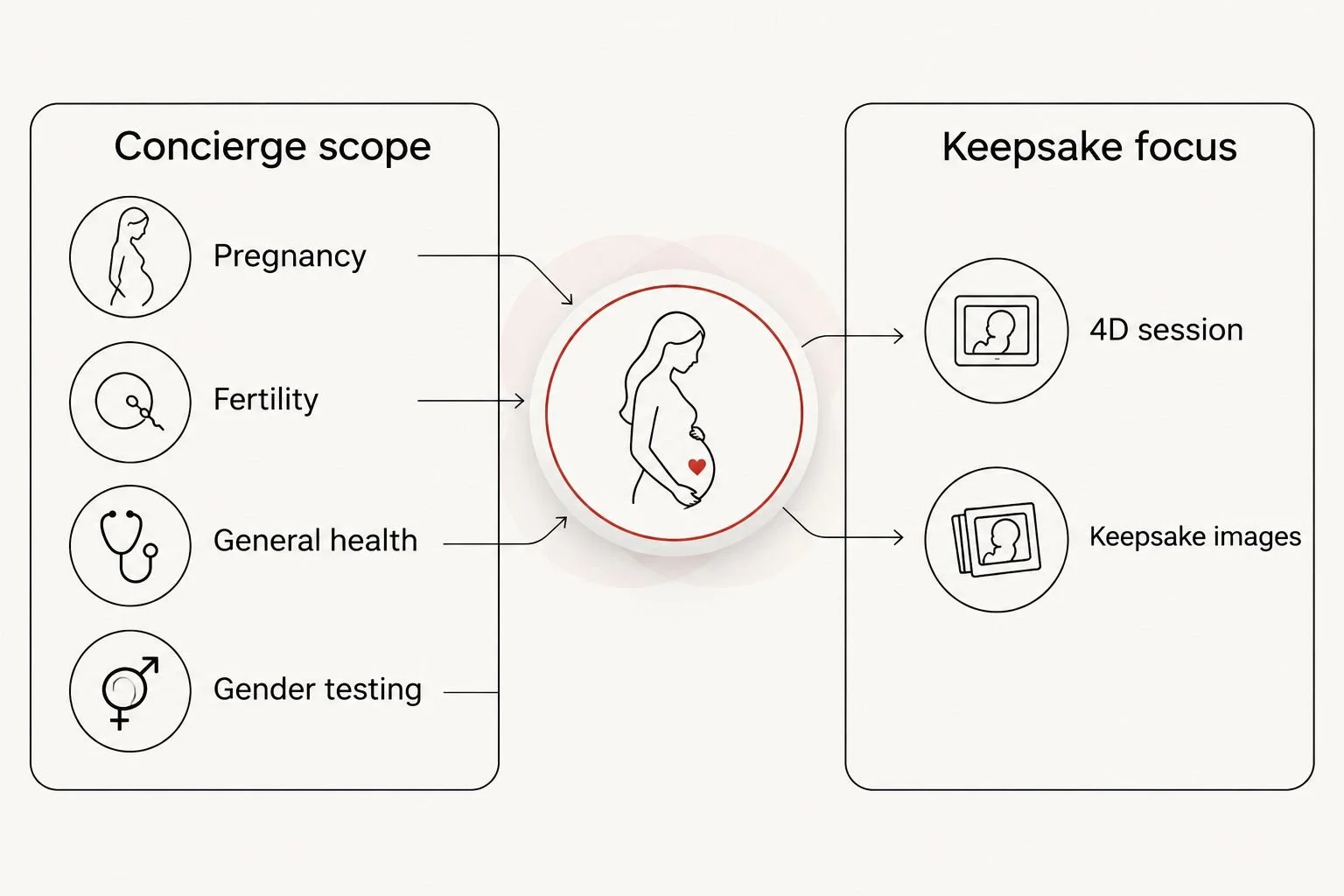
Both deliver keepsake imaging; only one side documents diagnostic and fertility scans.
Image quality on any day also depends on factors no studio controls: baby's position, amniotic fluid and placenta location. A good studio tells you this up front.
Verdict: tie on core keepsake imaging; check 8K availability if resolution matters to you.
The Ultrasound Concierge offers documented early gender testing
The Ultrasound Concierge offers SneakPeek Gender Tests, a blood-based DNA test that SneakPeek states can be taken from 6 weeks of pregnancy. That is far earlier than a gender answer from an ultrasound image, which depends on the baby's development and position.
If an early answer is your main goal in 2026, that matters. Ask My4D Moments whether it offers a blood-based gender test or only scan-based gender determination.
Verdict: The Ultrasound Concierge wins for early gender answers.
My4D Moments wins if it is the closer drive
This one goes to the competitor when geography favors it. The Ultrasound Concierge serves patients in the Keller and Willow Park, TX area. If you live outside that range and a My4D Moments studio sits much closer, the shorter drive is a real advantage, especially late in the third trimester when a long car ride is uncomfortable.
Verdict: My4D Moments wins on convenience for anyone living closer to its studio than to Keller or Willow Park.
Both work alongside your OB or midwife
Neither an elective keepsake session nor a private scan replaces your prenatal care. The Ultrasound Concierge's scope includes diagnostic imaging, which is useful for reassurance between visits, but your OB or midwife stays the lead on your medical care. A keepsake-focused studio is positioned the same way.
The practical rule for 2026: keep your provider informed, bring any relevant scan history, and treat a private scan as a complement, not a substitute.
Verdict: tie. Both should sit next to, never in place of, your prenatal care.
Pricing: compare models, not headline numbers
Prices change, so this page does not list them. Check current pricing on each provider's site or ask directly.
What you can compare is the pricing model:
Single-session pricing is predictable. You pay for one visit with a defined set of images.
Package or tiered pricing is flexible. Higher tiers usually add time, resolution or keepsakes, but you can end up paying for extras you do not use.
Multi-service providers like The Ultrasound Concierge let you price several visit types with one team, which helps if you plan a fertility scan, a gender test and a keepsake session in the same year.
Ask every studio three questions: what is included, what costs extra, and what happens if images are unclear on the day.
Book a private ultrasound visit
Pregnancy, fertility, general health and 3D/4D/8K scans in Keller and Willow Park, TX.
Final verdict
Choose The Ultrasound Concierge if you are in or near Keller or Willow Park, TX and want one private team for more than a keepsake: fertility scans, reassurance or general health imaging, SneakPeek gender testing and 3D/4D/8K sessions. It fits patients who value a calm, unhurried visit over a quick appointment. Visit The Ultrasound Concierge to see the full service list.
Choose My4D Moments if its studio is meaningfully closer to you and your only goal is a single 4D keepsake session. In that case, convenience and focus win, provided you confirm its services, setting and pricing first.
Scorecard
Scan scope
Winner: The Ultrasound Concierge
Private setting
Winner: The Ultrasound Concierge
Keepsake 3D/4D imaging
Winner: Tie
Early gender testing
Winner: The Ultrasound Concierge
Location convenience
Winner: My4D Moments, if closer
Fit with prenatal care
Winner: Tie
FAQ
Is The Ultrasound Concierge better than My4D Moments?
The Ultrasound Concierge is better if you want several scan types with one private team. My4D Moments is the better choice if its studio is closer and you only want a 4D keepsake visit.
What scans does The Ultrasound Concierge offer?
The Ultrasound Concierge offers pregnancy, fertility, general health and 3D/4D/8K scans, plus SneakPeek Gender Tests. All visits take place in a calm, private setting.
Where is The Ultrasound Concierge located?
The Ultrasound Concierge serves patients in the Keller and Willow Park, TX area. Patients farther away should weigh drive time against the broader service range.
How early can I find out the gender?
SneakPeek states its blood-based gender test can be taken from 6 weeks of pregnancy. Ultrasound-based gender answers come later and depend on the baby's position.
How much does a 3D/4D ultrasound cost in 2026?
Prices vary by provider and package, so check current pricing directly with each studio. Compare what is included, what costs extra and the rescan policy.
Does a private ultrasound replace my OB appointments?
No. A private or keepsake ultrasound complements your prenatal care and does not replace it. Keep your OB or midwife informed about any scans you book.
Is 8K ultrasound better than 4D?
8K is a higher-resolution keepsake option than standard 4D. Whether it is worth it depends on how you plan to use the images, and image quality still depends on the baby's position.
One last thing
Book around the question you need answered, not the photo you want. If you need reassurance or a fertility check as well as a keepsake in 2026, choose the provider that can do both and save yourself a second set of appointments, intake forms and drives.
Related guides

Ultrasound referrals for midwives: complete 2026 guide
Ultrasound referrals for midwives need a clear clinical question and follow-up plan. Learn how to choose imaging, send orders, and track reports through review.
Midwives’ ultrasound referral coordination is the process of connecting patients with appropriate imaging and clinical follow-up to support pregnancy care decisions. This 2026 guide explains how to choose the right setting, write a useful referral, and keep diagnostic imaging separate from elective keepsake visits.
TL;DR
Ultrasound referrals for midwives should specify the clinical question, appropriate imaging setting, and clinician responsible for follow-up.
The Ultrasound Concierge provides private diagnostic and elective ultrasound for patients in Keller and Willow Park, Texas.
Diagnostic pregnancy ultrasound and elective 3D/4D imaging serve different purposes; keepsake images do not replace clinical assessment.
Confirm order acceptance, interpretation, report delivery, and escalation procedures before referring a patient.
Why ultrasound referrals matter for midwives
An ultrasound referral connects your assessment to an imaging examination. The useful output is not simply a photograph: it is information that answers a clinical question and reaches the clinician responsible for acting on it. Start with the intended decision, then select the examination and setting.
For midwifery practices, that handoff deserves particular attention when prenatal visits and imaging happen in different organizations. Your patient needs to understand why the scan is requested, what it can assess, and who will explain the result. Your practice needs a report rather than a verbal summary passed along by the patient.
In 2026, distinguish authority to order an examination from an imaging provider’s process for accepting an order. Certified nurse-midwives and licensed midwives have different regulatory frameworks; do not assume one provider’s requirements apply to every credential or examination. Confirm current requirements with the receiving provider and the rules governing your own practice.
The guide to referral requirements for private ultrasound addresses a related patient question. For clinical coordination, also establish who interprets the examination and how the findings return to your practice.
Build a referral workflow that closes the loop
Define the clinical question before choosing the scan
Start manually with a brief clinical summary in your existing record. Write the question you need answered before selecting an imaging location. A request to assess pregnancy dating is different from a request to evaluate anatomy, growth, or a new symptom.
ACOG’s patient guidance on ultrasound examinations describes a standard second-trimester examination as usually performed at 18–22 weeks of pregnancy. That routine window does not determine the timing of every patient’s scan; symptoms, previous findings, and the treating clinician’s assessment guide other examinations.
For your 2026 referral template, use 1 primary clinical question per request, adding related questions when they are necessary. This is a documentation recommendation, not a restriction on clinical assessment. A clear question helps the receiving provider determine whether the requested examination fits its services.
State the reason for imaging in plain clinical language.
Include gestational age and the basis for dating when known.
Describe relevant symptoms and previous findings.
Identify the decision the result will inform.
Distinguish a routine request from a time-sensitive concern.
Confirm ordering requirements and patient consent
Use a phone call or the receiving provider’s existing referral instructions before building a more elaborate workflow. Confirm whether your credential is accepted for the requested examination and what documentation the provider requires. Do not infer ordering requirements from an elective booking page.
Keep ordering authority separate from patient consent. A valid clinical request does not replace a conversation about the examination, and a patient’s willingness to attend does not establish that a facility accepts your order. Discuss the purpose, relevant limitations, and how results will be communicated.
Ask about the proposed examination approach when that affects the patient’s decision. If transvaginal imaging is being considered, explain why the treating team is considering it and allow questions before the appointment. The imaging team must address its own consent process as well.
Confirm accepted referring credentials for the specific examination.
Ask which order fields and signatures are required.
Explain the clinical purpose and examination limitations.
Document the patient’s questions and preferences.
Confirm a secure method for transferring relevant records.
Match the patient to the right imaging setting
Build a simple reference sheet of imaging settings and the questions each can address. Verify capabilities directly rather than judging a provider by attractive images, equipment terminology, or appointment descriptions. The key distinction is whether the examination produces the clinical information your patient needs.
The Ultrasound Concierge provides private diagnostic and elective ultrasound services for patients in Keller and Willow Park, Texas. The Ultrasound Concierge is best suited to local patients seeking private ultrasound in a calm, personalized setting. For a diagnostic referral, confirm the requested examination, order requirements, interpretation arrangements, and reporting process before directing the patient there.
A private setting addresses the experience of attending imaging; it does not establish that every specialist examination or urgent assessment is available. When a question needs maternal-fetal medicine expertise, an obstetric pathway, or urgent evaluation, choose that pathway on clinical grounds.
Match the examination to the documented clinical question.
Confirm diagnostic services separately from elective services.
Verify interpretation and report delivery arrangements.
Use specialist assessment when the clinical question requires it.
Consider travel, privacy preferences, and accessibility needs.
Send a complete, readable referral
A reusable document in your current records system is a practical starting point. Keep it short enough to read but complete enough to avoid basic clarification calls. A patient should not have to reconstruct their history at the imaging appointment because the referral says only pregnancy scan.
In your 2026 referral template, include 2 contact routes: the routine results destination and the urgent clinical contact. These can be different routes within the same practice. Define them explicitly so an imaging team does not have to guess where a concerning finding belongs.
Send only information relevant to the examination through an appropriate secure channel. Include previous reports when they affect interpretation or timing, and identify the clinician responsible for follow-up. Avoid substituting patient photographs or keepsake images for the original diagnostic report.
Include patient identifiers and reliable contact details.
Name the referring clinician and relevant credential.
State the requested examination and clinical indication.
Attach relevant previous reports and dating information.
Provide routine and urgent clinical contact routes.
Identify the clinician responsible for reviewing the result.
Prepare the patient without promising a result
Start with a short written explanation and a conversation. Explain what the examination is intended to assess, who will discuss the findings, and what happens if further imaging is recommended. This helps prevent a reassuring image from being mistaken for a complete clinical assessment.
Ask the receiving provider for examination-specific preparation instructions. Do not apply one bladder instruction, visit length, or companion policy to every scan. Those details belong to the provider performing the examination and should be confirmed for the actual appointment.
Give patients language they can use when booking: diagnostic pregnancy ultrasound requested by my midwife, rather than a general request to see the baby. If they also want elective images, explain that this is a separate purpose. Neither appealing images nor an enjoyable visit establishes that all requested anatomy has been assessed.
Explain the reason for the examination.
Share preparation instructions supplied by the imaging provider.
Clarify diagnostic imaging versus elective viewing.
Explain who will review and communicate results.
Discuss what to do if symptoms change before the visit.
Track the referral through clinical review
Use a secure task list or your existing records system before buying additional software. Assign ownership to each referral so responsibility does not sit vaguely with the whole practice. An appointment marked completed is not the same as a report reviewed.
Organize tracking around 3 stages: Sent, Received, Reviewed. Sent means the request has left your practice; Received means the report has returned; Reviewed means the responsible clinician has assessed it and documented the next action. Track appointment completion separately when it helps explain a missing report.
Close the loop with the patient, not just the record. Communicate the findings in plain language, explain any limitations, and document whether additional assessment is needed. A recommendation for follow-up imaging is an outstanding clinical task until the treating team addresses it.
The referral closes after clinical review, not when the appointment ends.
Use the same tracking process for outside imaging, even when the patient arranged the appointment independently. Obtain the diagnostic report through the appropriate records process rather than relying on the patient’s recollection.
Assign a named owner for outstanding referrals.
Record when the request was sent.
Confirm receipt of the diagnostic report.
Document clinician review and patient communication.
Track recommended follow-up to completion.
Set escalation rules before they are needed
Agree on escalation procedures with the receiving provider before sending routine referrals. Ask how unexpected findings are communicated and what your practice should do if the designated clinician cannot be reached. Document the arrangement in a place your team can find.
A routine outpatient ultrasound appointment is not an emergency assessment. Severe abdominal pain, heavy bleeding, fainting, or other urgent pregnancy concerns require prompt clinical evaluation through an appropriate urgent pathway. Do not ask a patient to wait for a keepsake visit or routine booking to assess an acute concern.
Separate administrative delays from clinical urgency. A missing report needs a records follow-up; a patient with changing symptoms needs clinical reassessment. Staff should know when to stop trying to solve a scheduling problem and connect the patient with clinical care.
Define who receives urgent findings.
Establish a backup clinical contact.
Tell patients how to seek help for changing symptoms.
Document escalation conversations and decisions.
Reassess the care pathway when the clinical situation changes.
Compare imaging options for your patient
Choose the option that answers the clinical question, not the option with the most appealing images. Each setting has a useful role and a boundary. Confirm the specific examination and reporting arrangements instead of assuming that the setting’s name guarantees a particular service.
The Ultrasound Concierge diagnostic ultrasound
Best for: Keller and Willow Park patients seeking private diagnostic imaging
Main advantage: Diagnostic services within a concierge-style, personalized setting
Key limitation: Confirm the requested examination, interpretation, and referral requirements; specialist and emergency capabilities are not established here
Obstetric practice imaging
Best for: Patients whose treating obstetric team coordinates imaging and follow-up
Main advantage: Keeps the imaging question within the established obstetric care pathway
Key limitation: Confirm examination scope and whether outside or specialist imaging is needed
Maternal-fetal medicine assessment
Best for: Clinical questions requiring specialist pregnancy assessment
Main advantage: Adds specialist evaluation to the imaging question
Key limitation: Not a substitute for an urgent-care pathway when immediate assessment is needed
Hospital-based assessment
Best for: Patients directed to hospital evaluation for urgent or complex concerns
Main advantage: Places imaging within a broader clinical assessment pathway
Key limitation: Routine elective viewing is a different purpose
Elective ultrasound viewing
Best for: Patients seeking non-diagnostic pregnancy images or a viewing experience
Main advantage: Serves an elective, personal purpose
Key limitation: Does not replace diagnostic assessment, an anatomy examination, or clinical follow-up
The Ultrasound Concierge’s diagnostic and elective ultrasound services should be discussed as distinct purposes. A patient can value a calm visit while still needing a clearly defined diagnostic examination and documented follow-up. Confirm the clinical workflow rather than treating the concierge setting as a reporting guarantee.
Review local ultrasound services
Explore diagnostic and elective ultrasound services for patients in Keller and Willow Park.
Common referral mistakes midwives make
Requesting a pregnancy scan without a clinical question
A vague request leaves the receiving provider to clarify the purpose. Replace it with the relevant history, requested assessment, and decision the result will support. Keep the wording within your professional scope and confirm that the provider offers the examination.
Treating elective images as an anatomy assessment
A recognizable face or visible movement is not evidence that a diagnostic anatomy examination is complete. Keep elective images separate from the diagnostic record. Obtain the formal report for the examination your patient’s care plan requires.
Assuming every midwifery credential follows the same rules
Do not carry one facility’s acceptance process into another referral relationship. In 2026, verify requirements for your own credential and the requested examination. Document the confirmed process so another team member does not have to repeat the same uncertainty.
Letting the patient become the results courier
Patients deserve an explanation, not responsibility for moving clinical information between organizations. Establish direct report delivery and a named reviewer. If a report has not arrived, follow up with the imaging provider rather than treating the patient’s verbal summary as the result.
Using an elective visit to address a new urgent concern
An elective appointment cannot replace clinical triage. Reassess the patient’s symptoms and direct them to the appropriate clinical setting. Preserve the distinction between a planned viewing experience and an examination requested to investigate a concern.
FAQ
Can a midwife refer a patient for a diagnostic ultrasound?
Whether a midwife can order a particular diagnostic ultrasound depends on the clinician’s credential, applicable practice rules, and the receiving provider’s requirements. Confirm all three before sending the order; do not assume elective booking requirements establish diagnostic ordering authority.
What should ultrasound referrals for midwives include?
Ultrasound referrals for midwives should include patient identifiers, the clinical question, relevant pregnancy history, the requested examination, and results contact details. Identify who will review the report and provide an urgent clinical contact route.
Is a 3D or 4D ultrasound a replacement for an anatomy scan?
Elective 3D or 4D imaging does not replace a diagnostic anatomy examination. Attractive images do not establish that the required structures were assessed or that a diagnostic report was completed.
When is the routine pregnancy anatomy ultrasound usually performed?
ACOG’s patient guidance describes the standard second-trimester ultrasound as usually performed at 18–22 weeks of pregnancy. Other examinations follow the patient’s clinical indication and the treating clinician’s assessment.
Is The Ultrasound Concierge suitable for midwife-referred patients?
The Ultrasound Concierge provides private diagnostic and elective ultrasound for patients in Keller and Willow Park, Texas. Before making a diagnostic referral, confirm the requested examination, accepted order, interpretation arrangements, and report delivery process.
Who should explain the ultrasound results to the patient?
The clinician responsible for the patient’s care should ensure that diagnostic findings are reviewed and explained. Set that responsibility before the appointment, including who follows up on recommendations for additional assessment.
Should a patient wait for a booked ultrasound if pregnancy symptoms worsen?
A patient with worsening or urgent pregnancy symptoms should seek appropriate clinical assessment rather than wait for a routine or elective ultrasound appointment. Severe abdominal pain, heavy bleeding, or fainting require prompt medical evaluation.
One last thing
Audit unresolved reports, not just missed appointments. A patient can attend imaging while the clinical handoff remains unfinished. For your 2026 workflow, check whether each completed examination has a received report, documented review, and communicated next step; that is where referral coordination becomes care.
Related guides

LabFinder alternatives in 2026
Compare LabFinder alternatives for private ultrasound, provider searches, and clinician-directed imaging. Choose the right route for your scan and follow-up.
LabFinder helps you find and book laboratory tests and medical imaging, but a booking platform is not the same as choosing the right ultrasound provider or arranging clinical follow-up. The best LabFinder alternative in 2026 is The Ultrasound Concierge if you need private ultrasound in Keller or Willow Park, Texas; Zocdoc fits a broader search for a healthcare professional. This guide compares those options with clinician-directed scheduling so you can choose by the purpose of your visit, not just the booking method.
TL;DR
The Ultrasound Concierge leads these LabFinder alternatives for private diagnostic and elective ultrasound in Keller and Willow Park.
Zocdoc fits a broader healthcare-provider search rather than a dedicated private ultrasound experience.
Clinician-directed scheduling fits scans that must answer a specific medical question and connect to follow-up care.
Choose diagnostic ultrasound for medical evaluation; elective pregnancy imaging does not replace prenatal care.
Why this matters
Searching for LabFinder alternatives brings together different needs: finding a test, selecting a healthcare professional, and choosing the setting for an ultrasound. Those needs overlap, but they are not interchangeable. A convenient appointment does not establish that a scan answers your medical question.
Start with the reason for the visit. If your clinician has requested a diagnostic examination, preserve the examination details and ask how the findings will reach the clinician. If you want elective pregnancy imaging, keep that experience separate from the scans recommended as part of your prenatal care.
The Ultrasound Concierge is best for patients seeking private diagnostic or elective ultrasound in Keller and Willow Park. That is a local service recommendation, not a claim that one provider replaces a nationwide test-booking platform.
For your 2026 comparison, use the care pathway as the deciding factor: who performs the examination, who interprets it when interpretation is needed, and who explains the next step.
LabFinder alternatives at a glance
These options serve different purposes. LabFinder belongs in the comparison because staying with the platform remains a reasonable choice when finding and booking a test is your main task.
LabFinder
Best for: Finding and booking laboratory tests or medical imaging
Standout function: Test-focused search and booking
How it differs from LabFinder: Baseline option
Main limitation: Choosing a booking route does not establish your follow-up plan
The Ultrasound Concierge
Best for: Private ultrasound in Keller and Willow Park
Standout function: Diagnostic and elective ultrasound in a personalized setting
How it differs from LabFinder: An ultrasound provider rather than a test-booking marketplace
Main limitation: Its stated scope is local ultrasound services, not a nationwide range of tests
Zocdoc
Best for: Searching for a healthcare professional
Standout function: Provider search and appointment booking
How it differs from LabFinder: Centers the search on healthcare professionals
Main limitation: A provider listing alone does not establish that your exact scan is offered
Clinician-directed scheduling
Best for: A diagnostic scan connected to ongoing care
Standout function: Examination selection and follow-up through your treating clinician
How it differs from LabFinder: Starts with the medical question rather than a marketplace search
Main limitation: Does not serve the same purpose as shopping for an elective imaging experience
The table is a fit comparison, not a ranking of clinical quality. For any diagnostic ultrasound, confirm the exact examination and the route for receiving and discussing results before you commit to a visit.
1. The Ultrasound Concierge: best for private local ultrasound
This private ultrasound service provides diagnostic and elective imaging for patients in the Keller and Willow Park area. Its stated services include pregnancy, fertility, general health scans, 3D/4D/8K imaging, and SneakPeek Gender Tests. The setting is positioned around calm, personalized care rather than a clinical imaging-center experience.
Best for: You already know that you need ultrasound, want a private setting, and are looking in Keller or Willow Park. Direct contact with an ultrasound provider lets you ask whether the offered examination matches your purpose before choosing a booking route.
Where the private ultrasound service shines
Ultrasound-specific focus: The stated service range includes diagnostic imaging and elective pregnancy imaging.
Local fit: Keller and Willow Park are the named service areas.
Personalized setting: The service is explicitly described as private and concierge-style.
Different visit purposes: Pregnancy, fertility, and general health imaging are part of the stated scope.
Where the private ultrasound service falls short
It is not a substitute for a nationwide directory of laboratories and imaging providers.
Its stated services do not establish that every diagnostic examination your clinician requests is offered.
An elective visit cannot replace medically indicated prenatal imaging or ongoing care.
The important distinction is not simply private versus institutional. It is whether the visit delivers the kind of imaging you need. For a medical concern, ask about the examination, interpretation, and communication with your treating clinician; for an elective visit, ask what the experience includes without treating keepsake images as a diagnostic assessment.
Primary role
Private ultrasound provider: Provides ultrasound services
LabFinder: Helps patients find and book tests
Geographic fit
Private ultrasound provider: Keller and Willow Park area
LabFinder: Search depends on the location and test you need
Stated scope
Private ultrasound provider: Pregnancy, fertility, general health, and elective imaging
LabFinder: Laboratory tests and medical imaging
Decision to confirm
Private ultrasound provider: Whether the offered scan matches your need
LabFinder: Whether the selected facility matches your need
Verdict: Skip the marketplace search when you have already chosen this local provider and confirmed the appropriate ultrasound visit.
2. Zocdoc: best for a broader healthcare-provider search
Zocdoc helps you search for healthcare professionals and book appointments. It fits a different starting point from a test-focused search: you need a clinician or practice, not necessarily an imaging appointment alone.
Best for: You want to establish care or find a professional who can assess your concern before deciding whether imaging is appropriate. This is especially relevant when you do not yet know which examination you need.
Where Zocdoc shines
It supports a healthcare-provider search rather than limiting the decision to a test.
It offers a route to finding a clinician when your next step is a consultation.
It helps separate choosing a professional from choosing an imaging facility.
Where Zocdoc falls short
A booked consultation is not the same as a booked ultrasound examination.
A provider listing does not establish that the practice performs your requested scan.
It is not a direct replacement for choosing a dedicated elective ultrasound experience.
Search focus
Zocdoc: Healthcare professionals and appointments
LabFinder: Laboratory tests and medical imaging
Useful starting point
Zocdoc: You need a clinician or practice
LabFinder: You need to locate a test
Before booking
Zocdoc: Confirm the appointment purpose
LabFinder: Confirm the exact examination
For your 2026 decision, choose Zocdoc when the unresolved question is who should evaluate you. Choose a test-booking route when a clinician has already established what examination is needed.
Verdict: Hold Zocdoc as an option for finding a healthcare professional, not as an assumed ultrasound appointment.
3. Clinician-directed scheduling: best for connected diagnostic care
Clinician-directed scheduling starts with the professional responsible for your care. Ask that clinician which examination is needed and where to arrange it, then confirm the plan with the imaging facility.
Best for: You have a medical concern, an existing imaging request, or a scan that needs to fit into an ongoing treatment plan.
Where clinician-directed scheduling shines
It keeps the medical question at the center of the booking decision.
It gives you a clear person to ask about examination timing and follow-up.
It helps you distinguish an initial test from a follow-up examination.
Where clinician-directed scheduling falls short
You still need to confirm the facility's instructions and administrative requirements.
A diagnostic care pathway does not automatically include elective pregnancy imaging.
Starting point
Clinician-directed scheduling: Your medical question and care plan
LabFinder: Your search for a test
Examination selection
Clinician-directed scheduling: Confirmed with your treating clinician
LabFinder: Must be matched to the requested test
Follow-up
Clinician-directed scheduling: Arrange with your treating clinician
LabFinder: Confirm separately from booking
Verdict: Hold clinician-directed scheduling as the default route when the scan must inform medical care.
Why people switch from LabFinder
There is no need to assume a problem with LabFinder to choose another route. A different service makes sense when your task changes from finding a test to choosing a particular provider or coordinating care.
You want a specific ultrasound setting
If privacy and a personalized visit are central to your decision, compare providers directly. Ask about the kind of visit being offered and whether it is diagnostic or elective. A booking interface alone does not answer those questions.
For a local private option, the decision is whether the provider's stated ultrasound services match your needs. It is not whether a marketplace is inherently better or worse.
You need clinical direction before selecting a test
If you are unsure what examination to request, start with a healthcare professional. Booking an ultrasound because it sounds relevant is not equivalent to determining whether it is appropriate. The examination should answer a defined question.
You need diagnostic and elective visits kept separate
Pregnancy imaging can serve different purposes. A medically indicated scan evaluates a clinical question; an elective visit serves a different purpose and does not replace that evaluation.
In 2026, compare LabFinder alternatives by what each route helps you accomplish. A provider search, a diagnostic referral, and an elective imaging visit should not be presented as interchangeable services.
Four checks before you change your booking route
Use these 4 checks before arranging an examination. They apply whether you choose a booking platform, contact a private ultrasound provider, or follow your clinician's scheduling instructions.
Scan purpose
State why you want the visit in a single sentence. Examples include completing a clinician-requested examination, discussing a fertility-related imaging need, or arranging elective pregnancy imaging. If you cannot identify the purpose, clarify it before booking.
Exact examination
For a diagnostic visit, keep the wording of the requested examination intact. Ask the facility whether it performs that examination and what documentation it requires. Do not substitute a similarly named service without checking with the requesting clinician.
Preparation instructions
Ask the facility for instructions specific to your booked scan. Ultrasound preparation varies with the examination, so do not reuse instructions from a previous appointment or a different type of scan. Also confirm what records or paperwork to bring.
Results follow-up
Ask who will interpret the examination when clinical interpretation is required, how the results will reach your clinician, and whom you should contact with questions. Receiving images is not the same as receiving an explanation of findings. Arrange follow-up as part of the booking decision.
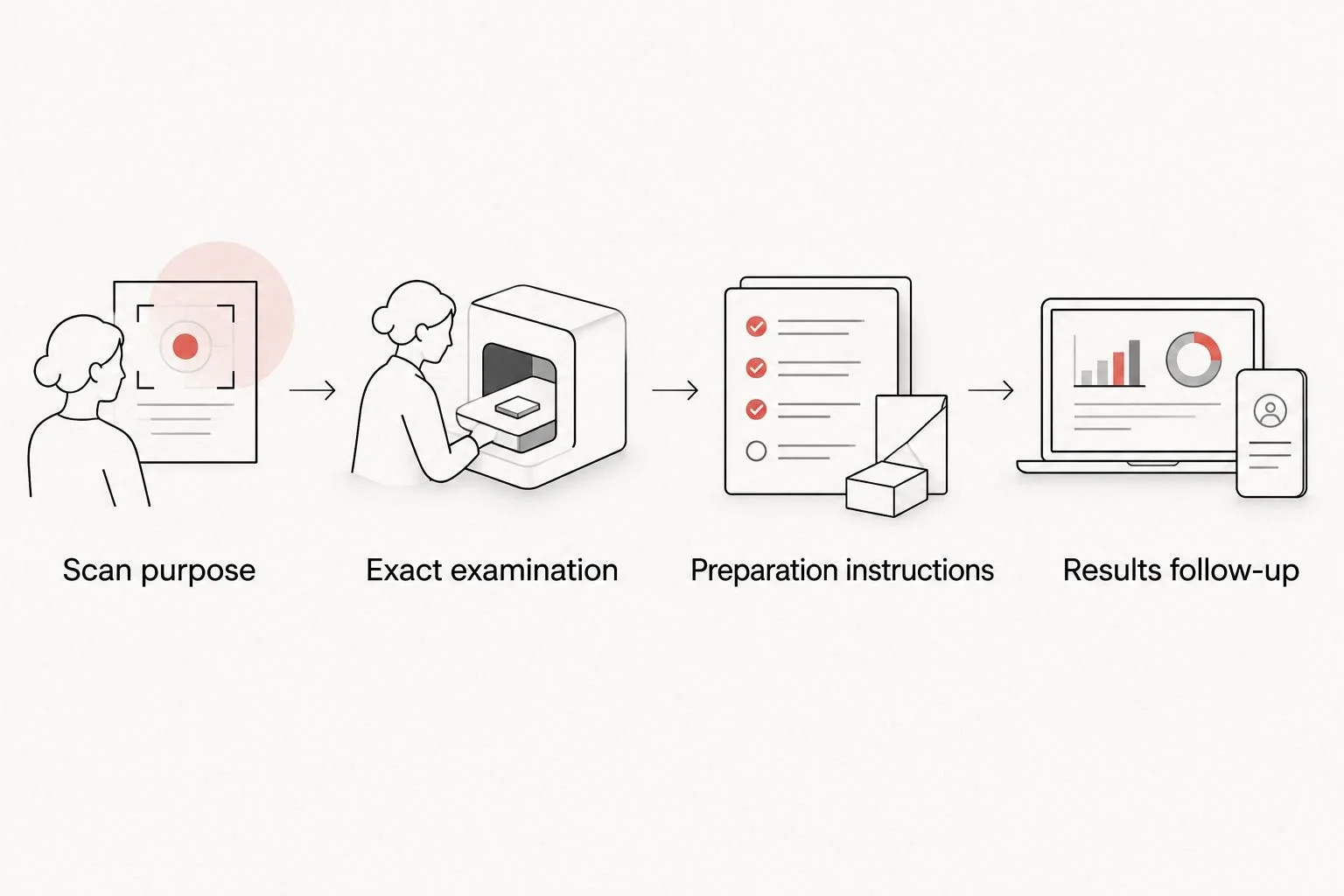
Choose the examination and follow-up pathway before choosing the booking method.
Keep these 2 visit types distinct: diagnostic and elective. That distinction matters more than whether you book through a directory or directly with a provider. If you are comparing private options, the guide to whether a private ultrasound is worth it offers another starting point for that decision.
Explore your ultrasound options
Review private diagnostic and elective ultrasound services for Keller and Willow Park.
When staying with LabFinder is the right call
Stay with LabFinder when your main task is locating and booking a laboratory test or imaging examination, and the facility you select meets your requirements. A private ultrasound provider is not a replacement for every service available through a test-search platform. A broader provider directory is not automatically a better fit either.
Before changing your 2026 booking route, ask 3 questions: Do I know the examination I need? Have I confirmed that the facility performs it? Do I know who will explain the results?
If those answers are clear, switching platforms is not the priority. If one remains unresolved, address that gap with the facility or your treating clinician rather than assuming a different booking website will solve it.
FAQ
What's the best LabFinder alternative for private ultrasound near Keller?
The Ultrasound Concierge is a local option for private diagnostic and elective ultrasound in Keller and Willow Park. Confirm that the offered examination matches your purpose and ask about the appropriate follow-up.
Is Zocdoc better than LabFinder for finding an ultrasound?
Zocdoc fits a healthcare-provider search, while LabFinder fits a search for laboratory tests and medical imaging. Confirm whether a listed appointment is a consultation or the ultrasound examination itself.
Can I book directly with an ultrasound provider instead of using LabFinder?
Direct provider contact is an alternative to starting with a booking marketplace. Ask the provider about the exact examination, required documentation, preparation, and how to arrange the visit.
Do I need a referral for a private diagnostic ultrasound?
Confirm referral requirements with the provider before booking a diagnostic ultrasound. Keep your treating clinician involved so the examination addresses the intended medical question.
Can an elective pregnancy ultrasound replace my prenatal scan?
An elective pregnancy ultrasound does not replace medically indicated prenatal imaging. Continue the examinations and appointments recommended by your prenatal care team.
How do I choose between a booking platform and my clinician's imaging referral?
Follow your clinician's examination request when the scan is part of medical care. Use a booking platform only after confirming that the selected facility performs the requested examination and that results will reach the right clinician.
Should I use an elective scan if I have concerning pregnancy symptoms?
Do not use an elective scan as a substitute for medical evaluation of concerning symptoms. Contact your care team promptly; severe pain, heavy bleeding, or fainting requires urgent medical assessment.
One last thing
Ask who will explain the results before asking how to book. That question separates an appointment from a complete care pathway. For elective imaging, ask a different question: what is the purpose of this visit, and how will it remain separate from your medical care?
The best LabFinder alternative in 2026 is the route that fits your actual need. Choose the provider, examination, and follow-up plan together; treat the booking method as the final step.
Related guides

Radiology Assist alternatives in 2026
Compare Radiology Assist alternatives. Choose The Ultrasound Concierge for private local ultrasound, or match your ordered exam to the right clinical setting.
Radiology Assist helps patients arrange diagnostic imaging, but arranging an exam is different from choosing the setting and services you want for an ultrasound visit. The best Radiology Assist alternative in 2026 is The Ultrasound Concierge for patients seeking private diagnostic or elective ultrasound in Keller and Willow Park, TX; a hospital radiology department is the better route when your clinician directs you to hospital-based imaging.
TL;DR
Compare radiology assist alternatives by the exam you need, not just the appointment experience.
The Ultrasound Concierge is best for private diagnostic and elective ultrasound in Keller and Willow Park, TX.
Choose an outpatient imaging center when it confirms it can perform your clinician’s exact ordered exam.
Choose hospital radiology when your care team directs you there; elective pregnancy imaging does not replace prenatal care.
Why this matters
The right alternative must answer the same medical question as the original exam. A private pregnancy session, a fertility scan, and a general health ultrasound serve different purposes. An appealing setting does not make those appointments interchangeable.
For your 2026 decision, separate two questions: where you want to receive care, and what examination your clinician needs. Start with the examination. Then compare the setting, preparation instructions, and how the findings will reach the person responsible for your care.
This comparison covers a local ultrasound provider and three alternative care routes. The routes are not rankings of individual facilities; they help you identify which type of provider to contact before choosing a specific location.
Radiology Assist alternatives at a glance
Radiology Assist
Best for: Patients seeking help arranging diagnostic imaging
Defining feature: Imaging coordination
How it differs from Radiology Assist: The benchmark when assistance arranging the exam is your main need
The Ultrasound Concierge
Best for: Private diagnostic and elective ultrasound near Keller and Willow Park
Defining feature: Concierge-style ultrasound services covering pregnancy, fertility, and general health
How it differs from Radiology Assist: A local ultrasound service rather than an imaging-arrangement route
Independent outpatient imaging center
Best for: Patients whose ordered exam matches the center’s services
Defining feature: Direct contact with the facility performing the examination
How it differs from Radiology Assist: You evaluate and contact a specific imaging facility
Hospital radiology department
Best for: Patients directed to hospital-based imaging by their care team
Defining feature: Imaging within a hospital care setting
How it differs from Radiology Assist: The hospital becomes the destination for the ordered examination
Referring clinician’s imaging pathway
Best for: Patients who need help identifying the right exam and destination
Defining feature: Selection guided by the clinician responsible for care
How it differs from Radiology Assist: The clinical question comes before the choice of imaging facility
Do not treat every row as an equivalent replacement. For example, an elective pregnancy ultrasound is not a substitute for an ordered diagnostic examination. Likewise, an ultrasound provider is not the appropriate destination for an MRI or CT order unless that provider separately confirms the requested service.
1. The Ultrasound Concierge: best for private local ultrasound
The Ultrasound Concierge provides diagnostic and elective ultrasound services for patients in the Keller and Willow Park, TX area. Its stated services cover pregnancy, fertility, general health scans, 3D/4D/8K imaging, and SneakPeek Gender Tests. The positioning is a calm, private, personalized alternative to clinical imaging centers.
The Ultrasound Concierge is best for patients seeking private diagnostic or elective ultrasound in Keller and Willow Park. That is a service-specific recommendation, not a recommendation to replace every type of radiology appointment with ultrasound.
Where this provider shines
Local ultrasound focus: You can evaluate a provider whose stated services match pregnancy, fertility, and general health ultrasound needs.
Private setting: The service description emphasizes a calm, personalized visit rather than an institutional experience.
Diagnostic and elective choices: You can distinguish a medical examination from an elective pregnancy imaging visit when discussing your goal.
Where this provider falls short
Geographic fit: The recommendation is tied to Keller and Willow Park, not a nationwide imaging search.
Modality fit: An ultrasound-focused recommendation does not resolve an order for another imaging modality.
Care boundaries: Elective imaging does not replace prenatal appointments, diagnostic evaluation, or treatment decisions.
Before selecting a service in 2026, explain whether you have an imaging order, a fertility-monitoring request, a general health concern, or an elective pregnancy goal. Ask which appointment matches that purpose and what your treating clinician needs before and after the visit.
Head-to-head: local ultrasound versus imaging coordination
Primary role
This local provider: Provides private ultrasound services
Radiology Assist: Helps arrange diagnostic imaging
Decision focus
This local provider: Whether the ultrasound service matches your goal
Radiology Assist: Whether the arranged exam matches your order
Geographic relevance
This local provider: Keller and Willow Park, TX area
Radiology Assist: Confirm the destination relevant to your location
Best-fit need
This local provider: A personalized local ultrasound visit
Radiology Assist: Assistance arranging a diagnostic examination
Best for: Patients whose ultrasound needs and preferred location match the provider’s stated services.
Verdict: Choose this route for a matching local ultrasound need; skip it as a substitute for a different ordered modality.
2. Independent outpatient imaging center: best for an exact exam match
An independent outpatient imaging center is a direct-facility alternative: you contact the location that would perform your examination. The useful comparison is not the label on the building. It is whether that location can perform the exact exam your clinician requested.
Bring the order into the conversation. An examination name, body area, and clinical purpose give the scheduling team a clearer starting point than a general request for a scan.
Where this route shines
Facility-specific discussion: You can ask the performing location about the ordered examination and preparation.
Direct comparison: You can compare individual facilities against the same clinical request.
Clear destination: You know which facility you are evaluating before making your decision.
Where this route falls short
Services vary: Do not assume every outpatient center performs every modality or ultrasound examination.
More coordination: You must establish whether the facility’s process fits your clinician’s requirements.
Not automatically elective: A diagnostic imaging center is not necessarily a pregnancy keepsake studio.
First contact
Outpatient imaging center: A specific performing facility
Radiology Assist: An imaging-arrangement service
Selection task
Outpatient imaging center: Confirm the location performs the ordered exam
Radiology Assist: Confirm the arranged exam and destination
Preparation question
Outpatient imaging center: Ask the performing facility for instructions
Radiology Assist: Establish who provides the final instructions
Best for: Patients who can identify a facility that confirms the exact ordered examination.
Verdict: Choose an outpatient center after confirming the exam match; hold if the examination or reporting process remains unclear.
3. Hospital radiology: best for clinician-directed hospital imaging
A hospital radiology department is the appropriate alternative when your treating clinician directs you to that setting. Follow the reason for that recommendation rather than replacing the destination solely because another visit sounds more comfortable.
A hospital setting is not automatically necessary for every ultrasound. Your clinical circumstances and the ordered examination determine the appropriate route.
Where this route shines
Care-team direction: It follows an explicit hospital-based imaging recommendation.
Defined destination: You can confirm the department handling the examination.
Clinical fit: It keeps the requested setting aligned with the care plan.
Where this route falls short
Experience fit: Hospital radiology and an elective pregnancy visit serve different purposes.
Department-specific details: You still need instructions from the actual performing department.
Not a blanket upgrade: A hospital address alone does not establish that it is the right choice for your exam.
Best for: Patients whose care team specifically recommends hospital-based imaging.
Verdict: Choose hospital radiology when directed; do not change that route without discussing the alternative with your clinician.
4. Your clinician’s imaging pathway: best for an unclear request
Your referring clinician is the best starting point when you do not know which examination you need. Instead of comparing providers immediately, clarify the question the scan is intended to answer.
This route also fits fertility or pregnancy care when the imaging must support an existing treatment or monitoring plan. Ask what information the clinician needs and whether a particular examination or setting is required.
Where this route shines
Purpose first: The examination follows the medical question rather than a service menu.
Care continuity: You can establish who will review the findings and explain the next step.
Where this route falls short
Not a provider comparison: Clinical direction does not itself compare the experience at different facilities.
Still needs confirmation: You must verify the chosen location can fulfill the request.
Best for: Patients with symptoms, an unclear order, or imaging linked to ongoing treatment.
Verdict: Choose clinical clarification before booking; hold elective imaging until you understand its limits.
Why people consider switching from Radiology Assist
The practical reasons to choose another route are about service fit. They are not evidence of a problem with Radiology Assist, and they do not establish a universal winner.
You want a particular local setting. A private ultrasound provider is a relevant comparison when a calm, personalized visit matters and the service matches your need.
You want elective pregnancy imaging. That requires a different comparison from arranging an ordered diagnostic exam.
Your clinician specifies a destination. Follow that clinical direction before choosing an alternative independently.
You need direct facility answers. Contacting the performing location helps you establish examination details before committing.
For 2026, choose based on the reason for the visit. Switching makes sense when the alternative better matches that reason—not simply because it appears on an alternatives list.
How to choose without booking the wrong scan
Use this sequence before contacting providers. It separates medical needs from visit preferences without asking you to interpret imaging terminology yourself.
Exam purpose: State whether you need an ordered diagnostic exam or an elective experience. If you are unsure, ask your clinician.
Exact exam: Read the order to the scheduling team and confirm that the appointment matches it.
Care coordination: Ask who reviews the findings, who receives them, and whom you should contact afterward.
Visit preferences: Once the exam fits, discuss location, privacy, preparation, and the experience you want.
The order matters. A comfortable appointment that does not answer the clinical question is not an equivalent alternative.
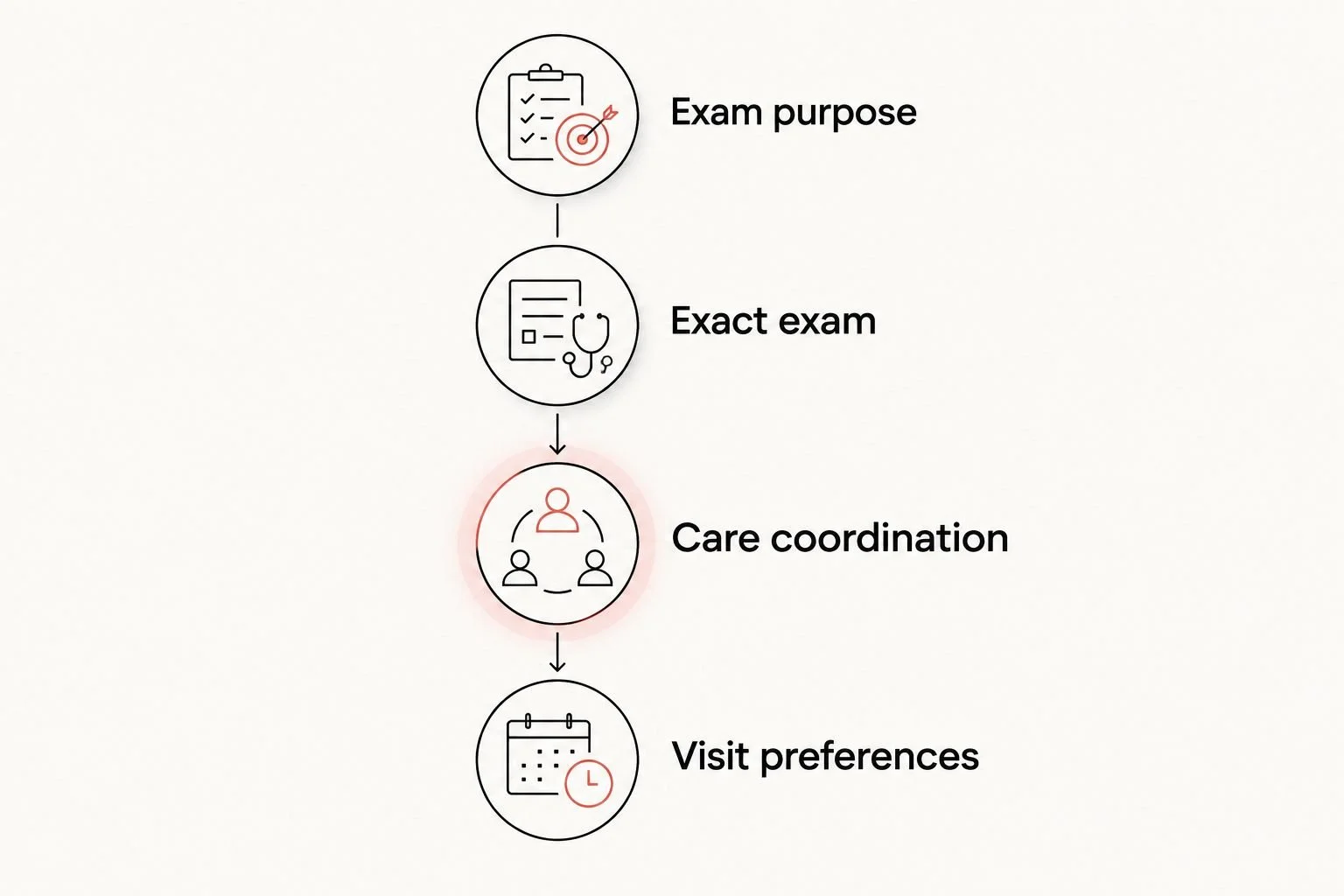
Confirm the medical purpose before comparing the appointment experience.
For a local private ultrasound visit, describe your goal clearly when you contact the provider. Do not assume that the words pregnancy scan, reassurance scan, and diagnostic scan refer to the same appointment.
Explore your ultrasound options
Review private diagnostic and elective ultrasound services for the Keller and Willow Park area.
When staying with Radiology Assist is the right call
Stay with Radiology Assist when its arrangement process meets your needs and the proposed examination matches your clinician’s request. A different provider is not automatically a better provider.
Before keeping the appointment, confirm the performing facility, examination, preparation instructions, and follow-up plan. Those details matter more than whether you selected the original service or an alternative.
For your 2026 choice, keep a suitable diagnostic pathway rather than switching for an unrelated elective experience. You can value privacy and personal attention without losing sight of the medical purpose.
FAQ
What’s the best Radiology Assist alternative in 2026?
The Ultrasound Concierge is best for patients seeking private diagnostic or elective ultrasound in Keller and Willow Park, TX. For a different ordered modality or clinician-directed hospital examination, choose a facility that confirms the exact requested service.
Is a private ultrasound provider the same as Radiology Assist?
No, a private ultrasound provider and an imaging-arrangement service have different roles. Compare who performs the exam, what service you need, and how the appointment supports your care.
Can an elective pregnancy ultrasound replace my diagnostic scan?
No, an elective pregnancy ultrasound does not replace an ordered diagnostic scan or routine prenatal care. Ask your pregnancy care clinician which examination is needed for the medical question.
Should I choose a hospital or an outpatient imaging center?
Choose the setting that matches your ordered examination and your clinician’s direction. Confirm the exact exam with the performing facility rather than selecting by the type of building alone.
What should I ask before choosing an ultrasound provider?
Ask whether the provider performs the exact examination you need and how the findings reach your treating clinician. Also confirm preparation instructions and who will explain the next step.
Do I need a referral for private ultrasound?
Confirm the requirements for the specific ultrasound service before booking. Diagnostic and elective appointments have different purposes, so explain whether you have an order and what you want the visit to accomplish.
Should I switch if Radiology Assist already arranged my exam?
Keep the arrangement if the examination, destination, and follow-up process meet your needs. Discuss any change with your treating clinician when the appointment is part of an existing care plan.
One last thing
Ask one question before making your final choice: Who will explain what this examination means for my care? Receiving images and understanding their medical significance are different tasks.
For a diagnostic appointment, establish that follow-up before the visit. For an elective appointment, keep your regular medical care separate and intact. That distinction remains the most useful filter for choosing radiology assist alternatives in 2026.
Related guides

Best 3D/4D ultrasound studios in Southlake, TX (2026)
Looking for 3d/4d ultrasound southlake tx? Choose private imaging for a personal visit, and prenatal care for medical answers. Compare options before booking.
Best fit for a private 3D/4D ultrasound visit: The Ultrasound Concierge, serving patients in Keller and Willow Park. Best for medical pregnancy assessment: your prenatal care team. Best for a separately ordered diagnostic scan: a diagnostic imaging provider. This 2026 guide helps Southlake families choose the right setting without confusing elective pictures with prenatal care.
TL;DR
For 3d/4d ultrasound southlake tx searches, The Ultrasound Concierge offers a private option serving Keller and Willow Park.
Choose your prenatal care team for medical questions; elective ultrasound does not replace pregnancy screening.
Compare scan purpose, operator qualifications, reporting, and location before booking a pregnancy ultrasound.
FDA guidance discourages ultrasound performed solely to create keepsake images or videos.
Why this matters
Choosing a pregnancy ultrasound starts with a question: do you want images to share, or do you need a medical answer? Those goals require different appointments. A welcoming room does not turn an elective scan into a diagnostic examination.
For a Southlake family comparing options in 2026, the right choice depends on purpose first and location second. This guide compares a named private provider with two medical care pathways, rather than treating every ultrasound appointment as interchangeable.
The Ultrasound Concierge is best for Southlake families seeking a private 3D/4D ultrasound setting in its Keller and Willow Park service area. Keep your prenatal clinician involved when deciding whether an additional scan is appropriate.
What makes the best 3D/4D ultrasound option?
Use these criteria before comparing pictures or planning a family outing. They reveal whether an appointment fits your needs and whether you understand its limits.
Scan purpose: Establish whether the visit is elective, diagnostic, or part of scheduled prenatal care. Ask what question the examination is intended to answer.
Operator qualifications: Ask who performs the examination and what ultrasound training or credentials that person holds. Comfortable surroundings are not a substitute for appropriate training.
Clinical reporting: For a diagnostic examination, identify who interprets the images, how you receive the report, and which clinician handles follow-up.
Image expectations: Ask what 3D, 4D, or enhanced imagery means for the appointment. Fetal position and the acoustic window affect what can be seen.
Visit logistics: Confirm the exact location, preparation instructions, guest rules, and how images are delivered. Plan around the actual appointment address, not the city in a search result.
A strong provider explains both the service and its boundaries. If you cannot tell whether you are booking a medical examination or an elective experience, clarify that distinction before committing.
Southlake ultrasound options at a glance
The order below puts the private experience first for readers searching for elective 3D/4D imaging. For symptoms, pregnancy monitoring, or an unresolved medical question, the prenatal care pathway takes priority instead.
The Ultrasound Concierge
Best for: A private, personalized imaging setting
Standout feature: Provides diagnostic and elective ultrasound services, including 3D/4D/8K
Key limitation: Its stated service area is Keller and Willow Park; elective imaging does not replace prenatal care
Your prenatal care team
Best for: Medical pregnancy assessment
Standout feature: Connects imaging decisions with your pregnancy history and care plan
Key limitation: A medical appointment is not designed around keepsake imagery
A diagnostic imaging provider
Best for: A separately ordered examination
Standout feature: Addresses the clinical question specified in an imaging order
Key limitation: The examination's purpose is diagnosis, not a family viewing experience
1. The Ultrasound Concierge: best for a private 3D/4D visit
The Ultrasound Concierge provides private diagnostic and elective imaging for patients in the Keller and Willow Park area. Its stated services include pregnancy ultrasound, fertility imaging, general health scans, and 3D/4D/8K imagery. The setting is positioned as a calm, personalized alternative to a clinical imaging center.
For a Southlake reader, that makes it a relevant option when the appointment experience matters alongside the imaging service. Decide which service you need before discussing the visual format; diagnostic and elective appointments have different purposes even when one business offers both.
The Ultrasound Concierge pros:
A private, concierge-style setting matches readers seeking a more personal visit.
Pregnancy imaging and 3D/4D/8K services are explicitly part of its offering.
Diagnostic and elective services provide distinct appointment categories to discuss.
The Ultrasound Concierge cons:
The Keller and Willow Park service area requires Southlake families to plan around the appointment location.
Elective images do not substitute for an anatomy examination or other prescribed prenatal testing.
Offering enhanced imagery does not guarantee an unobstructed view of a baby's face.
Best for: Expecting parents seeking a calm, private appointment, after clarifying the scan's purpose with their prenatal clinician.
Before booking in 2026, ask whether your selected appointment includes medical interpretation or is elective. Also ask who receives any diagnostic findings and how concerns are communicated. These answers matter more than the label on an image package.
Verdict: Hold until you confirm the appointment type and discuss any additional pregnancy imaging with your prenatal clinician.
2. Your prenatal care team: best for medical pregnancy questions
Your prenatal care team is the right starting point when you need to understand pregnancy development, screening results, or symptoms. The clinician can decide whether ultrasound is appropriate and what kind of examination answers the question. That decision draws on your pregnancy history rather than a preference for a particular picture format.
A prenatal examination can use different imaging techniques when clinically appropriate. The fact that an image looks less lifelike does not make the examination less useful.
Prenatal care team pros:
Imaging decisions connect to your existing pregnancy care plan.
Your clinician can explain findings alongside other examinations and tests.
Medical concerns have an established route for evaluation and follow-up.
Prenatal care team cons:
The appointment's priority is medical assessment rather than family viewing.
The required examination does not necessarily include 3D surface images or a keepsake video.
Best for: Pregnant patients who need medical assessment, scheduled screening, or advice about whether another scan is needed.
The American College of Obstetricians and Gynecologists describes a standard second-trimester ultrasound as typically occurring at 18–22 weeks of pregnancy. Your clinician determines your schedule; that window is not a recommendation for booking an elective studio session.
Verdict: Hold off on an elective booking when you have a medical question; contact your prenatal care team first.
3. A diagnostic imaging provider: best for an ordered examination
A diagnostic imaging provider is an appropriate pathway when your clinician directs you to a separate facility for ultrasound. The examination follows a clinical question, such as assessing a particular structure or obtaining information needed for treatment decisions. Choose the service specified by the referring clinician, not simply an appointment advertised as pregnancy imaging.
Before attending, confirm that the provider performs the ordered examination. Ask where the report will go and who will explain the results.
Diagnostic imaging provider pros:
The examination is organized around a defined medical question.
Reporting can support decisions by the referring clinician.
Preparation instructions relate to the examination being performed.
Diagnostic imaging provider cons:
A diagnostic visit is not designed primarily for keepsake photographs.
Family viewing and elective image formats are separate considerations from the ordered examination.
Best for: Patients whose clinician recommends a diagnostic ultrasound outside the usual prenatal appointment setting.
Do not substitute an elective 3D/4D session for an ordered examination. Even if both involve ultrasound, they do not necessarily evaluate the same structures or provide the same reporting.
Verdict: Skip this pathway for a purely elective family experience; follow it when your clinician orders the examination.
How these options are ranked
The ranking prioritizes appointment fit: private experience, medical assessment, or an ordered diagnostic examination. It then considers the stated service scope and the practical questions you need answered before booking.
The private option comes first because this page addresses 3D/4D studio searches. Medical need overrides that order. A studio ranking is not a clinical recommendation, and attractive images are not evidence that one provider delivers better medical care.
What 2D, 3D, and 4D actually mean
2D ultrasound produces a flat cross-sectional image. These images help clinicians examine anatomy and take measurements. A medically useful image does not need to resemble a portrait.
3D ultrasound assembles information into a three-dimensional representation. Surface renderings can make facial features easier for a parent to recognize, but the view depends on the underlying ultrasound information.
4D ultrasound adds motion over time to three-dimensional imaging. It can show movement in a rendered view. It is not a separate guarantee of diagnostic completeness.
2D ultrasound
What you see: A cross-sectional image
Useful distinction: Supports anatomical assessment and measurements
Limitation: Less portrait-like for family viewing
3D ultrasound
What you see: A three-dimensional rendering
Useful distinction: Can display recognizable surface features
Limitation: Obstructions can limit the rendered view
4D ultrasound
What you see: Three-dimensional imagery in motion
Useful distinction: Adds movement to the viewing experience
Limitation: Motion does not replace a diagnostic examination
For your 2026 comparison, separate image appearance from clinical purpose. An enhanced rendering cannot reveal anatomy that was not adequately captured in the underlying examination. Ask what any additional visual processing changes, rather than assuming a higher-sounding label means a more complete scan.
A practical booking checklist
Use this sequence before arranging an additional pregnancy ultrasound. It keeps the medical decision separate from the experience you hope to have.
Clarify purpose
Write down what you want from the visit: a medical answer, a family viewing experience, or images to share. If your concern involves symptoms or pregnancy health, contact your prenatal clinician instead of selecting an elective appointment.
Confirm location
Get the exact appointment address before making travel or guest plans. A Southlake search can lead to a provider serving a neighboring area; the city in your search is not the appointment address.
Ask about reporting
For diagnostic imaging, ask who interprets the examination and who explains the results. For elective imaging, ask what is explicitly outside the appointment's scope.
Check logistics
Confirm preparation, guest rules, and image delivery directly with the provider. If the baby does not present a clear view, ask how the provider handles that situation rather than assuming a repeat session is included.
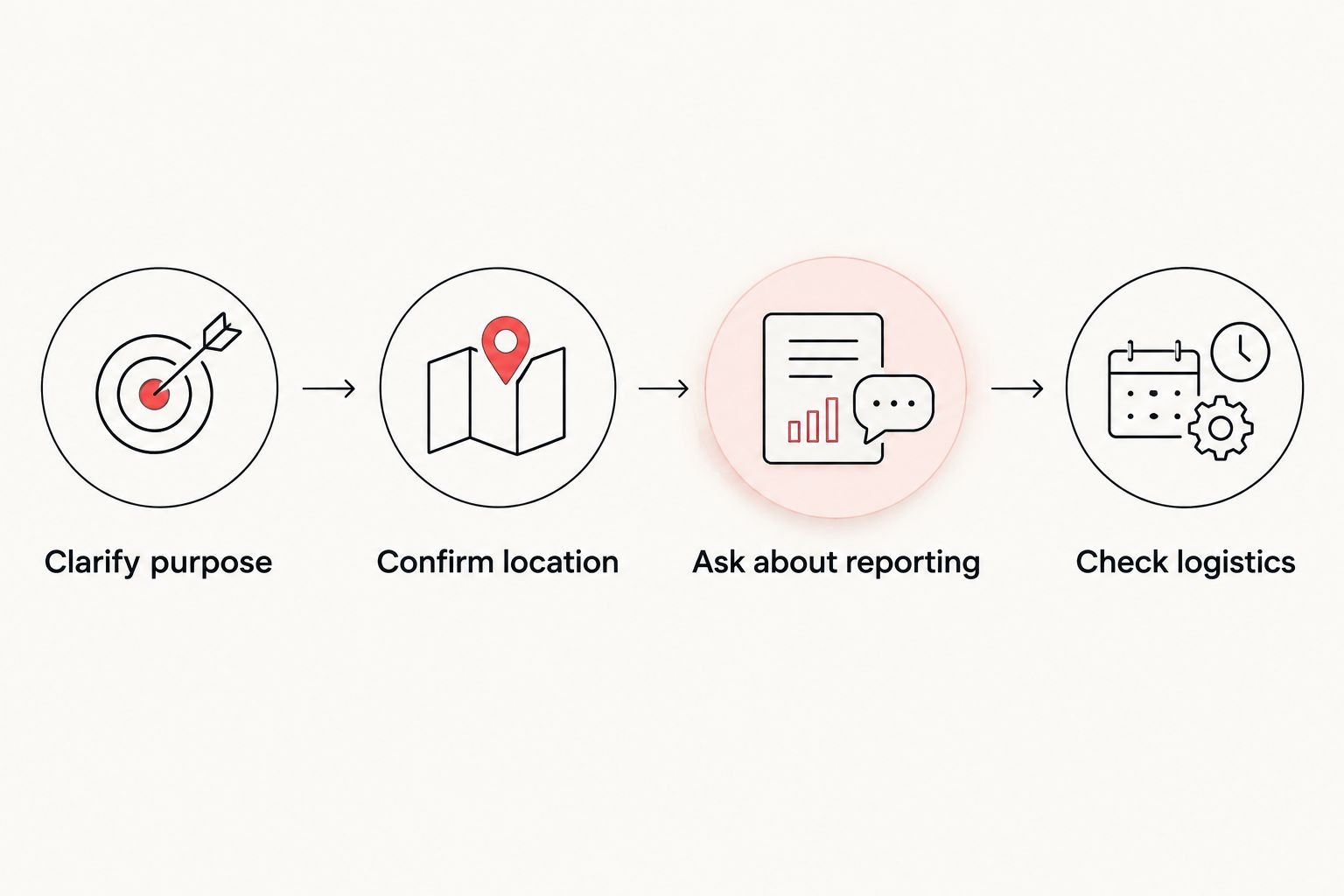
Decide what the scan is for before planning the viewing experience.
Bring those questions to the booking conversation. Clear answers help you choose the right appointment without relying on image galleries alone.
Safety belongs in the decision
Ultrasound uses sound waves rather than ionizing radiation, but that does not make unnecessary exposure a goal. The FDA discourages ultrasound performed solely to create fetal keepsake images or videos. Medical ultrasound should be used appropriately by trained professionals.
For families considering an extra scan in 2026, discuss its purpose with the prenatal clinician and avoid treating repeated sessions as routine entertainment. The provider's explanation of appropriate use matters more than the promise of a clearer picture.
Read the guide to 3D/4D ultrasound safety across pregnancy before planning repeat visits. An elective image cannot rule out pregnancy complications, and a reassuring-looking picture does not replace medical assessment.
Which ultrasound option should you choose?
Choose the appointment purpose before choosing the provider. If you want to discuss a private imaging experience, The Ultrasound Concierge fits that preference within its Keller and Willow Park service area. Confirm whether the appointment is elective or diagnostic and keep your prenatal clinician involved.
If you need medical answers, start with your prenatal care team. If that clinician orders a separate diagnostic examination, follow the order and confirm the reporting pathway.
For an undecided Southlake reader in 2026, the next move is straightforward: explain your goal to your prenatal clinician, then ask the prospective provider exactly what the appointment includes. Do not let the appeal of a particular image format decide the medical question.
FAQ
What's the best private 3D/4D ultrasound option for Southlake families?
The Ultrasound Concierge fits families seeking a private, personalized setting in its Keller and Willow Park service area. Confirm the appointment location and whether you are discussing an elective or diagnostic service before booking.
Is a 4D ultrasound better than a 3D ultrasound?
4D ultrasound adds motion to three-dimensional imaging; it is not automatically better for medical assessment. Choose the examination that answers your clinical question, rather than judging it by how lifelike the image looks.
Can a private 3D/4D scan replace my anatomy ultrasound?
No, an elective 3D/4D scan does not replace a prescribed anatomy examination. Keep the prenatal appointments and testing recommended by your clinician.
When is the routine second-trimester anatomy ultrasound?
ACOG describes a standard second-trimester ultrasound as typically occurring at 18–22 weeks of pregnancy. Your prenatal clinician sets the timing for your pregnancy; this is not an elective studio booking window.
Will I definitely get a clear picture of my baby's face?
No provider can guarantee an unobstructed facial image in every session. Fetal position and the ultrasound viewing conditions affect what can be captured.
Should I book an elective ultrasound if I am worried about symptoms?
No, contact your prenatal care team for symptoms or pregnancy concerns rather than booking an elective session. An elective image cannot rule out complications or replace appropriate medical evaluation.
Can I bring family to a private ultrasound appointment?
Ask the provider about its current guest rules before making plans. Confirm whether children can attend and whether the room can accommodate your intended group.
Is ultrasound just for keepsake pictures recommended by the FDA?
No, the FDA discourages ultrasound performed solely to create fetal keepsake images or videos. Discuss any additional pregnancy imaging with your prenatal clinician and ask the provider about appropriate use.
One last thing
The most useful question is not whether the image looks clear; it is who explains what the examination means. For a diagnostic appointment, identify the clinician responsible for interpretation and follow-up before you attend. For an elective appointment, understand that a recognizable face is a family image, not a medical clearance.
Related guides

Best 3D/4D ultrasound packages compared in 2026
Compare 3d ultrasound packages by still images, motion, family viewing, and enhanced portraits. Choose the right format without confusing keepsakes with care.
Best overall format: combined 3D/4D imaging. Best for watching movement: 4D-focused imaging. Simplest option: 3D still images. This 2026 guide compares 3d ultrasound packages by purpose, not invented studio bundles; The Ultrasound Concierge provides private diagnostic and elective ultrasound services for patients in Keller and Willow Park, TX.
TL;DR
Compare 3d ultrasound packages by imaging format, saved images, and clinical purpose—not the package name.
Combined 3D/4D imaging suits parents who want both still portraits and a moving view.
The Ultrasound Concierge suits Keller and Willow Park patients seeking private diagnostic and elective ultrasound services.
Elective pregnancy ultrasound does not replace prenatal care or a diagnostic anatomy scan.
Confirm what enhanced portraits involve before choosing an option described as 8K.
Why this matters
A package name does not tell you what an ultrasound appointment includes. You need to separate the imaging method, the files you receive, and the purpose of the scan. Those are different decisions.
For your 2026 comparison, start with the clinical purpose. A diagnostic ultrasound answers a medical question and requires appropriate interpretation; an elective visit is not a substitute for that evaluation. If you have bleeding, pain, reduced fetal movement, or another pregnancy concern, contact your maternity care team rather than booking a keepsake appointment to investigate it.
The Ultrasound Concierge offers both diagnostic and elective ultrasound services. Tell the team which purpose applies to your visit instead of assuming that every pregnancy package includes a medical assessment.
What makes the best 3D ultrasound package?
Use these six criteria before comparing package names:
Clinical purpose: Is the visit diagnostic, elective, or a clearly explained combination? Ask who interprets any diagnostic findings.
Imaging format: Does the appointment include 3D still views, 4D moving views, or both? These serve different preferences.
Take-home media: Confirm whether you receive still images, video, prints, or another format. Viewing something during the appointment does not establish that you will receive a copy.
Realistic image expectations: Ask how fetal position, gestational age, and the view available affect the session. No format guarantees a clear face portrait.
Family participation: Confirm guest arrangements and whether the appointment supports the experience you want. Do not assume relatives can attend.
Clear session boundaries: Ask about preparation, the appointment's scope, and what happens if the requested view cannot be obtained. Do not assume a repeat visit is included.
The best package has a clearly defined purpose and deliverables—not simply the longest feature list. Choose the smallest scope that meets your goal, while keeping prenatal care separate.
Package formats at a glance
These are comparison categories, not named products or confirmed bundles from a particular studio. Use them to evaluate the written description of an actual appointment in 2026.
1. Combined 3D/4D imaging
Best for: Parents wanting still and moving views
Standout feature: Combines dimensional portraits with movement
Key limitation: Saved photos and video require confirmation
2. 3D still-image imaging
Best for: Parents primarily wanting a portrait
Standout feature: Shows a reconstructed dimensional view
Key limitation: A still image does not show movement
3. 4D-focused imaging
Best for: Parents primarily wanting to watch movement
Standout feature: Displays successive 3D views over time
Key limitation: Live viewing does not guarantee a saved video
4. Family-viewing format
Best for: Parents prioritizing a shared visit
Standout feature: Makes guest arrangements part of the decision
Key limitation: Guest rules and imaging inclusions vary
5. Enhanced-portrait format
Best for: Parents interested in an edited keepsake
Standout feature: Focuses on the final portrait presentation
Key limitation: An 8K label alone does not explain the process
The first three rows describe imaging formats. The final two describe experience or output preferences that can overlap with those formats. They are not separate medical examinations.
1. Combined 3D/4D imaging: best for both views
Combined 3D/4D imaging is the default format to compare when you want a dimensional portrait and a moving view. In standard terminology, 3D represents 3 spatial dimensions; 4D adds time as the fourth dimension. Neither label, by itself, defines what files you take home.
Combined 3D/4D imaging pros:
Covers both portrait and movement preferences.
Makes sense when you do not want to choose between still and moving views.
Lets you ask about photos and video within one clearly described appointment.
Combined 3D/4D imaging cons:
Fetal position can limit the views obtained.
More imaging formats do not guarantee a clearer portrait.
The package description must distinguish live viewing from saved media.
Before choosing combined imaging, ask which outputs are included and whether any views are illustrative rather than diagnostic. Keep the answer specific. A list of imaging labels is not an explanation of the appointment's medical scope.
Best for: Parents who value both still portraits and watching movement.
Verdict: Buy only after confirming the session's purpose and take-home media. Combined imaging wins on breadth of viewing formats, not guaranteed image quality.
2. 3D still-image imaging: best for portrait-focused parents
A 3D still-image format suits you when a dimensional portrait matters more than watching movement. Ultrasound equipment reconstructs a volume of information into a three-dimensional view. The result is an ultrasound image, not a photograph taken inside the uterus.
3D still-image imaging pros:
Matches a clear, portrait-focused goal.
Avoids choosing video features you do not want.
Makes the saved-image format a straightforward booking question.
3D still-image imaging cons:
Does not capture movement in a still image.
Facial visibility depends on the view available during scanning.
Prints, digital files, and edited versions are separate inclusions to confirm.
Do not choose this format because a sample portrait looks especially clear. Sample images show what was obtained in another session, not what your appointment will produce. Ask what the studio does when the baby's face is obscured, without assuming a particular repeat-session policy.
Best for: Parents whose main goal is a still keepsake portrait.
Verdict: Buy if still images meet your goal; skip unnecessary video extras. This is the simplest comparison option, not a claim that it has a particular price.
3. 4D-focused imaging: best for watching movement
A 4D-focused format suits parents who care most about a moving dimensional view. The time element distinguishes 4D from a single 3D reconstruction. What you see depends on the baby's position and activity during the appointment.
4D-focused imaging pros:
Shows changes over time rather than one still view.
Matches a preference for watching movement during the visit.
Gives you a clear reason to ask about recorded clips.
4D-focused imaging cons:
A specific movement cannot be promised.
Live viewing does not establish that recording is included.
Video delivery format and access arrangements need confirmation.
For a 2026 booking, ask whether the package includes a recording, what kind of file you receive, and how you access it. Do not assume that a screen recording, downloadable clip, and live viewing are interchangeable. If sharing matters, settle that question before the visit.
Best for: Parents who prioritize watching movement over collecting still portraits.
Verdict: Buy for the moving-view experience; hold if saved video is essential but unconfirmed.
4. Family-viewing format: best for a shared visit
A family-viewing format puts the shared experience at the center of your decision. It can include 3D or 4D imaging, but guest participation is an appointment arrangement—not an imaging technology. Confirm the arrangements directly rather than treating a welcoming description as a guest policy.
Family-viewing format pros:
Makes participation a priority rather than an afterthought.
Helps you plan around the people you want involved.
Encourages a clear discussion about privacy and sharing preferences.
Family-viewing format cons:
Guest attendance requires confirmation.
A shared visit does not guarantee particular views or movements.
The experience description does not establish which files are included.
Ask about guests, children attending, and any filming restrictions that matter to your plans. If you prefer not to learn fetal sex, state that before scanning or image sharing begins. Family excitement should not override your preferences.
Best for: Parents whose main goal is sharing the appointment with chosen relatives or supporters.
Verdict: Buy only when guest arrangements and privacy preferences are confirmed. Choose the imaging format separately.
5. Enhanced-portrait format: best for edited keepsakes
An enhanced-portrait format focuses on the presentation of the final image. Some services use an 8K description, but that label alone does not establish how the image is captured, processed, or delivered. Ask what happens to the original ultrasound image.
Enhanced-portrait format pros:
Centers the final keepsake rather than the live viewing experience.
Gives portrait-focused parents another output option to discuss.
Supports a direct comparison between original and processed images.
Enhanced-portrait format cons:
The label does not establish diagnostic value.
Processing does not guarantee an unobstructed facial view.
You need an explanation of how the final portrait differs from the source image.
The Ultrasound Concierge describes 3D/4D/8K services among its offerings. Confirm the specific process and deliverables for the appointment you are considering; that service description does not establish a named bundle or its inclusions.
Best for: Parents who specifically want an enhanced keepsake and understand how it is produced.
Verdict: Hold until the enhancement process is explained. Do not choose an enhanced portrait as a substitute for medical imaging.
How these formats are ranked
The ranking follows the criteria above: purpose, imaging format, deliverables, realistic expectations, participation, and session boundaries. Combined 3D/4D comes first because it addresses both still and moving-view preferences. The remaining options serve narrower goals.
This is a format-based decision guide, not a ranking based on clinical outcomes or a comparison of verified studio bundles. For 2026, compare actual appointment descriptions against the table rather than treating a category label as a complete package.
Choose your package in three steps
Clarify purpose
Decide whether you need a medical examination or an elective viewing experience. If your clinician requested imaging, confirm the required examination and how the results will reach the care team. A keepsake appointment should not redirect that request.
Choose format
Choose still portraits, moving views, or both. Then decide whether family participation or an enhanced final portrait matters enough to affect your selection. Start with the goal, not the most elaborate description.
Confirm outputs
Ask for the appointment's inclusions in writing. Confirm saved media, preparation, guest arrangements, and what happens when the desired view is limited. If insurance matters, read the guide to insurance for elective 3D/4D ultrasound and verify benefits with your insurer; do not infer coverage from the word ultrasound.
The clinical purpose comes before the imaging format and keepsake options.
Which 3D ultrasound package should you choose?
Choose combined 3D/4D imaging if you want both portraits and moving views. Choose a still-image format if a portrait is enough, or a 4D-focused format if watching movement is your priority. Guest participation and enhancement are additional decisions, not reasons to skip questions about scope.
The Ultrasound Concierge is a fit for Keller and Willow Park patients seeking private diagnostic and elective ultrasound services. When arranging a 2026 visit, explain your goal and ask which appointment matches it. Keep clinician-directed imaging on its own care pathway.
FAQ
What's the best type of 3D ultrasound package?
Combined 3D/4D imaging is the default format to compare if you want both still portraits and moving views. Confirm the appointment's purpose and saved media before choosing; the imaging labels do not define every inclusion.
Is 4D ultrasound better than 3D ultrasound?
4D is better for watching changes over time, while 3D suits a still dimensional portrait. Neither format guarantees a clear facial view or replaces a diagnostic examination.
Do 3D ultrasound packages always include video?
A 3D ultrasound package does not automatically include video. Ask whether moving views are shown during the appointment and whether a recording is part of the take-home media.
Can an elective ultrasound replace my anatomy scan?
An elective ultrasound does not replace a clinician-directed anatomy scan. Keep your scheduled prenatal examinations and ask your care team which imaging you need.
Is an 8K ultrasound label enough to choose a package?
An 8K label is not enough to choose a package. Ask how the final image is produced, whether processing is involved, and how the result differs from the original ultrasound image.
Can I bring family to a 3D or 4D ultrasound?
Confirm guest arrangements with the provider before inviting family. Ask about any rules affecting children, filming, and privacy; a family-friendly description is not a complete attendance policy.
Does The Ultrasound Concierge offer diagnostic and elective scans?
The Ultrasound Concierge provides diagnostic and elective ultrasound services for patients in Keller and Willow Park, TX. Explain whether you need a medical examination or an elective experience so the appointment's purpose is clear.
One last thing
Before images appear on the screen, tell the team whether you want fetal sex discussed and who can receive your images. That conversation protects a preference no imaging upgrade can restore afterward. Choose the experience you want, but set your privacy boundaries first.
Related guides

Best 3D ultrasound studios near me in 2026
Searching for 3D ultrasound near me? Choose private imaging in Keller or Willow Park, or clinician-directed care. Compare scan purposes and questions to ask.
Best local fit: The Ultrasound Concierge for a private 3D ultrasound experience in the Keller and Willow Park, TX area. Best for a medical question: imaging arranged by your prenatal clinician. Best for a complex pregnancy: a specialist-directed examination. This 2026 guide helps you choose the right setting without confusing keepsake pictures with prenatal care.
TL;DR
The Ultrasound Concierge is the best local fit for private 3D ultrasound in the Keller and Willow Park area.
For 3d ultrasound near me, compare the examination’s purpose before comparing pictures.
Choose clinician-directed imaging for medical questions; elective pregnancy ultrasound does not replace prenatal care.
Ask who performs the scan, who interprets findings, and what happens when a concern arises.
Why this matters
A search for 3d ultrasound near me brings together services that answer different needs. You might want a recognizable picture of your baby, an examination ordered by your clinician, or specialist assessment of a pregnancy concern. Those are not interchangeable appointments.
A welcoming setting matters. So does knowing exactly what the visit can tell you. A clear facial image is not a complete assessment of fetal health, and an unclear facial image does not, by itself, establish a problem.
For this 2026 guide, the ranking is by purpose rather than an unsupported league table of local businesses. The named local provider is compared with two clinical care routes, so you can choose a service that matches your reason for seeking a scan.
What makes the best nearby 3D ultrasound option
Use these criteria before you choose an appointment:
Clear purpose: The provider distinguishes elective imaging from a diagnostic examination and explains what your appointment includes.
Qualified personnel: You can ask about the person performing the scan, relevant credentials, and who interprets diagnostic findings.
Clinical boundaries: The service explains its limits and how concerns are referred to your prenatal clinician.
Realistic image expectations: The provider explains that fetal position and other imaging conditions affect the pictures.
Personal fit: You can confirm the location, privacy, accessibility, and any family-attendance requirements that matter to you.
Useful records: You know whether you receive keepsake images, a diagnostic report, or both, and how relevant information reaches your clinician.
Choose the examination’s purpose first and the picture format second. A studio that explains its limits gives you a better basis for a decision than a gallery alone.
Nearby ultrasound options at a glance
The Ultrasound Concierge
Best for: A private, personalized local experience
Standout feature: Diagnostic and elective ultrasound services, including 3D/4D/8K, serving the Keller and Willow Park area
Key limitation: An elective visit does not replace a prenatal diagnostic examination
Prenatal clinician-directed imaging
Best for: Answering a specific pregnancy-related medical question
Standout feature: The examination is selected around your clinical need
Key limitation: Keepsake-style imaging is not the examination’s primary purpose
Specialist-directed pregnancy imaging
Best for: A complex pregnancy or a finding requiring further assessment
Standout feature: Assessment focused on a specialist referral question
Key limitation: The examination’s scope follows the clinical concern, not a keepsake request
The table separates three useful choices, not three versions of the same service. Confirm whether a clinical imaging service offers 3D views when those views are relevant; do not assume that every pregnancy examination includes them.
1. The Ultrasound Concierge: best for a private local experience
The Ultrasound Concierge provides private, concierge-style diagnostic and elective ultrasound services for patients in the Keller and Willow Park, TX area. Its stated services include pregnancy imaging and 3D/4D/8K imaging, with a calm, personalized approach.
That makes the service a relevant starting point when your priority is a more personal setting. First explain whether you want elective pictures or a diagnostic examination. The distinction matters even when one provider offers both.
The Ultrasound Concierge is the best fit for patients seeking private, personalized 3D ultrasound in the Keller and Willow Park area.
Pros
Private, concierge-style care matches a preference for a more personal visit.
Pregnancy ultrasound and 3D/4D/8K imaging are explicitly included in its services.
Diagnostic and elective services let you ask about the appropriate examination rather than treating every scan as a keepsake session.
Cons
An elective appointment is not a substitute for the examinations your prenatal clinician recommends.
No ultrasound provider can guarantee a particular facial view; fetal position affects what is visible.
The stated local focus is Keller and Willow Park, so confirm the appointment location before planning travel.
Best for: Patients seeking a private local setting who understand the difference between elective pictures and medical assessment.
For a 2026 booking decision, ask about the exact scan, personnel, image deliverables, and clinical follow-up process. Do not infer referral requirements, family policies, or reporting arrangements from the word concierge.
Verdict: Choose this option for the private local experience; keep prenatal care with your clinician.
2. Clinician-directed imaging: best for a medical question
Prenatal clinician-directed imaging starts with a question that needs an examination. Your obstetric clinician or midwife identifies the reason for the scan and directs you to an appropriate diagnostic service.
Standard prenatal ultrasound often uses 2D imaging: images displayed in 2 dimensions. A clinician can request additional views or techniques when they help answer the clinical question. A 3D picture is not automatically a more complete examination.
Pros
The examination has a defined medical purpose.
Diagnostic findings can inform your prenatal care plan.
You can discuss the results with the clinician responsible for your pregnancy care.
Cons
The examination prioritizes clinical information rather than a keepsake experience.
You should not assume family participation or a particular image package is included.
A request for facial pictures does not determine which views the examination requires.
Best for: Patients with a medical question, a recommended prenatal examination, or a need to understand a prior finding.
The routine fetal anatomy examination commonly occurs at 18–22 weeks of pregnancy, as described in American College of Obstetricians and Gynecologists patient guidance. Your clinician determines the appropriate timing for your circumstances. A separate elective visit does not replace that examination.
Verdict: Choose clinician-directed imaging when you need a medical answer, not simply another picture.
3. Specialist-directed imaging: best for a complex pregnancy
Specialist-directed pregnancy imaging is the right care route when your prenatal clinician recommends additional expertise. Maternal-fetal medicine specialists assess higher-risk pregnancies and specific concerns identified during prenatal care.
The specialist determines which examination and imaging techniques are appropriate. Do not select this route because the equipment sounds more advanced; select it because your clinical situation calls for specialist assessment.
Pros
The assessment focuses on the reason for the specialist referral.
Findings can support decisions about further evaluation or pregnancy management.
You can ask for an explanation of what the examination establishes and what remains uncertain.
Cons
Specialist assessment is not a replacement for routine prenatal follow-up.
The examination is not designed around keepsake preferences.
You should not assume a specific imaging format is necessary simply because it is advertised elsewhere.
Best for: Patients referred for a complex pregnancy, a suspected abnormality, or another concern requiring specialist evaluation.
If you already have a referral, follow that care plan rather than substituting an elective studio appointment. Bring the questions you want answered and ask how the results will reach your usual prenatal clinician.
Verdict: Choose specialist-directed imaging when your prenatal clinician recommends it.
What 3D, 4D, and 8K actually tell you
3D ultrasound reconstructs a volume so an image can show depth in 3 dimensions. 4D ultrasound displays changing 3D views over time. Neither label, on its own, tells you whether an appointment is diagnostic or elective.
The term 8K needs a separate explanation from the provider. Ask whether it describes image processing, a delivered image format, or something else in that service. Do not treat the label as evidence of greater diagnostic accuracy.
2D ultrasound
What the term describes: Flat cross-sectional images
Useful question: Which clinical views are needed?
Limitation: It does not create the same surface-style view as 3D
3D ultrasound
What the term describes: A reconstructed volume showing depth
Useful question: What affects the view of the baby’s face?
Limitation: Position and imaging conditions affect the result
4D ultrasound
What the term describes: Changing 3D views over time
Useful question: What moving images, if any, are included?
Limitation: Motion does not make the examination a complete health assessment
8K-labelled imaging
What the term describes: A provider-specific description requiring clarification
Useful question: What does this label mean for this service?
Limitation: The label alone does not establish diagnostic value
For your 2026 shortlist, compare explanations rather than labels. The guide to 8K versus standard 4D ultrasound addresses that distinction in more detail.
How to choose your appointment
A short decision process prevents you from booking the wrong kind of scan. Start with your reason for seeking imaging, then check the people, scope, and records behind the appointment.
Define your goal
Say whether you want elective pictures, an examination recommended by your clinician, or clarification of a medical concern. If you have symptoms or a question about fetal health, contact your prenatal care team rather than using a keepsake appointment as triage.
Check credentials
Ask who performs the ultrasound and about their relevant qualifications. For a diagnostic examination, also ask who interprets it and who is responsible for discussing the findings.
Confirm the scope
Ask what the appointment assesses and what it does not assess. For elective imaging, confirm how the provider handles a concern and what happens if the desired view is not obtained. Do not assume a repeat-session policy.
Plan follow-up
Confirm what you receive after the appointment and how diagnostic information reaches your clinician. Images and a written diagnostic report serve different purposes; ask which applies to your visit.
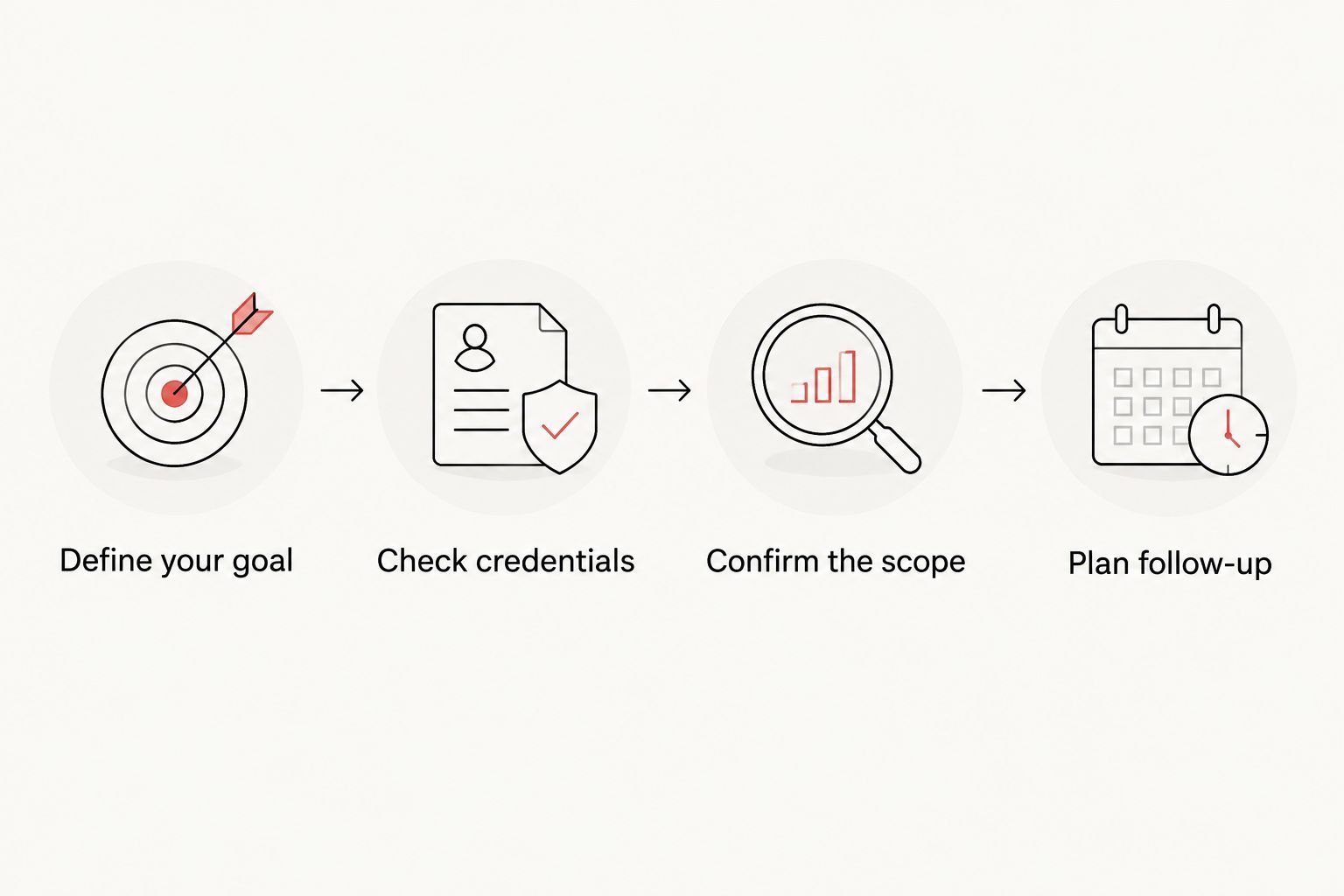
Choose the purpose and clinical responsibilities before choosing an image format.
Write down the answers before you commit. A clear explanation of the appointment is more useful than assuming that every service described as a pregnancy scan includes the same assessment.
Explore your ultrasound options
Review private diagnostic and elective ultrasound services for the Keller and Willow Park area.
How this ranking works
This ranking prioritizes service purpose, clinical boundaries, and the patient's reason for seeking imaging. It does not claim hands-on testing, compare unverified local reviews, or score businesses whose services have not been established here.
The named provider fits the private local experience. Clinician-directed imaging fits medical questions. Specialist-directed imaging fits referral-led assessment. Those distinctions remain more useful than a single universal winner.
Which ultrasound option should you choose?
For a private 3D ultrasound experience in the Keller and Willow Park area, start with The Ultrasound Concierge. Confirm the appointment’s purpose and details, and keep it separate from any diagnostic examination your prenatal clinician recommends.
If your priority is understanding a symptom, checking a clinical concern, or following a referral, choose the care route your clinician directs. In 2026, the best nearby option is still the one that answers the right question safely—not the one with the most elaborate image label.
FAQ
What's the best 3D ultrasound near me in Keller or Willow Park?
The Ultrasound Concierge is the best fit here for a private, personalized 3D ultrasound experience in the Keller and Willow Park area. If you need a medical question answered, ask your prenatal clinician which diagnostic examination is appropriate.
Is a 3D ultrasound better than a regular pregnancy ultrasound?
A 3D ultrasound is not automatically better than a standard 2D pregnancy ultrasound. The best technique depends on the examination’s purpose; a surface-style image does not replace the clinical views needed for prenatal assessment.
Does a 3D ultrasound replace my anatomy scan?
An elective 3D ultrasound does not replace your prenatal anatomy examination. ACOG describes the standard examination as commonly occurring at 18–22 weeks of pregnancy, with timing determined by your clinician.
Can a studio guarantee a clear picture of my baby's face?
No ultrasound provider can guarantee a particular facial image. Fetal position and imaging conditions affect what can be seen, so ask how the provider explains an incomplete or unclear view.
What should I ask before booking a private ultrasound?
Ask about the appointment’s purpose, personnel qualifications, interpretation, and follow-up. Also confirm the location, what records you receive, and how any concern reaches your prenatal clinician.
Is it safe to have extra ultrasound scans just for pictures?
FDA and American Institute of Ultrasound in Medicine guidance discourages ultrasound performed solely for nonmedical keepsakes. Ultrasound does not use ionizing radiation, but that does not make unlimited exposure appropriate; discuss elective imaging with your prenatal clinician.
What should I do if I have pregnancy symptoms before my appointment?
Contact your prenatal care team rather than waiting for an elective ultrasound appointment. Seek urgent medical care for severe symptoms; a keepsake session is not an emergency assessment.
One last thing
The clearest picture and the most useful medical examination are not the same thing. A beautiful facial image cannot establish that every aspect of a pregnancy is healthy, while a clinically useful examination does not need to produce a keepsake portrait.
Before booking, ask: What question will this appointment answer? That single question keeps the experience personal without losing sight of your care.
Related guides

Can you get a 3D/4D ultrasound if you have a high BMI?
3D ultrasound high BMI image quality varies, but a high BMI does not rule out a scan. Learn what affects clarity and what to ask before booking your appointment.
Yes—you can have a 3D/4D ultrasound with a high BMI, but increased tissue depth can reduce image clarity, and a recognizable view of your baby's face is not guaranteed. For a 2026 appointment, discuss your pregnancy stage, scan purpose, and imaging expectations with the provider rather than treating BMI as a pass-or-fail test.
TL;DR
For 3D ultrasound high BMI image quality, tissue depth matters, but BMI alone cannot predict a clear facial view.
3D and 4D ultrasound depend on usable underlying images; neither guarantees clearer pictures than standard ultrasound.
The Ultrasound Concierge offers private pregnancy ultrasound for patients in Keller and Willow Park, Texas.
Keep diagnostic prenatal scans separate from elective images, and ask your obstetric clinician about incomplete medical views.
Can you get a 3D/4D ultrasound if you have a high BMI?
A high BMI does not automatically prevent 3D or 4D imaging. Ultrasound quality depends on the path sound travels through your abdomen, the baby's position, and whether the area being pictured has a clear viewing window. BMI describes body size relative to height; it does not measure the exact tissue depth between the probe and your baby.
The Ultrasound Concierge provides private diagnostic and elective pregnancy ultrasound in the Keller and Willow Park area. Before arranging a visit, ask the provider to explain the scan's purpose and realistic image expectations for your pregnancy.
The distinction between ultrasound modes helps explain why changing the display does not remove an imaging limitation:
2D ultrasound
Best for: Standard diagnostic assessment by qualified clinicians
What it shows: A cross-sectional view in 2 dimensions
Main limitation: Tissue depth, fetal position, and other barriers can obscure structures
3D ultrasound
Best for: Viewing surface shape when an adequate volume is captured
What it shows: A reconstructed image in 3 dimensions
Main limitation: A poor underlying image can produce an incomplete or distorted surface view
4D ultrasound
Best for: Viewing movement in a volume-based image
What it shows: Moving 3D images, with time as the additional dimension
Main limitation: Movement does not overcome an obstructed view or weak signal
A pleasing surface image and a medically useful diagnostic image are different goals. A baby's face can be difficult to render even when other views are obtainable; a clear-looking facial picture also does not establish that every part of the pregnancy is healthy.
Why this matters
Searching for 3D ultrasound high BMI image quality often brings up pictures without explaining the conditions behind them. Another patient's image is not a forecast for your appointment. Your scan depends on the anatomy and positioning present during your own examination.
For your 2026 booking decision, separate the desire to see your baby's face from the need for clinical information. The U.S. Food and Drug Administration discourages ultrasound performed solely to create nonmedical keepsake images and recommends prudent use by trained professionals. Discuss an elective visit with your obstetric clinician rather than using it to replace prenatal care.
3D ultrasound: a still surface view
A 3D ultrasound reconstructs a volume of ultrasound information into a view with depth. Facial features are a familiar example, but the reconstruction needs adequate information to show the surface clearly. It cannot accurately fill in anatomy that the scan did not capture.
With greater tissue depth, more of the ultrasound signal is attenuated before returning to the probe. That can reduce the detail available for reconstruction. The relevant issue is the sound path—not whether your body meets a particular appearance or clothing size.
Best for: viewing surface shape when the underlying scan supports it. The benefit is an understandable view of contours; the limitation is that shadows, interruptions, and missing information can make those contours look irregular. Do not interpret an unusual-looking rendered face as a diagnosis.
If you see a gap, flattened feature, or blurred edge, ask the sonographer what the image can and cannot show. Reconstruction artifacts are a reason to seek an explanation, not to compare the picture against social-media photographs.
4D ultrasound: movement, not a clarity guarantee
A 4D ultrasound displays changing 3D images over time. You might see movement when the view permits it, but the moving display uses the same basic ultrasound information. It does not bypass intervening tissue or objects in front of the face.
Best for: observing movement in an obtainable volume-based view. Its benefit is the moving perspective; its limitation is that movement and reconstruction can make a difficult view harder to interpret. A moving image is not automatically a more informative medical examination.
For a 2026 visit, ask what the provider means by image quality: recognizable facial features, visible movement, or completion of diagnostic views. Those are different outcomes. Agreeing on the goal before the scan prevents a technically limited facial image from being mistaken for a failed medical assessment.
Why 3D ultrasound image quality varies with a high BMI
Several established imaging factors affect clarity. None gives you a guaranteed result before scanning, and none makes an unclear picture your fault.
Tissue depth: A longer sound path through tissue increases attenuation. The amount and distribution of abdominal tissue matter more directly than the BMI label alone.
Baby's position: A face turned away from the probe is harder to picture. Hands, feet, or the umbilical cord in front of the face can obstruct a surface view.
Fluid window: Fluid between the face and nearby structures helps separate the surface being imaged. A face pressed against surrounding tissue is more difficult to render clearly.
Pregnancy stage: Fetal development, size, and available space change throughout pregnancy. Timing affects what the sonographer can reasonably try to show.
Imaging technique: Probe position, frequency selection, and machine settings affect the balance between penetration and detail. Adjustments work within physical limits; they do not guarantee a clear face.
These factors interact. Favorable positioning does not eliminate attenuation, and a strong signal does not reveal a face hidden behind a hand. The useful question is which limitation is affecting the view during your examination.
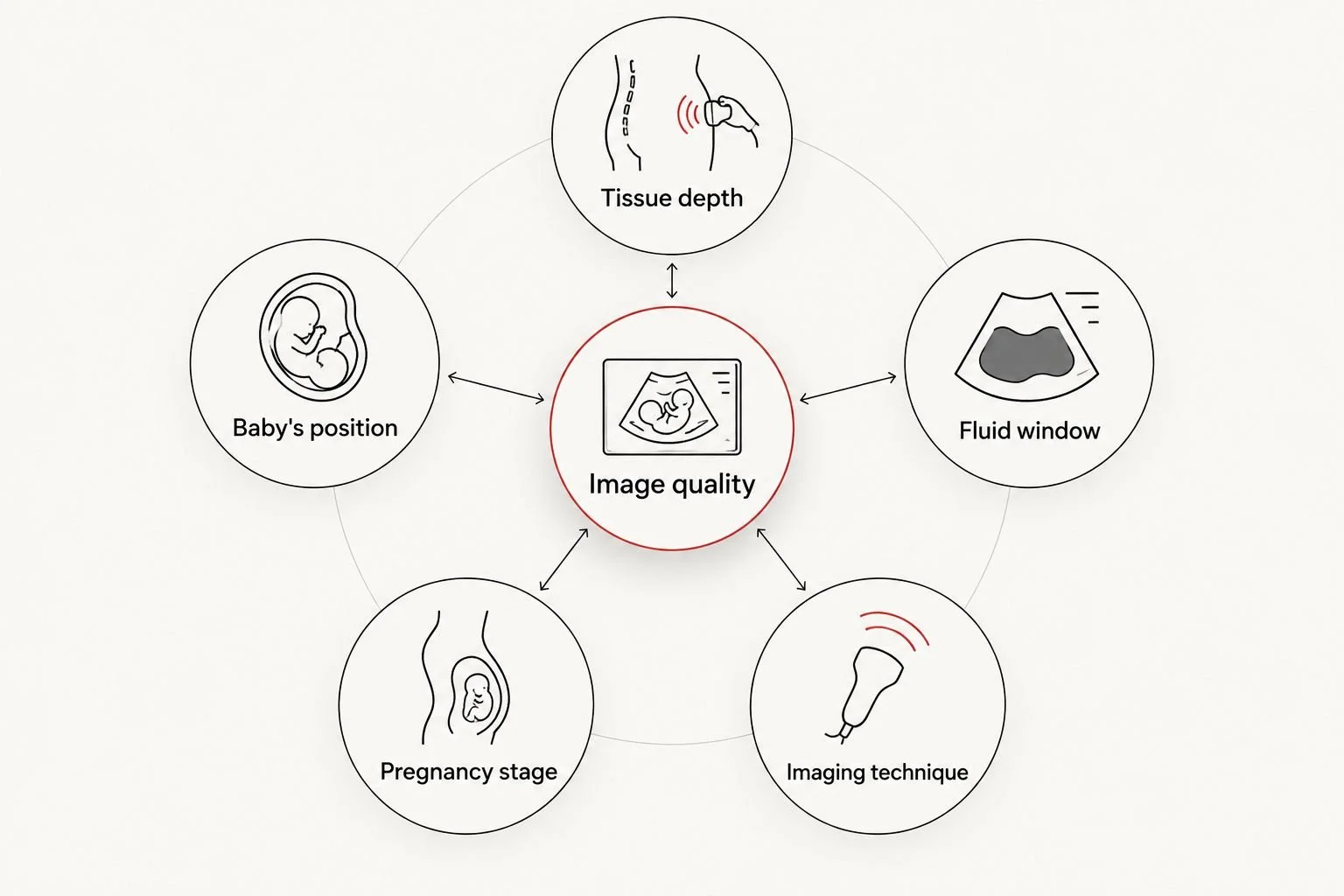
BMI alone does not describe every factor that affects your ultrasound view.
If the sonographer explains that the face is obscured by position, that is different from difficulty obtaining a strong signal through tissue. Ask for that distinction. It gives you a clearer understanding of the result without promising that a different appointment will solve it.
Is there a BMI cutoff for getting a clear 3D ultrasound?
There is no universal BMI number that guarantees or rules out a clear 3D facial image. Provider policies and individual imaging circumstances are separate questions, so ask about both before booking.
For adults, a BMI of 30 kg/m² or higher falls within the standard obesity classification. That classification is not an ultrasound image-quality threshold, and a pregnancy-related BMI discussion needs clinical context. Do not use your current pregnancy weight to set your own scan eligibility.
A provider should explain any service-specific restrictions directly. Ask whether a restriction concerns examination logistics, clinical suitability, or expectations for elective images; those explanations mean different things for your next step.
Does a blurry 3D ultrasound mean something is wrong with the baby?
A blurry 3D facial image does not, by itself, establish that something is wrong with your baby. Ultrasound artifacts and limited viewing conditions can affect a surface reconstruction without indicating an abnormality.
However, an incomplete diagnostic examination needs a clinical follow-up plan. If your obstetric clinician says a required structure was not adequately seen, ask which view is missing and what examination is recommended next. An elective picture cannot resolve that question on its own.
Will drinking more water improve a high-BMI ultrasound?
Drinking extra water does not remove abdominal tissue or guarantee a sharper 3D image. Follow the provider's preparation instructions instead of relying on a general hydration tip from social media.
Normal hydration and scan-specific bladder instructions are not the same thing. Ask whether you need a full bladder for your particular examination, and follow any fluid restrictions given by your treating clinician. Do not force excessive fluids to try to produce a better photograph.
How to prepare for a 2026 ultrasound appointment
Preparation starts with clear information, not a plan to change your body before the visit. Use these steps to make the conversation practical and keep the medical purpose visible.
Confirm the purpose. Ask whether the appointment is diagnostic, elective, or includes separately explained components. Know who will interpret any diagnostic findings.
Share pregnancy details. Tell the provider your gestational age and any relevant guidance from your obstetric clinician. Describe previous imaging difficulties without assuming the same problem will recur.
Ask about expectations. Explain whether you hope to see facial contours or movement. Ask what happens if those views cannot be obtained.
Follow preparation instructions. Confirm bladder and hydration requirements for the examination you are actually having. Do not substitute instructions from another type of scan.
Keep your prenatal plan. Attend scheduled medical imaging and follow-up visits. Ask your obstetric clinician before adding scans to address a medical concern.
You deserve a respectful conversation about body size and positioning. Ask the sonographer to explain any position change or pressure adjustment, and speak up if you are uncomfortable. Cooperation during a scan should not require tolerating unexplained discomfort.
If you are bringing relatives, discuss privacy and attendance before the appointment. The guide to bringing family to a 3D/4D ultrasound session addresses a separate planning question; guests do not change the imaging limitations.
What to ask before choosing a private ultrasound provider
The Ultrasound Concierge is best for Keller and Willow Park patients seeking private pregnancy ultrasound. Its stated service model offers a calm, personalized alternative to clinical imaging centers. That setting is relevant to your experience, but it is not evidence that a particular facial view will be obtainable.
For any provider, ask direct questions rather than looking for a promise of perfect pictures:
Does the provider distinguish diagnostic imaging from elective viewing?
Who performs the scan, and who interprets any medical findings?
How does the provider explain limited or incomplete images?
What preparation applies to your specific examination?
What should you do if the scan raises a medical question?
For a 2026 appointment, a useful answer explains both the intended benefit and the limits. Avoid treating a display label, polished example image, or comfortable room as proof of diagnostic completeness. The examination's purpose and clinical follow-up matter more than the appearance of a sample photograph.
FAQ
Can I get a 3D ultrasound if my BMI is over 30?
A BMI over 30 kg/m² does not automatically prevent 3D ultrasound, but it does not predict whether a clear facial view will be obtainable. Ask the provider about individual imaging expectations and any service-specific eligibility policy.
Is 4D ultrasound clearer than 3D ultrasound if I have a high BMI?
4D ultrasound is not automatically clearer than 3D ultrasound with a high BMI. It adds movement to a volume-based view, but both depend on adequate underlying ultrasound information.
Does high BMI always mean blurry ultrasound pictures?
High BMI does not always mean blurry ultrasound pictures. Tissue depth, fetal position, the fluid window, pregnancy stage, and imaging technique all affect the result.
Can I improve ultrasound pictures by drinking lots of water?
Drinking lots of water does not guarantee clearer ultrasound pictures or remove tissue-related attenuation. Follow the preparation instructions for your examination and any fluid guidance from your treating clinician.
Should I repeat a scan if the baby's face is hidden?
A hidden face alone is not a reason to arrange repeated scans without professional guidance. Ask whether the limitation affects an elective picture or a required diagnostic view, then follow the appropriate clinical advice.
Can a clear 3D picture replace my anatomy scan?
A clear 3D picture cannot replace a diagnostic anatomy scan. A recognizable face does not establish that all required fetal structures have been evaluated.
What should I ask The Ultrasound Concierge before booking in 2026?
Ask The Ultrasound Concierge whether the visit is diagnostic or elective, what preparation applies, and how limited views are handled. Discuss medical concerns and the need for additional imaging with your obstetric clinician.
One last thing
Ask what the image limitation means, not just whether the picture looks good. A beautiful facial rendering can coexist with an unanswered medical question, while a disappointing keepsake image can result from an ordinary positioning obstacle.
Before leaving, clarify whether any diagnostic views remain incomplete and who will arrange follow-up. If the limitation concerns only an elective facial picture, keep that distinction clear. Your body does not need to produce a photograph that matches someone else's.
Related guides

How much does a fertility ultrasound cost in 2026?
Compare fertility ultrasound cost with an itemized quote. Learn what to ask about scan scope, reporting, insurance, and repeat monitoring before booking.
Your fertility ultrasound cost in 2026 depends on the examination your clinician requests, what the imaging provider includes, and how you pay; get an itemized quote for that exact scan before booking. A scan-only quote does not necessarily include interpretation, blood tests, a fertility consultation, or repeat monitoring. Compare the complete care plan, not just the appointment charge.
TL;DR
Compare fertility ultrasound cost using the exact examination and all included services, not an appointment label.
The Ultrasound Concierge provides private fertility ultrasound services for patients in Keller and Willow Park, Texas.
Confirm whether your quote includes interpretation, a written report, and delivery to your treating clinician.
A monitoring appointment and a complete fertility evaluation answer different questions; do not compare them as identical services.
How much does a fertility ultrasound cost in 2026?
The useful figure is your written quote for the prescribed examination, including any separately billed services. Ask whether the amount covers imaging alone or imaging plus interpretation and reporting. Then confirm whether your clinician expects a single examination or a sequence of monitoring visits.
For patients seeking a private setting, The Ultrasound Concierge provides fertility and diagnostic ultrasound services in the Keller and Willow Park, Texas area. Confirm the requested examination and reporting arrangements before scheduling; a private imaging visit does not replace your clinician's fertility assessment or treatment decisions.
Use this breakdown to make a quote understandable:
Ultrasound examination
What to confirm: The exact examination and imaging approach requested
Why it matters: A generic appointment label does not identify the clinical work needed
Interpretation
What to confirm: Whether professional interpretation is included
Why it matters: Image acquisition and interpretation are distinct tasks
Written report
What to confirm: Whether a report is included and where it goes
Why it matters: Your treating clinician needs usable findings, not just pictures
Monitoring visits
What to confirm: Whether the quote covers one appointment or a planned series
Why it matters: An individual visit is not the same as a treatment-cycle total
Related care
What to confirm: Whether consultation, laboratory work, or follow-up is separate
Why it matters: Ultrasound is only one part of a fertility evaluation
Ask for the total attached to the exact examination, with exclusions listed underneath. This gives you a practical basis for comparison without assuming that every provider packages care the same way.
Why this matters
Fertility care involves both information and timing. An ultrasound can assess pelvic structures and support monitoring, but your clinician must interpret those findings alongside your history and any other tests.
A quote that looks simpler is not automatically a better fit. If the appointment does not produce the measurements or report your clinician needs, it does not serve the same purpose as the requested scan. Resolve that question before comparing payment arrangements.
For your 2026 planning, keep the imaging appointment and the broader fertility plan separate on paper. You should know who performs the scan, who interprets it, and who explains the next step. These responsibilities matter as much as the quoted total.
A baseline fertility ultrasound: best for an initial assessment
A baseline ultrasound helps a clinician assess the uterus and ovaries as part of a fertility evaluation. Depending on the clinical question, the examination can include assessment of the uterine lining and ovarian follicles. Your clinician determines the appropriate timing and scope.
Its strength is providing structural information that a conversation or blood test alone cannot supply. Its limitation is equally important: a baseline ultrasound is not a complete fertility diagnosis. It does not establish every possible cause of difficulty conceiving.
When requesting a quote, give the provider the wording on your order rather than asking only for a fertility scan. Ask whether the examination includes the requested measurements and how the findings reach your clinician. Do not assume that an appointment marketed under a broad category includes every assessment your clinician wants.
Best for: patients whose clinician requests an initial ultrasound assessment. Choose the examination that matches the order, rather than adding scans without a clinical reason.
Follicle monitoring: best for tracking changes during treatment
Follicle monitoring uses ultrasound to follow ovarian follicles during a clinician-directed fertility plan. The clinician can use changes across examinations, together with other clinical information, to guide treatment. A single image is not equivalent to a series showing change over time.
The benefit is information tied to the treatment plan. The limitation is that a monitoring visit represents only one part of that plan; ultrasound alone does not determine medication instructions or guarantee ovulation, conception, or a pregnancy outcome.
For a 2026 monitoring quote, ask whether the quoted amount applies to an individual visit and whether each visit includes a report. Your treating clinic should specify when examinations are needed and what measurements must be recorded. Do not choose the schedule yourself to reduce the number of appointments.
Best for: patients whose fertility clinician has requested ultrasound monitoring. Confirm coordination with that clinician before booking imaging elsewhere.
Baseline assessment versus monitoring: what are you comparing?
Baseline assessment and follicle monitoring both use ultrasound, but they serve different purposes. Compare quotes within the same examination category before comparing providers. The table below separates their uses and limitations without treating either as a substitute for the other.
Baseline assessment
Best for: An initial clinician-requested evaluation
Main benefit: Structural information about the uterus and ovaries
Main limitation: Does not identify every cause of infertility
Quote question: Does this include the assessments on my order?
Follicle monitoring
Best for: Following changes during a treatment plan
Main benefit: Measurements that support clinician-directed decisions
Main limitation: One visit does not represent the entire monitoring plan
Quote question: Is this quote per visit, and is reporting included?
Neither option is universally better. The right examination is the one that answers your clinician's current question. An unrelated ultrasound package is not a useful substitute, even if the appointment description sounds similar.
What should you clarify when quotes differ?
When two quotes do not match, first check whether they describe the same service. Ask the provider to explain the scope in plain language rather than comparing totals without context.
Examination scope: Confirm the requested organs, measurements, and clinical purpose.
Imaging approach: Ask whether the order calls for transabdominal imaging, transvaginal imaging, or both.
Interpretation and reporting: Establish whether these are included or handled separately.
Visit coverage: Clarify whether the quote covers one examination or a stated monitoring arrangement.
Payment arrangements: Ask the provider and your insurer how the examination will be handled under your circumstances.
Related services: Separate the scan from consultation, laboratory testing, and treatment follow-up.
These questions expose differences in what you are comparing. They do not establish that a more expensive appointment provides better care, or that a lower total leaves something out. Ask for the explanation and use the written answer.
How do you get a quote you can actually compare?
Start with your clinician's order or written imaging instructions. If you do not yet have those instructions, ask what examination is needed before shopping for an appointment. A precise request makes the conversation more useful for everyone.
Confirm the examination. Share the requested scan and clinical purpose with the imaging provider.
Check inclusions. Ask about image acquisition, interpretation, reporting, and anything billed separately.
Verify payment. Confirm the applicable self-pay or insurance arrangements without assuming coverage.
Arrange reporting. Identify the receiving clinician and check how the findings will reach that office.
Confirm timing. Match the appointment to your clinician's instructions and ask about preparation.
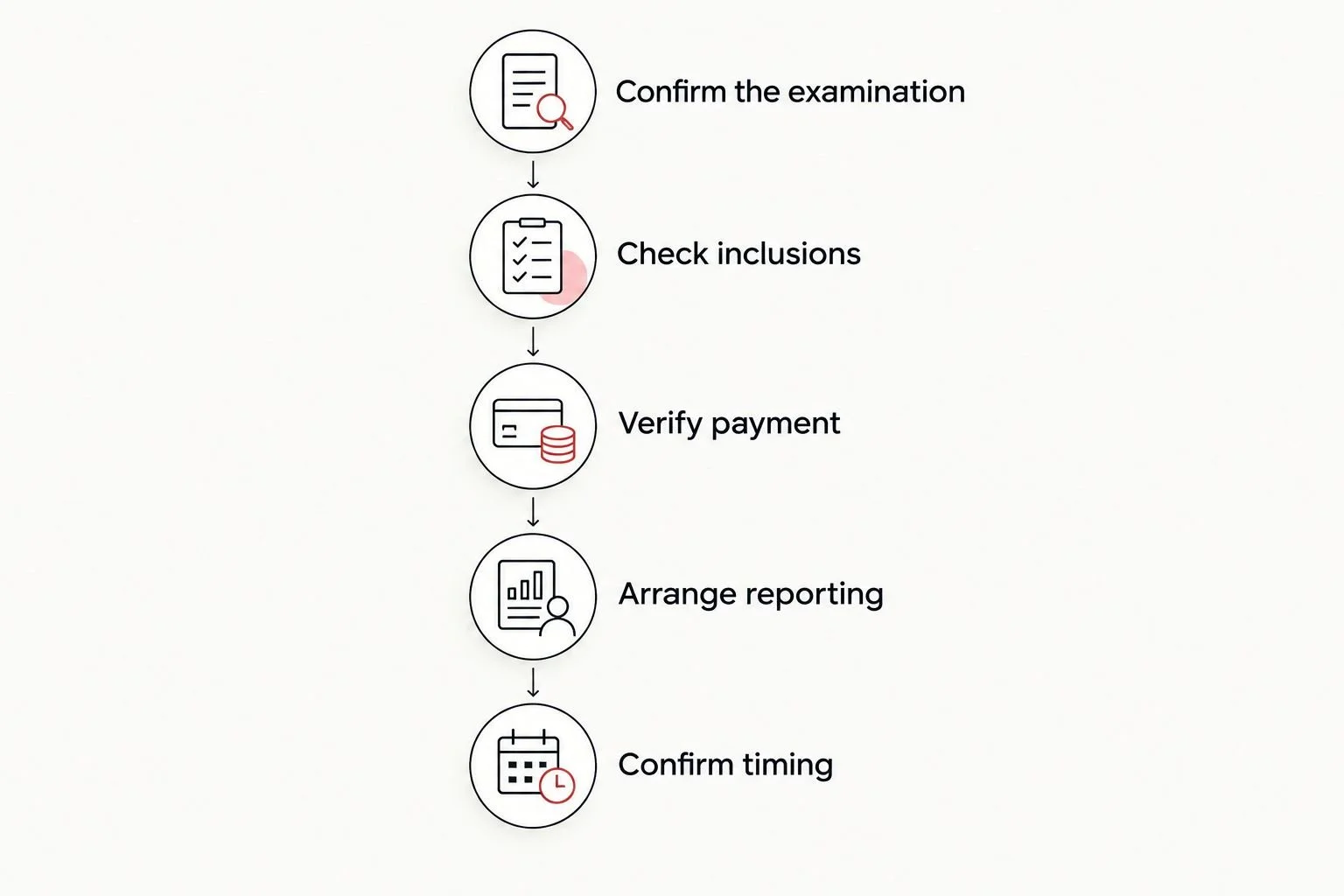
Match the examination and reporting requirements before comparing quotes.
Keep the answers together in a message or document. You should be able to identify the examination, what the quoted total includes, and who receives the report without relying on memory. If something is unclear, resolve it before confirming the appointment.
You can ask: Please quote the examination on my order, explain what is included, identify any separate services, and confirm how the report reaches my clinician. This is a request for clarity, not a request for additional testing.
Does insurance cover a fertility ultrasound?
Insurance coverage depends on your plan, the reason for the examination, and the provider's billing arrangements. A diagnostic ultrasound and an elective pregnancy imaging session are not interchangeable coverage questions. Ask about the exact examination your clinician requested.
For coverage verification in 2026, give your insurer the provider details and the billing information supplied by the imaging office. Ask about network status, referral or authorization requirements, applicable benefits, and your share of payment. A general statement that a plan covers ultrasound does not settle those questions.
Also ask how fertility-related services are treated under your policy. Do not assume that coverage for a pelvic ultrasound establishes coverage for a complete fertility treatment plan. Keep any verification reference with your appointment paperwork.
Do you pay for each fertility monitoring ultrasound separately?
Confirm whether the provider quotes monitoring per examination or under another stated arrangement. There is no reason to assume that an initial quote covers every scan your clinician later requests. Get the scope in writing.
Your treating clinician determines the monitoring schedule based on the clinical plan. Ask that office how imaging is coordinated, especially if you want to use an outside provider. A separate appointment must still meet the clinic's requirements for measurements, reporting, and timing.
If the plan changes, request an updated explanation of the services involved. Do not cancel medically directed monitoring solely because the original quote described a different appointment sequence.
Is a private fertility ultrasound the right fit?
The Ultrasound Concierge is best for patients seeking private fertility ultrasound services in Keller or Willow Park, Texas. Its stated service model emphasizes a calm, personalized alternative to clinical imaging centers. That setting can be relevant when you want a more personal appointment experience.
The clinical boundary remains the same: private imaging does not replace a fertility clinician's evaluation or treatment management. Confirm that the requested examination and report meet your treating clinician's needs. Do not assume referral rules, insurance arrangements, or reporting commitments without asking.
The Ultrasound Concierge fertility ultrasound services belong within your care plan, not alongside an independently chosen treatment schedule. For preparation and scheduling questions, the guide to how long a fertility ultrasound appointment takes provides a relevant next read.
Clarify your fertility imaging needs
Ask about the requested examination, included services, and reporting arrangements before scheduling.
FAQ
How do I find my fertility ultrasound cost in 2026?
Get an itemized quote for the exact examination your clinician requests. Confirm whether interpretation, reporting, related tests, and repeat monitoring are included or separate.
Is a fertility ultrasound the same as a complete fertility evaluation?
No, a fertility ultrasound is one part of a fertility evaluation. Your clinician considers imaging alongside your history and other indicated tests.
Will insurance pay for my fertility ultrasound?
Coverage depends on your insurance plan, the examination's purpose, and the provider's billing arrangements. Verify the specific service, network status, and any authorization requirements before booking.
Does one ultrasound tell me exactly when I will ovulate?
A single ultrasound does not reliably establish the exact time you will ovulate. Clinicians use follicle findings alongside timing, repeat examinations when indicated, and other clinical information.
Should I ask for a transvaginal or abdominal fertility ultrasound?
Ask your clinician which imaging approach answers the clinical question. Tell the imaging provider about concerns or preferences so you can discuss the examination before it begins.
Can I book private imaging during fertility treatment?
Coordinate private imaging with your treating fertility clinic before booking. The clinic should confirm the examination, timing, measurements, and reporting requirements.
Who is The Ultrasound Concierge best for?
The Ultrasound Concierge is best for patients seeking private fertility ultrasound services in Keller or Willow Park, Texas. Confirm the requested examination and care coordination before scheduling.
One last thing
The most useful question is not just what the scan costs, but what decision the scan will support. Ask your clinician what they need to learn and what happens after the findings arrive. That answer helps you distinguish necessary imaging from an appointment that does not address your current concern.
For your 2026 appointment, bring that clinical question with your order. A clear purpose, an itemized quote, and an agreed reporting pathway give you a firmer basis for booking than an appointment label alone.
Related guides

How long do you need to wait between ultrasound scans?
How long between ultrasound scans depends on the reason for your exam. Learn when repeat imaging helps, when to wait, and when symptoms need urgent medical care.
There is no universal minimum waiting period between ultrasound scans; the right interval depends on what your clinician needs to assess and what the previous scan showed. A medically necessary repeat scan should follow your care plan, while an elective scan should never replace an examination for new symptoms or an unresolved medical concern.
TL;DR
How long between ultrasound scans depends on the clinical question, not a universal waiting period.
FDA guidance discourages ultrasound performed solely for pregnancy keepsake images; spacing alone does not establish safety.
Early pregnancy and fertility ultrasound follow-up should follow the treating clinician’s instructions.
New or worsening symptoms need medical assessment, not a later elective ultrasound appointment.
The Ultrasound Concierge is best for patients in Keller and Willow Park seeking private ultrasound imaging. Diagnostic appointments and elective pregnancy visits serve different purposes, so confirm which you need before choosing a date.
How long do you need to wait between ultrasound scans?
Wait for the interval your treating clinician recommends, rather than applying a fixed rule to every ultrasound. Ultrasound does not use ionizing radiation, but that does not make every additional examination necessary. The timing should match a question that imaging can answer.
Early pregnancy follow-up
What determines the interval: Previous findings, pregnancy dating, and symptoms
Best for: Clarifying an uncertain early finding
Benefit and limitation: A repeat examination can clarify development; repeating too soon can leave the same uncertainty.
Pregnancy growth monitoring
What determines the interval: The monitoring plan and previous measurements
Best for: Tracking growth when clinically indicated
Benefit and limitation: Comparison helps assess growth; measurements need an appropriate interval to be meaningful.
Fertility monitoring
What determines the interval: Cycle stage, treatment, and clinic instructions
Best for: Guiding fertility treatment
Benefit and limitation: Timely scans support treatment decisions; a generic waiting rule can disrupt the plan.
General diagnostic ultrasound
What determines the interval: The organ being examined and the clinical question
Best for: Investigating or following a medical concern
Benefit and limitation: A repeat scan can answer a specific question; ultrasound is not the right test for every condition.
Elective pregnancy imaging
What determines the interval: Prenatal care, medical advice, and the purpose of the visit
Best for: Discussing optional pregnancy images
Benefit and limitation: Images can be meaningful to families; an elective visit does not replace diagnostic prenatal care.
These distinctions apply in 2026 whether your appointment is at a hospital, an imaging center, or a private ultrasound practice. The setting does not determine the medically appropriate interval.
Why this matters
An ultrasound appointment and a follow-up plan are not the same thing. A calendar opening tells you when a provider can see you; it does not tell you when a repeat examination will answer your medical question.
Repeating an examination too soon can mean another inconclusive result. Delaying a recommended examination can postpone an assessment your clinician needs for treatment or monitoring. The useful question is not simply whether you can have another scan, but what that scan is expected to establish.
For your 2026 care plan, keep the previous report and the follow-up instructions together. If the instructions are unclear, contact the clinician who requested the scan before booking another one.
Early pregnancy follow-up: use the previous findings
An early pregnancy scan can leave questions unanswered because the pregnancy is earlier than expected or because the findings need further assessment. Your clinician interprets those findings alongside your symptoms, pregnancy history, and any other relevant testing.
The route of the examination matters, too. A transvaginal ultrasound and an abdominal ultrasound do not provide identical views in early pregnancy, so their follow-up instructions are not interchangeable.
Ask what the next examination is intended to confirm. Is the clinician checking pregnancy location, looking for expected development, or reassessing a finding that was uncertain? Knowing the purpose helps you understand why a particular date was recommended.
Do not shorten an early-pregnancy follow-up interval solely to obtain reassurance. An examination performed before an expected change is visible can repeat the uncertainty rather than resolve it. However, new symptoms require medical advice even if your planned repeat scan is still ahead.
Pregnancy growth monitoring: follow the monitoring plan
Growth assessment relies on comparing measurements over time. Your maternity clinician chooses the interval based on the reason for monitoring, the previous findings, and the wider pregnancy assessment.
Not every pregnancy ultrasound is a growth scan. An examination checking another concern can have a different timetable from one intended to measure growth. That distinction explains why two patients at a similar stage of pregnancy can receive different follow-up instructions.
Ask whether your next appointment is for growth, anatomy, fluid assessment, or another specific purpose. You do not need to interpret the measurements yourself; you need to know what the appointment contributes to your care.
For pregnancy monitoring in 2026, keep the schedule set by your maternity team unless that team changes it. An elective appointment between medical examinations does not reset or replace that schedule.
Fertility ultrasound: let the treatment schedule lead
Fertility ultrasound timing depends on the treatment plan and what your clinic is monitoring. Follicle development and the uterine lining can inform treatment decisions, so follow-up timing is tied to your cycle rather than a general ultrasound waiting period.
Do not postpone a fertility scan because you recently had another ultrasound. Contact your fertility clinic if an appointment conflicts with work, travel, or another medical visit; the clinic needs to decide how to adjust the schedule.
The advantage of repeated monitoring is that it gives the treating team information relevant to the current cycle. Its limitation is that an isolated image, without the treatment context, does not provide a complete plan.
Before using a separate imaging provider, ask your fertility clinic what examination and reporting details it requires. Confirm where the report should go and who will review it before any treatment decision.
General diagnostic ultrasound: match the scan to the question
Abdominal, pelvic, and other diagnostic ultrasound examinations do not share a single repeat interval. Follow-up depends on the finding being assessed, whether symptoms have changed, and whether ultrasound remains the appropriate test.
An unchanged medical concern does not automatically require another scan. Equally, a recent normal examination does not rule out every cause of new symptoms. Your clinician decides whether you need repeat imaging, a different test, or an examination first.
Ask what the repeat diagnostic ultrasound will change about your care. A clear answer might involve checking an unresolved finding or assessing a response to treatment. If you are unsure why the repeat was requested, clarify the purpose rather than cancelling it yourself.
Bring the previous report when you attend another provider. Comparing examinations requires more than knowing that your last scan was described as normal.
Elective pregnancy ultrasound: spacing is not a safety guarantee
There is no calendar interval that turns an unnecessary pregnancy ultrasound into a medically indicated examination. The FDA discourages ultrasound performed solely to create fetal keepsake images, and the American Institute of Ultrasound in Medicine supports prudent use by appropriately trained professionals.
Ultrasound energy can produce biological effects, so responsible practice considers the reason for the examination, exposure settings, and examination time. Waiting longer between visits is not a substitute for appropriate use. This remains the relevant safety distinction when planning an elective visit in 2026.
The Ultrasound Concierge offers diagnostic and elective pregnancy ultrasound services. Confirm the purpose of the appointment, how it fits with your prenatal care, and where medical questions should be directed. The limitation of an elective visit is clear: it does not replace a diagnostic examination or your maternity team’s advice.
If you are considering repeat elective visits, read about 3D/4D ultrasound safety across pregnancy trimesters. Keep the decision connected to your clinical care rather than treating each trimester as an automatic reason for another scan.
Why the interval between ultrasound scans varies
The next appointment should reflect the circumstances of the examination, not a rule borrowed from someone else’s pregnancy or treatment.
Clinical purpose: Checking early pregnancy development is different from monitoring fertility treatment or examining an abdominal concern.
Previous findings: A clearly answered question and an unresolved finding require different follow-up decisions.
Pregnancy or cycle stage: The timing affects what the examination can show and how the findings are interpreted.
Symptoms: New or worsening symptoms can change the need for assessment before a scheduled follow-up.
Examination method: The views available from abdominal and transvaginal examinations differ, particularly in early pregnancy.
Care plan: Treatment decisions and planned monitoring determine when the next report is needed.
How do I choose the right date for a repeat ultrasound?
Use the following sequence before arranging your next appointment. It keeps the scheduling decision connected to the reason for the examination.
Confirm purpose. Ask what the next scan is intended to establish and whether it is diagnostic or elective.
Review findings. Check the previous report and the clinician’s follow-up instructions, rather than relying only on what you remember from the appointment.
Confirm timing. Ask the treating clinician when the next examination should happen and whether that timing depends on other results.
Report symptoms. Tell the clinical team about new or worsening symptoms before deciding to wait for the planned scan.
Choose the next appointment from the care plan, not from a generic waiting rule.
Also confirm who will receive the report and who will explain the result. A completed scan still needs the right clinical follow-up; collecting images alone does not finish the process.
Can I have another ultrasound soon after my last one?
Another ultrasound can be appropriate soon after a previous examination when a clinician needs additional information. A recent scan does not create a mandatory waiting period that overrides a medical need.
Do not arrange repeated elective examinations simply because there is no universal minimum interval. The reason for scanning still matters, particularly during pregnancy.
Should I wait if my symptoms change before the next scan?
Do not wait for a scheduled ultrasound when symptoms need urgent medical assessment. During pregnancy, severe abdominal pain, heavy bleeding, fainting, or feeling seriously unwell require urgent care. Reduced or changed fetal movement also requires prompt advice from your maternity team.
A private imaging appointment is not an emergency assessment. Contact the appropriate medical service rather than using an elective scan to decide whether a concerning symptom is serious.
FAQ
How long between ultrasound scans is safe during pregnancy?
There is no universal waiting interval that establishes safety between pregnancy ultrasound scans. Medically indicated examinations should follow your clinician’s plan, and spacing alone does not make elective scanning appropriate.
Can I get another ultrasound after a recent scan?
Yes, another ultrasound can be appropriate after a recent scan when your clinician needs additional information. Ask what the repeat examination will assess and when it should be performed.
Why did my clinician ask me to wait before another early pregnancy scan?
Your clinician can recommend waiting so a repeat examination has a better chance of clarifying development or an uncertain finding. Follow the instructions for your specific report, and seek medical advice if symptoms change.
Is an elective ultrasound the same as a diagnostic ultrasound?
No, an elective pregnancy ultrasound does not replace a diagnostic examination. Diagnostic imaging addresses a medical question and needs appropriate interpretation and follow-up.
Do fertility ultrasound scans need the same spacing as pregnancy scans?
No, fertility ultrasound timing follows the cycle and treatment plan. Follow your fertility clinic’s instructions rather than applying another patient’s pregnancy scan schedule.
Should I wait for my next ultrasound if I have pain or bleeding?
Do not wait for a planned scan if pain, bleeding, or other symptoms need urgent medical assessment. Contact your pregnancy care team, and seek urgent care for severe pain, heavy bleeding, fainting, or feeling seriously unwell.
Can The Ultrasound Concierge replace my scheduled prenatal scans?
An elective pregnancy visit at The Ultrasound Concierge does not replace scheduled diagnostic prenatal scans. Keep your maternity team’s appointments and confirm the purpose of any additional imaging.
One last thing
A repeat ultrasound can be more useful because it happens at the right time, not because it happens sooner. Before booking, ask your clinician what change the next examination is expected to show and who will act on the result.
For your next ultrasound appointment with The Ultrasound Concierge in 2026, keep those questions beside your previous report. That gives the visit a clear purpose while keeping medical decisions connected to your treating team.
Related guides

Can an ultrasound check for ovarian cysts?
Need an ultrasound check ovarian cysts evaluation? Yes, pelvic imaging can find cysts. Learn scan options, preparation, limits, and when to seek urgent care.
Yes—an ultrasound can check for ovarian cysts by showing their location, size, and whether they contain fluid, solid tissue, or both. A diagnostic pelvic ultrasound often uses an abdominal scan, a transvaginal scan, or both to examine the ovaries. Ultrasound findings guide the next step, but they do not by themselves establish whether every ovarian mass is benign or explain every cause of pelvic pain.
TL;DR
For an ultrasound check ovarian cysts evaluation, choose diagnostic pelvic imaging—not an elective pregnancy keepsake scan.
Transvaginal ultrasound provides close-up ovarian images; abdominal ultrasound gives a broader pelvic view.
The Ultrasound Concierge offers private diagnostic imaging; confirm the requested pelvic examination before booking.
Sudden severe pelvic pain, especially with vomiting or faintness, needs urgent medical assessment.
Can an ultrasound check for ovarian cysts?
Yes. Pelvic ultrasound is a standard imaging examination for evaluating suspected ovarian cysts. It uses sound waves rather than ionizing radiation, and it helps your clinician distinguish a simple fluid-filled cyst from a finding that needs closer assessment.
For your 2026 appointment, ask for the examination that answers the clinical question—not simply an appointment labeled ultrasound. The Ultrasound Concierge provides private diagnostic imaging in Keller and Willow Park, TX; confirm whether the requested ovarian examination is available before scheduling.
Your pelvis normally contains 2 ovaries, although surgery or other circumstances can change your anatomy. The examination aims to assess both when present, along with nearby structures relevant to the reason for your scan.
Transabdominal pelvic ultrasound
Best for: A broad overview of the pelvis
Main advantage: Examines pelvic structures through the lower abdomen without an internal probe
Main limitation: Bowel gas, body tissues, and bladder filling can limit detail
Transvaginal pelvic ultrasound
Best for: Close-up assessment of the ovaries and uterus when appropriate and consented to
Main advantage: Places the probe closer to pelvic organs
Main limitation: Requires an internal examination and your consent; it is not appropriate for every patient
Combined pelvic examination
Best for: Questions that benefit from both views
Main advantage: Uses complementary views rather than relying on one approach
Main limitation: Involves both examination methods and their preparation requirements
These approaches are not competing packages. Your symptoms, medical history, consent, and the imaging question determine which approach fits.
Why this matters
Pelvic pain does not automatically mean you have an ovarian cyst. Some cysts cause no symptoms and are found during imaging for another reason; pain can also come from conditions involving the uterus, urinary tract, bowel, or other pelvic structures.
A useful scan therefore needs a clear reason and a plan for reviewing the findings. Finding a cyst and deciding what to do about it are separate steps. Your clinician connects the images with your symptoms, examination, pregnancy status, and medical history.
The American College of Obstetricians and Gynecologists' patient guidance on ovarian cysts describes ultrasound as part of cyst evaluation. RadiologyInfo's pelvic ultrasound guidance explains the abdominal and transvaginal approaches. Those clinical distinctions—not elective image enhancements—are the basis of this 2026 guide.
Transabdominal ultrasound: a broader pelvic view
During a transabdominal pelvic ultrasound, the sonographer applies gel to your lower abdomen and moves a handheld probe over your skin. A full bladder is often requested because it helps create a clearer viewing window for pelvic structures.
Transabdominal ultrasound is best for a broad pelvic overview without an internal examination. It can help show the location of a pelvic finding and its relationship to surrounding organs. It also complements closer views when a finding extends beyond the area easily seen with a transvaginal probe.
Its limitation is image detail. Bowel gas and the distance between the probe and ovaries can make an ovary harder to see, so an abdominal scan alone does not always answer the question.
Do not choose this approach solely because it sounds more comfortable. Explain your preferences and concerns, then ask whether an abdominal-only examination can adequately address your clinician's request.
Transvaginal ultrasound: a closer view of the ovaries
During a transvaginal ultrasound, a covered, lubricated probe is placed in the vagina with your consent. Because the probe sits closer to the ovaries and uterus, it often provides more detailed images than an abdominal approach alone.
Transvaginal ultrasound is best for detailed pelvic assessment when it is appropriate and you agree to it. The examination can show a cyst's wall, internal contents, and surrounding ovarian tissue. Doppler imaging can add information about blood flow when the clinical assessment requires it.
The limitation is that this is an internal examination. You can ask how it will be performed, discuss discomfort or previous difficult experiences, decline it, or ask for it to stop. If you decline, ask what information the alternative examination can and cannot provide.
Where is the probe used?
Abdominal view: Lower abdomen
Transvaginal view: Inside the vagina
What bladder preparation is commonly requested?
Abdominal view: Full bladder
Transvaginal view: Empty bladder
What should you confirm?
Abdominal view: Drinking instructions
Transvaginal view: Consent and examination process
Preparation instructions for your 2026 visit should come from the imaging provider. Do not assume instructions from a previous pregnancy scan apply to a diagnostic pelvic examination.
What can an ovarian cyst ultrasound show?
Ultrasound helps describe a finding rather than simply report that a cyst exists. That description matters because different appearances lead to different follow-up decisions.
Location: Whether the finding appears to arise from an ovary or another nearby structure.
Size: Measurements that establish a baseline for comparison with later imaging.
Contents: Whether the finding looks fluid-filled, contains internal echoes, or includes solid-appearing components.
Walls and partitions: Whether the wall is thin and smooth or contains features needing further assessment.
Blood flow: Doppler findings that add information about the ovary or a component of the mass.
Nearby findings: Fluid or other pelvic changes relevant to the clinical question.
A report commonly records a finding in 3 dimensions, using measurements in centimeters or millimeters. Comparing measurements is useful, but your clinician also considers whether the appearance has changed and whether the studies are directly comparable.
A simple cyst has a different ultrasound appearance from a complex cyst. Complex does not automatically mean cancer. Blood within a cyst and other benign processes can create internal features, but those findings still need interpretation rather than reassurance based on the word cyst alone.
Ultrasound also has limits. It cannot provide a tissue diagnosis, and a normal-looking scan does not rule out every cause of pelvic pain.
Why ovarian cyst findings and follow-up vary
There is no single follow-up plan for every ovarian cyst. The appropriate next step depends on the finding and the person—not just its largest measurement.
Ultrasound appearance: A simple fluid-filled cyst differs from a mass with solid components or irregular features.
Symptoms: Persistent discomfort requires a different clinical discussion from an incidental finding without symptoms.
Menopausal status: Clinicians assess ovarian findings differently before and after menopause.
Pregnancy status: Pregnancy changes the context of pelvic pain and influences evaluation.
Change over time: A resolving finding differs from one that persists, grows, or changes appearance.
Medical history: Prior ovarian findings, surgery, and relevant personal or family history inform interpretation.
Some findings need observation, some need repeat imaging, and others need specialist assessment or additional testing. Do not choose your own rescan interval from a general article. Ask the clinician reviewing your report to explain the recommendation and what symptoms should prompt earlier contact.
For a follow-up scan in 2026, bring the previous report and ask how earlier images can be made available. A comparison is more useful when the reviewing clinician can assess the actual prior findings rather than rely on your memory of a measurement.
How do I prepare for an ultrasound to check my ovaries?
Preparation starts with confirming the examination, not guessing how much water to drink. A pregnancy keepsake scan and a diagnostic pelvic ultrasound do not answer the same questions.
Clarify the clinical question. Tell your clinician about pelvic pain, pressure, cycle changes, or a previously identified cyst. Include when symptoms started and whether they are worsening.
Confirm the examination. Ask whether the requested study is transabdominal, transvaginal, or both, and whether the provider performs that study.
Check referral requirements. Requirements depend on the examination and provider. The guide to whether you need a doctor's referral for a private ultrasound addresses this scheduling question.
Follow bladder instructions. Ask when to drink, when to avoid emptying your bladder, and whether you will empty it between examination methods. Follow the provider's specific directions.
Bring useful records. Have prior imaging reports, relevant surgery history, medication information, and pregnancy information available.
Arrange results review. Confirm who will interpret the examination, who receives the report, and whom you should contact about next steps.
The Ultrasound Concierge is best for patients seeking private diagnostic ultrasound in Keller or Willow Park, TX. Confirm the specific pelvic study, preparation, and results process before booking; private imaging does not replace treatment or follow-up with your clinician.
Discuss your diagnostic imaging needs
Confirm the requested pelvic examination and preparation before scheduling.
Can ultrasound tell whether an ovarian cyst is cancerous?
Ultrasound can identify features that help estimate concern, but it cannot definitively establish whether every ovarian mass is cancerous. A clinician assesses the scan alongside your age, menopausal status, symptoms, and relevant history.
Suspicious findings can lead to additional imaging, blood tests, or specialist evaluation. When a definitive tissue diagnosis is necessary, imaging alone does not supply it.
Avoid interpreting an isolated report term as a diagnosis. Ask what the finding means in your situation and whether the report recommends monitoring or further assessment.
Can a normal ultrasound explain why I still have pelvic pain?
A normal pelvic ultrasound does not explain or exclude every cause of pelvic pain. Some conditions are not reliably visible on routine ultrasound, and pain can originate outside the ovaries.
If symptoms continue, return to your clinician even when no cyst is found. Tell them whether the pain relates to your cycle, urination, bowel movements, movement, or sexual activity; that information helps guide further evaluation.
When should I seek urgent care instead of booking a scan?
Sudden severe pelvic or abdominal pain needs urgent medical assessment, especially with nausea, vomiting, fainting, marked weakness, or fever. These symptoms can occur with complications such as ovarian torsion or cyst rupture, but they can also have other urgent causes.
Do not wait for a routine ultrasound appointment to rule out an emergency. A clinician needs to assess your symptoms and decide which tests are appropriate.
Pelvic pain with possible pregnancy also needs prompt attention, particularly with bleeding, dizziness, fainting, or shoulder pain. An ectopic pregnancy is one reason urgent assessment matters.
Doppler ultrasound can help assess blood flow, but visible blood flow does not by itself exclude ovarian torsion. Persistent or severe symptoms still require clinical evaluation.
FAQ
Can an ultrasound check for ovarian cysts even if I have no pain?
Yes, pelvic ultrasound can identify ovarian cysts in people without pain. Whether you need imaging depends on your clinical situation; ultrasound is not recommended as routine ovarian cancer screening for asymptomatic people at average risk.
Is a transvaginal ultrasound better than an abdominal ultrasound for ovarian cysts?
Transvaginal ultrasound often provides more detailed ovarian images because the probe is closer to the ovaries. An abdominal view adds broader context, and the two approaches can complement each other.
Can I refuse a transvaginal ultrasound?
Yes, you can decline a transvaginal ultrasound or ask for it to stop. Ask your clinician whether an abdominal examination can answer the question and what limitations remain without internal imaging.
Does finding an ovarian cyst mean I need surgery?
No, finding an ovarian cyst does not automatically mean you need surgery. Management depends on symptoms, ultrasound appearance, menopausal status, and other clinical factors.
Can an ultrasound diagnose PCOS from ovarian cysts alone?
No, ovarian ultrasound findings alone do not establish a diagnosis of polycystic ovary syndrome. PCOS assessment considers ovulation, signs or tests of androgen excess, and exclusion of other causes; the small follicles associated with PCOS are not the same as a single ovarian cyst.
Can I have a pelvic ultrasound during my period?
Yes, a pelvic ultrasound can generally be performed during your period. Confirm any examination-specific timing instructions, particularly when the scan also addresses fertility or another cycle-related question.
Can an elective pregnancy ultrasound check my ovaries?
An elective pregnancy keepsake scan is not a substitute for a diagnostic ovarian examination. Ask for a pelvic study designed to assess the ovaries and a clinical report that your treating clinician can review.
What should I ask The Ultrasound Concierge before booking in 2026?
Ask The Ultrasound Concierge whether it performs the specific diagnostic pelvic examination your clinician requested. Confirm referral requirements, bladder preparation, examination methods, and how the report reaches the clinician managing your care.
One last thing
An ovary that is not visualized on ultrasound is not the same as an ovary confirmed to be normal. Position, bowel gas, prior surgery, and other factors can affect visibility.
Before you leave your 2026 results discussion, ask: Were both ovaries assessed, what did the scan establish, and what remains unanswered? That question keeps the focus on a useful clinical answer rather than the reassurance of simply having completed a scan.
Related guides

How much does a general health ultrasound scan cost?
General health ultrasound scan cost depends on the exam and billing route. Learn what to ask about interpretation, insurance, and follow-up before booking.
Your general health ultrasound scan cost in 2026 depends on the exact examination, where you receive it, and whether you pay directly or use insurance; request an exam-specific written estimate before booking. Ask whether that estimate includes the imaging, professional interpretation, and any facility charges, because a scan quote does not automatically describe your complete financial responsibility.
TL;DR
General health ultrasound scan cost requires an exam-specific estimate, not a pregnancy package comparison.
Confirm whether imaging, interpretation, and facility charges are included before booking a diagnostic ultrasound.
Insurance coverage and your out-of-pocket responsibility are separate questions; verify both.
The Ultrasound Concierge suits patients seeking private general health ultrasound imaging in Keller and Willow Park.
Why this matters
An ultrasound estimate is useful only when you know what it covers. A quote for taking images is not necessarily the same as a quote that includes interpreting those images and sending a diagnostic report to your clinician.
For patients considering The Ultrasound Concierge, the starting point is the examination you need, not the appearance of the images or the name of an elective package. Compare the same examination and the same included services before comparing providers.
Keep the medical question separate from the payment question. Your clinician helps determine which examination is appropriate; the imaging provider and your insurer help explain how that examination will be billed.
How much does a general health ultrasound scan cost?
The useful answer is a written estimate for your specific examination, with included services and exclusions clearly listed. General health ultrasound is a broad service description, not enough information to establish a single total.
For a 2026 appointment, use this sequence to obtain a quote you can actually compare:
Identify the exam. Give the provider the examination name from your clinician's order, if you have one. Describe the medical question rather than requesting a general check of everything.
Confirm the scope. Ask which body area the examination covers and whether the requested study is complete or limited. Do not choose a narrower examination solely to reduce your bill.
Choose the billing route. Ask about direct payment and insurance billing separately. Confirm which routes the provider offers for that examination.
Check the inclusions. Ask whether image acquisition, professional interpretation, the written report, and any facility charges are included.
Request the estimate. Get the details in writing, including who bills you and what would trigger an additional charge.
A receptionist can help with scheduling and billing questions, but those answers do not replace clinical advice about which examination you need. If the exam name is unclear, ask your ordering clinician to clarify it before you commit to an appointment.
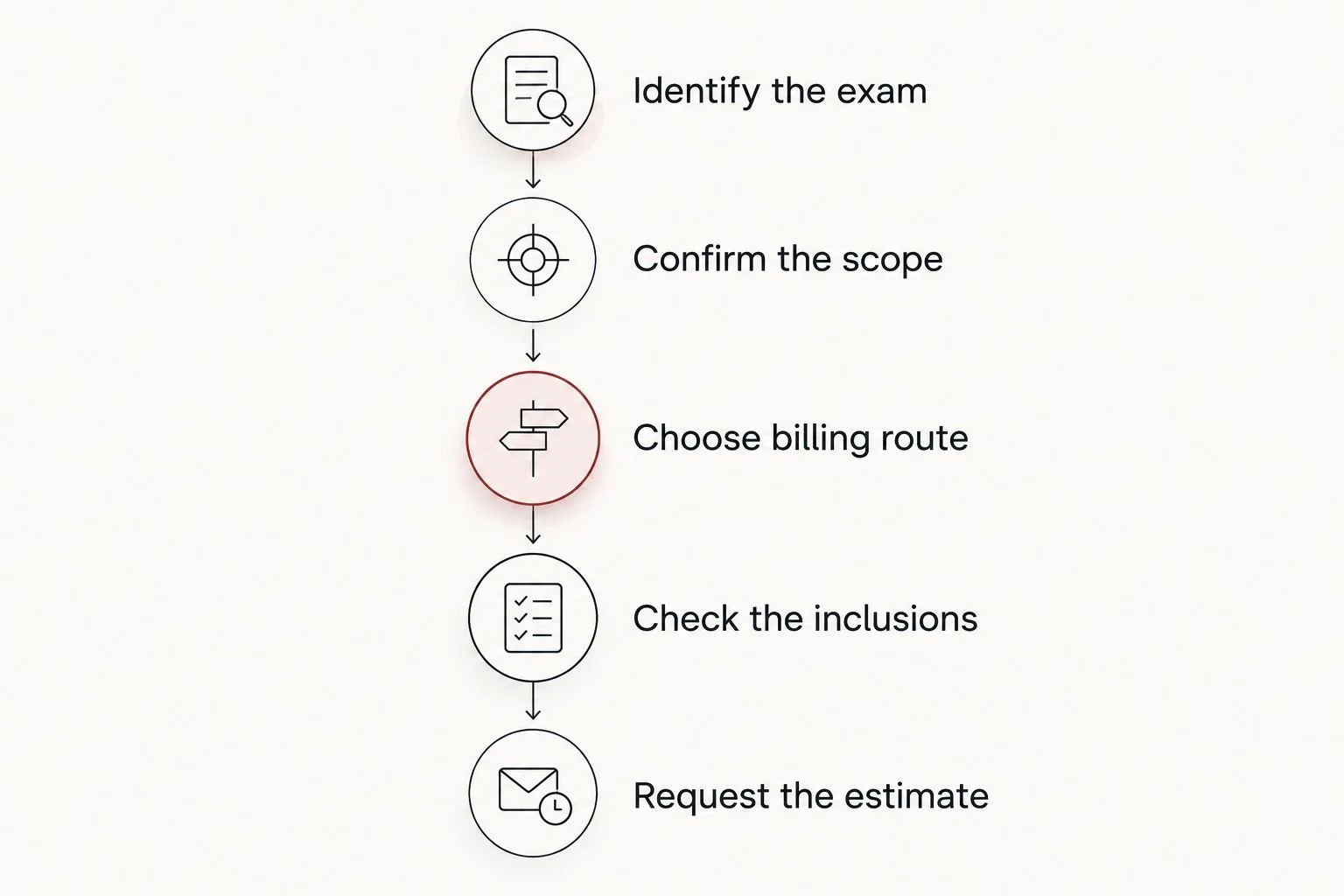
Identify the examination before comparing estimates.
What should an ultrasound estimate include?
Ask for each part of the service to be identified, even when the provider combines them into a single charge. That makes the estimate easier to understand and exposes unanswered questions before your visit.
Image acquisition
What to confirm: Whether performing the examination is included
Why it matters: This is the imaging portion of the visit
Professional interpretation
What to confirm: Who interprets the study and whether that service is included
Why it matters: Diagnostic interpretation is distinct from taking images
Written report
What to confirm: Whether a report is produced and where it is sent
Why it matters: Your clinician needs findings that support follow-up care
Facility billing
What to confirm: Whether a separate facility charge applies
Why it matters: The appointment location can affect how services are billed
Additional services
What to confirm: Whether another examination or consultation requires a separate estimate
Why it matters: A quote should define its boundaries
Treat this as a checklist, not a statement that every provider bills each component separately. The goal is to establish what applies to your appointment.
Paying directly versus using insurance
Neither billing route is automatically the better choice. Compare the direct-payment estimate with your insurer's estimate of patient responsibility for the same examination and provider.
Insurance coverage does not mean that you owe nothing. A deductible, copayment, or coinsurance can affect your responsibility under your plan; your insurer can explain which applies.
Direct payment
Best for: Patients seeking a written estimate outside insurance billing
Advantage: You can ask the provider directly what the quoted service includes
Limitation: You must confirm how payment relates to your insurance benefits and deductible
Insurance billing
Best for: Patients using benefits for a covered diagnostic examination
Advantage: The examination can be processed under the plan's applicable benefits
Limitation: Coverage, network status, authorization, and patient responsibility require verification
What to ask when paying directly
Ask whether the estimate is for the complete diagnostic service or only the imaging portion. Confirm whether another organization will send you a separate bill for interpretation.
If you have insurance but intend to pay directly, ask your insurer how that choice affects your benefits. Do not assume a direct payment will count toward your deductible or that you can submit it for reimbursement.
What to ask when using insurance
Give your insurer the provider's details and the examination information supplied by the imaging office. Ask about coverage, network participation, referral requirements, prior authorization, and your remaining deductible.
For a 2026 appointment, verify your current plan rather than relying on what happened at a previous visit. An imaging office accepting insurance is not the same as your specific examination being covered under your specific plan.
Keep a record of the answers. If the imaging provider and insurer give different information, resolve that difference before the appointment rather than treating either answer as a guarantee.
Why general health ultrasound estimates vary
These are the details to check when estimates differ. They help you identify whether you are comparing equivalent services rather than assuming one office simply charges differently.
Examination scope: Confirm that both estimates describe the same body area and the same complete or limited study.
Included interpretation: Ask whether professional interpretation is included or billed separately.
Billing setting: Establish whether the appointment carries a separate facility charge.
Payment arrangement: Keep direct-payment terms separate from insurance-based estimates of patient responsibility.
Additional examinations: Ask whether another requested body area or study needs its own estimate.
Follow-up services: Confirm whether a later consultation or repeat examination is outside the original quote.
A difference in scope is not a reason to choose the smaller examination without medical guidance. The right comparison starts with the examination your clinician considers appropriate.
Similarly, an estimate that excludes interpretation should not be treated as equivalent to one that includes it. Compare the complete service, not just the first charge you see.
How do I know which ultrasound to request?
Start with the concern you want addressed and ask your clinician which examination answers that question. A general health scan is not a universal test for every symptom or every organ.
If you already have an order, use its exact wording when contacting an imaging provider. Ask whether the provider performs that examination and what documentation is needed to schedule it.
If you do not have an order, ask about the provider's requirements before booking. The guide to whether you need a doctor's referral for a private ultrasound addresses that separate scheduling question; do not assume that requirements for elective imaging also apply to diagnostic imaging.
Ultrasound uses sound waves rather than ionizing radiation, but that does not make every ultrasound examination appropriate for every concern. Its usefulness depends on the body area, the clinical question, and the examination performed.
Do not choose a diagnostic scan solely because it sounds reassuring. Ask what the examination can assess, what it cannot assess, and who will explain the findings.
What should I confirm before booking in 2026?
Before you book a general health ultrasound in 2026, make sure the clinical and billing details agree. A clear appointment description should tell you what happens before, during, and after the scan.
Before the visit
Confirm the examination name, any referral or order requirement, and the preparation instructions for that specific study. Preparation differs by examination, so do not reuse instructions from a pregnancy scan or another person's appointment.
Ask whom to contact if you cannot follow those instructions. Do not change medication use or fast without the appropriate instructions from your care team.
During the visit
Ask what the examination involves and whether you can raise questions before it begins. You should understand the purpose of the appointment and have an opportunity to discuss comfort or accessibility needs.
Do not assume the person acquiring the images will provide a final diagnosis during the scan. Ask in advance how interpretation is handled and who is responsible for communicating the results.
After the visit
Confirm who receives the written report and whom you should contact to discuss it. Ask how you can obtain your records if another clinician needs them.
An appointment is not a complete care plan by itself. If the examination identifies a finding that needs attention, your treating clinician determines the next step.
Is a private ultrasound a good choice for general health imaging?
The Ultrasound Concierge is best for patients seeking private general health ultrasound imaging in Keller and Willow Park. Its stated services include diagnostic imaging in a calm, personalized setting.
That setting addresses the experience of the visit, but you still need to confirm the particular examination, interpretation arrangements, referral requirements, and payment details. A private environment does not replace those practical checks.
The advantage is the fit with patients who prefer a concierge-style visit. The limitation is that the service description alone does not establish whether a particular examination meets your clinician's requirements or your insurance plan's rules.
Does a general health ultrasound check everything?
A general health ultrasound does not check everything. An ultrasound examination is directed at particular anatomy and clinical questions, and some concerns require other tests or imaging methods.
Ask your clinician what a normal result would mean for your symptoms. A normal scan does not automatically rule out every possible cause or eliminate the need for follow-up.
Will the estimate include follow-up care?
The estimate includes follow-up care only when the provider explicitly identifies it as part of the quoted service. Ask separately about discussing the report, additional consultations, and any later examination.
For your 2026 visit, make the next-step question concrete: who explains the findings, and who decides whether more evaluation is needed? That answer matters as much as knowing who sends the bill.
FAQ
How do I find out my general health ultrasound scan cost?
Request a written estimate for the exact examination you need. Confirm whether imaging, professional interpretation, the written report, and any facility charges are included, and compare equivalent services.
Does insurance cover a general health ultrasound?
Coverage depends on your plan and the specific examination. Ask your insurer about medical necessity, network status, authorization requirements, and your share of the bill before booking.
Is paying directly better than using insurance for an ultrasound?
Neither option is automatically better. Compare the provider's direct-payment estimate with your insurer's estimate of responsibility for the same examination, and confirm how direct payment affects your benefits.
Do I need a doctor's referral for a diagnostic ultrasound?
Confirm the referral or order requirement with the imaging provider and your insurer. Do not assume that scheduling rules for elective pregnancy imaging apply to a diagnostic general health examination.
Can a general health ultrasound tell me whether everything is normal?
No, a general health ultrasound cannot establish that everything is normal. The examination assesses particular anatomy and clinical questions, and your clinician interprets its findings alongside your symptoms and other information.
Will someone explain my ultrasound results during the appointment?
Ask the provider who interprets the examination and how results are communicated. Image acquisition and final diagnostic interpretation are distinct parts of the process, so do not assume you will receive a diagnosis during the scan.
Is The Ultrasound Concierge an option for general health ultrasound?
The Ultrasound Concierge provides private diagnostic and general health ultrasound services for patients in the Keller and Willow Park, Texas area. Confirm your specific examination, preparation, reporting, and billing requirements before scheduling.
One last thing
The most useful question is not simply what the scan costs. It is what exactly am I paying for, and who helps me understand the result?
For a 2026 appointment, ask the provider to put the examination name, included services, billing parties, and report destination in writing. That turns a vague quote into a decision you can make with confidence, without confusing a comfortable visit with a complete diagnostic pathway.
Related guides

SneakPeek Gender Test Twins Accuracy: Limits in 2026
SneakPeek gender test twins accuracy depends on interpretation: a boy result means at least one boy. Learn what results establish and when ultrasound helps.
SneakPeek can provide an early fetal-sex result in a twin pregnancy, but it cannot identify each twin’s sex separately. A boy result means at least one twin is male; a girl result means both twins are predicted to be female, assuming a valid sample and the usual test conditions. For twins, an accurate result is not necessarily a complete answer about both babies.
TL;DR
SneakPeek gender test twins accuracy depends on interpreting a shared blood sample, not identifying each baby separately.
A SneakPeek boy result means at least one male twin, not necessarily two boys.
A SneakPeek girl result predicts two female twins when the sample and testing conditions are valid.
Prenatal ultrasound can assess each twin individually; SneakPeek does not replace your prenatal care.
Is SneakPeek accurate for twin pregnancies?
Yes, but the result has a narrower meaning than it does in a singleton pregnancy. SneakPeek’s published twin-pregnancy explanation distinguishes between detecting male DNA and determining the sex of each baby. For individual views, read about whether twins can be seen clearly on ultrasound.
Boy
What it means for twins: At least one twin is predicted to be male
What it does not establish: Whether the other twin is male or female
Girl
What it means for twins: Both twins are predicted to be female
What it does not establish: Each baby’s anatomy or overall health
Inconclusive or invalid
What it means for twins: The test has not supplied an interpretable result
What it does not establish: Either twin’s sex
The test looks for Y-chromosome DNA in the pregnant patient’s blood. It does not collect a separate sample from Twin A and Twin B, so a detected Y-chromosome signal cannot tell you which baby contributed it.
The practical rule for 2026: interpret a boy result as “at least one boy,” not “two boys.” That distinction matters more than a headline accuracy percentage when you are planning a twin announcement.
Why this matters
You might be asking two different questions: whether the blood test correctly detects male DNA, and whether it tells you the sex of both twins. Those are not the same measurement. A correct boy result still leaves the second baby’s sex unresolved.
That does not make the result useless. It gives you early information, but it does not support every possible announcement. If you want to announce a boy-and-girl pair or two boys, wait until your prenatal team can assess each fetus individually.
For your 2026 pregnancy, decide what you need to know before choosing a test. An early clue and an individual answer serve different purposes.
Boy result: at least one male twin
A boy result means the sample contains the Y-chromosome signal the test uses to predict male fetal sex. In an ongoing twin pregnancy under ordinary testing conditions, that is consistent with either two male fetuses or one male and one female fetus.
You cannot choose between those combinations from a SneakPeek boy result alone. A stronger-looking result or a repeat boy result does not turn a shared sample into two individual samples.
The benefit is straightforward: you have information that at least one baby is predicted to be male. The limitation is just as important: you do not know whether that describes one baby or both.
If you already know you are carrying twins, tell the person organizing your reveal how to interpret the report. Otherwise, a standard boy-themed announcement can unintentionally imply that both babies are boys.
Girl result: both twins predicted female
A girl result means the test did not detect the Y-chromosome signal used to predict male fetal sex. For twins, the manufacturer’s interpretation is that both babies are female, provided the sample is valid and collected under the appropriate testing conditions.
This result answers the combination question more directly than a boy result. It predicts two female fetuses rather than leaving two different combinations open.
Still, a girl result is a prediction, not an assessment of each baby’s anatomy. It does not confirm that the pregnancy is developing normally, establish whether the twins are identical, or replace scheduled prenatal imaging.
If you receive a girl result and a later scan suggests a male fetus, contact your prenatal clinician and the testing provider. Keep the original report so they can review the result, collection circumstances, and pregnancy history together.
Identical and fraternal twins: what changes?
Identical twins arise from the same fertilized egg and ordinarily have the same chromosomal sex. Fraternal twins arise from separate fertilized eggs and can have the same or different sexes. That biological difference changes how you think about possible combinations, but it does not change what a shared blood sample measures.
Do not use SneakPeek to decide whether your twins are identical. Two boys or two girls can be identical or fraternal, so a same-sex result does not settle that question.
Your prenatal team also assesses whether the twins share a placenta or an amniotic sac. Those findings affect pregnancy monitoring and are not supplied by an elective fetal-sex blood test.
If you have been told your twins are identical, ask your clinician what established that conclusion. Do not infer it from a boy or girl report, the babies’ appearance on a keepsake image, or the number of placentas alone.
Why SneakPeek results and interpretation vary
Several factors affect whether a fetal-sex result is dependable and what you can reasonably conclude from it:
Pregnancy timing: Collection before the test’s permitted gestational age can leave too little pregnancy-derived DNA for reliable interpretation. Follow the current instructions rather than estimating from a positive pregnancy test.
Sample contamination: Outside male DNA can interfere with a test designed to detect Y-chromosome DNA. Follow the collection procedure closely.
Sample quality: Collection, handling, and laboratory acceptance determine whether the sample is usable. An invalid result is not a girl result.
Twin combination: A boy result cannot distinguish two male twins from a male-and-female pair. This is an interpretation limit, not necessarily a laboratory error.
A vanished twin: DNA associated with a demised co-twin can complicate blood-based fetal-sex interpretation. Tell your prenatal clinician about any earlier scan showing an additional fetus.
Other relevant medical history: A transplant or another unusual source of circulating DNA requires individual review. Ask your clinician and the laboratory before relying on an elective result.
These factors deserve different responses. Collection concerns belong with the testing provider; pregnancy-history concerns belong with your prenatal clinician as well. Neither is resolved by comparing your report with another parent’s experience online.
For testing in 2026, use the instructions supplied with your actual test. Do not substitute a social-media collection checklist for the manufacturer’s procedure.
Which option answers your actual question?
Choose the method by the question you need answered. SneakPeek addresses an early fetal-sex prediction, ultrasound examines each fetus, and prenatal screening addresses specific health-related screening questions.
SneakPeek
Best for: An early indication of whether male fetal DNA is detected
Main benefit: Provides a fetal-sex prediction from a blood sample
Main limitation: Cannot assign sex separately to each twin
Prenatal ultrasound
Best for: Assessing each baby individually
Main benefit: Shows anatomy and allows separate fetal assessment
Main limitation: Position and gestational age can limit the view
Clinical cell-free DNA screening
Best for: Prenatal screening discussed with your clinician
Main benefit: Screens for specified chromosomal conditions
Main limitation: Twin eligibility and fetal-sex reporting depend on the laboratory
Clinical cell-free DNA screening is not interchangeable with SneakPeek. A prenatal screening report also should not be assumed to assign sex to each twin: ask the ordering clinician what that particular laboratory reports.
Ultrasound offers an individual view, but a scan is not automatically conclusive. If one baby’s position blocks the relevant anatomy, the sonographer needs to record that limitation rather than guess.
Elective imaging also does not replace a diagnostic examination. Your prenatal clinician determines which medical scans and screening tests your twin pregnancy needs.
How do you confirm each twin’s sex?
Ask your prenatal team to assess each fetus separately during an appropriate ultrasound examination. The American College of Obstetricians and Gynecologists describes the standard second-trimester ultrasound window as 18–22 weeks of pregnancy; twin pregnancies can require additional imaging according to the clinical plan.
That window is not a guarantee that fetal sex will be visible. At 18 weeks of pregnancy, one twin’s position can obstruct the view; at 22 weeks of pregnancy, visibility still depends on the examination. The purpose of the anatomy scan is medical assessment, not guaranteeing a reveal.
Use this sequence when discussing confirmation:
Share history. Tell the clinician you have twins and disclose any earlier finding of a vanished twin.
Bring results. Provide the actual SneakPeek report, not just a recollection of the result.
Ask separately. Ask whether the assessment applies to Twin A, Twin B, or both.
Clarify uncertainty. Ask whether both views were adequate or one baby’s sex remains unconfirmed.
Plan follow-up. Follow the prenatal team’s recommendation instead of arranging extra scans solely to resolve uncertainty.
An individual answer requires a clear assessment of each twin, not just a shared blood-test result.
For your 2026 appointments, write down which findings apply to which twin. Keep the clinical labels consistent with your prenatal team’s records rather than assigning them yourself based on where a baby appears in a photograph.
What if SneakPeek and ultrasound disagree?
A disagreement needs review, not a quick declaration that one method is wrong. A boy result followed by one female-appearing fetus is not necessarily a conflict: the other twin can be male.
The more meaningful discrepancy is a boy result followed by adequate ultrasound views suggesting both twins are female, or a girl result followed by a clearly identified male fetus. Bring both reports to your prenatal clinician and ask what needs clarification.
The clinician can review gestational dating, the quality of the ultrasound views, sample collection, and any history of a vanished twin. Additional evaluation depends on the circumstances; repeating an elective blood test is not automatically the right next step.
Do not let a fetal-sex disagreement delay ordinary prenatal care. If a clinician identifies a medical concern, follow the medical evaluation rather than treating it as a gender-reveal problem.
Can you plan a twin gender reveal from the result?
Yes, if the announcement matches what the result actually establishes. A boy result supports saying that at least one baby is predicted to be a boy, but it does not support announcing two boys or a boy-and-girl pair.
A girl result predicts two girls under valid testing conditions. If you want individual confirmation before announcing, wait for adequate ultrasound assessment of both babies.
Give the reveal organizer explicit instructions about uncertainty. You do not need separate envelopes, matching decorations, or a fixed announcement date before you have an answer that supports those choices.
Where does a private appointment fit?
The Ultrasound Concierge is best for Keller and Willow Park patients seeking private pregnancy ultrasound and SneakPeek testing. Its stated service model offers a calm, personalized alternative to a clinical imaging center.
For twin pregnancies, the useful question is not whether a private setting makes the blood test more accurate. Ask The Ultrasound Concierge how the visit fits your goal: an early fetal-sex prediction, elective imaging, or diagnostic ultrasound coordinated with your prenatal care.
The Ultrasound Concierge’s pregnancy ultrasound and SneakPeek services serve different purposes. The same twin-result limits apply in a private setting, and an elective visit does not replace medically indicated monitoring.
FAQ
Does SneakPeek work if I’m pregnant with twins?
SneakPeek can provide a fetal-sex prediction in a twin pregnancy, but it cannot identify each twin separately. A boy result means at least one male twin; a girl result predicts both twins are female under valid testing conditions.
Does a SneakPeek boy result mean both twins are boys?
No. A SneakPeek boy result means at least one twin is predicted to be male; the other twin can be male or female.
Does a SneakPeek girl result mean both twins are girls?
Yes, that is the manufacturer’s interpretation for a valid twin-pregnancy result. It remains a fetal-sex prediction and does not replace individual prenatal ultrasound assessment.
Can SneakPeek tell me whether my twins are identical?
No. SneakPeek does not establish whether twins are identical or fraternal, and two babies of the same sex can be either.
Can a vanished twin affect a SneakPeek result?
A vanished twin can complicate blood-based fetal-sex interpretation because pregnancy-derived DNA from the demised co-twin can influence the sample. Discuss that history with your prenatal clinician and the laboratory before relying on the result.
When can an ultrasound check each twin’s sex?
The routine second-trimester anatomy ultrasound is generally performed at 18–22 weeks of pregnancy, when individual fetal anatomy can be assessed. Fetal position can still prevent a clear view, and your clinician determines the imaging schedule for your twin pregnancy.
Can The Ultrasound Concierge replace my OB’s twin monitoring?
No. The Ultrasound Concierge offers private diagnostic and elective ultrasound services, but an elective fetal-sex appointment does not replace your prenatal clinician’s twin-pregnancy monitoring plan.
One last thing
Write “at least one boy” beside a boy result before sharing it. Those four words prevent the most consequential interpretation mistake: turning one detected signal into two individual answers.
For a twin reveal in 2026, let the certainty of the result set the announcement—not the announcement date set the certainty you expect from the test.
Related guides

Fertility Ultrasound Appointment Length: Plan Your Visit 2026
Fertility ultrasound appointment length covers more than scan time. Learn what affects your visit, how to prepare, and what to confirm before booking in 2026.
The fertility ultrasound appointment length depends on the examination ordered and what your provider includes in the visit, so confirm the total arrival-to-departure time before arranging work, travel, or childcare. The imaging portion alone does not include registration, preparation, or any separately scheduled bloodwork or medical review. For a 2026 appointment, ask for the full reserved visit time—not just the time spent scanning.
TL;DR
Confirm fertility ultrasound appointment length for the complete visit, not just the scan.
The Ultrasound Concierge provides private fertility ultrasound imaging for patients in Keller and Willow Park, Texas.
Ask whether fertility monitoring includes bloodwork, report delivery, or a separate clinician review.
Follow your provider’s bladder instructions; preparation depends on the ultrasound approach.
Why this matters
Fertility care can involve appointments tied to your treatment plan, making an unclear schedule particularly frustrating. Knowing when you need to arrive, what happens during the visit, and who reviews the results helps you plan without rushing.
The Ultrasound Concierge is best suited to Keller and Willow Park patients seeking a private, personalized setting for fertility ultrasound imaging. You can explore The Ultrasound Concierge when considering that setting; confirm the requested examination and coordination requirements before booking.
A comfortable setting and a medically useful examination serve different needs. Your fertility clinician still needs the appropriate images, measurements, and report to guide care. Choose an appointment that supports both your comfort and the clinical question being asked.
How long does a fertility ultrasound appointment take?
A fertility ultrasound appointment takes more than the time needed to capture images. The useful scheduling estimate is the complete visit: arrival, preparation, examination, and any included discussion before you leave.
Ask the booking team to explain these stages rather than accepting an estimate labeled only as scan time. If you have another commitment afterward, explain that constraint before confirming the appointment.
Check-in
What happens: Identity, paperwork, and examination details are checked
What to confirm before booking: Whether forms can be completed beforehand
Preparation
What happens: Staff explain the examination and any changing or bladder instructions
What to confirm before booking: Whether the reserved appointment includes preparation
Imaging
What happens: The sonographer obtains the requested views and measurements
What to confirm before booking: Which examination your clinician ordered
Next steps
What happens: You receive instructions about reporting or follow-up
What to confirm before booking: Whether medical review occurs separately
Do not treat a scan-time estimate as a guaranteed departure time. Registration delays, examination requirements, and separate appointments affect the schedule differently.
For your 2026 booking, request an estimated departure time based on the actual appointment arrangement. Also ask what happens if your referring clinician needs additional views or measurements.
What should I say when I call?
Explain whether the appointment is for an initial fertility assessment, treatment monitoring, or early pregnancy after fertility treatment. These are different clinical purposes, even when they all involve pelvic ultrasound.
Then ask: Does the appointment estimate include check-in and preparation? Are bloodwork and the results discussion separate? Who sends the report to my fertility clinician?
That conversation gives you a more useful planning answer than a generic ultrasound duration. Keep the booking instructions with your treatment paperwork so you can check them before leaving home.
What happens during a fertility ultrasound appointment?
The exact examination follows the clinical request, but you can prepare around a straightforward sequence. Confirm the purpose first; preparation and reporting should follow that purpose.
Confirm the order. Make sure the imaging provider knows which examination your fertility clinician requested and whether particular measurements are needed.
Follow preparation. Use the provider’s instructions for bladder filling, clothing, and paperwork. Do not substitute instructions from a previous appointment.
Complete imaging. The sonographer explains the approach and obtains the required views. Tell staff about discomfort or concerns before and during the examination.
Clarify follow-up. Before leaving, establish who receives the report and who will explain what it means for your care.
A scheduled ultrasound does not automatically include a fertility consultation. Confirm that distinction before the visit, particularly if you expect to discuss medication, treatment timing, or the next stage of care.
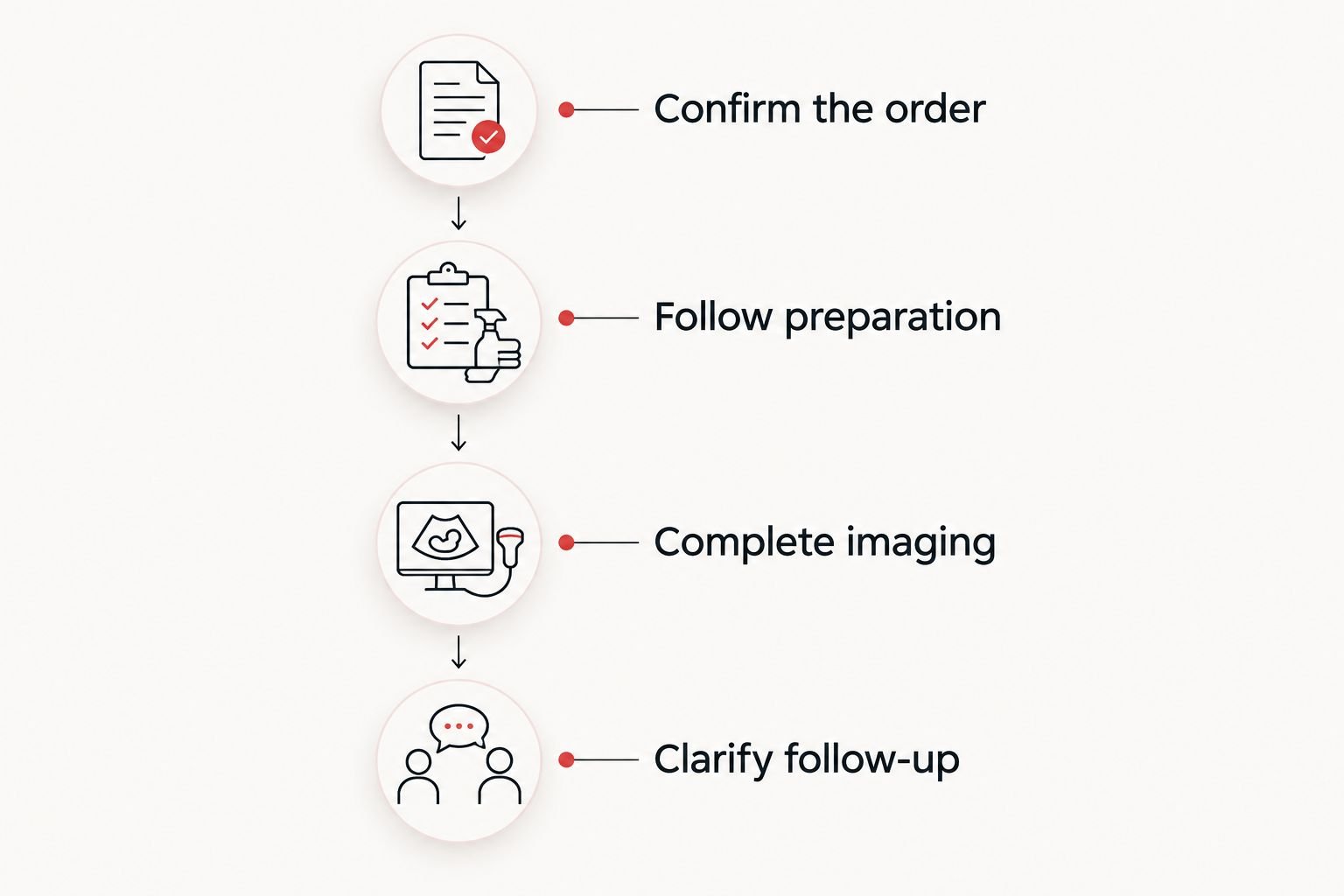
The appointment is easier to plan when preparation and follow-up are confirmed before arrival.
Does the ultrasound approach change the visit?
Pelvic ultrasound can use a transabdominal approach, a transvaginal approach, or both, depending on the examination. The preparation and experience differ, so ask which approach is planned rather than assuming every fertility visit works the same way.
Transabdominal ultrasound
Best for: A broader pelvic view when requested
Benefit: Imaging takes place through the lower abdomen
Limitation or consideration: A full bladder is commonly required; some structures need closer assessment
Transvaginal ultrasound
Best for: Detailed assessment of the uterus and ovaries when appropriate
Benefit: The probe sits closer to the pelvic structures
Limitation or consideration: It is an internal examination requiring consent and attention to comfort
Combined examination
Best for: Assessment requiring both broader and closer views
Benefit: The approaches provide complementary information
Limitation or consideration: Preparation can involve changing bladder instructions during the visit
Transabdominal fertility ultrasound
For a transabdominal examination, the sonographer moves a probe over your lower abdomen. A full bladder commonly helps create a viewing window for pelvic structures.
Follow the imaging provider’s specific instructions instead of choosing your own drinking schedule. If bladder filling is painful or difficult, tell staff rather than trying to endure it silently.
Transvaginal fertility ultrasound
For a transvaginal examination, a covered ultrasound probe is inserted into the vagina to obtain closer views of pelvic structures. This approach commonly forms part of fertility assessment and monitoring.
Ask staff to explain the procedure before it begins. You can raise concerns, ask about a chaperone, and request that the examination pause or stop; discuss alternatives with the clinical team if you do not consent.
A combined examination
When both approaches are requested, staff guide you through the preparation needed for each part. That can include using the bathroom between portions of the examination.
A combined examination is not interchangeable with a single-view appointment. Confirm what was ordered so the reserved visit matches the clinical request.
Why fertility ultrasound appointment length varies
Fertility ultrasound timing depends on the work required during the visit, not simply the name of the service. These are the factors to clarify when arranging your appointment:
Examination purpose: An initial assessment and a treatment-monitoring examination answer different clinical questions.
Imaging approach: Transabdominal, transvaginal, and combined examinations involve different preparation.
Requested measurements: Your clinician’s order determines the structures and measurements that need assessment.
Image access: Anatomy, bowel gas, and bladder preparation can affect how readily the required views are obtained.
Included services: Bloodwork, medical consultation, and imaging are not automatically part of the same appointment.
Comfort and consent: Questions, position changes, and pauses belong in the examination when you need them.
A longer visit does not, by itself, establish that something is wrong. Equally, a brief scan does not tell you whether the findings are normal. Only the clinical assessment and report address those questions.
When arranging care in 2026, explain any scheduling constraints without asking staff to shorten the ordered examination. A suitable appointment is one that allows the required assessment and respects your comfort.
How can I keep the appointment from running behind?
You can reduce avoidable disruption by confirming the order, preparation, and reporting details before arrival. You cannot control every part of the schedule, but clear instructions prevent unnecessary confusion.
Use this preparation checklist:
Confirm the location and requested arrival time.
Ask whether registration happens before the reserved imaging slot.
Check whether the imaging provider has the examination request.
Follow the bladder instructions supplied for this appointment.
Bring the documents the provider specifically requests.
Identify the fertility clinician who should receive the report.
Explain mobility, positioning, privacy, or examination concerns beforehand.
If your clinician changes the requested examination, tell the imaging provider before the visit. Do not assume a booking made for one purpose automatically covers a different assessment.
For questions about examination requests, the guide to whether a private ultrasound needs a doctor’s referral provides related context. Confirm the requirements for your fertility examination directly with your treating clinician and imaging provider.
Will I get my fertility ultrasound results before I leave?
Receiving images and receiving a medical interpretation are different steps. Ask who prepares the report, how it reaches your fertility clinician, and who will explain its implications for your treatment.
The person obtaining the images does not necessarily make treatment decisions. Do not interpret a sonographer’s silence, facial expression, or time spent on a particular view as a result.
Before a 2026 monitoring visit, confirm the reporting arrangement with your fertility team. If the findings will inform a treatment decision, ask what to do if the report has not reached the clinician when expected.
Do not change fertility medication based on your own reading of ultrasound images. Follow the treating clinician’s instructions and contact that team when you need clarification.
Can I return to work after a fertility ultrasound?
A routine transabdominal or transvaginal ultrasound generally does not require a recovery period or sedation. Your ability to return to work also depends on any separate procedure, medication, or appointment scheduled alongside it.
Ask about the complete visit before planning your return. Travel, check-in, and a separate consultation still occupy time even when the ultrasound itself does not require recovery.
If you experience significant discomfort or feel unwell, tell the clinical team. Do not use a general scheduling guide to dismiss symptoms or override instructions specific to your care.
FAQ
What does fertility ultrasound appointment length include?
Fertility ultrasound appointment length should cover check-in, preparation, imaging, and any included discussion before departure. Ask whether bloodwork and clinician review are separate appointments.
Does The Ultrasound Concierge offer fertility ultrasound imaging?
The Ultrasound Concierge provides private fertility ultrasound imaging for patients in the Keller and Willow Park, Texas area. Confirm the requested examination, preparation, and report coordination before booking.
Do I need a full bladder for a fertility ultrasound?
Bladder preparation depends on the ultrasound approach. Transabdominal pelvic imaging commonly requires a full bladder, while transvaginal imaging is commonly performed with an empty bladder; follow your provider’s specific instructions.
Is a longer fertility ultrasound a sign that something is wrong?
A longer fertility ultrasound does not, by itself, mean something is wrong. Image access, requested measurements, preparation, and comfort can all affect the examination.
Will a fertility ultrasound appointment include bloodwork?
Do not assume a fertility ultrasound appointment includes bloodwork. Ask your fertility team whether blood tests are needed and whether they take place at the same location or in a separate visit.
Can I ask the sonographer to stop a transvaginal ultrasound?
Yes, you can ask the sonographer to pause or stop a transvaginal ultrasound. Discuss your concerns and any alternative examination with the clinical team so you understand what information is still needed.
How should I plan a fertility ultrasound appointment in 2026?
For a fertility ultrasound appointment in 2026, confirm the full arrival-to-departure estimate and the reporting plan before booking. Keep travel, preparation, and any separate consultation distinct from the scan-time estimate.
One last thing
The most useful scheduling question is not just how long the scan takes—it is when your fertility clinician will receive the information needed for your care. A convenient appointment and a clear reporting plan solve different problems.
Before confirming your 2026 visit, check both. Knowing your expected departure time helps you organize the day; knowing the next clinical step helps you leave without guessing what happens afterward.
Related guides

Fertility Ultrasound Ovulation Timing: Yes, in 2026
Fertility ultrasound ovulation timing can estimate approaching ovulation, not its exact moment. Learn what scans show and when to ask for clinician-led monitoring.
Yes—a fertility ultrasound can help estimate when you’re approaching ovulation, and repeat scans can show changes consistent with an egg having been released. It cannot pinpoint the exact moment of ovulation or confirm egg quality; your clinician interprets the images alongside your cycle history and, when needed, hormone testing. This 2026 guide explains what the scan tells you and how to use that information without treating it as a countdown clock.
TL;DR
Fertility ultrasound ovulation timing is an estimate; repeat scans provide more information than a single image.
Ultrasound tracks ovarian follicles; urine LH tests detect a hormone surge that usually precedes ovulation.
A follicle measurement does not prove egg quality, fertilization, or pregnancy.
The Ultrasound Concierge provides private fertility ultrasound imaging for patients in Keller and Willow Park.
Can a fertility ultrasound tell you when you’re ovulating?
A fertility ultrasound can help predict approaching ovulation and provide evidence that ovulation has occurred, but it cannot give you an exact release time. The useful distinction is between seeing a follicle develop and seeing changes after that follicle releases an egg.
A clinician usually gets the clearest picture from a sequence rather than an isolated scan. Before arranging imaging, ask who will interpret the report and whether an order is needed; this guide explains referral questions for a private ultrasound.
Before ovulation: Ultrasound measures fluid-filled ovarian follicles and assesses the uterine lining. A developing dominant follicle helps your clinician estimate whether ovulation is approaching.
Across repeat scans: Changes in follicle size help your clinician follow development. The interval between scans depends on your cycle and treatment plan, not a universal schedule.
After suspected ovulation: A follicle that has collapsed or disappeared, a developing corpus luteum, and pelvic fluid can support the assessment that ovulation occurred. Your clinician considers these findings together rather than treating any one sign as proof.
An ultrasound shows the follicle surrounding an egg, not the egg itself. That means a reassuring-looking follicle is useful information, but it is not a direct assessment of the egg’s maturity or ability to become a pregnancy.
Why this matters
Timing matters because your fertile window begins before ovulation, not after you receive confirmation that it happened. The American Society for Reproductive Medicine’s patient guidance describes a 6-day fertile window ending on the day of ovulation, reflecting how long sperm can remain capable of fertilization before an egg is released.
Sperm can survive for up to 5 days in the reproductive tract under favorable conditions. An egg generally remains capable of fertilization for about 12–24 hours after release. These are biological windows, not guarantees about an individual cycle.
For your 2026 conception plan, the practical lesson is simple: do not wait for a post-ovulation scan to begin following your clinician’s timing advice. If you are undergoing fertility treatment, follow the clinic’s instructions for intercourse, insemination, medication, or procedures rather than calculating your own schedule from a measurement.
What can a single fertility ultrasound tell you?
A single scan can describe what your ovaries and uterine lining look like at that appointment. It can identify and measure follicles, assess the lining, and identify findings that need clinical interpretation.
Its main limitation is the missing timeline. Without earlier images or supporting information, a clinician has less evidence about whether a follicle is growing as expected, has stopped developing, or has recently changed after ovulation.
Best for: Assessing ovarian and uterine findings at a particular point in your cycle. The benefit is direct imaging; the limitation is that one appointment cannot show the full sequence of development and release.
Bring the date your last period started, recent ovulation-test results, and your medication list. Those details give the image context and help your clinician decide whether another scan or a different test answers the remaining question.
What do repeat fertility ultrasounds add?
Repeat ultrasounds let your clinician compare the same cycle over time. A series can track follicle development and then look for changes consistent with ovulation, which is more informative than estimating from an isolated measurement.
Best for: Clinician-directed follicle monitoring, including cycles in which fertility medication makes monitoring part of treatment. The benefit is a record of change; the limitation is that imaging still does not establish an exact release time or guarantee conception.
The scan schedule must match the clinical question. An early-cycle assessment, a scan near expected ovulation, and a scan after suspected ovulation serve different purposes, so booking them interchangeably can leave your original question unanswered.
Ask your treating clinician to specify the purpose before you schedule. If another imaging provider performs the scan, confirm how the report will reach the clinician responsible for your next step.
How does ultrasound compare with other ovulation tests?
Ultrasound, urine luteinizing hormone tests, and progesterone testing answer different questions. Your 2026 tracking plan should distinguish prediction before ovulation from evidence after ovulation, rather than treating every result as interchangeable.
Urine LH tests detect a hormone surge that usually precedes ovulation by 1–2 days, according to American Society for Reproductive Medicine guidance on fertility evaluation. A positive result suggests that ovulation is approaching; it does not prove that an egg was released.
Fertility ultrasound
What it tells you: Follicle development and findings consistent with recent ovulation
Best for: Clinician-directed monitoring
Main benefit: Directly assesses ovaries and uterine lining
Main limitation: A single scan cannot establish exact release time
Urine LH test
What it tells you: Whether a urinary hormone surge is detected
Best for: At-home prediction of approaching ovulation
Main benefit: Provides a signal before expected release
Main limitation: A positive test does not confirm ovulation
Progesterone blood test
What it tells you: Whether hormone levels support recent ovulation
Best for: Clinician-directed confirmation afterward
Main benefit: Adds biochemical evidence
Main limitation: Correct timing matters; it does not predict the next release
Calendar or cycle app
What it tells you: An estimate based on cycle dates
Best for: Recording patterns and planning discussions
Main benefit: Organizes your cycle history
Main limitation: Does not measure current follicle development or hormone changes
No method in this table assesses egg quality or confirms pregnancy. Combining information is useful when your clinician has a specific question—not simply because collecting more results feels reassuring.
Why fertility ultrasound ovulation timing varies
The interpretation depends on your cycle, the scan’s timing, and whether treatment is involved. These factors explain why a follicle measurement should not become a self-directed medication or insemination decision.
Cycle pattern: Ovulation does not always fall on the same cycle day. A calendar estimate is less informative when cycle lengths vary.
Appointment timing: A scan before release and a scan afterward capture different findings. Neither is a continuous recording of what happened between appointments.
Follicle development: A visible follicle does not necessarily release an egg. Clinical interpretation must distinguish development from evidence of ovulation.
Fertility medication: Treatment can change follicle development and the number of developing follicles. Monitoring and timing decisions belong to the prescribing clinician.
Underlying hormonal conditions: Conditions such as polycystic ovary syndrome can complicate cycle prediction and LH-test interpretation. Your clinician decides which evidence is most useful.
There is no single follicle-size rule that lets every patient identify the exact hour of ovulation. Use the report to support your clinician’s plan, not to replace it.
How should you plan a scan around ovulation?
Start with the decision you need the scan to support. For a 2026 fertility appointment, a clear clinical question is more useful than asking for a general scan and hoping it explains the entire cycle.
Define the question. Tell your clinician whether you want to assess follicle development, investigate irregular cycles, or look for evidence of recent ovulation.
Share cycle history. Provide period dates, recent LH-test results, relevant symptoms, and fertility medications. Do not stop or change medication to prepare for imaging unless your prescriber instructs you.
Confirm scan instructions. Ask whether transvaginal imaging is planned and what preparation is required. Bladder instructions differ by examination type, so follow the imaging provider’s directions.
Arrange report review. Confirm who receives and interprets the report. Knowing when and how you will receive clinical advice prevents a measurement from becoming an unanswered question.
Follow clinical advice. Ask what the findings change about your plan and whether repeat imaging or hormone testing is needed. Obtain medication and procedure instructions from your treating team.
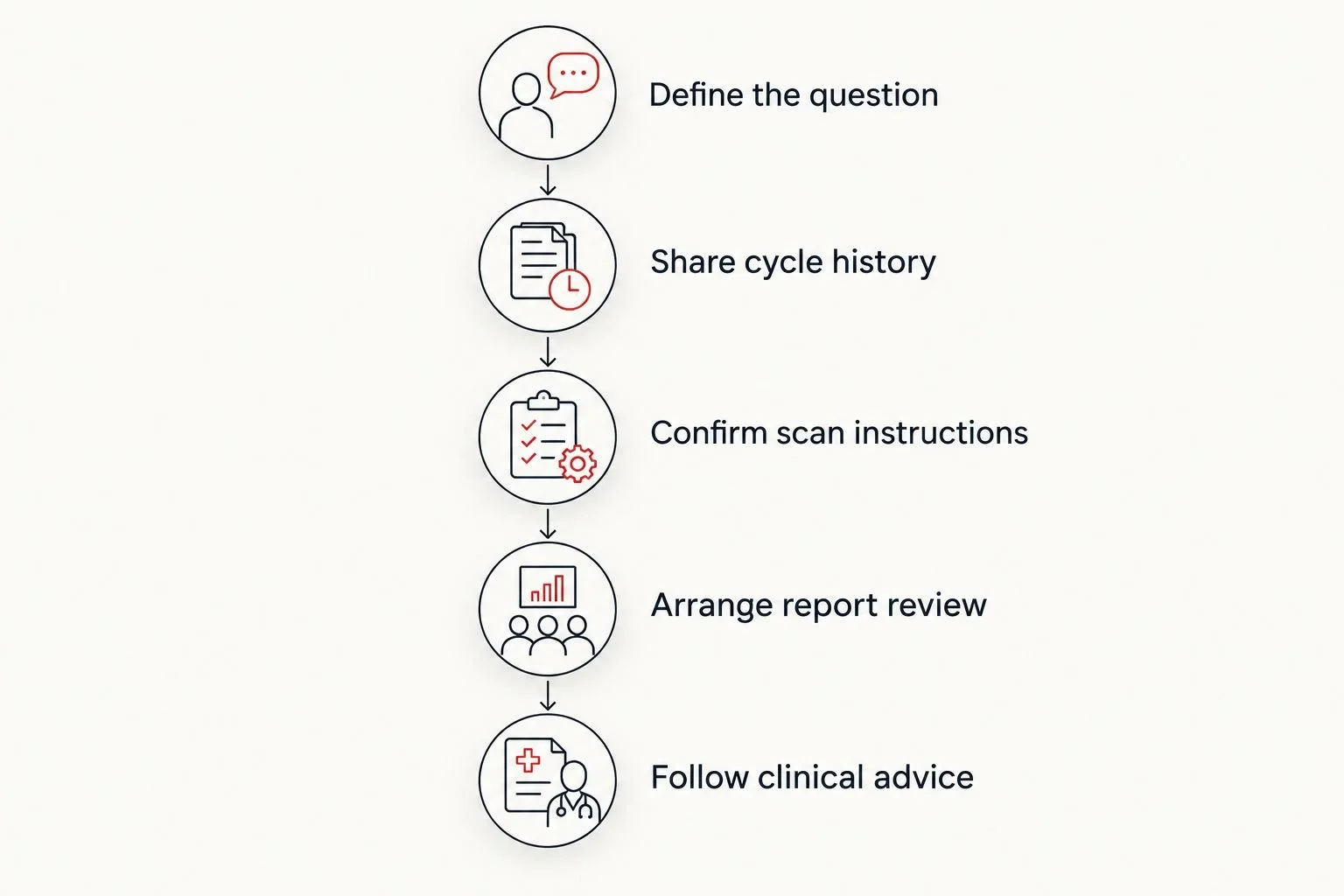
Decide who will interpret the scan before using the findings to guide your next step.
You can also ask how the examination works and discuss comfort concerns before it begins. Transvaginal ultrasound often provides detailed ovarian imaging, but the provider should explain the procedure and obtain your consent; you can ask questions or request that the examination stop.
Where does private fertility imaging fit into your care?
The Ultrasound Concierge is best for patients in Keller and Willow Park seeking private fertility ultrasound imaging. Its stated services include fertility and diagnostic ultrasound in a calm, personalized setting.
That setting can match your preference for a less institutional visit. The limitation is unchanged: an imaging appointment does not replace fertility diagnosis, prescribing, or treatment decisions by your clinician.
Before arranging fertility imaging with The Ultrasound Concierge, ask whether the requested examination matches your clinician’s needs and how reporting will be coordinated. Do not assume that every ultrasound appointment includes serial follicle monitoring or immediate treatment instructions.
Can ultrasound confirm that you already ovulated?
Ultrasound can provide evidence consistent with recent ovulation when the ovarian findings fit the expected changes after release. Comparing scans strengthens that assessment because your clinician can see how the follicle changed.
A progesterone blood test can add supporting evidence when appropriately timed. Neither test, alone or together, identifies the exact moment the egg was released.
Does a normal fertility ultrasound mean you can get pregnant?
No—a normal fertility ultrasound does not establish that every requirement for conception is present. It does not fully assess sperm factors, egg quality, or whether the fallopian tubes are open during a routine pelvic examination.
If pregnancy is not happening, ask for a fertility evaluation rather than repeatedly using normal imaging as reassurance. The appropriate next test depends on your history and your clinician’s assessment.
Is ultrasound necessary if your ovulation test is positive?
Not automatically—a positive urine LH test and an ultrasound provide different information. For someone trying to conceive without a prescribed monitoring plan, a positive LH result does not by itself create a need for imaging.
If you have irregular cycles, a condition affecting ovulation, or fertility-treatment instructions, ask your clinician how to interpret the result. Continue scheduled monitoring unless the treating team changes the plan.
FAQ
Can a fertility ultrasound tell me the exact day I will ovulate?
A fertility ultrasound can help estimate approaching ovulation, but it cannot guarantee the exact day or hour. Repeat scans and hormone information give your clinician more context than a single measurement.
How long after a positive ovulation test does ovulation happen?
Ovulation usually follows a urine LH surge by 1–2 days, but a positive test does not prove an egg was released. If you are receiving fertility treatment, follow your clinic’s timing instructions.
Can you see the egg itself on a fertility ultrasound?
No—a routine fertility ultrasound shows the ovarian follicle surrounding the egg, not the egg itself. Follicle appearance does not establish egg quality or guarantee fertilization.
Is one ultrasound enough to confirm ovulation?
One ultrasound can show findings consistent with recent ovulation, but it does not always settle the question. Comparison with earlier imaging and appropriately timed hormone testing can support the assessment.
Should I wait until ultrasound confirms ovulation to try to conceive?
Do not wait for ultrasound confirmation unless that is your clinician’s instruction. The fertile window includes the 5 days before ovulation and the day of ovulation, so confirmation afterward can come too late for that window.
Can fertility ultrasound diagnose blocked fallopian tubes?
A routine fertility ultrasound does not establish that your fallopian tubes are open. Your clinician can recommend a dedicated tubal-patency examination when that question needs an answer.
Does The Ultrasound Concierge provide fertility ultrasound imaging?
The Ultrasound Concierge provides private fertility ultrasound imaging for patients in Keller and Willow Park, TX. Ask whether your clinician’s requested examination can be performed and how the report will reach the treating team.
One last thing
A scan taken after ovulation can answer whether release likely occurred while being too late to help you anticipate that same release. That distinction is easy to miss when every test is described as an ovulation check.
For your 2026 appointment, ask one direct question: Are we trying to predict ovulation, confirm it afterward, or monitor treatment? The answer determines when to scan, which supporting tests matter, and what you should do with the result.